“Step back, rookie,” Senior Chief Cole Maddox ordered, gripping the nurse’s wrist before she could reach the wounded man. “Twelve interpreters failed, and your guessing will kill him.”
Morgana White ripped her arm free and stepped between the Navy SEAL commander and the hospital gurney. The injured Middle Eastern operator twisted beneath bloodstained sheets, speaking rapidly while six armed soldiers watched in helpless frustration. “He isn’t speaking standard Arabic,” Morgana said. “And he isn’t asking for medicine.”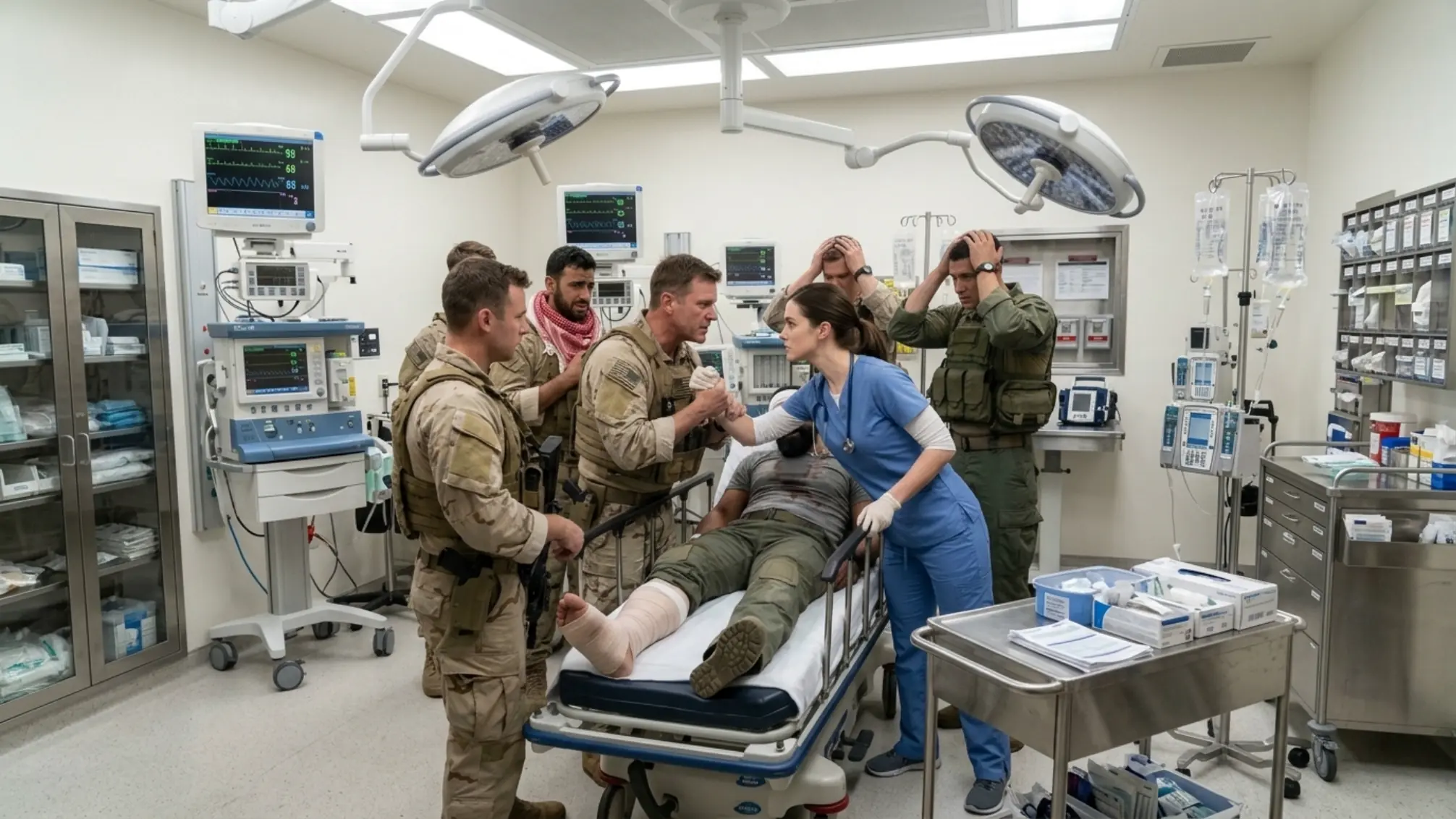
Cole moved into her face. “Lie again, and I’ll drag you out of this room myself.”
Morgana turned toward the silent soldiers surrounding the bed. “Then listen carefully. He says one of your men sold the extraction route.”
Nobody moved.
The trauma monitor continued beeping beside the gurney, recording a heart rate that climbed with every second. An IV bag hung above the patient’s shoulder, but the fluid had barely entered his vein because his blood pressure was collapsing. Beneath a gray shirt torn open at the chest, dark bruising spread across his ribs, and a bandage around his left thigh had already soaked through twice.
The wounded operator stared at Morgana.
She spoke to him again, this time more slowly.
His face changed immediately. The desperation vanished, replaced by the sharp concentration of a trained man who had finally found someone capable of receiving his warning. He answered in short, controlled phrases while Morgana listened without interrupting.
Cole watched her carefully.
The other five soldiers watched one another.
Morgana asked the patient a question in Arabic, then repeated part of it in Russian. When he failed to respond, she changed to Pashto. The wounded man corrected her in a dialect so narrow that no commercial interpreter at the naval medical center had recognized it.
Morgana adjusted instantly.
The man gripped her forearm and whispered a name.
She looked toward the soldiers.
“Who is Lieutenant Eric Shaw?”
A young man near the wall lowered his hands from his head.
He was thirty-one, lean, clean-shaven, and still wearing the dusty tactical vest from the mission. His face remained composed, but his right hand moved subtly toward the radio clipped near his chest.
Cole noticed.
“Keep your hands where I can see them,” he said.
Eric gave a confused laugh. “What is this?”
Morgana asked the wounded operator to repeat himself. He did, slower this time, adding details about a radio transmission, a vehicle route, and an identification phrase that only seven people had known.
Eric looked toward the trauma-room door.
Two soldiers shifted at once, quietly blocking it.
“This is insane,” Eric said. “The man is bleeding out and that nurse is inventing accusations.”
Morgana did not look at him. “He says you changed the extraction point fourteen minutes before the convoy moved. Then the ambush team appeared at the new location.”
“I wasn’t controlling the route.”
“He says you were the only man outside the command vehicle when the encrypted update came through.”
“That proves nothing.”
“He also says you used the phrase ‘the river bends twice’ over an unsecured channel.”
Eric’s face hardened.
Cole stopped breathing for a moment.
The phrase had been the mission’s emergency authentication code. It had never appeared in written orders and had been shared only during the final briefing.
No nurse could have guessed it.
No wounded man could have learned it after capture unless someone inside the team had used it.
Cole released Morgana’s wrist completely.
“Seal the room,” he ordered.
The naval medical center stood twelve miles from the Virginia coast, close enough to the base that helicopters passed overhead throughout the day. Its emergency department treated active-duty personnel, military families, foreign partners, contractors, and patients transferred from operations that never appeared on civilian news.
Morgana had worked there for twenty-two days.
During that time, most people knew her only as the quiet new nurse assigned to basic support duties. She arrived early, spoke rarely, and accepted whatever work the senior staff gave her. She cleaned gurneys, restocked supply carts, changed sheets, checked inventory, and performed the tasks others considered too ordinary to matter.
Dr. Walter Carver, the chief physician, had decided she was useless before her first shift began.
At 6:58 that morning, Morgana entered the emergency department wearing blue scrubs over a white undershirt. Her long dark-brown hair was secured in a low ponytail, and a stethoscope rested around her neck.
Carver looked at the clock.
“You’re late.”
“The shift starts at seven.”
“Rookies arrive early. Veterans arrive on time. You’re neither.”
He assigned her to clean Bays Four through Eight while permanent staff handled what he called meaningful cases.
Morgana said nothing.
She had learned long ago that correcting arrogant men rarely changed them. Results sometimes did, but only when the results became impossible to ignore.
For three weeks, she allowed Carver to believe whatever made him comfortable.
He saw a twenty-nine-year-old nurse with no military service listed in her personnel file. He saw a woman who accepted public criticism without argument. He saw someone whose hands occasionally trembled while carrying supplies.
He did not know the tremor came from injuries suffered eleven years earlier.
He did not know Morgana spoke eight languages fluently and understood fragments of six more. He did not know she had spent years operating inside regions where translators could not safely travel and official maps deliberately omitted certain roads.
Most importantly, he did not know her nursing résumé had been designed to conceal more than it revealed.
At 8:19 that morning, three injured men arrived from a classified operation overseas. Two were Americans. The third was a partner-force operator named Samir Haddad, who had worked beside Cole’s team for six weeks.
Samir spoke no English.
He had suffered a gunshot wound to the thigh, blunt trauma to the chest, and a hidden abdominal injury. Yet from the moment the ambulance doors opened, he kept repeating the same warning.
The medical staff assumed he was describing pain.
The language line connected them to four Arabic interpreters. None understood his dialect. A military translator tried Dari. Another attempted Farsi. A radiologist with conversational Russian listened and admitted the words were not Russian, though several military terms sounded familiar.
By the time the twelfth professional failed, Samir’s voice had weakened.
Morgana stood near the supply cabinet, pretending to review an inventory list.
She had recognized his dialect during his first sentence.
It came from a remote mountain corridor where Arabic, Pashto, Russian, and older tribal speech had blended across generations. Few outsiders understood it. Morgana had learned it while working alongside local medics during an assignment whose records remained classified.
She stayed silent at first because speaking would expose questions she had spent eleven years avoiding.
Then Samir repeated the emergency code.
Morgana set down the clipboard.
She could remain invisible, or she could let a wounded man die unheard.
The decision took less than a second.
Now Eric stood trapped inside the trauma room while Samir continued speaking. Cole instructed one soldier to contact base security and another to bring an intelligence officer without using the main radio network.
Eric moved toward the door.
The largest soldier blocked him.
“You’re holding me because a drugged foreigner said something in a language nobody understands?”
“Morgana understands,” Cole said.
“You don’t know who she is.”
Cole looked at the nurse.
That was true.
He knew what he had seen: a quiet woman assigned to gurney duty had walked into a communication failure and solved it in seconds. She spoke to Samir with the authority of someone familiar not only with the language but also with military reporting structures.
Cole had spent seventeen years judging people under pressure.
Morgana did not behave like a civilian translator.
She behaved like someone who had survived the same world as the men surrounding her.
“Tell us everything he said,” Cole ordered.
Morgana kept one hand on Samir’s pulse while translating.
The mission had begun as an equipment transfer through a mountain transit corridor. Eric received the final route electronically. Minutes later, he claimed the original road was compromised and redirected the convoy toward a dry riverbed.
The ambush waited there.
The attackers disabled the lead vehicle with an explosive and opened fire from elevated positions. Two Americans were injured immediately. Samir saw Eric move away from the team and transmit something through a private radio before returning to cover.
During the retreat, Samir found a damaged device dropped by one attacker. Its screen displayed the new route and the team’s authentication phrase.
He hid the device beneath his abdominal dressing.
Every interpreter believed he was asking doctors to examine the wound.
In reality, he was telling them where he had concealed the evidence.
Morgana carefully lifted the edge of the bandage.
A thin black memory module was taped beneath it.
Eric lunged.
Cole drove him into the wall before he crossed half the room. The two men collided with a medical cart, sending packaged instruments across the floor. Eric struck Cole once in the ribs and reached for the sidearm on his tactical belt.
Morgana pushed the gurney away from the fight.
Another SEAL trapped Eric’s weapon hand while Cole forced him facedown. Within seconds, plastic restraints closed around his wrists.
“You’re making a mistake,” Eric shouted. “That device could belong to anyone.”
Cole searched him.
Inside Eric’s vest, he found a second radio registered to no military inventory. The battery remained warm.
Base security arrived with two Naval Criminal Investigative Service agents. They photographed the memory module, secured both radios, and separated every member of the team for questioning.
Samir’s condition deteriorated during the confusion.
Morgana noticed before the monitor sounded.
His abdomen tightened, his pulse became thin, and the skin around his mouth turned pale. She pressed against the lower wound and felt internal resistance where none should have existed.
“He is bleeding into the abdomen,” she said. “We need surgery now.”
Dr. Carver entered at that moment.
He had heard that a rookie nurse was questioning an injured operator and accusing a SEAL officer of betrayal. He came prepared to restore order and found Eric restrained, NCIS agents collecting evidence, and Morgana issuing medical instructions.
“Step away from the patient,” Carver demanded.
“He has internal bleeding.”
“You are not the attending.”
“He will lose consciousness within minutes.”
Carver glanced at the monitor. “His pressure is low but stable.”
“It is falsely stable because he is compensating.”
“You are allowing drama to interfere with your judgment.”
Morgana pressed two fingers to Samir’s neck. “His pulse changed.”
Carver turned toward the resident. “Prepare imaging.”
“There isn’t time.”
“You do not decide that.”
Morgana looked directly at him. “Then decide correctly.”
The room became quiet again.
Carver’s face reddened. “I can end your contract before this patient reaches radiology.”
Morgana pointed at Samir’s abdomen. “And the autopsy will show you delayed surgery while he bled out in front of you.”
The senior trauma physician, Dr. Elaine Reigns, entered behind Carver. She examined Samir, reviewed the blood-pressure trend, and placed the ultrasound probe against his abdomen.
Dark fluid appeared on the screen.
Internal bleeding.
“Operating room now,” Elaine ordered.
Carver said nothing.
Morgana walked beside the gurney, translating every question until the surgical team placed Samir under anesthesia. Before his eyes closed, he held her hand and said one final sentence.
She answered him quietly.
Cole waited outside the operating room.
“What did he say?”
“He asked whether his warning reached the right people.”
“What did you tell him?”
“That it did.”
Cole looked toward the corridor where NCIS had taken Eric.
“You saved more than his life.”
Morgana started to leave.
“Who are you?”
She stopped.
“A nurse.”
“I know what your badge says.”
“Then you have your answer.”
“No classroom teaches that dialect.”
Morgana turned toward him. “Not every classroom has walls.”
Cole watched her walk back toward the emergency department.
The investigation moved quickly.
The recovered memory module contained encrypted route files, payment records, and messages between Eric and a private military contractor. Eric had sold operational information for nearly eighteen months, beginning with equipment schedules and growing into troop movements.
He believed small compromises would remain invisible.
Then his buyers demanded more.
The ambush was supposed to capture Samir because he had noticed irregular radio activity. Eric redirected the convoy, expecting the attackers to isolate Samir and leave no witness capable of identifying him.
He did not know Samir had taken the device.
He did not know the naval hospital employed a nurse who understood his language.
NCIS placed Eric under federal arrest that afternoon.
The remaining SEALs were cleared after individual interviews and device examinations. Cole remained at the hospital until surgeons confirmed Samir had survived.
Morgana returned to Bay Six and resumed restocking.
Dr. Carver found her arranging suture packages by size. For several seconds, he stood at the entrance without speaking.
“I reviewed your former employment records,” he finally said.
“You already did that this morning.”
“I called the hospitals.”
Morgana continued working.
“Your last director said you had the lowest complication rate in the department. She said you identified medication errors senior physicians missed.”
“That was part of my job.”
“She also said you refused every promotion.”
Morgana placed the final package inside the drawer. “Was there a question?”
Carver’s expression tightened. He was accustomed to people explaining themselves when he showed interest.
“Your file does not match your abilities.”
“People are not files.”
“Where did you learn those languages?”
“Places where patients still bleed when nobody understands them.”
Carver stepped into the bay. “You embarrassed me in front of military personnel and federal investigators.”
“No. You dismissed a patient assessment without checking it. I described what happened.”
His jaw moved.
“You think being right excuses your attitude?”
Morgana faced him. “You called me useless before I worked one shift. You assigned me to clean beds because my résumé did not impress you. Then you nearly delayed surgery because admitting I saw something first felt like losing authority.”
Carver stared at her.
“Do not confuse my silence with respect,” she continued. “I stayed quiet because patients mattered more than your opinion.”
For once, he had no immediate defense.
He left without threatening her contract.
At 2:47 that afternoon, hospital administration called Morgana to the third floor. Inside the director’s office waited Cole, a federal liaison named Rebecca Callaway, and Rear Admiral Nathaniel Voss.
The admiral knew Morgana’s real history.
Eleven years earlier, she had served as a medical and linguistic specialist attached to classified recovery teams operating across Central Asia and the Middle East. She treated wounded personnel, negotiated with local forces, and entered areas where a single incorrect word could turn cooperation into gunfire.
Her official records ended after an operation killed two members of her team and left Morgana severely injured.
The government offered another posting.
She disappeared instead.
Her nursing license remained valid, but the operational history vanished behind sealed documents and constructed employment records. Morgana moved between hospitals, helping people quietly and leaving whenever someone examined her too closely.
Admiral Voss placed a small metal insignia on the desk.
Morgana recognized it.
“You carried one of these for eleven years,” he said.
“Not anymore.”
“Cole found yours beside the supply inventory.”
She looked at the SEAL commander.
He slid the insignia toward her.
“I thought you might want it back.”
“I left it intentionally.”
“That’s what worried me.”
Callaway opened a folder. “Eric Shaw was part of a larger network. Samir’s evidence identifies three more compromised routes and at least two foreign assets currently in danger.”
Morgana did not touch the folder.
“You want a translator.”
“We want someone who understands the language, the culture, and the operational behavior.”
“I left that work.”
“You stepped back into it this morning.”
“To save a patient.”
“And you exposed a traitor standing beside his bed.”
Morgana looked toward the window. Below them, ambulances entered and left the medical center as though the day were ordinary.
“What happens to Samir?”
“He is stable,” Cole said. “The surgeons controlled the bleeding.”
“And Eric?”
“In custody.”
“Then my part is finished.”
Admiral Voss leaned forward. “You spent eleven years making yourself invisible. Today, twelve trained interpreters failed, and you answered one dying man. That does not mean you owe the government anything.”
Morgana looked at him.
“But it means the ability is still yours,” he continued. “What you do with it should finally be your decision.”
That distinction mattered.
For years, every agency had spoken about her skills as property belonging to the mission. Voss was asking rather than ordering.
Morgana closed the folder.
“I will consult,” she said. “No permanent field assignment. No hidden orders. No one decides where I go without asking.”
Callaway nodded. “Agreed.”
“And I keep my hospital position.”
Carver, who had been invited into the meeting without Morgana’s knowledge, stood near the door.
“That depends on whether she still wants it,” he said.
Everyone looked toward him.
He entered fully.
“I owe Nurse White an apology,” he continued. “Not because an admiral knows her name. Not because federal investigators need her. Because I decided she was incompetent before giving her the chance to work.”
Morgana said nothing.
Carver faced her. “I nearly allowed my pride to delay treatment. You were right, and I was wrong.”
“You were.”
The direct answer made him lower his eyes.
“What do you expect from me?” he asked.
“Treat the next quiet nurse as though her file might not contain her whole life.”
He nodded.
Morgana returned to the emergency department after the meeting. The walls remained government beige. The lights remained too bright. Bay Six still needed fresh linens, and a child in Bay Four was crying while his mother tried to calm him.
Nothing looked transformed.
Yet everyone now watched Morgana differently.
She disliked it immediately.
She ignored the attention, checked the child’s injured wrist, and asked where it hurt. When he pointed toward the wrong side at first, she smiled gently and waited until he stopped being afraid of giving the wrong answer.
Near the nursing station, Cole spoke with Linda.
Samir had awakened.
He wanted to see Morgana.
She entered his room near sunset. He looked exhausted but alert, with fresh dressings across his abdomen and thigh.
Morgana greeted him in his dialect.
He smiled.
They spoke for several minutes before Cole asked what he was saying.
Morgana translated only the final part.
“He says he thought nobody would understand before he died.”
Cole looked down.
“And now?”
“He says being heard saved him before the surgery did.”
Samir reached beneath the blanket and produced a thin woven cord that had been removed from his wrist before the operation. He gave it to Morgana.
She tried to refuse.
He insisted.
Morgana accepted it and tied it around her wrist beside the fading mark where Cole had grabbed her hours earlier.
Cole noticed.
“I should not have touched you.”
“No.”
“I thought I was protecting him.”
“You were protecting your control of the room.”
He considered that.
“You sound like Carver.”
“You behaved like Carver.”
Cole almost smiled. “That hurts.”
“It should.”
They stood beside Samir’s bed while evening settled beyond the window.
Twelve interpreters had failed because they searched for a language inside approved databases. Carver had failed because he searched for competence inside a résumé. Cole had nearly failed because he searched for authority inside rank.
Morgana succeeded because she listened to the man everyone else had reduced to a problem.
She did not become extraordinary when she spoke eight languages.
She had always been extraordinary.
The room simply reached a moment when remaining silent would have cost more than being seen.
Eric sold the extraction route because he believed confusion would protect him. He believed the wounded foreign operator would die surrounded by Americans who could not understand his warning.
He almost succeeded.
Then the rookie nurse set down her tray, walked to the gurney, and answered him in the language he thought no one else in the room could speak.
The patient lived.
The traitor was arrested.
And the people who had treated Morgana White as invisible finally understood that silence had never meant she had nothing to say.