Under the freezing Chicago rain, eleven-year-old twin brothers Malik and Micah Brown walked home from school with their jackets soaked through, their shoes leaking water, and their stomachs aching from hunger.
They did not have bus fare.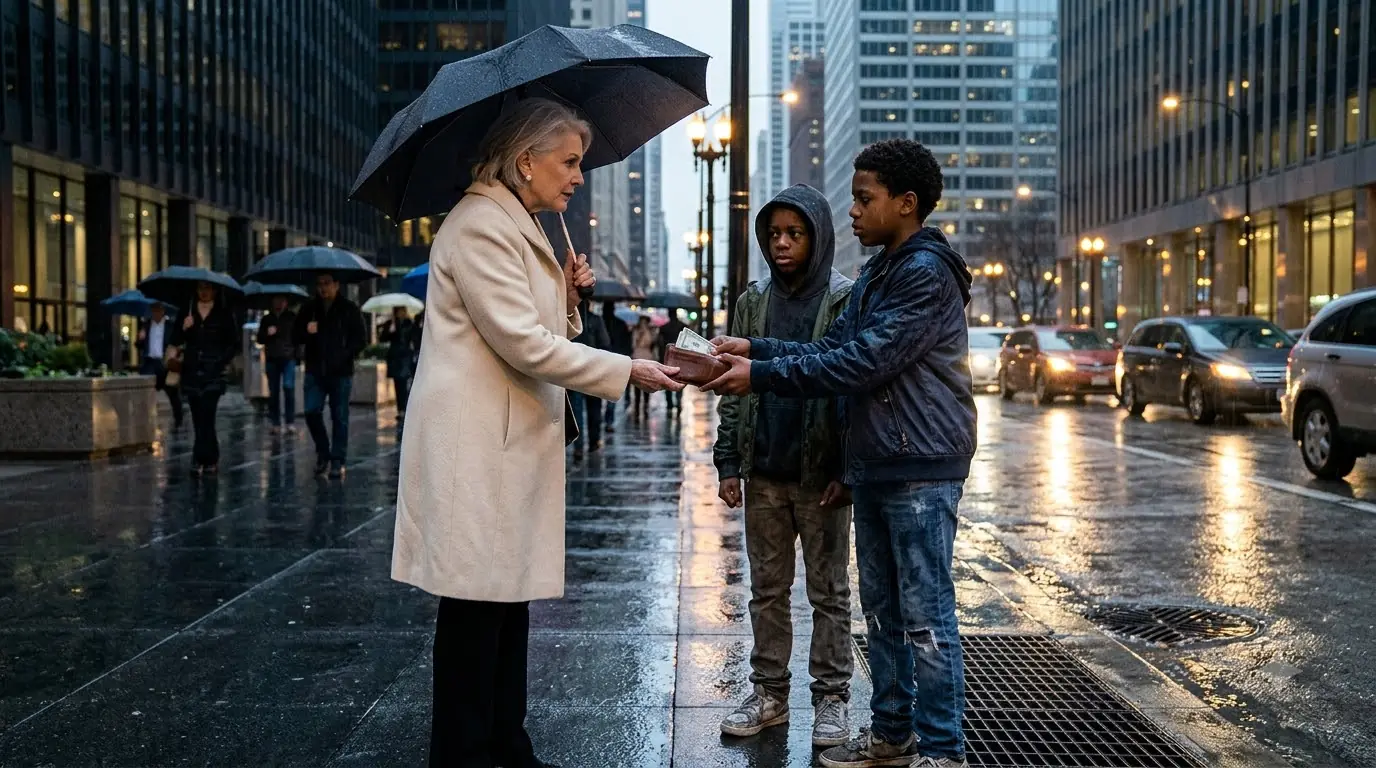
They did not have umbrellas.
They did not have parents waiting for them in a warm kitchen with dinner on the stove.
What they had was each other, two worn backpacks, and a long walk back to Hope Street Home, the crowded children’s shelter on the South Side that had been the closest thing to home for the past three years.
The rain fell hard enough to blur the glass towers of the financial district. Wind pushed between the buildings, sharp and bitter, turning the sidewalks into rivers of gray water. Men and women in expensive coats hurried past with umbrellas tilted low, rushing toward heated cars, private drivers, and apartments high above streets where boys like Malik and Micah were almost invisible.
Micah pulled his thin hood over his head, though it had already stopped helping.
“Man,” he muttered, his teeth nearly chattering. “I’m so hungry.”
Malik did not answer right away. His stomach had been growling since fifth period, when lunch had been nothing but half a granola bar and water from the hallway fountain.
“I know,” he said finally. “Just keep walking.”
“Maybe Ms. Jackson saved dinner.”
“Maybe.”
But both brothers knew what maybe meant at Hope Street.
Maybe meant cold toast if there was bread left.
Maybe meant peanut butter if the jar had not been scraped clean.
Maybe meant pretending not to be hungry because the younger kids were hungrier.
They crossed another street, their sneakers splashing through puddles. Malik’s left shoe had a split near the toe, and with every step, cold water slid inside his sock. Micah’s jacket had lost two buttons, so he held it closed with one hand while gripping the strap of his backpack with the other.
Around them, Chicago looked rich and untouchable.
Warm lobbies glowed behind walls of glass. Security guards stood beside brass doors. People carried coffee cups that probably cost more than the breakfast Hope Street served to twenty-four children combined.
Micah looked through one lobby window where a group of men in suits were laughing around a marble table.
“You ever wonder what it’s like?” he asked.
“What?”
“To not be cold.”
Malik glanced at him.
Micah tried to smile, but it faded quickly.
“I mean, really not cold. Not like for one hour because you’re inside the library. I mean having a coat that works. Shoes that don’t leak. A place where you can walk in and know the heat is always on.”
Malik shoved his numb hands deeper into his pockets, though one pocket had a hole large enough for two fingers to poke through.
“Yeah,” he said. “I wonder.”
They walked another block in silence.
Then Malik saw the woman.
She stood at the corner ahead, beneath a black umbrella that looked expensive enough to have a brand name. She was older, maybe in her seventies, with a long wool coat, pearl earrings, leather gloves, and posture so straight it made the entire sidewalk seem like a hallway in a mansion.
She was speaking into her phone, her voice sharp with irritation.
“Yes, I understand the market is unstable, but instability is not an excuse for incompetence.”
She stepped off the curb without looking down.
Her polished black shoe hit a slick patch of wet pavement. She stumbled, caught herself on the edge of a streetlamp, and swung her purse hard against her side.
A brown leather wallet flew out.
It landed on the sidewalk with a wet slap.
The woman did not notice.
Still speaking into her phone, she crossed the street and turned the corner, disappearing between two tall buildings.
For a second, the wallet just sat there.
Then rainwater began pushing it.
Slowly at first.
Then faster.
Toward the storm drain.
Micah grabbed Malik’s sleeve.
“Yo.”
But Malik was already moving.
He dropped his backpack, sprinted across the sidewalk, and slid on his knees through a puddle. Cold water soaked through his jeans instantly. The wallet was inches from the drain when he reached for it.
His fingers scraped against metal.
Pain shot through his hand.
But he caught the wallet by one corner and pulled it back.
“Got it,” he gasped.
Micah ran over, breathing hard.
“You good?”
Malik looked down at his scraped knees, then at the wallet in his hand.
It was heavy.
Not cheap heavy.
Expensive heavy.
Soft brown leather, stitched perfectly, with a gold clasp that clicked when his thumb brushed it.
Micah swallowed.
“Open it.”
Malik hesitated.
“We need to know who it belongs to.”
“Yeah,” Micah said quickly. “That’s what I meant.”
Malik opened the wallet.
The first thing they saw was cash.
A lot of cash.
Crisp bills stacked neatly in the center compartment. Hundreds. Fifties. Twenties. So many that Malik’s breath caught in his throat.
Micah leaned closer.
“Bro.”
Malik touched the edge of the money, not pulling it out at first, as if the bills might burn him.
He had never held that much money in his life.
He had never even seen that much money in one place.
He counted quickly, hands shaking.
One hundred.
Two hundred.
Five hundred.
One thousand.
By the time he reached three thousand, he stopped.
There was more.
He could not make himself keep counting.
Micah’s eyes were wide.
“That’s enough to feed Hope Street for a week.”
Malik knew.
That was the worst part.
His mind did the math before he could stop it.
Hot dinners.
Groceries.
New shoes for Marcus, the eight-year-old whose toes were crushed inside sneakers two sizes too small.
A real coat for Destiny, who wore three sweaters under a jacket with a broken zipper.
Medicine for little Carmen, whose cough had been getting worse because Ms. Jackson kept delaying a clinic visit until she could find transportation.
Maybe even a bus pass.
Maybe two.
Micah’s voice dropped to a whisper.
“Malik.”
“No.”
“You don’t even know what I’m going to say.”
“Yes, I do.”
Micah looked away, jaw tight.
“I’m not saying take all of it.”
Malik closed the wallet halfway.
“Micah.”
“I’m just saying…” His brother’s voice cracked. “She’s rich. Look at that coat. Look at this wallet. She probably won’t even notice a couple hundred missing.”
Malik stared down at the money.
His stomach cramped with hunger.
The rain ran down the back of his neck.
His scraped knees burned.
“We could buy food,” Micah said. “Not just for us. For everyone. That wouldn’t be selfish.”
Malik closed his eyes.
For a second, he let himself imagine it.
Walking into Hope Street with bags of groceries.
The little kids cheering when they saw real fruit, fresh bread, chicken, cereal that did not come from a donated box already half stale.
Ms. Jackson crying in the kitchen because, for once, she would not have to stretch three cans of soup into dinner for two dozen kids.
No one would know.
The woman would still have her credit cards. Still have her driver. Still go home to a place where heat worked and food never ran out.
The world already took from boys like Malik and Micah every day.
Would taking back a little really be so wrong?
Then another thought came, quiet but firm.
It’s not ours.
He opened his eyes.
“No,” Malik said.
Micah looked at him, disappointment and relief fighting across his face.
“We’re starving, Malik.”
“I know.”
“They’re starving back home.”
“I know.”
“So why does it feel wrong when it could help everybody?”
“Because if we take it, we’re not helping. We’re just stealing with a good excuse.”
Micah looked down.
His lips trembled, but he pressed them together quickly, embarrassed by the emotion.
Malik put the cash back carefully, then looked through the wallet for identification.
Driver’s license.
Eleanor Price.
Date of birth: March 4, 1953.
Address: Gold Coast.
Behind the license was a business card on thick ivory paper.
Eleanor Price
Chief Executive Officer
Price Holdings
Micah let out a breath.
“Price Holdings? Like the buildings?”
Malik had seen the name on construction sites, skyscrapers, and fancy plaques downtown. Price Holdings owned hotels, office towers, apartment complexes, and shopping centers across Chicago.
“She’s not just rich,” Micah whispered. “She’s rich-rich.”
Malik closed the wallet.
“Then she probably has people who’ll help her get it back.”
“And we’re those people?”
Malik looked at him.
Micah stared back, then sighed.
“Fine. Let’s find her.”
They ran.
The woman had turned the corner, and the rain made it hard to see, but Malik remembered the direction. He grabbed his backpack from the sidewalk, slung it over one shoulder, and sprinted after her with Micah beside him.
His knees stung with every step.
His lungs burned from the cold.
“Ma’am!” Malik shouted. “Ma’am, wait!”
The woman did not stop.
She was still on the phone, walking fast beneath the umbrella.
“Ma’am!” Micah yelled. “You dropped something!”
This time, she turned.
The first thing Malik saw was suspicion.
Her eyes flicked over their soaked jackets, worn shoes, and backpacks. Her free hand tightened around her purse. She took one small step back.
Malik understood immediately.
She thought they were running toward her because they wanted something from her.
And they did.
They wanted her to see them clearly.
He stopped a few feet away and held out the wallet with both hands.
“You dropped this,” he said, breathing hard. “Back on the corner. It almost went down the drain.”
The woman lowered her phone.
Her face changed.
Slowly, she reached out and took the wallet.
“This is mine,” she said.
“Yes, ma’am.”
She opened it immediately and checked the cash, cards, and compartments.
Micah’s jaw tightened.
Malik stared at the sidewalk.
Finally, she looked up.
“Everything is here?”
“Yes, ma’am.”
“You opened it?”
“We had to check your name,” Malik explained. “So we could find you.”
“And you didn’t take anything?”
That question hurt more than Malik expected.
Micah stiffened beside him.
“No, ma’am,” Malik said. “It wasn’t ours.”
Eleanor Price stared at them.
For the first time, she seemed to really see them.
The soaked clothes.
The shaking hands.
The scraped skin on Malik’s knees.
The way Micah stood slightly behind his brother, defensive and proud and hungry all at once.
Rain tapped against her umbrella.
A bus hissed past at the curb.
The city moved around them, but for a moment, Eleanor Price did not move at all.
“There is more than three thousand dollars in this wallet,” she said quietly.
“Yes, ma’am.”
“You saw it.”
“Yes, ma’am.”
“And you brought it back.”
“Yes.”
“Why?”
Malik looked at her.
“Because it belongs to you.”
She lowered the wallet slightly.
Most people had given Eleanor Price many things in her life.
Reports.
Profits.
Excuses.
Compliments.
Fear.
Very few people had given her honesty when dishonesty would have benefited them more.
Her voice softened.
“What are your names?”
“Malik Brown.”
“Micah Brown,” his brother added.
“Brothers?”
“Twins,” Malik said.
Eleanor looked from one face to the other.
Something flickered in her expression, something so quick Malik almost missed it.
“Come with me,” she said suddenly.
Both boys took a cautious step back.
“No,” Malik said.
Eleanor blinked.
“I only meant there’s a cafe right there. You’re freezing. Let me at least buy you something warm.”
“We have to get home.”
“Please.”
The word surprised them because it did not sound like an order.
It sounded almost human.
“I would like to thank you properly,” Eleanor said. “A few minutes. Public place. You can leave whenever you want.”
Malik looked at Micah.
Micah looked at Malik.
They had a whole conversation without words.
She’s still a stranger.
But we’re freezing.
Public place.
And food.
“Okay,” Malik said. “Just for a few minutes.”
The cafe was warm enough to make Malik’s skin sting.
It was the kind of place he and Micah had walked past many times but never entered. Dark wood tables. Soft lighting. Pastries behind glass. People typing on laptops, drinking lattes, speaking in low voices.
A waiter hurried over when he saw Eleanor.
“Mrs. Price, good evening.”
“David,” she said. “Two bowls of chicken noodle soup, two hot chocolates, and…” She looked at the boys. “Are you hungry?”
“We’re okay,” Malik said automatically.
Eleanor narrowed her eyes.
“When was the last time you ate?”
Micah answered before Malik could stop him.
“Lunch.”
“What did you have?”
“A granola bar,” Micah muttered.
“That is not lunch.”
She turned back to the waiter.
“Two burgers with fries as well. And make the hot chocolates large.”
The waiter nodded and left.
Malik sat stiffly in the booth, unsure where to put his wet hands. Micah stared at the table like he was afraid someone would take the food away if he looked too eager.
Eleanor placed her wallet into her handbag and folded her hands.
“Where do you live?” she asked.
“Hope Street Home,” Malik said.
“The shelter?”
“It’s a group home,” Micah corrected, though even he did not sound convinced.
“How long have you been there?”
“Three years,” Malik said. “Before that, different placements.”
“Your parents?”
Micah looked away.
Malik answered because he always did when things were hard.
“Our mom died when we were born. We don’t know our dad.”
Eleanor’s face tightened.
“I’m sorry.”
Malik shrugged.
It was the shrug of a child who had learned that if he made pain look small, adults moved on faster.
“We don’t remember her.”
The soup arrived.
Steam rose in thick, fragrant clouds.
Micah stared at his bowl.
Malik lifted his spoon slowly. The first mouthful nearly made his eyes close. Warmth spread through his chest and stomach, so sudden and comforting that for one dangerous second, he thought he might cry.
He did not.
He ate carefully.
Micah did too, but his hands shook.
Eleanor watched them with an expression Malik could not read.
“What grade are you in?” she asked.
“Sixth.”
“Lincoln Middle School.”
“Do you like it?”
Micah snorted softly.
“It’s school.”
Malik shot him a warning look.
Eleanor noticed.
“What do you want to do when you grow up?” she asked.
No one had asked Malik that in a long time.
Not seriously.
Not like the answer mattered.
He set his spoon down.
“I want to help kids like us,” he said.
Eleanor tilted her head.
“In what way?”
“Maybe social work. Maybe teaching. Maybe open a place better than Hope Street. Not because Ms. Jackson is bad,” he added quickly. “She’s good. She tries. But she doesn’t have enough money or help.”
Micah leaned forward, warming to the subject.
“And we’d keep siblings together. Nobody splitting up twins because it’s easier. Nobody making kids move five times in one year. And there’d be food. Real food. Every day.”
Malik nodded.
“And books. And people who actually listen.”
Eleanor’s eyes shifted between them.
“You’ve thought about this.”
“Every day,” Malik said.
The burgers arrived next.
Micah took one bite and made a sound he clearly did not mean to make.
Malik almost laughed.
For a few minutes, they just ate.
No one spoke.
The food filled something deeper than hunger.
When they slowed down, Eleanor asked, “Do you have anything from your mother?”
Malik hesitated.
Then he reached into his backpack and pulled out a plastic sleeve. Inside was a worn photograph, edges softened by years of handling.
A young woman smiled at the camera, holding two newborn babies wrapped in hospital blankets. Her eyes were bright, tired, and full of love.
Malik handed it across the table.
“Her name was Alicia,” he said. “Alicia Brown.”
Eleanor took the photograph.
Her expression changed so violently that Malik noticed before she could hide it.
Her fingers trembled.
She stared at Alicia’s face.
Then at the babies.
Then at the handwriting on the back.
Malik and Micah. Mommy loves you forever.
Alicia.
Eleanor closed her eyes.
“Are you okay?” Micah asked.
She opened them quickly.
“Yes,” she said, but her voice had changed. “I’m sorry. She was beautiful.”
“That’s all we really know about her,” Malik said.
Eleanor handed the photograph back with unusual care.
“Thank you for showing me.”
After the meal, Eleanor took an envelope from her purse and placed it on the table.
“I would like to give you a reward.”
Malik looked at it.
“How much?”
“Five hundred dollars.”
Micah’s eyes widened.
Malik pushed the envelope back.
“No, thank you.”
Eleanor looked surprised.
“You returned my wallet. You deserve something.”
“We didn’t do it to get paid.”
“I know. That is why I want to reward you.”
Malik shook his head.
“If we take money for doing the right thing, then it feels like we sold it.”
Eleanor stared at him.
Micah swallowed, clearly struggling, but nodded.
“We’re not for sale, ma’am.”
Something in Eleanor’s face cracked.
She put the envelope away and replaced it with a business card.
“This has my personal number. If you ever need anything, anything at all, call me.”
Malik accepted it because refusing twice felt rude.
“Yes, ma’am.”
“I mean it,” Eleanor said. “Day or night.”
When they left the cafe, the rain had slowed.
Eleanor offered a ride.
Malik refused.
He did not want this rich woman to see Hope Street Home. He did not want pity following them all the way back.
So the boys walked.
Behind them, Eleanor stood on the sidewalk, watching until they disappeared into the night.
Then she got into her car and said to her driver, “Take me home.”
But she did not rest.
At midnight, Eleanor Price stood in her penthouse overlooking Chicago, staring at the city she had spent her life conquering.
Price Holdings owned towers, hotels, luxury apartments, and commercial developments across the Midwest. People called her a legend in real estate. Ruthless. Brilliant. Untouchable.
Tonight, none of that mattered.
All she could see was the photograph.
Alicia Brown.
The name circled in her mind like a warning bell.
She had heard it before.
Years ago.
In a life she had buried beneath work, money, and regret.
Eleanor went to her office and called her longtime assistant.
“Ms. Carter,” she said when the woman answered groggily. “I need you here immediately.”
“It’s midnight.”
“I know.”
“Is something wrong?”
“Yes. Bring the archived files from 2013 and 2014. Everything related to Daniel.”
There was silence.
Then Ms. Carter said softly, “Your son?”
“Yes.”
Thirty-five minutes later, Ms. Carter arrived with three file boxes.
They worked in silence.
Eleanor’s hands shook as she moved through papers she had not opened in years.
Accident reports.
Hospital records.
Lawyer correspondence.
Estate documents.
Then Ms. Carter found the name.
Alicia Marie Brown.
Age twenty.
Death certificate.
Cause of death: complications following emergency childbirth.
Date: November 15, 2013.
Eleanor sat down slowly.
“No,” she whispered.
Ms. Carter pulled another document from the file.
“There are birth certificates.”
Eleanor looked up.
“Read them.”
“Malik Daniel Brown. Born November 14, 2013, 11:47 p.m.”
Eleanor’s breath caught.
“Micah James Brown. Born November 14, 2013, 11:52 p.m.”
The office seemed to tilt.
Malik.
Micah.
Daniel.
James.
Her son’s name.
Her husband’s name.
Ms. Carter continued softly.
“Father listed as unknown. Mother: Alicia Marie Brown.”
Eleanor pressed both hands over her mouth.
“There was a father,” she said. “There was.”
Ms. Carter pulled out a marriage certificate.
Alicia Marie Brown and Daniel James Price Jr.
Married August 3, 2013.
Eleanor closed her eyes.
Daniel.
Her only child.
The boy she had raised to inherit everything.
The boy who had come home one summer night with joy in his face and told her he had fallen in love.
“Her name is Alicia, Mom,” he had said. “She volunteers at the community center. She wants to be a teacher. She’s incredible.”
Eleanor remembered the coldness in her own voice.
“What does her family do?”
Daniel had frowned.
“What does that matter?”
“It matters because you are a Price.”
“No, Mom. I’m Daniel.”
She had not listened.
She had seen Alicia’s photograph and made a decision before meeting her. Poor. Black. From a neighborhood Eleanor only mentioned when discussing redevelopment. Not the kind of woman Eleanor wanted beside her son at charity galas and board dinners.
She had called it concern.
It had been prejudice.
Three weeks later, Daniel told her he had married Alicia in a small ceremony.
Eleanor had exploded.
She threatened his inheritance. His place in the company. His trust fund. His family name.
Daniel stood in the middle of her office, pale but steady.
“If you make me choose between my wife and your money,” he said, “then you already lost me.”
He walked out.
Three months later, he died while driving Alicia to the hospital during a storm.
A truck ran a red light.
Daniel was killed instantly.
Alicia survived long enough to deliver the twins, then died before sunrise.
Eleanor had gone to the hospital.
She remembered standing outside the NICU, staring through glass at two tiny boys in incubators.
Her grandsons.
Daniel’s sons.
Alicia’s sons.
A social worker had approached her gently.
“Mrs. Price, the babies have no legal guardian. Are you willing to discuss custody?”
Eleanor remembered saying, “I can’t.”
Not I need time.
Not Let me hold them.
Not They are my family.
I can’t.
She had told herself she was too old, too busy, too broken by grief. She told herself the babies would be better off with someone prepared for children.
But the truth was uglier.
She had looked at those babies and seen the girl she blamed for taking Daniel away.
So she walked away.
And for twelve years, she let the world swallow them.
Now they had returned her wallet in the rain.
Hungry.
Cold.
Honest.
Her grandsons had given back money she would barely notice because their mother and father had somehow left something good inside them, even from beyond the grave.
Eleanor covered her face and sobbed.
Ms. Carter stood silently beside the desk, tears in her own eyes.
“What are you going to do?” she asked.
Eleanor looked at the birth certificates.
“I’m going to Hope Street Home tomorrow,” she said. “And I’m going to tell them the truth.”
At 9:00 the next morning, Eleanor Price arrived at Hope Street Home.
She did not bring security.
She did not bring lawyers.
She did not bring a publicist.
She drove herself in a simple black sedan and parked beside a cracked curb in front of a tired brick building with peeling paint and crooked window blinds.
This was where her grandsons lived.
Her chest tightened.
Inside, Hope Street smelled of industrial cleaner, old furniture, and breakfast toast. Children’s drawings covered the hallway walls. Some were bright and joyful. Others showed houses, suns, families, things the children wanted more than they knew how to say.
A woman in her mid-forties stepped out of an office, carrying a clipboard and wearing the expression of someone who had already solved three problems that morning and expected ten more before lunch.
“Can I help you?”
“Are you Ms. Jackson?”
“I am.”
“My name is Eleanor Price. I need to speak with you about Malik and Micah Brown.”
Ms. Jackson’s eyes narrowed.
“Why?”
Eleanor swallowed.
“Because I’m their grandmother.”
For a moment, no one spoke.
Then Ms. Jackson stepped aside and pointed to her office.
“You better come in.”
Twenty minutes later, Malik and Micah sat in a small conference room across from Eleanor. Ms. Jackson stood near the door, arms crossed, watching every breath Eleanor took.
The boys looked confused.
Wary.
Malik’s hand rested near Micah’s wrist, ready to pull his brother away if necessary.
“You wanted to see us?” Malik asked.
Eleanor looked at them and nearly lost her courage.
In daylight, the resemblance was undeniable.
Daniel’s eyes.
Alicia’s mouth.
The same alertness in both faces, the same careful strength children should not have to develop so young.
“Yes,” Eleanor said. “I need to tell you something about your family.”
Micah’s face closed.
“We don’t have family.”
“You do.”
“No,” he said, sharper now. “We don’t.”
Eleanor reached into the folder she had brought.
“Your mother’s name was Alicia Marie Brown.”
Malik’s expression changed.
“You know our mom?”
“Yes.”
She placed the marriage certificate on the table and turned it toward them.
“Because twelve years ago, she married my son.”
The boys stared at the paper.
Malik read the names silently.
Alicia Marie Brown.
Daniel James Price Jr.
Micah’s voice went small.
“Our dad?”
“Yes,” Eleanor whispered. “Your father.”
Malik looked at the certificate as if it might vanish.
“But our birth certificate says unknown.”
“Because he died before you were born.”
Eleanor took out the accident report.
“He was driving your mother to the hospital. She had gone into early labor. A truck ran a red light. Daniel died at the scene. Your mother survived long enough to give birth to you both.”
Micah covered his mouth.
Malik sat frozen.
“She named you after him,” Eleanor said, looking at Malik. “Malik Daniel Brown. And Micah, James was your grandfather’s name. Daniel’s father.”
Micah’s eyes filled.
“So he knew about us?”
Eleanor nodded, tears spilling down her face now.
“He loved you before you were born. He painted a nursery. He bought two cribs. He carried ultrasound photos in his wallet. He talked about you like you were already the center of his world.”
Malik’s face twisted.
“Then why weren’t we with you?”
There it was.
The question she deserved.
Eleanor did not look away.
“Because I failed you.”
Ms. Jackson’s posture stiffened.
“When Daniel married your mother, I was cruel. I thought Alicia was not good enough for him. I judged her because she was poor, because she came from a world I did not understand, because I cared more about image than love.”
The room was deathly quiet.
“I told Daniel that if he chose her, he would lose me. He chose her. He was right to choose her.”
Micah’s voice trembled.
“Good.”
“Yes,” Eleanor said. “Good.”
She pressed one hand to her chest.
“After the accident, I went to the hospital. I saw you in the NICU. You were so tiny. Both of you. Fighting to live.”
Malik’s eyes burned.
“And you left?”
Eleanor closed her eyes briefly.
“Yes.”
“Why?”
“Because I was grieving and selfish and ashamed, and instead of becoming better, I became smaller. I told myself lies. That I was too old. Too busy. That someone else would care for you better.”
She opened her eyes.
“But the truth is, I could not bear to face the living proof that I had been wrong about your mother. So I walked away from my own blood.”
Micah wiped his face angrily.
“You let us grow up like this.”
“Yes.”
“You knew we existed.”
“Yes.”
“And you never came.”
“No.”
The truth was brutal.
Eleanor let it stand.
She had hidden from it for twelve years. She would not hide from it now.
“I do not deserve your forgiveness,” she said. “I am not asking for it. But you deserve the truth. Your father loved you. Your mother loved you. You were not unwanted. You were not abandoned by them.”
She pulled out a photograph of Daniel and Alicia on their wedding day.
Alicia wore a simple white dress and held a small bouquet. Daniel stood beside her in a suit that did not fit quite right, looking at her with complete devotion. One of his hands rested on her stomach.
Malik picked it up with shaking fingers.
“That’s him?”
“That’s your father.”
Micah leaned over.
“He looks like us.”
Eleanor’s voice broke.
“Yes. He does.”
The twins stared at the picture for a long time.
All their lives, their father had been a blank space.
Now he had a face.
A name.
A smile.
A hand resting protectively over the place where they had existed before they ever took a breath.
Malik suddenly stood and walked to the window.
His shoulders shook.
Micah stood too, but stayed by the table, crying silently.
“We thought nobody wanted us,” Malik said, his voice breaking. “All this time. We thought we were just… left.”
Eleanor stood, but did not approach too quickly.
“You were wanted,” she said. “By them. Desperately. Completely. And now, by me, if you’ll allow it.”
Malik turned.
His face was wet with tears and anger.
“You can’t just show up and fix it.”
“I know.”
“You can’t buy back twelve years.”
“I know.”
“You can’t make us forget being hungry.”
“I know.”
“You can’t make it not hurt.”
Eleanor’s voice was barely above a whisper.
“I know.”
Malik stared at her.
Then his face crumpled.
“But you’re really our grandma?”
“Yes.”
“And our dad really loved us?”
“More than anything.”
Malik crossed the room so suddenly Eleanor barely had time to breathe before he wrapped his arms around her.
He hugged her not gently, but desperately, like a child holding onto a rope thrown into deep water.
“Grandma,” he whispered.
Eleanor broke.
She held him and sobbed into his wet hair, not caring that Ms. Jackson was watching, not caring that her whole life had trained her never to fall apart in front of strangers.
Micah joined them a moment later, pressing his face against her shoulder.
For the first time in their lives, the twins were held by family.
For the first time in twelve years, Eleanor held what she had abandoned and understood the full measure of what pride had cost.
“I promise,” she whispered, her arms around both boys. “I will not leave again.”
Ms. Jackson turned away and wiped her eyes.
“Good,” she said roughly. “Because if you do, you’ll answer to me.”
Eleanor gave a broken laugh through her tears.
“I believe you.”
The weeks that followed were not simple.
Real healing never is.
There were lawyers, social workers, guardianship hearings, background checks, therapy appointments, and long conversations about trust. Eleanor did not sweep into Hope Street with a checkbook and carry the boys away like a fairy-tale ending.
Malik would not have allowed that.
Micah would not have trusted it.
Ms. Jackson would have blocked the door.
So they moved slowly.
Eleanor visited every day at first.
Not always with gifts.
Sometimes just with stories.
She brought photo albums of Daniel as a boy. Daniel covered in cake on his fifth birthday. Daniel on a bicycle. Daniel in a school uniform, missing one shoe. Daniel at eighteen, grinning beside an old car he had repaired badly and proudly.
She brought Alicia’s file too.
Not a legal file.
A human one.
Photos from the community center where she volunteered. Notes Daniel had written about her. A letter Alicia had once mailed to Daniel, folded carefully, full of jokes, hope, and love.
Malik and Micah devoured these pieces of their parents like starving boys discovering a new kind of food.
One evening, sitting in Hope Street’s old activity room, Micah held a photo of Daniel at age twelve.
“He looks exactly like Malik when he’s mad.”
“I do not look like that,” Malik said.
Eleanor smiled.
“You do.”
“Grandma Ellie, don’t take his side.”
The nickname had come out by accident three days earlier.
Grandma Ellie.
Eleanor had cried so hard the boys panicked and Ms. Jackson had to explain that adults sometimes cried because their hearts were too full.
The name stayed.
Eleanor also began fixing what she could.
Hope Street received new beds first.
Then winter coats.
Then a full kitchen renovation.
Then funding for two additional staff members, counseling services, transportation, tutoring, and a proper food budget that did not depend on expired donations and miracles.
But Eleanor learned quickly that money alone could offend people if it arrived without listening.
So she listened.
To Ms. Jackson.
To Rosa, the assistant caretaker.
To the kids.
To Malik and Micah most of all.
“If we leave,” Malik told her one afternoon, “we’re not leaving them behind.”
Eleanor looked at him.
“The other children?”
“All of them.”
Micah nodded.
“Destiny needs someone to read to her at night. Marcus needs shoes, but also someone to help with math. Carmen needs a doctor. Jamal acts tough, but he’s scared about aging out.”
Eleanor wrote everything down.
“What else?”
Malik stared at her.
“You mean that?”
“Yes.”
“Don’t just make Hope Street look nice for pictures,” he said. “Make it actually better.”
That sentence became the foundation of everything Eleanor did next.
Six months after the wallet, Malik and Micah moved into Eleanor’s home.
Not the original penthouse.
They chose a house.
A real house in a quiet neighborhood near the lake, with a backyard, a kitchen big enough for pancakes, and two bedrooms side by side because even though they finally had their own rooms, they did not want too much distance.
The first night, Micah stood in his bedroom doorway, staring at the bed.
“This whole room is mine?”
“Yes,” Eleanor said.
“What if I mess it up?”
“Then it will look lived in.”
Malik ran his hand over his new desk.
“I don’t know how to have this.”
Eleanor stood in the hallway between them.
“Neither do I,” she said honestly. “But we’ll learn.”
They did.
Slowly.
Awkwardly.
Beautifully.
Eleanor learned that Malik liked breakfast early and quiet.
Micah liked music while doing homework.
Both boys hated peas.
Both pretended not to like bedtime routines but slept better when she checked in.
Malik learned that Eleanor worked too much when she felt guilty.
Micah learned that making her laugh was easier than it looked if he said something completely ridiculous with a serious face.
They went to therapy together.
Family therapy.
The first session was brutal.
Malik asked questions he had held in his chest for years.
“Did you see us in the hospital?”
“Yes.”
“Were we ugly?”
Eleanor looked horrified.
“No. You were beautiful.”
“Then why didn’t you want us?”
Eleanor sobbed so hard the therapist handed her tissues and waited.
“I wanted to want you,” she said through tears. “But I let shame and prejudice be louder than love. That was my failure. Not yours.”
Micah asked, “Do you think our mom would hate you?”
Eleanor closed her eyes.
“I think she would have every right to.”
“Do you hate her?”
“No.” Eleanor’s voice shook. “I hate who I was when I judged her.”
Those sessions did not erase pain.
But they gave it language.
And sometimes language is the beginning of healing.
One year after the wallet, the Daniel and Alicia Foundation held its first public event.
The ballroom was full of donors, teachers, social workers, community leaders, and children from programs Eleanor had begun funding quietly months earlier.
A banner stretched across the stage.
The Daniel and Alicia Foundation
Where Every Child Belongs
Eleanor stood at the podium in a navy suit. Malik and Micah sat in the front row, dressed in shirts and ties, looking nervous and proud.
“Most people know me as a businesswoman,” Eleanor began. “Some call me successful. Some call me ruthless. Some call me powerful. For many years, I believed those things were the measure of a life.”
She looked at the boys.
“I was wrong.”
The room went quiet.
“Twelve years ago, I failed my son. I failed the woman he loved. I failed two newborn boys who needed family. I cannot undo that failure. But I can choose what I do with the years I have left.”
She told the story.
Not the polished version.
The true one.
The wallet.
The rain.
The cash.
The hungry boys who returned every dollar.
The photograph.
The birth certificates.
The shame.
The reunion.
Many in the room cried.
Eleanor did not soften her own guilt to make the audience comfortable.
“These boys had every reason to take what was in that wallet,” she said. “They were cold. They were hungry. They were living in a system that had asked too much of them and given too little in return. But they chose honesty.”
She placed a hand over her heart.
“They returned my wallet. Then they returned me to my humanity.”
Applause began, but she held up one hand.
“This foundation is not charity. Charity can become a way for powerful people to feel generous without changing anything. This foundation is responsibility. It is repair. It is a promise that children like Malik and Micah will not be invisible to those of us with the resources to see them.”
Then she turned.
“Malik. Micah.”
The boys stood.
They had prepared remarks, but Malik folded his paper before reaching the microphone.
“A year ago,” he said, “we thought nobody belonged to us.”
Micah stood beside him.
“And we thought we didn’t belong anywhere.”
Malik looked across the room.
“Hope Street gave us shelter, but not enough support. Ms. Jackson did everything she could, but one good person can’t fix a broken system alone.”
“So we’re going to help fix it,” Micah said.
The room listened.
The boys spoke about food programs, sibling protection, mental health care, school supplies, mentorship, and the importance of keeping children connected to their stories.
“Kids need more than beds,” Malik said. “They need people who remember their names.”
Micah nodded.
“And they need proof that being poor doesn’t mean being worth less.”
The applause after that was not polite.
It was thunder.
Within two years, the Daniel and Alicia Foundation transformed Hope Street Home.
The building was repainted bright yellow with blue trim. The broken playground was rebuilt. The old crowded dormitory became smaller rooms with proper beds, cubbies, and personal shelves for each child.
The kitchen served hot meals every day.
Not sometimes.
Every day.
Ms. Jackson received a salary that made her cry when Eleanor showed her the contract.
“This is too much,” Ms. Jackson said.
“No,” Malik told her. “This is what you should have had.”
The library expanded into a reading room.
Mrs. Thompson, the librarian who had given the twins hot chocolate and granola bars after school, helped design it. She stocked it with books children actually wanted to read, not just old donations no one else wanted.
Mrs. Miller from Lincoln Middle School became the foundation’s education advisor. The first time Eleanor asked what teachers needed, Mrs. Miller brought a three-page list and apologized for being demanding.
Eleanor read it and said, “Add more.”
The foundation created scholarships for foster children and group-home residents. It funded therapy. It provided emergency clothing, transportation, tutoring, and legal advocacy. It created a mentorship program where older children helped younger ones navigate school, grief, anger, and the specific loneliness of feeling unwanted.
Malik and Micah remained involved in everything.
They refused to become rich kids who forgot where they came from.
Every Saturday, they visited Hope Street.
They read to Destiny.
Helped Marcus with math.
Played basketball with Jamal, who pretended he did not enjoy their company but always showed up.
One rainy Saturday, Malik found Jamal sitting alone on the rebuilt playground.
“You good?” Malik asked.
Jamal shrugged.
“I heard you two got rooms now. At the rich lady’s house.”
“Our grandmother’s house,” Malik corrected.
“Yeah. Whatever.”
Malik sat beside him.
“You mad?”
Jamal kicked at the rubber mulch.
“Nah.”
But his voice said yes.
Micah sat on Jamal’s other side.
“You think we left.”
Jamal did not answer.
“We didn’t,” Malik said. “We’re here.”
“For now.”
Micah looked at him.
“Then come with us tomorrow. Foundation meeting. We need someone who knows what aging out feels like because you’re closer to it than us.”
Jamal finally looked up.
“You want me at some rich meeting?”
“Yes,” Malik said. “And don’t dress fancy. They need to see you.”
Jamal stared at them.
For the first time Malik could remember, the older boy had no sarcastic answer.
He came.
And when Jamal spoke at that meeting about fear, anger, and how older kids in the system were treated like problems waiting to happen, every adult in the room listened.
That became another program.
The Jamal Initiative.
Housing, job training, counseling, and mentorship for teenagers aging out of care.
Jamal pretended not to care that it was named after him.
Then he cried in the bathroom.
Micah guarded the door.
Malik brought tissues.
Three years after the wallet, Eleanor drove Malik and Micah back to the corner where everything began.
The rain had stopped that evening, leaving the streets slick and shining beneath streetlights. The financial district still glowed with wealth, but Malik did not look at it the same way anymore.
He no longer felt like an outsider staring at another world.
He knew now that buildings could be owned, sold, renamed, and replaced.
But integrity was something no one could take unless you handed it over.
They stood near the storm drain where the wallet had nearly disappeared.
Micah looked down.
“Crazy,” he said. “This little piece of sidewalk.”
Malik nodded.
“This is where we decided.”
Eleanor stood behind them, wrapped in a dark coat, her silver hair lifted slightly by the wind.
“Do you ever regret returning it?” she asked softly.
Both boys turned.
“No,” Malik said.
“Never,” Micah added.
“That money could have helped you.”
“It would have run out,” Malik said. “Food runs out. Shoes wear out. Money disappears.”
Micah smiled.
“But you stayed.”
Eleanor’s eyes filled.
“Only because you let me.”
“You’re family,” Malik said.
“And family stays,” Micah added.
Across the street, a small girl dropped her backpack. Papers scattered across the wet sidewalk. A few kids laughed and kept walking.
Before Malik or Micah could move, two younger boys in Daniel and Alicia Foundation hoodies ran over to help her.
One gathered the papers.
The other took off his hoodie and draped it over the girl’s shoulders.
“Hey,” one boy said. “It’s okay. We got you.”
The girl wiped her eyes.
“Why are you helping me? You don’t know me.”
The boy smiled.
“Because somebody helped us once.”
Malik felt his throat tighten.
Micah whispered, “It’s working.”
Eleanor reached for both their hands.
“Yes,” she said. “It is.”
They watched the children walk together toward the Daniel and Alicia Community Center two blocks away, a place filled with food, tutors, warm coats, books, music rooms, counseling offices, and adults trained to see children instead of case files.
The sign above the entrance glowed softly in the evening light.
Where Every Child Belongs.
That night, at home, Eleanor found Malik sitting in the kitchen with the old photograph of Alicia.
The original one.
He still carried it everywhere, though Eleanor had made copies and restored it professionally.
“Can’t sleep?” she asked.
He shook his head.
She sat beside him.
For a while, neither spoke.
Then Malik said, “Do you think they know?”
“Your parents?”
“Yeah.”
Eleanor looked at the photograph.
Alicia smiling with both newborn boys in her arms.
Daniel not in the picture, already gone before he had the chance to hold them.
“I hope so,” Eleanor said. “But more than that, I think they live in what you do.”
Malik looked at her.
“In how you help,” she said. “In how you refuse to become cruel. In how you and Micah make sure children who feel alone know someone is coming.”
He looked back at the photo.
“I used to think the worst thing was not having parents,” he said. “But maybe the worst thing was thinking we weren’t wanted.”
Eleanor’s tears came quietly.
“You were wanted.”
“I know that now.”
He leaned his head against her shoulder.
For a long time, Eleanor did not move.
She had missed his first steps.
First words.
First birthday.
First day of school.
She had missed eleven years she could never recover.
But she had this.
A boy leaning against her shoulder in a warm kitchen, believing at last that he had been loved from the beginning.
That was mercy.
Not because she deserved it.
Because love, when it comes back, is sometimes more generous than justice.
Five years after the wallet, Malik and Micah stood on a stage at the foundation’s annual gala.
They were sixteen now, taller than Eleanor, confident but still carrying that familiar twin rhythm. Malik spoke first, measured and thoughtful. Micah followed, warmer and quicker, making people laugh before making them think.
Behind them, a screen showed photos from the foundation’s work.
Children reading.
Teenagers moving into safe transitional housing.
Former foster youth starting college.
Families reunited.
Mentorship circles.
Hope Street Home glowing after renovation, no longer a shelter of last resort but a place of real care.
Malik stepped to the microphone.
“When we found that wallet, we thought the choice was between hunger and honesty. But we learned something bigger. The real choice was between becoming what hardship tried to make us or becoming who our parents would have wanted us to be.”
Micah continued.
“Our father chose love over money. Our mother chose hope even when life was hard. Our grandmother made terrible mistakes, but then she chose truth. And all of those choices live in us.”
Eleanor sat in the front row, crying without shame.
Malik smiled at her.
“So tonight, we ask every person here to make a choice too. Don’t just donate because it feels good. Show up. Mentor. Listen. Hire. Teach. Foster. Advocate. Use whatever wallet you have.”
Micah grinned.
“Maybe your wallet has money. Great. We accept checks.”
The room laughed.
“But maybe your wallet has time,” Micah continued. “Maybe it has knowledge. Maybe it has patience. Maybe it has a spare room, an open seat at your table, or the courage to ask one kid if they’re okay and actually wait for the answer.”
Malik looked across the crowd.
“Everybody has something to return to the world.”
The applause rose.
But Malik did not hear it fully.
He saw Ms. Jackson standing near the back, proud.
Mrs. Miller beside her.
Mrs. Thompson wiping her eyes with a napkin.
Jamal, now a program coordinator with the foundation, pretending he was not emotional.
Destiny, older now, sitting with a scholarship folder in her lap.
All the people who had given half sandwiches, safe rooms, small kindnesses, and time when there was no promise of reward.
All the people who had been wallets in their own way.
After the gala, Eleanor took the boys outside to get air.
Chicago stretched around them, bright and restless.
Micah looked at Malik.
“You ever think about that day?”
“All the time.”
“You think if we had taken the money, we’d still have found her?”
Malik shook his head.
“No.”
Micah nodded.
“Me neither.”
Eleanor slipped her arms through theirs.
“I thank God every day you were better than I was.”
Malik looked at her.
“You’re better now.”
Eleanor smiled sadly.
“Because you loved me into being better.”
“No,” Micah said. “You chose to be better. We just gave you a reason.”
They stood together under the city lights, three lives once broken by pride, poverty, and loss, now bound by truth, repair, and love.
The story of Malik and Micah Brown began long before the wallet.
It began with Daniel and Alicia, two young people brave enough to love across the borders others built for them.
It began with a mistake made by a proud woman who valued reputation over family.
It began with two babies born into loss, two boys raised by strangers, two brothers who learned to share half a piece of toast and still dream of helping others.
But the part people remembered most was simple.
Two hungry boys found a wallet in the rain.
They saw money that could have solved their immediate pain.
They chose honesty anyway.
That choice did not erase the past.
It did not bring back their parents.
It did not undo twelve years of loneliness.
But it opened a door.
Behind that door was a grandmother who needed forgiveness, a family waiting to be rebuilt, and hundreds of children who would one day find food, shelter, education, and love because two boys decided that doing right mattered even when doing wrong would have been easier.
Years later, Malik would become a social worker.
Micah would become a teacher.
Together, they would help run the Daniel and Alicia Foundation, expanding it beyond Chicago into other cities where children waited behind windows, in shelters, in group homes, in classrooms, wondering if anyone saw them.
And whenever they spoke to kids, they never began with money.
They began with choice.
“You may not control where life puts you,” Malik would say.
“But you control what kind of person walks out of it,” Micah would finish.
And somewhere in every room, some child would sit a little taller.
Because Malik and Micah were proof.
Proof that poverty could not steal integrity.
Proof that loss could not erase love.
Proof that family could be lost, found, and rebuilt.
Proof that one honest act in the rain could change not only a life, but hundreds of lives after it.
The wallet had been heavy with money.
But the choice had been heavier.
And because two hungry boys chose what was right over what was easy, the world became, in one corner of Chicago, a little warmer for every child who came after them.