Officer Brent Cole’s voice cut across the afternoon outside Eastbrook Recreation Center, loud enough to turn heads near the basketball courts.
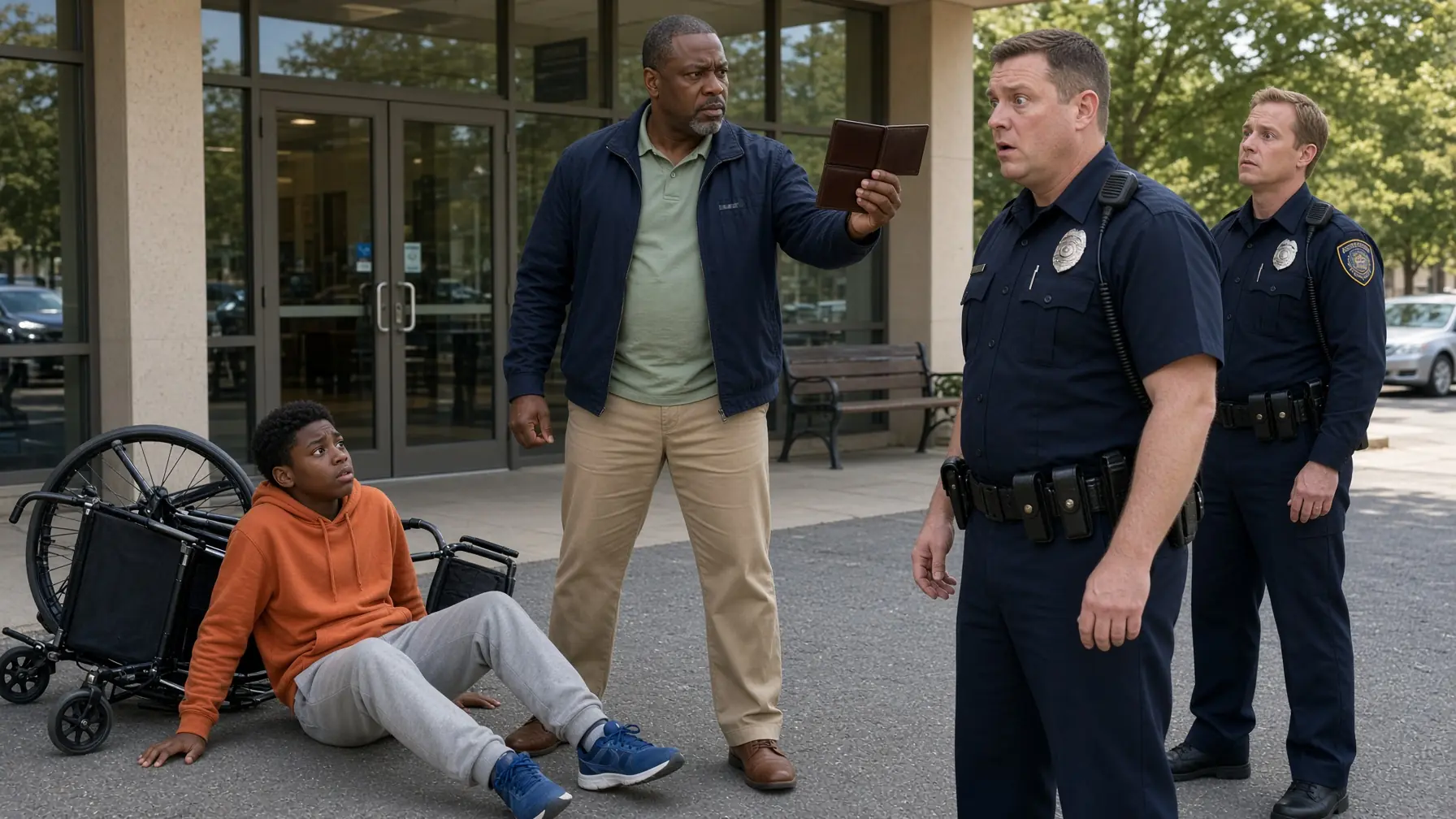
Thirteen-year-old Malik Carter tightened his fingers around the armrests of his black wheelchair. His blue sneakers rested on the footrests, his gray athletic trousers bunched slightly at the knees, and the sleeves of his orange hoodie trembled as he tried to turn toward the officer standing behind him.
“I can’t stand!” Malik cried. “Please, my dad’s coming!”
Cole leaned over the handles.
“Then I guess we’re about to find out.”
Beside the wheelchair, Officer Tyler Shaw smiled.
He was younger and leaner than Cole, with sandy hair and the relaxed expression of someone watching a joke unfold. His patrol uniform was clean, his hands rested near his duty belt, and he made no attempt to intervene when Cole tightened his grip.
Several people watched from the recreation center entrance.
A basketball bounced somewhere behind the building.
Malik glanced desperately toward the parking lot.
His father had promised to be there at four.
It was already four twelve.
“Sir, please,” Malik whispered. “My legs don't work right. I have a medical condition.”
Cole gave a dismissive snort.
“Funny how everybody suddenly has a condition when the police start asking questions.”
Then he jerked the wheelchair backward.
Malik grabbed the armrests, his shoulders snapping against the backrest as the front casters briefly lifted from the pavement.
“Stop!”
Cole shoved it forward.
The small wheels struck the uneven edge of the concrete walkway. Malik lost his grip, tipped sideways, and fell from the chair.
His shoulder and hip hit the pavement.
The wheelchair rolled half a turn before tipping onto its side beside him.
A woman near the entrance screamed.
For an instant, Malik could not breathe.
He lay on the concrete, one arm trapped beneath his body, the other stretched toward the wheelchair. His orange hoodie had ridden up slightly, exposing the edge of the protective brace beneath his clothing. He tried to move his legs, but they did not respond the way he needed them to.
Officer Shaw looked down.
Then he laughed.
“Look at that,” he said. “You got out after all.”
Malik stared up at him.
He was thirteen years old.
He had spent the last eighteen months learning how to navigate a world that had suddenly become full of stairs, narrow doorways, inaccessible bathrooms, and people who thought a wheelchair was an invitation to ask questions.
He had endured surgeries, rehabilitation sessions, sleepless nights, and the humiliation of needing help with things he once did without thinking.
But until that afternoon, no adult had ever deliberately thrown him from his wheelchair.
And no one had ever laughed while he lay helpless on the ground.
“Help me,” Malik whispered.
Neither officer moved.
Then a voice came from the parking lot.
“Malik!”
A tall Black man in a navy jacket was running toward them.
David Carter was forty-five years old, broad-shouldered, with closely cropped hair and the kind of controlled posture that made people instinctively move out of his path. He had a leather wallet in one hand and his car keys in the other.
He dropped both when he saw his son on the pavement.
“Malik!”
He reached the boy, fell to one knee, and gently placed a hand on his shoulder.
“Hey. Hey, look at me.”
Malik's breathing was uneven.
“Dad?”
“I'm here.”
“They threw me.”
David's face changed.
Not dramatically. Not with a shout or an explosion of anger.
Something colder passed through his expression.
He looked at the overturned wheelchair. He looked at the boy's scraped sleeve. He looked at the two uniformed officers standing above them.
Then he returned his attention to Malik.
“Can you feel your hands?”
Malik nodded.
“Any new pain in your neck or back?”
“My shoulder hurts. And my hip.”
“Okay. Don't try to move yet.”
David pulled out his phone and called for an ambulance, giving the dispatcher the recreation center's address and explaining that a child with a mobility disability had fallen from his wheelchair after police interference.
Cole stepped forward.
“Sir, you're going to need to back up. We're conducting—”
David raised one hand.
“Don't.”
The single word stopped Cole in mid-sentence.
David kept his palm against Malik's shoulder for another moment before slowly looking up.
“He told you he couldn't stand,” David said, quietly furious. “Which one of you decided to test it?”
Shaw's smile vanished.
Cole squared his shoulders.
“Your son was refusing lawful instructions.”
David looked at the wheelchair.
Then at the patch of concrete where Malik had fallen.
“Lawful instructions?”
“He was being uncooperative.”
“My son cannot walk.”
“We didn't know that.”
“He told you.”
Cole's jaw tightened.
David stood.
At six feet two inches, he was nearly eye level with the larger officer. His pale green polo showed beneath his open navy jacket, and his beige trousers were creased from sitting in the car. He looked like a father who had rushed from an ordinary afternoon appointment.