“Fake uniform. Fake ID. You’re done.”
The officer tightened the handcuffs around General Naomi Ellsworth’s wrists while his partner laughed beside the old gas pump. Naomi did not pull away, raise her voice, or attempt to overpower either man. She simply turned her head toward the secure phone inside her jacket and said, “Repeat that for the Pentagon.”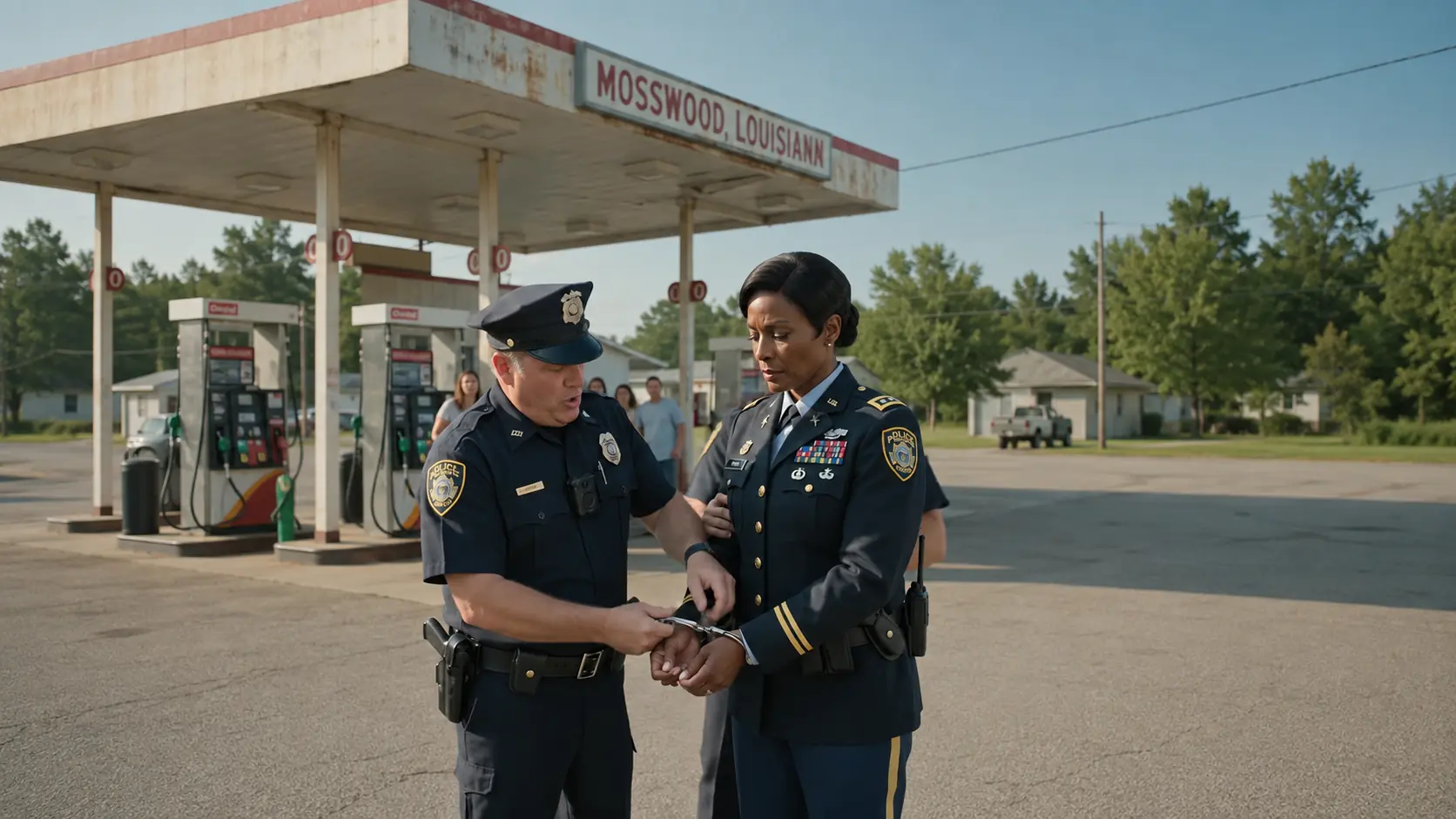
The heavier officer glanced at the decorated uniform covering her tall athletic frame. Four silver stars rested on each shoulder, rows of service ribbons crossed her chest, and command insignia gleamed beneath the Louisiana sun. His mouth twisted into a mocking smile.
“No one is coming for you,” he said.
Naomi looked toward the highway as the first black government vehicle turned onto the cracked road leading into Mosswood. Behind it came two military SUVs, a communications truck, and a Louisiana State Police vehicle with its lights flashing.
“They’re already here.”
Twenty minutes earlier, the gas station had been almost empty. Two pickup trucks stood near the entrance, and three local men drank coffee beside an ice machine that had not worked in years. Naomi had parked her gray rental sedan along the side of the building because it was the only place where her encrypted phone showed enough signal to reconnect with Pentagon Command Operations.
She was traveling to Barksdale Air Force Base for a classified readiness meeting involving senior military, intelligence, and emergency-management officials. The meeting concerned a possible breach in a regional defense communications network. Because the visit was not public, Naomi had declined an escort and planned to change into her dress uniform closer to the base.
That plan changed when Command Operations contacted her with an urgent update. A senior delegation had arrived early, and the base commander requested that she report in full uniform. Naomi retrieved the garment bag from her trunk, changed inside the gas station restroom, and returned to her vehicle while speaking through the secure line.
The call was still active when the Mosswood police cruiser entered the parking lot.
Officer Clayton Rusk stepped out first. He was forty-seven, heavyset, pale-skinned, and known throughout the town for turning routine encounters into displays of authority. His partner, Officer Dean Mercer, was younger and more physically fit, but he rarely challenged Rusk’s decisions.
Rusk watched Naomi standing beside her rental car with a black folder open on the hood. He noticed the military uniform, the secure phone, and the government documents before seeing her face. Instead of asking what was happening, he told Mercer that someone was impersonating an officer.
They approached with their hands resting near their duty belts.
“Step away from the vehicle,” Rusk ordered.
Naomi raised one finger toward the phone, indicating that she was on an official call. “Command Operations, remain connected.”
Rusk’s eyes narrowed. “I said step away.”
“I heard you, Officer. Identify the reason for the detention.”
The question irritated him immediately. He expected compliance without explanation, especially from someone he had already decided was suspicious. “We received a report of a woman using fake military credentials.”
“No report was made,” Naomi replied. “You watched me exit the building.”
Mercer glanced toward the men near the entrance. None of them had called the police. The cruiser had been passing on the county road when Rusk turned into the station.
Rusk extended his hand. “Give me the phone.”
“No.”
That single word transformed his suspicion into anger.
“You don’t get to refuse me.”
“This is a secured federal communication device. You are not authorized to touch it.”
Rusk laughed. “You expect me to believe the Pentagon gave you a special telephone?”
The voice of Lieutenant Commander Bryce Hanley came through Naomi’s earpiece. “General, do you require assistance?”
Naomi kept her eyes on the officers. “Remain on the line and begin recording.”
Rusk heard only her side of the conversation. He stepped closer, read the name on her uniform, and looked at the four stars on her shoulders.
“General Ellsworth?” he said. “That what you’re calling yourself?”
“That is my name and rank.”
Rusk turned to Mercer with theatrical disbelief. “We’ve got ourselves a four-star general.”
The men near the gas station entrance laughed nervously, unsure whether the officer was making a joke or preparing an arrest. Naomi did not react.
She had served twenty-nine years in the United States Army. She had commanded soldiers under rocket fire, supervised evacuations during natural disasters, and negotiated with officials who treated every conversation like a battlefield. Remaining calm beside a gas pump required far less courage than many mornings she had already survived.
Yet the insult carried a different weight.
Rusk did not doubt her because the uniform looked poorly made. It had been tailored by an authorized military supplier, and every ribbon was positioned correctly. He did not doubt her because her identification lacked security features. He had not yet examined it.
He doubted her because he could not imagine a Black American woman holding the rank displayed on her shoulders.
Naomi slowly reached toward the inside pocket of her uniform. Both officers reacted.
“Hands where I can see them!” Mercer shouted.
“My military identification is inside this pocket.”
“Don’t touch it,” Rusk said. “Turn around.”
Naomi remained still. “You requested identification.”
“I changed my mind.”
“Then state the legal basis for detaining me.”
Rusk moved behind her and seized one wrist. “I don’t need a lecture from someone wearing a costume.”
Naomi could have resisted. Even at fifty-two, she was stronger and better trained than either officer expected. But physical victory in a gas station parking lot would accomplish nothing. She allowed Rusk to pull her arm back while Mercer removed the secure phone from her hand.
The call remained connected.
“General?” Hanley’s voice sounded from the device.
Mercer stared at the screen. Encryption warnings covered the display, and a red banner identified the active connection as a restricted command channel. Instead of reconsidering, he pressed several buttons and failed to end the call.
“What is this thing?” he asked.
“Federal property,” Naomi answered. “Return it.”
Rusk tightened the first handcuff. “Women like you always have an excuse.”
The sentence traveled through the secure connection to the Pentagon operations room.
Hanley immediately alerted Naomi’s aide, Major Alexis Warren, who was already waiting at Barksdale. Warren confirmed Naomi’s location through the device’s emergency tracking system and contacted the nearest military security unit, Louisiana State Police, and the Department of Defense Inspector General’s field office.
The response began before the second cuff closed.
At the gas station, Rusk forced Naomi toward the rear of the patrol car. Mercer searched the rental sedan without consent, opening the passenger door and removing the black folder from the hood.
Inside were travel orders, classified routing instructions protected by coded covers, and official credentials bearing Naomi’s photograph. Mercer held up the identification.
“It says general,” he muttered.
Rusk barely looked. “People can print anything.”
“There’s a government seal.”
“So?”
Naomi watched him dismiss the document without examination. “Scan the embedded verification code.”
Rusk stepped into her space. “You’re not giving orders anymore.”
“I have not stopped being a general because you placed me in handcuffs.”
That answer drew another laugh from him. “You really committed to this story.”
A gas station customer began recording with his phone. Rusk noticed and ordered him to stop. The man lowered the device but continued filming from beside his truck.
Naomi turned slightly so the camera could capture her face and uniform. She wanted a complete record. Body-camera footage could disappear, audio could be muted, and reports could be rewritten. Civilian evidence often survived precisely because officers did not control it.
Rusk reached for the rear door of the cruiser.
Naomi did not move. “Before you put me inside that vehicle, you should contact your supervisor.”
“I am the senior officer on duty.”
“Then contact the state police.”
“This is Mosswood jurisdiction.”
“Contact the Department of Defense.”
Rusk leaned toward her. “You think repeating ‘Pentagon’ makes this real?”
“No,” Naomi said. “The people listening make it real.”
The secure phone still rested in Mercer’s hand.
A clear voice came through its speaker. “This is Pentagon Command Operations. Identify yourselves immediately.”
Mercer almost dropped it.
Rusk stared at the device, then recovered his arrogance. “Anybody can say they’re calling from Washington.”
“Officer Clayton Rusk,” the voice continued, reading information pulled from emergency databases. “Badge number 417. Officer Dean Mercer, badge number 522. You are detaining General Naomi Ellsworth, United States Army. Remove the restraints and preserve all recordings.”
Several witnesses stopped breathing.
Mercer looked toward Rusk. “They know our names.”
Rusk grabbed the phone and shouted into it. “This is a local law-enforcement matter. Stay off our channel.”
“You are holding a secured Defense Department device,” Hanley replied. “Federal authorities and military security are approaching your location.”
Rusk ended the call by throwing the phone onto the front seat of the patrol car. The connection remained active through its emergency mode.
“No one is coming,” he told Naomi, though his voice no longer carried the same confidence.
The first government SUV appeared less than four minutes later.
It moved quickly but stopped with disciplined control near the entrance. Major Warren stepped out before the vehicle fully settled. She was a thirty-four-year-old Black American Army officer in service uniform, carrying a secured tablet and wearing an expression Naomi had seen only during emergencies.
Two military police vehicles followed. State troopers blocked the road, while a Defense Department investigator approached with credentials raised.
Warren saw the handcuffs first.
“Remove those restraints from my commanding officer,” she said.
Rusk placed one hand near his weapon. “Back away. This woman is under arrest.”
“For what?”
“Impersonating a military officer, resisting instructions, and possessing suspicious federal documents.”
Warren stopped several feet away. “That woman is General Naomi Ellsworth, Deputy Commander of United States Army Strategic Operations.”
Rusk glanced at Naomi, then at the four-star vehicle flag now being attached to the lead SUV. Uniformed military personnel stood at attention near the road.
His face turned red.
The Defense Department investigator introduced himself and requested that Rusk hand over the secure phone. Rusk refused, claiming it had been collected as evidence.
The investigator looked toward the state troopers. “Secure that device.”
A lieutenant from Louisiana State Police stepped forward. “Officer Rusk, release the general and step away from your cruiser.”
Rusk appealed to local authority. “You don’t command me.”
“No,” the lieutenant replied. “But your chief does, and he is on the telephone ordering you to cooperate.”
Mercer removed Naomi’s handcuffs.
The metal left red marks around her wrists. Major Warren moved toward her, but Naomi raised a hand, signaling that she was uninjured.
Rusk watched the assembled officials with a mixture of fear and resentment. “How were we supposed to know?”
Naomi turned to face him fully.
“I told you.”
“You could have been lying.”
“You refused to verify my identification.”
“The uniform looked suspicious.”
“You could not identify one incorrect detail.”
Rusk had no answer.
Naomi looked toward the witnesses, the phones recording from several angles, and the officers who had watched their certainty collapse. “You did not make a mistake because information was unavailable. You made a choice not to examine it.”
The Defense Department investigator retrieved the secure phone. Its recording system had captured the entire encounter, beginning with Naomi’s authenticated call and continuing through every insult, search, and threat.
Rusk’s body camera had been running as well.
Mercer’s had not.
He claimed he forgot to activate it when leaving the cruiser. The state police lieutenant immediately ordered both officers separated and their devices preserved.
Naomi could have continued toward Barksdale once her wrists were free. The classified meeting still awaited her, and several senior officials had already adjusted the schedule.
Instead, she remained at the gas station.
She requested written names from every witness and asked the state police to secure surveillance footage from the pumps, store entrance, and parking lot. She photographed the marks on her wrists and dictated a factual account into her secure device.
Major Warren understood why.
This was no longer only an incident involving a general. If Naomi left after revealing her rank, the town might treat the event as an embarrassing misunderstanding corrected by powerful people. The deeper question would remain unanswered.
What happened to residents who had no convoy coming?
The investigation began that afternoon.
Mosswood Police Chief Aaron Bell arrived twenty minutes later, visibly shaken. He apologized repeatedly, promised full cooperation, and suspended Rusk and Mercer pending review.
Naomi listened, then asked one question.
“How many complaints have been filed against them?”
Bell hesitated.
That hesitation changed the direction of everything.
The department’s official database showed four complaints against Rusk during the previous five years. None resulted in discipline. Yet when state investigators examined archived emails, handwritten intake sheets, and municipal insurance records, they found twenty-three additional allegations.
Black motorists described being stopped without clear cause. Women reported degrading comments during searches. Military veterans said officers mocked their identification or accused them of exaggerating service histories.
Several complainants specifically named Rusk.
One man had been arrested after refusing to unlock his phone during a traffic stop. Charges disappeared, but he spent two nights in jail and lost his delivery job. A Black mother reported that Rusk searched her vehicle while her children watched, then laughed when she asked for a female officer.
A retired Army sergeant presented a worn copy of a complaint he filed three years earlier. Rusk had accused him of using a fake disabled-veteran license plate and forced him to remain beside the road for nearly an hour. The department never interviewed witnesses.
Chief Bell had signed the closure notice.
He claimed the complaints lacked evidence.
Investigators discovered that body-camera recordings were often missing, mislabeled, or overwritten. Supervisors accepted officers’ explanations without requesting independent footage. The town council received annual summaries reporting only the four formal complaints entered into the digital system.
The other allegations had been stored in a locked filing cabinet.
Naomi attended the first public hearing in civilian clothing. She sat in the front row beside people whose complaints had disappeared. The room was crowded with residents who had previously believed challenging the police would create more trouble than remaining silent.
Rusk’s attorney argued that Naomi had behaved unusually by refusing to surrender the secure phone. He said the officers faced a confusing situation involving military insignia, classified papers, and a woman who asserted authority outside their jurisdiction.
Naomi spoke after him.
“I did not ask those officers to obey military authority,” she said. “I asked them to identify a lawful reason for detention and verify government identification. They chose ridicule instead.”
She held up the recording transcript.
“The question is not whether they should have recognized a four-star general on sight. The question is why they believed mockery was a substitute for investigation.”
Rusk was dismissed from the department after an administrative hearing confirmed dishonesty, unlawful detention, improper search, discriminatory conduct, and misuse of restraints. Mercer received a suspension initially, but further investigation showed he had participated in several questionable arrests and repeatedly failed to activate his camera.
He was dismissed two weeks later.
Chief Bell resigned after investigators proved that he concealed complaints to protect the department’s insurance rating and public image. The town council requested an external review of every arrest made by Rusk during the previous seven years.
State prosecutors dismissed twelve pending cases after determining the officers’ reports could not be trusted. Three past convictions were referred for judicial review. People wrongly charged received refunds for impound fees, fines, and court costs.
Mosswood adopted new policies under state supervision.
All complaints received permanent digital tracking numbers. No allegation could be closed by an officer’s direct supervisor. Body-camera interruptions triggered automatic review, and missing footage could no longer be explained through a single written statement.
Officers were trained to verify military, federal, and professional credentials without ridicule or unnecessary escalation. Yet Naomi insisted the reforms could not focus only on prominent identities.
“Respect is not a reward for rank,” she told the town council. “A cashier, mechanic, teacher, veteran, visitor, and four-star general are entitled to the same lawful process.”
The gas station video spread nationwide.
News reports emphasized the moment military vehicles arrived, but Naomi declined interviews that framed the story as a spectacular rescue. She did not want the public to believe justice functioned because the Pentagon protected one of its generals.
“The convoy exposed the problem,” she said during a single press briefing. “It did not create my rights.”
At Barksdale, Naomi eventually completed the readiness meeting three hours late. She entered the conference room wearing the same uniform, with faint marks still visible around her wrists.
Every official stood when she arrived.
Naomi asked them to sit.
The meeting concerned national preparedness, secure communications, and institutional trust. Before beginning the classified presentation, she addressed what had happened.
“A system is not reliable merely because it responds quickly when an important person is endangered,” she said. “It is reliable when it protects people whose names carry no influence.”
Months later, she returned to Mosswood without a convoy.
Kelly’s Fuel and Food had repainted its walls and installed new security cameras. The men who had witnessed her arrest recognized her immediately, though she wore jeans, sneakers, and a simple Army jacket.
One of them approached with embarrassment. He had laughed when Rusk mocked her rank.
“I should have said something,” he admitted.
“You recorded.”
“I started after they put the cuffs on.”
“Next time, start sooner.”
He nodded.
Inside the station, the retired Army sergeant whose complaint had been hidden waited beside the coffee counter. He thanked Naomi for forcing the town to look at what had happened.
She corrected him.
“The officers forced the town to look. You and the others preserved the truth long enough for someone to find it.”
Before leaving, Naomi stood beside the same gas pump where Rusk had tightened the handcuffs. The cracked pavement remained unchanged, and weeds still pushed through the asphalt.
The location no longer felt humiliating.
It felt instructive.
Rusk had seen a Black American woman wearing four stars and decided the image was impossible. When evidence challenged his assumption, he dismissed the evidence. When authority corrected him, he resisted until greater authority arrived.
His failure was not simple ignorance.
It was the belief that his certainty mattered more than verification.
Naomi returned to her rental car and called Major Warren.
“General, do you require an escort this time?” Warren asked.
“No.”
A pause followed. “That answer has not become more reassuring.”
Naomi smiled. “I’ll check in when I reach the highway.”
She ended the call and looked once more toward the station.
Two officers had believed no one would come for her.
They were wrong because the Pentagon had heard every word.
But the real change in Mosswood began only after the town asked a harder question:
Who should have come for everyone else?