“Oh my God. Do you smell that, Brenda? Something must have wandered in from the street.”
Craig did not even lift his eyes from his phone. He merely wrinkled his nose toward the entrance.
Brenda leaned over the counter and chuckled.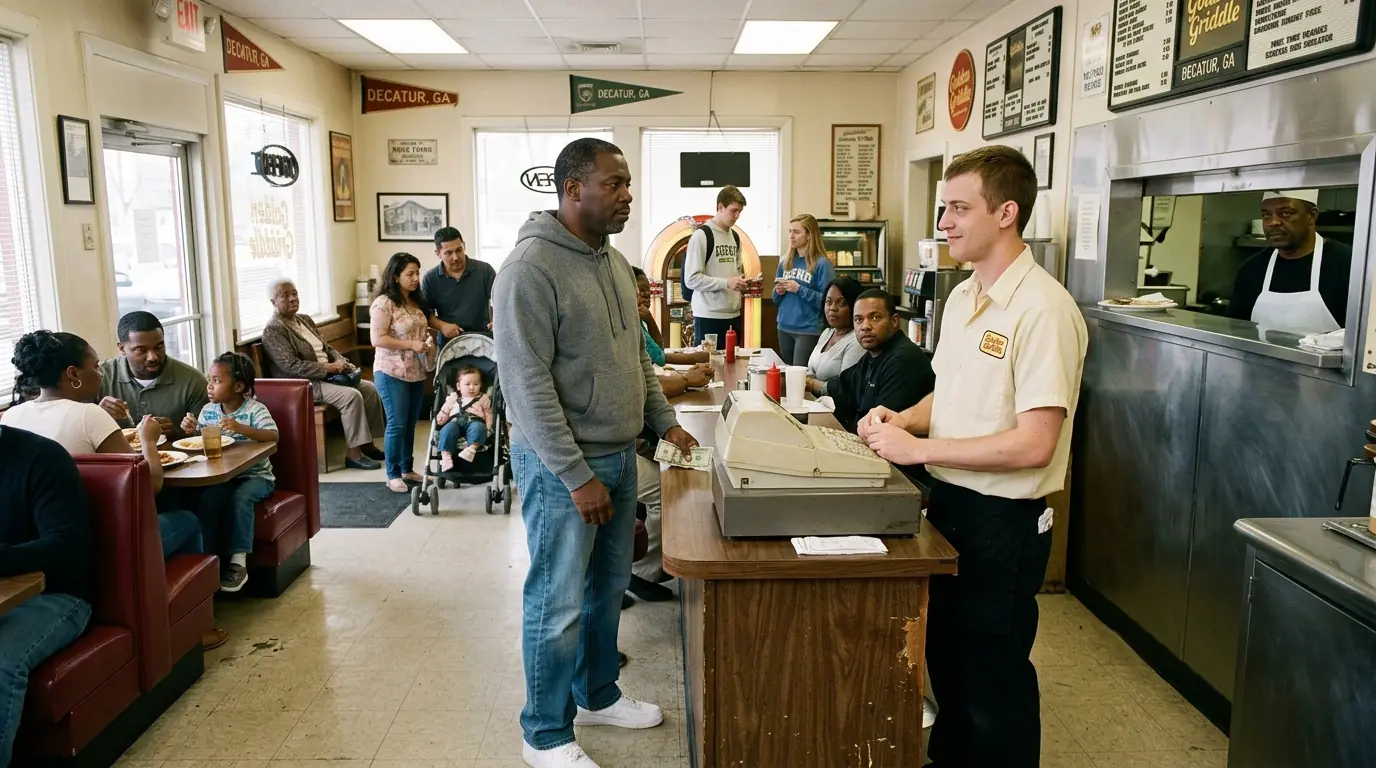
“Sir, this is not a charity. Do you have money, or are you only looking around?”
The man in the gray hoodie said nothing.
He continued toward the counter with his hands resting calmly at his sides.
“Hey, I am speaking to you,” Craig called. “Are you unable to hear me?”
The man glanced at the menu.
His voice was low and steady.
“I would like the Southern breakfast platter. Scrambled eggs and extra toast, please.”
“Fourteen dollars and ninety-nine cents,” Brenda replied. “Are you certain you can afford it?”
The man placed a twenty-dollar bill on the counter.
There was no anger in his expression.
No visible reaction.
Only calm.
Craig and Brenda had no idea whom they had just humiliated. They did not know what their behavior behind that counter was about to cost them.
That morning had begun quietly.
Henry Davis woke at 5:30 inside his home in Buckhead, Atlanta.
The house was large but simple. There were no marble columns, gold fixtures, or extravagant displays of wealth.
It had clean architectural lines, warm wooden surfaces, and framed photographs along the hallway.
One photograph showed twenty-six-year-old Henry standing outside a tiny diner beneath a hand-painted sign.
Golden Griddle.
Grand Opening, 2006.
Another photograph showed Henry shaking hands with the governor during a ribbon-cutting ceremony.
A third was a framed Forbes cover.
“Self-Made: How a Dishwasher Built a Ninety-Million-Dollar Diner Empire.”
Henry walked past all three without looking.
He had seen the photographs thousands of times.
Inside the bathroom, he studied his reflection in the mirror. Then he reached for the plain gray hoodie hanging behind the door.
He added faded jeans and white sneakers with a crease across the middle.
No expensive watch.
No ring.
No cologne.
Henry opened the garage.
A black Mercedes SUV stood beside a 2014 Honda Civic with a small dent in the rear bumper.
He picked up the Civic’s keys.
Twice a year, Henry conducted an inspection that nobody in the company knew was coming.
There was no announcement.
No calendar entry.
No advance notice to the regional manager.
Henry called it the real menu.
He would enter one of his thirty-eight Golden Griddle locations dressed like a man who possessed very little. Then he would observe exactly how his employees treated people they believed had nothing to offer them.
Before leaving, Henry attached a tiny body camera inside the pocket of his hoodie.
The lens was no larger than a pencil eraser.
Angela Brooks, Golden Griddle’s chief operations officer, was already inside the company’s Atlanta office watching the live feed on her laptop.
A member of the legal team was on standby.
Henry backed out of the driveway.
The morning sun had not fully risen, and the streets of Buckhead remained quiet.
Forty minutes later, he parked the Civic outside the Golden Griddle in Decatur, Georgia.
Decatur was a working-class community east of Atlanta with residents from many backgrounds.
It was 9:15 on a Saturday morning.
The busiest part of the breakfast rush was ending, but half the parking spaces were still occupied.
Henry remained in the car for a moment.
Through the window, he could see the diner’s interior.
Black-and-white checkered floors.
Red vinyl booths.
A jukebox in one corner playing Motown songs in a continuous rotation.
Henry had personally approved every detail of the design.
He wanted each Golden Griddle to feel like his grandmother’s kitchen.
Warm.
Safe.
A place where anyone could sit down and feel welcome.
Henry stepped out of the vehicle.
The air carried the smell of warm syrup and used coffee grounds drifting from the kitchen vent.
A small bell chimed when he opened the front door.
The diner was active.
A Black family of four sat near the window. The mother adjusted a napkin across her young daughter’s lap.
Two white college students shared a stack of pancakes near the jukebox.
A Latino couple with a toddler waited at the register.
Behind the counter stood two employees.
Craig Wilson was a white man in his late twenties. He leaned against the back wall with an earbud in one ear while scrolling through his phone and chewing gum with his mouth open.
His uniform shirt was untucked.
Brenda Taylor was a white woman in her early thirties. She stood at the second register and whispered something to Craig.
They both laughed.
The Latino couple remained at the counter.
Neither employee acknowledged them.
Ten seconds passed.
Then twenty.
Then thirty.
The husband cleared his throat politely.
Brenda finally looked up and released an exaggerated breath through her nose.
“What do you want?”
There was no smile.
No greeting.
No eye contact.
Less than fifteen seconds later, a young white couple walked through the door.
Craig immediately straightened.
He removed the earbud and smiled broadly.
“Good morning. Welcome to Golden Griddle. What are you both in the mood for today?”
The same minute.
Completely different service.
A woman named Lorraine Moore watched from the kitchen pass-through window.
Lorraine was a Black woman in her mid-fifties who had worked at that location for six years.
Her hands continued moving across the grill as she turned eggs, but her jaw had tightened.
She had witnessed the same pattern hundreds of times.
Lorraine had filed two formal complaints against Craig and Brenda.
Both had disappeared.
The regional manager was Derek Wilson.
Craig’s uncle.
Henry remained near the entrance and watched.
His hands hung loosely beside him.
His face revealed nothing.
Then he approached the counter.
That was when Craig made the comment about something coming in from the street.
Brenda leaned over his shoulder and watched Henry.
She folded her arms and raised one eyebrow.
“You have to check people these days,” Craig said loudly enough for the nearest booth to hear. “You never know with certain customers.”
Henry said nothing.
He continued watching.
Craig took the twenty-dollar bill and entered the order into the register.
His fingers moved rapidly.
Too rapidly.
Henry saw the screen before Craig changed the display.
The Southern breakfast platter cost fourteen dollars and ninety-nine cents.
Tax appeared beneath it.
Then there was a third line that did not belong.
Special preparation fee: three dollars and fifty cents.
The total was eighteen dollars and forty-nine cents.
Henry tilted his head.
“What is the special preparation fee?”
Craig did not raise his eyes.
“Standard charge. Everyone pays it.”
“I have eaten at other Golden Griddle locations. I have never seen that fee on a receipt.”
Craig placed both palms on the counter and leaned closer.
His voice became lower, not because he wanted privacy, but because he wanted to challenge Henry to object again.
“Other locations may conduct business differently. This is what it costs here.”
His eyes narrowed.
“Do you want the food or not?”
A woman seated behind Henry glanced over.
Her fork stopped halfway toward her mouth.
Then she quickly looked away and pretended not to have heard.
Henry held Craig’s gaze for two seconds.
“I will take the food.”
Craig opened the register and collected Henry’s change.
He did not count it.
He pushed the coins across the counter with the back of one hand.
Two quarters and a penny rolled over the edge, struck the tile, and spun before settling flat.
Craig looked down at the coins.
Then he looked at Henry.
A lazy smirk appeared.
“Oops.”
Brenda covered her mouth.
A muffled laugh escaped between her fingers.
Henry bent down without speaking.
He collected the coins one at a time and placed them inside his pocket.
Then he walked to a booth near the kitchen pass-through and sat quietly.
Beneath the table, he sent Angela a message.
“Fraudulent surcharge added to my order. Three dollars and fifty cents. It is not in our approved system. Continue recording.”
Angela responded four seconds later.
“Confirmed. Legal is watching the live feed.”
The diner continued around Henry.
Forks scraped across ceramic plates.
Quiet conversations mixed with the sound of food cooking through the kitchen window.
Marvin Gaye played softly from the jukebox.
The smells of melting butter, crisping hash browns, and fresh coffee filled the room.
Henry folded his hands on the table and waited.
Seven minutes later, the white couple who ordered after him received their food.
Brenda carried both plates carefully.
She lowered them gently onto the table and smiled.
“You both enjoy your breakfast. Let me know if you need anything.”
Their eggs were soft and steaming.
The toast was thick, golden, and covered in butter.
The grits filled the bowls, with a glossy piece of butter melting at the center.
Henry was still waiting.
Another five minutes passed.
Twelve minutes in total.
Brenda eventually carried Henry’s plate toward him with one hand while the other rested on her hip.
She dropped it onto the table.
The impact caused the silverware to rattle.
Brenda said nothing.
She turned and walked away.
Henry looked at the food.
The eggs were overcooked and dry. The edges were brown as though the plate had been sitting beneath a heating lamp.
The toast consisted of two heel slices from the ends of a loaf.
They were barely warm.
The grits formed a thin layer at the bottom of the bowl, not enough to fill one spoon properly.
Two booths away, a white man approximately Henry’s age ate the same platter.
His eggs were soft and seasoned.
His toast was golden and buttered.
His bowl of grits was full and steaming.
Same menu.
Same kitchen.
Same price.
A completely different plate.
Lorraine saw Henry’s food leave the counter.
Her spatula stopped in the middle of turning an egg.
She had prepared Henry’s order herself.
The eggs had been scrambled softly.
She had cut the bread from the center of the loaf.
The bowl of grits had been filled to the top.
What arrived at Henry’s table was not what Lorraine made.
She looked toward the front counter.
Craig leaned against the wall with his arms crossed.
He watched Henry with a knowing grin.
Brenda moved behind the register and whispered into Craig’s ear.
Craig gave a short, unpleasant laugh.
Henry picked up his fork and cut into the eggs.
They were dry and cold in the center.
He chewed once, placed the fork down, and pushed the plate slightly forward.
Henry did not complain.
He did not call anyone to the table.
He remained seated and silently recorded every detail.
Then the bell over the front door chimed.
An elderly Black woman entered.
She moved slowly and used one hand against the doorframe for balance.
She wore a carefully pressed floral dress and a small church hat pinned to one side of her head.
A thin gold chain rested against her collarbone.
Her purse hung from the bend of one arm.
She approached the counter with measured steps.
Brenda was wiping the register screen.
Her eyes remained lowered.
“Excuse me, dear,” the woman said softly. “Could you tell me what the soup of the day is?”
Brenda continued wiping.
Five seconds passed.
Then ten.
Then fifteen.
The woman stood quietly.
She waited with the patience of someone who had been forced to wait in similar circumstances throughout her life.
“Excuse me,” she repeated, slightly louder.
Brenda looked up and released a long, theatrical sigh intended to make the woman feel like a burden.
“Ma’am, you need to speak clearly. I cannot understand what you are saying.”
The woman had spoken clearly.
Every person within fifteen feet had heard her.
“I was asking about the…”
Craig interrupted from behind the counter without turning toward her.
“Perhaps she should try the children’s menu. Simpler choices.”
Brenda pressed her lower lip between her teeth.
A small laugh escaped through her nose.
The elderly woman tightened her fingers around the purse strap.
Her chin lowered toward her chest.
Her lips came together, not with anger, but with the practiced restraint of someone who had learned that certain places were not designed to welcome her.
She turned around.
Then she slowly walked out without ordering.
The bell chimed softly after the door closed.
The small sound remained in the diner like a sad note nobody wanted to acknowledge.
Nobody called after her.
Nobody apologized.
Henry placed his coffee mug on the table.
His jaw tightened.
He sent another message to Angela.
“Tell me you recorded every second of that.”
Angela replied.
“She is a regular customer. Loyalty records show she has visited this location for several years. What do you want to do?”
“Not yet. I need to see everything.”
Henry drank some coffee.
It was lukewarm and bitter.
He swallowed it anyway.
Several minutes later, Henry walked toward the restroom at the back of the diner.
The narrow hallway contained framed photographs from Golden Griddle’s earliest years.
The first restaurant.
The first team photograph.
The first favorable newspaper review.
Henry had selected those photographs for every location in the Southeast.
On his way back, he noticed the kitchen door resting open by several inches.
Lorraine stood behind it with a spatula in one hand and flour across her apron.
Her dark eyes met his through the gap.
She looked toward the counter.
Then toward the kitchen.
“Do not eat the grits,” she whispered.
Henry stopped.
“I saw what he did,” Lorraine continued.
Her voice trembled.
“Before the plate was carried out, Craig turned away from the window. I could not see the exact substance, but I saw his hands over your bowl.”
A cold sensation moved along the back of Henry’s neck.
“I have tried reporting them,” Lorraine said.
The words came faster now, like water pushing through a narrow crack.
“Twice. I wrote everything down and gave the complaints to the regional manager.”
She shook her head.
“Nothing happened. Derek is Craig’s uncle. The complaints disappeared.”
Lorraine’s eyes were glassy.
She was not crying.
She had the exhausted expression of someone who carried a burden alone for far too long.
Henry looked directly at her.
His voice was quiet and certain.
“Thank you.”
Lorraine remained still.
“I hear you,” Henry said. “I promise you that.”
She nodded quickly.
Then she blinked hard and stepped behind the kitchen door.
It closed with a soft creak.
Henry returned to his booth.
The grits remained untouched beneath the fluorescent light.
He pushed the entire plate toward the far edge of the table.
Then he sent Angela another message.
“Place the full legal team on standby. Contact the health department. Retrieve every complaint submitted about this location during the past fourteen months.”
Angela responded.
“Already underway. The team is moving.”
Henry placed the phone facedown on the table.
He folded his hands.
His posture had not changed.
His voice had not risen once since entering the restaurant.
Something behind his eyes had changed.
He was no longer merely observing.
Henry remained in the booth for another forty-five minutes.
He ordered a second cup of coffee so he had a reason to stay.
Then he watched.
What he saw was not random.
It was a system.
A Black father entered with his young son.
The child appeared to be approximately six years old. He held his father’s hand and stared with wide eyes at the jukebox.
Craig entered their order without greeting them.
He did not smile or make eye contact with the father.
The total was five dollars higher than the posted menu price.
When the father questioned it, Craig shrugged.
“Prices increased last week.”
They had not.
Henry knew every price on the board because he personally approved them.
A Latina woman ordered a sweet tea to take away.
Brenda filled the cup halfway, closed the lid, and pushed it across the counter without speaking.
The woman looked at the half-empty cup.
She said nothing.
She accepted it and left.
Three minutes later, a white teenager ordered the same sweet tea.
Brenda filled it to the top.
She smiled.
“There you go, sweetheart.”
Same drink.
Same cup.
Same employee.
Different customer.
Beneath the table, Henry opened the calculator on his phone.
Based on the fraudulent surcharges, inflated totals, and manipulated portions he had observed, he estimated that Craig was taking between two hundred and three hundred dollars during each shift.
Brenda appeared to help conceal the fraud.
After selected customers left, she voided the added charges in the system, allowing the register drawer to balance while the cash disappeared.
The operation was not careless.
It was organized.
It had clearly continued for months.
Lorraine watched from the kitchen pass-through.
She continued cooking.
She said nothing.
The previous two times she spoke, nothing changed except the way Craig treated her afterward.
Then the front door opened hard.
A young Black man entered.
He appeared to be twenty or twenty-one and wore a university hoodie with a backpack over one shoulder.
He approached the counter while checking the menu on his phone.
Craig immediately straightened.
He pointed toward the backpack.
“The bag stays near the front door.”
The young man looked confused.
“What?”
“Your bag. Place it beside the entrance.”
Craig gestured toward the umbrella stand.
“Store policy. Customers cannot walk through the diner carrying bags.”
No such policy existed.
Golden Griddle had never required customers to surrender backpacks, handbags, or briefcases at any of its thirty-eight locations.
Henry had never written or approved a bag-check rule.
The young man hesitated.
He looked around the diner.
Then he removed the backpack and placed it beside the entrance.
Fifteen seconds later, a white man in his thirties entered carrying a large leather messenger bag.
He walked past Craig and sat inside a booth.
Craig said nothing.
He did not even look toward the bag.
The young Black customer saw everything.
He stood at the counter waiting for his food and watched the difference unfold in real time.
He turned toward Craig.
His voice was quiet but firm.
“You did not ask him to leave his bag near the door.”
Craig’s expression changed instantly.
The lazy smile disappeared.
He stepped from behind the counter and stopped less than two feet from the customer.
“You have a problem?”
His voice was low and hard.
“I can contact the police right now. They are accustomed to dealing with people who cause trouble here.”
The young man tightened his jaw.
His eyes lowered toward the floor.
He did not speak again.
When the food arrived, he collected it, retrieved his backpack, and walked outside without looking back.
The door closed after him.
The bell barely made a sound.
Henry lowered his coffee.
His hand remained steady, but his knuckles had become pale around the handle.
He stood.
Then he walked toward the counter.
Every step was measured and deliberate.
His sneakers made almost no sound against the checkered floor.
Henry looked directly into Craig’s eyes.
“Do you treat every customer this way, or only the ones who look like me?”
The diner became quiet.
A fork stopped scraping against a plate somewhere behind him.
The jukebox had reached the space between two songs, leaving a gap of silence that felt enormous.
Craig blinked.
Then his face hardened.
He squared his shoulders and leaned over the counter.
“What did you just say to me?”
Brenda immediately picked up the store telephone.
She held it like a stage prop, with one finger hovering above the buttons.
“Should I call someone?”
Henry did not move.
“I would like to speak with the manager.”
Craig released a single sharp laugh.
“I am the manager on duty, and my uncle is the regional manager.”
He spread his hands.
“Good luck with that.”
Henry slowly nodded.
“All right.”
He turned as though returning to his booth.
Craig called after him.
“If you do not like the way we operate, the door is right there. Nobody is forcing you to stay.”
Henry did not respond.
He sat down again.
That should have ended the confrontation.
Craig was not finished.
He picked up the telephone behind the counter and dialed.
His voice became casual and practiced, the voice of someone who had done this before and knew precisely how to present the situation.
“Yes, hello. I have a customer who is becoming aggressive. He refuses to leave and is threatening my staff.”
Craig watched Henry from across the room.
“Could you send an officer?”
Henry had not raised his voice.
He had not approached anyone aggressively.
He had made no threat.
He asked one question.
Craig was constructing a story.
Brenda assisted him.
She stepped from behind the register and raised her voice.
It became shaky and theatrical.
“Sir, we asked you to leave politely. We do not want trouble. Please calm down.”
Henry sat with both hands folded on the table.
He had not spoken for thirty seconds.
The scene was already being arranged.
Two white employees.
One Black customer.
A call to the police.
A narrative that could write itself as soon as a patrol vehicle entered the parking lot.
Two customers near the window removed their phones and began recording.
An older white man wearing a trucker’s cap slowly shook his head.
A Black mother gathered her two children and moved them to a booth farther from the counter.
She pulled them close.
The tension became almost physical.
The grill hissed through the kitchen window.
The jukebox changed songs, but the music now felt as though it belonged to another room.
Four minutes later, a Decatur police cruiser entered the parking lot.
Its lights were not flashing.
Every person inside the diner turned toward the window.
Officer Trent Adams entered.
He was in his mid-forties, with broad shoulders and closely cropped hair.
One hand rested casually near his belt.
His eyes moved quickly around the room, evaluating the people and the atmosphere before anyone spoke.
Craig was already approaching.
He came around the counter and pointed toward Henry’s booth.
“That man has been harassing my staff.”
Craig’s voice was urgent and righteous.
“He refused to leave and became aggressive. I called because I was genuinely concerned about everyone’s safety.”
Officer Adams looked toward Henry.
Henry had not moved.
His hands remained folded.
A half-finished cup of coffee rested in front of him.
“Sir,” Adams said as he approached, “I need to see some identification.”
Henry slowly reached into his pocket.
He removed his driver’s license and placed it on the table.
Adams picked it up.
He read the name.
Then he compared the photograph to Henry’s face.
The officer looked back toward Craig, who stood with his arms folded and chin raised.
“Officer,” Henry said calmly, “I asked one question about the service inside this restaurant.”
Adams listened.
“I have not raised my voice, threatened anyone, or refused an instruction to leave.”
The officer looked around the diner.
The two customers continued recording.
The older man wearing the trucker’s cap caught Adams’s eye and slowly shook his head.
The gesture was small.
It communicated everything.
Nobody inside the diner supported Craig’s account.
Not one person.
Adams turned toward Craig.
His tone remained professional but became noticeably colder.
“I do not see a disturbance.”
Craig’s confident expression weakened.
“I need to speak with both of you separately.”
Something flickered behind Craig’s eyes.
The story he had rehearsed was no longer developing according to plan.
It was already too late for another story.
Through the front windows, a black SUV entered the parking lot.
The woman stepping from it was about to change the situation completely.
The front door opened.
The bell chimed again.
Angela Brooks entered.
She wore a navy blazer, pressed white blouse, and black heels that struck the tile with sharp, deliberate sounds.
A tablet rested in one hand.
A leather folder was in the other.
Two men followed her.
They were broad-shouldered and calm, wearing black polo shirts with small gold Golden Griddle logos.
Corporate security.
Conversations throughout the diner fell to murmurs.
Even the jukebox seemed quieter.
Craig looked toward the entrance.
He did not recognize them.
Still operating on the confidence created by his performance for the police, he stepped forward and raised his chest.
“Ma’am, we are handling a situation. You will need to wait.”
Angela did not look at him.
She did not slow.
She passed the counter and Officer Adams before stopping beside Henry’s booth.
“Mr. Davis.”
Her voice carried throughout the room.
“We received everything through the live feed. Legal has reviewed the footage in full.”
Angela looked at Henry.
“We are ready whenever you are.”
Craig’s mouth opened slightly.
His eyes moved from Angela to Henry.
“Mr. Davis?”
Angela turned toward Craig and Brenda.
Brenda remained frozen behind the register with the telephone still in her hand.
“My name is Angela Brooks. I am chief operations officer of Golden Griddle Incorporated.”
The words struck the room with force.
Craig moved backward by half a step.
His hand dropped from his hip.
Brenda slowly placed the telephone on the counter as though it had become too heavy.
Henry rose from the booth.
There was no rush.
He did not raise his voice.
Henry pulled the zipper of the hoodie down halfway.
The small body camera appeared inside the pocket.
It had recorded every second since he entered.
Henry looked at Craig.
Then Brenda.
“My name is Henry Davis.”
The room remained completely still.
“I am the founder, owner, and chief executive officer of Golden Griddle.”
He paused.
“Every location. Every menu. Every paycheck.”
Henry’s gaze settled on Craig.
“Including yours.”
There was absolute silence.
No forks.
No grill utensils.
No music anyone noticed.
Only the low hum of fluorescent lights and Craig’s increasingly heavy breathing.
The color in Craig’s face changed from red to white.
His lips moved.
Nothing came out at first.
Then a broken stammer appeared.
“Wait. You are not… I did not know.”
“You did not know what?”
Henry’s voice remained calm.
There was iron beneath it now.
“You did not know that the man you insulted, overcharged, and called the police on built this company from one frying pan and a five-hundred-dollar loan?”
Craig remained silent.
“You did not know that the man whose food you interfered with signs your paycheck every two weeks?”
Craig’s mouth hung open.
Brenda’s hands shook against the counter.
She pressed both palms flat in an attempt to stop the trembling.
It did not work.
Angela moved forward and turned the tablet toward the room.
The screen displayed two recordings.
On the left was Henry’s body-camera footage.
Every insult.
Every smirk.
Every fraudulent surcharge entered into the register.
On the right was footage from the diner’s security system.
Angles Craig and Brenda had either forgotten existed or assumed nobody would review.
The recordings showed Craig taking cash after Brenda voided fraudulent charges.
They showed Brenda helping conceal the transactions.
They showed Craig’s hands moving over Henry’s grits before the plate left the counter.
They showed the elderly woman being mocked until she walked away.
They showed the college student being forced to surrender his backpack while a white customer carried a larger bag past the same counter without question.
Four months of behavior appeared within four minutes.
Officer Adams watched without moving.
His jaw tightened.
When the footage of Henry’s food appeared, Adams reached for the notepad on his belt.
His expression toward Craig was now completely different.
Craig made one final attempt to escape responsibility.
“My uncle is Derek Wilson. He is the regional manager.”
His voice cracked.
“Call him. He will explain everything.”
“Derek Wilson was placed on administrative leave forty-five minutes ago,” Angela replied.
She did not allow Craig to finish.
“Our attorneys are already speaking with him about suppressed employee complaints and falsified performance reviews.”
Angela let the statement settle.
“There is nobody left for you to call, Craig.”
His knees weakened.
Craig caught the edge of the counter with one hand.
Brenda released a short, choked sound somewhere between a gasp and a sob.
Officer Adams closed his notepad and addressed Angela.
“I will need a copy of that footage, particularly the section involving the food.”
His tone was grave.
“That may constitute a serious criminal offense under Georgia law.”
Angela nodded.
“It is already prepared. Your department will receive it within the hour.”
Henry stood in the middle of his diner.
Craig and Brenda’s world had collapsed in less than three minutes.
Henry did not celebrate.
He did not shout or smile.
He looked at Craig.
“You had a good job.”
Craig lowered his eyes.
“You received a regular paycheck. Customers entered this diner trusting you to serve them safely and honestly.”
Henry’s voice became quieter.
“This is what you chose to do with that trust.”
For the first time all morning, Craig had nothing to say.
His entire body seemed to deflate.
His shoulders dropped.
His chin lowered.
His hands slipped from the counter.
Craig stepped toward Henry with both palms raised.
“Mr. Davis, please. I was having a bad day.”
His voice attempted to sound remorseful.
“I did not mean any of it. They were jokes. I am sorry.”
Henry looked at him with disbelief.
“A bad day?”
Craig swallowed.
“We possess recordings covering four months.”
Henry allowed each fact to land separately.
“Four months of fraudulent surcharges.”
A pause.
“Four months of stolen money.”
Another pause.
“Four months of customers being humiliated because of their race or background.”
He looked toward Lorraine through the kitchen window.
“Four months of Lorraine Moore reporting the conduct while your uncle buried the complaints.”
Henry faced Craig again.
“That is not a bad day.”
His voice remained steady.
“That is who you become when you believe nobody is watching.”
Craig’s eyes filled with tears.
They did not appear to come from guilt.
They came from fear.
The fear that follows when every exit has closed and the person trapped inside understands that he locked the doors himself.
Then Brenda stepped forward.
Tears moved down her face.
She clasped her hands against her chest.
“I did not want this.”
Her voice became high and unsteady.
“Craig told me what to do. I was afraid I would lose my job. I only followed along.”
Angela opened the leather folder.
She removed three printed screenshots, each with a timestamp and highlighted section.
Then she placed them on the counter one by one.
“This is you laughing after an elderly customer left the diner visibly hurt.”
The first screenshot landed.
“This is you voiding a fraudulent charge while Craig counted money behind the register.”
The second followed.
“This is you telling Craig which customers should receive the added fees.”
Angela placed the final page down.
She looked directly at Brenda.
“You were not a silent bystander. You participated.”
Brenda gripped the counter.
She began sobbing loudly.
Nobody moved toward her.
Henry straightened.
His voice carried the weight of someone who had made difficult personnel decisions before.
“Craig Wilson and Brenda Taylor, you are both terminated from Golden Griddle Incorporated effective immediately.”
Neither spoke.
“The grounds are gross misconduct, theft, discriminatory treatment of customers, and health-code violations.”
Henry continued.
“Your final pay will be mailed. You are prohibited from entering this or any other Golden Griddle location.”
Officer Adams stepped closer.
“You will both need to remain available for further investigation.”
He looked at Craig.
“The food-tampering evidence may result in criminal charges.”
Craig did not resist.
The two corporate security officers accompanied him toward the door.
His footsteps were slow and heavy across the checkered tile.
It was the same floor where he stood all morning behaving as though the diner belonged to him.
Brenda followed with her purse held against her body.
She continued crying.
The door closed behind them.
The bell produced the same cheerful sound it always made.
This time, it sounded like the final period in a very long sentence.
Several customers began applauding.
The sound started slowly and became louder.
The older man in the trucker’s cap nodded toward Henry.
The Black mother who had moved her children wiped her eyes.
Henry turned toward the kitchen.
Lorraine stood behind the pass-through window.
She had not moved.
The spatula remained in one hand.
Flour still covered the front of her apron.
Her expression had changed.
She looked like someone watching a locked door open after years of believing it never would.
Henry walked toward the kitchen entrance.
“Lorraine.”
She met his eyes.
“You attempted to do the right thing twice.”
Henry spoke gently.
“You submitted complaints that should have been investigated. The management system failed you.”
Lorraine blinked.
“That ends today.”
Her lips trembled.
“I would like to promote you to shift supervisor of this location, effective immediately.”
Lorraine stared at him.
“Every complaint you filed will be included in the formal corporate investigation.”
Henry paused.
“Your voice matters. It always did.”
The spatula slipped from Lorraine’s hand.
It struck the steel counter.
She covered her mouth with both palms.
Then the tears came.
They were not the frightened tears Brenda cried after losing her position.
They were quiet and deep.
The tears of someone experiencing a moment she had stopped believing would ever arrive.
Lorraine worked at the diner for six years.
Six years of preparing good food.
Six years of lowering her head and hoping someone would eventually listen.
Someone finally had.
The story did not end when Craig and Brenda walked through the door.
In many ways, it was only beginning.
During the following two weeks, Golden Griddle’s legal department hired an independent auditor to examine the Decatur location.
Every receipt was reviewed.
Every register entry.
Every voided transaction.
Every personnel file.
Every available security recording.
The findings were worse than Henry anticipated.
Craig’s fraudulent surcharge operation had continued for fourteen months.
Not several bad weeks.
Fourteen consecutive months of false fees, inflated totals, and money taken from the register.
The stolen amount reached approximately fifty-eight thousand dollars.
Brenda was directly involved in at least twenty-two thousand dollars of the fraud.
She voided transactions, adjusted totals, and helped ensure the register appeared balanced at the end of each shift.
The corruption extended beyond two employees.
Derek Wilson was the regional manager responsible for the Decatur diner and eleven additional locations around Atlanta.
He had received three formal written complaints concerning Craig and Brenda.
Each complaint followed the approved reporting process.
Each contained dates, specific examples, and employee signatures.
All three had been hidden inside a locked file drawer.
Lorraine’s two handwritten complaints were among them.
They were detailed.
They were never investigated.
Derek had also falsified Craig’s performance evaluations for more than a year.
On paper, Craig appeared to be an exemplary employee.
Punctual.
Professional.
Focused on customers.
Recommended for advancement.
The reports were fiction.
When Golden Griddle’s attorneys confronted Derek, he offered one explanation.
“He is family. I was trying to give him an opportunity to improve.”
An opportunity to improve.
Fourteen months of theft and discrimination had been protected as an opportunity for growth.
The Decatur Police Department moved quickly after Angela delivered the evidence.
Within seventy-two hours, investigators reviewed the body-camera footage, restaurant security recordings, and financial records from the independent audit.
The charges were serious.
Craig Wilson was charged with theft, food tampering, filing a false police report, and offenses connected to the discriminatory treatment of customers.
His bail was set at thirty-five thousand dollars.
He could not pay it.
Brenda Taylor was charged as an accessory to theft and with conspiracy to commit fraud.
She was released under court supervision and ordered to remain in the county.
Derek Wilson was charged with obstruction, falsifying business records, and conspiracy.
He surrendered at the Decatur precinct on a Tuesday morning.
Derek wore a pressed suit and a blank expression.
He still seemed unable to understand how protecting his nephew’s conduct had become his own criminal case.
Meanwhile, the story had already escaped the diner.
One customer recorded the confrontation.
The footage included Craig calling the police, Angela entering, and Henry revealing his identity.
The customer uploaded the video that Saturday afternoon.
By Sunday night, it had more than four million views.
On Monday morning, an Atlanta news station reported the incident.
The headline appeared across the screen.
“Golden Griddle CEO Goes Undercover and Records Employees Stealing and Discriminating Against Customers.”
By Tuesday, national outlets were covering the story.
Television networks showed the recording during morning broadcasts.
Social media filled with commentary, reaction videos, and discussions about the treatment of customers inside restaurants.
One section of Henry’s announcement was shared repeatedly.
The quiet voice of a man in a gray hoodie saying:
“I am the founder, owner, and chief executive officer of Golden Griddle. Every location, every menu, every paycheck, including yours.”
Two days later, Henry held a press conference at Golden Griddle’s corporate headquarters in Atlanta.
He stood behind a podium with the company logo on the wall.
It was the same logo stitched onto the shirts of the security officers who entered the Decatur diner.
Henry announced three immediate changes across all thirty-eight locations.
First, every employee would complete mandatory anti-discrimination education within sixty days.
The requirement applied to cashiers, cooks, shift supervisors, general managers, and regional executives.
There would be no exceptions.
Second, Golden Griddle would create a confidential employee complaint line reporting directly to the corporate office.
Regional managers could no longer intercept or bury complaints submitted against relatives or favored employees.
Third, Henry created a customer advocacy fund.
He contributed five hundred thousand dollars of his personal money.
The fund would support customers who experienced unlawful discrimination inside restaurants and other food-service businesses across the Southeast.
Then Henry spoke about the elderly woman in the floral dress.
The room became quiet.
“A woman entered my diner that morning wearing a church hat.”
Henry looked toward the cameras.
“She approached the counter and asked about the soup of the day. Two employees mocked her until she left without ordering.”
He paused.
“Her name is Dorothy Anderson.”
Reporters listened without moving.
“She has been a Golden Griddle customer for four years. We identified her through the loyalty program, and I contacted her personally last night.”
Henry’s voice softened.
“Mrs. Anderson will receive a lifetime dining pass valid at every Golden Griddle location.”
He looked down briefly.
“She also received a personal apology. Not from the communications department. From me.”
Three months later, the criminal cases went to court.
Craig Wilson was convicted on all counts.
The food-tampering charge carried the greatest weight.
Prosecutors presented the body-camera recording and laboratory results from the sample of grits Henry preserved and gave to investigators that same afternoon.
The judge described Craig’s conduct as a calculated pattern of cruelty concealed beneath casual indifference.
Craig received a three-year state prison sentence.
He was also ordered to repay the fifty-eight thousand dollars taken through the fraudulent scheme.
Brenda accepted a plea agreement.
She pleaded guilty to accessory offenses.
The court sentenced her to eighteen months of probation and two hundred hours of community service at a local food bank.
The conviction became part of her permanent record.
Derek Wilson was convicted of obstruction and falsifying business records.
He received a one-year prison sentence.
The court also prohibited him from holding a management position in Georgia’s food-service industry.
Golden Griddle’s attorneys filed a civil lawsuit against all three defendants.
The company sought damages for lost revenue, reputational harm, and injury to its brand.
The case was settled for an undisclosed amount.
Twelve affected customers were later identified through register logs, security recordings, and loyalty-program records.
They joined a formal civil-rights complaint filed with the Georgia Commission on Equal Opportunity.
The case became part of a statewide training program distributed to more than three thousand food-service businesses.
The system that protected Craig, enabled Brenda, and silenced Lorraine was dismantled.
Completely.
Publicly.
Permanently.
It began with a man wearing a gray hoodie ordering scrambled eggs.
Six months later, the Golden Griddle in Decatur felt like a different place.
The walls had not changed.
The black-and-white floor remained.
The red vinyl booths were still there.
The jukebox continued playing Motown songs during quiet Saturday mornings.
Henry designed those details to last.
They did.
The feeling inside the diner was different.
Lorraine Moore no longer remained hidden behind the kitchen pass-through.
She stood behind the front counter as shift supervisor.
Her name badge displayed the title.
Her posture communicated it more clearly.
Lorraine greeted every customer entering the restaurant.
She meant the greeting each time.
The employees around her were new.
They came from different backgrounds and had been trained properly.
They smiled because they wanted to welcome people, not because a manager was watching.
The kitchen smelled of fresh biscuits and real butter.
The coffee was always hot.
Every Saturday at 9:15, an elderly woman wearing a floral dress and small church hat entered.
Dorothy Anderson.
She no longer hesitated beside the door.
She did not brace herself for what might happen at the counter.
Dorothy walked inside as though she belonged there.
Because she did.
“Good morning, Miss Dorothy,” Lorraine would say. “Would you like your usual?”
“Yes, baby. The soup and some cornbread, if you have it.”
“We always have it for you.”
Dorothy sat in the booth beside the window.
It was the same booth she used before two employees made her feel unwelcome inside her neighborhood diner.
Now she ate her soup and cornbread with a lifetime dining card tucked inside the front pocket of her purse.
She carried it like a badge of honor.
One Saturday in late spring, the door opened and a man entered.
He was not wearing a hoodie.
Henry Davis wore a navy suit, polished shoes, and a watch that reflected the light.
Lorraine looked up.
Her eyes widened.
Then she smiled.
It was the kind of smile that began somewhere deep and slowly reached the surface.
Henry crossed the checkered floor.
Lorraine came from behind the counter.
Without speaking, she embraced him.
Henry hugged her in return.
For several moments, neither said anything.
Nothing needed to be said.
Henry later stood outside and looked at the Golden Griddle sign.
He had designed it twenty years earlier when the company existed only as a dream held together by a frying pan and a five-hundred-dollar loan.
He remembered himself at fourteen.
A child washing dishes inside a diner not unlike the one in Decatur.
Some days, the owner would not allow him to eat the leftover food.
Henry built Golden Griddle because he wanted every person to feel that they mattered when they walked through the door.
Their appearance should not matter.
Their income.
Their background.
Their clothing.
Craig and Brenda betrayed that mission.
Derek betrayed the company’s trust.
Lorraine protected the mission by refusing to become completely silent.
She spoke even after the system ignored her.
She continued documenting what she saw.
When someone finally listened, her words helped change everything.
People who abuse small amounts of authority often become frightened when genuine accountability arrives.
People who remain silent while watching wrongdoing can eventually become part of it.
The people who speak, even when they are afraid and believe nobody is listening, are often the ones who make change possible.
Character is not the smile presented to a powerful employer.
It is not the handshake offered to an important customer.
The true measure of a person appears on an ordinary morning when that person believes nobody meaningful is watching.
Eventually, patterns become visible.
Shortcuts.
Lies.
Customers treated poorly because employees believed there would be no consequences.
People remember.
Records remain.
Sometimes the right person sees the evidence at the exact moment it can no longer be hidden.
The man in the hoodie should receive the same respect as the man in the suit.
Not because the hoodie might conceal a wealthy owner.
Because respect was already the right thing to offer.
The camera did not create the truth inside the Decatur diner.
It only preserved it.
The truth had been present the entire time.