Asha Williams entered Aurora Maison at 10:06 on a Tuesday morning carrying one handbag and no visible proof that she owned anything inside the building.
That was intentional.
The Madison Avenue flagship occupied three floors of cream limestone, polished brass, imported marble, and carefully controlled light designed to make handbags look almost ceremonial. A customer entering from the street passed through black-framed glass doors into a showroom where every shelf was illuminated as though the products deserved their own atmosphere.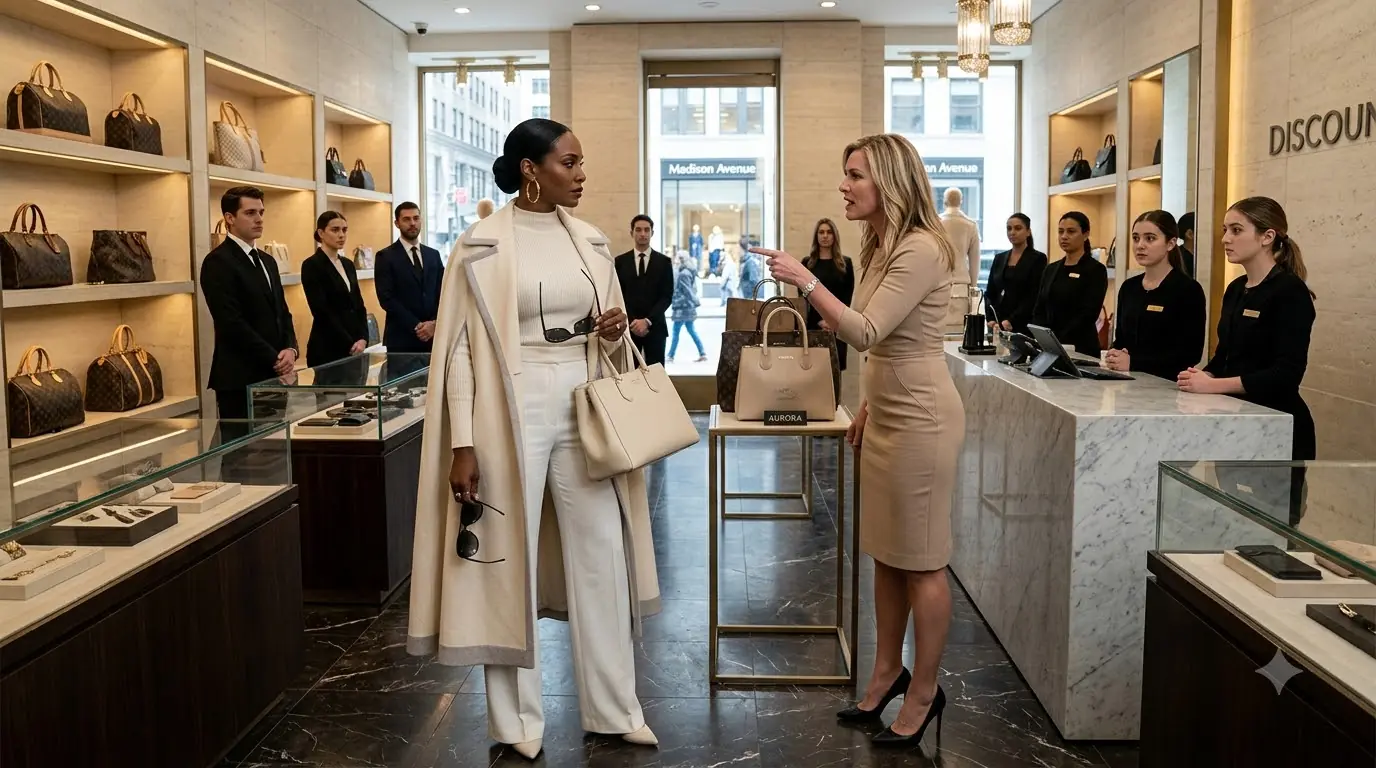
Asha had approved much of the renovation herself.
Yet most employees in the building had never met her.
Aurora Maison employed more than four thousand people across the United States and Europe. Asha appeared in quarterly executive videos, annual reports, investor presentations, and occasional fashion-industry interviews, but store employees generally dealt with regional leadership rather than the CEO.
That distance bothered her.
For six months, customer-service reports from three flagship locations had become strangely inconsistent.
Official satisfaction scores remained excellent.
Private complaints told another story.
Customers described being ignored.
Watched.
Redirected toward cheaper merchandise.
Asked repeatedly whether they needed help when wealthier-looking shoppers were allowed to browse freely.
Several complaints included phrases Asha disliked immediately.
“I felt like they wanted me to leave.”
“They decided I couldn’t afford anything.”
“I was treated differently until they saw my card.”
None proved systematic discrimination by themselves.
Together, they formed a pattern.
Asha wanted to see it personally.
So she told only three executives where she was going.
No entourage.
No appointment.
No store announcement.
She dressed the way she actually liked to dress on days without board meetings: ivory ribbed high-neck top, wide-leg white trousers, pointed white heels, gold hoops, several bracelets, and a long cream cape-style coat with pale gray trim.
Her hair was pulled into a perfectly smooth low bun.
Oversized black aviator sunglasses covered much of her face.
In her left hand hung one structured cream tote.
Expensive.
Elegant.
Nothing about it screamed CEO.
Asha walked through the entrance.
A young sales associate near the jewelry case immediately looked toward her.
Then smiled.
“Good morning.”
“Morning.”
“Please let me know if you’d like to see anything.”
“Thank you.”
Normal.
Exactly what Asha hoped.
She moved toward the handbag gallery.
Shelves displayed limited-run pieces spaced widely enough that the empty space itself communicated price.
A burgundy Italian leather bag caught her attention.
Three thousand two hundred dollars.
Asha almost smiled.
She remembered approving that collection six months earlier.
She reached toward the display.
A voice interrupted.
“Can I help you?”
Asha turned.
Jennifer Cole.
Forty-six.
Flagship general manager.
Nine years with Aurora.
Top-performing store manager in the Northeast region for three consecutive years.
Sales numbers excellent.
Client retention high.
Executive evaluations consistently praised her “strong commercial instincts.”
Asha knew all of that before Jennifer approached.
Jennifer did not know who Asha was.
She wore a tailored beige dress, black heels, gold watch, and the expression of someone who believed excellent posture could substitute for warmth.
Asha smiled slightly.
“I’d like to see this one.”
Jennifer looked at the burgundy handbag.
Then at Asha.
Her eyes traveled downward.
Shoes.
Trousers.
Coat.
Tote.
Then upward again.
The inspection lasted perhaps two seconds.
It felt longer.
Jennifer smiled.
“The Valeria collection is reservation priority.”
Asha glanced at the bag.
“I know.”
Jennifer seemed surprised.
“You’re familiar with it?”
“Yes.”
Asha reached again.
Jennifer stepped sideways.
Small movement.
Enough to block access.
“We normally show those pieces to established clients.”
Asha lowered her hand.
“I’m a customer.”
“Yes, of course.”
Jennifer’s smile remained.
“But these pieces require a certain clientele.”
Asha stared at her.
There it was.
Not explicit enough to trigger immediate corporate liability.
Clear enough to understand.
Asha asked:
“What clientele?”
Jennifer looked slightly uncomfortable.
Then recovered.
“Clients with established purchasing histories.”
“Did you ask for mine?”
Jennifer paused.
“No.”
“Then how do you know I don’t have one?”
The young associate near the counter looked up.
Another employee turned slightly.
Jennifer’s smile hardened.
“I’ve managed this location for nearly a decade.”
Asha waited.
Jennifer continued.
“I know most of our serious clients.”
“Most?”
“Yes.”
“So there are some you don’t know.”
“Of course.”
“Then perhaps I’m one.”
Jennifer’s face changed.
The conversation had become inconvenient.
She shifted her body more firmly between Asha and the bag.
“Ma’am, those designer bags aren’t for people like you.”
Silence.
Asha felt something old and unpleasant move through her chest.
She had expected subtlety.
Perhaps neglect.
Maybe unnecessary suspicion.
Not that sentence.
Jennifer continued, pointing toward the rear of the showroom.
“You may be more comfortable browsing our seasonal markdown section.”
Asha removed her sunglasses slowly.
The young associate behind the counter froze.
Asha’s dark eyes locked onto Jennifer.
“I’m sorry?”
Jennifer repeated:
“Our discounted merchandise is toward the back.”
Asha did not move.
Jennifer smiled.
“It may be more appropriate.”
Asha’s voice became very quiet.
“No.”
Jennifer frowned.
“Excuse me?”
“Say the first sentence again.”
“What?”
“The one before the discount section.”
Jennifer looked around.
Employees were listening.
Two customers had slowed nearby.
Her authority now had witnesses.
Some people became more cautious in front of an audience.
Jennifer became more determined.
“I said those pieces aren’t for people like you.”
Asha nodded.
“Thank you.”
Jennifer’s eyebrows narrowed.
“For what?”
“I wanted to remember exactly how comfortable you were saying it.”
The young employee behind the counter stared openly now.
Her nameplate read MAYA COLLINS.
Twenty-four.
Sales associate.
Eight months with Aurora.
Asha knew the name only because she intentionally read it.
Jennifer crossed her arms.
“I don’t appreciate your attitude.”
Asha almost laughed.
“My attitude.”
“Yes.”
“I asked to see a handbag.”
“And I explained our policy.”
“No.”
Asha stepped slightly closer.
“You explained your assumption.”
Jennifer’s jaw tightened.
“Do not accuse me of anything.”
“I haven’t.”
“You’re clearly trying to.”
Asha looked toward the burgundy handbag.
“May I see it?”
“No.”
“Why?”
“I’ve already answered.”
“No, you haven’t.”
Jennifer pointed toward the rear of the store again.
“Please browse something more suitable.”
Asha looked at her finger.
Then at Jennifer.
“Put your hand down.”
Jennifer did.
Not because Asha raised her voice.
Because the command sounded strangely natural.
For half a second, Jennifer appeared confused by her own obedience.
Then irritation returned.
“You need to leave.”
Asha glanced around the showroom.
“Why?”
“You’re creating a disturbance.”
“Who am I disturbing?”
Jennifer looked toward the employees.
None answered.
Asha continued:
“I haven’t raised my voice.”
“You’re being confrontational.”
“I’m standing still.”
“You’re refusing staff direction.”
“What direction?”
“To move away from premium merchandise.”
There.
Again.
Asha felt Maya watching.
She turned slightly.
“Maya?”
The young associate’s face changed when Asha read her name.
“Yes, ma’am?”
“Is there a written store policy preventing customers without purchase history from viewing that handbag?”
Maya looked toward Jennifer immediately.
Jennifer answered for her.
“She doesn’t need to discuss policy with you.”
Asha returned her eyes to Jennifer.
“I asked her.”
“And I’m her manager.”
“That does not make her incapable of answering.”
Jennifer’s face reddened.
Maya swallowed.
“No.”
Jennifer snapped:
“Maya.”
Maya stopped.
Asha watched.
Interesting.
Fear.
Not confusion.
Maya knew something.
Jennifer stepped closer to Asha.
“You’re done.”
Asha remained calm.
Jennifer pointed toward the doors.
“Leave now.”
“No.”
The word landed cleanly.
Jennifer stared.
Asha continued:
“I want to purchase the burgundy Valeria.”
Jennifer laughed.
It was the wrong reaction.
Short.
Disbelieving.
Asha heard a customer inhale behind her.
Jennifer said:
“That bag is thirty-two hundred dollars.”
“I know.”
Jennifer looked toward Asha’s tote again.
“You understand we require payment in full?”
Asha’s expression changed.
“Do you explain that to everyone before allowing them to touch merchandise?”
Jennifer knew immediately that she had gone too far.
She recovered with irritation.
“I’m protecting company property.”
Asha nodded slowly.
“From me.”
“From anyone whose purchasing ability hasn’t been established.”
Asha looked toward a white woman examining a handbag fifteen feet away.
No employee stood beside her.
No one asked about purchase history.
Asha gestured gently.
“Has hers been established?”
Jennifer followed her gaze.
“That customer is a regular.”
Asha pointed toward another woman near the entrance.
“What about her?”
Jennifer did not answer.
Asha waited.
Jennifer’s expression hardened again.
“Security.”
Maya’s eyes widened.
Asha did not move.
A stocky man in a black suit approached from near the entrance.
Thomas Reed, store security supervisor.
He looked toward Jennifer.
“Problem?”
Jennifer gestured toward Asha.
“This customer refuses to leave.”
Thomas looked at Asha.