“Take your filthy hands off that valve before I tear those stolen pipes out and bury your father’s farm with them!”
The County Farming Chairman jabbed one dirt-stained finger inches from the girl’s face while five veteran farmers stood behind him in the cracked soybean field. Thirteen-year-old Lily Hart gripped a heavy pipe wrench with both hands, her faded gray coveralls streaked with mud and her long brown ponytail stuck to her neck beneath the merciless Iowa sun. On one side of the rusted irrigation line, dead soybean stalks rattled in the dry wind; on the other, several rows of healthy green plants stretched toward her family’s weathered farmhouse.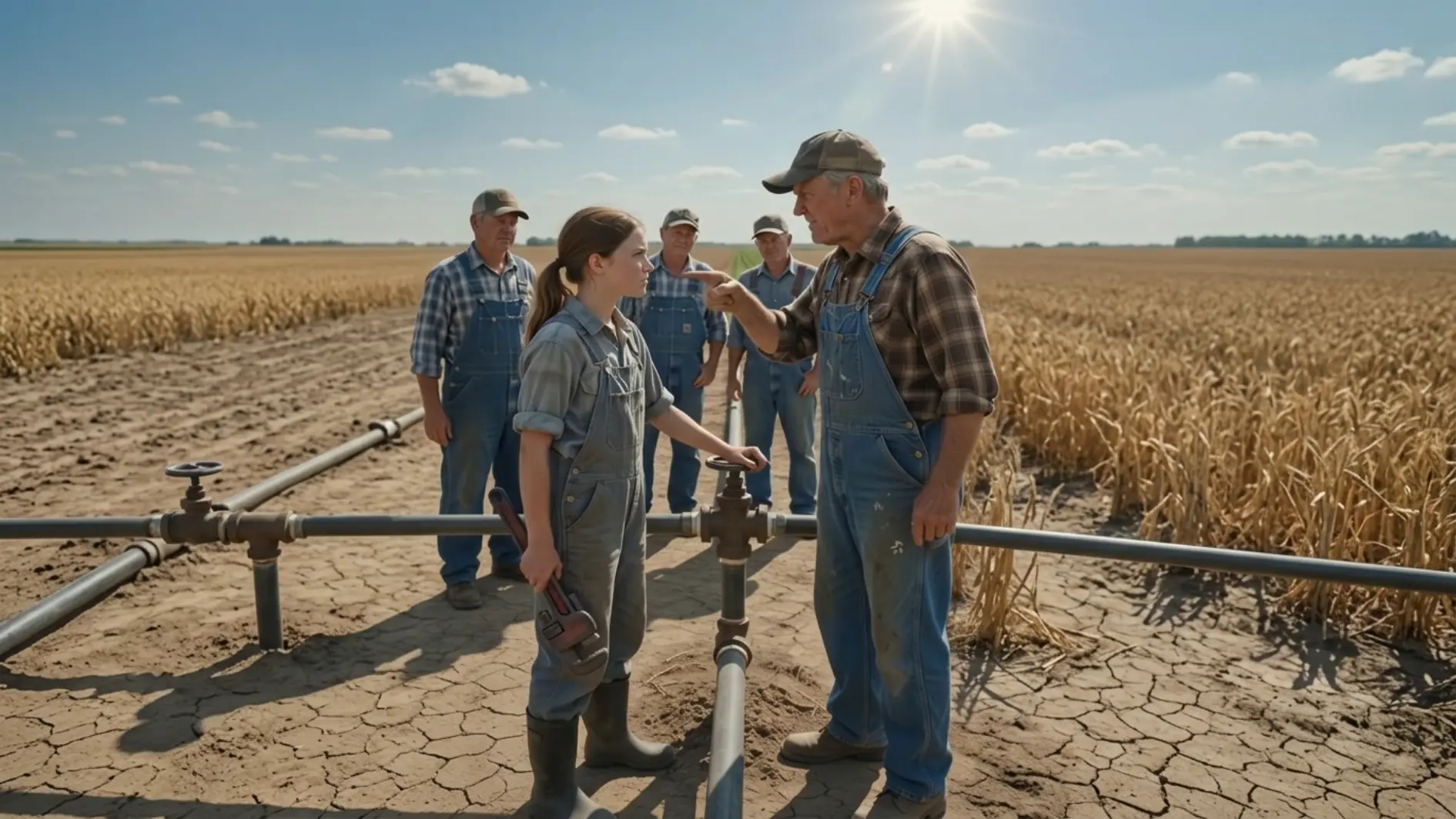
Lily stepped closer instead of backing away. “Touch one pipe, and I’ll show every farmer here where you’ve been stealing their water.”
The chairman’s weathered face darkened. “You lying little thief—I’ll have the sheriff drag you off this land before sunset!”
Lily locked the wrench around the valve. “Call him—then explain why every stolen gallon leads straight to your family’s field.”
She twisted.
The rusted valve groaned, the buried line shuddered beneath the soil, and water surged through the narrow channel beside the green soybeans. A pressure gauge wired to the pipe jumped from twenty pounds to nearly eighty. Hundreds of yards away, beyond a line of cottonwood trees, an engine suddenly roared to life on land owned by the chairman’s oldest son.
The farmers turned toward the sound.
The chairman did not.
Three months earlier, no one in Franklin County would have believed that a thirteen-year-old girl could uncover anything experienced farmers had missed. Lily was known as the quiet daughter of a struggling widowed farmer, a child who spent more time repairing equipment than visiting friends in town. Her father had taught her to drive a tractor before she could reach every pedal without stretching, and her late grandfather had shown her how to listen for pressure changes in old irrigation lines.
Their family owned only forty-six acres. That made the Hart farm small by county standards, barely large enough to remain profitable even during a good season. During a drought, it became a countdown measured in unpaid bills, dying crops, and the number of weeks before the bank came calling.
Lily’s mother had died when she was seven. Her father, Daniel, raised her alone while working every field, repairing every machine, and taking nighttime hauling jobs during the winter. He never complained in front of Lily, but she knew what the envelopes on the kitchen table meant. She knew why he calculated seed prices twice, delayed replacing worn tires, and sometimes claimed he had already eaten.
The drought began in April.
Rain clouds passed over the county without releasing more than a few scattered drops. By June, shallow ponds had become cracked bowls of hardened clay, creek beds showed bare stones, and irrigation pumps ran from before sunrise until late at night. Farmers watched their water meters climb while their fields continued turning brown.
The county had recently completed a privately managed irrigation expansion. A company called Prairie Flow Systems installed larger underground lines connecting several wells to farms across the eastern district. The chairman had promoted the project as the only protection against future droughts and pressured nearly every farmer to sign expensive service contracts.
Daniel Hart refused.
The connection fee was more than he earned during some entire seasons. Instead, he kept using the narrow irrigation pipes his father had installed decades earlier. They were rusted, patched, and too weak to cover the whole property at once, but Daniel knew every valve and every underground turn.
Then the old system began losing pressure.
At first, Daniel blamed the well. He replaced a filter, cleaned the pump, and repaired two visible leaks. Nothing helped. Water entered the main line at full pressure but reached the southern field as little more than a slow stream.
The same problem spread across neighboring farms connected to Prairie Flow’s system. Pumps worked harder, bills doubled, and crops still withered. The chairman blamed the drought and told everyone to purchase larger pumps from a dealership partly owned by his brother.
Veteran farmers accepted the explanation because droughts had always demanded sacrifice. They sold cattle, delayed equipment purchases, and borrowed money for fuel. Few questioned why the chairman’s family fields remained greener than anyone else’s.
Lily questioned everything.
She noticed that the pressure dropped at nearly the same hour every morning and returned shortly after sunset. Natural leaks did not follow schedules. Neither did failing wells.
She began recording numbers in an old school notebook. At sunrise, she checked the pump gauge. At noon, she measured the water reaching each field. At night, she repeated the test and wrote down temperature, wind, pump speed, and pressure.
Daniel discovered the notebook after two weeks.
“You should be sleeping before dawn,” he told her.
“You should be sleeping after midnight.”
He looked at the page filled with measurements. “What are you trying to prove?”
“That our water isn’t disappearing.”
“Then where is it going?”
“I don’t know yet.”
Daniel wanted her to forget the problem and focus on schoolwork. He feared she had inherited his habit of believing every failing machine could be repaired through enough patience. Sometimes, he knew, a farmer had to accept that the weather had won.
Lily refused to accept it.
She walked every irrigation route across their land. The old pipes ran above the soil in some sections and disappeared underground in others. She found cracked joints, replaced gaskets, and marked every repaired section with yellow paint.
One afternoon, she followed a wet patch beyond the southern boundary. It should have ended at the county drainage ditch, but the muddy trail continued beneath weeds toward an abandoned equipment yard. There, half buried beneath scrap metal, she found several broken irrigation pipes.
The pieces carried county project markings.
Lily dragged one home in a small wagon. Daniel examined the end and noticed something unusual: the pipe had not split from pressure or corrosion. It had been cut cleanly and fitted with a branching connector before someone tried to remove it.
“This came from the Prairie Flow system,” he said.
“There are dozens more.”
“Do not go back there alone.”
“Why would someone throw away good pipe?”
Daniel had no answer.
Over the next week, farmers began noticing Lily collecting discarded sections from drainage ditches, abandoned sheds, and field edges. Some laughed at the sight of a small girl pulling rusted metal behind an old lawn tractor. Others said Daniel had become so desperate that he was sending his child to steal scrap.
The County Farming Chairman heard the rumors and arrived at the Hart farm in a polished truck.
He was sixty-two, broad and powerful despite his age, with gray hair, sunken blue eyes, and hands hardened by forty years of agricultural work. He had served on the water board, grain committee, and county lending council. Farmers trusted him because he spoke with the authority of someone who had survived floods, droughts, market collapses, and government inspections.
He found Lily beside the barn arranging pipes according to size.
“You’ve been taking county property,” he said.
“These were abandoned.”
“Property does not become yours because someone leaves it beside a field.”
“They’ve all been cut.”
The chairman glanced at the connectors. “Broken irrigation junk isn’t a mystery.”
“Then why are the cuts identical?”
His expression changed for only a second. “Children see patterns where none exist.”
Lily held up one of the branching pieces. “This fitting redirects water.”
“It redirects nothing now.”
“Where did it redirect water before?”
The chairman ordered Daniel to make his daughter stop interfering with county infrastructure. He warned that Prairie Flow could sue for theft, trespassing, and damage to utility property. Daniel promised nothing, but after the chairman left, he locked the collected pipes inside the barn.
That night, Lily heard her father coughing in the kitchen. She found him at the table holding a letter from the bank.
The Hart farm was behind on two loan payments. If the soybean harvest failed, Daniel would have ninety days to settle the debt before foreclosure proceedings began. He folded the letter before Lily could read the final amount.
“We’ll manage,” he said.
“How?”
“I’ll sell the northern acreage.”
“That’s almost half the farm.”
“It is land, Lily.”
“It was Grandpa’s.”
“And he would rather lose part of it than leave you with nothing.”
Lily returned to bed but did not sleep. Before sunrise, she took the key from the nail beside the back door and opened the barn.
She was no longer trying merely to repair an irrigation problem. She was trying to keep her father from cutting their family farm in half.
Lily connected several discarded pipes behind the barn. Most leaked at the altered joints, but one section still held pressure. When she capped the side opening, water traveled normally. When she removed the cap, most of the flow escaped through the branch.
Someone had installed hidden outlets in the county system.
She needed to find where those outlets led.
Her grandfather’s old irrigation maps covered only the Hart property, but the public library stored county drainage and utility records. Lily rode her bicycle seven miles into town and asked the librarian for access.
The newest irrigation map showed a single main line serving six farms. Yet an older construction draft included an additional branch running southeast beneath property once considered unusable marshland.
The name listed beside that parcel stopped her.
The land belonged to the chairman’s son.
Public records showed that he had bought it for almost nothing two years before Prairie Flow construction began. Since then, the family had transformed the marshland into several hundred acres of soybeans and corn. The chairman claimed they had drilled private wells, but the construction map showed no approved well permits.
Lily copied the map by hand.
On her way home, she passed the chairman’s family fields. Their crops stood thick, tall, and green. A large pumping station operated behind a locked fence, drawing water from a buried line.
She understood the entire plan.
Prairie Flow charged farmers based on water entering the county system, not the amount reaching individual properties. Hidden branches redirected part of that water toward the chairman’s family land. Every participating farmer paid for water that was quietly stolen before it reached their crops.
The drought made the theft more profitable and harder to detect. Everyone expected poor pressure. Everyone blamed the weather.
Lily showed Daniel the copied map.
He studied it in silence. “This is serious.”
“I know.”
“If we accuse him without proof, we could lose everything faster.”
“The pipes are proof.”
“They prove someone altered the system, not who ordered it.”
“The branch crosses our southern boundary before reaching his son’s land.”
Daniel looked toward the dry soybean field. “What are you planning?”
“I want to reconnect it.”
“Absolutely not.”
“Only to measure the pressure.”
“No.”
“Dad—”
“You are thirteen years old. This is not a broken tractor or a school project. The chairman controls the county board, the irrigation company, and half the loans around here.”
“He controls our loan too?”
Daniel did not answer.
That silence told Lily enough.
The chairman had approved the bank’s agricultural lending recommendations. He could not directly seize the Hart farm, but he could influence whether the bank extended deadlines. If Daniel challenged him and failed, the northern acreage would not be the only land they lost.
For several days, Lily obeyed.
Then one of the veteran farmers arrived to buy Daniel’s remaining hay. His soybean crop had failed, and he needed feed for cattle because his pastures were dead. He had farmed for forty-eight years and had never before needed to purchase hay from a smaller neighbor.
Another farmer sold his combine.
A third announced that his sons were leaving agriculture after harvest.
Lily realized the chairman was not stealing only water. He was destroying families who had spent generations building their farms.
She returned to the pipes.
Using the old construction map, she found the hidden branch beneath the Hart property. It lay nearly four feet underground beside an unused drainage route. Someone had covered the access point with fresh soil and planted grass over it.
Lily could not excavate the line alone, so she told Samuel Price, a sixteen-year-old neighbor whose family faced foreclosure. Samuel believed her because his father’s water bills had tripled while their pressure disappeared.
They dug after sunset.
The hidden branch contained a valve stamped with Prairie Flow’s manufacturer code. Beside it was an electronic timer programmed to open every morning and close every evening. When the valve opened, water flowed away from the farms and toward the chairman’s land.
Samuel wanted to take the device immediately.
Lily stopped him. “If it disappears, he’ll say we invented everything.”
“What do we do?”
“Make it visible.”
They spent three nights building a temporary aboveground connection from discarded pipes. The line ran from the hidden branch to a narrow strip on the Hart farm. Lily planted the last bag of soybean seed along it.
Daniel discovered the project after the pipes were already buried.
He was furious.
“You ignored everything I told you.”
“I listened. You said we needed proof.”
“You could have been injured. You could have damaged a county line.”
“It was already stealing from us.”
Daniel looked at the homemade system and then toward the bank letter inside the house. He wanted to dismantle everything. Instead, he asked how she planned to prove where the water went.
Lily showed him the pressure gauge.
When the hidden valve opened, the pressure would rise on the chairman’s side and fall on the farmers’ side. Closing it would reverse the readings. If an independent inspector witnessed the change, the chairman could not dismiss it as a child’s invention.
Daniel finally agreed under one condition: they would notify the state agricultural water office before confronting anyone.
Lily mailed copies of the map, photographs, measurements, and pipe markings to the state inspector. She expected no reply.
Two weeks later, the green soybean rows appeared.
The narrow strip fed by the redirected branch grew rapidly while the rest of the Hart crop remained weak. Farmers driving past saw the impossible line of green and stopped to stare.
Instead of asking how Lily had achieved it, several accused her of stealing their water.
The chairman encouraged them.
He claimed Lily had damaged the county system and secretly connected her farm to water paid for by others. He told veteran farmers that the Hart family had exploited the drought while their neighbors suffered.
By the time he brought five farmers to confront her, they had already decided she was guilty.
The chairman pointed at the pipes and demanded she step away from the valve. Lily saw anger in the farmers’ faces, but beneath it she saw exhaustion and fear. They were not truly furious with a child. They were terrified of losing everything and desperate for someone to blame.
She twisted the valve.
Water surged into her soybean rows, and the distant pump on the chairman’s family property roared.
Then two vehicles appeared along the dirt road.
The first belonged to the county sheriff.
The second carried the seal of the State Agricultural Water Division.
The chairman’s face lost its color.
A state inspector stepped out carrying Lily’s mailed folder. She was followed by an engineer, a utility investigator, and a representative from the attorney general’s agricultural fraud unit. Daniel emerged from the farmhouse with photographs of the buried timer and construction map.
The chairman tried to take control.
He accused Lily of tampering with regulated infrastructure and demanded that the sheriff arrest her. The inspector asked him to provide the approved plans for the branch line leading toward his son’s property.
“There is no branch line,” he said.
Lily pointed toward the pressure gauge. “Close the pump on your son’s field.”
The investigator radioed another team waiting near the chairman’s property. Seconds later, the distant engine stopped.
The gauge dropped.
Water slowed through the green soybean rows.
The farmers watched in silence.
The engineer reopened the hidden valve. A second gauge connected to the main county line immediately lost pressure while the meter recording total water distribution continued climbing. The chairman’s family had been receiving thousands of gallons billed to neighboring farms.
The veteran farmer who had threatened to tear out Lily’s pipes turned toward the chairman. “How long?”
The chairman said nothing.
“How long have we been paying for your water?”
The investigation lasted six weeks.
Officials excavated more than a dozen unauthorized branches hidden throughout the irrigation system. Prairie Flow records revealed altered blueprints, false maintenance reports, and payments routed through companies controlled by the chairman’s relatives.
The theft had begun before the drought.
During normal seasons, it was small enough to escape notice. When rainfall disappeared, the chairman increased the diversion to protect his family’s harvest, sacrificing every neighboring farm to save his own.
He was removed from the county board and charged with utility fraud, conspiracy, falsifying public records, theft, and misuse of agricultural relief funds. His son lost control of the secretly irrigated land, which was placed under court supervision until ownership and water rights could be resolved.
Prairie Flow’s county contract was canceled.
The farmers received corrected bills, emergency water credits, and access to a state recovery fund. The bank suspended foreclosures connected to crop failures caused by the diversion. Families who had been preparing to sell received enough time to plant another season.
The Hart farm kept its northern acreage.
Yet Lily’s greatest result was not the chairman’s arrest.
The discarded pipes she had collected became the beginning of a farmer-owned irrigation cooperative. Instead of allowing one private company to control measurements, each farm received an independent gauge with records visible to every cooperative member. No hidden branch could open without triggering an alert.
The veteran farmers elected Daniel to oversee maintenance.
He refused unless Lily could attend every engineering meeting.
Some men laughed at the idea of a thirteen-year-old sitting beside them. Then the oldest farmer in the county placed the first repaired pipe on the meeting table.
“She saw what all of us missed,” he said. “She stays.”
By the following spring, soybean rows stretched green across farms that had nearly disappeared. Water usage fell because leaks were repaired instead of ignored, and farmers shared pressure data rather than protecting it as private information.
Lily’s narrow strip of soybeans was harvested separately.
The yield was not large enough to save the county, but the seeds were placed in labeled sacks and distributed among the six farms harmed most severely by the theft. Every family planted at least one row from them the following season.
The veteran farmer who had first confronted Lily came to the Hart farm carrying a new steel pipe wrench.
“I owe you an apology,” he said.
“You owe every farmer whose water you helped him steal.”
His face tightened with shame. “I believed him because he had been farming longer than your father has been alive.”
“That doesn’t make him honest.”
“No,” the farmer admitted. “It only made us stop asking questions.”
He offered her the wrench.
Lily accepted it.
Years later, people in Franklin County still pointed toward the southern field when telling the story. The original green rows were gone, replaced by healthy crops covering the entire property, but a short section of rusted pipe remained mounted beside the Hart barn.
Below it hung a simple wooden sign:
BROKEN THINGS STILL TELL THE TRUTH—IF SOMEONE IS WILLING TO LISTEN.
Lily had begun as a child collecting irrigation scraps while experienced farmers mocked her from the road. She did not defeat the chairman because she was stronger, wealthier, or more powerful.
She defeated him because she measured what others had accepted, studied what others discarded, and followed the water until it reached the man who had stolen it.
The drought had nearly destroyed Franklin County.
The little girl’s green soybean rows did something more important than save a harvest.
They taught an entire farming community never to confuse authority with truth again.