A waitress insulted a sixty-two-year-old grandmother in a luxury restaurant, unaware that the woman was the undercover owner.
The sun was setting over the bustling city, painting the sky with hues of orange and pink.
Inside L’Étoile, one of the city’s most exclusive restaurants, the atmosphere was vibrant with soft music, the clinking of glasses, and the low hum of polite conversation.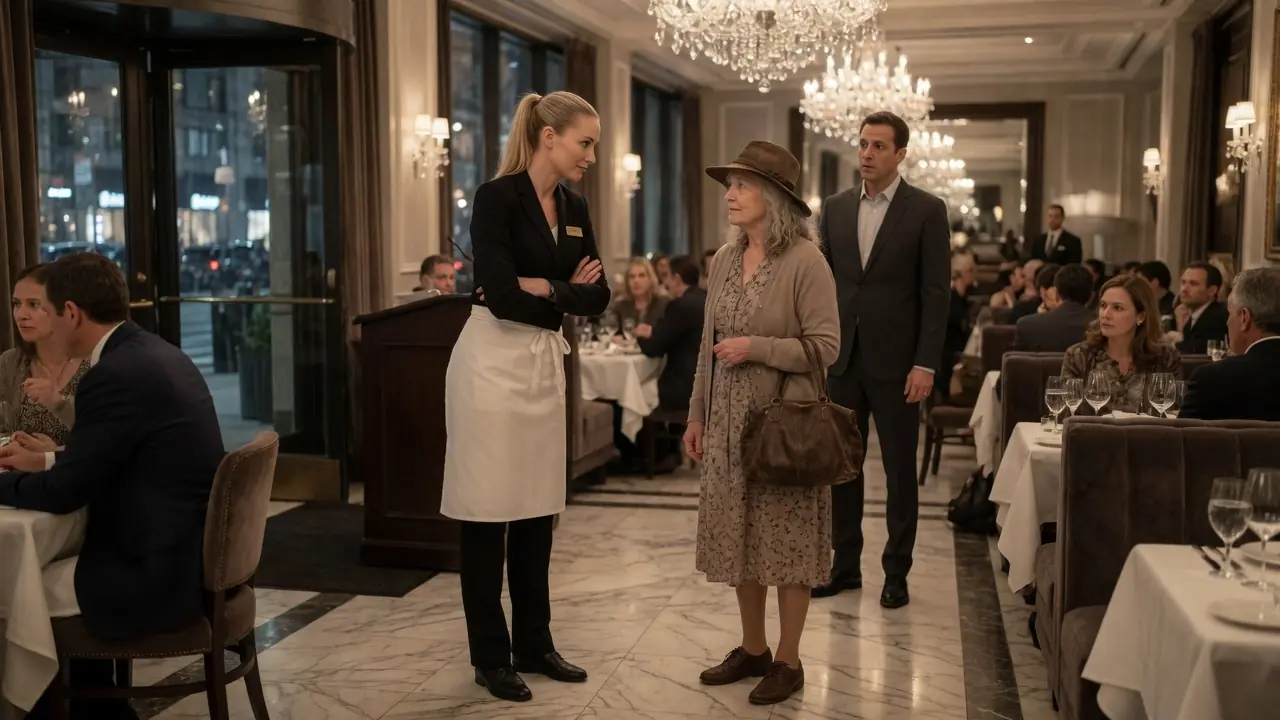
Every detail of the restaurant screamed luxury, from the chandeliers dripping with crystals to the velvet-lined booths that hugged the walls.
At the entrance, a tall, elegant hostess stood behind her podium, greeting each guest with practiced charm.
Tonight, as every night, L’Étoile was a sanctuary for the elite, those who could afford its exorbitant prices and enjoy its refined air of exclusivity.
That exclusivity, however, was about to be tested.
The glass doors swung open, and a figure shuffled in, causing the hostess’s smile to falter slightly.
A woman likely in her sixties entered hesitantly, her frizzy silver hair peeking out from beneath a wide-brimmed hat that had seen better days.
She wore a faded cardigan over a floral dress and carried a well-worn handbag slung over one arm.
But it was not her appearance that caught everyone’s attention.
Trailing at her heels was a scruffy dog.
The dog was a peculiar sight. Its wiry fur was a patchwork of brown and gray, and its tail wagged lazily as it padded into the marble-floored restaurant.
It was not a small, handbag-friendly breed one might expect in a place like this. Instead, it was medium-sized, with floppy ears and soulful eyes that seemed to take in the grandeur of the room with curious indifference.
The hostess froze, her carefully curated composure slipping.
“Ma’am,” she began, her tone clipped but still polite, “pets are not allowed in the restaurant.”
The elderly woman smiled warmly, her eyes crinkling at the corners.
“Oh, don’t mind him,” she said, patting the dog’s head. “He’s very well behaved.”
Several heads turned in their direction. Conversations hushed as diners exchanged puzzled glances.
This was not the sort of scene anyone expected at L’Étoile.
The hostess’s polite veneer cracked further.
“I’m sorry, but L’Étoile has a strict no-pets policy. You’ll need to remove the dog from the premises.”
The woman’s smile did not waver.
“I understand, dear,” she said, her tone as calm as ever. “But you see, he’s not just a pet. He’s my companion. We’ve been through a lot together.”
At this point, a young waitress approached the scene.
She was tall, with sleek blonde hair tied in a ponytail. Her name tag read Marissa. She was known for her sharp tongue and an attitude that often teetered on the edge of rudeness, especially toward those she deemed unworthy of L’Étoile’s elegance.
“What seems to be the problem here?” Marissa asked, her voice laced with annoyance.
“This lady seems to think it’s acceptable to bring a dog into a fine dining establishment,” the hostess explained, clearly relieved to pass the issue on.
Marissa’s eyes flicked to the dog and then to the elderly woman. Her lip curled ever so slightly.
“This isn’t a park,” she said flatly. “We have standards here.”
The elderly woman met Marissa’s gaze with steady calmness.
“Standards are important,” she said softly. “But kindness is even more so.”
Marissa let out a short, sharp laugh.
“Kindness won’t keep the floors clean. Either the dog goes, or you both do.”
There was an audible gasp from a nearby table, where a young couple watched the exchange with wide eyes.
A murmur spread through the room, the tension palpable.
“I understand your concerns,” the woman said after a moment. “But I assure you, he won’t cause any trouble. He’s had a hard life, and I couldn’t leave him behind. I’ll keep him under the table, out of sight.”
Marissa crossed her arms, her expression hardening.
“This isn’t up for debate. If you can’t follow the rules, you shouldn’t have come here in the first place.”
The elderly woman’s calm demeanor finally wavered for a split second.
Something flashed in her eyes, something strong and unyielding.
But just as quickly, it was gone.
“Very well,” she said quietly, bending down to pat the dog’s head. “Come on, boy. Let’s go.”
As she turned to leave, the dog gave a soft whimper. The sound was almost human in its sadness, and it tugged at the hearts of a few nearby diners.
One man stood up as if to intervene, but his wife grabbed his arm and shook her head.
Marissa watched the woman and her dog walk toward the door, a smug smile creeping across her face.
But just as the pair reached the threshold, something unexpected happened.
The dog stopped.
It planted its paws firmly on the marble floor and refused to move, letting out a low, determined bark.
The elderly woman tugged gently on its leash, but the dog stood its ground, its eyes fixed on something in the distance.
“What’s going on now?” Marissa snapped, her patience clearly wearing thin.
The elderly woman looked down at her companion, then followed his gaze. Her eyes widened slightly, and a small smile played on her lips.
“I think he’s found something,” she said softly.
Marissa rolled her eyes.
“What could he possibly have found in here?”
But before anyone could respond, the dog suddenly bolted, slipping out of its leash and darting toward the back of the restaurant.
Diners gasped as plates and glasses rattled in its wake.
“Stop that dog!” Marissa shouted, her voice rising in panic.
Several staff members rushed after the dog, but it was surprisingly quick, weaving between tables with the agility of a much smaller animal.
It finally came to a halt near the kitchen doors, where it began barking insistently at something on the wall.
The elderly woman caught up to her companion, her cheeks flushed but her expression calm. She knelt beside the dog, placing a hand on its back to soothe it.
“What is it, boy?” she murmured.
The staff and diners watched in stunned silence as the woman reached up and removed a small framed photograph from the wall.
She studied it for a moment, her expression unreadable.
Marissa stormed over, her face red with anger.
“What do you think you’re doing?” she demanded.
The elderly woman rose slowly, holding the photograph in her hands. She turned to face Marissa, her voice steady but filled with a quiet power.
“This,” she said, “is where it all began.”
Marissa’s irritation flared as she stepped closer, her voice cutting through the tension.
“What do you mean, this is where it all began? That’s just an old photograph. You have no right to touch it, let alone remove it from the wall.”
Ignoring Marissa’s outburst, the woman held the picture up for everyone to see.
The black-and-white photo depicted a much simpler version of L’Étoile. The opulent chandeliers and velvet-lined booths were nowhere to be seen. Instead, the restaurant appeared cozy, almost humble, with wooden tables and handwritten menus propped on easels.
The staff in the picture wore plain uniforms, their smiles genuine and unguarded.
“I remember this day vividly,” the elderly woman said, her voice soft yet tinged with nostalgia. “This was taken over forty years ago, when the restaurant first opened. Back then, it wasn’t about chandeliers or exclusivity. It was about community, about making people feel welcome, no matter who they were or what they looked like.”
Marissa frowned, crossing her arms.
“You’re mistaken. That’s just an archival piece, something to show how far we’ve come. It doesn’t mean anything now. You can’t just waltz in here with your dog and disrupt our service.”
The elderly woman’s gaze did not waver.
“Perhaps it means nothing to you,” she said. “But it means everything to me.”
The room buzzed with whispers. People leaned closer to their companions, speculating about who this woman might be.
A few even began pulling out their phones, taking pictures and videos of the scene.
Marissa, noticing this, grew visibly uncomfortable.
“You need to leave,” she snapped, her tone harsh. “This has gone on long enough.”
Before the woman could respond, a deep voice interrupted from the back of the room.
“What’s going on here?”
The restaurant’s manager, a tall, imposing man named Gregory, approached with measured steps. His tailored suit and polished shoes reflected the establishment’s elegance, but his sharp eyes betrayed the stress of managing a demanding clientele.
“Gregory,” Marissa exclaimed, relief evident in her tone. “This woman brought a dog into the restaurant and started causing a scene. I was just about to escort her out.”
Gregory glanced at the woman, his brow furrowing as if something about her seemed oddly familiar.
Then his eyes fell to the photograph in her hands, and his expression shifted. There was a flicker of recognition, followed by uncertainty.
“Excuse me, ma’am,” he said, his voice careful. “May I ask why you removed that photograph?”
The elderly woman studied him for a moment before answering.
“I wanted to show your staff something they seem to have forgotten.”
Gregory’s gaze shifted to Marissa, who looked defensive.
“And what would that be?” he asked.
“That this place wasn’t always about exclusivity,” the woman replied. “It was built on the idea that food has the power to bring people together, rich or poor, young or old. This restaurant started as a dream, not a status symbol.”
Gregory hesitated, his usually unflappable demeanor faltering. He glanced at the photograph again, then back at the woman.
“I’m sorry, ma’am, but I don’t understand. Are you saying you have a personal connection to this restaurant?”
The woman smiled faintly, the kind of smile that carried years of untold stories.
“I’m saying,” she replied, “that this restaurant wouldn’t exist without me.”
A collective gasp rippled through the room.
Even the diners who had been trying to maintain a polite distance could not help but lean in closer now.
Gregory’s eyes widened, but before he could speak, Marissa interrupted with a laugh.
“This is absurd,” she said. “You’re telling us you own this place? That’s ridiculous.”
The elderly woman did not respond immediately.
Instead, she reached into her bag and pulled out a folder thick with documents. She handed it to Gregory, who opened it with cautious hands.
His face paled as he flipped through the papers.
Title deeds.
Legal agreements.
A recent inspection report.
All bearing her name.
Margaret Hensley, sole proprietor of L’Étoile.
Gregory’s mouth fell open.
“You’re the owner,” he stammered.
“I am,” Margaret said firmly. “And I have been for forty years. I never sold this place. I stayed behind the scenes, allowing others to manage it while I watched quietly from a distance. But after what I witnessed tonight, I couldn’t stay silent any longer.”
Marissa looked as though she had been struck.
“This… this can’t be real. Why would you hide that you’re the owner?”
Margaret’s gaze hardened.
“Because I wanted to see how my dream was being carried forward. And what I’ve seen is a restaurant that has lost its way, a place where kindness and inclusivity have been replaced by arrogance and elitism.”
Gregory’s face reddened as he turned to Marissa.
“Is this true? Did you treat her poorly?”
Marissa opened her mouth to respond, but faltered, the weight of the evidence against her too great to deny.
Margaret’s voice cut through the silence, firm and resolute.
“This restaurant was built on a foundation of respect and love for people, not just profit. Tonight, that foundation has been betrayed, and it’s time for a change.”
Gregory stepped back, his shoulders slumping.
Margaret, with her dog at her side, stood tall, quiet authority emanating from her.
“Things will be different from now on,” she said. “Starting tonight.”
The morning sun filtered through the tall windows of L’Étoile, casting golden streaks across the restaurant’s polished marble floors.
The staff gathered in the main dining area, their chatter subdued and nervous.
The previous night’s events had left everyone shaken, and now, under Margaret’s directive, they awaited what promised to be a pivotal meeting.
Marissa sat near the back, arms crossed, her face set in a mask of defiance. Beside her, Gregory shuffled papers nervously. The rest of the staff exchanged glances, unsure of what to expect from their newly revealed owner.
Margaret entered quietly, the same scruffy dog padding by her side.
Unlike the polished elegance that characterized the restaurant, Margaret was dressed simply in a cardigan and slacks. Her demeanor was calm but commanding.
She walked to the center of the room and turned to face her staff.
“Thank you all for coming,” she began, her voice steady. “I know last night came as a surprise to many of you. It wasn’t my intention to disrupt things so abruptly, but what I saw made it clear that I could no longer stay silent.”
She paused, her eyes sweeping over the room.
“This restaurant was built on a dream, my dream, to create a place where everyone could feel at home. But somewhere along the way, that dream was overshadowed by profit margins and exclusivity. And I’ll admit, I’m partly to blame. I stayed in the shadows too long, trusting others to uphold the values this place was founded on.”
Her gaze landed on Marissa, whose posture stiffened under the scrutiny.
“But no more,” Margaret said firmly. “It’s time to make things right.”
Marissa rolled her eyes, her defiance finally breaking through.
“And how exactly do you plan to do that?” she asked, her tone dripping with skepticism. “By running this place like it’s still the 1980s? Times have changed. People come here for luxury, not sentimentality.”
Margaret’s lips curved into a faint smile.
“You’re right, Marissa. Times have changed. But kindness, respect, and inclusivity are timeless. And if you think those values don’t belong in a place like this, then perhaps you don’t belong here either.”
The room fell silent.
Marissa’s cheeks flushed with anger, but before she could retort, Margaret continued.
“However, I believe in second chances for everyone. That includes you, Marissa. But you’ll have to earn it.”
Gregory cleared his throat, eager to move past the tension.
“Margaret, perhaps we could outline the changes you’re envisioning,” he suggested.
Margaret nodded.
“First, we’re reinstating community nights. One evening a month, we’ll offer discounted meals and open the doors to everyone, regardless of their ability to pay. It’s a tradition we started decades ago, and it’s time to bring it back.”
Murmurs rippled through the room, a mix of curiosity and skepticism.
“Second,” Margaret continued, “we’re going to revisit our hiring practices. This restaurant should reflect the diversity of the community it serves. We’ll be reaching out to organizations that help people from underrepresented backgrounds find work in hospitality.”
Marissa scoffed.
“And how do you expect that to work? This is a luxury restaurant, not a charity.”
Margaret’s eyes sharpened.
“Luxury isn’t about exclusion, Marissa. True luxury is about making people feel valued. If you can’t understand that, then I suggest you start looking for a new job.”
Marissa’s jaw tightened, but she said nothing.
The tension in the room was palpable, but Margaret’s calm authority kept it from boiling over.
“Finally,” Margaret said, her tone softening, “I want to hear from all of you. What’s working? What’s not? What ideas do you have to make this place better?”
A hand went up in the middle of the room.
It was Rosa, a young waitress who had been working at L’Étoile for less than a year. She hesitated, then spoke.
“I think some of us feel like we can’t speak up when we see something wrong. Like if a guest is being mistreated, or if something feels unfair, we’re afraid of retaliation.”
Margaret’s expression softened.
“Thank you for sharing that, Rosa. That’s exactly the kind of feedback I need to hear. From now on, my door is always open. If something doesn’t feel right, I want you to come to me. No one should be afraid to speak up.”
The dog, who had been quietly lying at Margaret’s feet, suddenly stood and trotted over to Rosa. He nudged her hand with his nose, earning a surprised laugh from the young waitress.
Margaret smiled.
“Looks like he agrees with you.”
The room relaxed slightly, the tension beginning to dissipate.
But just as things seemed to be settling, the doors to the restaurant burst open.
A man in a suit stormed in, his face red with anger.
“Where is she?” he demanded, his voice booming. “Where’s Margaret Hensley?”
The staff turned as one, startled by the sudden intrusion.
Margaret stepped forward, her expression calm but wary.
“I’m Margaret Hensley. And you are?”
The man pointed a finger at her.
“I’m Richard Gaines, your landlord, and I just found out about your little community night plan. Let me make one thing clear. If you start giving away meals, you’re not going to be able to afford the rent. And when you can’t pay, I’ll make sure you’re out of here faster than you can blink.”
Gasps echoed through the room.
Margaret’s staff exchanged uneasy glances, their newfound hope now tinged with fear.
But Margaret did not flinch.
“Mr. Gaines,” she said, her voice steady, “I’m well aware of the financial risks. But this isn’t just a restaurant. It’s a legacy, and I’m willing to fight for it.”
Richard’s laugh was cold and humorless.
“We’ll see how long that fight lasts,” he sneered.
Then he turned on his heel and stormed out, leaving the room in stunned silence.
Margaret turned back to her staff, her expression resolute.
“We’ll face challenges,” she said. “But if we work together, we can overcome them. And we will.”
The staff nodded, their earlier skepticism giving way to determination.
For the first time in years, the restaurant felt alive again, not just as a business, but as a community.
The room buzzed with unease after Richard Gaines’s abrupt exit.
Margaret’s staff sat in silence, their earlier sparks of hope dimmed by the looming threat of eviction. The weight of his words lingered like a heavy cloud, casting doubt over her bold plans.
But Margaret was not one to let fear dictate her actions.
“I’ll address Mr. Gaines,” she said firmly, her voice cutting through the tension. “But first, we need to focus on what we can control. This is about more than rent. It’s about restoring the soul of this restaurant, and that starts with all of us.”
Her words seemed to ignite something in the room.
Rosa, emboldened by Margaret’s earlier encouragement, raised her hand again.
“Mrs. Hensley,” she began, “if we’re going to bring back community nights and hire more diverse staff, shouldn’t we also revisit our menu? A lot of the dishes feel outdated. They’re fancy, sure, but they don’t connect with people the way food should.”
Margaret’s eyes sparkled.
“Excellent point, Rosa. Food is the heart of any restaurant, and ours needs to be stronger. I’d like everyone to contribute ideas. Let’s create a menu that reflects our values and tells a story.”
Pierre, the head chef, folded his arms thoughtfully.
“I’ve been meaning to experiment with more approachable dishes,” he admitted. “Things that are still high quality but not so intimidating. Maybe we could bring back some of the original recipes from the Golden Plate and modernize them.”
Margaret nodded, a smile spreading across her face.
“Now you’re thinking. And Pierre, I’d love it if you could teach the kitchen staff about the history of those recipes. It’s important they understand the roots of this place.”
Gregory chimed in hesitantly.
“Margaret, if we’re going to make all these changes, we’ll need to communicate them to our patrons. Many of them are used to the current format and may resist the shift.”
“You’re absolutely right,” Margaret agreed. “Which is why transparency is key. We’ll announce our plans publicly and invite the community to participate. I’ll host a launch event for the new menu, and we’ll include a tour of the kitchen to show people where their food comes from. Make it personal.”
As the discussion continued, a young busser named Amir tentatively raised his hand.
He had been quiet until now, usually overshadowed by more outspoken staff.
“Mrs. Hensley,” he said shyly, “I think we should also focus on sustainability. People care about that now. Maybe we could partner with local farmers and use more seasonal ingredients.”
Margaret’s face lit up.
“Amir, that’s an excellent idea. Sustainability aligns perfectly with the sense of community we want to foster. Gregory, can you look into potential partnerships?”
“Of course,” Gregory replied, scribbling notes furiously.
The brainstorming session lasted for hours, with every member of the team contributing ideas.
Margaret’s leadership was transformative, pulling the staff together in a way they had not experienced in years.
By the end of the meeting, the room buzzed with a sense of purpose.
Later that evening, as the staff dispersed, Margaret lingered in the empty dining room.
The dog, whom she had affectionately started calling Buddy, sat beside her, his tail thumping gently against the floor. She stroked his fur absent-mindedly, her thoughts drifting to the challenges ahead.
“You’ve got a knack for bringing people together, you know that?” she said to Buddy.
He looked up at her with soulful eyes as if he understood every word.
Her reverie was interrupted by the sound of footsteps.
She turned to see Rosa standing hesitantly by the door.
“Mrs. Hensley, do you have a moment?”
“Of course, Rosa. What’s on your mind?” Margaret asked, gesturing for her to sit.
Rosa hesitated before speaking.
“I just wanted to say thank you for listening to us. It’s been hard working here sometimes. People like Marissa make it clear they don’t see us as equals. But today felt different, like maybe things can really change.”
Margaret reached across the table and squeezed Rosa’s hand.
“Things will change, Rosa. I promise you that. It won’t happen overnight, and it won’t be easy. But we’ll get there, and I’m counting on people like you to help make it happen.”
Rosa smiled, her eyes glistening.
“Thank you, Mrs. Hensley. That means a lot.”
As Rosa left, Margaret leaned back in her chair, her heart swelling with a mixture of pride and determination.
For the first time in years, she felt truly connected to the place she had built.
The next day, Margaret sat in her office, poring over old blueprints and records of the restaurant’s early days.
She wanted to reconnect with every detail of the Golden Plate and use it to inform the restaurant’s future. Buddy lay curled up at her feet, a constant source of quiet companionship.
Her concentration was broken by a knock at the door.
Gregory entered, looking concerned.
“Margaret, we have a problem,” he said.
She straightened.
“What is it?”
“It’s Richard Gaines,” Gregory said grimly. “He’s filed a formal complaint with the city claiming that our community nights violate the terms of our lease. He’s threatening to have us shut down.”
Margaret’s jaw tightened, but her voice remained calm.
“Let him. He’s bluffing. The lease doesn’t prohibit charitable events.”
“That’s true,” Gregory agreed. “But he’s influential, and he’ll use every connection he has to make our lives difficult. This could get messy.”
Margaret leaned back in her chair, her mind racing.
“Then we’ll fight back,” she said firmly. “If he wants to turn this into a battle, we’ll give him one. But we’ll do it the right way, with transparency and the community on our side.”
The air in Margaret’s office was thick with tension after Gregory’s warning.
She leaned back in her chair, staring at the folder of lease agreements on her desk. Buddy sat at her feet, his ears twitching as if sensing her unease.
Margaret knew Richard Gaines would not back down easily, but she had no intention of letting him win.
A knock on the door interrupted her thoughts.
“Come in,” she called.
To her surprise, it was not Gregory or Rosa.
Instead, a tall, sharply dressed man entered the room. His presence was commanding but not intimidating.
Margaret recognized him immediately.
Daniel Morgan, a prominent food critic whose reviews could make or break a restaurant.
“Mr. Morgan,” she said, rising from her chair. “This is an unexpected visit. To what do I owe the pleasure?”
Daniel smiled faintly.
“I heard about the eventful evening you had yesterday. News travels fast in this city, especially when it involves someone like Richard Gaines. I wanted to hear your side of the story before he tries to spin it his way.”
Margaret gestured for him to sit.
“I appreciate that,” she said. “But I’m curious. Why are you interested in this?”
Daniel’s smile faded, replaced by a more serious expression.
“Because I care about the legacy of places like this. I’ve been a critic for over twenty years, and I’ve seen too many restaurants lose their soul in the pursuit of profit. What you’re trying to do here is rare, and I think it deserves a fair chance.”
Margaret studied him for a moment, then nodded.
“All right, then. Here’s the truth. Richard Gaines is trying to bully us into abandoning our plans for community nights and other changes that prioritize people over profit. He’s threatening us with legal action, but I won’t let him dictate how this restaurant is run.”
Daniel leaned forward, his interest piqued.
“And you’re prepared to fight him?”
“Absolutely,” Margaret said without hesitation. “This place was built on the idea that everyone deserves to feel welcome. I let that vision slip for too long, and I’m not about to let it be erased entirely.”
Daniel nodded thoughtfully.
“If you’re serious about this, I might be able to help.”
Margaret raised an eyebrow.
“How so?”
“I have connections,” he said simply. “Journalists, influencers, people who care about preserving the culture and history of our city. If we can generate enough positive attention around your plans, it will make it much harder for Richard Gaines to sabotage you. Public pressure can be a powerful tool.”
Margaret considered his offer.
“And what would you want in return?”
Daniel chuckled.
“Just an invitation to the first community night, and maybe a chance to write a story about how you’re revitalizing this place. That’s all.”
Margaret smiled.
“You’ve got yourself a deal.”
The next few days were a whirlwind of activity.
With Daniel’s help, Margaret’s plans for L’Étoile began to take shape. Journalists and bloggers were invited for an exclusive behind-the-scenes look at the restaurant’s transformation.
Pierre and his kitchen staff worked tirelessly to perfect the new menu, blending classic recipes from the Golden Plate with modern flavors and techniques.
Amir coordinated with local farmers to source fresh, seasonal ingredients, while Rosa and the rest of the front-of-house team prepared for the upcoming launch event.
Gregory managed the logistics, ensuring every detail was accounted for.
Meanwhile, Margaret focused on building community support. She visited local businesses, schools, and community centers, inviting everyone to the restaurant’s first community night.
Her message was simple.
L’Étoile was for everyone.
Despite the progress, tension remained high. Richard Gaines’s threats loomed over their efforts, and Margaret knew it was only a matter of time before he escalated.
Her fears were confirmed when Gregory burst into her office one afternoon, holding a legal document.
“Margaret,” he said breathlessly, “Richard filed an injunction. He’s trying to block the community night, claiming it violates health and safety regulations.”
Margaret took the document and scanned it quickly.
“This is ridiculous,” she muttered. “He’s grasping at straws.”
“Ridiculous or not, it could delay our plans,” Gregory said. “We need to respond quickly.”
Margaret’s mind raced.
She knew they could not afford to lose momentum.
“Contact our lawyer,” she said. “And get in touch with Daniel. If Richard wants to play dirty, we’ll make sure everyone knows exactly what he’s doing.”
That evening, Margaret stood in the dining room watching as her staff prepared for the launch event.
Buddy sat beside her, his tail wagging as he watched the flurry of activity.
Margaret knelt down and scratched behind his ears.
“You’ve been my good luck charm so far,” she said softly. “Let’s hope that continues.”
The door opened, and Daniel walked in carrying a folder.
“I have some good news,” he said, handing her the folder.
Inside were pages of articles, social media posts, and messages of support from the community.
“People are rallying behind you,” Daniel said. “And not just locals. This has struck a chord with people all over the city. Richard Gaines won’t be able to ignore this.”
Margaret’s eyes filled with gratitude.
“Thank you, Daniel. This means more than I can say.”
Daniel smiled.
“The real thanks go to you. You’ve reminded people what’s important. Now let’s make sure this event is a success.”
As the night of the event approached, Margaret’s determination only grew.
She knew the road ahead would not be easy, but for the first time in years, she felt truly connected to her dream.
With her staff, her community, and her unlikely ally by her side, she was ready to face whatever challenges lay ahead.
The courtroom buzzed with anticipation as Margaret Hensley walked to her seat, her head held high.
Behind her, a small crowd of supporters, many of whom were patrons and staff from L’Étoile, filled the gallery.
Daniel Morgan sat among them, his notepad in hand, ready to document every detail of the day.
Across the aisle, Richard Gaines sat with his legal team. His expression was smug, but Margaret could see the tension in his clenched jaw.
She had spent weeks preparing for this battle, and now it all came down to this moment.
The judge, a no-nonsense woman with sharp eyes and an air of authority, entered the courtroom. Everyone rose, then sat again.
She looked over the case file in front of her.
“We are here today to address the injunction filed by Mr. Richard Gaines against L’Étoile, seeking to block their planned community night on the grounds of health and safety violations,” the judge began, her tone measured but firm. “Let’s proceed.”
Gaines’s lawyer rose first, presenting their argument with polished rhetoric.
He claimed that community nights would compromise the restaurant’s standards and violate the lease agreement. He even brought in a so-called expert to testify about hypothetical overcrowding issues.
When it was Margaret’s turn, she stood calmly, her years of experience and resilience shining through.
Her lawyer began by dismantling Gaines’s claims, presenting evidence that the lease agreement did not prohibit charitable events.
They pointed out that the health and safety concerns were speculative and lacked any factual basis.
But the moment that turned the tide came when Margaret herself addressed the court.
“Your Honor,” she began, “L’Étoile is more than just a restaurant. It is a place where people have celebrated milestones, shared meals with loved ones, and found comfort during difficult times. Community nights are not a threat to this establishment. They are its heartbeat. They represent everything this restaurant was built to stand for.”
She paused, her voice steady despite the emotion behind her words.
“Mr. Gaines’s attempt to stop these events isn’t about health and safety. It’s about control. But I refuse to let fear and greed dictate the future of this restaurant.”
The gallery erupted into murmurs of support, prompting the judge to call for order.
Gaines’s face darkened, but he said nothing.
Margaret’s words had struck a chord, not just in the courtroom, but far beyond it.
The judge deliberated briefly before delivering her decision.
“The court finds no legal basis for the injunction filed by Mr. Gaines,” she declared. “L’Étoile may proceed with its planned community events. Case dismissed.”
Applause broke out, and Margaret’s supporters rose to their feet, cheering.
Richard Gaines stood abruptly, his face a mixture of shock and fury, and stormed out of the courtroom without a word.
Margaret exhaled deeply, her hands trembling slightly as she accepted hugs and congratulations from her team.
Daniel approached her, smiling.
“You did it,” he said. “This is going to be one remarkable story.”
Margaret smiled back.
“It’s not just a story, Daniel. It’s a new beginning.”
The transformation of L’Étoile was nothing short of remarkable.
In the weeks that followed the court victory, the restaurant reopened its doors with a renewed sense of purpose.
The first community night was a resounding success, drawing in families, students, and even a few skeptics who left as believers.
The new menu, crafted under Pierre’s guidance, was an instant hit. It featured dishes that honored the restaurant’s origins while embracing modern tastes.
Rosa’s input led to the inclusion of vegetarian and vegan options, which quickly became crowd favorites.
Amir’s sustainability initiative garnered praise from customers and local media alike.
One particularly touching moment came when Margaret invited a group of elderly patrons from a nearby care home to dine for free.
Among them was a woman who had visited the Golden Plate on its opening night decades ago.
Tears filled her eyes as she tasted the familiar flavors of Margaret’s original recipes.
“It’s like coming home,” she whispered, holding Margaret’s hand.
Richard Gaines, despite his threats, seemed to back off after the court ruling.
Margaret suspected the overwhelming public support for the restaurant had made him wary of further tarnishing his reputation.
Whatever the reason, she was glad to be rid of his interference.
Daniel’s article about L’Étoile’s transformation went viral, drawing attention from across the country.
It was not long before other restaurants began reaching out to Margaret for advice on how to balance community and commerce.
She was humbled by the recognition, but remained focused on her mission.
Buddy, the scruffy dog who had started it all, became a beloved mascot.
He greeted guests at the door with a wagging tail and an air of quiet wisdom, as if he knew the role he had played in reviving the restaurant’s spirit.
Children adored him, and he became a favorite subject for photos shared on social media.
One evening, after the last table had been cleared and the lights dimmed, Margaret sat at her usual spot in the dining room.
Buddy lay at her feet, and she sipped a cup of tea, reflecting on how far they had come.
Gregory approached her carrying a bottle of champagne.
“A toast, Margaret,” he said, pouring them each a glass. “To the heart and soul of L’Étoile.”
Margaret raised her glass, her eyes shining with gratitude.
“To all of us,” she replied. “This place isn’t just mine. It belongs to everyone who believed in it.”
As she clinked glasses with Gregory, she looked around the room.
The restaurant had become what she had always dreamed it would be: a place where everyone was welcome, where stories were shared, and where kindness and community reigned.
And in that moment, Margaret knew that L’Étoile was no longer just a restaurant.
It was a legacy.
One that would endure for generations to come.