Jonas Harlan set his hat on the table and asked if there was anything besides stew. Edmund Hollis did not look up from his ledger.
The only sounds in the room were the scratch of his pencil and the clatter of someone’s spoon.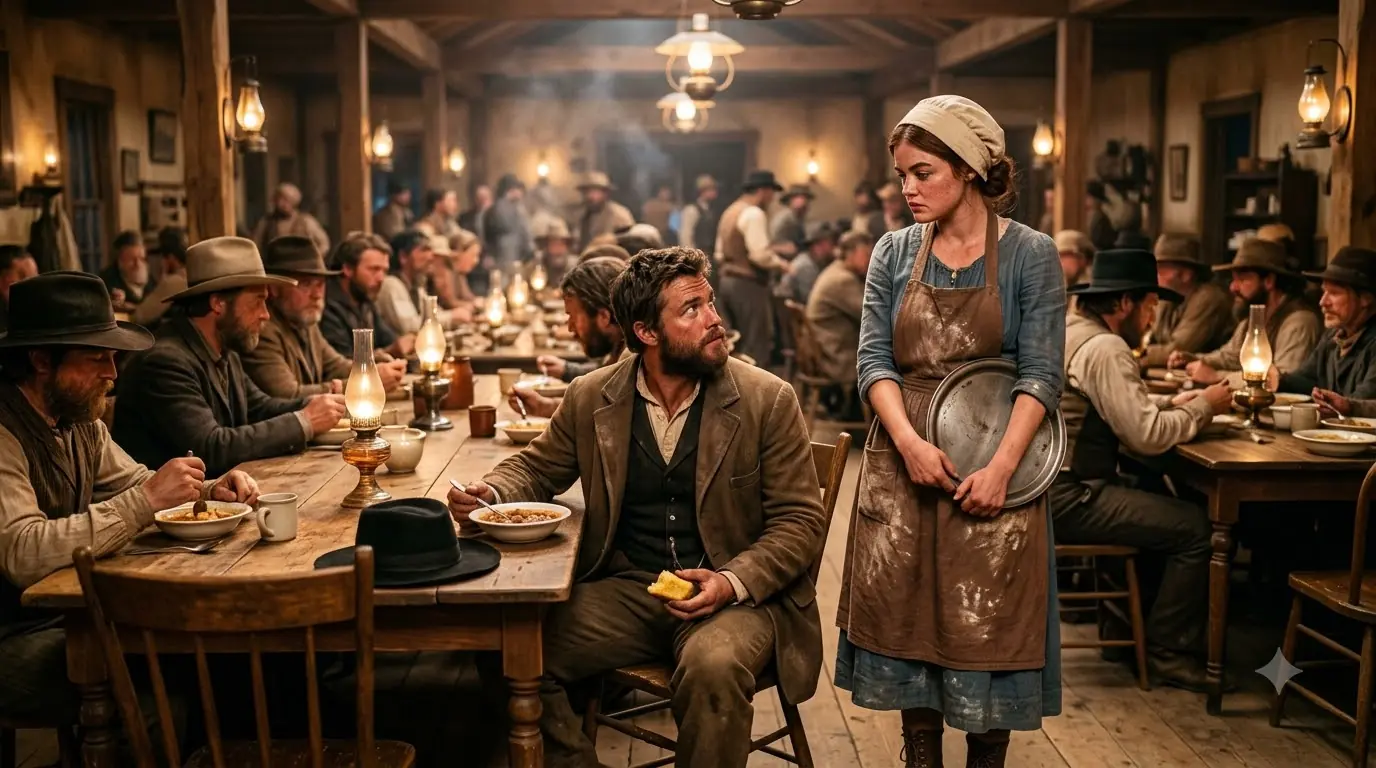
“There is cornbread if you want it,” Edmund said. “The woman in back made too much.”
He said it the way a man might mention leftover firewood.
Lucy brought it out herself, a plate in one hand and her eyes fixed somewhere beyond Jonas’s shoulder. She set it down and turned to leave.
“Hold on,” Jonas said.
He broke off a piece and ate it while still standing there in front of the entire dinner crowd because he had not thought to sit first.
“That is the best cornbread I have ever had.”
Lucy stopped.
Something crossed her face that was not quite gratitude.
“Glad it suits you.”
She returned to the kitchen as though the compliment carried a weight she did not want to hold.
Jonas watched her go.
Around him, the dinner crowd continued eating. Rail workers had come in from the new grading project. A traveling salesman sat with a case of tin samples, and two ranch wives had stopped for supper while they were in town buying supplies.
None of them looked up.
Whatever had just happened, it had happened only to Jonas.
He thought about it during the ride home, turning it over in his mind the way a man turns over a stone whose shape he does not understand.
Jonas was twenty-six, and the Harlan ranch belonged to him. His father had left it to him three years earlier. It was a fair-sized spread for the area, not the largest in the county but close enough, with a handful of hired men and more cattle each season than the one before.
The town had grown around Jonas without his paying much attention. It had a second street now and serious talk of a rail spur. Jonas had grown with it in the dull, steady way of a man who kept his attention fixed on fence lines and forgot to ask what else there might be to want.
He had been engaged once, four years earlier, to a woman who packed her belongings and returned to her mother without ever telling him why. Since then, Jonas had not gone looking for reasons to feel the absence of anything.
Lucy had grown up in the county orphanage two towns away. She remained there beyond the age when she was required to leave because the cooking needed doing and she was good at it.
When the growing town began needing more workers than it had, Lucy arrived on her own two feet. She found employment at Edmund Hollis’s boarding house and had remained there ever since.
Most people looked past her. She was plain-faced, quick about her work, and carried nothing in her manner that invited a second glance.
Lucy had become accustomed to being overlooked and had stopped expecting anything different.
A few days later, Jonas rode through town on an errand that could easily have waited. He saw Lucy crouched on the boarding house porch beside a boy of five or six.
She broke the heel of a loaf in two and placed the larger half inside his hands.
The boy accepted it with both hands as though it were the only thing anyone had given him all week.
His mother came up the street calling his name. When she found him, she thanked Lucy plainly, in the same manner someone might thank another person for holding open a door.
Lucy smiled.
It was a full, easy smile, unlike anything Jonas had seen cross her face inside the dining room.
“Lucy, back to it.”
He was not exactly unkind. He was merely a man tending his business the way he tended everything else, with no more weight behind the words than he would have given an instruction to add wood to the stove.
Lucy’s smile disappeared like a candle pinched between two fingers.
She wiped her hands against her apron and went inside without speaking.
Jonas remained on his horse longer than his errand required.
He did not understand what he had just witnessed, but he knew he had witnessed something.
The town was preparing for the harvest festival that week. Banners were being raised along Main Street, and the bank was polishing its front window as though anyone cared.
Twice that week, Jonas found reasons to ride past the boarding house that had not existed the week before. Both times, he told himself it had something to do with supplies.
Old Mrs. Vane, who missed nothing from her chair on the mercantile porch, remarked to her daughter that the Harlan boy seemed to be eating an unusual amount of stew for a man who did not care for stew.
Her daughter said she had not noticed.
Mrs. Vane said she had.
Jonas ate at the boarding house again two days later and asked for nothing unusual. He ate his stew and watched Lucy move through the room, quick, capable, and closed tightly within herself.
He saw nothing of the woman who had knelt on the porch with a piece of bread.
Whatever that softness had been, she did not allow it to appear for customers.
Jonas found himself paying closer attention than the meal warranted. He noticed the careful way she cleared each table and the way she never allowed her eyes to rest on anyone’s face longer than business required.
It occurred to him, not for the first time, that a person could live a long while inside a town of that size and still remain mostly unseen.
That evening, Jonas found Edmund at the saloon. Edmund ended most evenings with the same glass of whiskey in the same chair, like a man faithfully keeping an appointment with himself.
The room was loud with rail crews and card games, but Edmund’s corner maintained its own quiet country.
“That cook of yours,” Jonas said. “Is she always like that?”
Edmund rotated his glass a quarter turn.
“Like what?”
Jonas turned his own glass in imitation.
“Quiet. Like she is always waiting for someone to tell her to stop doing something.”
Edmund did not answer immediately. He took his time with the whiskey, as he took his time with most matters that meant something.
“She is an orphan,” he eventually said. “Never had much reason to trust grown people.”
He drank.
“Hardest worker I have.”
“Does she close herself off that way with everyone?”
“Mostly around adults.”
Edmund placed the glass on the table.
“Children make her soft. The rest of us, she keeps at a distance.”
The saloon continued around them with the usual Thursday noise. Neither man spoke for a while.
Jonas turned the answer over.
“Why?”
Edmund gave him a shrug that was not truly an answer.
“The festival is next week. I am handling the food again.”
He looked sideways at Jonas.
“There will be more cornbread than you can eat.”
Jonas looked at him.
Edmund said it like a man who meant nothing more by it, then returned to his whiskey.
The harvest festival filled the town square with bunting strung between the feed store and the bank. Fiddle music played while townspeople appeared in clothing Jonas had not seen them wear since Christmas.
Lanterns hung from the porch posts even though the sun had not yet set, waiting for darkness.
Edmund arranged tables end to end along the boardwalk and loaded them with enough food for twice the population of the town.
Lucy worked behind them in her boarding house apron. Her hair was coming loose near her collar, and perspiration marked her temple.
People danced and laughed around her in their polished boots.
Nobody thought to ask whether she wanted to join them.
Jonas watched from the edge of the crowd before walking across the square.
“Dance with me.”
Lucy looked at him as though he had asked her to fly.
She glanced beyond him toward Edmund, who stood near the drinks table with his arms crossed.
Edmund gave a single nod, small enough that most people would have missed it.
Lucy untied her apron and laid it across the table.
She was stiff during the first song, counting each step and watching her own feet instead of Jonas.
Then the fiddle changed tunes.
Lucy stopped counting.
Partway through the second song, she smiled.
The smile was not directed at anything in particular. Perhaps it came from the lantern light, the noise of the gathering, or simply the unfamiliar pleasure of having both hands free during an evening.
Jonas decided he liked the sight of it more than he had any right to decide so quickly.
When the song ended, he asked if they could speak away from the crowd, where nobody could easily make something of the conversation.
“I need a cook at the ranch,” he said. “Good wages and a cabin of your own.”
Lucy glanced toward Edmund.
“Mr. Hollis needs me here.”
“I will speak with Hollis.”
She studied Jonas the way someone studies a fence line before deciding whether it will hold a horse.
“I will come look.”
“That is not a yes.”
“That is fair.”
Jonas touched the brim of his hat.
Lucy rode to the ranch the next morning inside a wagon Edmund lent her without needing to be asked twice.
Jonas showed her the kitchen first. It was a long room with a good stove and a window above the sink overlooking the corrals.
A flour bin had been built into the counter by someone who understood what a cook needed rather than what looked handsome.
He showed her the cabin behind the main house. It had its own door, its own small stove, and enough distance from the house to offer privacy.
He introduced the two young women who helped with washing and housework. Hattie and Lilly were sisters, daughters of a homesteader who lived two miles away.
They looked Lucy over the way young women examine anyone new who might outrank them inside a kitchen.
Lucy returned their attention without apology.
Something settled between the three women before anyone spoke, the kind of understanding that required no words.
Jonas told her supper was served at six and breakfast before sunrise. Beyond that, the kitchen would belong to her, and she could run it however she considered best.
He did not tell her how to perform her work.
Lucy noticed and did not mention it.
She looked at the cabin for a long moment, then at the flour bin and finally toward the corrals, where dust rose softly above the herd.
“I will come on a trial,” she said. “We will see if it suits.”
“It will suit.”
She started to turn toward the kitchen.
“I have one condition,” Jonas said.
Lucy waited.
“I need you to smile more.”
Something in her face gave way before she decided whether to allow it.
She smiled, small but genuine, and let it remain for a moment before answering.
“I will see what I can do.”
Lucy arrived two weeks later with one bag and no complaint that the cabin was smaller than the boarding house kitchen.
It was the first room she had ever possessed that could be locked from the inside with her own key. She took private satisfaction in that fact without ever mentioning it aloud.
The ranch hands quickly grew fond of her cooking. She fed eight men as though she had done it all her life, which, in a way, she had.
Lucy kept the kitchen the way Edmund kept his ledger, exact, orderly, and without complaint.
Within a month, Hattie and Lilly had begun calling her “Mrs.” partly in jest. Nobody corrected them.
The ranch hands fell for her cornbread in much the same way Jonas had.
During the second week, Levi Tupper, a quiet rider who rarely requested anything, gathered enough courage to ask whether there might be more cornbread on some evenings than others.
Lucy said there might.
After that, there generally was.
The men ate it without remark, in the way working men consume anything good and dependable without thinking to name what it means to them.
Within the same month, Jonas noticed that Lucy never sat down to eat.
She fed the ranch hands, then Hattie and Lilly, and finally him. By the time everyone else had cleared away, she was usually beside the stove with an untouched plate while scraping the pots.
For a while, Jonas said nothing.
Then one evening, after the men had left, he returned to the kitchen. He pulled the second chair away from the table and placed Lucy’s plate in front of it.
“Sit.”
She looked at the chair and then at him.
“You do not need to wait on me, Mr. Harlan.”
“I am not waiting on you.”
He sat across from the empty chair.
“I am waiting for you.”
Lucy remained standing.
“Eat before it gets cold,” he said.
She sat.
They ate inside the quiet kitchen and made nothing of it.
After that night, it happened during most evenings without either of them suggesting it again.
The household formed itself around the habit in the way a path forms through repeated walking.
Hattie and Lilly noticed but said nothing to Lucy’s face.
The ranch hands noticed and said almost nothing at all. One or two looks passed across the bunkhouse and settled into something closer to approval than curiosity before the first month ended.
Jonas continued running the ranch as he always had. Fences were repaired, cattle moved, and accounts balanced according to schedule.
Beneath all of it, however, the days had begun arranging themselves around an hour in the evening that had not existed before Lucy arrived.
Jonas noticed but spoke of it no more than he spoke of the weather.
By the second month, he knew that Lucy drank her coffee black and did not care for eggs.
He also knew she hummed when she believed the kitchen was empty and stopped the moment she heard a boot strike the porch step.
Jonas never revealed that he knew either thing.
He simply stopped wearing his boots quite so loudly when approaching from the barn.
That same month, the wind from the northern pasture found a gap beneath Lucy’s cabin door. No number of rags pushed along the threshold could stop it.
Lucy mentioned the problem to no one.
One afternoon, while she was in town buying supplies, Jonas removed the door from its hinges. He planed the lower edge until it sat properly and rehung it before supper.
He told her nothing.
That night, Lucy noticed that the door swung closed quietly and evenly for the first time since she moved into the cabin.
She said nothing either.
She merely swept the curled wood shavings still scattered across the floor and placed another log inside her stove with something close to a smile.
In the spring, a heifer died while calving and left behind a wet, trembling calf that nobody had time to feed by hand.
Jonas carried the calf to the kitchen porch inside a feed sack because the kitchen was the warmest building on the ranch. He expected Lucy to object to the mess.
She did not.
Lucy warmed milk on the stove and created a bottle from a flask and the finger of a glove.
At two in the morning, she sat on the porch boards in her nightclothes with the calf’s head resting in her lap. She spoke to it in a low, steady voice, the same way she had spoken to the small boy with the piece of bread.
Jonas found her there near dawn.
The calf had finally fallen asleep against her knee.
He said nothing about the hour, the cold, or the state of her nightclothes.
Jonas carried out a blanket, placed it around her shoulders, and sat on the step below her.
They remained there until the light became strong enough for them to see their breath.
The calf lived.
The ranch hands named her Cornbread before anyone considered stopping them. The name remained with the cow for the rest of her long life.
It was repeated so frequently around the ranch that eventually nobody except Jonas and Lucy remembered how it began.
Neither of them explained it when anyone asked.
When summer came, Jonas noticed that Lucy slowed each time she crossed the near pasture where black-eyed Susans grew wild beside the fence.
He also noticed that none ever appeared inside a jar in the kitchen.
It seemed a strange kind of restraint for a woman who clearly enjoyed looking at them.
Jonas did not ask.
Whenever his work took him near that fence, he began carrying a handful back to the house. He placed the flowers inside a jar on the windowsill above the sink without comment.
He said nothing when they wilted and nothing when he replaced them.
Lucy never mentioned the flowers.
By August, she had begun filling the jar herself on mornings when Jonas did not reach the pasture.
That was its own kind of answer, given without a word passing between them.
One evening soon afterward, Lucy sat beneath the kitchen lamp repairing a tear in an apron. Without being asked, she mentioned that the orphanage had maintained a garden behind the main building.
She had learned much of what she knew about cooking by making do with whatever the ground produced each season.
Lucy said nothing more.
Jonas did not ask for more. By then, he understood that what she offered freely was worth more than anything he might pry loose.
In return, he told her his mother had once maintained a garden behind the old ranch house. It had gone to weeds long before Lucy arrived.
Jonas had always intended to restore it but never had.
The following week, without discussion, the weeds were cleared from that section of fence. Freshly turned earth waited for whatever Lucy wanted to plant.
She began with herbs. The following spring, she added vegetables.
Lucy never thanked Jonas for clearing the garden.
By then, he understood that the garden itself was thanks enough.
In the fall, the calf had grown into a yearling but still came whenever Lucy called.
Jonas found Lucy sitting on the cabin step, shelling beans inside the last evening light. He sat beside her without asking, as he had begun doing during most evenings.
“Your cornbread is better than what Hollis used to ration me,” he said.
Lucy did not look away from the beans.
“That is because Hollis’s flour was old. I told him for two years.”
“I believe you.”
She continued shelling beans as though the compliment did not deserve a pause.
“You would believe nearly anything I told you.”
“I would believe most of it.”
Jonas looked toward her.
“I would not take all of it on faith.”
The corner of Lucy’s mouth moved.
She did not argue.
By winter, the ranch hands had stopped remarking on how often Jonas ate a late supper at the same table as the cook.
Nobody made anything of it.
It had simply become the natural shape of the evenings, just as the second chair had quietly become Lucy’s.
Snow arrived early and remained.
The house settled into the kind of quiet created by long winters on a working ranch. Chores ended early, evenings stretched, and the fire performed most of the talking.
One night, Jonas asked Lucy to sit beside the hearth instead of returning immediately to her cabin.
She came with a dish towel still resting over one shoulder and sat inside the good chair Jonas had never before seen her use.
He poured her coffee himself and placed the cup inside her hands before sitting across from her.
“I have been thinking about something,” he said.
Lucy turned the dish towel between her fingers.
“You usually are.”
“This ranch ran properly before you came.”
Jonas looked into the fire rather than at her.
“It runs differently now.”
He leaned forward, took the cup from her hands in the middle of a sip, and placed it on the hearthstone, just as she had set his plate down on so many evenings without asking.
“I do not need a cook anymore, Lucy.”
She remained still.
“I need you to stay because the house does not work properly when you are not inside it.”
Lucy did not move.
“Marry me,” Jonas said.
She looked at the empty space where the coffee cup had been and then at him.
“I told you once that I would come on a trial and see whether it suited.”
“Did it suit?”
“Yes.”
Lucy reached across the space between them and took his hand instead of the coffee.
“I will marry you.”
For a moment, Jonas remembered another winter four years earlier.
There had been signed papers, a packed trunk, and a house left silent without his ever understanding why.
He discovered that he did not want to think about it longer than that.
He also discovered he did not need to.
Outside, the snow continued falling, steady and unhurried, the way it does when it has nowhere else to be.
News reached town within a week, as news always does in a place of that size.
Nobody seriously pretended to be surprised.
Edmund told anyone who asked that he had seen it coming since the harvest festival. He said it in a manner suggesting he had personally arranged the entire matter.
Nobody believed him, and nobody troubled him about it.
The week before the wedding, Lucy told Jonas she did not want a fuss.
“I am not made for that kind of attention,” she said. “Keep it small.”
Jonas knew better.
He sent word to the orphanage two towns away, the place that had raised her.
Three women who had cared for Lucy as a girl traveled by wagon through the last of the snow for two days to see her married.
Half the town came as well.
Edmund stood among them, looking almost proud of something he would not openly claim credit for.
Lucy waited inside the church doorway wearing a dress three women from the boarding house had sewn together.
Snow melted from the boot tracks at the entrance.
For one entire afternoon, Lucy stood at the center of every eye in town.
She did not mind it nearly as much as she had claimed she would.
Children arrived during the years that followed, one after another.
The house filled with the particular noise of a place that had once been too quiet and had finally stopped being so.
Their oldest child began standing on a stool beside Lucy before he could properly speak. More often than not, he wore the flour rather than using it.
Lucy allowed him to remain through every mess instead of sending him away to play.
She treated him with the same patience she had once shown a boy on a boarding house porch when she gave him the larger half of a piece of bread.
Jonas watched them from the doorway during some evenings.
He never spoke aloud about what he was thinking.
He did not need to.
It was plainly written across his face for anyone who cared to look, which by then was mostly Lucy.
Twenty years later, the Harlan spread had grown beyond anything either of them imagined during that first harvest festival.
There were more cattle, more ranch hands, and a second barn.
Cornbread, the old cow, had long since retired to the back pasture, where she still approached the fence whenever anyone carried scraps.
The harvest festival continued every autumn.
Edmund managed the food tables until his knees finally prevented it.
Every year, without being asked, Lucy sent more cornbread than Edmund could reasonably use.
It had become a private joke between them that neither explained to anyone who had not been there at the beginning.
Their oldest son was eighteen. He could outride any hired hand on the ranch and most riders in the county besides.
He shared his father’s habit of saying little and meaning everything he said.
Their second son was fourteen. He possessed a gift with horses nobody had taught him and nobody could explain.
He spent more hours inside the barn than the house, much as Jonas had before he gained a reason to come inside earlier.
Their daughter was ten and informed anyone willing to listen that she intended to become a princess.
She saw no reason the ranch could not accommodate that ambition in the meantime.
Nobody had yet found enough courage to tell her otherwise.
One evening, Jonas and Lucy sat beside the fire as they always had.
The house was quiet behind them. The children had gone to bed, and the cattle were settled for the night.
Through the window, the herb bed Lucy planted years earlier sat dead beneath the frost. The season’s first dusting of snow covered the earth while it waited for spring to ask something of it again.
Lucy leaned her head toward Jonas’s shoulder.
“I never told you.”
He looked at her.
“Told me what?”
She watched the fire instead of him.
“The day we met.”
“What about it?”
The fire popped once inside the grate before she answered.
“That cornbread was not meant for customers.”
Jonas remained quiet.
“It was my supper.”
Lucy allowed the truth to rest between them for a moment.
“I went to bed hungry that night.”
“You should have told me,” Jonas said. “I would have eaten the stew.”
“Going hungry was worth it.”
Lucy smiled.
“That was the best cornbread I ever made.”