“Ma’am, do you need some help?”
Martha Lancaster lifted her tear-streaked face and found a stranger standing several yards away with his hat held respectfully against his chest. He was tall and broad-shouldered, with a dark beard, tired brown eyes, and the weathered hands of a man who had spent most of his life working beneath an unforgiving sky. Behind him stretched miles of open Oklahoma grassland and a lonely white farmhouse sitting on a rise.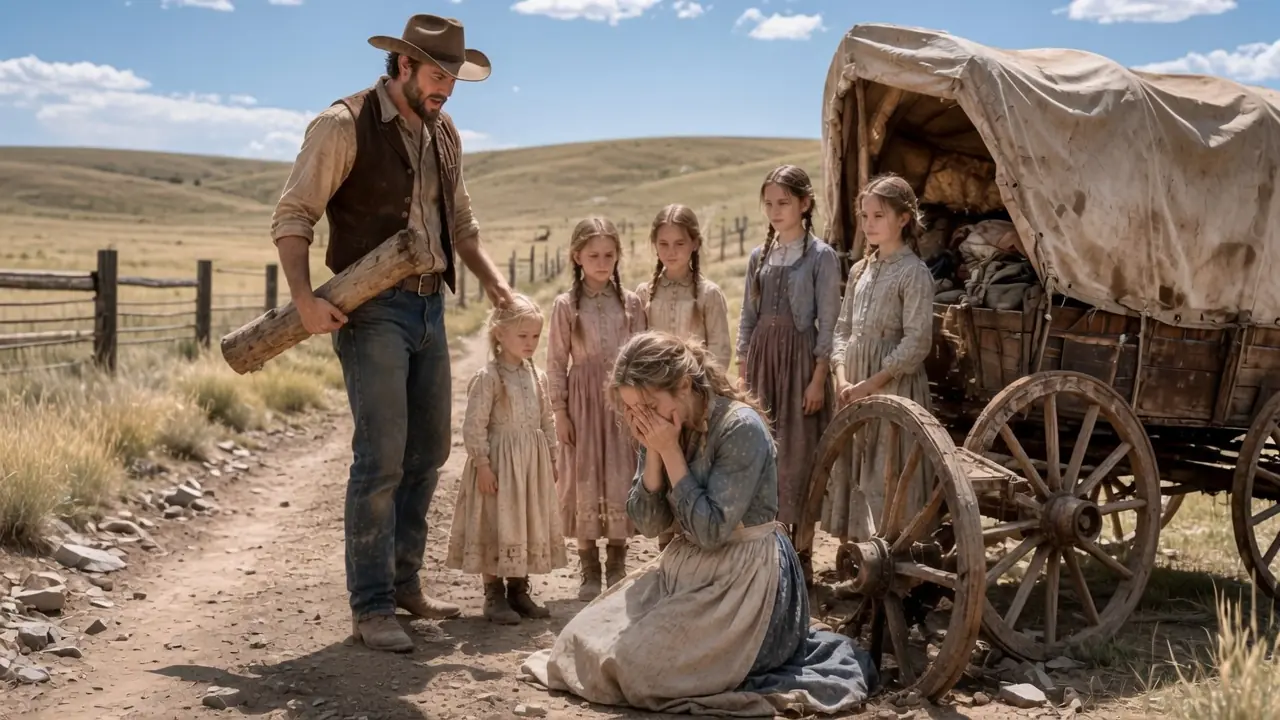
“The axle is broken,” Martha said, wiping her cheeks quickly. “I have five daughters—but not a dollar left.”
The stranger crouched beside the wagon and examined the split timber. He ran his fingers along the break, then looked toward the girls standing silently beside their scattered belongings. “Keep your money. Your girls need food and shelter before the sun goes down.”
Martha followed his gaze toward the distant farmhouse. “Why would a stranger open his home to six people he never asked for?”
The man’s expression softened.
“Because my house has been empty for three years,” he said, looking at the five girls. “And tonight it finally has someone worth opening the door for.”
Martha’s voice trembled. “You don’t know us. My daughters may become a burden you never wanted.”
“They’re not a burden, Martha. They’re the family this ranch has been waiting for.”
She stared at him. “And what are you waiting for?”
He held out his hand.
“For you to trust me enough to come home.”
Martha did not take his hand immediately.
She had trusted men before. Her late husband, Thomas, had promised they would build a secure life in Missouri, but fever had taken him within three weeks of their youngest daughter’s birth. Her brother had promised work in Oklahoma, yet the letter lying in the road beside her Bible explained that his mill had closed and he had already moved west.
Promises had become beautiful doors that opened only onto disappointment.
The stranger seemed to understand her hesitation.
“My name is Benjamin Quincy,” he said. “The house is mine, and there is a spare room with a lock on the inside. You and your daughters may stay tonight. Tomorrow, after I repair the wagon, you may leave without owing me anything.”
“Nothing?”
“Nothing.”
Men who wanted nothing frightened Martha almost as much as men who demanded too much.
She studied his face, searching for hidden calculation, but found only concern. Finally, she placed her hand in his.
Benjamin helped her stand, then turned toward the girls. Lily, the eldest at twelve, stepped protectively in front of her sisters. Her serious brown eyes inspected him with the suspicion of someone who had learned too early that adults could fail.
“Will Mama be safe?” Lily asked.
Benjamin did not smile or offer a careless promise. “As safe as I know how to make her.”
The honesty seemed to satisfy the girl more than reassurance would have.
Benjamin gathered the fallen dresses and returned them to the trunk. When he reached for the folded letter, Martha snatched it from the dust before he could read it.
“I’m sorry,” she said.
“A private letter is private.”
He lifted the trunk into the wagon as though it weighed nothing. Then he led the horse slowly toward the ranch while Martha and the girls walked beside the damaged vehicle.
The farmhouse grew larger as they approached.
It had two stories, a deep porch, and enough windows to make Martha wonder how one man could tolerate living there alone. A barn stood behind it beside a windmill, several fenced pastures, and a vegetable garden that had been carefully planted but poorly weeded.
Everything looked maintained, yet untouched by warmth.
Benjamin opened the front door.
The house smelled of cedar, dust, and something faintly floral. A woman’s embroidered shawl still hung from a peg near the stairs, and a pair of delicate porcelain birds rested on the mantel.
Martha noticed Benjamin looking at them.
“My wife, Sarah, chose those,” he explained. “She died three years ago.”
“I’m sorry.”
“So am I.”
He did not say more.
The five girls entered cautiously.
Pearl, six years old and incapable of remaining quiet for long, looked up at the staircase. “Is this whole house yours?”
Benjamin nodded.
“Why?”
He blinked. “Why is it mine?”
“Why do you need so much house when there’s only one of you?”
Martha closed her eyes. “Pearl.”
Benjamin surprised her by laughing.
“I’ve been asking myself that for three years.”
Little Ruth had already begun swaying with exhaustion. Benjamin carried her upstairs without waiting to be asked and placed her on the spare-room bed. She curled against the pillow fully dressed and fell asleep before Martha removed her boots.
The other girls gathered around a bowl of stew Benjamin reheated on the stove.
They ate slowly at first, watching their mother for permission. Then hunger overcame caution.
Grace scraped the bottom of her bowl with bread. Rose asked whether there was more but immediately apologized for asking. Lily ate only half her portion and tried to save the rest for Ruth.
Benjamin noticed.
“There’s enough,” he said. “No one has to save food tonight.”
Martha looked away because those words nearly made her cry again.
After supper, Benjamin brought blankets and placed them outside the spare bedroom door. He showed Martha the inside lock, then stepped backward into the hallway.
“I’ll sleep downstairs.”
“This is your room?”
“It was Sarah’s sewing room. I never changed it.”
Martha glanced at a covered sewing machine near the window and shelves filled with folded fabric. “You kept everything.”
“I wasn’t ready to move it.”
She understood that kind of grief.
Before closing the door, Benjamin said, “If you hear footsteps, they’ll be mine checking the fire. I won’t enter.”
Martha locked the door and leaned against it.
Lily watched her from the bed.
“Do you trust him?” the girl whispered.
“I don’t know.”
“He gave us food.”
“Kindness and trust are not always the same thing.”
Lily considered that, then crawled beneath the blankets beside her sisters.
Martha remained awake long after the girls slept. Wind moved across the prairie and pressed softly against the windows. From below came the occasional creak of floorboards as Benjamin tended the stove.
No hand tested the locked door.
No voice demanded payment.
By morning, Martha found him outside beneath the wagon.
He had removed the damaged axle and laid several tools beside him. His hat rested on the ground, and sunlight caught in his dark hair.
“You started early,” she said.
“So did you.”
“I’m used to waking before children.”
“You have five. I imagine sleep has become a rumor.”
She almost smiled.
Benjamin explained that the axle could be repaired, but the wood needed several hours of shaping and reinforcement. He could finish by late afternoon.
Martha looked toward the eastern road.
The letter in her pocket felt heavier than before.
“Where were you traveling?” he asked.
“Guthrie.”
“Do you have family there?”
“My brother was working at a mill.”
“Was?”
Martha removed the folded letter.
It had reached her two days before the wagon broke, but she had hidden the truth from the girls. Her brother had moved to Colorado after the mill closed. He had no home, no job, and no means of helping them.
“I have nowhere to go,” she admitted.
Benjamin did not offer pity.
“What can you do?”
The question startled her. “I can cook, sew, keep accounts, tend chickens, preserve vegetables, teach children to read, and work harder than most men believe a woman can.”
“Can you manage a household?”
“I have managed poverty for twelve years.”
“That is usually harder.”
He wiped his hands on a cloth.
“My cook left in January to marry a blacksmith. The house needs work, and I lose track of every account that does not involve cattle. I can offer wages, a room for you and the girls, and meals.”
Martha stared at him. “You would employ me?”
“For six months. Long enough for you to save money and decide where you want to go.”
“And if it doesn’t work?”
“You leave with your wages.”
She searched for the hidden condition.
“Why?”
Benjamin looked toward the house. Through the kitchen window, Pearl and Grace were making faces at them.
“Because you need work,” he said. “And I need help.”
Martha accepted.
The first weeks were uncomfortable for everyone.
Benjamin had lived alone long enough to forget that children moved like sudden weather. They left ribbons on chairs, books on stairs, and muddy footprints exactly where he had cleaned. Pearl asked questions during meals until her sisters begged her to breathe between them.
Ruth followed Benjamin everywhere.
She watched him mend fences, oil saddles, repair gates, and sharpen tools. Whenever he stopped, she sat down beside him as though assigned to supervise.
One afternoon, he handed her a small wooden hammer.
“For important ranch business.”
Ruth carried it proudly for the rest of the day.
Martha transformed the house without meaning to.
She washed curtains, opened windows, polished furniture, and brought flowers from the field into Sarah’s old blue pitcher. She never moved the porcelain birds or the embroidered shawl without asking.
Benjamin noticed that restraint.
“You don’t need permission to use the house,” he told her.
“It was hers before it was mine to clean.”
“It isn’t yours to clean. It’s yours to live in while you’re here.”
The distinction unsettled her.
No one had given Martha space without reminding her it was temporary.
She kept a careful ledger of every household expense and refused to take more than the wages they agreed upon. When Benjamin bought shoes for all five girls after seeing cardboard inside their old ones, Martha added the cost to a page marked DEBT.
He found the ledger.
“What is this?”
“What I owe you.”
“You owe me nothing for the shoes.”
“They are not your children.”
Benjamin closed the book.
“No, but they live under my roof.”
“That does not make them your responsibility.”
“Maybe responsibility is not always something forced upon a man.”
Martha took the ledger from him. “You are too generous.”
“And you are too determined to turn kindness into a bill.”
The argument ended without resolution.
Their life settled into a rhythm.
Lily helped with household accounts and surprised Benjamin with her ability to calculate feed costs faster than he could. Rose loved animals and began caring for an orphaned calf. Grace followed Martha in the kitchen, while Pearl appointed herself messenger between the house and barn.
Ruth remained Benjamin’s shadow.
The ranch changed around them.
Laughter returned to the porch. Small dresses appeared on the washing line. The dining table, once used only at one end, became crowded every evening.
Benjamin began coming in before sunset instead of working until darkness made the fences invisible.
Martha noticed.
One evening, she found him standing in the doorway watching the girls read aloud.
“You can sit,” she said.
“I didn’t want to interrupt.”
“You live here.”
The words slipped out naturally.
Both of them became quiet.
Benjamin sat beside the fire while Lily read from an adventure book. Ruth climbed into his lap without asking, and he held her as though the gesture no longer surprised him.
Martha looked at his hand resting protectively against the child’s back.
Something dangerous began to awaken in her heart.
Hope.
It frightened her more than poverty.
In May, a man named Silas Crowe arrived at the ranch.
He was a freight operator from Kansas City with narrow eyes and a red waistcoat. Martha recognized him before he dismounted.
She immediately pulled the girls behind her.
“You owe me thirty-eight dollars,” Crowe said.
Benjamin stepped onto the porch. “For what?”
“The wagon and horse she rented in Missouri. Payment was due upon arrival in Guthrie.”
“The wagon broke.”
“Still my property.”
Martha had intended to pay him after finding work. Now he demanded the wagon, horse, and interest large enough to consume nearly all her saved wages.
Crowe smiled when she explained.
“Then perhaps one of the older girls can work off the balance at my sister’s hotel.”
Lily gripped Martha’s dress.
Benjamin’s expression became dangerously still.
“No child is going anywhere with you.”
Crowe looked him over. “This is business.”
“Then speak like a businessman instead of a man shopping for children.”
Benjamin offered the original debt without Crowe’s invented interest.
Crowe refused.
He claimed Martha had signed a contract allowing him to seize personal property and place her children into service until payment was complete. Martha remembered signing a document before leaving Missouri, but she had been desperate and had barely understood the legal wording.
Benjamin sent for the county sheriff.
The contract was legal enough to cause trouble but vague enough to challenge. Crowe promised to return in one week with a judge’s order.
After he left, Martha packed her trunk.
Benjamin found her folding dresses.
“What are you doing?”
“Leaving before my trouble reaches your house.”
“Where will you go?”
“I don’t know.”
“You have five daughters and no wagon.”
“I had five daughters and no home when you found me.”
“And I will not find you broken beside another road.”
His voice was sharper than she had ever heard it.
Martha straightened. “You cannot solve every hardship with your money and strength.”
“I know.”
“Then let me go.”
“No.”
She stared at him.
Benjamin lowered his voice. “Not because I own your choices. Because this family has become mine to care about, and I will not pretend otherwise.”
Martha’s eyes filled.
“You don’t understand what you’re saying.”
“I understand it perfectly.”
He took one step closer but did not touch her.
“I love those girls. I love the noise they make, the mess they leave, and the way Ruth hides nails in my pockets. And I love their mother.”
Martha’s breath caught.
Benjamin continued before fear could silence him.
“I have loved you slowly, Martha. Not because you needed rescue, but because you made this house alive again. You see every person beneath their pride, including me.”
She looked down at the dress in her hands.
“You loved Sarah.”
“Yes.”
“I cannot replace her.”
“I would never ask you to.”
“What if you wake one morning and realize this was gratitude?”
“I have lived with gratitude. This is not it.”
Martha sat on the trunk because her knees would no longer support her.
“I’m afraid.”
“So am I.”
“You don’t look afraid.”
“Men often hide fear beneath bad manners and work.”
A tear slipped down her cheek.
Benjamin knelt in front of her.
“You do not owe me love because I helped you. You do not owe me marriage because you live here. Stay as my employee, leave when the debt is settled, or tell me never to speak of this again.”
“And if I love you too?”
His face changed.
“Then I would spend the rest of my life trying to deserve it.”
Crowe returned six days later with a deputy and papers authorizing him to seize the wagon, horse, and Martha’s trunk. He also demanded that Lily enter service until the remaining debt was paid.
Benjamin stood beside Martha in the ranch yard.
Before he could speak, she stepped forward holding her ledger.
Crowe had made a mistake.
The contract charged daily penalties after arrival in Guthrie, but Martha had never reached Guthrie. More importantly, the wagon axle had failed because the timber contained an old split hidden beneath paint.
Benjamin had preserved the broken piece.
The county blacksmith confirmed the defect had existed before Martha rented the wagon. Under territorial law, Crowe could not charge full hire for unsafe equipment.
The judge reduced the debt to seven dollars.
Martha paid it herself.
Crowe took the broken wagon and left without Lily, her wages, or the satisfaction of seeing Benjamin rescue her.
That evening, Martha placed the stamped receipt on the table.
“I paid my own debt,” she said.
Benjamin nodded solemnly. “You did.”
“Do you know why that matters?”
“Because you needed to know you could.”
She looked at him with new tenderness.
“And because now, if I stay, no one can say I stayed because I had nowhere else to go.”
Benjamin became very still.
“Are you staying?”
Martha reached into her pocket and removed the ledger. She opened it to the page marked DEBT, tore it out, and placed it in the stove.
The paper curled in the flames.
“I am staying because I want to.”
Benjamin crossed the room slowly.
“May I kiss you?”
Martha smiled through tears. “You may.”
Their wedding took place in June beneath the cottonwood trees beside the farmhouse.
The girls wore dresses Martha made from fabric found in Sarah’s sewing room. Before using it, she had asked Benjamin whether that would feel disrespectful.
He touched the folded cloth and shook his head.
“Sarah wanted children running through this house. She would be glad it became something beautiful.”
Lily stood beside Martha during the ceremony. Rose carried wildflowers. Grace held the rings, Pearl whispered every word of the vows along with the minister, and Ruth kept Benjamin’s wooden hammer tucked inside her sash for important ranch business.
When the minister declared them husband and wife, Benjamin kissed Martha gently.
The girls cheered loudly enough to frighten the horses.
Life after the wedding was not effortless.
Drought threatened the pasture that summer, and two cows died during a winter illness. Martha and Benjamin disagreed about money, discipline, and his dangerous habit of working while injured.
But neither used fear as a weapon.
They argued, listened, apologized, and continued.
Benjamin eventually adopted all five girls legally.
On the day the judge signed the papers, Lily asked whether she had to call him Father.
“No,” Benjamin said. “You call me whatever feels true.”
She hugged him.
“Papa feels true.”
Years later, a new wing was added to the farmhouse.
The porch became crowded with grandchildren, muddy boots, schoolbooks, and arguments over chores. Martha’s blue-gray travel dress remained folded in a cedar chest beside the letter that once told her she had nowhere to go.
She kept both as reminders.
The broken wagon had seemed like the final proof that she had failed her daughters.
Instead, it stopped beside the one place where they would finally become safe.
Benjamin often said he had rescued six stranded travelers.
Martha always corrected him.
“You repaired an axle and offered us supper,” she would say. “We rescued each other after that.”
He never argued.
Every spring, when the road turned dusty and the cottonwoods grew green, they walked to the place where her wagon had broken. Benjamin had placed a small wooden sign beside the fence.
Martha once asked why.
He took her hand and read the carved words aloud.
HOME BEGAN HERE.