When Nola Vero texted me, “I’m staying at my friend’s place for a week,” I stared at the message for almost a full minute before I replied.
The old version of me would have called her immediately. He would have asked what happened, whether Maya was okay, whether Nola needed anything, whether there was something wrong between us that she was too afraid to say out loud.
That version of me would have begged for an explanation before he even understood he was being lied to.
But that version of me had already been buried under six months of locked screens, late-night meetings, soft perfume on dresses I never saw, and smiles she no longer gave to me.
So I typed one word back.
“Alright.”
Then I pressed send and placed my phone face down on the kitchen island.
My name is Asher Trevan, and for most of my adult life, people have paid me to solve problems before they become disasters.
I manage logistics for companies that cannot afford mistakes. My job is to notice delays before shipments fail, missing pieces before schedules collapse, and tiny patterns that reveal much larger failures waiting down the road.
Maybe that was why it bothered me so much that I had missed the slow collapse of my own marriage.
Nola had not disappeared overnight.
She had simply learned how to leave me while still standing in our kitchen.
We had been married eight years.
From the outside, we looked like the kind of couple people envied. We had the house in Riverside Estates, the black cars in the driveway, the charity dinners, the business friends, and the polished photographs where Nola always leaned into me like we were still in love.
She was beautiful in a way that made people turn before they realized they had turned.
Dark hair always styled with deliberate softness. Sharp green eyes. Elegant wrists. Perfect posture. A voice trained to make strangers feel chosen within seconds of meeting her.
She worked public relations for Meridian Corp., the largest development firm in the state.
Meridian built luxury towers, waterfront districts, hotel complexes, and shopping plazas disguised as lifestyle destinations. Nola’s job was not just to make those projects look good.
Her job was to make people forget what had been removed to create them.
She knew how to soften a headline.
She knew how to turn controversy into opportunity.
She knew how to make anything look beautiful from the right angle.
What I did not understand then was that she had been applying the same skill to our marriage.
The first change was her phone.
It used to sit on the coffee table, on the kitchen counter, on the bed, forgotten and ordinary. If it buzzed while she was in another room, she would call out, “Can you see who that is?”
Then it became part of her hand.
Locked.
Turned face down.
Carried to the bathroom.
Tucked under her pillow at night like it contained state secrets.
When I asked about it, she smiled and said work was intense.
The smile was familiar.
The eyes were not.
The second change was her schedule.
At first, it was one late meeting.
Then two.
Then “client drinks.”
Then “emergency reputation strategy.”
Then “a crisis with Owen’s downtown tower project.”
Every excuse was plausible by itself.
That was the dangerous part.
People think lies announce themselves by sounding ridiculous. The best lies sound reasonable, especially when spoken by someone who has made a career out of persuasion.
The third change was her laughter.
Nola had a laugh people remembered.
Bright.
Musical.
Perfectly timed.
The kind of laugh that made powerful men feel clever and ordinary men feel temporarily important.
I had not heard it directed at me in months.
Not really.
Then one Thursday evening, I came home early.
My meeting had ended ahead of schedule, and I stopped by the florist because I had decided, foolishly or faithfully, that maybe we just needed to remember how to try.
I bought white tulips.
Nola loved white tulips, or she used to.
When I opened the front door, I heard her laughing in the kitchen.
Not politely.
Not professionally.
Laughing.
Warmly.
Freely.
The sound floated through the hallway and stopped me before I reached the marble island.
She was leaning against the counter with her phone pressed to her ear, twirling a strand of dark hair around her finger.
“Owen, stop,” she said, smiling in a way I had not seen in too long. “I can’t wait for this weekend either.”
The flowers felt suddenly foolish in my hand.
Owen Rusk was her boss.
He was Meridian Corp.’s chief executive and public face, a divorced developer with expensive suits, a permanent tan, and the kind of confidence that comes from rarely being told no.
I had met him twice.
Both times, he shook my hand as if he was measuring whether I could be useful to him.
When Nola saw me standing in the doorway, her expression changed so quickly most people might have missed the sequence.
Surprise.
Guilt.
Irritation.
As if I had interrupted something that belonged to her.
She ended the call quickly.
“Work,” she said.
I set the tulips on the island.
“The penthouse sounded nice.”
Her jaw tightened so slightly that anyone else might have missed it.
“It’s for a client meeting, Asher.”
“On the weekend?”
“Business does not stop because it’s Saturday.”
I nodded.
That was all.
I did not demand the phone.
I did not ask why she looked more alive speaking to Owen for five minutes than she had looked sitting across from me for five months.
In my line of work, you do not confront a failing system until you understand exactly where it is breaking.
That night, Nola put the tulips in a vase.
She did it carefully, because performance was instinct to her.
“They’re beautiful,” she said.
“I thought you liked them.”
“I do.”
She kissed my cheek.
It was light, practiced, and empty.
The kiss told me more than the phone call had.
After that, I stopped being a husband trying to save a feeling and became a man studying a pattern.
Nola’s late meetings always lined up with Owen’s travel schedule.
Her sudden weekend obligations were always vague, always urgent, and always impossible for me to verify without looking jealous.
She bought new dresses I never saw at home.
She began wearing perfume she claimed was for events, though the scent was always strongest when she returned late at night.
She hid lingerie in the back of a drawer she thought I never opened.
She started using phrases that did not belong to us.
“Space.”
“Individual fulfillment.”
“Emotional independence.”
“Not every marriage has to look traditional.”
She said these things over dinner while scrolling her phone, never quite looking at me.
I listened.
I learned.
I waited.
There is a particular humiliation in suspecting betrayal before you can prove it.
You begin to feel guilty for noticing.
You tell yourself maybe you are becoming paranoid. Maybe work really is stressful. Maybe your marriage is simply aging into a quieter form of love.
Then one small truth breaks through, and suddenly the whole room changes shape.
For me, that truth came from Cleo Martinez.
Cleo was Nola’s best friend and coworker.
She was quick, glamorous, always overdressed, and loyal to Nola in the reckless way some people are loyal to a story because they helped build it.
At Meridian’s holiday party, Cleo drank too much champagne.
The party was held in a glass-walled event space overlooking the river, with silver trees in the corners and waiters carrying trays of appetizers nobody really wanted.
Nola looked stunning that night.
Emerald dress.
Bare shoulders.
Hair pinned loosely at the nape of her neck.
Owen spent half the evening near her, never too close for cameras, never far enough to look like nothing.
I watched them while making polite conversation with donors, contractors, and city officials.
Then Cleo found me near the bar.
She had a glass in one hand and the overbright smile of someone three drinks past caution.
“I just have to say,” she told me, leaning closer, “I admire how modern you and Nola are.”
I looked at her.
“Modern?”
“You know,” she said, waving one hand vaguely. “The arrangement.”
My body went very still.
“What arrangement?”
Her face changed.
Alcohol had loosened the truth, but fear sobered her quickly.
“Oh,” she said. “Never mind. I just meant you both have very independent schedules.”
“Cleo.”
She looked past me toward Nola.
I did not turn.
“What did she tell you?”
Cleo swallowed.
“She said you were fine with it.”
“With what?”
Her lips parted, then closed.
That was enough, but I waited.
People reveal more when you give them silence to fill.
“She said you understood that she and Owen had a connection,” Cleo whispered. “That you two had talked about it. That you weren’t possessive. That weekends at the penthouse were part of their strategic planning sessions, but also… not something you wanted made awkward.”
I remember setting my glass down on the bar.
Very carefully.
If I had held it any longer, I might have crushed it.
Across the room, Nola was laughing beside Owen.
Touching his arm with careful casualness.
Smiling like the whole world was too stupid to notice.
And maybe we had been.
For a moment, I felt something cold settle in my chest.
It was not shock exactly.
Part of me had already known.
It was the terrible relief of finally having a name for the thing poisoning my house.
I looked back at Cleo.
“Thank you.”
Her eyes filled with panic.
“Asher, please don’t say I told you.”
“I won’t.”
“I didn’t mean to—”
“No,” I said. “You did more than Nola has done in six months.”
Cleo looked like she might cry.
I left the party early.
Nola did not come home until after one in the morning.
She slipped into bed carefully, smelling faintly of champagne and Owen’s cologne.
I lay still beside her, eyes open in the dark.
The next day, I began preparing.
For three weeks, I said nothing.
I gathered dates.
Receipts.
Screenshots.
Call patterns.
Hotel confirmations.
Parking garage access photos.
Event schedules.
Expense reports.
Small pieces of truth that fit together like a map.
I did not hack her phone.
I did not break the law.
I did not need to.
Liars are rarely as careful as they think they are. They protect the center of the lie and forget the edges.
A valet receipt in her coat pocket.
A dinner charge on a corporate card.
An email preview visible on a laptop screen before she snapped it shut.
A calendar invitation with “O.R.” instead of Owen’s name.
A photograph posted by a Meridian contractor that showed Nola’s reflection in the penthouse window behind Owen.
I copied important household documents.
I moved money legally, under my lawyer’s instruction.
I separated my personal accounts.
I photographed valuables.
I documented joint assets.
I called Gavin Pierce, a divorce attorney known for smiling politely while taking people apart with paperwork.
The first thing Gavin asked me was whether I wanted revenge or a clean exit.
“At first,” I told him, “I wanted revenge.”
“And now?”
“I want her to stop having access to my life.”
Gavin nodded.
“Good. Revenge makes people sloppy. Documentation makes them quiet.”
He told me what to collect.
He told me what not to say.
He told me not to threaten, not to confront, not to give Nola the satisfaction of seeing how much she had wounded me before I was legally protected.
So I waited.
And while I waited, I watched Nola perform marriage.
She asked about my day.
She left half-finished coffee on the counter.
She kissed my cheek before bed.
She complained about work.
She bought a new black dress and said it was for “a women’s leadership panel.”
She stood in our bedroom one morning, fastening earrings in the mirror, and asked if I thought we should redo the guest bathroom in spring.
I looked at her reflection.
The calmness in her face amazed me.
She was planning renovations in a house she was using as a stage.
“Sure,” I said.
“Maybe pale stone,” she said. “Something softer.”
“Sounds good.”
She smiled at herself in the mirror.
I wondered how long she had been doing that.
Smiling at herself because I was no longer the audience she cared about.
The opening came on a Friday evening in January.
Nola stood in our bedroom with a suitcase on the bed.
A red dress lay folded beside a black overnight bag.
Expensive heels stood neatly near the chair.
The perfume on the dresser was the one she only wore when she wanted to be remembered.
“Maya is having a really hard time,” she said.
Her voice was gentle, touched with concern.
A good performance.
“Her divorce is getting ugly, and she asked if I could stay with her for a week.”
I looked at the suitcase.
“A whole week?”
“She needs support.”
“She doesn’t have family nearby?”
Nola paused for half a second too long.
“Not the kind she can talk to.”
I nodded.
“Makes sense.”
She did not meet my eyes as she folded the red dress.
“I might be gone through Monday or Tuesday, depending on how she feels.”
“Of course,” I said. “Take all the time you need.”
She looked relieved.
That almost made me laugh.
Imagine standing in the wreckage you created and feeling relieved that the person beneath the rubble is not making noise.
She zipped the suitcase.
Then she crossed the room and kissed my cheek.
“You’re the best husband a girl could ask for.”
“I try to be,” I answered.
She left fifteen minutes later.
I stood in the foyer and watched her taillights disappear beyond the gates of Riverside Estates.
I waited until the sound of her engine was completely gone.
Then I picked up my phone.
The first call was to Gavin.
“She gave me the week,” I said.
“Address?”
“Harbor View Towers. Owen’s penthouse.”
“Good. I’ll finalize the filing.”
The second call was to Rodriguez, a process server who specialized in uncomfortable deliveries.
“I need you tomorrow morning,” I said. “Twentieth floor. Harbor View Towers. She’ll be there.”
“She expecting me?”
“No.”
“Those are my favorite.”
The third call was to Jake Morrison.
Jake was my oldest friend, a former college roommate, and the closest thing I had to a brother. He had known something was wrong before I told him anything because he knew the difference between my normal silence and my survival silence.
“Meet me tomorrow at eight,” I told him. “Harbor View Towers.”
There was a pause.
“She’s there?”
“Yes.”
“With him?”
“Yes.”
Jake exhaled slowly.
“I’ll bring coffee.”
Saturday was cold, gray, and perfect for endings.
Harbor View Towers rose over the river like a monument to money that wanted to see itself reflected. All glass, steel, private elevators, and polished stone.
Owen Rusk owned the penthouse.
Of course he did.
Men like Owen did not live in places.
They occupied symbols.
Jake stood beside me outside the building with two coffees and the expression of a man who knew enough not to ask too many questions.
“You sure she’s up there?” he asked.
I showed him the photo I had taken an hour earlier from the parking garage.
Nola’s black car was tucked in Owen’s private section.
Jake looked at the photo.
Then he looked at me.
“Then let’s go.”
Rodriguez arrived wearing a gray coat, black gloves, and the deeply bored expression of a man who had served divorce papers at golf clubs, offices, hotels, hospital waiting rooms, and once, according to him, during a baptism.
“You Trevan?” he asked.
“Yes.”
“You calm?”
“Yes.”
“Good. Calm people make my job less dramatic.”
Jake muttered, “Depends on your definition of dramatic.”
The concierge tried to stop us until Rodriguez showed paperwork and a court-stamped authorization. He did not explain more than necessary.
Professionals rarely do.
The elevator ride to the twentieth floor was silent except for the soft hum of machinery.
Rodriguez held the envelope under one arm.
Jake stood beside me with his hands in his coat pockets.
I watched the floor numbers climb.
Twelve.
Thirteen.
Fourteen.
I thought I would feel rage.
Instead, I felt clarity.
There is a strange calm that arrives when heartbreak has finally finished turning into decision.
The elevator opened directly into a private foyer.
Owen’s door was tall, dark wood, with a brass handle and a camera mounted discreetly near the frame.
Smooth jazz played faintly from inside.
The kind of music rich men use to make bad choices feel elegant.
Rodriguez knocked.
The music stopped almost immediately.
A few seconds passed.
Then Owen opened the door.
He wore a silk robe.
Dark blue.
Barefoot.
Hair slightly disheveled.
His expression died the moment he saw me behind the process server.
“Asher,” he said.
My name cracked in his mouth.
Rodriguez looked at his clipboard.
“Owen Rusk?”
Owen blinked.
“Yes, but what is this?”
“These papers are for Nola Vero,” Rodriguez said. “I was told she would be here.”
Owen stepped halfway into the doorway, trying to block the view behind him.
“You have the wrong address.”
His face had already betrayed him.
Then Nola’s voice floated from inside the penthouse.
Soft.
Irritated.
Intimate.
“Owen, who is it?”
I did not raise my voice much.
I did not need to.
“It’s your husband,” I called. “And I brought your divorce papers.”
The silence after that was almost beautiful.
No music.
No footsteps.
No pretending.
Just the sound of two people realizing the door they had hidden behind was open.
Then came movement.
Hurried.
Frantic.
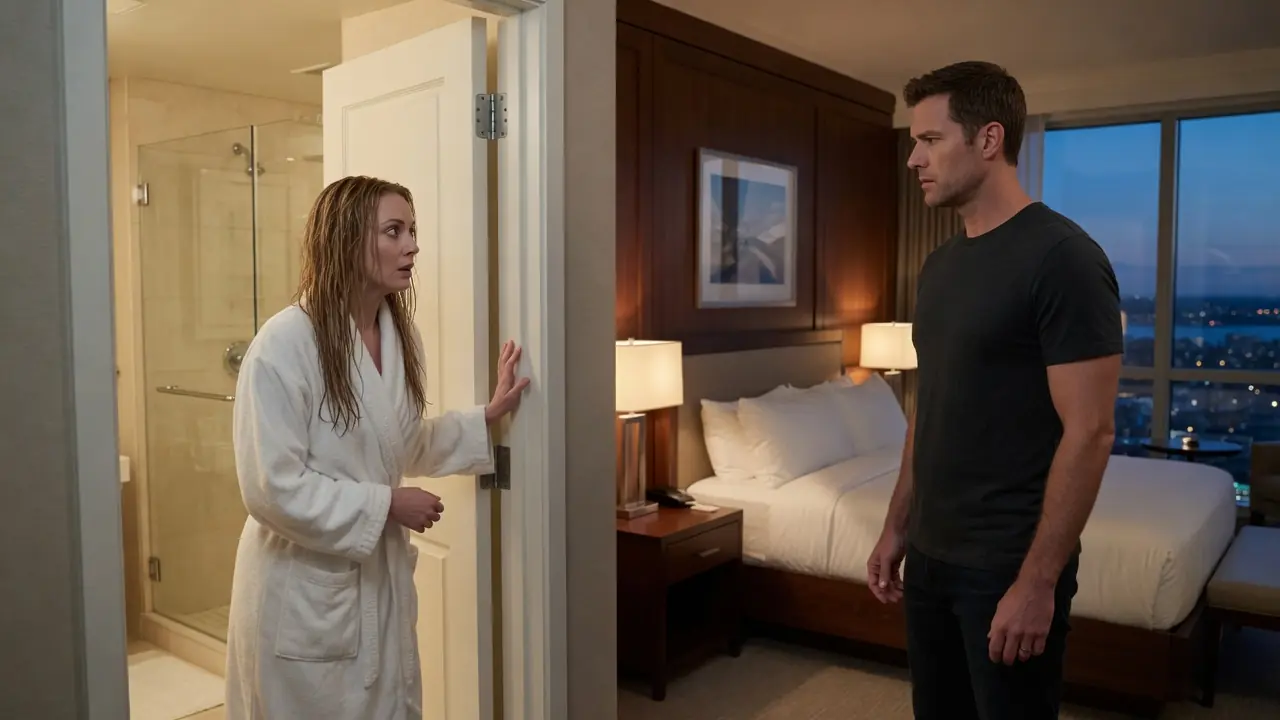
Nola appeared behind Owen wearing one of his white shirts and nothing else visible below it.
Her hair was messy.
Her makeup was faded.
Her face held horror, rage, and disbelief in rapid succession.
“Asher,” she whispered. “What are you doing here?”
“Delivering your mail.”
Rodriguez stepped forward.
“Nola Vero, you have been served.”
He handed her the envelope with professional boredom.
She took it with shaking hands and looked down as if the words might change if she stared hard enough.
“You can’t do this,” she said.
“I can,” I replied. “And I did.”
Owen tried to recover his dignity by stepping forward, but the robe ruined most of the effect.
“Now look here, Asher—”
“No.”
My voice cut the hallway clean.
“You look. Both of you. This is what happens when you mistake silence for stupidity.”
Nola flinched.
“I knew about the penthouse,” I said. “The weekends. The red dress. The lies about Maya. The holiday party. The calls. The parking garage. The way both of you smiled in my face while treating my marriage like a joke.”
Nola’s eyes filled with tears.
I knew her tears too well to trust them.
She cried when things got ugly, not always when she felt sorry.
“Please,” she said. “It wasn’t supposed to happen like this.”
I looked at her standing in another man’s doorway.
“That is the first honest thing you’ve said in months. You never cared that it happened. You only cared that I found out.”
Owen’s face reddened.
“This is a private matter.”
“You made it public the moment you brought my wife into your office, your events, your hotel rooms, and your bed.”
He stiffened.
“You should be careful.”
I almost smiled.
“People say that when they have run out of truth.”
Nola clutched the papers to her chest.
“Asher, we can talk. Please. Just come inside.”
“No.”
“It’s not what you think.”
Jake made a low sound behind me.
Even Rodriguez looked briefly amused.
I tilted my head.
“You are standing barefoot in your boss’s penthouse wearing his shirt after telling me you were staying with Maya. Which part am I misunderstanding?”
Nola’s mouth opened.
Nothing came out.
I reached into my coat pocket and pulled out a small folded list.
“Dates. Locations. Account activity. Phone records. Witness statements. Photographs. Emails. Enough patterns to make your lawyer hate the day you met Owen Rusk.”
Her face drained of color.
“Documents?”
“Yes. I document problems before they become disasters. You knew that about me. You just forgot it applied to you too.”
Owen stepped closer.
“You have no right to threaten us.”
“I have every right to protect myself.”
Nola’s fear sharpened into anger.
“You’re cruel.”
“No,” I said. “Cruel is lying beside someone at night while planning your next weekend with another man. Cruel is kissing your husband goodbye while your lover waits upstairs. Cruel is letting your friends believe I consented to your affair so you could make your betrayal sound progressive.”
That hit her.
Good.
Cleo’s drunken confession had clearly not been part of Nola’s risk plan.
“What did Cleo say?” she whispered.
“Enough.”
Owen looked toward Nola.
Just a glance.
But I saw it.
Not concern.
Calculation.
He was already measuring the damage she had brought to his door.
“You told people Asher was fine with this?” Owen said under his breath.
Nola turned toward him.
“You said we needed a simple explanation.”
“I said discretion mattered.”
“Do not do this right now,” she snapped.
I watched them begin to turn on each other in the doorway and felt the last trace of attachment inside me die quietly.
There was no grand heartbreak in that moment.
No final explosion.
Just the small, clean click of a lock turning.
“You will find the locks changed by noon,” I said to Nola. “Your personal belongings will be packed and delivered to whatever address your attorney provides. The joint accounts are frozen pending legal division, and the car you drove here will be returned because I am no longer paying for transportation to your affair.”
She stared at me.
“You planned all of this.”
“Yes.”
“You wanted to hurt me.”
“No,” I said. “I wanted to stop being hurt by you.”
For one second, shame crossed her face.
Then panic covered it.
“Asher, please. We can handle this quietly.”
I looked past her into the penthouse.
Expensive furniture.
Half-empty wine glasses.
Black heels by the sofa.
The red dress hanging over the back of a chair.
“You had six months to talk,” I said. “You used that time to lie.”
Owen lowered his voice.
“Think carefully before you make this ugly. People in this city know me.”
“That is exactly the point, Owen.”
He narrowed his eyes.
“Meaning?”
“Investors know you. Your board knows you. Your employees know Nola reports to you. By Monday morning, they will know just how closely you two have been working.”
Nola whispered his name.
Not mine.
His.
She was more afraid for him than for what she had done to us.
That told me everything I needed to know.
I stepped toward the elevator.
“Enjoy the rest of your week at Maya’s.”
The doors opened.
Jake followed me inside.
Just before they closed, I saw Nola clutching the divorce papers in Owen’s doorway, with Owen standing behind her like a man watching a building collapse from the top floor.
The elevator began to descend.
Jake exhaled slowly.
“I have seen bar fights less brutal than that.”
“I did not touch either of them.”
“No,” Jake said. “You did worse. You made them look at themselves.”
By noon, the locks were changed.
By two, the car service I had arranged retrieved the vehicle from Harbor View’s private garage.
By five, Nola’s attorney called Gavin.
By six, Nola texted me fifteen times.
I read none of the messages.
I forwarded them to Gavin.
That was the first peaceful thing I had done in months.
By Monday morning, Hartford Heights was whispering.
Nola’s first move was predictable.
She tried to control the story before the truth could.
She posted careful little messages about betrayal, cruelty, and learning who people really are during hard times.
Friends who knew nothing commented with hearts and outrage.
You’re so strong.
You deserve peace.
Some people only show their real face when things get hard.
I saved every post.
I saved every comment.
Then I sent them to Gavin, who responded with one sentence.
“She is building our case for us.”
That was the problem with people like Nola.
They were so skilled at shaping public perception that they forgot facts still existed.
On Tuesday, she came to my office dressed like a woman entering battle.
Navy suit.
Perfect makeup.
Hair sleek.
Eyes sharp enough to cut glass.
She walked past my assistant without waiting and sat across from my desk as if she still had the right to demand my attention.
“We need to talk,” she said.
“I thought that was what lawyers were for.”
“Do not be cute, Asher.”
“I stopped being cute when I found you in your boss’s penthouse.”
Her face tightened.
She kept her voice low.
“This does not have to ruin both our lives. We can settle quietly, split things fairly, sign non-disclosure agreements, and move on.”
“By fairly, you mean I stay silent while you keep the reputation you used to lie to everyone.”
“I mean we act like adults.”
“No,” I said. “Adults tell the truth before they get caught.”
She leaned forward.
For a moment, I saw the woman who had once convinced entire rooms of executives to believe impossible things.
“Owen is worried about publicity,” she said. “Meridian is already asking questions. If this gets bigger, people could lose their jobs.”
“That is interesting.”
“Asher—”
“You were not worried about jobs when you started sleeping with the CEO.”
Her eyes flashed.
“You do not get to reduce what happened to one ugly sentence.”
“I can reduce it to four,” I said. “You cheated with Owen.”
She looked away.
That small movement was more honest than anything she had said.
“I was unhappy.”
“So was I.”
“You were always working.”
“So were you.”
“You were distant.”
“You were lying.”
She looked back at me, angry now.
“You never fought for us.”
I stood.
“I fought quietly for months. I asked questions. I came home early. I bought flowers. I tried to understand why my wife had become a guest in our marriage.”
Her expression shifted.
I continued.
“You mistook my restraint for indifference. That was your mistake.”
For the first time, her confidence cracked.
“You are enjoying this.”
“No,” I said. “I am surviving it. There is a difference, and it says a lot about you that you cannot tell.”
When she left my office, she told me I would regret refusing her offer.
I believed she meant it.
But I also knew panic had started making her careless.
Within days, Meridian opened an internal investigation into her relationship with Owen.
I did not need to fabricate anything.
The truth had more teeth than any lie I could invent.
Cleo called me on Thursday night.
Her voice trembled.
“I’m sorry,” she said before I could greet her.
I stood near the window in my temporary apartment, looking down at traffic.
“For what?”
“For knowing.”
I said nothing.
“She told me you were okay with it,” Cleo whispered. “I thought it was strange, but she said you two had some modern understanding. I wanted to believe her.”
“Why?”
“Because believing her meant I didn’t have to decide what kind of friend I was being.”
That was honest.
Painfully so.
“What changed?” I asked.
“She asked me to lie. She wanted me to say she stayed at Maya’s if anyone asked. She even told me what dates to use.”
Cleo’s breath shook.
“I recorded part of the conversation.”
“Why?”
“Because I finally understood she would let me fall with her if she needed to.”
She sent the recording to Gavin.
When he heard it, he called it a gift wrapped in arrogance.
Owen tried to distance himself first.
Men like him always do when consequences get expensive.
He told Meridian’s board that Nola had misunderstood their relationship.
He said she had become emotionally attached during a difficult marriage.
He said he had tried to guide her professionally.
He said he regretted any confusion.
Confusion.
That was the word he chose.
Not betrayal.
Not misconduct.
Not abuse of authority.
Confusion.
Nola heard about his statement through Cleo and called me screaming, as if I were responsible for Owen betraying her too.
“He is making me sound unstable,” she said.
“That is the thing about men who cheat with married women,” I told her. “They are usually not famous for loyalty.”
She went silent.
For the first time, I heard fear in her breathing rather than anger.
Owen had sold her a fantasy, and now he was trying to return it before the bill arrived.
The man she had risked everything for was already calculating how to save himself.
It might have been satisfying if it had not also been pathetic.
The divorce moved quickly after that.
Nola’s attorney came in aggressive, accusing me of emotional cruelty, financial control, and intentional public humiliation.
Gavin answered with documents.
Timelines.
Bank records.
Travel receipts.
Witness statements.
Screenshots.
Parking logs.
Evidence of hidden income Nola had never disclosed.
Every accusation she made required a door to be opened.
Behind every door was another truth she did not want seen.
By the second hearing, her side stopped performing outrage and started asking about settlement.
I remember that hearing clearly.
The room was small, beige, and colder than necessary.
Nola sat across the table in a cream blazer, her hands folded perfectly, though the skin around her eyes looked tired.
Her attorney spoke often.
Nola spoke only when forced.
At one point, Gavin slid a printed timeline across the table.
Nola’s attorney skimmed it.
Then stopped.
Then looked at her.
“Is this accurate?”
Nola looked down.
Her lips pressed together.
“Yes.”
One word.
One small collapse.
Gavin did not smile.
Neither did I.
Owen’s problems became worse.
Meridian suspended him after investors demanded an explanation for undisclosed relationships with employees.
Former staff began talking.
Old complaints resurfaced.
A pattern appeared, because patterns always appear when people stop being afraid separately and start speaking together.
There was the assistant who had transferred departments after rejecting his invitations.
The project manager whose promotion vanished after she pushed back on his “mentorship dinners.”
The consultant who said Owen blurred boundaries so often that the company had learned to call it charisma.
He had wanted Nola as proof of his power.
In the end, their affair exposed how carelessly he had used it.
Nola moved into a corporate apartment on the edge of town.
The red dress disappeared from her social media, along with the wounded posts and brave captions.
She looked smaller when I saw her at mediation.
Not physically.
In the way people look when they realize the story they told themselves cannot survive contact with reality.
She avoided my eyes until the final papers were placed on the table.
“I loved you once,” she said quietly while the lawyers reviewed the documents.
“I know.”
“I lost myself.”
“No,” I said. “You chose yourself. You just did not like what that choice revealed.”
She flinched.
I did not say it to wound her.
That was simply the truth as I understood it.
She cried then.
Softly.
Without performance.
For the first time, I almost felt sorry for her.
Almost.
But pity is not forgiveness.
Sadness is not trust.
And regret is not repair.
Some bridges burn so completely that even memory cannot cross them safely.
The settlement was clean.
The house would be sold.
The cars divided by legal ownership.
The accounts separated.
No spousal support beyond what the law required.
No public statements naming me as abusive, controlling, or responsible for her affair.
No non-disclosure agreement protecting Owen.
Nola hated that clause most.
Not because she wanted Owen protected.
Because she wanted the whole thing buried.
“You are really going to let people talk about me forever?” she asked outside the mediation room.
“People will talk for two weeks,” I said. “Then they will talk about someone else.”
“That is not comforting.”
“It was not meant to be.”
She looked at me then.
Really looked.
For a second, I saw the woman I had married.
Not the polished PR director.
Not Owen’s lover.
Not the person trying to negotiate reputation like an asset.
Just Nola.
Tired.
Frightened.
Human.
“I made a terrible mistake,” she whispered.
“No,” I said. “A mistake is forgetting an anniversary. Missing a flight. Sending an email to the wrong person. What you did was a series of choices.”
Her eyes filled again.
“You sound like you hate me.”
“I don’t.”
“Then what is this?”
I took a breath.
“This is what love becomes after trust dies and dignity survives.”
She had no answer for that.
The house sold in spring.
Strangers walked through rooms where I had once tried to build a life with Nola. They opened closets, admired the kitchen, discussed natural light, and stood in our bedroom without knowing what had begun and ended there.
I expected grief to hit me hardest then.
It did not.
The bedroom no longer looked like a place where betrayal had happened.
It was just a room.
Walls.
Windows.
Floorboards.
Waiting for people who did not know our ghosts.
On the day I moved out, Jake helped me load the last boxes into a rented truck.
He carried two lamps, one badly packed box of books, and a framed photograph he found in the hallway closet.
It was from our fifth anniversary.
Nola and me at the coast.
Her head on my shoulder.
My arms around her waist.
Both of us smiling at someone out of frame.
Jake held it up.
“You keeping this?”
I looked at the photo.
The man in it looked happy.
The woman did too.
Maybe she had been.
Maybe we both had.
“No,” I said.
Jake nodded and placed it gently in the trash bin instead of making a ceremony of it.
That was one of the reasons I loved him like family.
He knew when not to make something bigger than it needed to be.
“Where are you going first?” he asked after we closed the truck.
“I rented a small place near the water for a few months.”
“Sounds peaceful.”
“That’s the idea.”
He studied me.
“You okay?”
I thought about lying.
Then decided I was done living inside polite falsehoods.
“No,” I said. “But I’m closer than I was.”
Jake nodded.
“That counts.”
That evening, I stood alone on the porch before locking the front door for the last time.
Riverside Estates was calm.
The lawns were trimmed.
The windows glowed.
Perfect houses holding imperfect lives inside them.
For years, I had believed peace meant keeping the picture steady no matter what was happening behind it.
Now I understood that peace begins the moment you stop protecting a lie.
I locked the door.
Dropped the key in the agent’s box.
Walked away.
Three weeks after the divorce became final, Nola texted me.
I hope one day you understand I never meant to hurt you this badly.
I read it twice.
Not because it moved me.
Because it sounded exactly like her.
Even in apology, she measured the damage by what she had intended, not what she had done.
I typed a reply.
Then deleted it.
There was nothing left to explain.
Some people mistake silence for weakness.
Sometimes silence is simply the sound of a door closing forever.
Owen resigned from Meridian two months later.
The official statement said he was leaving to pursue private investment opportunities.
Everyone knew what that meant.
Nola left soon after.
Not dramatically.
No farewell post.
No brave caption.
No elegant statement about new beginnings.
She simply disappeared from the professional circles where she had once moved like a queen.
I heard from Cleo that she had taken a consulting role in another city.
I did not ask which one.
The new apartment near the water was smaller than the house in Riverside Estates.
Much smaller.
One bedroom.
Old hardwood floors.
A narrow balcony.
A kitchen with cabinets that stuck when it rained.
But the windows faced the river, and every morning the light came in honest.
No staged photographs.
No half-truths.
No perfume I had learned to dread.
No phone buzzing face down on marble.
At first, the quiet unnerved me.
I had grown used to silence meaning something was hidden.
Now silence meant there was nothing to decode.
It took time for my body to believe that.
On Sunday mornings, I made coffee and sat by the window.
I watched boats cut through the water.
I answered emails only after breakfast.
I bought tulips once, white ones, because I realized I still liked them.
That felt important somehow.
Not letting the betrayal own even the flowers.
Months passed.
The legal file closed.
The house money cleared.
Gavin sent one final email that said, “All done.”
I stared at those two words longer than expected.
All done.
Eight years of marriage did not feel like something that could be ended by two words in an email.
But legally, it had.
Emotionally, it had ended in stages.
The phone.
The laughter.
The red dress.
The penthouse door.
The envelope in her shaking hands.
The moment she whispered Owen’s name before mine.
The final ending was not the divorce decree.
It was the morning I woke up and realized I had not wondered where she was.
That was freedom.
Not happiness exactly.
Not yet.
Freedom.
One afternoon, Jake came by with sandwiches and two coffees.
He stood on the balcony beside me, looking at the river.
“You miss her?” he asked.
I thought about it.
“I miss who I thought she was.”
“That’s not the same.”
“No.”
“Do you miss the house?”
“Sometimes.”
He nodded.
“Do you miss being married?”
I watched sunlight move across the water.
“I miss believing I was safe with someone.”
Jake did not answer quickly.
Then he said, “You will again.”
I looked at him.
He shrugged.
“Not today. Not tomorrow. But someday.”
Maybe he was right.
Maybe he was not.
For now, I was learning something simpler.
How to be in a room without scanning it for lies.
How to sleep without waiting for the sound of a car in the driveway.
How to eat dinner without studying someone’s face across the table.
How to stop confusing vigilance with love.
Nola had once told me I was the best husband a girl could ask for.
At the time, it had sounded like gratitude.
Later, it sounded like mockery.
Now, months later, it sounded like evidence of the saddest part of the whole thing.
I had been a good husband.
Not perfect.
Not romantic enough every day.
Not always present in the way she may have needed.
But faithful.
Steady.
Honest.
And she had mistaken steady for blind.
That was her mistake.
Mine was believing love required me to keep making space for someone who had already left.
The lesson cost me eight years.
But I learned it.
For the first time in months, no one was lying to me.
No phone buzzed with half-truths.
No one stood in a doorway clutching another man’s shirt and begging me to misunderstand what I had seen with my own eyes.
No polished smile asked me to ignore the obvious.
There was only quiet.
River light.
Coffee cooling in my hand.
The clean ache of a life after betrayal.
And for once, quiet did not feel like planning.
It felt like freedom.