"Get out."
"Sir, I have an appointment."
"I don't care. Get your filthy boots off my floor."
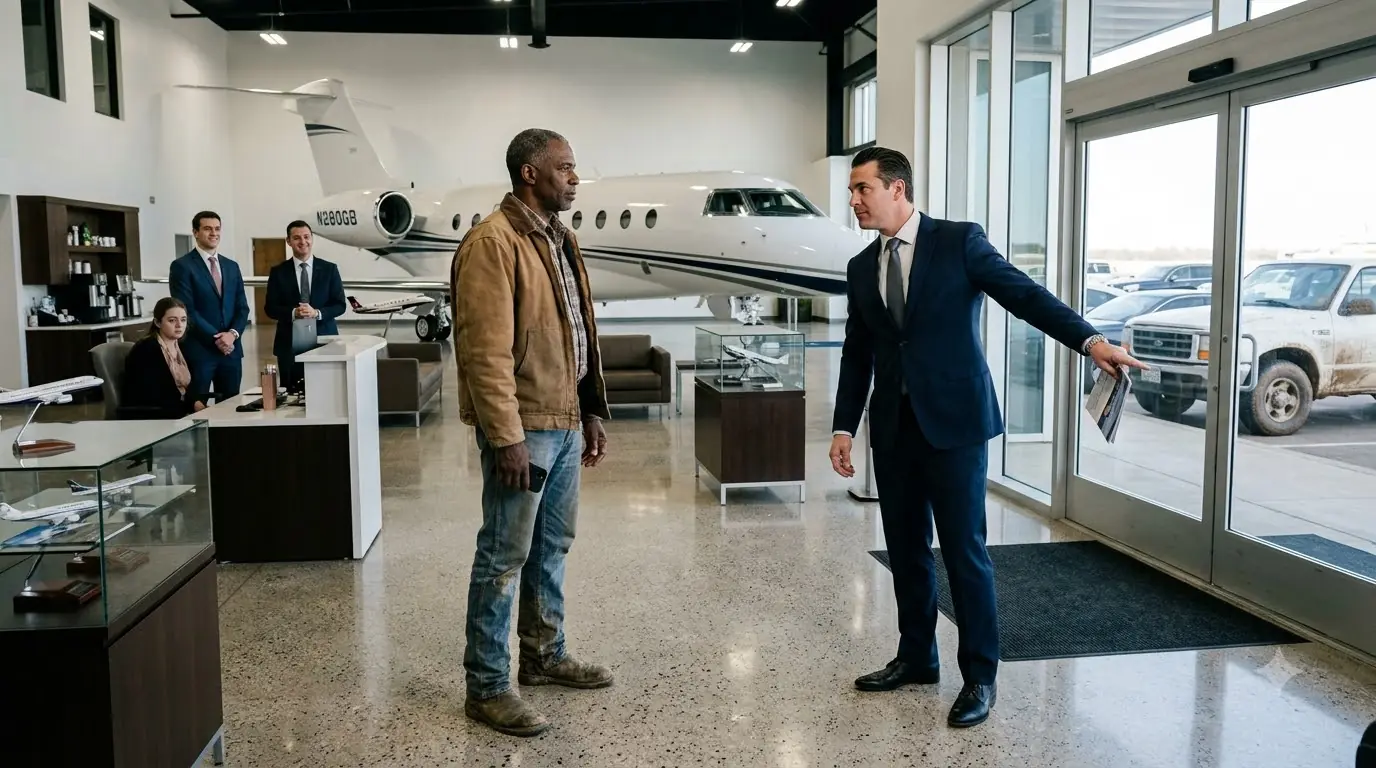
"I'm here about the G280."
"A jet? You? Oh. That's the funniest damn thing I've heard all year. Garrett, come here. This dirty, stinking farmer thinks he can buy a jet."
"I scheduled online last week. I can show you the confirmation."
"Listen to me, you reek like a cattle pen. People like you don't walk into places like this. Now, get out before I throw you out myself."
"I'd like to speak with your manager."
"My manager would laugh harder than me. Now, move."
The Black man didn't move one inch. His eyes locked on the salesman, calm, still, unbroken. Because what happened next, nobody in that showroom saw coming. His name was Aaron Brooks, 53 years old, hands rough as sandpaper, skin dark as the Oklahoma soil he'd worked since he was 12. Every morning Aaron woke at 4:30, not because an alarm told him to, but because his body just knew.
Thirty years of the same rhythm: feet on cold hardwood, coffee brewing before the sun cracked the horizon. By 5:00, he was walking his land, 4,800 acres of winter wheat, soybeans, and grain sorghum stretching across the Oklahoma plains.
The red dirt crunched under his boots. Morning frost bit at his knuckles. The smell of wet earth and diesel hung in the air like perfume he'd worn his whole life. Aaron didn't look like a man worth $220 million. He drove a 10-year-old Ford F-250 with a dent in the tailgate.
He wore the same rotation of three Carhartt jackets, all faded, all patched at the elbows. He lived in the same farmhouse his grandfather built in 1956, though he'd renovated it twice over the years. But behind that quiet exterior was an empire. Brooks Agricultural Holdings. Three states, Oklahoma, Arkansas, Kansas.
Annual revenue, $85 million. Contracts with three of the five largest food distributors in the country. Two processing plants. A grain elevator network. A fleet of 60 trucks moving product across the Midwest every single day.
Aaron built all of it from 90 acres. That's what his grandfather left him. 90 acres and a handwritten note that said, "Don't ever sell the land, son. The land is the only thing that can't lie to you." He never sold a single acre.
He bought more. His wife Denise ran the business office from a converted barn behind the farmhouse. Sharp, elegant, the kind of woman who could read a quarterly report at breakfast and negotiate a supply contract by lunch. She'd been telling Aaron the same thing for 2 years now.
"You fly commercial six times a month, Aaron. Six. Buy the jet already." He finally listened.
Aaron did what he always did, his homework. He spent 3 months researching, talked to pilots, studied fuel costs, range, maintenance schedules. He settled on the Gulfstream G280, mid-range, reliable, perfect for hopping between his farms, processing plants, and distributor meetings across the Midwest. He went to the Summit Air Aviation website, filled out the inquiry form, checked the box for aircraft in the $25 to $35 million range, hit submit, got a confirmation email the next morning with a 10:00 appointment. Denise looked at him that morning as he grabbed his truck keys.
She was leaning against the kitchen counter, coffee in hand, one eyebrow raised. "You're going like that?" Aaron looked down at himself, boots, jeans, work jacket. "What's wrong with this?" "Aaron, you're walking into a jet dealership."
"If they need me in a suit to take my money, they don't deserve the sale." Denise shook her head, but smiled. "Don't say I didn't warn you." He kissed her on the forehead and walked out the door.
The screen slammed behind him. The dogs barked from the porch. The morning air tasted like cold metal and hay.
Forty-five minutes later, Aaron pulled his mud-splattered F-250 into the parking lot of Summit Air Aviation near Wiley Post Airport in Oklahoma City. The building was all glass and steel, sleek, modern. Two flags snapped in the wind out front, American and corporate. The parking lot looked like a luxury car commercial.
A black Porsche, a white Range Rover, a silver Mercedes with a vanity plate, and then Aaron's truck. Red dirt on the wheel wells, a cracked bug guard on the hood, a pair of work gloves on the dashboard. He sat in the cab for a moment, looked at the building, took a breath. Then he stepped out, boots hitting asphalt, and walked toward the glass doors.
Inside, the showroom was cathedral quiet. Marble floors reflected the overhead lights. The air was cool and carried a faint scent of cologne and polished metal. Scale models of jets lined the walls. Brochures fanned across glass tables.