June Marlowe thought it was just another Tuesday morning until she pressed record on her phone in a dark alley and heard a man describe her death like a scheduling call.
It was 8:47 a.m. in October.
June stood at her counter, coffee pot in hand, watching two men in gray suits who had not touched their coffee in eleven minutes and had not taken their eyes off her once.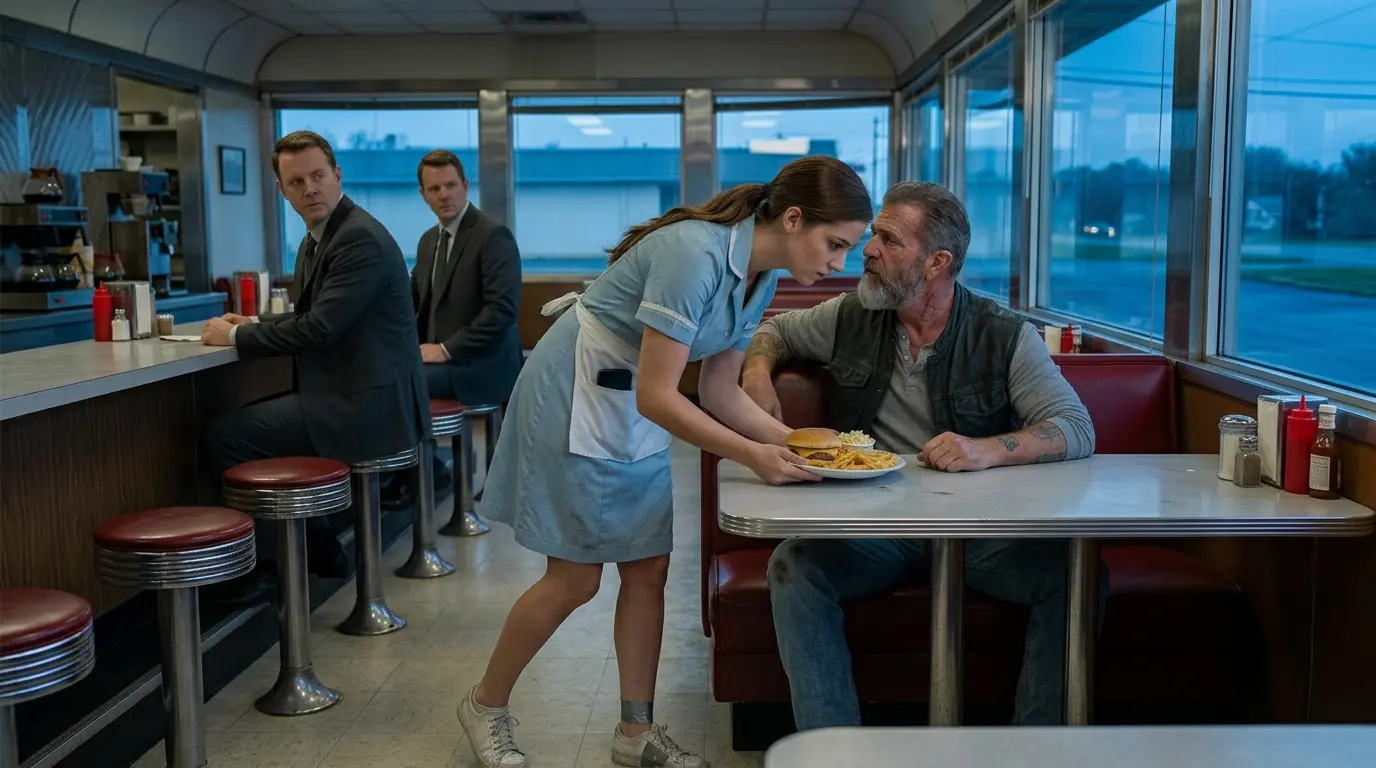
The recording in her apron pocket was 47 seconds long.
She had replayed it four times.
She still did not know what the Hensley situation was. She only knew that whatever it meant, she had 31 days before the same thing happened to her.
That was when the lawyer at table three confirmed his lunch reservation instead of calling for help.
That was when the red Roadster couple left their bill in cash and walked out without looking back.
That was when a scarred biker in the back booth, a man who had known her dead father’s secret for 23 years, stood up and crossed the floor.
All June had was 47 seconds of audio, a name she did not recognize, and nine words whispered by a stranger that were about to rewrite everything she had ever been told about her own life.
“I recorded him because I thought if I didn’t, nobody would believe me.
“I was right about that part.
“What I was wrong about was thinking I was alone.”
The split in the sole of June’s left sneaker made a sound on the linoleum that nobody at Melvin’s Roadhouse Diner had ever put a name to.
Tap-squeak.
Tap-squeak.
It traveled ahead of her each morning like an announcement.
Coffee pot in her right hand. Order pad tucked in her apron pocket. Dark eyes already moving across the room before she had fully cleared the kitchen door, clocking exits, occupied seats, and the corner by the emergency door that had been empty since six.
She had been doing this since she was old enough to walk into a room.
She could not have told you why.
She had stopped trying to explain it, even to herself.
October in Murfreesboro had turned the light gray and thin, pressing flat against the plate-glass windows of the diner and going no further.
The coffee machine hissed.
The radio was playing something with steel guitar.
In the kitchen, Jimmy hummed along to a song the radio was not playing. Off-key, comfortable, the sound of a man who had worked the same eight square feet of kitchen floor for eleven years and had made his peace with it.
June refilled table three, cleared table two, and felt the back of her neck tighten before she consciously understood what her eyes had already told her.
Two men sat at the counter in dark suits, the kind that did not wrinkle.
They had come in together at 8:17, but sat one stool apart, not looking at each other, not speaking.
One of them had ordered coffee.
The other had not.
Neither cup had been touched.
Their eyes had not moved from June in four minutes.
She pressed a crescent mark into her left palm without noticing, her thumbnail driving into the old groove, and moved toward the far end of the counter where two truckers were sitting with their phones face up, thumbs scrolling.
She let the coffee pot tilt slightly, a small fumble practiced in quiet, just enough to create a reason to lean close.
She tilted her head toward the suited men without looking directly at them.
“Something’s wrong,” she said with her eyes.
“Please.”
Neither trucker looked up.
Here is something about that moment worth sitting with.
June Marlowe was 24 years old. She had no language for what she was feeling, only the feeling itself pressed hard behind her sternum like a stone that had been there so long she had learned to breathe around it.
She had no evidence that would satisfy anyone with a badge.
She had a 47-second phone recording she did not fully understand, a man outside saying her shift times out loud, and 23 years of something is always wrong that she had been told her whole life was just anxiety.
The truckers were not bad men.
They had their own mornings, their own phones, their own lives running at full speed.
But here is the thing about vigilance that exhausted itself asking for help.
At some point, it stops asking.
And the people who know the least about what it cost her to reach toward those truckers with her eyes are often the ones who later say, “Well, why didn’t she just say something?”
She said something three times.
The retired couple at the window booth saw her.
A woman of sixty-eight and her husband of seventy-one, sharing a plate of wheat toast like they had probably shared it every Tuesday for twenty years.
They were the ones who actually saw.
June was crossing back toward the service station when she caught the woman’s eye across the diner. She held it for one second longer than professional, and then, barely, she mouthed a single word.
“Please.”
The woman’s face changed.
You know that change, when someone’s expression shifts from open to careful.
Her hand moved across the table and touched her husband’s arm.
They left their bill in cash, folded under the edge of the toast plate.
They did not look back.
The door closed behind them quietly.
They had seen something was wrong.
They had done the math and chosen the door.
June stood at the service station for three full seconds, coffee pot still in her hand.
Then she picked up a cloth and wiped down a counter that was already clean.
The lawyer at table three had a Rutherford County Courthouse ID badge on his lanyard and a legal pad in front of him with a case number printed neatly at the top.
Early fifties. The comfortable authority of a man who had spent his career in rooms where his word carried weight.
June approached to refill his coffee. She kept her voice below the radio, not whispered, just low. The register of someone trying not to make a scene while making a scene.
“Those two men at the counter have been watching me since they sat down,” she said. “I’m scared. Can you help me?”
The lawyer looked up.
He looked at the counter.
He looked back at June.
Then he reached for his phone.
She thought he was calling someone.
He was confirming a lunch reservation.
“Sweetheart, I can’t get involved in whatever’s going on here. I’ve got a deposition in forty minutes.”
That lawyer had the full weight of the legal system printed on the badge around his neck.
He had a warm cup in his hand.
He had, based on where he sat every Tuesday morning, almost certainly passed that courthouse badge through a security scanner earlier that day. A scanner that existed specifically to stand between harm and the people who needed the system to function.
And he looked at a young woman with shadows under her eyes and a coffee pot that would not stop shaking, and he chose his deposition.
He was not a monster.
He was a person who did what most people do in that moment. The fast, private calculation between something is wrong here and this is not my problem.
It takes less than two seconds to run that math.
Most of the time, nobody even knows they ran it.
But that math has a cost, and the cost is not paid by the person who ran it.
It is paid by the girl with the shaking coffee pot.
The radio played.
Jimmy hummed.
The suited man at the counter shifted his weight, and the leather of his shoe creaked against the floor.
Tap-squeak.
Tap-squeak.
June was moving back toward the service station when she felt a hand settle on her shoulder.
Not gripping.
Not pulling.
Just landing, heavy and warm, with the particular steadiness of something that had been on its way for a very long time.
She stopped.
He was already beside her when she turned.
Or rather, he had positioned himself so that his body was between her and the counter before she had finished turning, and she understood without thinking about it that this was not an accident.
He was six feet two, maybe two hundred and twenty pounds, with a burn scar running from his jaw down the side of his neck, silver and settled, old enough that he had stopped being aware of it.
He wore a Hells Angels Tennessee chapter cut over a gray thermal, worn Levi’s, and boots resoled so many times the leather had soft creases where a new pair would not.
His lips barely moved.
“You’re in danger. Pretend I’m your father.”
Nine words.
That was all.
Here is the thing about those nine words.
He did not say, “I can help you.”
He did not say, “Don’t worry.”
He said the one thing that required her to do something immediately, in the next breath, before she had time to think about whether she trusted him.
“Pretend I’m your father.”
And the word father landed in a place that had been empty her entire life.
June’s knuckles tightened on the coffee pot.
Her eyes went to the counter. One suited man had turned toward them now.
Then she looked back to the man in front of her.
She took one breath.
“Dad,” she said. “I already told you I can’t make it Sunday.”
His name was Gideon Marsh.
Road name, Copperhead.
Fifty-three years old. Twenty-two years in the United States Marine Corps. Force Recon. Three tours. Retired as Master Gunnery Sergeant.
Seventeen years in the Hells Angels Tennessee chapter.
Road captain.
He had been sitting in the back booth of Melvin’s Roadhouse since 8:17 that morning. A cup of black coffee sat in front of him, untouched.
He had been watching the front entrance in the reflection of the window glass.
He had not planned to move today.
Today was supposed to be surveillance only.
Then the second suited man had locked his eyes on June Marlowe and held them there for four minutes straight.
And Gideon had set down his cup, slid out of the booth, and crossed the floor.
What he did not say to June because there was no time, and because the diner was not the place, was what he had been doing in this diner and the ones before it. In parking lots and side streets across three states for seven years.
That was going to take longer than nine words.
It was going to take everything.
“Play along,” Gideon said, his voice low and conversational. The easy tone of a man catching up with family. “You’re doing well. Don’t look at them directly. Look annoyed with me. Like you’ve heard the story before.”
June exhaled through her nose.
She shifted her weight, crossing one arm over the coffee pot in a posture that read exactly like a daughter who had been having this argument since middle school.
“You always do this,” she said.
The words came out more steadily than she expected.
“And you always come around eventually,” Gideon answered.
From the counter behind them came the sound of a coffee cup being set down.
Not finished.
Just placed.
The way you set something down when you are paying attention to something else.
Gideon did not look.
His eyes moved from June’s face to a point just past her left shoulder, then back.
“How long have they been here?”
His lips moved in the space between one sentence and the next.
Almost invisible.
“Since 8:17.”
“Both of them?”
“They came in together. One minute apart. But they knew each other.”
His jaw tightened once.
Then released.
“Your apron pocket,” he said. “Is your phone in it?”
“Yes.”
“Keep your hand on it. If I tell you to move, you move. Back of the diner, through the kitchen, door into the alley. Don’t stop.”
June felt something strange happen in her chest.
Not calm exactly.
But the opposite of the free fall she had been in for four minutes.
Something had found the floor.
She brought the coffee pot up in a familiar arc, refilling a cup that did not need refilling, and said at normal volume, “Well, tell Mom I said hi.”
He guided her to a booth.
His body remained between her and the counter. Not obviously. Not with theater. Just positioned there the way a man is positioned when he has been doing this for a long time and it has become reflex.
She sat.
He sat across from her.
The suited men at the counter had not moved, but one of them had put his phone away.
“Three weeks ago,” June said, her voice dropping to the edge of the radio’s reach, “I was outside this diner taking out the trash after close. There was a man in the alley. He was on the phone. Back turned. I heard him talking.”
“What did he say?”
June put her hand in her apron pocket and found the familiar weight of her phone.
“He said I work Tuesdays. He knew my schedule. Not my general hours. My specific days.”
She swallowed.
“He mentioned a 31-day deadline. He said to make it look like a car accident. And he said…”
She stopped.
On the other side of the room, a shoe moved on linoleum.
“He said, same as the Hensley situation.”
Gideon’s face did not move.
But something behind it did.
“Did you record it?”
“Forty-seven seconds. I hit record before I understood why. I’ve replayed it four times. I still don’t know what it means.”
He looked at her for a long moment.
Not the evaluating look she had braced for.
Not, is she credible?
Not, is she exaggerating?
Just a look that held something she had not expected from a stranger.
“I know what it means,” he said.
He turned his left wrist over on the table, face up, palm toward the ceiling.
In the gray morning light coming through the window, the name inked on the inside of his wrist was legible now.
Thomas.
June’s eyes went to it.
Then back to his face.
Then back to it.
“Your father made me a promise the night he died,” Gideon said. “That I would not let them have you.”
He paused.
“I’ve kept it twenty-three years. I’m not stopping now. Not in this diner. Not today.”
What June did not fully understand yet, what she would not understand for another two hours in a parking garage on Gateway Boulevard with a cold wind coming off the November overcast, was the scale of what she had walked into.
She did not know about Warren Calloway.
She did not know about the Braddock syndicate.
She did not know that the 31-day window Calloway’s voice described on that recording was a legal mechanism. A dormant fund established 19 years ago, when her father’s name briefly surfaced in a federal investigation before the case was buried.
A fund holding just over $312,000, unclaimed for two decades, now sitting inside a probate review window that Calloway had been working for months to redirect through a shell company before federal auditors could get near it.
She did not know that the two men at the counter were not there to gather information.
The decision had already been made.
They were closers.
Their presence in the diner meant the clock had already moved from 31 days to hours.
But she knew about the name on his wrist.
For right now, that was enough to keep her in the booth.
Gideon made one call from the parking lot sixty seconds after they walked out the back.
June was beside him, still in her diner uniform, the October cold finding the gap between her collar and her neck.
She wrapped her arms around herself and watched him without speaking.
The call lasted 41 seconds.
“Brimstone, it’s Copperhead.”
“Talk to me.”
“Melvin’s Diner on Shelbyville. Two operators on a girl named June Marlowe. Braddock syndicate. Thirty-one-day legal window. Already inside the final stretch. They are not here to watch.”
A pause on the other end.
Short.
“How many do you need?”
“However many chapters answer when you call.”
Another pause.
“Give me until tonight.”
The line went dead.
Gideon lowered the phone.
The parking lot was quiet around them. Morning traffic on Shelbyville Pike. A truck backing into the strip mall across the road. The smell of exhaust and cold pavement.
June said, “Who was that?”
“Forrest Calloway. Road name, Brimstone. He runs the chapter.”
“What did he say?”
Gideon put the phone in his pocket.
“He said tonight.”
Forrest “Brimstone” Calloway was sixty-one years old and had a hip replacement four years back that he managed with the same attitude he applied to everything else: acknowledgement of inconvenient facts followed by decisive movement.
He had done eleven years on a weapons charge he chose not to fight because fighting it would have exposed two brothers.
He came out of those eleven years with a paralegal certificate, an encyclopedic knowledge of civil procedure, and absolutely zero interest in being thanked for any of it.
When his phone buzzed at 8:47 that morning and he saw Copperhead’s name on the screen, he was in his kitchen drinking coffee.
He was sixty-one. He had been in the chapter for twenty-nine years. He knew what a call from Copperhead meant.
He called the Murfreesboro chapter sergeant at arms first.
Forty-one riders on the roster.
He told him the situation in three sentences.
“How many can roll tonight?”
“All of them.”
He called the Smyrna chapter next.
Twenty-nine riders.
Same answer.
By 11:30 that morning, a message had gone out through the network. Three words and a location.
By 11:47, the Nashville chapter had confirmed twenty-seven more riders driving south.
Ninety-seven motorcycles.
Three chapters.
The largest combined turnout in Tennessee in nine years.
Forrest had not asked for a number. He had sent one message and trusted the people he had ridden with for decades to understand what mattered.
They always did.
The parking garage on Gateway Boulevard was three levels of poured concrete and wind.
Gideon had chosen the third level. Empty this time of morning. Open to the sky on the east side. The kind of place where you could hear anyone approaching from any direction sixty feet before they arrived.
They sat on the hood of his truck, the metal cold through the denim, and Gideon told June about her father.
Not everything.
Not yet.
There was a sequence to this, and he had learned long ago that delivering the whole truth at once was not mercy.
It was avalanche.
You gave people what they could stand upright in.
Then you let them find their footing.
Then you gave them the next part.
Thomas Marlowe had been twenty-nine years old when he was recruited as a federal cooperating witness against a criminal network operating through Rutherford and Davidson counties.
He had gone in willingly.
He had documented everything.
He died before the trial.
Officially, it was a single-vehicle accident on a two-lane road outside Smyrna. There was a blood alcohol reading the medical examiner had recorded without ever speaking to a single person who actually knew Thomas Marlowe.
People who knew him knew he did not drink.
“He knew the risks,” Gideon said.
The wind moved through the open side of the garage.
“He knew what they would do if the investigation got too close. He gave everything he had to the federal prosecutor in Nashville. Documents, financial records, names, dates. He gave it all.”
He paused.
“And then the case got buried.”
He took a breath.
“The night before he died, he came to me. He said, ‘If anything happens to me, watch over my daughter. Don’t make contact. Don’t put her in the crosshairs by being too close. Just watch.’”
June’s voice, when it came, was level in the way voices are level when the alternative is breaking open.
“How old was I?”
“Fourteen months.”
She said nothing for a long time.
Traffic moved below them on Gateway. Somewhere in the distance, a truck horn sounded, low and fading.
“The recording,” Gideon said finally. “Play it for me.”
She found it on her phone.
Forty-seven seconds of ambient sound.
Alley noise.
A distant car.
The faint hiss of the diner’s exhaust vent.
Then a man’s voice, measured and calm, the register of someone who had made calls like this many times before.
“She’s at the diner on Shelbyville. Tuesday shift, six to noon. Regular. No, the mother doesn’t know. We’ve confirmed it. Keep it that way. The filing window closes in thirty-one days. We need her gone before that, or the fund triggers a federal review. Same as the Hensley situation. Clean. Routine. Nobody looks twice at a car accident. Yeah. And this time we leave nothing that can come back.”
Gideon sat with it for a long moment after it ended.
Then he said, “Do you know whose voice that is?”
“No.”
“His name is Warren Calloway. He owns fourteen commercial properties across two counties. Coaches youth baseball. Runs the food bank board. Volunteers every Thursday delivering meals to people who can’t leave their homes.”
June looked at him.
“He also runs the Tennessee corridor for the same network that killed your father.”
Gideon looked at her phone.
“I want you to understand something about that forty-seven seconds. You created evidence. You did the one thing that may hold up because you were present, you were the subject of the conversation, and Tennessee recognizes one-party consent under the right circumstances.”
June stared at him.
“You’re saying it matters?”
“I’m saying it matters more than everyone else understood.”
She looked at the phone in her hand.
For three weeks, she had carried forty-seven seconds of valid criminal evidence in her apron pocket. Every person she had considered showing it to, her manager Jimmy, the police she had almost called, the lawyer at table three who confirmed his lunch reservation, had treated it as something fragile, deniable, unlikely to matter.
But it mattered.
It was solid.
She had done the legally correct thing in a situation where everyone with actual legal training had failed to help her.
Her instincts were right.
The system just did not know what to do with them yet.
“The thirty-one-day window,” Gideon said, “I need you to understand what that is.”
He explained it the way a man explains something he had to understand piece by piece over years.
Not like a lesson.
Like a reckoning.
When Thomas Marlowe died, a criminal injury compensation fund had been established in his name. A partial federal investigation had briefly surfaced his identity as a cooperating witness. Not enough to bring charges, but enough to create a dormant financial record.
That fund sat untouched for nineteen years, holding just over $312,000, because the beneficiary was a child whose legal identity had been changed and whose whereabouts were unknown.
Warren Calloway had found out about it. He had spent two years preparing a fraudulent probate claim through a shell company, forged dependency documentation, a nominee account, and a Nashville law firm that asked fewer questions than it should have.
The claim was filed.
The thirty-one-day review window had opened.
If the window expired without challenge, the payout transferred automatically.
If June was declared legally dead or simply absent past the deadline, the federal dormancy review that would expose the entire fraudulent filing never triggered.
“He needs you gone before the window closes,” Gideon said. “Not disappeared. Gone. So it reads as an accident, and nobody asks the right questions.”
June stared at the gray sky over the open edge of the garage.
“And Hensley?” she asked. “The name he mentioned.”
“Dale Hensley. Calloway’s business partner. He found out about the storage units Calloway was using for the syndicate. Things that had no business being in a commercial storage facility. He emailed a business attorney about financial irregularities three days before his car went off Interstate 24 at two in the morning.”
Gideon’s voice stayed low.
“The report said alcohol. His family says he had been sober eleven years. They couldn’t afford to fight the finding.”
His voice had not risen once during the conversation.
It was the steadiness of someone who had carried this information for a long time and had learned that carrying it quietly was the only way to carry it at all.
“There’s one more thing,” June said.
She reached into her apron pocket, not for the phone this time, but for a folded piece of paper she had been carrying for three weeks. It had been unfolded and refolded so many times the creases had gone soft.
“My address,” she said. “My actual address. The one I’ve never put on anything official. He had it.”
Gideon looked at the paper.
Then at her.
“How long?”
“Long enough that he knows I replaced the tape on my left sneaker last month.”
That landed.
She watched it land.
Gideon’s jaw shifted once.
“There is a threshold,” he said carefully, “where repeated surveillance becomes criminal stalking. Schedule tracking. Photographs. Location patterns. Repeated monitoring.”
June’s hand tightened around the folded paper.
“I filed a police report nine months ago,” she said. “A man was photographing me outside my apartment for three days. The officer said photography in a public place wasn’t a crime without a direct threat.”
“The officer wasn’t wrong about photography,” Gideon said. “He was wrong about what the photography meant.”
He looked out over the garage.
“Sometimes the law sees the tree and not the forest burning behind it.”
He turned back to her.
“Tonight, ninety-seven riders are going to park their motorcycles outside Warren Calloway’s world, and the world is going to look different in the morning.”
He said it without drama, the same way he might describe a weather forecast.
“Why are you doing this?” June asked. “After twenty-three years, still?”
He turned his left wrist over on the truck’s hood.
The name was visible in the flat morning light.
Thomas.
“Because I made him a promise,” Gideon said. “And promises don’t have expiration dates.”
He did not look away from her when he said it.
He did not need her to respond.
He let the silence hold what words could not quite carry.
The weight of 23 years of watching from a distance. Of never making contact. Of keeping faith with a man who had been dead since the year this girl learned to walk.
There is a particular kind of keeping.
Keeping faith with someone who will never know you kept it. For no audience. With no end date written anywhere. With no possibility of acknowledgment.
Gideon Marsh had spent 23 years doing right by Thomas Marlowe in a darkness nobody could see.
He had routed intelligence to a federal prosecutor for seven years without asking for credit. He had sat in the back booth of this diner on Tuesday mornings for longer than June knew, watching exits and occupied seats and unoccupied corners because a man he loved had asked him to watch over a daughter he had never gotten to know.
If you have ever done something right in the dark for someone who would never know, if you have ever kept a promise long past the point where anyone would have blamed you for letting it go, then you understand what Gideon’s left wrist meant.
It explained itself.
Two hours later, as the afternoon light thinned and the temperature dropped, Gideon made one more call.
This one went to a man named Gravel Dupree, fifty-eight years old, retired Rutherford County sheriff’s detective, twenty-four years on the job, a man who knew every judge on the county circuit and the name of every prosecutor who owed a favor and had not forgotten it.
After Gravel came “Pitchfork” Odom, sixty-four, Army combat medic, Gulf War veteran, a waterproof trauma kit under his rear fender at all times.
Then Driftwood Cain, forty-seven, former high school history teacher who quit when a student he had reported for abuse was returned to the same home within a week. Driftwood was the one who sat down with victims in quiet rooms and made the floor feel solid again.
Then Rimshot Vega, thirty-one, the youngest full patch in the chapter, a former IT contractor who could trace a financial footprint through three shell companies in the time it took most people to pour their second cup of coffee.
Then Sandstone Pruitt, seventy-two, club founder, four years past his hip replacement, the man who had not been on a long run since, but whose presence in a room made the room quieter without anyone being able to say exactly why.
Not fear.
Something older than fear.
By nine that night, the call had gone through every chapter in the network.
Three words and a location.
No one asked for proof.
No one asked for context.
Forty-one riders from Murfreesboro.
Twenty-nine from Smyrna.
Twenty-seven from Nashville driving south in the dark.
Ninety-seven motorcycles.
The line went dead, and that was it.
No debate.
No committee.
No one running the math between something is wrong and it is not my problem.
Because that math only runs in one direction when you know what is on the other side of the equal sign.
You might picture chaos when you imagine ninety-seven motorcycles arriving in formation on a cold October night in Murfreesboro, Tennessee.
Leather and chrome and noise.
Men with fists already made.
Maybe some part of you thinks that is what this kind of justice looks like. Intimidation, threat, the kind of thing that solves one problem by creating three more.
That is not what happened.
What happened looked, from the outside, like a military operation run by people who had no patience for disorder.
Because that was exactly what it was.
These were men who had spent decades learning that the loudest thing in a room is not always the most powerful. That discipline is more frightening than chaos. That ninety-seven motorcycles parked in perfect formation and ninety-seven men standing still and silent say something no amount of shouting ever could.
They say, “We are not leaving.”
The rumble started at 11:14 that night, a low roll coming from the south that passengers on Shelbyville Pike might have mistaken for distant thunder if the sky had been right for it.
It grew as it moved, building in the way only a large number of engines in formation can build. Each cylinder adding to the next until the sound was no longer a collection of individual machines but a single thing.
A weather event.
Moving up the boulevard with the unhurried certainty of something that knew exactly where it was going.
By 11:27, ninety-seven motorcycles were turning off Industrial Loop onto the wide commercial frontage road bordering Calloway Property Group’s storage facility at 88.
They pulled in with the coordinated efficiency of men who had ridden together for years.
Not in a pack.
In formation.
Rows of two, tight and smooth, no gaps, no straggling.
They parked one by one in the lot across the access road. Engines cutting off almost in sequence, the way a musical phrase ends. Not all at once, but close. Each silence folded into the next until the last engine died.
What was left was the kind of quiet that feels heavier than noise.
The smell of exhaust.
The tick of cooling metal.
The wind off the Tennessee darkness carrying the faint mineral smell of approaching rain.
Ninety-seven men stood without moving, without shouting, helmets off, cuts visible, arms at their sides.
Present.
Gideon stood at the front of the formation with Brimstone beside him.
Forrest Calloway, at sixty-one, was a broad man built low to the ground, the kind of build that read as stable from any angle. He had a face worked on by weather and years, and a hip he compensated for in a way most people never noticed.
He surveyed the line of his brothers without speaking, then looked at the facility.
Unit 7 was three hundred feet from where they stood. Climate-controlled. Steel walls. Eastern door reinforced. The lights inside were off.
“Gravel,” Brimstone said.
Gravel Dupree stepped forward, wearing his cut over a fleece. He had made three calls in the last four hours. Two to prosecutors he had known for a combined forty years. One to a judge who had issued emergency warrants on shorter notice than this for weaker cases.
He held a folder.
“Rutherford County Sheriff is twenty minutes out,” Gravel said. “Search warrant covers the facility, Unit 7, and all associated vehicles registered to Calloway Property Group. We are not going through that door ahead of law enforcement.”
Nobody argued.
Nobody had planned to.
“What we are going to do,” Gideon said, his voice carrying the length of the formation without effort, “is make sure that when they arrive, nobody inside that facility leaves through any other door.”
The formation moved.
Warren Calloway was not at the storage facility that night.
He was nine miles away in the house he had lived in for fourteen years, in the study on the second floor that he had furnished with the deliberate taste of a man who wanted visitors to understand he had made something of himself.
Built-in bookshelves, filled selectively.
A desk that looked like the kind of desk where decisions got made.
The digital voice recorder in the top right drawer, the one containing fourteen conversations with people who could implicate him, sat where it always sat.
He was on the phone when the knock came.
Not at the front door.
Three firm, unhurried sounds on the study window from outside, from a height that required standing on the porch roof.
He turned.
Gideon Marsh was outside the window, second floor, standing on the porch overhang with his arms loose at his sides, looking at Warren Calloway with the particular expression of a man who had been patient for a very long time and had decided that the patience was over.
Calloway put the phone down.
He wore khaki pants and a blue Oxford shirt. Not his public Oxford, but a softer one, worn at the collar. Reading glasses on.
He looked in that moment exactly like what he had spent 23 years constructing.
A reasonable man.
A community member.
Someone who had built something legitimate and would have no idea what you were talking about.
He opened the window.
“Can I help you?”
His voice did not shake.
That was the discipline of a man who had talked his way out of things before.
“I don’t know how you got up there, but I’m going to need you to—”
“Dale Hensley,” Gideon said.
The name hit the room like a dropped weight.
Calloway’s shoulders dropped from their defensive line.
His hands opened, palms up, a practiced move. Rehearsed surrender. The gesture of a man who had run this scenario before and knew which body language bought the most time.
His head tilted slightly to the right.
“I don’t know what you’ve been told,” he said, his voice finding the warm register. “But Dale’s death was a tragedy for this whole community. I handled his funeral personally. His family—”
“His family said he had been sober eleven years.”
“Grief affects people’s memories. People remember what they need to.”
“The business partnership life benefit was doubled fourteen months before the accident. You presented it as a routine business protection review.”
A beat.
Calloway’s expression shifted.
Not a break.
Not yet.
Just a recalibration.
The smile stayed.
But something behind the eyes moved sideways, like furniture rearranging itself in a dark room.
“I think you need to talk to my attorney. I’m happy to set that up for you. I have nothing to hide, and I understand that whatever you think you know—”
“The FBI,” Gideon said.
That word landed differently from every other word in the room that night.
Calloway’s body registered it before his face caught up. A micro-contraction across the chest. A half second where the performance went offline.
“He’s already talking to the Nashville prosecutor,” Gideon continued. “Has been for about three hours. They have the recording. They have the probate filings. They have the ledger from the refrigeration unit in Unit 7, which a Rutherford County deputy is documenting right now.”
The warmth left Calloway’s face.
Not dramatically.
Not the way a villain drops a mask in a movie.
More like the way temperature drops, not visible until you realize you are cold.
“Whatever financial arrangement you’re describing, I’ve never—”
“The probate filing was legal, Warren.”
The first name was flat and final.
“You had a twenty-four-year-old woman’s home address. You knew when she replaced the tape on her sneaker. You made a call three weeks ago outside the diner where she works and described her death as routine. She recorded it.”
Calloway looked at him for a long time.
“I want my attorney,” he said.
His voice had changed.
The warmth was completely gone.
What was underneath it was smaller.
“He’s on his way,” Gideon said. “So are the sheriff and the FBI. I’d suggest you use the time to decide which conversation you want to be having when they get here.”
Calloway came downstairs on his own.
He was calm in the way people are calm when they have decided to run the calculation from a different angle.
Not defeated.
Repositioning.
He walked to the kitchen, filled a glass with water, drank half of it, and set it on the counter.
He tried the charm sequence one more time on the two brothers standing in his living room. A different register from the one he had used with Gideon. Warmer, more self-deprecating.
He mentioned the Meals on Wheels route. The food bank donation records. The booster club.
“I’ve given a lot to this community,” he said. “I think if you actually looked at what I’ve done for people in this county—”
Driftwood Cain, former teacher, the one who sat with people in quiet rooms, looked at him and said eight words.
“I’m not interested in your reasons. Neither is she.”
Calloway tried the legal threat next.
False imprisonment.
Litigation.
A name on the county circuit court, spoken with particular significance.
Gravel Dupree, who had spent 24 years learning the names on that circuit court, looked at the wall and said nothing.
His expression communicated everything that needed to be communicated.
Then Calloway tried sympathy.
It was, in its way, the most revealing part of the evening. Not because it was effective. It was not. But because of what it showed about how a man like Warren Calloway actually experienced his own life.
He talked about pressure. About what he had inherited when he took over the family property business. About how people did not understand the obligations that came with certain relationships. How, once you were inside something of that scale, you did not simply walk away.
How he had actually tried to—
He stopped himself.
Something had slipped out that he had not meant to say.
The room went quiet.
Not with shock.
With recognition.
Then the performance collapsed.
Not dramatically.
Not with a speech.
Just a sudden stillness, like a machine whose last belt finally gave way.
His hands, which had been open and expressive, went to his sides.
His shoulders dropped.
He sat down on the edge of his own couch.
“I was careful,” he said.
He was not talking to anyone in the room.
“I was so careful.”
The Rutherford County deputies arrived at 11:53.
Two vehicles, lights on, no sirens.
They read Warren Calloway his rights in his own living room. He did not resist and he did not make a scene. He asked once, quietly, if someone would call his neighbor about his mail.
As if that were the thing that needed handling.
As if the machine he had built and the lives he had destroyed could wait while he sorted out his correspondence.
“He looked up once at the deputy reading the charges,” Gravel said afterward, “like a man who had been told his flight was canceled. Not even angry. Just inconvenienced.”
The charges were read in full.
Conspiracy to commit murder. Criminal solicitation. Organized crime participation. Fraud upon a probate proceeding. Unlawful surveillance and criminal stalking. Obstruction of justice in connection with the federal investigation into Thomas Marlowe’s death would be added in the morning, once the prosecutor reviewed the contents of the digital voice recorder from the top right drawer of the study.
Fourteen conversations.
Names.
Arrangements.
Things people had said when they believed no one who mattered would ever hear them.
The refrigeration unit in Unit 7 contained what the coded ledger described, and what the ledger described would take federal investigators four months to fully parse.
But in the first two hours after the warrant was executed, three things became clear.
First, the financial trail was not limited to the Marlowe probate claim. It stretched back eleven years through seven shell entities in three states, through a Nashville law firm that had been drafting fraudulent dependency filings for clients it had never met in person.
Second, the eastern door of Unit 7 led to a room with no windows, no proper ventilation, and a drain in the floor. What the room told the investigators who entered it first was a story that none of them discussed aloud afterward, at least not that night.
Third, the burner phones in the refrigeration unit contained contact records for nineteen individuals in four states.
Rimshot Vega, sitting in the war room the brothers had established in the Murfreesboro chapter clubhouse, was working through those records in real time.
“Third device,” Rimshot said.
He was thirty-one, the youngest full patch, the one the chapter did not fully understand and relied on completely.
He had a laptop open, two phones running trace programs, and a legal pad with columns of numbers that he was cross-referencing with public property records.
“Third device has outgoing calls to a Nashville number. Nashville number belongs to a transport service that was flagged in connection with three prior incidents. I’ve got the registration documents here. The service is incorporated under a different name in every state it operates in, but the articles of organization in each state list the same registered agent.”
He looked up.
“Same registered agent as one of Calloway’s shell LLCs.”
Gravel was standing at the whiteboard.
They had brought a whiteboard because Gravel thought better standing at a whiteboard. He uncapped a marker.
“So the transport service and the property development network are co-owned?”
“Through a nominee, but yes.”
“Which means the storage units aren’t a side operation. They’re infrastructure.”
Gravel wrote the word infrastructure on the whiteboard.
Underlined it twice.
“How long?” Brimstone asked from the back of the room.
Rimshot looked at the property records.
“Earliest document I can find connecting the two entities is from 2009. Fourteen years.”
Nobody spoke.
The refrigerator in the corner of the clubhouse hummed. Somewhere outside, a motorcycle idled, then cut off.
Every man in that room understood, without saying it out loud, that they were not dealing with a man who had made a series of bad decisions.
They were dealing with a structure.
A machine.
Something that had been running quietly and profitably in plain sight for fourteen years.
That was the layer beneath the layer.
And it changed the weight of everything.
Three hours after Calloway’s arrest, while Rimshot was still working through the third burner phone’s records, Gravel drove to a house on Northfield Boulevard that belonged to a man named Philip Estes.
Philip Estes was fifty-six years old. He was a partner at a Nashville law firm, the firm that had drafted the fraudulent probate filing on the Marlowe fund.
He had a wife, two adult children, and a seven-year-old granddaughter whose photograph he kept on his desk.
He had, by his own later admission, understood what he was filing.
He had chosen to file it anyway because Calloway had been his client for nine years, and the fee structure for their arrangement had contributed substantially to his daughter’s medical school tuition and his son’s business startup funding.
He had told himself that what he was doing was legal in the narrow technical sense.
He had told himself this often enough that he had stopped noticing he was telling himself.
Gravel knocked on the door at 2:47 in the morning.
He showed his retired shield, which had no legal authority but communicated something important about who was standing on the porch.
He put a folder on the hall table.
Then he sat down in Philip Estes’s living room and said very quietly, “Tell me everything from the beginning, or I make one call and you answer to people with considerably less patience than I have right now.”
Philip Estes looked at the folder for a long moment.
He looked at Gravel.
He was wearing a bathrobe. He had clearly been awake when the knock came.
Not sleeping.
Sitting somewhere in the house in the small hours, which told you something about where his mind had been living lately.
He told Gravel everything.
It took 91 minutes.
He named the shell entity. He described the nominee account structure. He explained in precise legal language how a fraudulent dependency filing can operate under probate procedure, how it exploits a dormancy review window, and how it redirects a dormant fund to a controlled account before the federal audit trigger can activate.
He described the mechanism that made the fraud difficult to catch.
The forged documentation was not filed in the victim’s county of residence. It was filed in a different jurisdiction, in this case Davidson County, where the lack of local knowledge about the Marlowe family created no red flags in the courthouse system.
The filing looked routine.
It was designed to look routine.
A dormant criminal injury compensation fund can sit in a probate system for decades, accumulating no attention, generating no review, appearing in no one’s active caseload. A single fraudulent filing, supported by forged dependency documentation and a compliant attorney, can redirect that fund through a review window that closes automatically.
The federal dormancy audit that would catch the fraud only triggers if someone with legal standing challenges the filing before the window closes.
The only person with legal standing to challenge it was June Marlowe, who until three days ago did not know the fund existed.
Philip Estes broke in 91 minutes.
His cooperation agreement was formalized by ten that morning.
Afterward, sitting in his car outside the house, Gravel sat with the engine off for a long time.
This was the part that made his chest heavy.
Not Calloway.
Calloway was comprehensible. Calloway was a predator who had made a calculation and run it for fourteen years. That was terrible, but it was a shape you could recognize.
This was different.
Philip Estes was a man who had attended his granddaughter’s birthday party, coached his son through a startup, driven to a courthouse, and filed a document designed to erase a twenty-four-year-old woman before she could claim the only inheritance her murdered father had ever been able to leave her.
He had done it for tuition, for a startup, for the comfort of not having to explain to his family why the arrangement had ended.
He had not thought of himself as someone doing harm.
He had thought of himself as someone managing obligations.
That was the thing about institutional complicity, and it is worth saying plainly, that made it harder to prosecute than the predation it enabled.
The predator knows what he is.
The enabler builds an entire architecture of self-description designed to ensure he never has to.
Philip Estes was not an anomaly.
He was a structure.
A recurring character in every story like this one.
The person who holds the door and looks away from what walks through it.
At 6:17 the following morning, a woman walked into the Murfreesboro chapter clubhouse and showed credentials to the brother at the door.
Special Agent Teresa Malone, FBI Nashville Field Office.
Plain clothes. Practical coat. The kind of face that had been running on too much coffee and not enough resolution for long enough that the coffee had stopped making a difference.
She had been working the Braddock syndicate case for twenty-two months.
She had a financial trail.
She had a former syndicate courier who had agreed to cooperate.
She had 1,700 pages of documentation and a gap in the timeline that her office had not been able to close.
A gap corresponding exactly to the years Thomas Marlowe had been working as a cooperating witness before his death.
Gideon acknowledged her with a single nod.
He did not extend his hand.
She said, “I’m told you have something relevant to an open federal investigation.”
He said, “Depends on what you’re investigating.”
A short pause.
“Braddock syndicate, Tennessee corridor. Specifically the Calloway operation.”
He looked at his brothers.
A decision was made without words.
She sat down at the table.
Gideon placed the first document in front of her. The coded ledger from Unit 7, photographed page by page and copied before evidence processing.
Then a printed transcript of the 47-second recording.
Then a photograph, Rimshot’s work, pulled from the third burner phone’s contact records, showing the connection between Calloway’s shell LLC and the transport service.
Agent Malone reviewed each item.
She was writing when the transport service photograph landed in front of her.
She set her pen down and leaned forward slightly.
“How long has your office known about Calloway?” Gideon asked.
The answer was uncomfortable.
Twenty-two months.
They had been building the case carefully, legally, by the book. They had wanted it airtight. They had wanted every charge to hold.
“While you were building it,” Gideon said, “a twenty-four-year-old woman was being photographed outside her apartment, followed across three jobs, surveilled down to her shift schedule, and targeted for a staged accident within a thirty-one-day window that was already inside its final days when we became aware of it.”
Malone had no good response to that.
She did not offer one.
“We got her out in one morning,” Gideon said. “You had twenty-two months.”
The room was quiet for a moment.
Then Malone said, “This fills a gap we haven’t been able to close. The Thomas Marlowe connection. We had the financial trail. We didn’t have the timeline. We didn’t have the probate mechanism. If this is authenticated, it changes the scope significantly.”
“We go from a fraud and trafficking case,” Gideon said, “to conspiracy to commit murder with a documented prior victim as precedent.”
“One condition,” Gideon said.
She waited.
“June Marlowe gets a victim advocate assigned before the first federal interview. Nobody talks to her without her asking first. And the second arrest, the attorney, happens before the business day ends.”
Malone looked at him for a moment.
Then she said, “That’s the job.”
She gathered the documents.
At the door, she turned back once.
“You know what the difference is between what you did last night and what we do?”
Gideon said nothing.
“Timeline,” she said.
Then she left.
After the door closed, Sandstone Pruitt, seventy-two years old, club founder, hip replacement and all, said from the back corner of the room where he had been sitting in silence for the better part of two hours, “She’s right about the timeline.”
Nobody argued.
The system was not broken.
That is what people sometimes get wrong when stories like this make the news. People say the system is broken, and they mean it as a condemnation, but it misses something important.
A broken system could be fixed with the right tools, the right funding, the right legislation.
What June Marlowe encountered was not a broken system.
It was a system that worked exactly as designed, built to move carefully, to require documentation, to protect the rights of the accused even at the cost of the victim’s clock.
Nobody built it to be cruel.
Nobody sat down and designed a probate review window specifically to disadvantage women who did not know their murdered fathers had left them money.
It just turned out that way sometimes when the person inside it needed saving faster than the paperwork could catch up.
Gideon Marsh and ninety-six brothers had not replaced the system.
They had bought the system the time it needed to work.
That is a different thing from vigilantism.
It is a different thing from taking the law into your own hands.
It is, when you strip away the leather and the chrome and the size of it, simply what happens when people who see that something is wrong decide that the clock has run out and they are going to move.
The full scope of what the investigation uncovered took four days to document.
Seventeen victims identified in the Tennessee corridor. Eleven historical. Six in active situations at the time of Calloway’s arrest.
A transport service operating under five different names across four states.
A total of $263,000 routed through Calloway’s property management accounts in a single fiscal year, appearing in records as legitimate rental income.
The Nashville law firm involved in three separate fraudulent filings across the region, with Philip Estes the architect of two of them.
Dale Hensley’s death, officially a single-vehicle accident on I-24 with a blood alcohol reading his family had disputed for years, was reclassified by the Rutherford County Medical Examiner’s Office as a pending review following the discovery of financial documents establishing Calloway as the sole beneficiary of a partnership life benefit that had been doubled fourteen months before the accident.
The Hensley family, who had disputed the finding for three years without the resources to pursue it, was notified on a Thursday morning by a victim advocate who had been assigned to their case that morning.
His daughter later said she sat on the kitchen floor for twenty minutes before she could stand up.
The charges against Warren Calloway, when finalized, included conspiracy to commit murder, criminal solicitation, organized crime participation, fraud upon probate proceedings, unlawful surveillance, criminal stalking, and obstruction of justice in connection with a federal investigation.
Bail was denied.
Flight risk, the judge ruled.
The evidence of broader criminal connections made bail structurally indefensible.
The lead prosecutor requested the maximum on every count.
She had her case.
She had her timeline.
She had fourteen conversations on a digital voice recorder.
She had everything.
The key was a physical thing.
That mattered more than June had expected.
Not a card. Not a code. Not an app on a phone that could be revoked.
A key.
Metal cut specifically, the weight of it in the palm of her hand on a Wednesday afternoon in October while a woman named Carol, a friend of Sandstone Pruitt’s, stood in the hallway and waited for her to go inside.
Carol was a property manager who had been renting this particular apartment at below market rate to people who needed it for longer than June had been alive.
The apartment was on Maple Street.
Second floor. One bedroom. A kitchen with a window that faced east. A bathroom with a clawfoot tub that had been repainted so many times the enamel had built up in soft ridges around the drain.
It smelled like old wood, fresh paint, and someone’s good intentions.
It was the kind of place that looked, on its best days, like a beginning.
June stood in the doorway for a long time.
Carol did not rush her. She had been told in two sentences by Sandstone everything she needed to know. She understood the difference between a person who was slow because they were uncertain and a person who was slow because they were learning how to trust a space.
She waited.
June stepped inside and walked to the kitchen window.
She looked out at the east-facing morning.
The light was still gray, October doing its best, but it was coming through the glass and landing on the counter and sitting there uncomplicated.
She said, without turning around, “How long do I have it for?”
Carol said, “As long as you need.”
That phrase.
Those four words.
June held on to them the way you hold on to something after a long time of having nothing to hold.
The chapter had raised $14,300 across three fundraising calls in forty-eight hours. The Murfreesboro chapter contributed the majority. Nashville and Smyrna each added what they could.
The money covered first and last month’s rent, a security deposit, and three months of groceries estimated by Pitchfork Odom, who had taken a specific kind of satisfaction in making that calculation.
There was money left over. It was put in an account in June’s name at a bank on Main Street, with a debit card that arrived five days later in a plain envelope.
June’s first meal in the new apartment was a bowl of soup she made herself at seven on a Wednesday evening.
She sat at the kitchen table.
She ate without watching the door.
She ate the whole bowl.
It seems like a small thing to list.
It was not a small thing.
Pitchfork Odom sat in the waiting room of the Murfreesboro Medical Center on a Thursday morning with a paperback copy of a Lee Child novel he was not reading and a brown paper bag containing a blueberry muffin and a small container of orange juice.
He had bought it at the gas station two blocks away because he thought, driving over, that if he were June, he would want something to eat afterward.
He had been an Army combat medic for eight years. He had seen the things bodies survive and the things they do not, and he had learned, slowly and imperfectly, that the difference between those two categories was not always the injury itself but the care that surrounded it.
The small attentiveness.
The blueberry muffin.
The person sitting in the plastic chair outside the door who was still there when you came out.
The doctor who had seen June came to the waiting room door and looked at Pitchfork for a moment with the expression of a medical professional encountering something she had not prepared for.
A large bearded biker in a worn cut, reading glasses perched on the end of his nose, holding a Lee Child novel upside down.
Then she said quietly, “Chronic sleep deprivation. Malnutrition, not severe, but long-standing. Tension headaches that have probably been continuous for years without being treated. She’s physically intact, but she’s been running on fumes for a long time.”
Pitchfork nodded.
The doctor looked at him a moment longer.
“Thank you for getting her here.”
He put the novel in his jacket pocket.
“How long before she’s sleeping?”
“Weeks, not days. But she’ll get there.”
He stood up when June came through the door.
He handed her the brown paper bag without preamble.
She looked inside.
Then she looked at him.
“You brought a muffin.”
“You need to eat,” he said. “Eat the muffin.”
She ate the muffin standing in the hallway of the medical center while Pitchfork held the door.
It was, all things considered, one of the most functional moments either of them had experienced in recent memory.
The therapy referral came through Driftwood Cain, who had spent seven years learning how to put people in rooms with the right professionals after spending ten years watching what happened when people ended up in the wrong ones.
He had a list.
Not a long one.
A careful one.
Therapists who understood trauma that did not announce itself as trauma. Trauma that wore the clothes of anxiety, hypervigilance, chronic low-grade alertness, the kind that had kept June Marlowe alive for 23 years and had cost her, in doing so, almost everything else.
The therapist’s name was Dr. Patricia Wells.
She practiced out of an office on Church Street with a waiting room that had three plants in it, all of them healthy, which Driftwood had once told a brother was actually a reasonable proxy for the quality of the practice.
He had been half joking.
He had also been right three times in a row.
June’s first appointment was on a Monday morning.
She drove herself.
She sat in the waiting room with the three plants and a magazine she did not open.
When Dr. Wells came to the door and said her name, June stood up and went in.
She did not tell Gideon about the appointment.
He found out through Driftwood, who mentioned it in passing.
Gideon did not bring it up with her.
He understood that the going was the thing.
That saying, “I’m glad you went,” would somehow make it smaller.
Linda Marlowe was brought to Murfreesboro by Gravel Dupree on a Friday, three days after the arrest.
She had been living in Memphis, the most recent address in a sequence of addresses that traced, in retrospect, the geography of a woman doing everything right for 23 years under circumstances that would have broken most people earlier.
The reunion between June and her mother took place in the apartment on Maple Street.
Gideon was not there.
This was not the moment for anyone else.
What Linda told June in the kitchen that evening, with the east-facing window dark behind them, took three hours.
She told her about Thomas.
About who he was.
Not the dead father.
Not the mystery.
The actual man.
His laugh. His handwriting. His habit of naming every car he owned. His absolute conviction that what he was doing was worth the cost, even as the cost became clear.
She told June about the night she had sat on a bench at J. Percy Priest Lake and told him she was pregnant.
How he had been quiet for a long time and then said, “June. I want to call her June.”
Because June is when everything good starts.
He had not lived to see June’s first June.
Linda had kept the cassette tape for 23 years because it was the only place Thomas’s voice still lived.
She had told June it was radio songs because she could not, when June was seven or twelve or seventeen, find a way to say, “Your father was murdered. The people who killed him are still looking for you. The only safe lie I know how to tell you is that he left.”
The tape was still in its cracked case on June’s nightstand.
It had been there for 23 years, moved from apartment to apartment in a box of things June never quite knew why she kept.
After Linda left that night, June sat on the edge of the bed for a long time.
Then she opened the nightstand drawer and took out the tape.
The cassette player had come from Thomas’s waterproof evidence box, retrieved from beneath the third plank from the left on a bench at the Vivrette Creek boat launch.
Gideon had known where it was for years.
He had given it to June without ceremony, wrapped in the original plastic sheeting the day after the arrest.
She unwrapped it.
Loaded the tape.
Pressed play.
His voice, recorded the night before he died, filled the bedroom of the apartment on Maple Street.
He described what he knew, what he had documented, and why he had done it.
He described Linda with the particular tenderness of someone who understood he was leaving.
He said, “I don’t know if you’ll ever hear this. I hope you don’t need to. But if you’re listening, I want you to know that everything I did, I did so that you wouldn’t have to live in the world I was helping to make.”
The tape ran for eleven minutes.
At the end, his voice changed slightly. A catch he had not edited out, or maybe had not noticed.
He said, “Katherine June Marlowe, I chose the middle name because June is when everything good starts. Your mother will know what to do with that.”
The tape stopped.
June sat in the quiet for a long time.
The east-facing window was dark.
The apartment was warm.
Somewhere in the building, a neighbor’s television was audible through the wall. Low. Companionable.
She was not healed.
This is the part people get wrong about nights like this one. They imagine it as a conclusion, a door closing on everything that came before.
It is not that.
It is something smaller and more honest.
It is the moment when the weight shifts.
When what you are carrying moves from something that is happening to you into something you are carrying.
The difference is subtle.
The difference is everything.
She was not healed.
But she was, for the first time in her life, not running.
Gideon came by the apartment twice that first week.
Both times for specific, practical reasons.
Once with Gravel, who needed June’s signature on a victim’s rights filing.
Once with a grocery bag that Pitchfork had assembled and Gideon had wordlessly agreed to deliver.
The second time, June met him at the door before he knocked.
She had heard his boots on the stairs. The particular sound of them, which she had apparently already learned without meaning to.
She said, “I listened to the tape.”
He said nothing.
He handed her the grocery bag.
She said, “He called me Katherine. My actual first name. Did you know that?”
“Yes.”
“You’ve known my name my whole life.”
“Yes.”
She looked at him for a moment in the way people look at each other when language is not quite equal to the moment.
“Thank you,” she said. “For the groceries.”
“Pitchfork chose everything. I just carried it.”
“Thank you for carrying it.”
He nodded once and turned to go back down the stairs.
At the landing, he stopped.
“Your father would have liked you,” he said without turning around. “I’ve thought about that often. He would have liked exactly who you turned out to be.”
He went down the stairs.
June stood in the doorway until she heard the front door close.
Then she went inside and stood at the east-facing window for a long time, looking at the street below.
The October trees.
A neighbor walking a dog.
The ordinary, beautiful, unremarkable safety of a Tuesday evening with nowhere she needed to be and no one, for the first time in her life, watching from across the street.
That night, Gideon rode south on 41A until the road opened up and the strip mall lights fell away.
Then it was just him in the dark and the sound of the engine.
He rode without a destination.
This was the thing he did after a case closed.
Not always immediately. Sometimes weeks later, when the weight had settled into the specific configuration that told him it was time to move.
He had a folder on his phone, added to over seven years, labeled simply with the initials of the first case that had started all of it.
It contained messages from people he had never met.
A father in Knoxville.
A grandmother in Clarksville.
A woman in Memphis who had sent a photograph of her daughter at a high school graduation.
No text.
Just the image.
He understood what it meant without needing the words.
He pulled off the road at a rest stop somewhere south of Smyrna.
Cut the engine.
Sat in the silence of the October night.
The particular silence that is not empty, but full.
Insects. Distant traffic. Wind through grass. The cooling tick of the engine.
He thought about Thomas Marlowe, who had been twenty-nine years old and had known what he was walking toward and walked toward it anyway because he believed the alternative was worse.
He thought about the night Thomas had come to him.
Not afraid. Gideon had always remembered this. Not afraid, but steady. The way a man is steady when he has made a decision he does not intend to revisit.
“Watch over my daughter.”
Three decades of his own life arranged around those four words.
No audience.
No recognition.
No end date written anywhere.
He had never regretted it.
He wanted to be clear about that, not to anyone in particular, just to himself in the dark at the side of a Tennessee highway.
He had never regretted a single Tuesday morning in that back booth. He had never regretted the seven years of evidence routed to a Nashville prosecutor who barely knew his name. He had never regretted the nights like tonight, when the case was closed and the girl was safe in her apartment and his part of it was, for the moment, done.
What he felt was not satisfaction exactly.
Not pride.
It was something quieter than both of those.
The specific peace of a man who knew that what he had been asked to do had been done, and that the doing of it was worth exactly what it cost him.
The name on his wrist.
Thomas.
The ink had been there so long it was part of him now, as settled and unremarkable as a scar.
He thought, She’s sleeping in a room with the lights off for the first time.
He thought, That’s what a kept promise looks like from the outside.
He sat there until the cold worked through his jacket.
Then he started the engine, pulled back onto the road, and rode north toward Murfreesboro.
Six months later, June Marlowe walked into Classroom 14B of the Middle Tennessee Community College Continuing Education Building on a Thursday evening, carrying a travel mug and a used copy of Criminal Law: Concepts and Cases that she had found for four dollars at a used bookshop on Main Street.
She had underlined things already.
There were sticky notes in three colors.
She was enrolled in the paralegal studies certificate program. The first step, the advisor had told her at orientation, toward a career in victim advocacy law.
She had nodded in the way of someone who already knew where she was going and was merely completing the required geography to get there.
The classroom held fourteen students.
She sat in the second row.
When the instructor asked everyone to introduce themselves and say what brought them there, June said, in a voice that was level and practiced and entirely her own, “I found out six months ago that the legal system almost erased me using a mechanism I didn’t know existed. I’d like to understand what I didn’t know.”
The room was quiet for a beat.
The instructor said, “Then you’re in exactly the right place.”
Three things had changed in the six months since October.
The first: the Middle Tennessee Victim Advocacy Coalition, in partnership with the Rutherford County Prosecutor’s Office, had begun a formal review of dormant probate filings in the county going back fifteen years, looking specifically for signs of fraudulent dependency documentation. The review was modeled, the coalition director said in a public statement, on the mechanism uncovered in the Marlowe case.
The second: Dr. Patricia Wells had added a Thursday morning session to her schedule to accommodate two new clients. Both referrals from Driftwood Cain. Both women in circumstances that shared certain structural features with June’s. Driftwood had not orchestrated this. He had simply, quietly, given two people a name and said, “She’s good.”
The third: June was sleeping through the night.
Not every night.
Most nights.
The shadows under her eyes were still there. They were, the doctor had said, the kind that take years to fully clear because they are not bruises but habits carved by a long time of not being safe.
But they were lighter.
That was real.
That was measurable.
She was not healed.
She had started counting different days.
Rimshot Vega stopped by the apartment one evening in March, five months in.
He was on his way somewhere else. He was always on his way somewhere else.
He knocked on the door and handed June a piece of paper without preamble.
It was a printout of a news item from a Nashville legal journal.
The Nashville law firm that had handled the fraudulent probate filings, Philip Estes’s firm, had reached a civil settlement with seven identified victims of the fraudulent filing scheme. The settlement amount was not disclosed, but the consent decree required the firm to submit to an independent compliance monitor for five years and to fund a legal aid program specifically for victims of probate fraud.
“Thought you’d want to see it,” Rimshot said.
June looked at it for a moment.
“How did this happen?”
“Gravel made some calls. The federal investigation generated enough pressure that the civil case was almost automatic.”
“Did you—”
“I pulled some records,” he said. “That’s all.”
He was already turning to go.
He paused at the top of the stairs.
“You doing okay?”
“I’m taking a paralegal class,” she said.
He smiled, the fast, specific smile of someone who had just received information that confirmed a hypothesis he already held.
“Good doing,” he said.
Then he went down the stairs two at a time.
Three years later, the waiting room of the Middle Tennessee Victim Advocacy Center on Church Street had a particular quality of light in the late afternoon.
South-facing windows. The October sun coming in low and gentle, landing on the chairs in a way that made the room feel, against the context it served, almost kind.
June Marlowe, twenty-seven years old, had arranged the waiting room this way on purpose.
She had chosen the chairs.
She had chosen the plants, three of them, all healthy.
She had chosen the placement of the window blinds so the afternoon light came in at that particular angle.
She understood from personal experience that the room you wait in before someone helps you sets the terms for whether you believe help is possible.
She was the intake coordinator.
She had the paralegal certificate, two years of supervised work at the county prosecutor’s victim-witness assistance division, and a specific understanding of the probate fraud mechanism that had been cited twice in continuing legal education materials distributed to Tennessee attorneys.
On a Thursday in October, a young woman came through the door.
Twenty-two years old.
She moved along the wall rather than through the open floor, turned corners wide before committing to them, and swept the room with her eyes before she had fully entered it.
Clocking exits.
Occupied seats.
Unoccupied corners.
June recognized it.
She had worn it for twenty-four years.
She came around the reception desk.
Not fast.
Not with performance.
She walked to the young woman and said, in a voice that was level and warm and completely unhurried, “My name is June. I’m going to sit with you. You don’t have to tell me anything until you’re ready. And when you are, I’m going to listen to all of it.”
The young woman looked at her for a moment with the particular combination of terror, hope, and exhaustion that is the face of someone who has been failed enough times to stop expecting anything but has not quite given up yet.
She sat down.
June sat beside her.
She did not walk past.
She did not tell herself it was not her problem.
She did not run the math.
She crossed the room.
There is a bench at the Vivrette Creek boat launch at J. Percy Priest Lake where Thomas Marlowe sat 27 years ago and learned he was going to be a father.
The bench had been replaced twice in the intervening years. Weather, time, and the particular wear of a spot where people come to sit with things too large for indoors.
The third plank from the left was unremarkable now.
There was nothing beneath it.
June went there in October, three years after everything.
She drove herself.
She sat on the bench in the afternoon light and looked at the water and thought about a man she had never met who had chosen her name because he believed June was when everything good starts.
She thought he was right.
Not about the month.
About the principle.
Gideon Marsh found out about the advocacy center from Driftwood, who mentioned it in passing at a chapter meeting with a characteristic Driftwood understatement, the way a man might describe a contained small fire when what had actually happened was a controlled burn that cleared two hundred acres for new growth.
Gideon did not visit.
This was a decision he made consciously, with the understanding that the best thing he could do for June Marlowe’s work was to stay out of its way.
She did not need a guardian anymore.
She needed room.
He had the folder on his phone.
It had grown.
The initials at the top were still the same, the same first case, the same starting point. Seven years back now, becoming ten.
The messages were still there.
The graduation photograph from Memphis.
A note from a man in Knoxville, three paragraphs that he had read so many times the words had arranged themselves into something he could hold without looking at the screen.
He rode on Tuesday mornings still.
Not to Melvin’s.
Melvin’s had closed. The strip mall had been repurposed. Another thing time had moved through.
He rode other roads.
He stopped at different diners.
He drank coffee he did not always taste and sat in booths where he could see the entrance in the window’s reflection.
And he watched.
Not for June.
She was past the watching.
He watched because the world was full of people who needed someone in the back booth.
Because the front door of a diner at 8:17 in the morning is where stories begin, and stories need someone paying attention if they are going to end differently from how they start.
He thought, on a Thursday morning in October on a road south of Smyrna, about a question he had been asked once by a federal agent.
“What’s the difference between what you do and what we do?”
She had answered it herself before he could.
“Timeline.”
He thought about that word.
About what it meant to live inside a timeline, to move at the speed the system requires, carefully and legally and with all the right documentation, while the person inside the story moves at the speed of the threat bearing down on them.
He was not a replacement for the system.
He had never thought of himself that way.
He was what happened in the space between when the system started moving and when it arrived.
He was the back booth.
He was the nine words.
He was the twenty-three years of keeping faith with a dead man because somebody had to, and it might as well be him.
He rode north toward Murfreesboro.
The October light was good.
The road was clear.
The engine ran the way an engine runs when it has been maintained by someone who respects what it does.
He was fine.
The diner on Shelbyville Pike had opened its doors on an October Tuesday at six in the morning.
Gray light had come through the plate-glass windows. The coffee machine had hissed. A radio somewhere in the kitchen had played steel guitar.
A young woman in a blue uniform had come through the kitchen door and moved along the wall toward the counter, dark eyes sweeping exits and occupied seats and unoccupied corners.
That was how it started.
That was the Tuesday she was still running from something she could not name.
There was another Tuesday now, three years forward, in a south-facing room on Church Street with three healthy plants in the window and a young woman sitting down next to someone who was not quite ready to speak yet.
That was the Tuesday where the running stopped.
Same woman.
Same eyes.
Still quick.
Still scanning.
Probably always would be.
But not scanning for threats anymore.
Scanning to make sure no one in the room had been missed.