Silence swept across the farmyard as the heavy wooden doors opened. Behind Nora Hayes stood twelve oak fermentation barrels, three stainless-steel tanks, and long tables covered with amber bottles carrying a simple cream label: Hayes Second Harvest Vinegar. Two buyers in business clothes were examining samples beside a regional grocery distributor, while a photographer documented the facility for an upcoming food-industry feature.
Gordon Pike’s laughter disappeared.
Only moments earlier, the fifty-eight-year-old orchard owner had stood beside his blue dump truck as if he were delivering a final humiliation. Thousands of bruised, split, and overripe apples formed a red-and-yellow mountain beside Nora’s barn. Gordon expected the sight to prove that the struggling twenty-seven-year-old farmer had finally turned her inherited land into a garbage dump.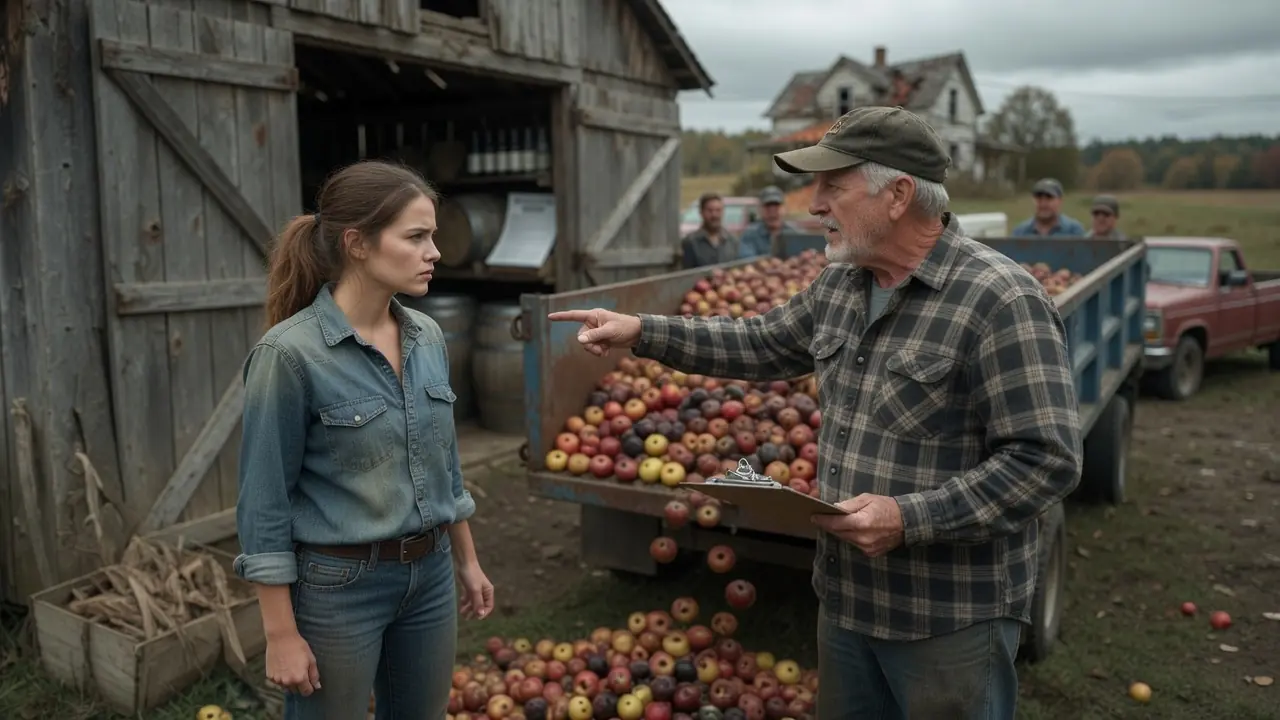
Instead, the rotting fruit smelled like opportunity.
Nora stepped into the barn and lifted one of the finished bottles. The vinegar inside glowed a deep amber, with a layer of natural sediment resting near the bottom. It was not the clear, aggressively filtered liquid sold cheaply in supermarkets.
It had been aged for fourteen months.
The aroma carried apples, oak, honey, and a faint sharpness that made chefs lean closer instead of pulling away. Nora had learned how to turn damaged fruit into something that could sell for twenty times the value of ordinary processing apples. Gordon had unknowingly delivered the raw material for her largest production run yet.
The visitors emerged from the barn one by one.
The first was Elena Ruiz, purchasing director for Harvest Table Markets, a chain of specialty grocery stores operating across six states. The second was Marcus Bell, owner of a restaurant group known for using regional ingredients. Beside them stood a representative from a natural-food distributor who had spent the previous hour negotiating a six-figure supply agreement.
Elena looked at the pile of apples and smiled.
“Is this the additional fruit you mentioned?” she asked.
Nora nodded. “About eighteen tons, based on the truck weight.”
“Excellent. That should cover the first expansion order.”
Gordon’s face reddened. “Those apples came from my orchard.”
“You dumped them on her land,” Elena replied.
“I allowed her to take waste.”
Nora reached toward the clipboard still clutched in Gordon’s hand. “You signed a transfer agreement stating that every rejected apple delivered here became my property.”
Gordon pulled the document against his chest. He had signed it without reading carefully because he believed Nora was desperate. His orchard normally paid thousands of dollars each month to transport spoiled fruit to a commercial waste facility.
Nora had offered to take it for free.
To Gordon, the arrangement had seemed like proof of her poverty. He told workers that Nora was so broke she had started collecting garbage from successful farms. What he had not understood was that she had spent two years quietly building a fermentation process designed specifically for fruit rejected by commercial packing houses.
Nora had not always planned to make vinegar.
Five years earlier, she returned to Hayes Farm after her father suffered a severe stroke. The property covered eighty acres of rolling land in upstate New York, but only twenty acres remained actively cultivated. The greenhouse needed new glass, the irrigation lines leaked, and the barn roof allowed rain to fall directly onto the concrete floor.
Her father had borrowed against nearly everything.
Nora had studied food science before leaving college to care for him. She believed she could keep the farm alive by growing vegetables for farmers’ markets, but transportation costs, unpredictable weather, and wholesale prices destroyed most of her profit. At the end of her first full season, she earned less than she would have made working at a grocery store.
Gordon Pike noticed her weakness immediately.
Pike Orchard bordered the eastern edge of Hayes Farm and covered more than six hundred acres. Gordon had inherited it from his father, expanded it through aggressive purchases, and spent years trying to acquire Nora’s land. Her property included a spring-fed creek and the only practical access road to a section Gordon wanted to develop into luxury cabins.
He made his first offer during her father’s recovery.
The amount would have paid the farm’s debts, but it was far below the property’s value. When Nora refused, Gordon laughed and told her she would return within a year begging him to repeat the offer. He began referring to Hayes Farm as “the dying place beside my orchard.”
The name spread through town.
Suppliers demanded faster payment from Nora. A lender reduced her operating credit, and a local equipment dealer refused to repair her tractor without cash in advance. Gordon never openly admitted influencing them, but his conversations with local businesses always seemed to occur shortly before Nora’s problems became worse.
She survived by repairing what she could and working nights at a food-testing laboratory.
That job changed everything.
One evening, the laboratory received samples from a cider producer investigating why several fermentation batches had developed unusually rich flavors. Nora studied the natural bacteria and yeast cultures transforming apple sugars into alcohol and eventually into acetic acid. She became fascinated by the difference between cheap industrial vinegar and slow-fermented traditional vinegar.
The process required patience more than expensive machinery.
Nora began experimenting in glass jars inside the farmhouse kitchen. She collected bruised apples from a farmers’ market, removed any genuinely unsafe portions, crushed the usable fruit, and measured sugar, acidity, temperature, and microbial growth. Her first batch smelled terrible.
Her second tasted worse.
The third developed a clean apple aroma but lacked depth. By the seventh batch, she created a vinegar bright enough for salad dressing and complex enough for marinades. A restaurant chef who visited the laboratory bought six bottles before Nora had even designed a label.
That small sale gave her a direction.
She converted an unused section of the barn into a licensed fermentation space. Every improvement came from salvaged materials, secondhand equipment, and favors exchanged with neighboring tradespeople. Nora painted the walls herself, installed washable surfaces, repaired the drainage system, and completed food-safety certification at night.
She needed more apples than Hayes Farm could grow.
Commercial orchards discarded enormous quantities of fruit that did not meet supermarket appearance standards. Some apples were too small, unevenly colored, hail-marked, or bruised during transport. Others became overripe before packing.
Much of that fruit remained perfectly usable for fermentation.
Nora approached several orchards, but owners dismissed her business as a hobby. Gordon laughed hardest when she offered to collect his rejected fruit. He told her she could take every rotten apple his workers swept from the sorting floor, provided she removed it quickly and never associated Pike Orchard’s name with her “barnyard experiment.”
Nora agreed.
She insisted on written transfer documents for every load.
Gordon signed them because the arrangement saved him disposal fees. He even ordered his drivers to dump the apples visibly near Nora’s barn rather than unloading them neatly behind it. He wanted passing motorists to see the piles and believe Hayes Farm had become a landfill.
Nora let him believe the humiliation was working.
She sorted every delivery carefully. Moldy fruit was separated for controlled composting, while sound but unattractive apples were washed, crushed, and fermented. Laboratory testing confirmed the safety of every production lot.
The first commercial batch filled only two barrels.
Nora sold it at a weekend market under a handwritten sign. Most shoppers walked past, assuming vinegar should cost only a few dollars. A retired chef tasted it, bought three bottles, and returned the following week with two restaurant owners.
Word spread slowly.
Local chefs used the vinegar in sauces, pickles, reductions, and drinks. A bakery brushed it into fruit glazes. A butcher blended it into marinades, while a health-food shop began selling small bottles near local honey and maple syrup.
Nora reinvested every dollar.
She did not buy new clothes, replace her aging pickup, or repair the farmhouse porch. Instead, she purchased testing equipment, better barrels, a fruit press, and a small bottling machine. She hired one part-time employee during peak production and paid him before paying herself.
Gordon continued mocking her.
Whenever his trucks delivered fruit, he made sure someone photographed the piles. He posted one image online with the caption, Some farmers grow crops. Others collect what real farmers throw away. The post received hundreds of laughing reactions.
Nora saved a copy.
She also saved every invoice showing how much Gordon had previously paid to dispose of the fruit. He thought he was giving her worthless material, but he was effectively providing free inventory while reducing his own operating costs.
Her largest breakthrough came when Marcus Bell tasted the vinegar at a regional food exhibition.
Marcus operated nine restaurants and had been searching for locally produced vinegar with consistent quality. He visited Hayes Farm expecting a small hobby operation. Instead, Nora showed him batch records, acidity tests, traceability documents, and a controlled aging system she had designed herself.
He ordered four hundred bottles.
His chefs began mentioning Hayes Second Harvest Vinegar on menus. Food writers noticed, and a short article praised Nora for transforming cosmetically rejected apples into a premium product. Online orders increased faster than she could bottle them.
That attention led Elena Ruiz to the farm.
Harvest Table Markets wanted a sustainable regional product with a strong origin story, but Elena cared as much about reliability as marketing. She inspected the facility twice, reviewed safety reports, and asked Nora to produce enough vinegar for an initial sixty-store launch.
The proposed order was worth $118,000.
Nora read the figure repeatedly before signing.
The contract required enough apples to fill every fermentation tank and several new barrels. Nora contacted Gordon and asked whether Pike Orchard had additional rejected fruit. He assumed her operation was failing beneath the waste already delivered.
He offered two more truckloads while laughing over the phone.
“Take all of it,” he said. “Maybe you can bury that little farm faster.”
Nora requested a signed transfer for each load.
Gordon agreed again.
He personally accompanied the final truck because he wanted to watch the fruit crush what remained of her pride. Several orchard workers followed in pickup trucks, expecting entertainment. Gordon stepped down, pointed toward the massive pile, and delivered the mocking question Nora had known was coming.
She answered by opening the barn.
Now the workers stood silently beside the truck while Elena explained the retail rollout. The photographer captured the exact moment Gordon realized his waste had become the foundation of a six-figure business.
“You deceived me,” Gordon said.
Nora set the bottle on a table. “I told you I knew what the apples were worth.”
“You never said you were selling vinegar at this scale.”
“You never asked.”
“You used my fruit to build this.”
“You paid to throw it away.”
Gordon glanced toward the signed agreement. “I withdraw permission.”
“The apples already belong to me.”
“I’ll stop every future delivery.”
Nora nodded. “That’s your right.”
Her calmness worried him more than an argument would have.
Nora had already secured supply agreements with three smaller orchards. Unlike Gordon, those growers understood the value of their rejected apples. Nora would pay them a modest amount per ton and include their farms in the product’s sourcing story.
Gordon was no longer essential.
Elena completed the purchase agreement that afternoon. Harvest Table Markets also approved a second product made from apple scraps aged with maple wood. If the initial launch performed well, the distributor expected annual purchases to exceed $300,000.
Gordon left without speaking to Nora again.
Two days later, the county health department arrived for an unannounced inspection.
The inspector claimed to have received a complaint alleging that Nora used rotten, contaminated fruit in unsafe conditions. He searched the production room, reviewed cleaning logs, sampled finished vinegar, and examined the outdoor apple piles.
Nora cooperated fully.
Every required document was ready. The fruit was separated by condition, the composting area complied with agricultural rules, and the fermentation process remained within approved acidity levels. Independent laboratory reports showed no dangerous contamination.
The inspector found no violation.
A second complaint reached the county zoning office the following week. It claimed Nora had transformed agricultural land into an industrial factory without approval. Her attorney demonstrated that farm-based processing was specifically permitted under local regulations.
The complaint was dismissed.
Gordon changed tactics.
He contacted a packaging supplier and claimed Pike Orchard owned the rights to the phrase Second Harvest because the apples originated on his land. The supplier temporarily froze Nora’s bottle order while its legal department investigated.
Nora produced her trademark registration.
She had filed it eighteen months earlier.
Next, Gordon told local growers that Nora’s vinegar process could spread disease into their orchards. Nora organized an open workshop with a university fermentation specialist and a state agricultural extension officer. They explained that properly managed fruit processing presented no such threat.
More than forty farmers attended.
Several signed supply agreements before leaving.
Gordon’s attempt to isolate Nora instead expanded her network.
His anger finally became reckless.
Late one evening, Nora saw headlights near the barn and discovered someone opening the valve on a fermentation tank. She shouted, and the intruder ran toward a waiting pickup. Security footage showed a jacket carrying Pike Orchard’s embroidered logo, though the man’s face remained hidden.
The damaged batch represented nearly $14,000 in potential sales.
Nora contacted the sheriff, but Gordon denied involvement. He claimed anyone could purchase one of his company jackets. Without a clear image, the investigation stalled.
Nora refused to let the loss destroy her.
She invited Elena and Marcus to witness the disposal of the compromised batch. Instead of hiding the problem, she documented exactly what happened and explained the safeguards being installed. Her honesty strengthened their confidence.
Elena increased the first deposit to help fund security upgrades.
Nora installed cameras, locks, motion sensors, and tamper-evident seals on every tank. She also purchased insurance covering malicious contamination. Gordon had cost her money, but he had forced her to build a stronger operation.
The retail launch began three months later.
Hayes Second Harvest Vinegar appeared in sixty stores with a photograph of Nora standing beside her barn. The label explained that the vinegar came from apples rejected for appearance, not flavor. Customers responded immediately.
The first shipment sold out in eleven days.
Food bloggers used it in recipes. A television chef mentioned the product during a cooking segment, and online sales tripled before Nora even saw the broadcast. Harvest Table requested an emergency second shipment.
Within the first year, the business generated $186,000 in revenue.
Nora paid the farm’s overdue taxes, repaired the barn roof, and cleared the highest-interest loan. She hired four local employees, including two former Pike Orchard workers who had lost hours after Gordon purchased an automated sorting system.
She did not become wealthy overnight.
Production costs remained high, and fermentation required months before revenue arrived. Some batches failed, bottles broke during shipping, and one distributor paid nearly sixty days late. Nora learned that a six-figure business could still feel frighteningly close to collapse.
But the farm was no longer dying.
Rows of young apple trees appeared on the hillside behind the barn. Nora planted varieties chosen for flavor and acidity rather than perfect supermarket appearance. She also restored the greenhouse and began experimenting with herb-infused vinegars.
Gordon watched the improvements from across the property line.
His own orchard faced growing problems. A major supermarket reduced its contract after customers complained about flavorless varieties bred mainly for appearance and shelf life. Disposal costs increased after Nora stopped accepting his waste.
For the first time, Gordon had to pay to remove every rejected apple again.
He approached Nora the following autumn.
She was inspecting a delivery from one of her new partner orchards when his black pickup stopped near the barn. Gordon stepped out carrying none of his former confidence. His orchard had thousands of tons of surplus fruit, and his storage facilities were nearly full.
“I hear you’re buying processing apples now,” he said.
“From partner farms.”
“I can give you more volume than all of them combined.”
Nora closed the inspection notebook. “You called it garbage.”
“It’s business.”
“You tried to shut my business down.”
“You can’t prove I filed those complaints.”
“I can prove the man who damaged my tank worked for you.”
Gordon’s jaw tightened. The sheriff had recently identified the intruder after another camera captured his license plate. The man admitted Gordon paid him to frighten Nora and ruin one batch, believing she would lose the Harvest Table contract.
Charges were pending.
Gordon looked toward the fermentation barn. “What do you want?”
Nora could have demanded his orchard for almost nothing. His finances were weak, and the sabotage case threatened his reputation. Instead, she placed a standard supplier agreement on the hood of his truck.
“The same terms every grower receives,” she said. “Quality standards, traceability, and a fair price per ton.”
“You expect me to put your company name beside mine?”
“I expect you to decide whether pride is more valuable than your apples.”
He read the contract.
Nora added one final condition. Pike Orchard would fund a community processing program for small growers who could not afford storage or transportation. The money would come from the savings created by avoiding landfill fees.
Gordon looked at her in disbelief. “You’re turning my punishment into charity.”
“I’m turning waste into value. That’s what I do.”
He signed three weeks later.
The partnership did not make them friends. Nora never forgot the public humiliation, the false complaints, or the sabotaged tank. She simply refused to let revenge become another form of waste.
By the third year, Hayes Second Harvest Vinegar supplied stores across fourteen states.
Annual sales passed $640,000. The company purchased imperfect fruit from twenty-two regional farms and diverted hundreds of tons of usable apples from disposal. Nora created stable jobs on land everyone had expected her to lose.
A framed photograph hung inside the barn office.
It showed Gordon pointing toward the mountain of apples while Nora stood calmly beside the open doors. Beneath it, she displayed the first signed transfer agreement and the original Harvest Table purchase order.
Visitors often assumed the display celebrated Gordon’s humiliation.
Nora corrected them.
“It reminds me that value doesn’t disappear because someone powerful refuses to see it.”
Outside, another truck arrived carrying bruised apples from a family orchard struggling after a hailstorm. The young driver apologized for the fruit’s appearance and asked whether Nora could still use it.
She picked up one apple, cut away the damaged section, and tasted the flesh.
It was sweet, tart, and full of flavor.
“Bring the next truck too,” she said.
This time, nobody was laughing.