Claire Whitmore first heard about the rotten apples from a man who was trying to insult her.
It was October 1981, three weeks after the first hard frost touched the lower fields outside Yakima, Washington, and Claire was standing inside the feed store counting out coins for a replacement tractor belt when two orchard workers began talking behind her. They were not speaking quietly. Men who assumed a young woman was irrelevant rarely bothered lowering their voices.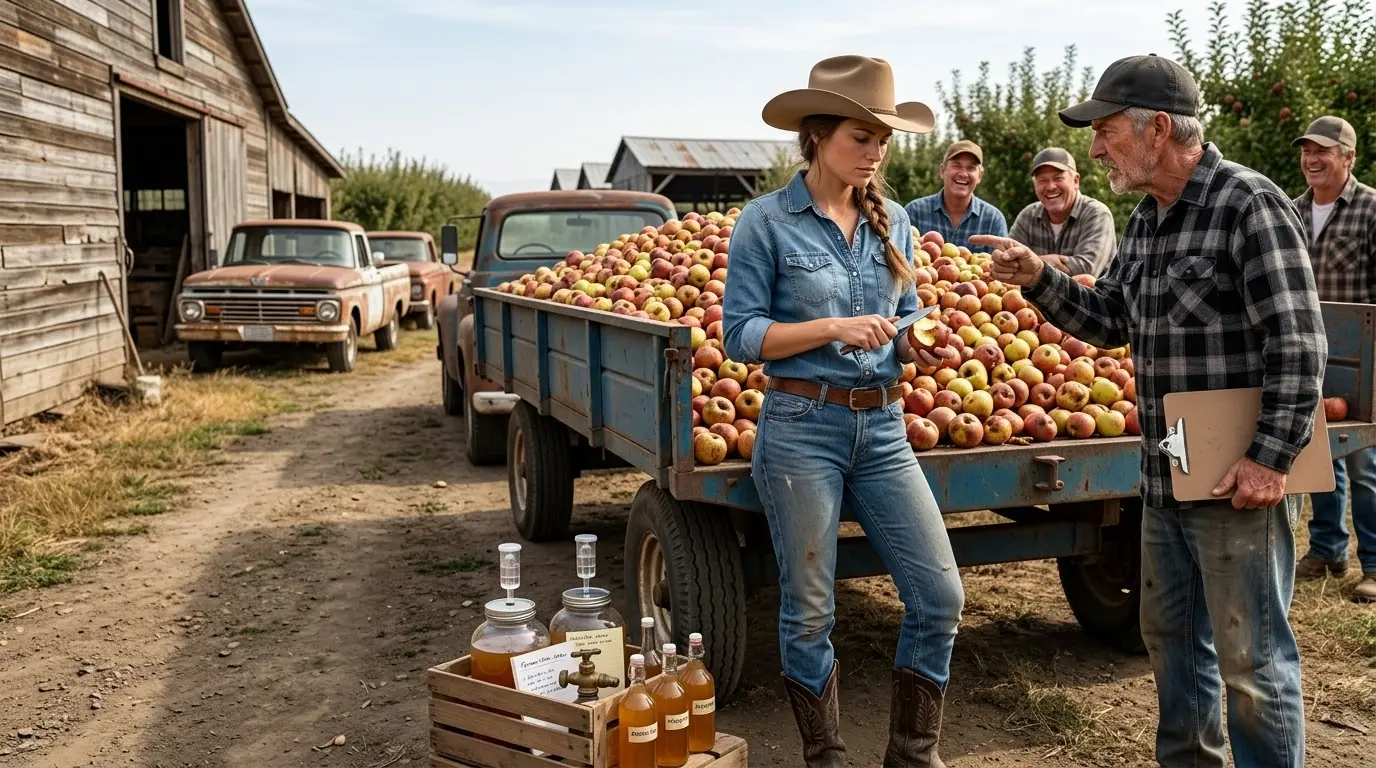
“Mercer’s dumping another trailer tomorrow,” one said.
“Whole load?”
“Near enough. Windfalls, bruisers, worm marks, too small for packing. Harold says it’s cheaper to push them into the compost pile than sort them again.”
The second man laughed.
“Maybe Whitmore here can buy them. She buys everything nobody else wants.”
Claire counted the last coin.
Then turned.
Both men were looking directly at her now.
The taller one grinned.
“What?”
Claire folded the receipt and put it into her jacket pocket.
“How much fruit?”
His smile weakened.
“You serious?”
“How much?”
The second worker shrugged.
“Several tons over the week.”
Claire picked up the tractor belt.
“Tell Harold I’ll be there tomorrow morning.”
The men laughed after she walked outside.
Claire heard them through the closing door.
That part did not bother her anymore.
At twenty-four, she had spent nearly half her life being laughed at by men who confused confidence with expertise.
Her father, Thomas Whitmore, had died two years earlier after a short battle with pancreatic cancer, leaving Claire sixty-eight acres of marginal ground, a weather-beaten farmhouse, twelve acres of neglected apple trees, a small vegetable plot, one tractor old enough to have opinions, and debt spread across three institutions. Thomas had never been wealthy, but he had been respected because he worked until his hands cracked and paid every man exactly when he promised.
His daughter inherited the work ethic.
The respect came more slowly.
Some neighbors assumed Claire would sell.
Others expected an uncle to take over.
Several buyers arrived during the first month after the funeral with offers so low they embarrassed themselves.
Claire rejected every one.
Not because she had a brilliant plan.
Because leaving felt worse.
Whitmore Farm had been in the family since her grandfather bought the first thirty acres after World War II. Claire had learned to walk between rows of apple trees. Her father had taught her to drive a tractor at eleven and balance farm accounts at sixteen.
Her grandmother, Evelyn Whitmore, taught her something else.
Never confuse ugly food with useless food.
Evelyn had grown up during the Depression, and waste offended her almost personally. Crooked carrots became soup. Soft berries became preserves if they were still safe. Apples with superficial bruising were trimmed, cooked, pressed, or fed to animals instead of being discarded automatically.
And every autumn, the Whitmore cellar smelled faintly of apple vinegar.
Claire remembered rows of brown glass bottles lined along the shelves.
She remembered Evelyn holding one toward the light.
“This takes patience.”
Claire had been nine.
“How long?”
“Long enough that impatient people usually stop asking.”
That sounded like her grandmother.
Evelyn died when Claire was seventeen.
Her notebooks remained.
For years Claire barely opened them.
Then her father died.
The farm accounts became frightening.
Fresh apples from Whitmore’s neglected orchard did not produce enough premium fruit to compete with large commercial growers. Claire could sell vegetables seasonally, lease pasture, and do custom tractor work, but none of those created enough margin to repair the farm.
She began looking at what she already had.
Not land.
Not machinery.
Waste.
Every orchard produced it.
Apples too small for supermarket standards.
Bruised during picking.
Damaged cosmetically.
Dropped before harvest.
Perfect fruit rarely became waste, but perfectly edible fruit did.
Claire started experimenting.
Not carelessly.
She borrowed books from the Yakima library.
Visited county extension offices.
Talked to food processors.
And eventually met Margaret Ellis, a sixty-year-old retired chemistry and home-economics teacher who had spent years teaching food preservation before retiring to a small property outside town.
Margaret’s first reaction to Claire’s vinegar experiment was suspicion.
“You are not selling anything from untested barrels.”
“I’m not.”
“You are not using moldy fruit because somebody told you fermentation kills everything.”
“I know.”
“You are not bottling until you understand what you’re making.”
“I know.”
Margaret stared.
“You say ‘I know’ often.”
“My father said it annoyed people.”
“He was correct.”
Then Margaret helped her anyway.
For ten months Claire produced small experimental batches.
She learned which apple varieties produced good flavor.
Which produced sharpness.
Which produced nothing worth repeating.
She kept notes.
Temperature.
Time.
Source fruit.
Flavor.
Appearance.
Acidity measurements handled with proper equipment and professional guidance.
Failures went into disposal.
Successes went into labeled bottles.
Nothing was sold.
By September 1981, Margaret finally tasted batch seventeen.
She held the glass toward the window.
Smelled.
Tasted.
Then sat quietly.
Claire waited.
“Well?”
Margaret took another taste.
“That is irritating.”
Claire frowned.
“What?”
“It is good.”
Claire laughed.
Margaret pointed at her.
“Do not become pleased with yourself.”
“Too late.”
“You still need proper licensing.”
“I know.”
“Suitable workspace.”
“I know.”
“Labels.”
“I know.”
“Consistent sourcing.”
Claire stopped smiling.
That was the difficult one.
Her own orchard could not produce enough.
Buying good commercial apples would destroy the margin.
But buying rejects?
That could work.
The problem was finding growers willing to sell them consistently.
Which was why the conversation in the feed store mattered.
Mercer Orchard was large.
Not enormous by Washington standards, but large enough to dominate the immediate area.
Harold Mercer owned almost four hundred acres of apples, several packing sheds, cold storage, three trucks, and a reputation for treating every conversation as a negotiation he had already won.
He was sixty-one, gray-haired, narrow-eyed, and deeply proud of the fact that his family had grown apples for three generations.
Harold believed he understood apples.
He did.
Claire never denied that.
But he understood them as fresh-market commodities.
Fruit had value when it looked right.
Wrong color?
Lower grade.
Wrong size?
Lower grade.
Bruised?
Processor price.
Too damaged?
Discard.
Harold’s world had categories.
Claire was beginning to wonder whether value could exist outside those categories.
She reached Mercer Orchard just after eight the next morning.
A rusty blue farm trailer stood beside the packing barn overflowing with rejected apples.
Red Delicious.
Golden Delicious.
Jonathans.
A few Granny Smiths.
Some were badly spoiled and useless.
Others simply bruised.
Many undersized.
Several misshapen.
Exactly what Claire hoped.
Harold stood beside the trailer with two workers.
He held a clipboard.
When Claire climbed from her pickup, his expression became amused.
“Whitmore.”
“Harold.”
“Heard you wanted my garbage.”
“I wanted to look.”
He pointed dramatically toward the trailer.
“Behold.”
The workers laughed.
Claire ignored them.
She walked toward the apples.
Picked up one.
Bruised along one side.
No obvious mold.
She cut through it with her pocketknife.
The inner flesh remained sound away from the damaged area.
Another apple.
Then another.
Harold watched.
“You planning to sell those?”
“No.”
“Then what?”
Claire did not answer.
He smiled.
“That bad, huh?”
She selected six sample apples.
“What do you want for the load?”
Harold laughed.
“You actually want it?”
“The usable portion.”
“You don’t get to stand here and sort all day.”
“I know.”
“Take everything.”
Claire looked at the trailer.
“That includes unusable fruit.”
“That’s why it’s cheap.”
“How cheap?”
Harold studied her.
He understood bargaining.
Claire knew enough not to speak first.
Finally he said, “Forty dollars.”
“For this load?”
“All of it.”
Claire nearly smiled.
The fruit had more value than that even as livestock feed.
Harold wanted it gone.
But she kept her face still.
“Twenty.”
His eyebrows rose.
“You’re buying garbage and still bargaining?”
“I’m hauling your waste.”
“Thirty-five.”
“Twenty-five.”
“Thirty.”
Claire extended her hand.
“Deal.”
Harold stared.
Then shook it.
One worker started laughing.
“Jesus, Harold. She really bought it.”
Harold grinned.
“Thirty dollars says she’ll be back asking for her money before winter.”
Claire looked toward him.
“Why would I?”
“No grocery store is buying fruit that looks like that.”
“I’m not selling apples.”
Harold frowned.
“Then what are you selling?”
Claire picked up another bruised apple.
“That’s my business.”
His smile disappeared slightly.
The worker behind him laughed.
Harold pointed toward the trailer.
“Take every damn apple, sweetheart. By next week you’ll learn garbage doesn’t turn into money just because a pretty girl believes in it.”
Claire cut open the apple.
Smelled the clean flesh.
Then looked at him.
“You spent forty years selling what an apple looks like.”
Harold stared.
“I’m interested in what happens after you stop looking.”
The men laughed again.
Claire did not.
She climbed into her truck and moved the trailer.
It took three trips to transfer everything.
The first load attracted attention along the road because several apples bounced free whenever Claire crossed rough pavement.
By the time she reached Whitmore Farm, her younger cousin Ben Carter was waiting beside the barn.
Ben was twenty-one, lanky, permanently amused, and worked part-time for Claire when his community-college schedule allowed.
He stared into the trailer.
“Please tell me you didn’t pay for these.”
“Thirty dollars.”
Ben closed his eyes.
“You did.”
“Help me sort.”
“Claire.”
“Ben.”
“These are rotten.”
“Some.”
“Most.”
“No.”
“Half?”
“We’ll find out.”
He looked toward her.
“You have a plan?”
“Yes.”
“Good plan?”
“Unknown.”
“Excellent.”
They began sorting.
That became the first lesson.
Cheap fruit was not free fruit.
Every apple had to be evaluated.
Anything moldy, extensively decayed, contaminated, or otherwise unsuitable was discarded completely.
No romantic nonsense about turning rot into treasure.
Rot was rot.
Claire wanted sound material hidden inside the rejected stream.
Not unsafe shortcuts.
By late afternoon, they had separated enough acceptable fruit to justify the trip.
Ben stared at the usable pile.
“Well.”
Claire smiled.
“What?”
“I hate when you’re right.”
“You’ll get used to it.”
“No.”
Margaret arrived before sunset.
Her reaction was harsher.
“What have you done?”
“Bought apples.”
“You bought compost.”
“Some compost.”
Margaret picked through the bins.
Then her expression changed.
“You sorted carefully?”
“Yes.”
“Anything questionable?”
“Discarded.”
Margaret looked toward Claire.
“Good.”
She picked up an apple with hail scars.
“People throw away strange things.”
Claire nodded.
“That’s the business.”
Margaret looked at her.
“No.”