Hannah Miller looked up from tying a ribbon around a pastry box and saw the elderly woman standing on the other side of the glass display. Rain slid down the bakery windows behind her, turning the street outside into a gray blur of umbrellas, headlights, and passing footsteps. The woman held a worn brown handbag against her chest with one hand and a few folded bills in the other. Her coat was clean but thin, her shoes were carefully polished but old, and her voice carried the quiet shame of someone trying very hard not to be noticed.
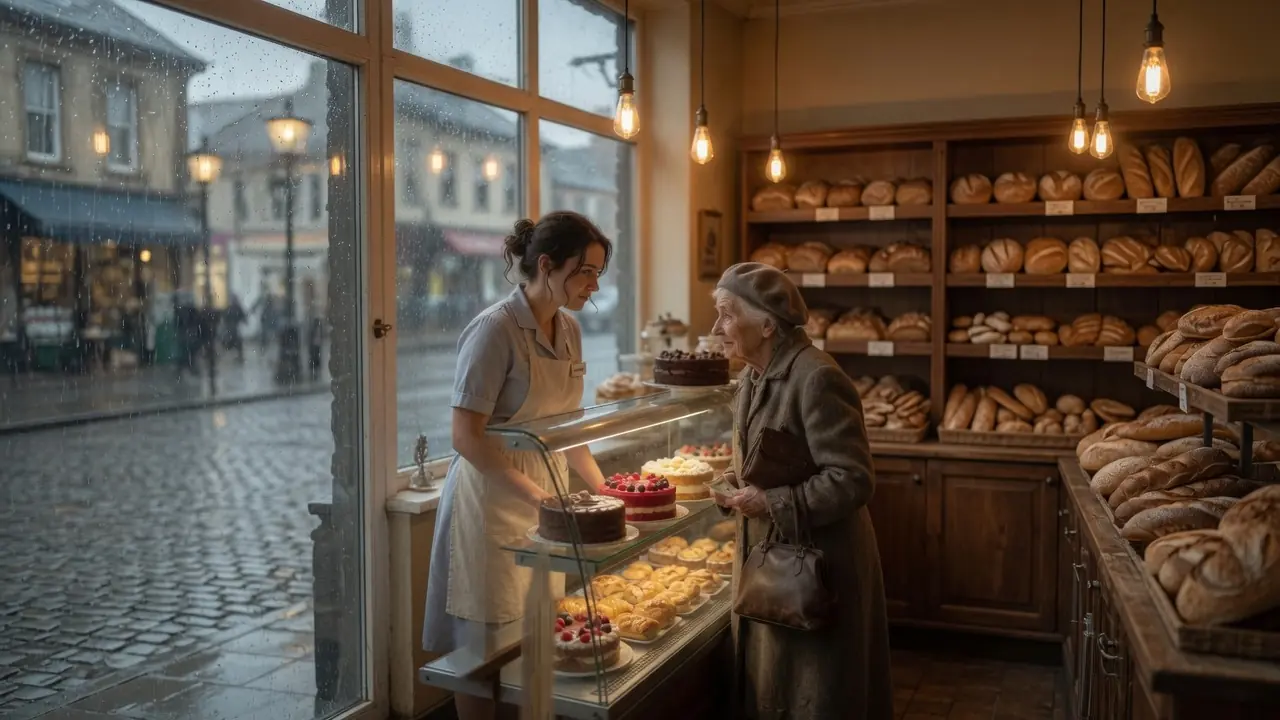
Hannah was twenty-six then, young enough to still believe hard work would someday become a door, but old enough to know some doors stayed locked no matter how gently you knocked. She worked the afternoon shift at Golden Falls Bakery, a warm little shop on Maple Street where the smell of butter, sugar, coffee, and fresh bread could almost convince people the world was kinder than it was. Almost. Hannah had learned that hunger did not always arrive loudly. Sometimes it came politely, counting coins on a rainy afternoon.
The elderly woman looked down at the display case, where chocolate cakes, lemon slices, strawberry tarts, and cream-filled pastries sat in neat rows under warm lights. Her eyes lingered on the small cakes near the corner, the ones usually bought for birthdays or quiet celebrations. Then she looked back at the folded bills in her hand, and Hannah saw her fingers tremble. Not from age alone, but from the fear of asking for too much.
“We have small slices,” Hannah said gently. “But not tiny cakes.”
The woman nodded quickly, embarrassed. “A slice is fine. The smallest one, please. Nothing fancy.” She tried to smile. “I only wanted something sweet for one lonely afternoon.”
That sentence stayed with Hannah. It was not dramatic. It was not begging. It was worse because it was simple. One lonely afternoon. Not a party, not a birthday, not a holiday. Just a small sweetness to survive a day that had clearly been too long.
Hannah glanced toward the back room. Mr. Weller, the bakery owner, was busy checking inventory with his usual tired scowl. He counted flour like flour had personally betrayed him, and he counted kindness even more carefully. The shop had rules about discounts, leftovers, staff meals, and waste. Hannah had broken all of them at least once.
She turned back to the woman and opened the display case. Instead of reaching for the smallest slice, she lifted out a fresh vanilla cream cake with berries around the top. It was not large, but it was beautiful, soft and bright under the glass, the kind of cake someone bought for a person they loved. The elderly woman’s eyes widened immediately.
“Oh no,” she whispered. “Not that one. That’s too much.”
Hannah placed it gently into a white box. “Then take this.”
The woman blinked. “Dear, I can’t pay for that.”
“You don’t have to.”
The woman looked around quickly, as if kindness might be illegal if someone important witnessed it. “Please don’t get in trouble.”
Hannah tied the box with a ribbon and slid it across the counter. “You asked for something sweet. This is sweet.”
The woman stared at the box, then at Hannah. Her eyes filled, but she held herself together with the dignity of someone who had spent a lifetime not crying in public. She took one folded bill and tried to push it toward Hannah. “At least take this.”
Hannah gently pushed it back. “Keep it for tomorrow.”
The woman’s lips trembled. “You don’t even know me.”
Hannah smiled softly. “I know enough.”
For a moment, the bakery seemed to quiet around them. The rain tapped the windows. Coffee steamed near the machine. A customer laughed at a table behind them, unaware that something small and important had just happened at the counter. The elderly woman placed one hand over the cake box and whispered, “My name is Eleanor Grace.”
“Hannah Miller.”
Eleanor repeated the name as if she was placing it somewhere safe in her memory. “Hannah Miller,” she said softly. “I won’t forget this.”
Hannah had heard sentences like that before. Customers said they would come back, call, leave a good review, remember. Most of them forgot by the time they reached the door. Life was busy, and small kindnesses often disappeared into the noise of larger troubles. Hannah did not mind. She had not given the cake to be remembered.
Eleanor tucked the box carefully beneath her coat to protect it from the rain. At the door, she turned once and looked back. “You gave me more than cake today,” she said. Then she stepped outside into the wet afternoon and disappeared beneath the gray sky.
Mr. Weller came out of the back room five minutes later and frowned at the display case. “Where’s the vanilla berry cake?”
Hannah wiped the counter. “Sold.”
He glanced at the register. “I don’t see it.”
“I paid for it.”
His eyes narrowed. “With what? Your smile?”
Hannah reached into her apron pocket and removed the tip money she had earned that morning. It was not much, but it was enough to cover most of the cake at staff price. Mr. Weller stared at the bills, then at her. “You’re too soft, Hannah. Soft people get stepped on.”
Hannah placed the money in the register and closed the drawer. “Maybe. But hard people don’t always sleep better.”
He muttered something about young women who thought the world ran on feelings, then went back to inventory. Hannah said nothing. She had rent due, a cracked phone screen, and shoes that pinched her feet after six hours standing. She knew softness cost something. She just had not yet learned whether hardness cost more.
Years passed.
Not quickly, not cleanly, but with the slow weight ordinary years bring. Hannah kept working at Golden Falls Bakery, first part-time, then full-time, then opening shift, then assistant manager without the official title or pay. She learned how to frost wedding cakes with steady hands, calm angry customers with tired smiles, and stretch her paycheck across rent, groceries, medicine, and bus fare.
Her mother became ill the following winter, and Hannah spent nearly two years moving between the bakery, the hospital, and the small apartment they shared. Some nights, she came home smelling of sugar and disinfectant. Some mornings, she slept sitting upright beside her mother’s bed because she was too tired to undress. Through it all, she baked.
Baking became the place where Hannah still believed effort could become beauty. Flour, butter, eggs, salt, sugar, heat, time — each thing had a purpose. If you measured carefully and waited long enough, something changed. Life rarely worked that fairly, but cakes did, most of the time.
After her mother passed, Hannah nearly left town. There seemed to be no reason to stay in Maple Street anymore except habit and bills. But Golden Falls Bakery had become part of her hands. She knew which oven ran hot, which regular wanted extra cinnamon, which lonely widower came every Thursday for two plain rolls because his wife used to buy them.
Mr. Weller grew older and meaner, though not cruel in the dramatic way stories preferred. He was simply tired, tight-fisted, and afraid of losing money. When business slowed, he blamed the staff. When rent rose, he cut hours. When a customer could not pay, he became suspicious, as if poverty itself was a trick.
Hannah kept a quiet habit anyway. Once a week, she paid for a small box of unsold pastries and gave it to the community pantry two blocks away. When teenagers came in counting coins, she rounded prices down without saying so. When elderly customers asked for day-old bread, she sometimes added a fresh roll beneath the napkin.
She never saw Eleanor Grace again.
At least, not for seven years.
By then, Hannah was thirty-three and exhausted in a different way. Golden Falls Bakery was struggling. A chain café had opened near the corner, selling bright drinks, fast pastries, and loyalty points Hannah could not compete with. Mr. Weller finally admitted he wanted to sell the shop, but only after months of ignoring repairs, unpaid supplier balances, and a landlord who had lost patience.
“You should find another job,” he told Hannah one morning, not unkindly, but not kindly either. “This place is done.”
Hannah stood in the kitchen beside trays of cooling bread. “It doesn’t have to be.”
Mr. Weller laughed softly. “You think you can save a bakery with good intentions?”
“No,” Hannah said. “But good bread might help.”
He shook his head. “You still haven’t learned.”
Maybe he was right. Hannah did not know. All she knew was that the thought of Golden Falls closing made something inside her ache. The bakery had fed people through snowstorms, birthdays, funerals, school celebrations, first dates, last goodbyes, and lonely afternoons. It was not just a business to her. It was a place where people remembered sweetness when life became bitter.
Two weeks later, the invitation arrived.
It came in a cream envelope with Hannah’s name written in careful ink. Inside was a formal request for her to attend a community luncheon at the town hall, hosted by the Fresh Slice Fund. Hannah had never heard of it. The note said the fund supported small food businesses, local bakers, and community meal programs.
She almost threw it away, assuming it had been sent by mistake. But at the bottom, in smaller handwriting, were four words:
Please come, Hannah Miller.
Something about the handwriting made her pause.
The luncheon took place on a Saturday afternoon in the old community hall. The room smelled of coffee, flowers, and warm bread from several local bakeries. Round tables filled the space, and people Hannah recognized from town sat chatting beneath soft lights. Near the front stood a table with a framed sign that read Fresh Slice Fund, surrounded by folders, donation cards, and small wrapped cakes.
Hannah arrived in a simple navy dress and gray cardigan, feeling underdressed and uncertain. She expected to stand near the wall, listen politely, and leave before anyone asked why she was there. Instead, an elderly woman in a lavender sweater turned from the front table and looked directly at her.
Hannah stopped breathing for half a second.
The woman was older now, smaller somehow, her white hair neatly styled, glasses perched low on her nose. But the eyes were the same. Tired once, shining now. Polite, steady, and full of memory.
“Eleanor?” Hannah whispered.
Eleanor Grace smiled. “You remembered.”
Hannah walked toward her slowly. “I thought about you sometimes. I wondered if you were all right.”
Eleanor’s face softened. “I was not all right that day. But I became all right again.”
She held a blue folder against her chest. Her hands still trembled, but now there was strength in the way she stood. Around them, the luncheon continued, but Hannah felt as if the room had narrowed to only the two of them.
Eleanor opened the folder slightly, then closed it again, as if the words inside carried more weight than paper should. “You gave me a fresh cake when I asked for a tiny one.”
Hannah’s throat tightened. “You remembered that?”
“I remembered everything,” Eleanor said. “The rain. The ribbon on the box. The way you pushed my money back and told me to keep it for tomorrow.”
Hannah looked down, embarrassed. “It was just a cake.”
“No,” Eleanor said gently. “It was the first time in months someone saw my loneliness without making me feel ashamed of it.”
Hannah did not know what to say. She looked at the blue folder in Eleanor’s hands, then smiled softly through her confusion. “What is this folder?”
Eleanor’s eyes filled with tears. “An offer.”
Hannah blinked. “For what?”
“For your bakery. For your future. And for every person who walks through a door with only enough money for a tiny cake.”
Before Hannah could answer, Eleanor guided her to a quieter corner near the Fresh Slice Fund table. She explained slowly, with the careful clarity of someone who had rehearsed this moment many times. Years earlier, when she entered Golden Falls Bakery, Eleanor had been newly widowed, nearly broke, and too proud to tell anyone how close she was to giving up. Her husband had left behind debts she did not understand, and medical bills had taken nearly everything.
“I was not starving,” Eleanor said. “Not exactly. But I was disappearing.”
Hannah’s eyes stung.
Eleanor continued. “That afternoon, I had enough money for bread, bus fare, or one small sweetness. I chose sweetness because grief had made every day taste like dust.” She laughed weakly. “Then you gave me the fresh cake.”
She told Hannah that she had taken the cake home to her tiny apartment, made tea, and eaten one slice at the kitchen table where her husband used to sit. She saved the rest for the next day. Then, for the first time in weeks, she called her nephew and admitted she needed help.
“That cake did not solve my problems,” Eleanor said. “But it reminded me I was still a person worth helping.”
Her nephew, it turned out, was a lawyer. He helped Eleanor recover funds from a mishandled estate account and sell a piece of property her husband had owned outside town. Over the next few years, Eleanor stabilized her life, then did something unexpected. She used part of the recovered money to start the Fresh Slice Fund, a charitable foundation supporting food access and small local bakers.
“I kept looking for you,” Eleanor said. “But I wanted to come back when I could do more than say thank you.”
Hannah looked at the crowded hall. “All of this came from that?”
“All of this came from remembering what dignity tastes like,” Eleanor replied.
Then she opened the folder.
Inside was a proposal written in formal language Hannah had to read twice. The Fresh Slice Fund wanted to purchase Golden Falls Bakery from Mr. Weller, renovate it, and place Hannah as managing partner with a path to ownership over five years. The bakery would continue operating as a business, but it would also run a weekly community program offering pay-what-you-can bread, birthday cakes for children in struggling families, and training positions for young bakers who could not afford culinary school.
Hannah stared at the pages. “This can’t be real.”
“It is real.”
“I don’t have money for something like this.”
Eleanor smiled. “You already paid the first price seven years ago.”
Hannah shook her head, overwhelmed. “Eleanor…”
The older woman touched her arm. “You have skill. You have patience. You have the kind of heart that gives without humiliating people. That is rarer than money, Hannah.”
Hannah looked across the hall at the Fresh Slice Fund sign. “Why me?”
Eleanor’s expression became serious. “Because I do not want charity run by people who enjoy feeling generous. I want it run by someone who knows how to help quietly.”
The words settled deep inside Hannah. She thought of every lonely customer, every embarrassed teenager counting coins, every elderly person asking for day-old bread as if fresh bread belonged only to others. She thought of her mother, who used to say food given with kindness could keep a person standing one more day.
“What about Mr. Weller?” Hannah asked.
“He has agreed to sell if the paperwork closes by the end of the month,” Eleanor said. “He does not know you are the intended managing partner yet.”
Despite everything, Hannah almost laughed. “He’ll say I’m too soft.”
Eleanor smiled. “Then let him.”
The official announcement came later that afternoon. Eleanor stood at the front of the hall with Hannah beside her, the blue folder held between them. Her voice trembled at first, but grew stronger as she told the room about the rainy afternoon, the fresh cake, and the young woman who gave dignity without asking for a name beyond kindness.
Hannah cried before Eleanor finished.
People clapped, but Hannah barely heard them. She looked at Eleanor, then at the folder, then at the sign reading Fresh Slice Fund. She had spent years thinking small kindnesses vanished into the air. Now one had returned carrying keys, paperwork, and a future.
A month later, Golden Falls Bakery closed for renovation.
Mr. Weller handed over the keys with mixed embarrassment and relief. When he saw Hannah standing beside Eleanor and the contractor, his face changed. “You?” he said.
Hannah held his gaze. “Me.”
He looked around the old bakery, at the scratched counters, the worn floor, the ovens, and the display case where Eleanor had once asked for a tiny cake. For once, Mr. Weller did not speak quickly. “You’ll need to be harder than you are,” he said.
Hannah smiled gently. “No. I’ll need to be stronger.”
He did not argue.
The renovation took six weeks. They repaired the ovens, repainted the walls, replaced cracked tiles, and kept the old wooden bread shelves because Hannah insisted they carried too much history to throw away. Above the display case, they hung a small sign:
Fresh Cake. Fresh Bread. Fresh Mercy.
On opening day, people lined up before sunrise. Some came out of curiosity. Some came because they loved Golden Falls. Some came because Eleanor’s story had spread through town, growing more emotional with every retelling. Hannah stood behind the counter in a clean apron, her hands shaking slightly as she tied the first ribbon around a cake box.
Eleanor sat at a small table by the window, watching the rain begin softly outside. She looked at Hannah with quiet pride.
Near noon, an elderly man came in holding coins in his palm. He looked embarrassed, tired, and hungry. “Do you have any day-old rolls?” he asked.
Hannah looked at him, then at the fresh tray behind her.
She reached for a paper bag and filled it with warm rolls, adding one small honey cake on top. The man began to protest, but Hannah only smiled.
“Then take this,” she said.
Eleanor heard the words from her table and looked away, blinking fast.
Years later, people in town would say the Fresh Slice Fund saved Golden Falls Bakery. Some would say Eleanor Grace saved it. Others would say Hannah Miller saved it by being the right person at the right time. Hannah never argued with any of them, but privately, she believed the truth was simpler.
A lonely old woman walked into a bakery with too little money.
A tired young woman gave her something fresh instead of something small.
And between them, without either knowing it, they planted a kindness large enough to become a place where nobody had to be ashamed of hunger again.