At twenty-four, Jenna Parker had already learned that people were often wrong about two things.
Who looked dangerous.
And who actually needed help.
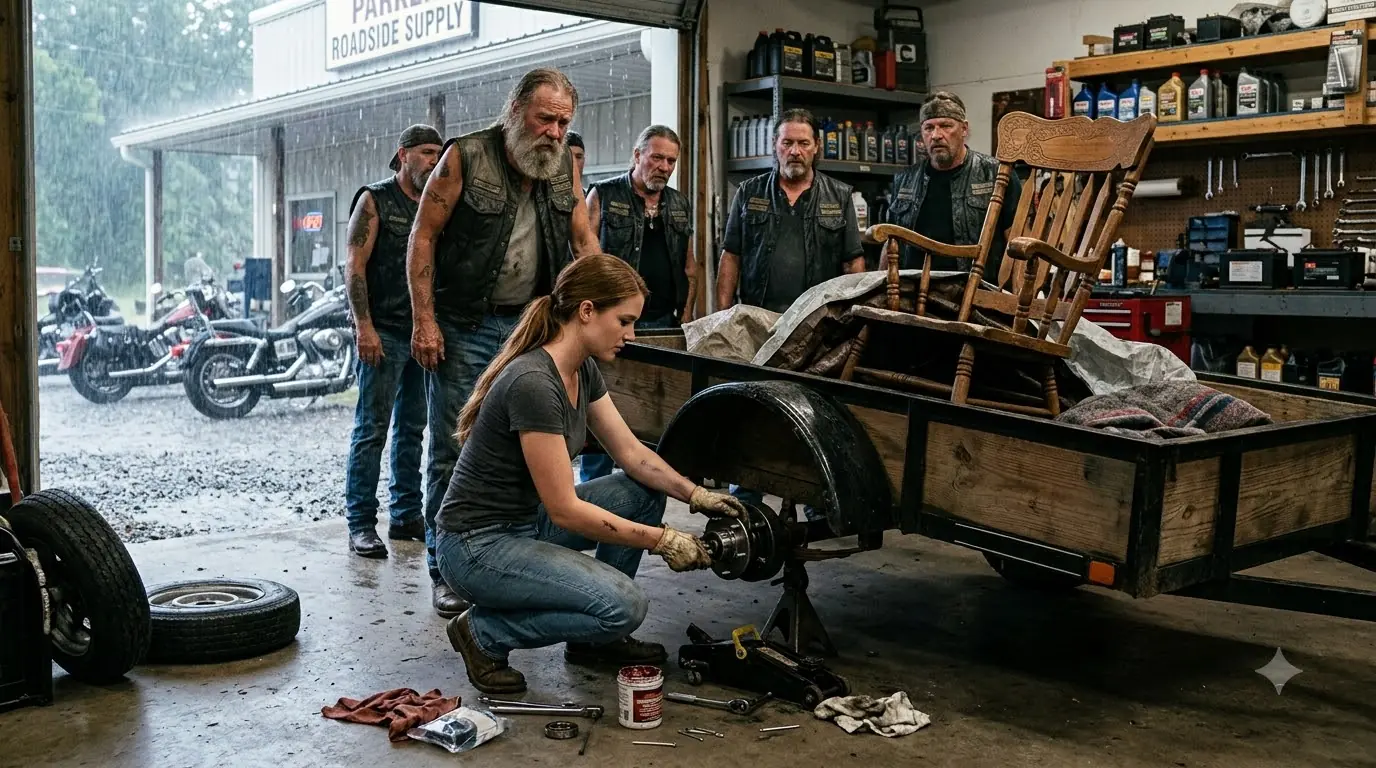
She had learned the first lesson from growing up along Highway 41 outside Ridgefield, Tennessee, where strangers came through town in every imaginable condition. Families with overheated minivans. Truckers with blown trailer lights. College kids who had ignored dashboard warnings for fifty miles. Elderly couples with flat tires. Delivery drivers whose batteries gave up at the worst possible moment.
And bikers.
Lots of bikers.
Ridgefield sat between better-known places, which meant most travelers never planned to stop there. They stopped because something broke.
That was why Jenna’s father, Samuel Parker, always said his little roadside shop did not really sell parts.
It sold relief.
Parker Roadside Supply stood on a gravel lot just outside the center of town, between an old filling station that had been converted into a feed store and a weathered brick building where a barber had worked since before Jenna was born.
The shop itself was not much to look at.
A faded red metal roof.
Two service bays.
A front room packed so tightly with shelves that customers sometimes had to turn sideways around display racks.
Oil filters.
Spark plugs.
Trailer connectors.
Tire plugs.
Belts.
Fuses.
Brake fluid.
Batteries.
Tie-down straps.
Emergency lights.
Rain ponchos.
Jumper cables.
Cheap work gloves.
Coffee that Samuel proudly described as “technically drinkable.”
Jenna loved every inch of it.
She loved opening the shop before sunrise when the air still smelled like wet grass and cold pavement.
She loved the sound of an impact wrench echoing through the garage.
She loved opening a hood and finding something that made sense.
A loose connection.
A bad relay.
A cracked belt.
A failed battery.
Problems were easier than people sometimes.
A machine did not lie because it was embarrassed.
It did not pretend to be fine because it did not want to bother anyone.
It told you something was wrong.
You simply had to learn how to listen.
Samuel Parker had taught Jenna that.
He had also taught her something more important.
“People don't come here because their day is going well.”
Jenna had been fourteen the first time he said it.
A young mother had pulled into the lot with steam rolling from beneath the hood of a Chevrolet minivan. Two crying children sat in the back seat. The woman looked close to crying herself.
Jenna had laughed when the woman asked whether the red temperature warning meant she needed oil.
Samuel waited until the customer was inside buying water before taking Jenna aside.
“Don't ever do that again.”
Jenna’s smile disappeared.
“I wasn't trying to be mean.”
“Doesn't matter.”
“She just didn't know.”
“Exactly.”
He pointed toward the minivan.
“She doesn't come here because she wants a mechanical education. She comes because something scared her.”
Jenna looked toward the store.
Samuel continued.
“People don't come here because their day is going well. So don't make them feel stupid for needing help.”
Jenna never forgot it.
Years later, she sometimes caught herself repeating those exact words to younger employees.
By twenty-four, Jenna could diagnose common roadside problems faster than plenty of mechanics twice her age.
Not because she knew everything.
Samuel made sure she never believed that.
“You know the quickest way to become dangerous with tools?”
“What?”
“Start thinking you know everything.”
He made her read manuals.
Check specifications.
Ask questions.
Admit uncertainty.
If a repair was beyond the shop’s equipment or their expertise, they referred it somewhere else.
That honesty built trust.
Trust kept Parker Roadside Supply alive.
Barely.
The business paid its bills, most months.
Samuel paid Jenna a modest wage.
The old building was owned outright, which helped.
But there was never much extra.
Jenna’s dream therefore remained written inside a spiral notebook in her bedroom.
ROAD MERCY REPAIRS.
She had written the name at nineteen.
Underneath:
Mobile roadside mechanical help for rural drivers.
The idea had grown from years of watching people arrive at Parker’s after being stranded for hours.
Tow companies served Ridgefield, but their service area was broad. On busy weekends, waits could stretch.
Some rural roads had weak cell coverage.
Farm lanes turned muddy after storms.
Motorcyclists broke belts or lost electrical power in places where hauling the bike cost more than the repair.
Families sometimes abandoned cars overnight because nobody could reach them quickly.
Jenna imagined a different kind of service.
Not towing unless absolutely necessary.
Go to the driver.
Carry enough equipment for common roadside repairs.
Batteries.
Tires.
Minor electrical faults.
Trailer wiring.
Belts and hoses where practical.
Fuel delivery.
Basic diagnostics.
Safe temporary fixes that got someone off the shoulder and into a proper shop.
She pictured a dedicated service truck.
Side compartments.
Portable power.
Air.
Lighting.
Weather gear.
A dispatch number.
Maybe eventually two trucks.
Then three.
She had even sketched the logo.
Her father had found the notebook once.
He said nothing for a minute.
Then:
“Road Mercy.”
“You hate it.”
“No.”
“You made the face.”
“What face?”
“The Dad Face.”
“I have several.”
“The one before you explain why something is unrealistic.”
Samuel sat on the edge of her workbench.
“How much have you priced?”
“Some.”
“Insurance?”
“Yes.”
“Commercial vehicle?”
“Yes.”
“Tools?”
“Yes.”
“Business license?”
She pointed toward a page.
“Certification?”
Another page.
“Advertising?”
Another.
“Emergency reserve?”
Jenna became quieter.
Samuel smiled.
“That's where dreams get expensive.”
“I know.”
“How much are you short?”
“Depending on the truck?”
“Yes.”
“A lot.”
Samuel looked through the notebook again.
Then handed it back.
“Good.”
Jenna frowned.
“Good?”
“If the only thing stopping you is money, that’s a solvable problem.”
“Not quickly.”
“Nobody said quickly.”
He tapped the notebook.
“Keep building it.”
So Jenna did.
She saved when she could.
Her old Ford pickup became an experiment.
She added tool storage.
Portable jumper pack.
Tire kit.
Reflective triangles.
Flashlights.
A small compressor that sounded like it was dying every time she used it.
Whenever Samuel received a roadside call from a regular customer, Jenna sometimes went.
No official business yet.
No marketing.
Just experience.
Then came the Friday in July when seven motorcycles rolled into the Parker lot carrying something far more important than any of them initially understood.
The heat had been miserable since breakfast.
By two in the afternoon, the thermometer outside the shop read ninety-six.
Humidity made it feel worse.
Storm clouds had begun building west of Ridgefield, tall and gray above the pine line.
Samuel was replacing a water pump in bay one.
Jenna was restocking trailer wiring kits in the front room.
The radio warned of severe thunderstorms moving east.
“Probably hit around five,” Samuel called.
Jenna looked outside.
“Earlier.”
“You a meteorologist now?”
“My knee hurts.”
“You’re twenty-four.”
“Advanced weather knee.”
Samuel laughed.
Then Jenna heard motorcycles.
One engine would not have been unusual.
Seven together got her attention.
The low vibration came first.
Then headlights appeared through the dusty front windows.
A group of motorcycles rolled into the lot one after another.
Large touring bikes.
Road grime.
Saddlebags.
Travel gear.
Nothing polished for display.
These machines had been ridden.
The riders wore leather vests and jackets despite the heat.
Most were older.
Gray beards.
Heavy boots.
Tattooed forearms.
Serious faces.
A few customers inside the shop glanced toward the window and immediately became quieter.
Jenna did not look at the riders first.
She looked at the trailer.
A small utility trailer followed the lead motorcycle.
The left wheel leaned outward.
Wrong angle.
Very wrong.
One tie-down strap hung loose, its torn end fluttering.
The trailer rocked slightly even after stopping.
Jenna abandoned the box in her hands.
“Dad.”
Samuel looked out from the bay.
“Yeah.”
“They’re lucky.”