Rain drifted across Redwood Memorial Cemetery as Daniel “Hawk” Turner knelt beside the polished marble headstone bearing his daughter’s name. His massive tattooed arms trembled beneath his worn leather vest, and both hands covered the face that had frightened strangers for most of his adult life. Behind him, several bikers waited near their motorcycles, giving their grieving friend the distance he needed.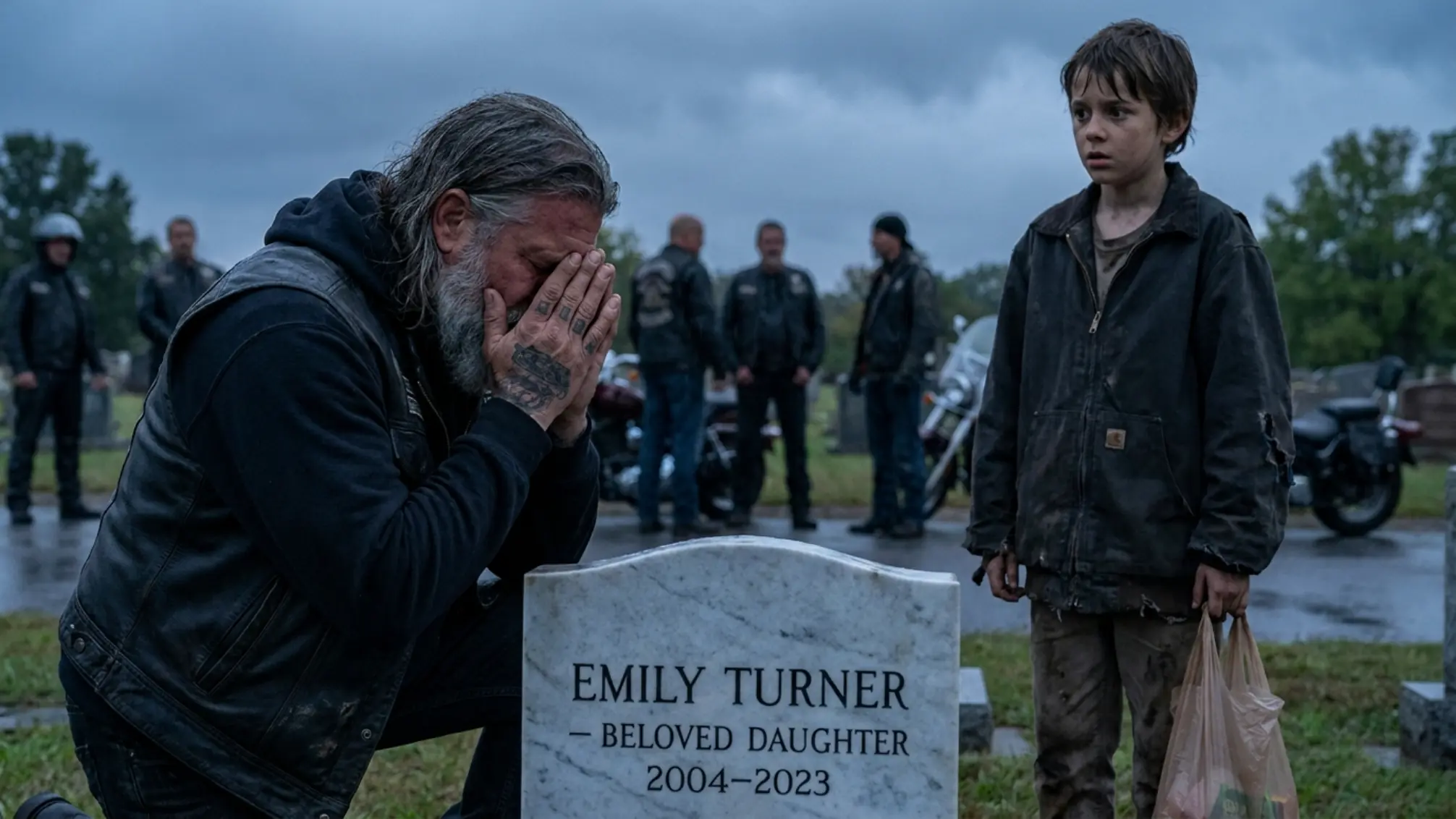
A thin homeless boy approached through the wet grass, clutching a plastic grocery bag containing everything he owned. His tangled brown hair clung to his pale forehead, his oversized jacket hung from narrow shoulders, and fear filled his eyes as he stopped beside the grave.
Hawk closed his hand around the necklace he had placed around Emily’s neck on her eighteenth birthday. His voice broke as he looked into the child’s frightened eyes.
Two weeks earlier, Hawk had been repairing a motorcycle inside his garage when two police officers knocked on the open bay door.
He knew something terrible had happened before either man spoke. Their uniforms were damp from rain, their faces carefully controlled, and neither would look directly into his eyes. One officer asked whether he was Daniel Turner and whether he had a daughter named Emily.
“There was an accident on Highway Seventeen,” the officer said.
Hawk placed the wrench on the workbench.
“What kind of accident?”
“Her vehicle went through a barrier and entered a ravine. The car caught fire.”
The words continued after that, but Hawk barely heard them. A body had been found inside. The damage was severe. Identification had supposedly been established through documents recovered from the vehicle and personal items believed to belong to Emily.
Hawk demanded to see her.
The officers explained that viewing the body would not be advisable.
He demanded dental records, medical confirmation, and independent testing. The authorities told him those procedures were unnecessary because the evidence was considered sufficient.
Everything moved too quickly.
The investigation closed. A death certificate appeared. The funeral home recommended a sealed casket, and people began speaking about Emily in the past tense before Hawk had accepted that she was gone.
During the funeral, he stood rigid while the coffin was lowered into the ground. Friends from his motorcycle club, the Iron Saints, surrounded him in respectful silence. Some had known Emily since she was a toddler wearing a helmet too large for her head and begging for rides around the garage parking lot.
Hawk did not cry.
He stared at the casket and felt something cold beneath the grief.
The story did not feel right.
Emily was a careful driver. No witness had seen the vehicle leave the road. The fire had supposedly destroyed nearly everything, yet her identification remained conveniently intact.
Still, grief was heavier than suspicion.
For the next two weeks, Hawk returned to the cemetery every evening. He sat beside the grave and spoke to Emily as though she could hear him beneath the earth.
He told her he was sorry for every argument.
He apologized for the nights he came home late, the birthdays interrupted by emergencies at the garage, and the times his protective nature made her feel trapped. He remembered teaching her to ride a bicycle and watching her graduate from high school.
On the evening Leo approached him, Hawk had been telling Emily about the first time she rode on the back of his motorcycle.
She was eight years old, terrified and thrilled, gripping his jacket so tightly that her fingers hurt. At the end of the street, she shouted into the wind and asked him to go faster.
Hawk had laughed then.
Standing beside her grave, he could no longer remember how laughter felt.
Then the boy spoke the impossible words.
Hawk stared down at the silver feather necklace in his palm. The metal was scratched, and one edge was darkened by dirt, but he recognized every detail.
He had purchased it from a small shop during a ride through Colorado. Emily loved feathers because she said they reminded her that freedom could be gentle.
She wore the necklace every day.
“Where did you get this?” Hawk asked.
Leo looked toward the cemetery gate before answering.
“A woman gave it to me.”
“What woman?”
“She said her name was Emily.”
Hope struck Hawk so violently that he almost became angry.
He rose to his full height, towering over the boy.
“Look at me.”
Leo did.
“This isn’t something you say because you want money.”
“I don’t want money.”
“It isn’t something you invent because you heard people talking about the funeral.”
“I didn’t.”
Hawk held the necklace between them. “Where did you see her?”
Leo’s voice dropped.
“Near the harbor.”
The boy explained that he sometimes slept inside abandoned buildings when the weather became too cold or wet. Three nights earlier, he hid behind stacked shipping crates inside an old warehouse near the river.
A dark van arrived shortly before midnight.
Several men opened the rear doors and forced frightened people into the building. Leo remained hidden beneath a torn tarp, afraid that even breathing too loudly might reveal him.
One of the captives was a young woman with long brown hair.
Her arms were bruised. Her clothes were torn, and she moved as though she had been injured.
While the men argued near the warehouse entrance, the woman slipped behind the crates and found Leo.
“She asked if I knew a man called Hawk,” Leo said.
Hawk’s heart pounded.
“What exactly did she say?”
“She said, ‘Find my father. His name is Daniel Turner, but everyone calls him Hawk. Tell him I’m alive.’”
Leo looked toward the grave.
“She took off the necklace and gave it to me. She said you would know it belonged to her.”
Hawk closed his fist around the silver feather.
“Why did you wait three days?”
“I was scared.”
“Of the men?”
Leo nodded. “One of them saw me near the docks before. I thought he might follow me.”
“Then how did you find me?”
“I heard people at a shelter talking about a biker who came to the cemetery every night. They said his daughter died in a car fire.”
Leo’s eyes moved toward Emily’s name.
“I thought maybe she was your daughter.”
Hawk crouched until they were at eye level.
“What is your name?”
“Leo.”
“How old are you?”
“Twelve.”
“Where are your parents?”
The boy looked away.
“My mother died. My father left before that.”
Hawk felt another kind of pain move through him.
Leo had no reason to help a stranger. He had risked being discovered by dangerous men, crossed miles of city streets, and waited near a cemetery because a captive woman had trusted him with a message.
“You did the right thing,” Hawk said.
“I should’ve come sooner.”
“No. You came.”
One of the Iron Saints approached from the motorcycles. Marcus Hale was sixty-one, gray-haired, and one of the few men who could question Hawk without causing an argument.
“What happened?” Marcus asked.
Hawk opened his hand and showed him the necklace.
Marcus recognized it immediately.
“Emily’s.”
“The boy saw her alive three nights ago.”
Marcus stared at Leo, then toward the grave.
“What do you need?”
Hawk rose.
“Everyone at the garage.”
Within twenty minutes, motorcycles moved through Ridgewood beneath a darkening sky. Leo rode inside Marcus’s truck, wrapped in a clean blanket and holding a cup of hot chocolate purchased from a gas station.
Hawk traveled ahead of them.
The silver necklace remained locked inside his fist.
At the Iron Saints’ garage, every conversation ended when Hawk entered. A dozen men stood among motorcycles, tool cabinets, and old photographs covering the walls.
Emily appeared in many of those pictures.
In one, she sat on Hawk’s shoulders during a charity ride. In another, she stood beside the riders after helping serve meals at a homeless shelter. The men in that room had watched her grow from a fearless child into a thoughtful nineteen-year-old woman.
Hawk placed the necklace on the scarred wooden table.
“She’s alive.”
Nobody questioned him.
He repeated Leo’s story, including the van, the warehouse, and the frightened captives. The riders listened without interruption.
When Hawk finished, Marcus leaned forward.
“Where do we begin?”
“With the accident.”
Hawk did not want them rushing blindly toward the harbor. If the crash had been staged, someone had access to official documents and enough influence to close the case quickly.
They needed evidence.
Hawk called Carl Donovan, an old acquaintance who supervised the county vehicle-storage yard. Carl owed Hawk a favor after the Iron Saints helped find his missing teenage son years earlier.
“Is Emily’s car still there?” Hawk asked.
A long silence followed.
“It’s scheduled for destruction Friday.”
“Why so soon?”
“I don’t know.”
“I need to see it tonight.”
“Hawk, that vehicle is evidence.”
“The case is closed.”
Carl sighed.
“Give me forty minutes.”
The riders left Leo at the garage with Miriam, Marcus’s wife, who brought him clean clothes and a bowl of soup. Hawk promised the boy he would return.
“You believe me?” Leo asked.
Hawk placed one hand on his shoulder.
“My daughter trusted you. So do I.”
The county storage yard stood behind two high fences on the industrial edge of Ridgewood. Carl unlocked a side gate after checking the road to ensure nobody was watching.
He led Hawk and Marcus toward a tarped vehicle in the far corner.
“I never saw the body,” Carl admitted. “Outside officials removed it before the car arrived.”
“What outside officials?”
“They didn’t identify themselves to me.”
Carl pulled the tarp away.
The burned sedan looked like a blackened skeleton beneath the yard lights. Most of the passenger compartment had been destroyed, yet the fire damage appeared strangely uneven.
Marcus walked around the wreck.
“The driver’s door isn’t crushed.”
Hawk examined the steering wheel. Despite the reported intensity of the fire, part of it remained almost untouched.
“Could someone have exited before the fire?” he asked.
Carl nodded slowly. “Easily.”
Hawk leaned through the broken passenger window.
Beneath the seat frame, something reflected the overhead light. He reached through twisted metal and pulled out a damaged cell phone.
The case carried a faded mountain sticker.
Emily had placed that sticker there during a hiking trip with friends.
Hawk turned the device over.
The battery and memory card were gone.
“They wanted the phone found,” Marcus said. “Just not anything inside it.”
Hawk looked at the wreck.
The vehicle had not proved Emily was dead.
It had been built to make everyone stop searching.
Carl lowered his voice. “There’s more.”
He told Hawk that the accident paperwork arrived already completed. A man from an unspecified regional office ordered local personnel not to photograph the body or request additional testing. When Carl asked why, he was told the victim had already been identified.
“Who signed the order?” Hawk asked.
Carl looked uncomfortable.
“Detective Adrian Vale.”
Hawk recognized the name.
Vale had handled the death notification.
“Where is he tonight?”
“I don’t know.”
Hawk placed Emily’s broken phone inside his vest.
“We’re going to the harbor.”
Marcus gripped his arm.
“We need help.”
“We have each other.”
“We also have a warehouse full of captives. That means medical care, evidence, and arrests. We contact the state investigative unit before going inside.”
Hawk’s jaw tightened.
Waiting felt impossible.
But he knew Marcus was right.
They called an investigator the Iron Saints had assisted during a previous missing-person search. Hawk provided the address, Leo’s statement, details from the staged wreck, and the suspiciously sealed paperwork.
The investigator asked them to remain outside the warehouse until a response team arrived.
Hawk agreed.
He did not promise patience.
Back at the garage, Leo had fallen asleep on a couch with an empty soup bowl nearby. Miriam had washed the dirt from his face, revealing a child who looked even younger without it.
Hawk sat beside him.
Leo awakened immediately.
“Did you find her?”
“Not yet.”
The boy’s hope faltered.
“But we found proof that the crash was a lie.”
Hawk held up the broken phone.
“She’s where you said she is. Now I need you to show us the exact building.”
Leo nodded.
A short time later, they drove toward the harbor with Leo inside Marcus’s truck. The motorcycles stayed several blocks behind to avoid drawing attention.
Industrial buildings rose beside the dark river. Rusted fences, abandoned loading docks, and silent cranes cut against the night sky.
Leo pointed toward a long concrete warehouse near the water.
“That one.”
Fresh tire tracks crossed the mud beside the building.
A dark van stood near a side entrance.
Hawk’s body tightened.
Marcus checked his phone.
The investigators were ten minutes away.
Then a faint scream came from inside the warehouse.
Hawk moved before anyone could stop him.
Marcus followed, signaling two riders to remain with Leo.
The side door stood slightly open. Yellow light escaped through the narrow gap, accompanied by men’s voices and the sound of metal scraping concrete.
Hawk pushed inside.
Rows of crude holding cages lined the far wall. Young men and women sat behind metal bars, their faces exhausted and terrified. Some held blankets. Others stared toward the floor as though they had learned that hope only caused more pain.
Two guards stood near a folding table covered with papers and cash.
One reached beneath his coat.
Marcus shouted for him to stop.
The guard froze as the rest of the riders entered behind Hawk. Their presence filled the warehouse before anyone needed to strike.
The second man attempted to run toward a rear exit, but sirens became audible outside.
Investigators had arrived.
Hawk barely noticed.
His eyes moved from cage to cage.
“Emily!”
No answer.
He walked deeper inside.
“Emily!”
A weak voice came from behind stacked crates.
“Dad?”
Hawk stopped breathing.
A smaller enclosure stood partly hidden in the far corner. Behind its bars was a young woman with bruises across her arms and dried blood near one temple.
Her long brown hair was tangled.
Her face was pale.
But she was alive.
“Emily.”
Hawk crossed the distance and gripped the bars.
She stumbled forward and pressed both hands against his.
“I knew you’d come.”
Investigators entered behind the bikers, securing the guards and calling paramedics. Someone cut the lock from Emily’s enclosure.
The door opened.
Hawk pulled his daughter into his arms.
For two weeks, he had imagined holding her again only in dreams. Now she trembled against his chest, breathing, crying, and repeating the word “Dad” as if nothing else remained in the world.
Hawk held her so tightly that she finally whispered, “I can’t breathe.”
He immediately loosened his arms.
Emily laughed through tears.
The sound broke him.
Hawk lowered his head against her shoulder and wept in front of every person in the warehouse.
Nobody looked away.
After paramedics examined her, Emily explained what happened.
A van forced her vehicle toward the edge of the highway. Two men dragged her from the car while another poured fuel into the passenger compartment. They placed another body inside and set the vehicle on fire.
Emily did not know who the dead woman was.
She only knew someone had arranged documents identifying the body as hers.
At the warehouse, she discovered other captives whose disappearances had also been disguised as accidents, voluntary departures, or unexplained deaths. The organization planned to move them through several states using forged identities.
Emily escaped her enclosure briefly when a guard failed to secure the lock. She found Leo hiding behind the crates and gave him the necklace before being recaptured.
“I didn’t know whether he would find you,” she said.
Hawk looked toward the entrance.
Leo stood there beneath Miriam’s oversized jacket.
He had followed the investigators inside after the building was secured.
Emily saw him.
“That’s him.”
Leo remained uncertain, as though he feared he had entered a place where he did not belong.
Hawk held out one hand.
“Come here, son.”
Leo approached slowly.
Emily knelt despite her injuries and wrapped her arms around him.
“You found my father.”
“I was late.”
“No,” she whispered. “You were brave.”
Leo began crying.
Emily held him while Hawk placed one hand across the boy’s back.
The rescue revealed twenty-three captives inside the warehouse. Some had been missing for weeks. Others had families who believed they were dead.
Documents recovered from the folding table connected the operation to staged crashes, falsified reports, and officials paid to close investigations quickly.
Detective Adrian Vale was arrested the following morning.
He had authorized Emily’s false identification and pressured local authorities to avoid independent testing. Several accomplices were taken into custody during the next week.
The body buried beneath Emily’s headstone was eventually identified as another missing woman whose family had spent months searching for her.
Hawk insisted that she receive a proper funeral under her real name.
Three days after the rescue, he returned to Redwood Memorial Cemetery with Emily and Leo.
The false headstone still carried Emily’s name, but arrangements had already been made to remove it.
Hawk stood beside the grave in silence.
Emily slipped her hand into his.
“You came here every day?”
“Yes.”
“What did you say?”
“That I was sorry.”
“For what?”
“Everything I thought I would never have the chance to fix.”
Emily leaned against his shoulder.
“Then fix it now.”
Several feet away, Leo held the plastic grocery bag that had once contained all his belongings. Inside it were clean clothes, a new toothbrush, and the wooden model motorcycle Marcus had given him.
Hawk looked toward the boy.
Leo had no safe home and no family waiting for him. Social workers explained that temporary foster placement would be necessary while they searched for relatives.
Hawk understood procedure.
He also understood promises.
He crouched before Leo.
“You told me to believe my daughter was alive.”
Leo nodded.
“Now I need you to believe something.”
“What?”
“You are not going back to the street.”
Leo stared at him.
Hawk continued, “The proper people have to make decisions, and there will be paperwork. But until they find the safest answer, you have a room above my garage, food at my table, and more stubborn uncles than anyone should be forced to tolerate.”
Emily smiled.
Leo’s voice trembled. “Why?”
“Because you brought my family home.”
The boy looked toward the bikers standing near the cemetery path.
“And because,” Hawk added, “family should return the favor.”
Months later, the court approved Hawk as Leo’s guardian.
The arrangement surprised people who knew only Hawk’s appearance and reputation. Those who knew him personally were not surprised at all.
Leo attended school regularly for the first time in years. Emily recovered from her injuries and began helping other rescued victims reconnect with their families.
She wore the silver feather necklace again.
The chain had been repaired, but one scratch remained across the metal. Emily refused to polish it away.
“That mark belongs to Leo now,” she said.
Every year on the anniversary of the rescue, Hawk, Emily, and Leo returned to the cemetery. They placed flowers on the grave of the unidentified woman whose body had once been buried beneath Emily’s name.
Eventually, her real family found them there.
Hawk apologized for mourning their daughter as his own.
The woman’s mother took his hands and said, “For two weeks, someone loved her grave. I’m grateful she wasn’t alone.”
The lie created to erase Emily had instead connected two grieving families.
Years later, people told the story as though it began with motorcycles roaring toward a harbor warehouse.
It did not.
It began quietly.
With a homeless child standing beside a grave, terrified that nobody would believe him.
Leo possessed no money, influence, home, or reason to think his voice mattered. Yet he had something every powerful criminal involved in the operation lacked.
The courage to tell the truth.
Hawk believed his daughter was dead because official papers told him so.
Leo believed she was alive because he had looked into her frightened eyes and listened.
One whisper changed everything.
It reopened an investigation.
It exposed a lie.
It rescued twenty-three people.
Most importantly, it returned a daughter to the father kneeling beside her empty grave.
Hawk had arrived at the cemetery believing hope was the cruelest thing a grieving person could receive.
He left understanding that sometimes hope did not come through experts, documents, or powerful institutions.
Sometimes it arrived in torn shoes, carrying a plastic grocery bag and a silver feather.
And sometimes the smallest voice was the only one brave enough to say what the entire world needed to hear:
“Your daughter isn’t dead.”