She was only twelve years old.
Her face was marked with dark bruises, and she pushed open the door to a biker clubhouse that most grown men in town would cross the street to avoid.
But she did not ask for help.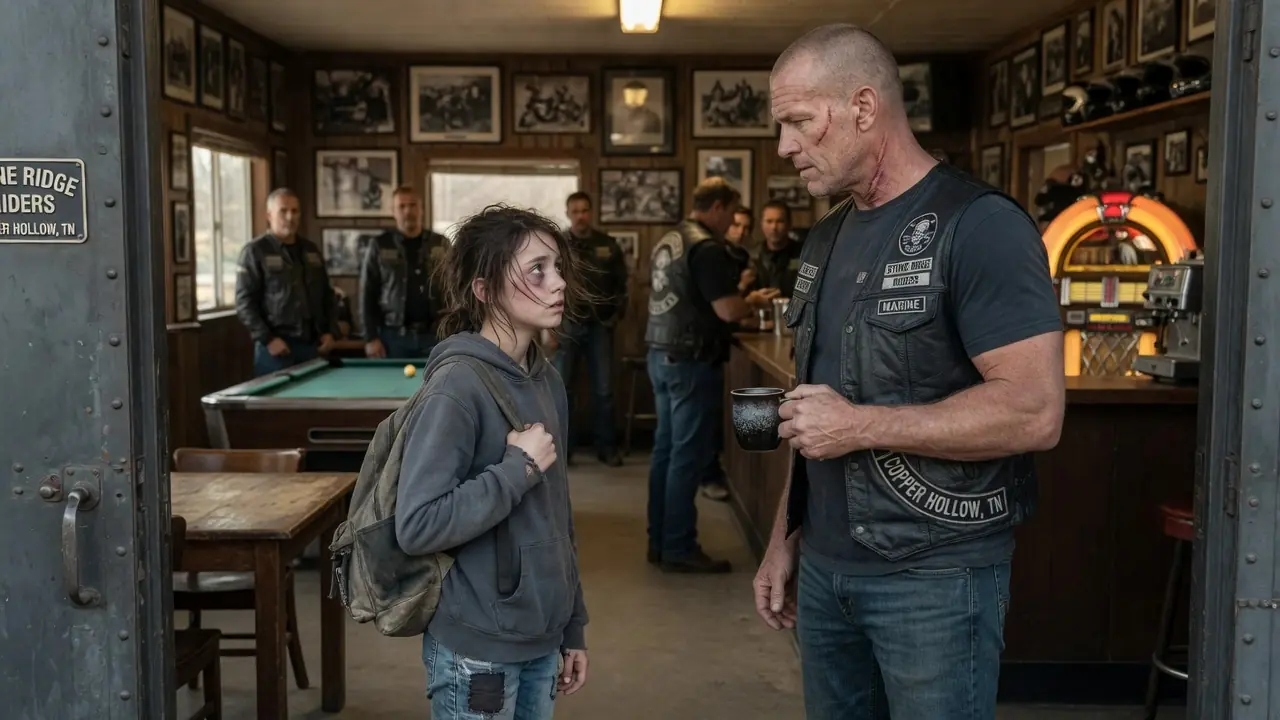
She did not beg for food or money.
She looked the room full of hardened bikers straight in the eye and asked for one thing that left every single one of them speechless.
“Can I work here?”
The late afternoon sun was bleeding out behind the low hills east of Copper Hollow, Tennessee, when the heavy steel door of the Stone Ridge Riders Motorcycle Club creaked open on its rusted hinges.
Inside, the clubhouse was alive with the low rumble of conversation, the clink of beer bottles against scarred tabletops, the sharp crack of pool balls breaking on warped felt, and the steady thump of southern rock drifting from an old Wurlitzer jukebox wedged in the far corner.
The air was layered thick with decades of living.
Motor oil and worn leather.
Cigarette smoke that had soaked so deep into the wood-paneled walls it had become part of the grain.
The faint bitterness of strong black coffee brewing on a stained Bunn machine in the narrow kitchen behind the bar.
More than a dozen men filled the space that evening.
Big men. Tough men. Men with scarred knuckles and faded tattoos that told stories of roads traveled and battles fought.
They wore patched leather vests that marked decades of loyalty to each other and to the road.
They were mechanics and veterans and ex-convicts, fathers who had lost custody and loners who had never wanted company.
The town of Copper Hollow whispered about them, but never truly knew them.
Every head in that room turned when the door opened.
The music seemed to fade.
Conversations died mid-sentence.
A pool cue froze in mid-strike, the eight ball left spinning in place.
Even the coffee machine seemed to pause its gurgling, as though the building itself was holding its breath.
Standing in the doorway was a small girl drowning in a faded gray hoodie two sizes too big for her narrow shoulders.
Her jeans were patched at both knees with mismatched fabric.
Her sneakers were held together with silver duct tape wrapped so many times around the toes that the original color was impossible to determine.
Her dark brown hair was messy and unwashed, falling over eyes that looked far older than twelve.
And across her left cheek, spreading up around the socket of her eye, there bloomed a brutal bruise in shades of purple and yellow that no one in that room could miss.
A few bikers exchanged glances.
One man near the pool table chuckled low and shook his head.
“Wrong address, kid!” a voice called from somewhere near the back of the room.
There was laughter.
Not cruel exactly, but dismissive.
The sound of men who had seen everything and assumed this was nothing.
But the girl did not turn and run.
She stepped fully inside the clubhouse, letting the heavy steel door swing shut behind her with a thud that echoed through the silence like a judge dropping a gavel.
Her hands stayed buried deep in the front pocket of that oversized hoodie.
Her shoulders were hunched slightly against the cold she had carried in from outside, but her chin was level, her eyes were steady, and she did not back down.
“I am looking for work,” she said.
Her voice was quiet but clear, cutting through the stale air and the silence and the low hum of the jukebox like a blade through paper.
“After school, I can sweep floors, wash bikes, clean tools, organize the shop, whatever you need done. I am good at it. I will not cause any trouble.”
The laughter came then, louder this time, rolling through the room like distant thunder.
A giant of a man with a red beard that hung down to the middle of his chest and arms thick as bridge cables slapped the bar top hard enough to rattle the bottles.
Several others joined in, shaking their heads and nudging each other with elbows and grins.
But one man in that room was not laughing.
Wade Colton sat in the corner booth, nursing a cup of black coffee that had gone cold twenty minutes ago.
He was forty-five years old, a former United States Marine. Two tours in Afghanistan, one in Iraq.
His head was shaved clean, and a jagged scar ran from below his left ear all the way down to his collarbone, a souvenir from a dusty road outside Kandahar where an IED had turned his convoy into a furnace.
He had pulled two brothers from the burning wreckage.
He had held dying friends in his arms.
He had made decisions in seconds that haunted him for decades.
And somewhere in those years, he had learned to read people the way other men read road maps.
He saw something in this girl’s eyes that stopped him cold.
Determination wrapped in quiet shame.
The kind of strength that only comes from surviving things no child should ever have to face.
Wade set down his coffee.
He stood slowly, and his heavy boots thudded on the stained concrete floor with a weight and deliberateness that made the room go quiet all over again.
When Wade Colton moved with purpose, people listened.
Not because he was the loudest man in the room. He almost never raised his voice.
But because every man in the Stone Ridge Riders knew that Wade had walked through fire, real fire, and come out the other side still standing.
His rank was road captain.
His authority was something deeper than rank.
He crossed the room and stopped six feet from the girl.
Close enough to talk.
Far enough not to crowd her.
“What is your name, kid?”
“Marin. Marin Harmon.”
“You live around here?”
Marin gave a small nod.
“Maple Street. The blue house with the sagging porch and the chain-link fence out front.”
Wade knew that house.
Everyone in Copper Hollow knew it, even if they pretended they did not.
It sat at the far end of Maple Street, where the sidewalk crumbled into gravel and the street light had been out for three years.
It was a foster placement run by Dale Fenton, a big, loud man who collected monthly checks from the state and kept to himself, kept his curtains drawn, and kept whatever happened behind those walls strictly behind those walls.
Children came and children went.
Bruises were explained away as rough play.
No one ever pushed too hard.
“How old are you?” Wade asked.
“Twelve. Thirteen in February.”
Wade stepped one pace closer.
The girl’s shoulders tensed. Her hands curled tighter inside that hoodie pocket, but she did not flinch.
She did not step backward.
And that single detail told Wade Colton everything he needed to know.
Because a child who flinches has been hit.
But a child who has trained herself not to flinch has been hit so many times that she has learned to absorb the blow without showing pain because showing pain only makes it worse.
“That is a hell of a bruise you have got there.”
Marin’s jaw tightened.
The muscles in her thin neck went taut.
“Fell off my skateboard,” she said.
“You ride that skateboard to school sometimes,” Wade said, keeping his voice level and easy, the way he had once spoken to terrified villagers in provinces where a wrong word could start a firefight. “Where exactly did you fall? Sidewalk? Driveway? Parking lot?”
Marin’s eyes flicked downward for just a fraction of a second.
Calculating.
Weighing the truth against its consequences.
The way no child should ever have to calculate anything.
When her eyes came back up, they were guarded again.
“Does it matter?”
“Yeah,” Wade said.
His voice dropped low and steady, the way a river sounds just before it reaches the falls.
“It matters a lot.”
The silence that followed stretched between them like a wire pulled to its breaking point.
The other bikers had gone still.
They were pretending to focus on their drinks or their phones or the television mounted above the bar, but every ear in that clubhouse was tuned to the conversation near the front door.
Wade made his decision.
“Tell you what,” he said, easing his tone back to something casual. “I need to check the shop out back, see what kind of work we actually have available. You wait here. Do not touch anything. Just sit.”
He pointed to an old cracked leather couch near the front window.
It was the kind of couch that had seen better decades, with exposed springs pushing through the cushions and stuffing leaking out in places like the tired memories of all the men who had sat there before.
Marin walked over and sat down straight-backed, hands still in that pocket, eyes fixed on the scuffed concrete floor.
She did not fidget.
She did not look around the room with curiosity or fear.
She simply sat perfectly still, the way a person sits when they have learned that being small and quiet and invisible is the safest way to survive.
Wade did not go to the shop.
He stepped outside into the cold Tennessee evening, pulled the collar of his leather vest up against the wind coming down off the ridge, and dialed a phone number he had not used in nearly three years.
It belonged to an old Marine buddy from his first tour, a woman named Taggart, who had traded her combat boots for a desk at the county Department of Children’s Services.
She answered on the second ring, and Wade spoke for four minutes without stopping.
He told her about the girl, about the bruise, about the house on Maple Street, about the way Marin Harmon had walked into a room full of dangerous men and asked for honest work with the composure of someone who had run out of every other option.
“I will start pulling files tomorrow morning,” Taggart said. “But Wade, I need evidence. Documented, dated, verifiable. Without it, that girl goes right back to that house.”
“I know,” Wade said. “We will get it.”
Two slow hours passed in the clubhouse.
Men came and went.
The jukebox cycled through Lynyrd Skynyrd, the Allman Brothers, and Waylon Jennings.
Someone ordered a basket of wings from the kitchen.
And then Jolene Pruitt appeared.
Jolene was the club’s unofficial den mother.
Fifty-two years old, built like a woman who had spent decades hauling trays and never complained about it.
She ran a small diner on Route 9 that had been feeding the Stone Ridge Riders for fifteen years.
She had buried one husband, divorced another, and raised three sons who had all turned out better than anyone expected.
She had hands that were rough from work, but impossibly gentle when they needed to be.
She came out of the kitchen carrying a plate.
A thick ham and cheese sandwich on fresh bread, a pile of chips, and a cold bottle of Coca-Cola with the cap already twisted off.
She walked to the couch where Marin sat and set the plate down silently on the armrest beside the girl.
She gave Marin’s shoulder the gentlest squeeze, a touch so light and careful it was almost not there at all.
Then she turned and walked away without a word.
Marin stared at that plate of food for nearly ten minutes.
She stared at it the way a person stares at something they desperately want, but have learned through hard experience to distrust.
As though she were waiting for someone to come and take it away.
As though the sandwich and the chips and the cold bottle of Coke were a test, and the wrong answer would bring consequences she knew too well.
Finally, she ate.
Small, careful bites.
Chewing slowly.
Savoring each one as though she had learned long ago that food was not guaranteed and nothing should ever be wasted.
She drank the Coke in sips, holding the bottle with both hands.
And when a small piece of chip fell onto the couch cushion, she picked it up and ate that, too.
When Wade came back into the main room, Marin was exactly where he had left her.
She had not moved an inch.
The plate was clean. The bottle was empty. Her hands were back in her pocket. Her eyes were on the floor.
“All right, Marin,” Wade said, pulling a chair over and sitting down so they were at eye level. “We have got work. Sweeping, organizing tools, washing bikes, basic stuff. Ten dollars an hour, three days a week. Tuesdays, Thursdays, and Saturdays. Two hours after school. You show up on time, you work hard, you do not steal, and you never lie to us. Can you handle that?”
For the first time since she had walked through that steel door, something shifted in Marin Harmon’s carefully guarded expression.
Her eyes widened by just a fraction.
It was hope.
Not the loud kind.
Not the kind that announces itself with smiles and celebration.
It was the quiet kind.
The dangerous kind.
The kind a person who has been disappointed a hundred times allows herself to feel only in the smallest possible dose because she knows from experience that hope is the thing that hurts the most when it is taken away.
“Yes, sir,” Marin said.
“Good. We start Tuesday at four. Do not be late.”
Marin stood.
She nodded once.
She walked to the door.
Her hand was on the steel handle when Wade called after her.
“Marin.”
She turned.
“That bruise did not come from any skateboard.”
It was not a question.
It was a statement delivered in the flat, certain tone of a man who had seen enough wounds in his life to know the difference between an accident and an attack.
For one heartbeat, Marin’s mask slipped.
Just for a breath, something raw and desperate flashed across her face.
Something that wanted so badly to speak, but was held back by years of training and terror and the bone-deep knowledge that telling the truth had never once made anything better.
Then the mask slid back into place.
“Tuesday,” Wade said quietly. “Four o’clock.”
The door closed softly behind her.
The clubhouse let out a collective breath that no one had realized they were holding.
Boon Kesler spoke first, his earlier laughter completely gone, replaced by something heavy and troubled.
“You serious, Wade? Hiring a kid?”
Wade stared out the window, watching the small figure in the oversized gray hoodie disappear down the darkening street, shoulders hunched against the cold wind blowing down from the Cumberland Plateau.
“That,” he said quietly, “was a kid throwing out a lifeline in the only way she knew how. And we are damn well going to grab it.”
Tuesday arrived under a steel-gray sky that pressed down on Copper Hollow like a lid on a pot.
Marin was waiting outside the clubhouse ten minutes before four, shifting her weight from one taped-together sneaker to the other.
Her breath was visible in the cold air, her body coiled with the tension of someone ready to bolt at the first sign that this whole thing had been a joke or a trick or a lie.
Wade opened the front door before she could knock.
“Early,” he said. “That is a good start. Come on in.”
He led her through the main room, quieter now, and out the back door into the large garage.
The space was enormous, a converted warehouse bay with concrete floors and fluorescent lights hanging from steel rafters.
The air smelled of gasoline and rubber and the faintest trace of something Marin would later come to understand was possibility.
Five motorcycles sat in a gleaming row along the far wall.
Harley-Davidsons, every one.
Chrome catching the light.
Tools hung in precise order on pegboard walls. Wrenches arranged by size. Socket sets in labeled drawers.
“This is Rooster,” Wade said, gesturing to a wiry man in his late fifties leaning against a workbench with a shop rag over one shoulder.
His real name was Gil Sutton, but no one had called him that in decades.
He had earned the name in the Gulf War, where he served as an Army medic in the deserts of Iraq and was reportedly the first man awake every morning of his entire deployment.
He had salt-and-pepper hair pulled back in a short ponytail and permanent grease etched into his fingertips.
He could diagnose an engine problem from twenty feet away just by listening.
“Kid is on cleanup and organization duty,” Wade told him. “Show her what needs doing.”
Rooster gave Marin a long, measuring look.
His eyes lingered for just a moment on the fading bruise around her eye, and something tightened in his jaw.
But he said nothing about it.
He simply reached behind him, pulled a push broom from its hook on the wall, and held it out to her.
“Start in the back corner,” he said. “Work your way forward. Every inch.”
Marin took that broom and attacked the job as though her life depended on it.
She swept every corner of that massive garage, every hidden crevice beneath the workbenches, every crack in the concrete where dust and metal shavings had accumulated over months.
She moved toolboxes to sweep behind them.
She got down on her hands and knees to reach under the hydraulic lift.
She did not miss a single speck of dust or a single dropped bolt or a single forgotten shop rag.
Rooster watched without comment, but he noticed.
He noticed the focus, the precision, the quiet pride she took in doing the job correctly.
This was not a child going through the motions.
This was a child who understood that the quality of your work was the only thing in this world you could truly control.
And she was determined to control it perfectly.
After an hour, Rooster called her over to the main workbench.
“You know anything about engines?” he asked.
“No, sir.”
“Want to learn?”
Something happened in Marin’s face when he asked that question.
It was as though someone had flipped a switch deep inside her, illuminating a room that had been dark for a very long time.
Her eyes widened. Her lips parted slightly.
For just a moment, the guarded, careful, old-beyond-her-years composure fell away, and she looked exactly like what she was.
A twelve-year-old child who had just been offered something wonderful.
“Yes,” she said. “Yes, sir.”
Rooster pulled a large plastic bin from under the workbench.
It was filled with a jumbled mess of bolts, washers, nuts, gaskets, and small engine parts that had accumulated over weeks of project work.
“Sort these,” he said. “Group them by size and type. Think you can handle it?”
Marin nodded and sat down on the concrete floor with the bin between her knees.
Her hands moved quickly but carefully, separating the parts into neat rows organized by diameter, thread count, and material.
Twenty minutes later, Rooster walked over to check her progress and stopped short.
The parts were organized better than he usually managed himself.
Every bolt was aligned. Every washer was stacked.
She had even separated the stainless-steel fasteners from the zinc-plated ones, a distinction most first-year mechanics would not have caught.
“You have got steady hands and a good eye,” Rooster said, and his voice was softer than it had been before.
Warmer.
Marin looked up, and for just a second, her guard dropped completely.
“My mom used to let me help her in the garage,” she said.
“Before.”
The word hung in the air between them.
Before.
A single word carrying the entire weight of a life divided into two halves.
The half that had a mother, and the half that did not.
“Before what?” Rooster asked gently.
Marin’s face closed again.
Not abruptly.
Not with fear.
But with the practice of someone who had learned exactly how far to open a door before pulling it shut again.
Rooster did not push.
He had spent enough years patching up wounded men in field hospitals to know that some stories only come out when they are ready, and pushing before that moment does more harm than good.
“Well,” he said, straightening up and crossing his arms. “If you keep showing up like this, I will teach you the real stuff. How an engine breathes. How to take one apart and put it back together so it runs better than the day it rolled off the factory floor. Might come in handy someday.”
Marin stared at him.
“Really?”
“Really.”
That evening, after her two-hour shift ended, Marin sat on an overturned milk crate outside the garage bay, carefully sketching something in a small notebook she had pulled from her backpack.
Rooster walked past on his way to lock up and glanced over her shoulder.
She had drawn, entirely from memory, a diagram of the V-twin engine he had shown her earlier that afternoon.
The cylinders were in the right position. The pushrods were labeled.
Even the oil passages were roughly indicated with small arrows showing flow direction.
Rooster stared at that drawing for a long time.
Then he looked at the girl who had made it.
This thin, bruised, quiet child in duct-taped sneakers and a hoodie that looked like it had come from a donation bin.
Something shifted in his chest.
Something he had not felt in a very long time.
He did not say anything.
He just nodded once, slow and deliberate, the way one professional acknowledges another.
As Marin gathered her backpack to leave, a huge man appeared in the garage doorway.
Six foot four and broad as a doorframe, with a snow-white beard and eyes so gentle they seemed to belong to a different man than the one attached to those enormous scarred hands.
Everyone called him Timber.
His real name was Hank Dwire.
He was the club’s vice president, a widower who spoke slowly and never wasted a word.
Years ago, his teenage daughter had been pulled into the foster care system during the worst period of his life, when alcohol and grief had made him into someone he did not recognize.
By the time he had gotten sober, his daughter was gone, aged out at eighteen, and vanished.
He had never found her.
He had never forgiven himself.
“Mind if I walk you partway home?” Timber asked Marin. “Getting dark out.”
They walked in comfortable silence for several blocks, their footsteps crunching on gravel shoulders where the sidewalk gave way to dirt.
The streetlights in this part of Copper Hollow were spaced far apart, and the darkness between them felt heavy and old.
“You like the work?” Timber finally asked.
“Yeah. A lot.”
“Rooster is good people.”
“Best mechanic I have ever known,” Timber said. “And I have known a few.”
They turned onto Maple Street.
The change in Marin was immediate and unmistakable.
Her steps slowed. Her shoulders drew inward.
Her hands, which had been swinging freely at her sides for the first time all day, retreated back into that hoodie pocket.
Her entire body seemed to shrink as the blue house came into view at the end of the street.
Peeling paint.
Overgrown yard.
Curtains drawn.
A porch light that flickered but gave off almost no useful light.
A chain-link fence with a gate that hung crooked on one hinge.
Timber noticed all of it.
He stopped one house away and reached into the inside pocket of his leather vest.
He pulled out a small card with the clubhouse phone number handwritten on it in his own careful block letters.
“If anything ever feels wrong,” he said, holding the card out to her. “If you ever need someone, you call this number. Day or night. Does not matter what time it is. Someone will answer. Someone will come.”
Marin took the card and stared at it in the fading light.
She turned it over in her fingers as though it were made of something precious and breakable.
“Why are you doing this?” she asked.
Her voice was so small and so bewildered that Timber felt his throat close up like a fist had grabbed it.
He thought about his daughter, about the system that had swallowed her whole, about all the years he had spent searching and the silence that was worse than any answer could have been.
He thought about the promises he had made to himself in the darkest hours of his sobriety, promises that he would never again look away when a child was drowning.
“Because you walked in and asked for work instead of a handout,” he said. “That takes real courage, kid. And courage deserves backup.”
Marin tucked the card deep into the front pocket of her jeans, pressing it down with her fingertips as though she wanted to make absolutely certain it could not fall out.
“Thank you,” she said.
Timber waited on the sidewalk until the girl disappeared through the crooked gate, up the sagging porch steps, and through the front door of the blue house.
He watched the door close.
He watched the porch light flicker three times and then go steady.
He listened for shouting and heard nothing, which somehow made him feel worse instead of better because silence in a house like that usually meant someone was being very careful not to make a sound.
He pulled out his phone and called Wade.
“It is bad, brother,” he said, keeping his voice low even though there was no one on the dark street to hear him. “That house feels wrong. The kid is scared to even walk through the front door. Her whole body changes when she sees the place.”
Wade’s voice on the other end of the line was ice.
“I know. I have already started making calls. We document everything. Bruises, dates, times, every single detail. We build a case so solid that no caseworker and no judge can look at it and do nothing.”
“And if the system moves too slow?” Timber asked.
Wade was silent for a moment.
Then he said, “We will cross that bridge when we get to it.”
Timber stood on Maple Street for another minute after he hung up, watching the blue house, watching the drawn curtains, watching the darkness settle around it.
Then he walked back to the clubhouse alone.
Three weeks passed.
Marin Harmon became a quiet fixture in the Stone Ridge Riders garage, as much a part of the landscape as the toolboards and the oil drums and the gleaming row of Harleys along the back wall.
She showed up every scheduled day without fail.
Tuesdays at four. Thursdays at four. Saturdays at ten in the morning.
She was always early.
Five minutes at least. Sometimes ten.
Waiting outside the door in that same oversized gray hoodie, those same duct-taped sneakers, silent and watchful and ready.
She swept and organized and scrubbed and sorted with a thoroughness that put some of the adult members to shame.
She learned the name and purpose of every tool on the pegboard.
She could identify a socket wrench by size without looking at the markings.
She began helping Rooster with basic disassembly tasks, carefully removing spark plugs and cleaning them with a wire brush, draining old oil into catch pans, organizing replacement parts for upcoming builds.
Her hands, once hesitant and uncertain, grew steadier with each session.
Calluses formed on her palms and fingertips.
A small, careful smile sometimes appeared on her face when Rooster praised a job well done.
A smile that was gone as quickly as it came, like sunlight through a crack in a wall.
For two hours at a time, three days a week, Marin Harmon was safe.
She was seen.
She was learning that hard work could earn respect instead of pain.
She was discovering that there were men in this world who used their strength to protect instead of to punish.
And she was beginning, just barely, to understand what it might feel like to belong somewhere.
But the bruises kept coming.
A split lip on a Thursday.
She said she caught an elbow during gym class.
A dark ring around her wrist the following Tuesday that looked exactly like the imprint of adult fingers wrapped tight enough to leave marks.
She said she bumped it on a doorframe.
A row of small bruises along her rib cage, visible for just a second when she reached up to hang a wrench and her hoodie rode up.
She pulled the fabric down quickly and did not offer an explanation.
No one asked for one because by then they all knew.
The club watched.
They documented.
Quietly, carefully building the record Wade had promised.
Wade took photographs with his phone whenever he could do so without Marin noticing.
He captured the split lip from across the garage, the wrist bruises when she was focused on sorting bolts, the way she winced when she twisted to the left, suggesting bruised or cracked ribs beneath that baggy hoodie.
He dated every photo.
He noted the time.
He sent copies to Taggart at DCS.
Timber kept a small leather notebook in the inside pocket of his vest.
Every time Marin arrived at the clubhouse, he wrote down the date, the time, and a description of any visible injuries.
He noted her demeanor, whether she was more withdrawn than usual, whether she flinched at loud noises, whether she ate the food Jolene packed for her with the desperate efficiency of someone who did not know when the next meal would come.
And Jolene made it her personal mission to ensure that Marin did not go hungry.
She slipped extra food into a backpack she had purchased for the girl from Goodwill.
Sandwiches. Apples. Protein bars. Water bottles.
She packed it all in the bottom beneath a folded sweatshirt, so it was not immediately visible, because she understood that a child conditioned to have things taken away will hide anything of value.
Marin never refused the backpack.
But she never said thank you out loud.
She just slung it over her shoulder and tucked it close like treasure.
Then came the Thursday that changed everything.
Marin walked into the garage four minutes before four.
She moved slowly, more slowly than usual, and she kept her left arm pressed close to her body in a way that Wade recognized immediately.
He had seen soldiers carry injured limbs exactly like that.
Close to the torso.
Protective.
The body’s instinct to shield what hurts from further damage.
Rooster was at the workbench recalibrating a valve spring compressor.
He looked up when Marin entered, and his hands went still.
“Hey, kid,” he said, keeping his voice light. “Grab a rag and help me clean these valve stems.”
Marin reached for the shop rag on the bench, and her hoodie sleeve slid back.
The burn was on the inside of her forearm.
It was round and red and unmistakable, the size and shape of a cigarette pressed into skin and held there long enough to leave a mark.
The tissue around it was inflamed, which meant it was fresh.
Hours old at most.
Rooster’s face did not change.
His voice did not change.
But his eyes went to a place that Wade, standing in the doorway behind Marin, recognized from his own years in combat.
It was the look of a man who had just identified a threat and was calculating the most effective response.
“That is a nasty one,” Rooster said carefully. “What happened?”
And here, in this moment, something happened that none of them had expected.
Marin did not lie.
She looked at the burn on her arm.
She looked at Rooster’s face.
She looked over her shoulder at Wade standing in the doorway.
She looked at the garage around her, at the tools she had organized, the floor she had swept, and the workbench where she had learned how an engine breathes.
She looked at the place that had become, in three short weeks, the only safe ground she had ever known.
And she made a choice.
“He did it,” she said.
Her voice did not waver.
Her eyes did not drop.
She held her arm out so they could see the burn clearly, and she spoke with the terrifying calm of a child who had decided that the truth could not possibly make things worse than they already were.
“I was two minutes late washing the dinner dishes. He put a cigarette out on my arm and told me to move faster next time.”
The garage went completely silent.
Even the fluorescent lights seemed to stop buzzing.
Wade stepped forward.
His face was stone.
“Who?”
“You know who,” Marin said.
There was no accusation in her voice.
No anger. No self-pity.
Just the simple, exhausted honesty of someone who was done pretending.
“Mr. Fenton. He does it when he is angry. He does it when he is drunk. Sometimes he does it for no reason at all.”
Rooster set down the valve spring compressor.
His hands were shaking, not from fear, but from the effort of restraining something that wanted very badly to break free.
Wade crouched down so he was at Marin’s eye level.
The scar on his neck caught the light.
“Thank you for telling us,” he said, and his voice was steady and warm, even though his blood had turned to ice. “That was the bravest thing you could have done. And I need you to know something. From this moment forward, you are not alone in this. Do you understand? You are not alone.”
Marin nodded.
A single tear escaped from her left eye and traced a path down her cheek, following the faded yellow edge of the bruise that had brought her through that clubhouse door three weeks ago.
She did not wipe it away.
She just let it fall.
That night, after Timber walked Marin home and Boon circled the block on his Harley like a chrome-plated guardian angel, Wade sat in the clubhouse office with the door locked and his laptop open.
And he began to dig.
What he found made him sick.
Dale Fenton was not a simple drunk who lost his temper.
He was a predator who had been operating inside the foster care system of the state of Tennessee for over twelve years, and everything about him had been carefully constructed to avoid detection.
He had been a foster parent in four different counties.
McMinn County from 2012 to 2015.
Meigs County from 2015 to 2018.
Rhea County from 2018 to 2021.
And now Hamilton County, which included Copper Hollow, from 2021 to the present.
In every county, the pattern was identical.
He would request children with no living relatives and minimal caseworker oversight.
He would keep them for one to two years, collecting monthly support payments.
He would maintain just enough compliance to avoid red flags, and then, just before questions started being asked, Dale Fenton would move to the next county and start over.
He had never been charged.
Never been investigated.
Each county maintained its own records, and the system for sharing information between jurisdictions was so outdated that a man who moved every three years was effectively invisible.
Wade stared at the screen.
He thought about Marin eating a sandwich in careful bites.
He thought about the cigarette burn on her arm.
He thought about how many other children had waited in rooms like that blue house for someone to notice.
He picked up his phone and called Taggart.
“It is worse than we thought,” he said. “This is not a one-time situation. This man is a professional. He has been doing this for over a decade, and the system has let him walk every single time.”
He sent her everything.
The county records.
The dates.
The addresses.
The pattern.
Then he sat alone in the office for a long time, staring at the wall, thinking about a twelve-year-old girl who had walked into a room full of strangers and asked for work because it was the only way she knew how to ask for help.
But none of them could have predicted what would happen next.
Or how fast things were about to explode.
It was a Thursday evening, three days after Marin had shown them the cigarette burn.
The garage was warm with the smell of coffee and engine grease and the low sound of Tom Petty playing on the portable radio Rooster kept on his workbench.
Marin was beside him, carefully cleaning a set of carburetor jets with a small wire brush, her face bent close to the work, concentrating with the intensity she brought to everything she did in that garage.
The front door of the clubhouse slammed open so hard the entire building seemed to shake.
“Where is she?”
The voice was thick with alcohol and rage.
It carried through the clubhouse like a thrown bottle crashing through the quiet and leaving sharp edges everywhere it landed.
Dale Fenton stood in the doorway between the main room and the garage.
He was six foot three, at least 240 pounds, most of it packed into a gut that strained the buttons of a stained work shirt.
His face was flushed the deep, mottled red of a man who had been drinking since noon.
His eyes were bloodshot and unfocused, but locked on to one target.
The small girl standing frozen beside the workbench.
Marin’s hands stopped moving.
The wire brush slipped from her fingers and clinked on the concrete floor.
Her breathing went shallow.
Her eyes went wide.
Every cell in her body seemed to recoil at once, pulling inward, making herself smaller, as though she could disappear into the air if she just got small enough.
Rooster stepped forward, placing himself between Marin and the doorway.
The shop rag was still in his hand.
His posture was relaxed.
His voice was calm.
“Can I help you?”
“You can get the hell out of my way,” Dale snarled. “That is my foster kid. Her shift, or whatever the hell you people call this little arrangement, is over. She has got chores at home. Real responsibilities, not playing mechanic with a bunch of degenerate bikers.”
Wade appeared from the office hallway like a shadow materializing from a wall.
Calm. Deliberate.
Every movement controlled and precise.
Behind him, Boon and two other club members rose from where they had been sitting in the main room and positioned themselves in a quiet wall of muscle and leather and silent intent.
“Mr. Fenton,” Wade said, and his voice was even, but edged with something that could cut steel. “Marin’s shift ends at six. It is five-twenty. She will be home when she is done.”
Dale’s face darkened to something approaching purple.
“I did not sign off on any of this. I did not give permission for her to be here. She has got responsibilities at home, and I am taking her now.”
“What kind of responsibilities?” Wade asked, taking one slow, measured step forward.
“That is between me and her,” Dale snapped.
“Is it?” Wade’s tone could have frozen fire. “Because she keeps showing up here with new marks. Split lips. Finger bruises on her arms. A cigarette burn that was still raw when we saw it three days ago. And her caseworker has not checked in once in over two years. So I am real curious, Mr. Fenton. What exactly are these responsibilities that are so urgent you had to drive over here half drunk to collect her?”
The garage went dead silent.
The radio seemed to fade.
Every man in that room was looking at Dale Fenton.
And what Dale Fenton saw in those faces was not the disorganized anger of a bar fight.
It was the coordinated, controlled fury of men who had made a collective decision and were waiting to see what happened next.
Dale’s fists clenched, but he was not stupid.
Five large bikers stood between him and the girl.
Wade’s military bearing radiated a threat no amount of drunken rage could overcome.
“You do not know what you are talking about,” Dale muttered, his bluster cracking like cheap paint. “Kids are clumsy. They fall. They bruise easy. And if she would just listen and do what she is told instead of running off to play in some greasy garage every other day, then maybe things at home would not be so difficult.”
He cut himself off.
But it was too late.
“If she would just listen,” Wade repeated, his voice dropping to something low and dangerous, barely above a whisper. “What happens when she does not listen, Mr. Fenton?”
Dale’s mouth opened and closed.
The calculation behind his bloodshot eyes was almost visible.
He was assessing the situation, measuring his options, and arriving at the conclusion that this particular confrontation was one he could not win through intimidation.
He jabbed a thick finger toward Marin.
“You’ll be home in one hour,” he said. “Do not make me come back here. Because next time I will bring the law, and we will see how these boys in their leather jackets feel about harboring a minor without guardian consent.”
He turned and stormed out.
The front door slammed behind him hard enough to rattle a wrench off the pegboard.
Marin stood perfectly still.
Her hands were shaking.
Her face was white.
She stared at the doorway where Dale had been standing and breathed in short, rapid gasps she was trying desperately to control.
Rooster crouched beside her.
“You are okay, kid. He is gone. You are safe right here.”
“I should go,” Marin whispered. “If I am late, if he has to come back, it will be worse. It is always worse.”
“Not yet,” Wade said.
He was already reaching for his phone.
“Timber, get over here now.”
Twenty minutes later, Timber walked Marin home.
But this time, Boon followed on his Harley, the engine rumbling low and steady, circling the block in slow loops like a guardian shark making its rounds.
When they reached Maple Street, Dale was visible through the front window of the blue house, pacing back and forth, bottle in hand, shouting at someone on the phone.
Timber stopped Marin one house away from the gate.
“You do not have to go in there tonight,” he said. “You can come back to the clubhouse. We will figure something out.”
“I do,” Marin said.
Her voice was flat, rehearsed, as though she had practiced this exact response many times before for exactly this situation.
“If I do not go back, he calls the caseworker and tells them I ran away. Then it is a group home. I have been in three already. They are worse.”
Timber’s chest tightened so hard he could barely draw a breath.
“How do you know they are worse?”
“Because after four placements, they stop trying,” Marin said.
She looked at him with those old, old eyes.
“You just age out. You turn eighteen, and they hand you a garbage bag with your stuff in it, and you walk out the door, and that is it. Nobody comes looking for you. Nobody remembers your name.”
She gave a small, hollow shrug that broke Timber’s heart more than any amount of crying ever could have.
“Thanks for the bump,” she added quietly. “It has been really good.”
She walked to the gate alone.
She pushed it open, and it scraped against the concrete.
She climbed the porch steps.
She opened the front door and disappeared inside.
The porch light went dark.
Timber waited until the street was silent, then pulled out his phone and called Wade.
“We are out of time, brother,” he said, and his voice was rough with the effort of keeping it steady. “That man is going to hurt her bad real soon. I could see it in his face tonight. He is not just angry anymore. He is scared. And scared men with something to hide are the most dangerous animals on earth.”
“I know,” Wade said. “Meet me at Jolene’s diner. We need to talk.”
Jolene’s diner was warm and dimly lit, smelling of fresh coffee and bacon grease.
She had stayed open late because Wade had called ahead, and she knew from the sound of his voice that this was not a social visit.
She poured three cups of coffee without being asked and set them on the table in the back booth.
“How bad?” she asked, sliding into the booth across from Wade.
“Bad,” he said. “We need evidence fast. Documented. Photographs. Medical records if we can get them. Something concrete enough for DCS to act on before Fenton packs up and moves to the next county like he has done every time before.”
Jolene nodded slowly, her weathered face thoughtful.
“What is the girl’s full name again?”
“Marin Harmon.”
Something flickered across Jolene’s expression.
A shadow.
A memory trying to surface.
She was quiet for a moment, then stood and disappeared into the small office behind the kitchen.
Timber and Wade heard the sound of boxes being moved, filing cabinet drawers opening and closing, papers shuffling.
She came back carrying a thin manila folder yellowed at the edges and soft with age.
“I was cleaning out old employee records last year,” she said, setting the folder on the table. “Getting ready for taxes. Found this filed in the wrong year. I kept it because something about it bothered me, and I could never figure out what.”
She opened the folder.
Inside was a faded employment record.
The name on it was Jenna Harmon.
Waitress.
Start date: March of 2013.
Performance notes in Jolene’s own handwriting.
Excellent worker. Never late. Always volunteers for extra shifts. The kind of girl who makes you believe people are fundamentally good.
Then one day in November of 2013, Jenna Harmon had simply stopped showing up.
No call.
No notice.
No two-week resignation.
She had just vanished like smoke on a cold morning.
She never came back to collect her final paycheck.
She never returned the apron she had borrowed.
She never called to explain.
Jolene’s eyes filled with tears.
“She was sweet,” she said. “Barely twenty-one, working double shifts to support her baby. She talked about her daughter all the time. Marin this and Marin that. Said that little girl was her whole world.”
Jolene reached into the folder and pulled out a small Polaroid photograph that had been tucked behind the employment forms.
It showed a young woman with dark brown hair and tired, luminous eyes holding a smiling infant against her chest.
The woman was thin. Her clothes were worn.
But she was smiling with a radiance that seemed to push against the edges of the photograph.
On the back, in faded blue ink, someone had written four words and a number.
Marin, four months. My heart.
Wade stared at the photograph.
At the mother’s eyes.
At the baby’s face.
At the handwriting that was careful and loving and entirely at odds with the story Dale Fenton had told twelve years ago about a troubled young woman who had abandoned her infant at a gas station and disappeared.
“I called the police when she stopped showing up,” Jolene said. “Filed a missing person’s report myself. An officer asked a few questions, wrote some things down, and told me that single mothers sometimes just leave. Case closed in less than a week.”
Wade picked up the Polaroid and held it under the diner’s light.
He looked at Jenna Harmon’s face, at the fierce, protective love in her expression, at the way she held her daughter close, and he felt something cold and certain settle into his chest.
“Jesus,” Timber whispered.
Wade took photographs of everything in the folder.
The employment record.
The dates.
The Polaroid, front and back.
Jolene handed over the originals.
“You think Dale had something to do with it?” she asked. “With Jenna disappearing?”
Wade set the photograph down carefully.
“A devoted mother does not abandon her baby without a trace,” he said. “She does not leave behind her last paycheck and every possession she owned and walk away from the only thing she said she lived for.”
He looked at Jenna’s face one more time.
“And I think Dale Fenton knows exactly what happened to her. I think he has known for twelve years.”
Outside the diner, the street was dark and empty.
But two blocks away on Maple Street, Boon Kesler’s engine still rumbled past the blue house every few minutes.
A low, steady sound in the cold night.
A promise that sounded like thunder.
A promise that tonight at least, Marin Harmon would not face the darkness completely alone.
The photograph of Jenna Harmon holding her infant daughter changed everything the Stone Ridge Riders thought they knew about Marin’s past.
But it was what happened in the days that followed that revealed just how deep the darkness ran beneath that blue house on Maple Street, and how far a twelve-year-old girl was willing to go to drag the truth into the light.
Wade did not sleep that night.
He sat in the clubhouse office with the door closed, the overhead light buzzing, and Jolene’s folder spread across the desk beside his laptop.
He stared at the Polaroid for a long time.
At Jenna Harmon’s tired, luminous eyes.
At the infant pressed against her chest.
At the handwriting on the back that was so careful and loving it made his teeth ache.
Marin, four months. My heart.
Then he went to work.
He cross-referenced every date in the employment record against the county’s foster care database, which Taggart had quietly given him restricted access to three days earlier.
The timeline assembled itself like a crime-scene photograph developing in a dark room.
Jenna Harmon had been hired at Jolene’s Diner in March of 2013, when Marin was barely a month old.
She worked double shifts six days a week for eight months.
Her performance reviews were flawless.
She never missed a day. She never called in late.
She was, by every account, a young woman holding her life together with her fingernails and sheer willpower for the sake of a baby she loved more than breathing.
Then in November of 2013, she vanished.
No resignation.
No phone call.
No forwarding address.
She left behind her last paycheck, her work apron, and every possession she owned.
Gone like smoke.
Six months later, in May of 2014, Dale Fenton appeared at the McMinn County Department of Children’s Services with a toddler, a barely walking infant he identified as Marin Harmon.
He told the intake officer that the child’s mother, whom he described as a troubled young woman he had known casually through a church program, had left the baby with him at a gas station one night and never returned.
He said he had waited months for her to come back.
He said he had grown attached to the child and wanted to provide her with a stable home.
He filed for emergency foster placement as a family friend.
The intake officer processed the paperwork.
A single home visit was conducted two weeks later by a caseworker who noted that the residence was clean and adequately furnished and that Mr. Fenton appeared sober and cooperative.
No background check beyond the standard state database was performed.
No effort was made to locate Jenna Harmon or verify Dale’s account of how he had come to possess her child.
No one contacted hospitals or morgues or law enforcement agencies in neighboring counties.
No one asked the single most obvious question.
Why would a devoted mother abandon her four-month-old baby to a man she barely knew?
Wade sat back in his chair and pressed his palms against his eyes.
The answer was so clear it burned.
She would not.
She never did.
Something happened to Jenna Harmon in November of 2013.
And Dale Fenton knew exactly what it was.
For twelve years, a system had been too broken, too overwhelmed, and too willing to accept the simplest explanation to bother looking for the truth.
He sent everything to Taggart.
The employment records.
The timeline.
The Polaroid.
His own analysis of the dates and discrepancies.
He typed the email at three in the morning, and his hands were steady, and his words were precise because this was the kind of work he understood.
Building a case.
Assembling evidence.
Preparing for a fight that had to be won because losing was not something he could afford to contemplate.
Then he waited.
But Dale Fenton did not wait.
The morning after his confrontation at the clubhouse, Dale drove to the county DCS office and filed a formal complaint against the Stone Ridge Riders Motorcycle Club.
He alleged that the organization was employing a minor without legal guardian consent, exposing her to dangerous working conditions, and exercising undue influence over a foster child for purposes he characterized as suspicious and potentially criminal.
He demanded that Marin’s work arrangement be terminated immediately and requested that her caseworker conduct a home visit to confirm the child’s welfare and continued placement in his care.
It was a calculated move.
Precise.
Practiced.
The kind of maneuver that a man who had spent twelve years navigating the foster care system had rehearsed in his mind a hundred times, waiting for exactly this situation.
By filing first, Dale positioned himself as the concerned guardian protecting his ward from outside influences.
He shifted the narrative from his own behavior to the club’s involvement.
He created a paper trail that would make any future action against him look like retaliation rather than justice.
And he forced DCS into a procedural response that would eat up days or weeks of bureaucratic processing time, which was all the time he needed to plan his disappearance.
Wade found out about the complaint when Taggart called him the following afternoon.
Her voice was tight with frustration, the sound of a woman who had spent her career fighting a system she believed in and was watching it be weaponized by the very people it was supposed to protect children from.
“He beat us to it,” she said. “Filed a formal complaint first thing this morning. My supervisor is now asking questions about why a motorcycle club is employing a twelve-year-old. And until we can demonstrate otherwise, the optics are terrible. I need to pause the investigation until I can navigate the internal review.”
“How long?” Wade asked.
“Could be a week. Could be two. I am doing everything I can, but this man knows the system better than most of the people who work in it.”
Wade hung up and stared at the wall for a long time.
Then he called a meeting.
That evening, every senior member of the Stone Ridge Riders sat around the main room table.
Wade laid out the situation in the same measured, factual tone he had once used to brief platoon commanders before combat operations.
Dale had filed a complaint.
DCS was temporarily stalled.
The club’s direct contact with Marin was now legally complicated in ways that could be used against them if they were not careful.
And the clock was ticking because Dale Fenton’s pattern was clear.
When pressure increased, he ran.
And if he ran with Marin, they might never find her again.
Timber spoke first.
His voice was low and heavy.
“What about the girl?”
“That is the problem,” Wade said. “Dale is going to cut her off. No more visits to the clubhouse, no more work shifts. He is going to isolate her completely. And then he is going to start planning his exit. New county, new address, same game.”
“Then we need to move faster than him,” Rooster said.
“We need Marin to move,” Wade said.
Everyone in the room understood what he meant.
They could not rescue her.
The law would not allow it, and forcing the issue would destroy the case they were building.
But if Marin chose to act on her own, if she chose to leave that house of her own free will and bring them something concrete, something undeniable, then the calculus changed entirely.
The question was whether a twelve-year-old girl who had spent her entire life being taught that silence was survival would find the courage to break that silence on her own terms.
They did not have to wait long for the answer.
Three days passed.
Tuesday came and went with no sign of Marin at the clubhouse.
Wade drove past Maple Street that evening and saw that the blue house had new padlocks on the front gate.
The windows on the second floor, where Marin’s small room was located, had been fitted with cheap hardware-store latches that were visible even from the street.
Dale was not just grounding her.
He was caging her.
Thursday came.
Still no Marin.
Rooster left her toolbox untouched on the workbench.
The broom she usually used stood in the corner where she had last placed it.
The engine diagram she had been working on lay open on the workbench, her careful pencil lines waiting for hands that did not come.
Her absence filled the garage like a held breath.
Like the silence between heartbeats.
Like the space a person leaves behind when they are taken from a place where they were finally beginning to belong.
Jolene came by on Thursday evening with a plate of food nobody ate.
She sat at the bar and stared at the empty couch where Marin had once sat with a ham sandwich.
She thought about Jenna Harmon, twenty-one years old, smiling in a Polaroid, writing in blue ink about her baby girl.
The distance between that photograph and this silence was enough to break a person in half.
Saturday came.
Wade sat in the clubhouse office until midnight, unable to sleep, going over the case files again and again.
Timber paced the main room like a caged animal.
Boon sat at the bar, cleaning his rings one by one and saying nothing.
At 12:40 in the morning, someone knocked on the back door of the garage.
Not the front.
The back.
The service entrance that opened onto the alley behind the building, where the dumpster sat and the gravel was loose and the security light had been burned out for months.
Timber was closest.
He opened the door with one hand on the frame and the other reaching instinctively for the knife on his belt.
And then he stopped.
Marin stood in the alley.
She was breathing hard. Her face was flushed from running.
She wore the same gray hoodie and the same duct-taped sneakers.
There was a fresh bruise on her jawline, dark and swollen, no more than a few hours old.
Her hair was wild. Her eyes were wide.
In her arms, she clutched a dirty canvas backpack so tightly that her knuckles had gone white.
“I got out,” she said.
The words came fast, tumbling over each other like water breaking through a crack in a dam.
“He locked my window, but he forgot about the basement. There is a window in the basement behind the furnace, and the latch is rusted, and I have been working on it for two days with a butter knife I hid under my mattress. He passed out on the couch at eleven with the television on, and I waited an hour to make sure he was really out. Then I went down the basement stairs one at a time because the third one creaks, and I went through the window, and I cut my hand on the frame, and I ran the whole way here, and I did not stop once.”
She held up her right palm.
A thin cut ran across it, still oozing, smeared with rust and dirt.
She was shaking.
Not just her hands.
Her whole body vibrated with adrenaline and fear and something else that Timber recognized from the very deepest part of his own memory.
It was the tremor of someone who had just done the bravest thing they had ever done in their life and did not yet know whether it was the right decision or the last mistake they would ever make.
He stepped aside, and she came in.
Wade appeared from the office.
Jolene, who had been sleeping in the back room because she had refused to go home while things were this uncertain, emerged with a blanket and wrapped it around Marin’s shoulders without a word.
They sat her down at the table.
Rooster brought her water.
Boon stood near the door, arms crossed, watching the alley.
Marin drank half the water in one long swallow, then set the glass down and looked at Wade with those old, old eyes.
“I found something,” she said. “In the basement. Something he has been hiding.”
She opened the backpack.
Inside was a small metal box, the kind you could buy at any hardware store for keeping documents safe from water damage.
It was dented and scratched and streaked with dirt.
When Marin set it on the table and opened the lid, the smell of old paper and dust rose into the air like a confession.
She reached in and pulled out the contents one by one, laying them on the table with the careful precision she brought to everything she did.
Her hands moved slowly, deliberately, as though she understood that each item she placed on that scarred wooden surface was a piece of a life that had been stolen from her before she was old enough to remember it.
A Tennessee driver’s license.
The photograph showed a young woman with dark brown hair and tired, luminous eyes and a chin that tilted upward slightly, defiantly, as though the woman behind the camera lens had been determined to face whatever was coming with her head held high.
The name on it was Jenna Marie Harmon.
Date of birth: April 14, 1992.
The address listed was a street in Copper Hollow that no longer existed, torn down years ago to make room for a strip mall parking lot.
The license had expired in 2014.
No one had ever renewed it.
No one had ever reported it missing.
A small gold ring with a tiny chip of blue stone set in it.
Not expensive.
Not the kind of ring that came in a velvet box from a jewelry store.
The kind of ring a young mother might wear every day because someone she loved had given it to her, and it meant more than anything money could buy.
The gold was worn thin on the underside from years of wear against skin.
A bundle of papers held together with a rubber band so old it crumbled when Marin touched it.
Utility bills.
A lease agreement for a studio apartment.
A pay stub from Jolene’s Diner dated September 2013.
Evidence of a life, small and modest and desperately maintained.
The paper trail of a twenty-one-year-old woman who was trying with everything she had to build something safe for her daughter.
And a notebook.
Small. Spiral-bound.
The cover was stained with water damage, and the pages had yellowed and curled at the edges, but the handwriting inside was still legible.
Careful. Feminine.
Written in blue ink that had faded to something closer to gray.
Marin opened the notebook to the last page that had writing on it.
Her hands were steady now.
Her voice was clear.
“Read it,” she said.
Wade picked up the notebook and held it under the overhead light.
The entry was dated November 8, 2013.
The handwriting was shakier than the pages before it, as though the hand that wrote it had been trembling.
Dale came by the diner again today. Third time this week. He keeps asking where I live. He keeps asking about Marin. I told Jolene I do not like it, but she was busy, and I do not think she heard me. He offered to babysit. I said no. He got angry. Not loud angry. Quiet angry. The kind that is worse. I am going to talk to the police tomorrow. If anything happens to me before I can, please find Marin. Please take care of my baby. She is everything.
The room was silent.
Not the silence of an empty space.
The silence of a room full of people who had just heard something that rearranged everything they thought they understood about the world and about the cost of looking away.
Wade set the notebook down on the table beside the driver’s license, the gold ring, the pay stubs, and all the small remnants of a life that had been erased.
His face was stone, but his eyes were burning with something that went beyond anger.
Something that lived in the territory where grief and fury meet and become indistinguishable from each other.
Jolene had both hands pressed over her mouth.
Tears were streaming down her face, and she was making no sound at all because the sound she wanted to make had no words attached to it.
Rooster had turned away and was gripping the edge of the workbench so hard the metal creaked under the pressure of his hands.
His shoulders were shaking with the effort of holding himself together.
Timber stared at the notebook and the driver’s license and the little gold ring, and he thought about his own daughter lost to the system, vanished into a world that was supposed to protect her and instead swallowed her whole.
The grief he had carried inside himself like a second skeleton for all those years cracked open like a fault line, and something molten and terrible poured through.
Marin watched them all.
She was not crying.
Her face was calm in a way that was almost frightening for a twelve-year-old child.
The calm of someone who had suspected the worst for a very long time and had finally found the proof that confirmed what her heart already knew.
“She did not leave me,” Marin said quietly. “Did she?”
“No,” Wade said.
His voice was barely audible.
“She did not leave you.”
“I always knew. Everyone told me she abandoned me at a gas station. That she did not want me. He told me that every single day, but I never believed it. I could feel it. That someone had loved me once. I just could not prove it until now.”
She looked at the driver’s license photograph, at her mother’s face, at the eyes that were exactly like her own.
“She was pretty,” Marin said.
The simplicity of the statement, the way a twelve-year-old girl looked at the photograph of the mother she had never known and offered the first fumbling words of a relationship that had been stolen from her before it ever had a chance to begin, broke something in every person in that room.
Wade was the first to recover.
He photographed everything.
The license. The ring. The papers. Every page of the notebook, front and back.
He called Taggart and left a voicemail because it was one in the morning, and even dedicated civil servants had to sleep.
Then he called a contact at the county sheriff’s office, another former Marine, a man he trusted with his life, and told him what Marin had found.
The deputy arrived within the hour.
He was a quiet man in his forties named Gentry.
He looked at the evidence laid out on the clubhouse table with the careful, methodical focus of someone who understood that what he was seeing was not just a collection of old documents, but the key to a twelve-year-old crime that had never been investigated.
He photographed everything.
He placed the notebook, the license, and the ring in evidence bags with gloved hands.
He recorded Marin’s statement on his body camera.
She gave it with the same clear, steady voice she had used when she told Rooster about the cigarette burn, looking directly into the lens with those old brown eyes and describing exactly where she had found the box, exactly how she had gotten out of the house, and exactly what Dale Fenton had been doing to her for as long as she could remember.
When the deputy left, Wade sat Marin down in the corner booth and crouched in front of her.
“You understand what you did tonight,” he said.
Marin nodded.
“You did not wait for us to come save you. You saved yourself. You found the one thing that changes everything, and you brought it here on your own two feet in the middle of the night. I have served with Marines who would not have had the guts to do what you just did.”
Marin looked at him.
A ghost of a smile crossed her face.
It was small and tired and fragile, but it was real.
“I did not want to wait anymore,” she said. “I have been waiting my whole life for someone to figure it out. And then I realized that maybe the person who was supposed to figure it out was me.”
Wade held her gaze.
“Yeah,” he said. “That is exactly right.”
They set up a cot in the storage room behind the garage.
Jolene brought sheets and a pillow from her car.
Timber checked every lock on every door and window in the building.
Boon took first watch, sitting in a chair by the front entrance with a cup of coffee and a clear view of the parking lot.
Marin lay on the cot in the darkness, staring at the ceiling, and for the first time in twelve years, she slept in a place where she was not afraid to close her eyes.
The next five days moved with a speed and intensity none of them had anticipated.
Taggart listened to Wade’s voicemail at six in the morning and was at the clubhouse by seven-thirty.
She examined the photographs of Jenna’s notebook, the driver’s license, and the ring.
Her face went through several stages of controlled fury before settling into the cold professional focus of a woman who had spent her career fighting a system she knew was failing and had just been handed the proof.
“This changes the jurisdictional calculation,” she said. “The complaint Dale filed is now secondary to an active criminal investigation involving the suspected disappearance of Marin’s mother. I can invoke emergency protective custody under Tennessee Code 37-1-114 and remove Marin from Dale’s guardianship effective immediately while the investigation proceeds.”
She made five phone calls in forty minutes.
By noon, an emergency protective custody order had been issued by a county judge.
Marin was officially removed from Dale Fenton’s care and placed in temporary emergency housing at the clubhouse under the informal supervision of Hank Dwire, whose background check, initiated weeks earlier by Wade, had come back clean.
By Tuesday, the county sheriff’s office had opened a formal criminal investigation into the disappearance of Jenna Marie Harmon.
Deputy Gentry and a detective from the major crimes unit pulled the original missing person’s report from 2013 and found exactly what Wade had suspected.
The report was four paragraphs long.
Four paragraphs to account for the vanishing of a human being.
The investigating officer had conducted a single interview with the diner where Jenna worked, accepted Dale’s account without corroboration, and closed the case nine days after it was opened.
No forensic work.
No canvassing of neighbors or coworkers.
No subpoena of phone records or financial documents.
No follow-up of any kind.
A woman had disappeared from the face of the earth, and the entire weight of the justice system had responded with four paragraphs and a shrug.
The detective, a woman in her fifties named Caldwell, had worked homicides in Memphis for twenty years before transferring to the quieter life of a rural county.
She read the report twice, then set it down on her desk and sat very still for a long time.
“This is not a missing person,” she said to Gentry. “This is a homicide that nobody bothered to investigate because nobody bothered to care about a twenty-one-year-old single mother with no family and no money and no one to make noise when she disappeared.”
Teachers from Marin’s school came forward with statements they had never filed.
Observations about bruises and withdrawn behavior, about the way Marin always wore long sleeves even in summer and always sat in the back corner of the classroom with her body angled toward the door as though she was calculating escape routes even in a place where she was supposed to be safe.
One teacher, a woman who had taught Marin in fourth grade, broke down during her interview and said she had suspected something was wrong for two years, but had been told by the school administration to follow protocol.
And protocol meant filling out a referral form that went to a caseworker who never came.
The school nurse produced clinic records documenting seven separate visits over three years, all for injuries attributed to accidents, falls, collisions, or rough play at recess.
The kind of explanations that are easy to accept when accepting them means you do not have to confront the possibility that a child in your care is being systematically destroyed by the person who is supposed to protect her.
Old missing person records confirmed that Dale had been questioned briefly about Jenna’s disappearance in 2013.
He had told police the same story he told DCS.
A troubled girl left the baby and never came back.
He described himself as a family friend from a church program, though no church in Copper Hollow or the surrounding counties had any record of his membership or participation in any program of any kind.
The case was building brick by brick, layer by layer.
A wall of evidence rising around Dale Fenton, so thick and solid that no amount of legal maneuvering or county hopping could breach it.
But Dale Fenton had one more move.
It came on a Wednesday afternoon, exactly eight days after Marin had escaped through the basement window.
The clubhouse was busy.
Rooster was teaching Marin how to adjust valve clearances on a Harley shovelhead in the garage.
Timber was restocking the kitchen.
Boon was out front changing the oil on his Road King.
Wade was in the office on the phone with Detective Caldwell, reviewing the timeline of Jenna’s disappearance.
A silver sedan pulled into the parking lot.
It was clean and polished and completely out of place among the row of heavy motorcycles.
Two men stepped out.
The first was Dale Fenton.
The change in him was startling.
He was clean-shaven.
He wore pressed khakis and a collared shirt that looked new.
His eyes were clear.
He was sober, and the sobriety made him more dangerous, not less, because it revealed the calculating intelligence that had always been there beneath the drunken bluster.
The second man was a lawyer.
Mid-fifties. Gray suit. Leather briefcase.
The kind of attorney who did not advertise on billboards, but instead maintained a quiet practice serving clients who needed problems to disappear without attracting attention.
They walked through the front door of the clubhouse without knocking.
Wade met them in the main room.
Timber materialized behind him.
Boon came in from the parking lot, wiping oil from his hands with a rag that he kept twisting between his fingers in a way that suggested the rag was a substitute for something else.
Dale did not raise his voice.
He did not curse.
He did not threaten.
He stood in the center of the room with his hands clasped in front of him and a thin smile on his face and let his lawyer do the talking.
The attorney’s name was Purcell.
He opened his briefcase and produced a stack of documents that he laid on the bar top with the practiced efficiency of a man who had done this before.
“My client,” Purcell began, “is the legal foster guardian of the minor known as Marin Harmon. He has maintained continuous, uninterrupted custody of the child for over eleven years under the authority of the Tennessee Department of Children’s Services. His guardianship has never been challenged, revoked, or suspended by any court or agency.”
He paused to let that settle.
“Three days ago, the child left Mr. Fenton’s residence without permission in the middle of the night and was subsequently harbored by your organization. This constitutes custodial interference under Tennessee law. Additionally, my client has evidence that members of this club have been photographing the child without guardian consent, maintaining unauthorized contact, and engaging in a pattern of behavior designed to alienate the child from her legal guardian.”
Purcell produced another document.
“This is a motion for emergency transfer of the child to a foster facility in Bledsoe County, where my client has already secured a placement with an approved foster family. We are filing this motion with the Hamilton County Family Court this afternoon. Unless the court grants the emergency protective custody order your associate at DCS has requested, which I expect will be challenged and delayed through standard procedural channels, my client will be within his legal rights to have the child transferred within forty-eight hours.”
The silence that followed was absolute.
Dale Fenton stood behind his lawyer and looked at Wade with an expression that contained no anger, no desperation, no fear.
Just the quiet confidence of a man who had spent twelve years learning every loophole and pressure point in a system designed to protect children and had turned that knowledge into a weapon.
Wade felt something cold settle into his chest.
Not fear.
Recognition.
He was looking at the same kind of enemy he had faced in Afghanistan.
Not the loud ones who charged at you screaming.
The quiet ones.
The patient ones.
The ones who planted devices in the road and waited for you to drive over them.
Boon stepped forward.
He towered over Purcell by a full head.
The attorney did not flinch, but his eyes flickered.
“Bledsoe County,” Boon said. “That is three hours from here. Three hours from the school she attends. Three hours from every person she has ever known. You want to uproot a child who just escaped an abusive home and ship her to the other end of the state so your client can start this whole game over with nobody watching. That is your plan?”
Purcell’s expression did not change.
“My client’s plan is to exercise his legal rights under the state foster care statutes. What you characterize as a game, Mr. Kesler, the courts will characterize as due process.”
Dale spoke for the first time.
His voice was calm and measured and utterly controlled.
“Where is she?”
He said it softly.
“I want to see her.”
“She does not want to see you,” Wade said.
“That is not her decision to make. She is twelve years old. She is my ward, and until a court says otherwise, I have every legal right to contact with her.”
“You do not have the right to put cigarettes out on her arm,” Timber said from behind Wade. “You do not have the right to leave fingerprint bruises on her wrists and fist marks on her ribs. And you sure as hell do not have the right to whatever you did to her mother twelve years ago.”
Something flickered in Dale’s eyes just for a moment.
A crack in the mask.
It was gone almost instantly, replaced by that thin, patient smile.
But every man in the room saw it.
And every man in the room understood what it meant.
Dale Fenton was afraid.
Not of the bikers.
Not of the fists and the leather and the muscle.
He was afraid of a twelve-year-old girl, a dead woman’s notebook, and the truth that had been buried under his house for over a decade.
“We are done here,” Purcell said, gathering his documents. “You will be served with the motion by tomorrow morning. I suggest you retain counsel.”
They walked toward the door.
Dale paused at the threshold and turned back.
He looked around the clubhouse one more time.
At the pool table. At the jukebox. At the photographs on the wall of men on motorcycles, men who had found brotherhood in the roar of engines and the stretch of open road.
His eyes lingered on a corkboard near the kitchen where Marin’s homework assignments had been pinned next to ride schedules and takeout menus.
A small drawing of a V-twin engine in careful pencil lines.
A spelling test with a score of ninety-eight written in red ink.
Dale stared at those papers for a long moment.
Then he turned and walked out without a word.
The silver sedan pulled out of the parking lot and turned south toward the county courthouse.
The clubhouse was quiet for a long time after the engine faded.
Then Marin’s voice came from the doorway to the garage.
She had been standing there the entire time, just out of sight, listening to every word.
Rooster stood behind her with his hand on her shoulder.
“He is going to move me,” she said. “That is what he does. He moves to a new county and starts over and nobody ever finds me again.”
Wade turned to face her.
His scar caught the light.
“Not this time.”
“He wants to bury this like he buried everything else,” Marin said, and her voice was steady, but her eyes were burning. “Like he buried my mom.”
The room went still.
Marin stepped fully into the main room.
She was small and thin, wearing the same gray hoodie and the same battered sneakers.
She stood among men who were three times her size and twice her age, and she looked every single one of them in the eye.
“I am not going to Bledsoe County,” she said. “I am not going to another group home. I am not going to disappear. My mother disappeared, and nobody looked for her for twelve years. That is not going to happen to me because this time somebody is paying attention.”
Wade looked at this girl.
This twelve-year-old girl who had walked through his door asking for work and had ended up exposing a predator and unearthing a crime that an entire system had failed to see.
He thought about every soldier he had ever served with, every Marine who had stood up in the face of impossible odds and refused to back down.
He realized that none of them had been braver than the child standing in front of him right now.
He picked up his phone.
He called every contact he had.
Taggart at DCS.
Deputy Gentry at the sheriff’s office.
Detective Caldwell in Major Crimes.
His old commanding officer, who now worked as a federal prosecutor in Knoxville.
A family court judge in Chattanooga who owed a favor to a Marine who had once pulled his nephew out of a burning Humvee.
The conversations lasted three hours.
Favors were called in. Strings were pulled. Legal precedents were cited. Emergency procedures were invoked.
By nine that evening, Wade had what he needed.
A hearing.
Emergency session.
Hamilton County Family Court.
Friday morning at nine.
Judge Patricia Callaway presiding.
The matter of Marin Harmon versus the State of Tennessee, with Dale Fenton named as respondent, and the Stone Ridge Riders Motorcycle Club named as proposed temporary guardians.
Wade hung up the phone and walked out to the garage, where Marin was sitting on her overturned milk crate, sketching engine diagrams in her notebook by the light of the fluorescent overheads.
Rooster sat nearby, pretending to read a parts catalog but really just keeping watch.
“Friday morning,” Wade said. “Nine o’clock. County courthouse. There is going to be a hearing, and the judge is going to ask you some questions about where you have been living, about what has been happening to you, and about where you want to go.”
Marin set her pencil down.
She looked at him with those brown eyes that were so much like her mother’s it made his chest ache.
“Will you all be there?” she asked.
“Every single one of us,” Wade said.
Timber appeared in the doorway.
He had been listening from the hall.
He crouched down so he was at Marin’s eye level, the way he had done on that very first evening when he walked her home from the clubhouse and gave her a card with a phone number on it and told her that courage deserves backup.
“Tomorrow morning,” he said, “for the first time in your life, you get to choose. Not the system. Not a caseworker. Not the man who has been hurting you. You. And whatever you decide, we will be right behind you.”
Marin looked at Timber.
At the white beard and the gentle eyes and the enormous scarred hands that had never once touched her with anything but kindness.
She thought about the card he had given her.
The broom Rooster had handed her on her first day.
The sandwich Jolene had set beside her on the couch without a word.
Wade standing in a room full of bikers and saying, “That was a kid throwing out a lifeline, and we are damn well going to grab it.”
She thought about her mother.
About the notebook.
About the last words Jenna Harmon ever wrote.
Please find Marin. Please take care of my baby. She is everything.
She thought about the basement window with the rusted latch that she had worked open with a butter knife while the man upstairs drank himself unconscious.
About the three-block run through dark streets with a metal box clutched to her chest and her heart hammering so hard she could feel it in her teeth.
About the look on Wade’s face when he read her mother’s last diary entry.
About the way Timber had crouched down to meet her eyes and told her that courage deserves backup.
She had been backed up.
But the courage had always been hers.
“Okay,” Marin said.
She picked up her pencil and went back to her drawing, but her hand was shaking, and no one in that room pretended not to notice.
That night, the Stone Ridge Riders did not sleep.
Boon and two prospects took turns patrolling the perimeter of the clubhouse on foot, their heavy boots crunching on gravel in the darkness, their breath visible in the cold air.
Rooster cleaned and organized every tool in the garage, which was his way of managing the anxiety that had been building in his chest like pressure in a cylinder ever since Marin had walked through the door three weeks ago with a bruise on her face and a question on her lips that none of them had been prepared to answer.
Jolene baked enough food to feed an army, which was her way of holding the world together.
Cornbread and biscuits and a cast-iron skillet of peach cobbler that filled the clubhouse with a warmth that had nothing to do with the oven.
Timber sat in the main room in the dark, in the same chair he always sat in, staring at the wall where the light from the parking lot made slow shapes through the blinds.
He was thinking about his daughter.
About the day the social workers came, and he was too drunk to stand, and they took her away in a car with state plates, and he never saw her again.
About the sound she made when the car door closed.
He had never been able to describe that sound to another living person.
He did not have the words.
Some sounds live in parts of the body that language cannot reach.
Wade sat at his desk and reviewed the evidence one final time.
The photographs of Marin’s injuries arranged in chronological order, from the first fading bruise he had captured on her cheek to the cigarette burn on her forearm that she had shown them with the terrifying composure of a child who had decided the truth could not hurt worse than the silence.
The dates and times from Timber’s notebook, written in his careful block letters.
The school medical records.
Jenna Harmon’s employment file.
The Polaroid of a young mother and her baby.
The driver’s license and the ring.
The notebook found in the basement of a house where a little girl had lived for twelve years above the buried evidence of her own mother’s murder.
Twelve years of silence, documented and dated and cross-referenced and laid out in a sequence so clear and so damning that no judge with a conscience could look at it and do nothing.
He closed the folder, pressed his palms flat against the desk, and breathed.
Tomorrow.
Everything changes tomorrow.
And in the storage room behind the garage, on a narrow cot with clean sheets that Jolene had washed twice because she wanted them to smell like safety, Marin Harmon lay with the blanket pulled up to her chin.
Her mother’s driver’s license photograph, printed from Wade’s phone, was propped against the pillow where she could see it in the thin light that crept under the door from the hallway.
She studied her mother’s face in the dim light.
The dark hair.
The tired eyes.
The smile that was trying so hard to be brave.
“I found you,” Marin whispered. “Twelve years late, but I found you.”
She closed her eyes.
Outside, the wind came down from the Cumberland Plateau and moved through the valley and rattled the windows of the clubhouse.
Somewhere in the distance, a motorcycle engine turned over and rumbled to life.
The sound carried through the cold, dark Tennessee night like a heartbeat that refused to stop.
Friday morning at the Hamilton County Courthouse dawned cold and sharp and impossibly bright, as though the sky itself had decided this was a day when nothing should be hidden and nothing should be left in shadow.
Sunlight poured through the tall arched windows of courtroom B on the second floor, falling in long golden rectangles across polished wooden benches and a tile floor that smelled of old wax and the faint chemical bite of industrial cleaner.
The room was smaller than Marin had imagined.
In her mind, courtrooms were vast and echoing, the kind of places where voices got lost and small people disappeared.
But this room was close.
Tight.
The kind of space where every word carried and every face was visible and there was nowhere to hide.
Marin sat at the front table on the left side of the aisle.
She wore the same gray hoodie she had worn every day since she first walked into the Stone Ridge Riders clubhouse and asked for work.
The same duct-taped sneakers.
The same jeans patched at the knees.
Jolene had offered to take her shopping the night before, but Marin had shaken her head.
“This is who I am,” she said. “I want them to see me, not some dressed-up version that pretends everything is fine.”
Her hands were folded tightly in her lap.
Her back was straight.
Her face was composed in that careful, practiced stillness she had spent twelve years perfecting.
The mask of a child who had learned that showing emotion was dangerous and showing weakness was fatal.
But beneath the table, where no one could see, her right knee was bouncing in small, rapid tremors she could not control.
Directly behind her in the first row of the gallery sat Timber.
He had trimmed his white beard for the first time in months.
He wore the only button-down shirt he owned, a navy-blue Oxford that Jolene had pressed for him that morning, tucked into clean dark jeans, and over it his leather vest with the Stone Ridge Riders patches that he had worn every day for twenty-three years.
His massive frame filled the bench like a wall.
His scarred hands were folded in his lap, and his gentle eyes were fixed on the back of Marin’s head with an expression that contained so many things it was impossible to separate them.
Fear.
Hope.
The ghost of a daughter he had lost.
The fierce protective love of a man who had been given a second chance he knew he did not deserve and was determined not to waste it.
Wade stood beside him, arms crossed, scar visible in the hard fluorescent light that supplemented the morning sun.
He wore a clean black shirt and his vest, and he stood the way he always stood.
Balanced and watchful.
A man trained to assess threats before they materialized.
His eyes moved continuously across the room, cataloging exits, measuring distances, reading faces.
Behind them, the gallery filled.
Rooster in a flannel shirt with his ponytail tucked into his collar.
Boon Kesler, his red beard freshly combed, enormous arms resting on the bench back in front of him.
Jolene in a dark dress and her reading glasses, a folder of documents in her lap.
And behind them, filling the last three rows, sat eight more members of the Stone Ridge Riders Motorcycle Club.
They had come from across three counties, men who had heard about the girl with the bruises and the blue house on Maple Street and had driven through the cold morning darkness to be here.
They sat quiet and respectful in their leather vests and road-worn boots.
They did not speak.
They did not fidget.
And the collective weight of their presence filled the courtroom like an anchor dropped into deep water.
Across the aisle, Dale Fenton sat with his court-appointed attorney.
The lawyer Purcell had withdrawn from the case two days earlier, when the criminal investigation into Jenna Harmon’s disappearance became public knowledge and continuing to represent Dale became a liability his practice could not afford.
Dale’s new attorney was a younger man who kept adjusting his tie and shuffling papers with the nervous energy of someone who had realized too late what he had agreed to defend.
Dale himself was clean-shaven and dressed in the same pressed khakis and collared shirt he had worn to the clubhouse.
His hands were still.
His face was blank.
He had not looked at Marin once since she entered the room, and he did not look at her now.
He stared straight ahead at the empty judge’s bench with the flat, disconnected gaze of a man running calculations in his head, measuring odds, looking for angles, even now, even here, even with the walls closing in from every direction.
The bailiff called the room to order.
Judge Patricia Callaway entered from the chamber door behind the bench.
She was a silver-haired woman in her mid-sixties with reading glasses on a chain around her neck and the kind of face that had seen too many broken children pass through this room and had never once allowed that accumulated grief to compromise her judgment.
She had presided over family court in Hamilton County for nineteen years.
She had granted adoptions and terminated parental rights and placed children in foster care and removed them from foster care and listened to more lies and half-truths and desperate pleas than most people would hear in ten lifetimes.
She was known for her patience, her thoroughness, and her absolute refusal to tolerate any form of deception in her courtroom.
She settled into her chair, put on her glasses, and opened the file in front of her.
“We are here on an emergency petition for change of custody regarding the minor Marin Harmon, age twelve,” she said.
Her voice was clear and measured.
“The petitioning party is the Hamilton County Department of Children’s Services, represented by Miss Taggart. The respondent is the current foster guardian, Mr. Dale Fenton. I understand there are additional matters before the court related to an ongoing criminal investigation. We will address those as they arise. Miss Taggart, you may proceed.”
Taggart rose from the table beside the judge’s bench.
She was a compact woman in her early forties with short brown hair and a face that gave nothing away, the face of someone who had learned to keep her emotions behind a locked door while she did the work of trying to save children in a system that made saving them almost impossible.
She carried a thick folder that she set on the table and opened with steady hands.
“Your honor,” she began, and her voice was calm, but edged with a controlled anger that had been building for weeks. “I am presenting evidence that the minor Marin Harmon has been subjected to sustained physical abuse over a period of at least three years while in the foster care of the respondent, Dale Fenton.”
She laid the first photograph on the table and slid it toward the judge.
It was the image Wade had captured on his phone of the bruise on Marin’s cheek, the first one, the one she had been wearing the day she walked into the clubhouse and asked for work.
More photographs followed.
The split lip.
The fingerprint bruises on her wrist.
The row of marks along her rib cage.
And the cigarette burn.
The round, red, unmistakable imprint of a cigarette pressed into the skin of a twelve-year-old girl’s forearm and held there long enough to scar.
Taggart presented each photograph with the date and time it was taken.
She presented the corresponding entries from Timber’s notebook, written in his careful block letters, documenting every injury he had observed over the course of Marin’s employment at the clubhouse.
She presented the school medical records, seven visits to the nurse’s office in three years, for sprains and bruises and a suspected hairline fracture of the left wrist that had never been x-rayed because Dale had refused to authorize medical treatment beyond basic first aid.
She presented statements from three teachers who had observed signs of abuse and had filed internal reports that went nowhere because the system for escalating those reports required caseworker follow-up that never came.
She presented the DCS file on Marin Harmon and pointed to the last entry from a caseworker.
It was dated twenty-six months ago.
A single paragraph noting that the home appeared adequate and the child appeared healthy.
No follow-up had been scheduled.
No follow-up had occurred.
Then Taggart laid a different file on the table.
“Your honor,” she said, and her voice dropped half a register. “I would now like to present evidence related to the circumstances under which Mr. Fenton obtained custody of Marin Harmon twelve years ago.”
She told the story of Jenna Harmon, the twenty-one-year-old single mother who worked double shifts at a diner to support her infant daughter.
The woman who vanished in November of 2013 without a trace, leaving behind her final paycheck, her possessions, and her four-month-old baby.
The man who appeared at DCS six months later, claiming to be a family friend carrying that same baby, telling a story about abandonment that no one had bothered to verify.
She presented Jolene Pruitt’s employment records, the Polaroid photograph of Jenna holding Marin at four months old, and the words on the back in faded blue ink.
She presented the original missing person’s report and noted for the record that it had been closed in nine days with a single interview and no forensic investigation.
Then she presented the notebook.
“This diary was found by Marin herself,” Taggart said. “The child located it in a hidden compartment in the basement of Mr. Fenton’s residence. A basement the child states she was forbidden from entering for the entire duration of her placement. The final entry is dated November 8, 2013. Three days before Jenna Harmon was last seen alive.”
She read the entry aloud.
Every word.
The careful handwriting transcribed into careful speech, filling the courtroom with the voice of a dead woman who had tried to warn someone, anyone, that she was in danger and that her baby needed protecting.
“Dale came by the diner again today. Third time this week. He keeps asking where I live. He keeps asking about Marin. I told Jolene I do not like it, but she was busy, and I do not think she heard me. He offered to babysit. I said no. He got angry. Not loud angry. Quiet angry. The kind that is worse. I am going to talk to the police tomorrow. If anything happens to me before I can, please find Marin. Please take care of my baby. She is everything.”
The courtroom was silent when Taggart finished reading.
Judge Callaway removed her glasses and set them on the bench.
She looked at the photographs and the medical records and the caseworker file and the notebook.
She was quiet for a long time.
Then Taggart delivered the blow that shattered whatever remained of Dale Fenton’s carefully constructed facade.
“Your honor, I would like to call Detective Margaret Caldwell of the Hamilton County Major Crimes Unit to present additional findings relevant to this case.”
Caldwell took the stand.
She was a tall, lean woman with short gray hair and the steady, unhurried demeanor of someone who had spent two decades looking at the worst things human beings do to each other and had learned to present her findings with precision rather than emotion.
“Detective Caldwell,” Taggart said, “in the course of your investigation into Mr. Fenton’s background, did you discover any information regarding prior foster placements?”
Caldwell opened a folder on her lap.
“Yes. Upon reviewing interstate and inter-county foster care records, we identified four additional children who were placed in Mr. Fenton’s care across three Tennessee counties between 2010 and 2021. All four were minors with no living relatives and no established guardian at the time. All four were removed from his care under what were categorized as routine placement changes. In each case, the removal occurred within weeks of Mr. Fenton relocating to a new county.”
She paused.
“We have since reinterviewed two of those children, now adults. Both have provided statements alleging sustained physical abuse during their time in Mr. Fenton’s home. One described injuries consistent with those documented on Marin Harmon. The other described being locked in a basement room for days at a time as punishment. Neither had previously reported the abuse because both believed, based on Mr. Fenton’s repeated statements, that no one would believe them and that reporting would result in placement in worse conditions.”
The courtroom stirred.
A low murmur rippled through the gallery.
Judge Callaway silenced it with a look.
“Is it your assessment, detective, that Mr. Fenton engaged in a deliberate pattern of targeting vulnerable children within the foster care system?”
Caldwell met the judge’s eyes.
“Yes, your honor. The evidence indicates a systematic pattern spanning approximately fifteen years. Mr. Fenton specifically sought children with no family oversight, maintained placements only long enough to collect state support payments, relocated to avoid emerging scrutiny, and used his knowledge of DCS procedures to insulate himself from investigation.”
She paused.
“This was not impulsive behavior. This was calculated predation enabled by systemic gaps in cross-jurisdictional information sharing within the Tennessee foster care system.”
Dale Fenton sat perfectly still in his chair.
His face had not changed, but something behind his eyes had shifted like a light going out in a room far back in a house.
His attorney stared at the table and said nothing.
Judge Callaway turned to Marin.
The courtroom seemed to contract around the girl, drawing in close, holding its breath.
The sunlight through the windows had moved across the floor and now fell directly on the front table where Marin sat, lighting her face, illuminating the faded remnants of the bruise on her cheekbone and the thin scar on her forearm where the cigarette burn was still healing.
“Marin Harmon,” the judge said softly, “you have heard everything that has been presented here today. I want you to know that you are not on trial. You are not in trouble. You have done nothing wrong. This is your chance to speak if you choose to. No one will force you. Do you understand?”
Marin nodded.
“Yes, your honor.”
“Do you feel safe in Mr. Fenton’s home?”
Marin’s hands tightened in her lap.
She looked at the judge.
She looked at Dale Fenton for the first time since the hearing began.
Dale finally looked back at her.
And what passed between them in that moment was something everyone in the room could feel, but no one could describe.
It was the breaking of a chain.
The severing of something that had held her in place for twelve years through fear and silence and the carefully maintained lie that this was normal and that she deserved it and that there was no alternative and that no one would ever come.
“No,” Marin said. “I have never been safe there.”
“Can you tell me why?”
And here, in this moment, Marin Harmon did something that no one had asked her to do and no one had prepared her for.
No one had coached or scripted or rehearsed it.
She stood up.
She pushed her chair back from the table and rose to her feet.
She stood in that courtroom in her patched jeans and duct-taped sneakers and faded gray hoodie.
She looked at Judge Patricia Callaway with those brown eyes that were exactly like her mother’s.
And she spoke.
“He hits me,” she said.
Her voice was quiet at first, barely above a whisper.
But with every sentence, it grew stronger, steadier, clearer, like a flame that someone had been trying to smother for twelve years finally catching oxygen.
“He hits me when he is angry. He hits me when he is drunk. He hits me when he is sober and bored and there is nothing good on television and he needs somewhere to put whatever is rotting inside him. He puts cigarettes out on my arm. He grabs me by the wrist hard enough to leave marks that take weeks to fade. He locked me in my room with hardware-store latches on the outside of the windows because I went to work at a garage where people were kind to me, and he could not stand the thought that I had somewhere to go that was not his house.”
She paused.
She breathed.
“He told me every single day that my mother abandoned me. That she did not want me. That she left me at a gas station like I was garbage. He told me that I was lucky he took me in because nobody else ever would. He told me that if I ever said a word to anyone, they would put me in a group home where things would be ten times worse. And I believed him for a long time. I believed every word because when you are small and scared and alone, and the person who is hurting you is the only person you have, you will believe anything that lets you survive one more day.”
A tear ran down her cheek.
She did not wipe it away.
“But I stopped believing. I stopped because I walked into a building full of strangers and asked if I could sweep their floors and wash their motorcycles. And instead of laughing me out the door, they gave me a broom and a toolbox and a plate of food. They let me be useful. They let me learn things. They let me be good at something. And then they told me that what was happening to me was not normal, and it was not my fault, and I did not deserve it. And once somebody says that to you, and you can see in their eyes that they mean it, you cannot go back to believing the lies. You just cannot.”
Her voice broke for just a moment.
She swallowed and kept going.
“I found my mother’s diary in the basement of his house. He had it hidden in a metal box under the floor. He had her driver’s license, her ring, her papers, everything she owned in the world, buried under his house like evidence because it is evidence. She did not leave me. She did not abandon me at a gas station. She loved me. She wrote it down. She wrote that I was everything. And then she disappeared, and he took me, and he told me a lie every single day for twelve years. And the system let him do it because nobody checked, and nobody asked, and nobody cared enough to look.”
She turned to face the gallery.
She looked at Timber, at Wade, at Rooster and Boon and Jolene, and the row of men in leather vests who had driven through the dark to sit in a courtroom for a girl they had known for less than two months.
“I did not come here to ask anyone to feel sorry for me,” Marin said. “I came here because I am done being invisible. My mother was invisible, and she disappeared, and nobody looked for her. I am twelve years old, and I have been invisible my entire life. I am standing here today because I decided that I would rather walk into a room full of bikers and ask for a job than spend one more day pretending that everything was fine.”
She turned back to the judge.
Her eyes were bright with tears, but her chin was level, and her voice did not waver.
“You asked me where I want to live. I want to live with them. The Stone Ridge Riders. They gave me work when I asked for it. They taught me how an engine works. They fed me when I was hungry. They wrote down every bruise and every mark because they knew that someday someone would need to see the proof. They did not save me. I saved myself. But they made sure I had somewhere safe to run to when I finally found the courage to do it.”
She sat down.
The courtroom was absolutely still.
No one moved.
No one spoke.
The sunlight held its position on the floor as though the earth itself had stopped turning to listen.
Judge Callaway removed her glasses.
She pressed her fingertips against her eyes for a moment.
When she lowered her hands, her expression was composed, but there was something in her face that had not been there before.
Something that looked like the weight of nineteen years of family court finally finding its center of gravity in the words of a twelve-year-old girl in a gray hoodie.
She looked at Timber.
“Mr. Dwire,” she said. “Please step forward.”
Timber stood.
His boots were heavy on the tile floor.
He walked to the front of the courtroom and stood before the bench with his hands at his sides, his white beard trimmed, his leather vest bearing the patches of a life spent on the road, the scars of mistakes that had cost him everything, and the quiet trembling hope that this time, this one time, he might be enough.
“You heard the child’s wish,” Judge Callaway said. “Are you prepared to accept temporary emergency guardianship of Marin Harmon pending full background verification, home study, and foster certification?”
Timber’s voice cracked on the first word.
He cleared his throat and started again.
“Yes, your honor. Whatever it takes, however long it takes, I will keep her safe.”
The judge studied him for a long moment.
She saw the leather vest and the tattoos and the white beard and the scarred hands and the gentle eyes.
She had presided over cases involving motorcycle clubs before, usually on the wrong side of the law.
But she had also learned, in nineteen years of listening to people at their most desperate and most honest, that the outside of a person and the inside of a person are not always the same thing.
And the people the world judges most harshly are sometimes the ones with the most to give.
“Emergency temporary guardianship of the minor Marin Harmon is hereby granted to Hank Joseph Dwire,” she said. “Effective immediately. Mr. Fenton, you are ordered to have no contact with the child. No phone calls, no letters, no proximity within five hundred feet. Bailiffs will escort you for processing on the existing charges. I am informed that detectives from the Major Crimes Unit are waiting outside regarding the matter of Jenna Marie Harmon.”
Dale Fenton erupted.
It was as though the mask he had worn for twelve years, the patient, calculating, system-gaming mask of a man who had turned the foster care system into his personal hunting ground, finally cracked and everything behind it came pouring out.
He lunged to his feet.
He cursed.
He shouted about constitutional rights and conspiracies and a motorcycle gang that had brainwashed his foster child.
He pointed at Marin and called her a liar.
He pointed at Wade and called him worse.
His attorney grabbed his arm, and Dale shoved him away so hard the younger man stumbled into the railing.
The bailiffs moved in.
Two of them.
Both large.
Both practiced in the art of restraining men who had lost control.
They had Dale’s arms behind his back and his wrists in handcuffs before his shouting had finished echoing off the courtroom walls.
Marin did not look at him.
She sat perfectly still in her chair with her hands folded in her lap and her eyes forward.
She did not turn her head.
Not once.
Not even when Dale screamed her name.
Because she understood something that had taken her twelve years to learn.
His voice had no power over her anymore.
His anger was not her responsibility.
His lies were not her truth.
And the sound of handcuffs clicking shut behind her was not something she needed to witness because she already knew what freedom felt like.
She had known it since the night she climbed through a basement window with a metal box in her arms and ran through dark streets to a place where people were waiting for her.
The gavel fell.
The bailiffs escorted Dale Fenton through a side door.
His shouting faded down the hallway and then went silent, swallowed by the thick walls of the courthouse the way the blue house on Maple Street had swallowed the sounds of everything he had done for twelve years.
It was over.
The courtroom exhaled.
Then everything happened at once.
Jolene reached Marin first.
She came around the railing and wrapped her arms around the girl and held her the way she had once held her own sons when they were small and frightened and needed to know that the world contained softness as well as sharp edges.
Marin stiffened for just a moment, the instinctive response of a body that had learned to associate touch with pain.
Then she let go.
She let her forehead drop against Jolene’s shoulder.
She closed her eyes.
And she breathed.
Rooster was next.
He ruffled her hair with his grease-stained hand and said, “Not bad, kid,” in a voice that was trying very hard to sound casual and failing completely because his eyes were red and his chin was trembling.
Boon lifted her off the ground in a hug so enormous and so careful that it was like being held by a mountain that had decided to be gentle.
Marin laughed.
It was a small sound, startled out of her, raw and unpolished and real.
The first time any of them had heard her laugh since the day she walked through the clubhouse door.
The sound of it moved through the group of bikers like an electric current, and several of them turned away because they were not the kind of men who cried in public and they were not prepared for how much that small surprise laugh was going to cost them.
Wade shook her hand.
He did not hug her.
He did not ruffle her hair.
He extended his hand the way he would to a fellow Marine, and Marin took it, and they shook once.
Firm.
Solid.
Equal.
“Well done,” Wade said.
“Thank you for grabbing the lifeline,” Marin said.
Wade nodded because he did not trust his voice to hold.
Then Timber.
Timber crouched down in the hallway outside the courtroom, his knees cracking on the tile, and he looked up at Marin with those gentle eyes that carried twenty years of grief and guilt and the stubborn, unbreakable hope that had kept him sober and kept him searching and kept him standing outside the clubhouse door on that first evening, waiting to walk a stranger’s child home because every stranger’s child was in some small way the daughter he had lost.
“You okay, kid?” he asked.
Marin looked at him.
She studied his face the way she studied engine diagrams, with focus and care and the desire to understand how all the pieces fit together.
“I am free,” she said.
“Yeah,” Timber said.
His voice was thick and rough and barely held together.
“You are free. And you are coming home with me.”
Marin reached out and took his hand.
Her small fingers wrapped around two of his enormous ones, and she held on.
The grip was fierce and certain.
It said everything that words could not.
The clubhouse transformed in forty-eight hours.
They cleared out the old storage room off the back hallway, the one that had been collecting dust and spare parts and forgotten boxes for as long as anyone could remember.
Wade and Rooster painted the walls a clean pale blue, the color of sky on a morning when everything feels possible.
Boon built a sturdy loft bed from reclaimed lumber, sanding every edge smooth so there was not a single splinter.
Beneath it, he constructed a desk with drawers, a reading lamp, and enough space for homework and engine diagrams and whatever else a twelve-year-old girl might need to begin building a life.
Jolene brought new sheets with a subtle motorcycle pattern she had found at a shop two towns over, pillows, and a thick warm comforter in dark blue and gray.
She hung curtains on the small window, placed a reading light on the nightstand, and set a framed print of the Tennessee mountains on the wall because she said, “Every child deserves to wake up and see something beautiful.”
Rooster contributed a small bookshelf he built from scrap wood and filled it with books on engine mechanics and motorcycle history, along with a secondhand copy of a novel about a girl who runs away and finds a family in the most unlikely place.
He did not say where he had found the novel.
He did not need to.
Someone donated a small television.
Another member hung a pegboard on the wall near the desk and labeled the hooks with a label maker.
Marin’s tools.
Her wrenches. Her screwdrivers. Her wire brushes. Her torque gauge.
The tools Rooster had been teaching her to use, arranged with the same precision she brought to everything she touched.
And they installed a door.
A real door.
Solid wood.
With a lock on the inside.
A deadbolt that could only be turned from within the room.
So that for the first time in twelve years, Marin Harmon could close a door and know that it would stay closed until she decided to open it.
By Sunday evening, the room was finished.
Marin stood in the doorway with her backpack in her hand.
The same backpack Jolene had given her weeks ago, the one from Goodwill, the one she had carried food home in and hidden under her bed so Dale would not find it.
It contained everything she owned in the world.
A change of clothes.
A toothbrush.
Her small notebook full of engine diagrams.
And her mother’s driver’s license photograph, printed from Wade’s phone, creased from being folded and unfolded and studied in the dark.
She stared at the room.
At the blue walls and the loft bed and the desk and the pegboard and the reading lamp and the curtains and the comforter and the bookshelf full of books and the lock on the inside of the door.
She stared at all of it for a very long time, and her face went through something none of them had ever seen on her before.
A slow, uncertain unraveling of the mask she had worn for so long it had become part of her skin.
Layer by layer, the composure fell away.
What was underneath was not the tough, guarded, old-beyond-her-years survivor who had walked into a biker clubhouse and asked for a job.
What was underneath was a twelve-year-old child who had never had a room of her own, never slept in a bed that belonged to her, and never in her entire life stood in a space and known that it was hers and that no one was going to take it away.
The entire club had gathered in the main room.
They stood in a rough semicircle holding bottles and cans, waiting.
They had not planned a speech.
They had not rehearsed anything.
They were men who were better with wrenches than words, more comfortable on a motorcycle than in a moment of emotional vulnerability.
But they were here.
Every single one of them.
Timber raised a bottle of root beer.
The others raised whatever they were holding.
Beer. Coffee. A can of Coca-Cola that Boon had grabbed from the fridge because he could not find anything else.
“To Marin Harmon,” Timber said.
His voice was steady even though his hands were not.
“The kid who walked through our door and asked for work instead of a handout. You have got more courage in your little finger than most grown men carry in their whole bodies. You have got a family now. It is messy, and it is loud, and it is rough around the edges, and it probably snores. But we have got your back today, tomorrow, always.”
He paused.
“To family,” he said.
“To family.”
The room echoed, voices rough and deep and overlapping like the rumble of engines warming up on a cold morning.
Marin tried to speak.
Her mouth opened and closed, and no sound came out because the words she wanted to say had gotten tangled up with twelve years of silence and the effort of finally letting that silence break.
Tears fell.
She did not wipe them away.
She just stood there in the doorway of her own room, crying freely for the first time in longer than she could remember.
The men around her did not look away.
They did not fidget.
They did not pretend it was not happening.
They just stood with her, present, witnessing, holding space for a grief and a joy that were so intertwined they could not be separated.
Later that evening, Timber found Marin sitting on the front steps of the clubhouse, staring up at a sky packed with stars.
The cold air smelled of pine and exhaust and the distant sweetness of Jolene’s peach cobbler still cooling in the kitchen.
The parking lot was quiet.
The motorcycles sat in their row, chrome reflecting starlight, engines silent and patient.
Timber lowered himself onto the step beside her.
His knees protested.
His back protested louder.
He did not care.
“You good?” he asked.
Marin thought about it.
Not the quick, automatic response she had trained herself to give whenever anyone asked how she was doing.
She actually thought about it.
She sat with the question the way Rooster had taught her to sit with an engine problem, turning it over, examining it from every angle, being honest about what she found.
“Yeah,” she said quietly. “For the first time. Yeah.”
She leaned her head against Timber’s shoulder.
A small gesture.
A tiny shift of weight.
But Timber felt it go through him like a current, like the vibration of an engine turning over for the first time after a long rebuild.
He understood that this was what trust felt like when it came from someone who had every reason in the world never to trust again.
He put his arm around her.
Carefully.
Gently.
The way you hold something precious that has been broken and is only just beginning to heal.
“Will we ever find out what happened to my mom?” Marin asked.
Timber was quiet for a moment.
He thought about lying.
He thought about softening the truth.
He thought about saying something hopeful and vague that would protect her from whatever was coming.
Then he remembered who he was talking to.
This was a girl who had climbed through a basement window, found a dead woman’s diary, carried it through dark streets to a room full of bikers, and looked them in the eye while she told them the truth.
She did not need protection from the truth.
She needed someone who respected her enough to give it to her straight.
“The police are working on it right now,” he said. “Your mom’s diary mentioned a place. A cabin outside of town that Dale used to own. The detectives are following up on it. Whatever the truth is, Marin, you will not face it alone. I promise you that.”
Marin nodded slowly.
She kept her head against his shoulder.
“Thank you for seeing me that day,” she said.
Timber’s throat closed so tight he could barely breathe.
He thought about the afternoon Marin had walked through the clubhouse door.
The bruise on her face.
The duct tape on her shoes.
The way she had stood in a room full of men who could have crushed her with one hand and asked for honest work with the dignity of a grown woman.
He thought about the card he had given her with the clubhouse phone number.
He thought about his daughter, wherever she was, and he sent a silent prayer into the darkness that someone somewhere had given her a card, too.
“Thank you for being brave enough to walk through that door,” he said.
They sat together in the cold starlight for a long time without speaking.
Two days later, Wade’s phone rang at seven in the morning.
It was Detective Caldwell.
Her voice was flat and professional, the way it always was when she was about to deliver news that would change the shape of everything.
“We searched the cabin,” she said. “The one from Jenna Harmon’s diary. Property records show Dale Fenton purchased it in 2011 and sold it in 2016. The current owners gave us consent for a full search. We brought in a forensic team with ground-penetrating radar.”
She paused.
Wade heard her take a breath.
“We found remains,” she said. “Buried beneath the concrete floor of a storage shed behind the main structure. The medical examiner has confirmed they are human female. The skeletal analysis is consistent with a woman in her early twenties. We are running DNA comparison against Marin’s sample now, but based on the location, the timeline, and the personal effects found with the remains, I am confident that we have found Jenna Harmon.”
Wade closed his eyes.
“She did not leave,” Caldwell said. “She never left. He killed her, buried her, took her baby, and spent twelve years telling that baby her mother did not love her enough to stay. And the system let it happen because nobody asked the right questions.”
Wade sat in the office for a long time after the call ended.
He thought about the Polaroid.
The young woman with the tired eyes holding her daughter close.
The handwriting on the back.
Marin, four months. My heart.
He thought about how to tell a twelve-year-old girl that her mother had loved her more than anything in the world, and that the proof of that love had been buried under concrete for twelve years.
He found Marin in the garage, sitting on her milk crate, drawing in her notebook.
Rooster was nearby, pretending to inventory spark plugs.
Wade pulled a chair over and sat down.
Marin looked at his face, and she knew.
She knew before he said a word because she had spent her entire life reading the faces of the people around her for danger and truth.
The truth on Wade’s face was unmistakable.
“They found her,” Marin said.
It was not a question.
“Yeah,” Wade said. “They found her.”
“She did not leave me.”
“No. She never left you. Not for one second. Not by choice. Not ever.”
Marin set her pencil down on the notebook.
She looked at the engine diagram she had been working on, the careful lines and labels, the precise rendering of something mechanical and logical and understandable.
Something that made sense in a world that so often did not.
Then she looked at the photograph of her mother that she kept tucked into the front cover of the notebook.
Jenna Harmon at twenty-one, holding her baby, smiling, trying so hard to be brave.
“She loved me,” Marin said.
“With everything she had,” Wade said. “And the last thing she ever wrote was asking someone to find you and take care of you.”
Then Marin did something she had never done before.
She held the photograph in both hands and looked at her mother’s face for a long time.
Then she pressed the photograph against her chest and held it there, close to her heart, the way Jenna had held her in the Polaroid twelve years ago.
She closed her eyes and let the tears come.
Rooster set down his clipboard, walked over, and put his hand on her shoulder.
Wade sat beside her and said nothing because some moments do not need words.
They just need someone to be there.
The truth was terrible.
It was the worst possible answer to the question Marin had carried with her for as long as she could remember.
But it was also, in its own devastating way, a kind of freedom.
Because the lie she had been told every day of her life, the lie that she was unwanted and unloved and abandoned, had been destroyed, replaced by something painful but real.
Her mother had loved her.
Her mother had fought for her.
Her mother had tried to protect her.
And in the end, the last words Jenna Harmon ever wrote were not about her own fear or her own survival.
They were about Marin.
Please find Marin. Please take care of my baby. She is everything.
That evening, Marin pinned the Polaroid photograph to the wall above her desk in her room.
Beside it, she placed the printout of her mother’s driver’s license.
And beside that, in her own careful handwriting on a small index card, she wrote a single line.
Jenna Marie Harmon, April 14, 1992 to November 2013. My mother. She loved me.
She stepped back and looked at the wall.
At the photographs and the words and the pale blue paint and the pegboard full of tools and the engine diagrams and the homework assignments and the reading lamp and the lock on the inside of the door.
She looked at the room that was hers.
Downstairs, in the main room of the Stone Ridge Riders clubhouse, where the jukebox played low and the coffee was always hot and the corkboard was pinned with ride schedules and takeout menus and a twelve-year-old girl’s spelling test and a drawing of a V-twin engine in careful pencil lines, Timber sat in his chair and listened to the sound of footsteps moving in the room above him.
Small footsteps.
The footsteps of a child settling in.
Opening drawers.
Closing drawers.
The creak of a loft bed accepting a small weight for the first time.
And then silence.
The good kind.
The kind that means someone is finally safe enough to sleep.
He leaned back, closed his eyes, and breathed.
Outside, the Tennessee wind came down off the Cumberland Plateau and moved through the valley and stirred the flags on the clubhouse porch and rocked the motorcycles gently on their kickstands.
Somewhere far down the road, past the edge of town where the streetlights ended and the darkness began, a single engine turned over and rumbled to life.
The sound carried through the cold night air like a promise.
Sometimes the family you choose is the strongest one you will ever have.
Sometimes all a child needs is for someone to truly see them.
And sometimes the people the world judges by their leather and their scars are the ones with the biggest hearts beating underneath.
That day a bruised girl walked into a biker clubhouse and asked, “Can I work here?”
That was the day everything changed.
Not just for Marin.
For every Stone Ridge Rider who realized that the best thing they had ever done in their lives was not a ride they had taken, a fight they had won, or a road they had conquered.
It was answering a question from a twelve-year-old girl in duct-taped sneakers who had the courage to ask for what she needed and the strength to save herself.