Grandpa Gus stopped in the doorway of the barn and did not move.
His overnight bag slipped from one hand and landed softly in the dirt. For nearly thirty seconds, the sixty-eight-year-old farmer simply stared at the faded green John Deere Model B sitting beneath the rafters. His eyes traveled across the larger carburetor, the redesigned air intake, the handmade exhaust system, and the fresh metalwork that had not existed when he left the farm four days earlier.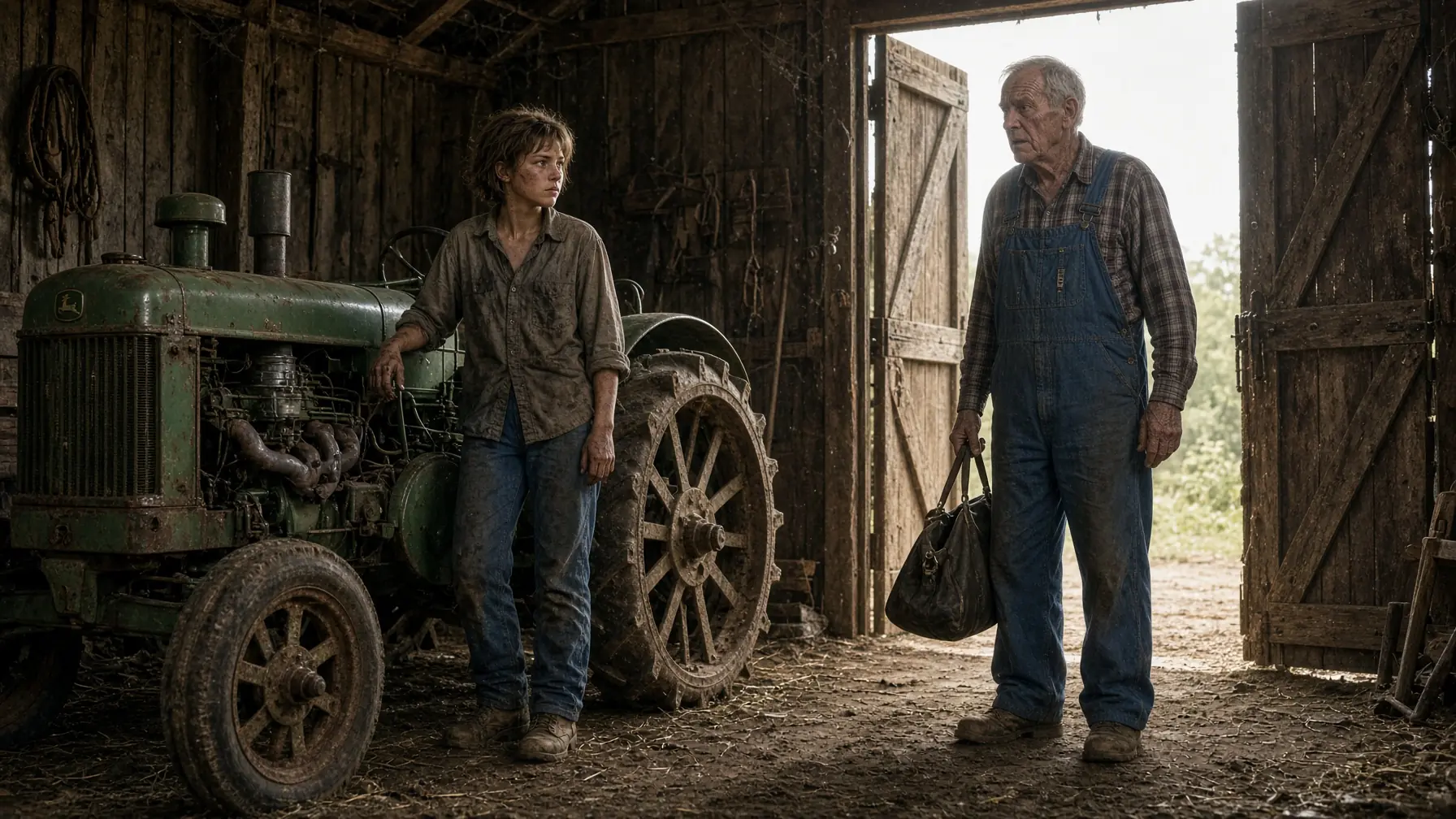
Then his eyes found fifteen-year-old Marigold Hartwell standing beside it.
Goldie wore one of her late father’s faded work shirts, loose blue jeans, and battered boots. Grease covered her fingers and darkened one cheek. She had spent almost two full days transforming the machine her grandfather had treated like sacred property for as long as she could remember.
Grandpa Gus finally spoke.
“What the hell did you do to my tractor?”
Goldie swallowed.
“I improved it.”
His expression hardened.
“That machine is the only reason this farm is still standing.”
“And doing nothing is exactly how we’re going to lose the farm.”
The words escaped louder than Goldie intended.
For weeks, numbers had filled every conversation inside the Hartwell kitchen. The family owed almost four thousand dollars to the bank. Their wheat crop had suffered through another miserable season. Grandma Lorelei’s medicine had become more expensive, and there were nights when Goldie noticed the elderly woman quietly leaving food on her plate so the rest of the family could eat more.
Everyone tried pretending things were manageable.
Goldie knew they were not.
The Hartwell farm consisted of sixty hard Kansas acres beneath a sky so enormous that storms could be watched crawling toward the horizon for hours. The white farmhouse needed paint, the barn roof leaked near the western wall, and the fences were repaired more often with determination than money.
At the center of everything sat the old John Deere.
Grandpa Gus had bought it used in 1946. For twenty-one years it had plowed, planted, hauled, and harvested. The paint had faded and the seat had been repaired twice, but every evening at six, Gus still walked to the barn to check its oil, grease its fittings, and listen to the engine.
Goldie had always been allowed to watch.
She had never been allowed to touch anything important.
Her father, Jasper Hartwell, had been different.
Before he died when Goldie was eight, Jasper had taught his daughter how to hold a wrench, how to feel when a bolt was tight enough, and how to understand a machine without being frightened of it.
“Metal doesn’t care if you’re a boy or a girl,” he used to tell her. “It only cares whether you understand what it needs.”
Those words stayed with Goldie.
At school, other girls discussed dresses, music, and boys.
Goldie read mechanical magazines.
She fixed bicycles for neighbors. Then lawn mowers. Then small engines. Sometimes she earned a dollar. Sometimes somebody paid her with pie, eggs, or a jar of preserves.
The other students thought she was strange.
Goldie had learned not to care.
But one Sunday afternoon, Weston Caldwell managed to find the one part of her pride that was still tender.
West was sixteen and the son of the wealthiest farmer in the county. His family owned hundreds of acres, several new tractors, and a spotless white farmhouse that looked like something from an advertisement.
He arrived in a red Jeep, looked into the Hartwell barn, and laughed.
“My dad says tractors that old belong in museums.”
Grandpa ignored him.
Then West noticed Goldie.
“Oh, right. You probably don’t understand much about machinery anyway.”
“Why?”
West grinned.
“Because you’re a girl.”
Goldie did not answer.
But she remembered every word.
That night, something more important happened.
She woke after eleven and heard her grandparents speaking in the kitchen. Their voices were low, but the old farmhouse carried every sound.
“We don't have the money,” Gus said.
“I know.”
“The bank wants payment in September.”
Silence.
Then Grandma Lorelei said something Goldie had never expected.
“Maybe we should sell.”
Goldie sat upright in bed.
A few seconds later, she heard her grandmother crying.
Not loudly.
That somehow made it worse.
The following morning Goldie climbed into the attic and began searching through boxes that had belonged to her father.
She eventually found an old leather journal.
Jasper had filled it with crop notes, repair diagrams, weather observations, and ideas for improving farm equipment. Near the middle, Goldie found an entry written only weeks before he died.
Her father had tried modifying the John Deere’s carburetor.
He wanted more power without using significantly more fuel.
The experiment had failed.
But beneath the technical notes was one sentence that changed Goldie’s entire summer.
Maybe Goldie will figure it out someday. She’s smarter than I was.
Goldie sat alone in the attic with tears running down her face.
Her father had believed in her.
She decided that morning she would try.
Not immediately.
Not recklessly.
For six weeks she studied.
Every afternoon after chores, Goldie rode her bicycle into town and visited the library. She borrowed books about combustion, fuel mixture, airflow, exhaust efficiency, and agricultural engines.
She filled notebooks with calculations.
Forty-seven versions of the carburetor modification appeared in her sketches before she trusted one enough to test.
She also had help.
Dorothea Finch, known around town as Dotty, was a fifty-eight-year-old widow and the best welder for miles. Some men complained about a woman doing welding work right until their equipment failed.
Then they stood politely in Dotty’s workshop and paid her.
Goldie had worked there since she was thirteen, cleaning and helping in exchange for lessons.
Dotty had one rule she repeated constantly.
“Never experiment on something you cannot afford to lose.”
Goldie knew exactly which machine Dotty was talking about.
So Goldie practiced on an old engine first.
Her first attempt failed.
The second cracked.
The third worked.
When Dotty discovered what Goldie was planning, she stared at the girl for a long time.
“You understand what happens if you ruin that John Deere?”
“Yes.”
“Your family could lose the farm.”
“I know.”
“And you're still going to do it?”
Goldie nodded.
Dotty sighed.
“Then I’m coming with you.”
The opportunity came at the end of August.
Grandpa Gus had to leave for several days to help a relative. Goldie’s older sister, Iris, went with him. Grandma Lorelei traveled to another town to discuss extending the bank loan.
For forty-eight hours, Goldie had the farm almost completely to herself.
She started by photographing everything.
Twenty-three photographs.
Every bolt.
Every hose.
Every connection.
If she failed, she wanted a path backward.
Then she removed the original carburetor.
Her heart pounded harder with every turn of the wrench.
This was the machine Grandpa had protected for decades.
This was the machine that fed them.
And Goldie was taking it apart.
A rusted mounting bolt nearly stopped the entire project.
Goldie bicycled to Dotty’s workshop for help.
The older woman brought heavy tools and stayed.
Together they installed the larger carburetor, changed the intake, and began fabricating a more efficient exhaust manifold.
Goldie’s first weld cracked.
Dotty made her grind it away.
The second overheated.
Again, Dotty made her start over.
The third took four hours.
When Goldie finished, Dotty ran a finger along the metal.
“That’ll hold.”
By early Thursday morning, everything was ready.
Goldie climbed into the tractor seat.
She pressed the starter.