In a raging blizzard, a billionaire CEO found herself stranded beside her sleek Tesla with a flat tire.
Her phone had no signal. Her billion-dollar empire couldn’t help her now.
She tried to fix it herself and failed.
Just when all hope seemed lost, three teenagers appeared through the storm, poor, freezing, and carrying nothing but kindness. They fixed her car in minutes. And when she offered them $1,000 each, they refused.
What they said next left the billionaire in tears and changed her life forever.
“Damn it.”
Victoria Wellington’s voice cracked through the frozen evening air as she kicked the flat tire. Pain shot through her foot, but she didn’t care. The anger felt better than the panic rising in her chest.
7:43 in the evening.
The sun should have set by now, but the blizzard had turned the sky into a wall of gray and white. Snow fell so thick Victoria could barely see 10 feet ahead.
She stood on the side of Highway 12, both hands pressed against the side of her Tesla, breathing hard. Each breath came out in white clouds that disappeared into the storm.
“This can’t be happening,” she said, her voice shaking. “This cannot be happening to me.”
But it was.
The tire had blown 20 minutes ago.
Victoria had been driving 75 miles per hour, maybe faster, trying to make up time. Then boom. The sound had been so loud she thought someone had shot at her.
The car jerked right. Her hands fought with the steering wheel. The Tesla skidded, fishtailed, and finally stopped at an angle on the shoulder.
Now here she was, stuck on a back road in Colorado in the middle of a blizzard.
Victoria pulled out her phone. Her hands were already going numb, even through her leather gloves. She held up the phone, squinting at the screen through the falling snow.
“No signal. No,” she whispered.
She walked forward a few steps, holding the phone higher.
“Come on.”
Still nothing.
Just those two words at the top of the screen.
No service.
Victoria tried calling anyway.
She pressed her assistant’s number and waited.
The phone didn’t even ring. It just went straight to call failed.
She tried again. Same thing.
She tried her driver.
Call failed.
She tried her lawyer.
Call failed.
She tried 911.
Call failed.
“Perfect,” she muttered.
Six hundred million dollars in assets, and her $1,000 iPhone couldn’t even find a signal.
The wind picked up, blowing snow sideways into her face. Victoria turned away, squinting. Her coat, Prada, $3,800, was already covered in white. The coat had felt so warm in her hotel that morning.
Now it felt like paper.
She walked to the back of the car and popped the trunk.
Inside, perfectly organized, sat the spare tire. Next to it, a jack, a lug wrench, an emergency kit she’d never opened.
Victoria stared down at it all.
She had no idea what to do with any of it.
“Okay,” she said out loud, trying to calm herself. “Okay, I can figure this out. I went to Wharton. I built a $4 billion company. I can change a tire.”
But even as she said it, she knew she couldn’t.
Twenty-two years ago, maybe.
Back when she was poor and drove that piece-of-crap Honda Civic. Back when she was 20 years old and working three jobs to pay for college. Back then, she’d fixed everything herself because she had to.
Oil changes, brake pads, flat tires.
But that was another life.
Now, Victoria Wellington paid people to do things like this.
She had people for everything.
Her assistant handled her schedule. Her driver took her everywhere. Her building manager dealt with problems. Her lawyers dealt with contracts. Her accountants dealt with money.
Victoria just made decisions and signed papers.
She reached down and grabbed the lug wrench. It was heavier than she expected, cold metal even through her gloves.
She walked to the flat tire and knelt down in the snow.
Her Jimmy Choo boots, $1,200, sank into the snow. She could feel the cold water soaking through immediately, freezing her feet. Her pants, custom-made, $1,500, were getting soaked at the knees.
Victoria positioned the wrench on one of the lug nuts and pulled.
Nothing happened.
She pulled harder.
The wrench slipped off and she fell backward into the snow.
She scrambled up. Snow all over her coat, her pants, her hair.
She tried again.
This time she put her whole body into it, pulling with all her strength.
The wrench slipped again.
Victoria went down hard, her shoulder hitting the side of the car. She stayed there for a moment on her knees in the snow, breathing hard.
Her shoulder throbbed, her hands hurt, her feet were going numb, and the lug nut hadn’t moved at all.
“I can’t do this,” she said quietly.
Then louder.
“I can’t do this.”
Victoria stood up.
She was shaking now. Not from the cold, but from frustration, from anger, from fear she hadn’t felt in 20 years.
She looked at her watch.
7:52.
The meeting in Denver started at 9:30. She had one hour and 38 minutes. It was a 50-minute drive from here, if she had a working car, which she didn’t.
“Think, Victoria,” she told herself, pacing next to the car. “Think, think, think.”
But there was nothing to think about.
She had no signal.
No one was coming.
She was alone.
The snow kept falling. Already, it had covered her footprints from just a minute ago. Nature was erasing her bit by bit, like she didn’t matter.
Victoria looked around.
On both sides of the road, nothing but white fields and dark trees. No houses, no cars, no people. Just endless Colorado wilderness.
She’d chosen this route because it was faster, 40 minutes faster than the interstate. Her assistant had warned her.
“Miss Wellington, the weather report says…”
But Victoria had cut her off.
“I don’t care about the weather. I need to be in Denver by 9:30.”
So stupid.
So arrogant.
And now here she was, paying for it.
Victoria walked back to the driver’s seat and sat down, leaving the door open. She stared at the dashboard, at all the buttons and screens and technology.
This car had cost $130,000. It had every feature money could buy. Heated seats, autopilot, premium sound system, navigation with real-time traffic updates.
None of it mattered now.
She tried the phone again.
Still no signal.
She checked the battery.
18%.
“Perfect,” she muttered. “Just perfect.”
Victoria sat there watching the snow fall, feeling the cold creep into the car. She should close the door, save the battery, save the heat. But she couldn’t move.
She just sat there, numb.
This was supposed to be her triumph.
The Denver Deal.
$2.3 billion.
The biggest acquisition in MedCorp’s history. The deal that would cement her legacy. The deal that would prove she’d been right all along, that success was worth any sacrifice, any cost, any loss.
Even her marriage.
Victoria’s throat tightened.
She tried so hard not to think about Daniel, about the divorce, about the way he’d looked at her during their last fight.
“You’ve made yourself so hard, Victoria,” he’d said. Not yelling. Just sad. “You think it makes you strong, but it just makes you brittle.”
“I’m not brittle,” she’d shot back. “I’m resilient.”
“No.” Daniel had shaken his head. “You’re frozen. And frozen things don’t bend. They break.”
Victoria had laughed at him, dismissed him, told him he was too soft for the real world.
Now, sitting in her broken car in the middle of a Colorado blizzard, she heard his words echo in her head.
Frozen things don’t bend. They break.
She looked at her hands.
They were red, raw, bleeding in places where she’d torn the skin trying to change the tire. Her expensive gloves were ruined. Her expensive coat was soaked. Her expensive boots were destroyed.
Six hundred million dollars in net worth.
And she couldn’t change a tire.
She had 842 contacts in her phone. CEOs, investors, board members, politicians, lawyers, consultants.
She couldn’t think of a single one she could call who would actually care that she was stranded.
Not care about the deal.
Not care about MedCorp’s stock price.
Care about her.
About Victoria, the person.
She couldn’t think of anyone.
The realization hit harder than the cold.
Victoria Wellington, the iron mind of modern healthcare, was completely and utterly alone.
She pressed her palms to her eyes, forcing back the sting.
Not tears.
Not yet.
Just exhaustion.
Just the weight of everything she’d built pressing down all at once.
Her breath shook in the freezing air.
When had it all become this?
When had she traded warmth for ambition, connection for control?
When had success started to feel like failure in disguise?
The wind howled. The temperature dropped.
Victoria’s phone buzzed.
Battery at 10%.
She looked up at the white void surrounding her car.
Nothing.
No one.
Just snow and wind and cold.
“This is how it ends,” she whispered. “Alone in the middle of nowhere, having achieved everything and having nothing at all.”
But then, faint through the storm, she heard something.
Voices.
Victoria didn’t know how long she’d been sitting there when she heard them.
“Hey, lady! You okay?”
Victoria scrambled out of the car, nearly falling in her desperation. She squinted through the blizzard, trying to see where the voice was coming from.
Three shapes emerged from the white wall of snow.
Small shapes, moving toward her on bicycles.
Bicycles in a blizzard.
Victoria blinked hard, certain she must be seeing things.
But no.
As they got closer, she could see them clearly.
Three kids. Teenagers, maybe, pedaling through the storm like it was nothing more than a spring rain.
They were laughing, actually laughing, talking to each other as if a Colorado blizzard was just another Tuesday evening.
They rode right up to where she stood and stopped, bikes crunching in the snow.
The tallest one, wearing a torn red jacket, looked at the Tesla with wide eyes.
“Whoa. That’s a seriously nice car, lady.”
Victoria just stared at them, her brain struggling to process what she was seeing.
“Where did you come from?”
“Pinewood.”
He gestured vaguely behind him through the storm.
“Town’s about three miles back that way. We’re heading home from the community center.”
He noticed the flat tire, his expression changing from curiosity to concern.
“Oh man, that’s blown out pretty bad.”
“Yes,” Victoria managed to say, finding her voice. “I know.”
The boy stepped off his bike, letting it fall into the snow without ceremony.
“We can fix it.”
Victoria let out a sharp, almost hysterical laugh.
“You can fix it?”
“Yeah.”
The boy looked at her like it was the most obvious thing in the world.
“You can’t?”
The question stung more than Victoria wanted to admit. She felt her face flush with embarrassment and frustration.
“I don’t… I mean, I was trying to.”
The boy with glasses, his frames held together with tape, spoke up gently.
“It’s okay, ma’am. Lots of people don’t know how. We’ve done this tons of times.”
“On a Tesla?”
Victoria heard how snobby she sounded the instant the words left her mouth, but she couldn’t help it.
The smallest kid grinned, showing a gap between his front teeth.
“A tire’s a tire, lady. Physics don’t care what brand the car is.”
Victoria looked at them more carefully now.
They were so young. Fifteen, sixteen maybe.
Their clothes were old, worn, patched in places. The tall one wore a wool sweater, frayed at the cuffs and torn at the elbow. The one with glasses had on a faded yellow knit, stretched out and missing a button near the collar. The smallest wore a bright orange pullover, two sizes too big, sleeves rolled up multiple times.
None of them had proper gloves.
Their hands were red and raw from the cold.
And yet here they were in the middle of a blizzard, offering to help a complete stranger.
“Look, I appreciate the offer,” Victoria started. “But…”
“But what?” the tall one interrupted, not rudely, just directly. “You got somewhere you need to be?”
Victoria checked her watch.
8:03.
Twenty minutes had passed since she’d heard the voices.
“Actually, yes. A very important meeting in Denver.”
“Then we better hurry up and get you back on the road.”
The boy walked past her to the trunk, which was still open.
“I’m Malik, by the way.”
The one with glasses grabbed the jack with practiced ease.
“Jamal.”
The small one reached for the lug wrench.
“Deshawn.”
They didn’t wait for permission. They didn’t wait for her to agree. They just started working, moving with a coordination that spoke of experience and practice.
“Wait,” Victoria said, suddenly aware of how this looked, how vulnerable she was. “You can’t just…”
But they already were.
Malik knelt by the flat tire, his bare hands red from cold as he examined it.
“Yeah, this is done. Can’t patch this. You’re going to need the spare.”
“In the trunk,” Victoria said quickly. “There’s a jack, wrench, everything that came with the car.”
“Perfect,” Jamal said, already moving. “You’d be surprised how many people don’t even have the tools.”
They pulled out Victoria’s emergency kit, the same one she’d stared at in confusion just minutes before.
Malik slid the jack into place under the frame while Jamal examined the lug wrench. He reached into his backpack and pulled out a short metal pipe, maybe two feet long.
Victoria blinked.
“You carry that around?”
“Mr. Davis taught us to,” Jamal said. “It’s called leverage. Works better than muscle.”
He slipped the pipe over the wrench handle, pressed down hard.
The nut resisted, creaked, then cracked loose with a metallic pop.
Malik grinned through chattering teeth.
“There we go.”
They worked fast, but not easily.
The wrench slipped once, scraping Jamal’s knuckles. Deshawn steadied the car, his breath coming in ragged clouds.
“You okay?” Victoria asked, startled at the sight of his bleeding hand.
“We’re fine,” Malik said, not looking up. “Done worse in January.”
Snow swirled around them, the storm biting at their faces. Malik’s fingers were stiff and red. Jamal’s breathing quickened, but they didn’t stop.
They worked in rhythm.
Loosen, lift, swap, tighten.
Focused, calm, practiced.
Victoria stood there, feeling useless in her thousand-dollar boots, her designer coat no match for the cold or the silence inside her.
She watched their breath fog the air and felt something shift in her chest. Small, sharp, unfamiliar.
It wasn’t pity.
It was admiration.
Envy, maybe.
A memory of who she used to be before success taught her to outsource everything human.
“See, ma’am,” Jamal said between breaths. “Jack goes here under the frame. Otherwise, you’ll dent the car. Learned that the hard way.”
Victoria nodded like she understood, though she didn’t.
These kids were speaking a language she’d forgotten decades ago.
The language of doing, not delegating.
Deshawn started humming while he steadied the car, some hip-hop tune that carried strangely well through the storm.
“You boys shouldn’t be out in this weather,” Victoria said, the words coming out half maternal, half disbelief.
“We’re used to it,” Deshawn said, still humming. “Been riding in worse than this.”
“Used to blizzards?” Victoria asked.
“Born and raised in Pinewood,” Malik said.
He was working the second nut now, his movement slower but sure.
When the final nut turned free, Malik exhaled a shaky breath that misted the air.
“Almost done.”
Jamal swapped out the flat for the spare, tightening each nut carefully in a star pattern.
“Top first, then bottom right, then top left. Keeps the pressure even.”
Victoria’s throat tightened.
She’d spent her life commanding boardrooms full of people twice their age. But in this storm, she couldn’t command a thing.
It wasn’t quick and it wasn’t effortless. But when they finished, the Tesla settled back on four solid tires with a satisfying thunk.
Deshawn brushed snow off his oversized orange sweater.
“All set, lady.”
Victoria looked at the tire, then at the boys, then back again.
She couldn’t quite believe it.
“You actually did it.”
“Told you we could,” Malik said, smiling for the first time.
The smile transformed his face, made him look even younger.
And for the briefest moment, something warm flickered in her. The kind of warmth money could never buy.
Victoria felt something tight and painful in her throat. An emotion she couldn’t quite name, hadn’t felt in years.
“How long did that take?”
Jamal checked his watch, an old digital one with a cracked face.
“Twenty-two minutes.”
What Victoria couldn’t do at all, couldn’t even begin to figure out, these three kids had accomplished in 22 minutes.
“That’s incredible,” she whispered, genuinely awed.
Victoria pulled out her wallet with shaking hands, her fingers still numb from the cold. Inside was a thick stack of hundreds. She always carried cash. Old habit from her poor days.
She pulled out 30 bills.
“Three thousand dollars,” she said, holding them out to Malik, her voice urgent. “You earned this. All of you. A thousand each. You saved my life out here.”
Malik looked at the money.
Really looked at it.
Victoria saw something flash in his eyes, recognition of how much money that was, what it could buy.
But then he shook his head slowly.
“No, thank you, ma’am.”
Victoria blinked, certain she’d heard wrong.
“What?”
“We don’t need it,” Malik said simply.
Victoria pushed the money closer, almost aggressive in her insistence.
“This is $3,000. One thousand each. Take it. Please.”
“We didn’t do it for money,” Jamal said quietly, like he was explaining something obvious to a child.
Deshawn was already back on his bike, ready to leave.
“You needed help, lady. That’s all. That’s the whole story.”
“But I’m offering you $3,000.”
Victoria’s voice rose with desperation and confusion.
“Why won’t you take it?”
Malik wiped his hands on his jacket, leaving dark smudges on the fabric. His breath came out in white clouds as he looked at her.
His eyes met hers directly, with a wisdom that seemed far beyond his years, beyond his circumstances.
“My dad used to say, ‘You don’t help people for what you get back. You help because it’s right. You help because that’s what good people do.’”
Victoria stood there, arm extended, holding money.
These kids were refusing.
Money that could probably buy them new coats, new gloves, maybe help their families with bills, judging by their worn clothes and obvious poverty.
“You’re sure?” Her voice came out quieter now, almost vulnerable, stripped of her usual confidence. “You’re absolutely certain?”
Malik looked at the money one more time.
Three thousand dollars.
A fortune to kids like these.
Then he looked at his two friends.
That silent communication again, that understanding that went deeper than words.
“We’re sure, ma’am,” Malik said gently.
But then he paused, seeming to make a decision.
“Can I tell you something about why we can’t take your money?”
Victoria lowered her hand slowly, the bills feeling heavy suddenly, wrong somehow.
“Okay.”
“You see, two years ago, my dad got sick.”
Malik looked down at his hands, still covered in grease from Victoria’s tire. The snow continued falling around them, but the blizzard seemed to quiet slightly, as if even nature wanted to hear this story.
“Two years ago, my dad got real sick,” Malik said.
His voice was soft but steady.
“Cancer started in his lungs, spread everywhere. He was a mechanic. Worked at Miller’s Auto Shop in town. Best mechanic in Pinewood, probably in all of Colorado.”
Pride filled his words.
Victoria heard it clearly, saw it in the way Malik’s shoulders straightened slightly.
“People came from three towns over just to have him work on their cars. He could fix anything. Anything at all. Cars, trucks, tractors, whatever. Had this gift for just knowing what was wrong.”
Jamal and Deshawn stood quiet, snow accumulating on their shoulders.
They’d heard this story before, Victoria realized. Probably many times. But they listened anyway, out of respect, out of love.
“One day, middle of winter, just like this, a woman broke down on this exact same highway.”
Malik gestured around them at the snow-covered road.
“Her car just died. Temperature was minus 20, brutal cold. She had two little kids in the back seat, both under five. They were crying, scared.”
Malik’s breath came out in white clouds as he talked.
Victoria found herself holding her own breath, not wanting to interrupt.
“My dad was driving home from work. Saw her. He could have kept going. Nobody would have blamed him. He was tired. He’d worked 12 hours that day. Mom was waiting with dinner. My little sister Kesha was waiting up to show him her spelling test.”
“But he stopped,” Victoria said quietly, knowing the answer already.
“Yeah. He pulled over, spent three hours in the freezing cold fixing her car. It was the alternator or something. I don’t remember exactly, but he got it running again, got them back on the road. The woman tried to pay him. She had about $40, probably all the money she had with her.”
Malik looked up at Victoria now. His eyes were bright with unshed tears that the cold made even more visible.
“Dad said no. He told her to use that money to buy her kids something hot to eat at the next town. Then he followed her there, like 35 miles out of his way, just to make sure she made it safe. Got home at almost midnight. Dinner was cold. Kesha was asleep. But Dad didn’t care. Said he did the right thing.”
The wind howled around them, but Victoria barely felt the cold anymore.
She was completely absorbed in this story, in this glimpse of a man she’d never meet.
“Four months later,” Malik’s voice got quieter, heavier with grief, “Dad collapsed at work. They found the cancer. It was bad. Stage 4. In his lungs, his liver, his bones, everywhere.”
“God,” Victoria whispered, her hand instinctively going to her mouth.
“He couldn’t work anymore. We had some savings, but not much. Medical bills started piling up real fast. Insurance covered some, but not enough. Never enough. We were going to lose our house. Mom was working two jobs, sometimes 16 hours a day, but it still wasn’t enough.”
Jamal spoke up now, his voice gentle behind his taped-up glasses.
“That’s when people started showing up.”
“What people?” Victoria asked.
“Everyone,” Malik said.
And now, despite the sadness, he was smiling.
“The whole town. People Dad had helped over the years. They brought food, money, whatever they could spare. Sometimes just their time, just their company.”
“Mrs. Chen, the lady who runs the grocery store,” Deshawn added. “She organized a fundraiser at the community center. Raised almost $20,000.”
“Mr. Patterson at the hardware store,” Jamal continued. “He paid four months of their mortgage, didn’t ask for it back, just said it was what neighbors do, what community means.”
Malik’s voice grew stronger, warmer.
“The woman with the two kids, the one Dad helped that night on the highway, she drove six hours to visit him in the hospital, brought a card signed by over 60 people Dad didn’t even know. People she told about what he did. The card had $3,000 in it.”
Victoria felt tears burning her eyes, threatening to fall.
When was the last time she’d cried?
She genuinely couldn’t remember.
“Dad died seven months later,” Malik said, his voice steady, but weighted with an ocean of grief. “But before he did, a few days before the end, he called me to his hospital bed. He could barely talk by then. The cancer was in his throat, made every word hurt. But he grabbed my hand. His grip was so weak, but he held on, and he said something I’ll never, ever forget.”
Malik stopped, took a breath.
When he spoke again, his voice cracked just slightly. The only crack in his composure.
“He said, ‘Malik, I’m leaving you boys without much. No big inheritance, no college fund, no house paid off. But I’m leaving you something more important. I’m leaving you a good name. People will remember me as someone who helped. That’s worth more than any amount of money. You understand, son?’”
A single tear ran down Malik’s face. He wiped it away quickly, almost embarrassed.
But Victoria saw it.
“I told him I understood. Then he said, ‘When you see someone who needs help, you help them. Not because they can pay you. Not because you’ll get something back. Not even because it’s the nice thing to do. You help because that’s what makes you human. That’s what makes life mean something. That’s how you become rich in the ways that actually matter. Promise me, Malik. Promise me you’ll help people.’”
Malik’s hand went to his chest, over his heart, like he was holding something precious there.
“I promised him. We all did. Me, Mom, Kesha. We were all there around his bed. That was the last real conversation we had with him. Three days later, he was gone.”
The three boys stood in the snow, silent.
Victoria realized Jamal was crying, too, tears running down his face behind the taped glasses. Deshawn’s eyes were red, his usual cheerful expression subdued by memory and love.
“After the funeral,” Jamal said quietly, “we made a pact, the three of us. We’d honor Mr. Davis’s memory by helping people whenever we could.”
“My dad knew Malik’s dad,” Deshawn added, his voice uncharacteristically serious. “They worked together sometimes. Mr. Davis taught my dad everything about fixing cars. When he died, my dad cried for a week straight. Said he lost the best man he ever knew.”
Malik looked directly at Victoria now.
He looked at the money still in her hand, then into her eyes with that unsettling wisdom.
“So you see, ma’am, we can’t take your money. It’s not about being proud or stubborn. It’s about keeping a promise to a man who taught us what really matters. My dad used to say that when you help someone for money, it’s just a transaction. But when you help someone for nothing, it’s a connection. And connections are what we’re all here for. To connect. To be human together.”
The words crashed into Victoria like waves, each one eroding something she’d built up over years.
“He also said,” Malik continued softly, “that being rich isn’t about what you have in your bank account. It’s about what you have in here.”
Malik tapped his chest over his heart.
“How many people would cry at your funeral? How many lives did you make better? That’s how you measure wealth. Not in dollars or deals or board meetings. In love. In connection. In the difference you made.”
Victoria stood frozen, the money forgotten in her hand.
She thought about her own father, a ruthless businessman who died five years ago. At his funeral, maybe 30 people had shown up. Most were business associates there out of obligation.
No one had cried.
Not even Victoria.
She’d stood there dry-eyed, wondering why she felt so little.
She thought about her own life.
How many lives had she made better, really better?
She couldn’t think of any.
She’d made investors richer, made board members happy, made shareholders excited.
But actual lives?
Actual human beings?
She couldn’t think of a single one.
“Your father,” Victoria said, her voice rough with emotions she couldn’t control, “sounds like he was an incredible man.”
“He was,” Malik said simply. “Best man I ever knew. Best man I’ll probably ever know.”
“And you’re honoring him by helping strangers in blizzards.”
“We’re trying, ma’am. Some days it’s hard. Like today.”
Malik smiled slightly.
“It’s cold as hell out here. Excuse my language. But then we think about Dad, about how he never complained, never asked for anything back, and it makes it easier. Makes it feel right.”
Deshawn spoke up, his gap-toothed grin returning slightly.
“Plus, it feels good. Helping people, you know, makes you feel like you matter.”
Victoria realized with a shock that she didn’t know.
She couldn’t remember the last time she’d helped someone without expecting something in return.
Every interaction in her life was transactional now. Every relationship had an angle.
Even her marriage to Daniel, she saw now with painful clarity, had become a transaction she’d expected him to accept.
“So that’s why we can’t take your money,” Malik finished. “It’s not about pride. It’s about keeping a promise to a man who taught us what really matters. It’s about honoring his memory by living the way he lived.”
The three boys stood there in their torn jackets in the freezing cold, having just spent 22 minutes fixing a stranger’s car.
And they were refusing $3,000 because of a promise made to a dying father.
Because of love.
Because of integrity.
Victoria felt something break inside her. Some wall she’d built up over years of deals and negotiations and treating everything, everyone, as a transaction. Some fundamental part of her that she’d frozen to protect herself.
“Your father would be proud of you,” Victoria said, her voice thick with tears she could no longer hold back. “All three of you. So incredibly proud.”
“Thank you, ma’am,” Malik said softly. “That means everything to us.”
“Can I ask you something?” Victoria heard herself say.
“Sure.”
“Do you ever regret it? Helping people for free when you have so little yourselves?”
The three boys looked at each other.
Then Malik shook his head firmly.
No hesitation.
“No, ma’am. We’ve got everything that matters. We’ve got each other. We’ve got people in town who love us. We’ve got food on the table. We’ve got the community center. We’ve got Mom and Kesha. That’s more than enough. That’s everything.”
“But your jacket,” Victoria said, pointing at the tear in Malik’s sleeve. “Your glasses, Jamal. They’re held together with tape. You’re riding bicycles in a blizzard. You could use this money for so many things.”
“We could,” Jamal agreed, pushing his glasses up his nose. “But we don’t need it. There’s a difference between could use and need. We’ve got what we need.”
Deshawn grinned, pulling his oversized jacket tighter.
“Besides, this jacket’s got character. I’ve had it since I was 10. It’s like an old friend now. Wouldn’t trade it.”
Victoria looked at them.
Really looked.
Three boys who had almost nothing by society’s standards, but somehow had everything that actually mattered. Who understood something fundamental about life that Victoria, with all her education and success and wealth, had completely missed.
“I wish I’d met your father,” Victoria said to Malik, meaning it with her whole heart.
“Me too, ma’am. He would have liked you.”
“How do you know? You don’t even know me.”
“Because you stopped to listen,” Malik said simply. “Dad always said you can tell everything about a person by whether they listen or just wait to talk. You listened to my whole story. You cared. That means something.”
Victoria felt tears streaming down her face now, freezing on her cheeks.
“I’ll never forget this. Any of this. Any of you.”
“Just pay it forward, ma’am,” Malik said, echoing his father’s wisdom. “That’s what Dad always said. You can’t pay back kindness. You can only pay it forward. Help someone else when they need it. That’s how it works.”
The boys climbed onto their bikes, ready to leave, ready to pedal through a blizzard to get home.
“Malik,” Victoria called out, voice breaking.
The boy turned back, one foot on his pedal.
“Your father was right about everything. About all of it.”
Malik smiled.
Not a sad smile anymore.
A real one full of warmth and certainty and peace.
“I know, ma’am. I know.”
And then they were gone.
Three boys on bicycles disappearing into the snow, leaving tracks that would be covered within minutes, carrying with them a legacy of kindness that a dying mechanic had left behind.
Victoria stood on that empty highway for a full five minutes after the boys disappeared into the white storm.
The money was still in her hand, forgotten.
She looked at it now, really looked at it.
Money she’d been trying to use as a transaction, as payment, as a way to discharge an obligation.
But there was no obligation.
There was just kindness.
Pure, simple human kindness.
Slowly, carefully, Victoria folded the bills and put them back in her wallet, but her hands were shaking, and not from the cold.
She got in the Tesla, closed the door, and sat in silence.
The heater kicked on automatically.
Outside, snow kept falling, covering her tire tracks, covering the evidence of three boys who’d stopped to help.
But inside the car, inside herself, Victoria felt like something fundamental had shifted.
She kept seeing Malik’s face, that kid maybe 15 years old, crying while talking about his dead father, but still smiling, still helping, still keeping a promise.
When you help someone for money, it’s just a transaction. But when you help someone for nothing, it’s a connection.
The words echoed in her head, getting louder, more insistent, impossible to ignore.
She looked at the dashboard clock.
8:35.
She had 55 minutes to get to Denver. Fifty minutes of driving.
If she left right now, she could still make the meeting, still close the deal, still achieve her triumph.
Victoria started the engine.
The Tesla hummed to life, powerful and responsive.
She pulled back onto the highway heading toward Denver.
But something had changed.
Something fundamental had cracked open inside Victoria Wellington, and she had no idea if she’d ever be able to close it again, or if she even wanted to.
Victoria made it to Denver with 32 minutes to spare.
The Paramount Tower rose 47 stories into the clearing sky. The blizzard had mostly passed this far south. Glass and steel gleamed in the artificial lights, cold and perfect, just like everything else in her world.
She pulled into the underground garage.
A valet rushed over with an umbrella, even though they were inside, protected from any weather.
“Good evening, Miss Wellington.”
Victoria didn’t respond.
Couldn’t respond.
She handed over the keys, her mind still on that highway, still seeing three boys who’d refused $3,000.
She walked to the elevator, her ruined boots squelching with each step. Her reflection stared back from the polished steel doors.
Expensive suit rumpled and stained. Perfect hair now a mess. Makeup smudged from tears she tried to hide.
She looked like disaster.
But all she could see were three boys in torn jackets.
That’s how you measure wealth. Not in dollars.
Malik’s voice echoed endlessly in her head.
The elevator climbed.
Victoria watched the numbers light up.
Each floor taking her higher, further from the ground, further from those boys, further from something real she’d touched briefly on that snowy highway.
The doors opened.
Her assistant Patricia, not the woman from Pinewood, but her New York Patricia, was waiting, tablet in hand, looking panicked.
“Miss Wellington, thank God. I couldn’t reach you. Mr. Harrison’s been here for 30 minutes already. He’s getting impatient. And your phone’s been off. We were starting to worry something happened.”
“Something did happen,” Victoria said quietly.
Patricia blinked.
“Are you all right? You look…”
“I’m fine. Let’s get this done.”
Patricia led her down the hall, heels clicking on marble floors.
Everything here clicked and echoed and felt hollow.
Empty.
“We set up in conference room A. Harrison brought four lawyers. I’ve got all your materials ready, but Victoria, are you sure you’re okay? You seem…”
“I said I’m fine.”
But she wasn’t fine.
Nothing was fine.
The conference room had floor-to-ceiling windows overlooking Denver. The city stretched out below like a game board, buildings and streets and tiny cars, all of it looking small and insignificant and far away.
Richard Harrison sat at the head of the table.
Fifty-two years old, silver hair, $10,000 suit. Four lawyers flanking him like guards, like soldiers prepared for battle.
“Victoria.”
Harrison stood, extending his hand. His smile didn’t reach his eyes. It never did with men like him.
“Cutting it rather close, aren’t we?”
Victoria shook his hand automatically.
The grip was firm, competitive, everything a power play.
“Car trouble. Flat tire in the storm.”
“In this weather, you’re lucky you made it at all. We were about to start without you.”
The threat was subtle but clear.
They sat.
Papers covered the table. Contracts, projections, financial statements. $2.3 billion in and white.
Victoria opened her laptop.
The presentation she’d spent three months perfecting. Every slide memorized, every number rehearsed, every argument honed to perfection.
But her hands felt heavy on the keyboard, distant, like they belonged to someone else.
“Shall we begin?” Harrison said.
It wasn’t really a question.
Victoria stood, clicked to the first slide, and heard herself speaking.
“Rocky Mountain Medical Group represents a significant opportunity in the healthcare consolidation sector.”
Her voice sounded hollow, like someone else was speaking through her mouth, using her vocal cords to say words that no longer meant anything.
“Eighteen hospitals across six states, projected annual revenue of 470 million. Market position in underserved rural communities…”
She clicked through slides.
Market analysis.
Growth projections.
Cost savings through consolidation.
Efficiency improvements.
Margin optimization.
The words came automatically, perfectly, exactly as she’d practiced.
But they felt empty.
Meaningless noise.
Victoria looked around the room.
Harrison watching her with cold, calculating eyes. The lawyers taking notes, looking for angles and weaknesses. Patricia nodding encouragement from the doorway.
Everyone here was rich.
Everyone here was successful.
Everyone here was powerful.
And no one here would stop to help a stranger change a tire.
No one here would refuse $3,000 for the right reasons.
No one here would keep a promise to their dying father about helping people.
“The synergies with MedCorp’s existing portfolio,” Victoria heard herself say, “will reduce operational costs by 18% in year one.”
More slides.
More numbers.
More meaningless, empty words.
In her mind, she saw Malik’s bare hands on the lug wrench, red from cold, working without complaint, working for nothing but kindness and a promise to a dead man.
“Victoria.”
She blinked.
Harrison was staring at her, annoyed.
“I asked about the timeline for regulatory approval.”
“Right. Timeline.”
Victoria looked at her slide. The words blurred.
“Six to eight months for full regulatory clearance. Assuming no complications.”
She finished the presentation on autopilot.
When it was done, Harrison stood and applauded. Slow, deliberate, not entirely sincere.
“Excellent work, Victoria. Very thorough, very compelling.”
The lawyers nodded, shuffled papers, prepared for the signing.
The dance continued, predictable and hollow.
They moved to the far end of the table.
Someone handed Victoria a pen.
A Montblanc. $2,000. She’d bought it specifically for this moment, this signing, this triumph.
“Sign here,” a lawyer said, pointing with a manicured finger. “And here. Initial here.”
Victoria put pen to paper.
Her hand shook slightly.
She signed page after page, her signature getting sloppier with each one, like she was losing control of her own hand.
When it was done, Harrison shook her hand again, harder this time.
The grip of a winner.
Of a shark smelling blood.
“Congratulations, Victoria. This is going to be very profitable for both of us. Very profitable indeed.”
“Yes.”
“We should celebrate. Drinks at the Prime Club. My treat.”
Victoria looked at Harrison’s smile, sharp and cold.
At the lawyers packing their briefcases, already thinking about their next deal.
At Patricia giving her an enthusiastic thumbs-up from across the room.
This was it.
The moment she’d been working toward for eight months.
$2.3 billion.
The deal that would cement her legacy. The achievement that proved she’d been right all along.
And she felt absolutely nothing.
No.
That wasn’t true.
She felt something.
She felt empty.
Hollow.
Like she’d just sold something important for something worthless.
“Actually,” Victoria said suddenly, “I need to go.”
Harrison’s smile faltered, confusion crossing his face.
“Go? We just closed the biggest deal of the quarter. This calls for celebration.”
“I know, but I have something I need to do.”
“Something more important than this?”
Harrison’s voice carried an edge now. Subtle offense at the slight.
Victoria paused.
Twenty-four hours ago, nothing was more important than this.
This deal was everything.
Her whole world.
But now, now she couldn’t stop thinking about three boys who measured wealth by how many people would cry at your funeral.
“Yes,” Victoria said quietly but firmly. “Something more important.”
She walked out, leaving Harrison standing there confused and slightly angry.
Patricia called after her.
“Victoria, wait. What about the press release? The board call? The investors?”
But Victoria didn’t stop, didn’t slow down, just kept walking toward the elevator, toward the exit, toward something she couldn’t name but desperately needed to find.
She took the stairs.
All 47 floors.
Her legs burned, her lungs screamed, but she needed to feel something. Anything. Real physical pain to match the emotional chaos inside her.
By the time she reached the parking garage, she was breathing hard, sweating despite the cold, feeling more alive than she had in the sterile conference room.
She got in her Tesla and sat there, engine off, just sitting in the dark garage, surrounded by expensive cars that meant nothing.
The passenger seat was still wet from the snow.
She could see where the boys had worked.
Grease marks on the door frame where Malik had steadied himself.
A small handprint, child-sized, on the window.
Victoria put her head on the steering wheel.
She had just closed a $2.3 billion deal, the biggest of her career.
Her name would be in The Wall Street Journal tomorrow. Her competitors would be calling, jealous and congratulating her in the same breath.
But all she could think about was Malik’s father, a mechanic named James Davis, who died with nothing but left everything that mattered.
How many people would cry at Victoria’s funeral?
Her assistant would probably be relieved.
Her competitors would pretend to be sad while calculating how to divide up her company.
Her board members would worry about stock prices and succession planning.
But who would actually cry?
Who would actually miss her?
Who would tell stories about how she’d helped them, changed their life, made them better?
Victoria couldn’t think of anyone.
Not one single person.
Not even Daniel.
She thought about her ex-husband now, really thought about him.
Daniel, who’d spent every Saturday at a free clinic in the Bronx. Who’d come home exhausted but fulfilled. Who tried for years to get her to come with him, to see what he did, to understand what mattered to him.
“Just come once,” he’d said. “Just see what it’s like to help people who can’t give you anything back.”
And she’d refused every single time.
Too busy.
Too important.
Too successful for charity work.
“You don’t understand,” she told him once, voice sharp with frustration. “I’m building something real. You’re just putting bandages on problems that can’t be fixed. I’m creating sustainable value.”
“I’m creating human connection,” he’d replied quietly. “That’s sustainable, too.”
She’d laughed at him.
Actually laughed.
And now, sitting in her Tesla in a parking garage after closing a billion-dollar deal, she finally understood what he’d meant.
Victoria pulled out her phone, turned it on for the first time in hours.
It immediately exploded with notifications.
Forty-seven missed calls.
Seventy-three text messages.
Countless emails.
She scrolled through them mechanically.
Her assistant, her board, Harrison, lawyers, investors, everyone wanting to congratulate her, to leverage this success, to use this momentum for the next deal.
Not one person asking if she was okay.
Not one person caring about Victoria, the human being.
She found Daniel’s number, stared at it for a long moment, then she typed:
You were right about everything. I’m sorry.
She sent it before she could change her mind.
Then she typed into the search bar:
Pinewood, Colorado.
Population 2,043.
Forty-two miles from Denver.
Victoria started the engine.
She didn’t know what she was doing.
Didn’t have a plan.
Didn’t know what she’d say if she found those boys again.
But she couldn’t go back to New York.
Couldn’t return to her empty apartment and her empty life and pretend everything was fine when nothing was fine.
For the first time in 22 years, Victoria Wellington had everything she’d ever wanted and realized it was nothing compared to what she actually needed.
She drove out of the parking garage.
The sky was clear now, the blizzard passed, stars visible in the darkness above.
Her phone buzzed.
Patricia calling.
Then Harrison.
Then three board members.
Victoria ignored them all.
She drove toward Pinewood, toward three boys who’d refused her money, toward a mechanic’s legacy, toward something she couldn’t name but desperately needed to understand.
The highway stretched ahead, dark and empty.
Mountains loomed in the distance, massive and indifferent.
Victoria pressed harder on the gas.
Behind her, Denver disappeared. The Paramount Tower getting smaller in her rearview mirror. The city of glass and steel and empty success fading into nothing.
Ahead, somewhere in a small town she’d never heard of until a few hours ago, three boys were probably home now, warm, safe.
Poor by every measure Victoria had spent her life caring about.
Rich by every measure that actually mattered.
Victoria’s chest felt tight. Her eyes burned with tears.
She didn’t try to stop them anymore.
She’d spent 22 years climbing, building, achieving, becoming someone important, someone powerful, someone successful.
And in 22 minutes, three kids on bicycles had shown her she’d been climbing the wrong mountain entirely.
The deal was done.
The money was hers.
The triumph was complete.
But for the first time in her life, Victoria Wellington didn’t care about any of it.
She cared about something else.
Something those boys had that she didn’t.
Something she needed to find before it was too late.
Before she became like her father, dying surrounded by nothing but money and regret.
Victoria drove faster toward Pinewood, toward answers, toward a different kind of wealth, toward home, though she didn’t know it yet.
The highway to Pinewood was empty.
Victoria drove through the darkness, the Tesla’s headlights cutting through the night like searchlights looking for meaning.
Her phone kept buzzing.
She glanced at the screen.
Patricia: Where are you? Harrison is furious. The board wants to talk now.
Harrison: Victoria, this is unprofessional. We need to discuss next steps immediately.
Three board members.
Two major investors.
Her lawyer.
Victoria pulled over to the side of the road, turned off the phone completely, and threw it on the passenger seat.
For the first time in her career, she didn’t care about next steps. Didn’t care about professional obligations. Didn’t care about any of it.
The sign appeared after 30 minutes of driving.
Pinewood, 10 miles.
Victoria’s hands tightened on the wheel.
What was she doing?
What was she going to say to those kids if she even found them?
Hey, you changed my tire and now I’m having a complete breakdown of everything I thought I believed.
But she kept driving because she had nowhere else to go, no one else to turn to, nothing else that made sense.
The town appeared slowly.
First a gas station, dark and closed, then a few houses scattered along the road, lights glowing warm in windows.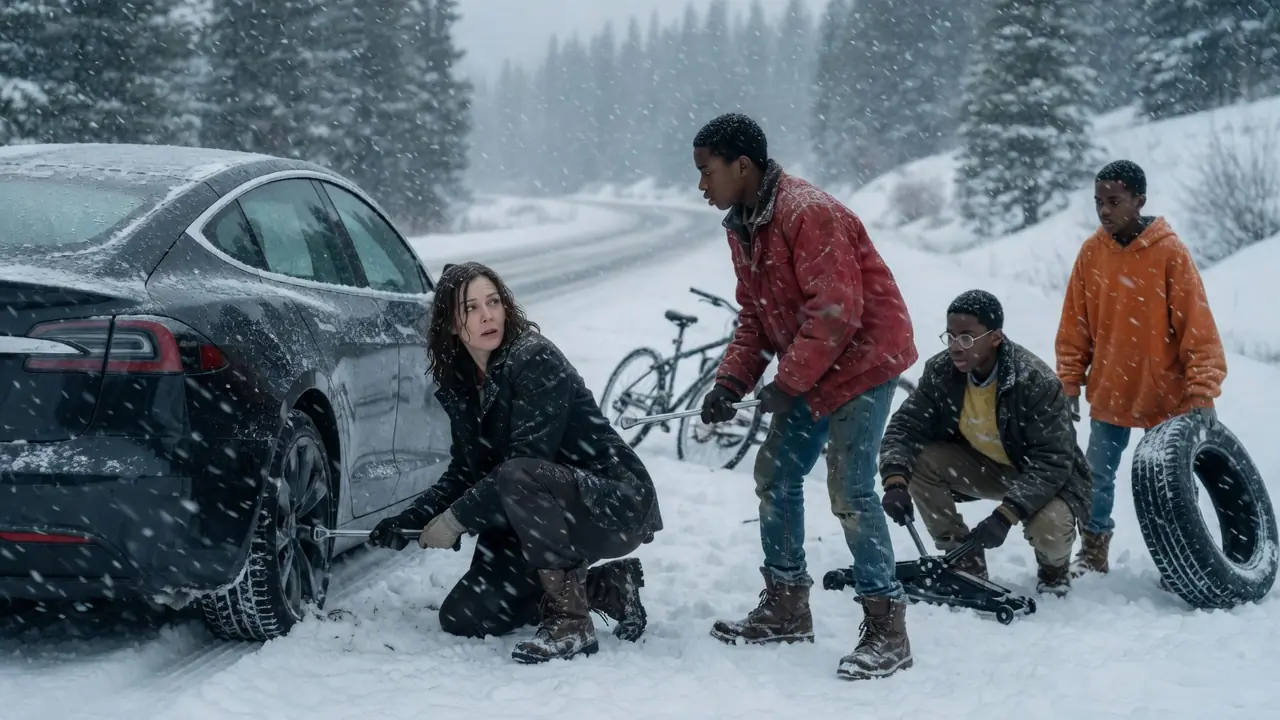
Then Main Street.
Victoria slowed down, taking it in.
Pinewood was tiny.
Really tiny.
One stoplight, a grocery store, a hardware store, a diner called Rosie’s with a faded red sign and lights still on inside despite the late hour.
The buildings were old, paint peeling, some windows boarded up.
This was the kind of town that had seen better days and was still waiting for them to come back.
This was the kind of town Victoria would normally dismiss without a second thought.
Flyover country.
Economically depressed.
No opportunity.
No future.
But three boys from this town had shown her more humanity in 22 minutes than she’d experienced in 22 years of success.
Victoria pulled into the empty parking lot of Rosie’s Diner. Through the window, she could see a handful of people inside. Working folks, farmers maybe, wearing flannel and work boots, drinking coffee from thick white mugs.
She looked down at her suit, now rumpled and stained, her ruined boots, the Tesla that probably cost more than most of these people made in five years.
She didn’t belong here.
But she got out anyway.
The cold hit immediately, sharp and biting, colder than Denver somehow. The kind of cold that lives in small towns and never leaves.
Victoria walked to the diner door.
Her hand hesitated on the handle.
What if the boys weren’t here?
What if this was a terrible idea?
What if she was having some kind of breakdown?
She pushed the door open.
A bell rang above her head.
Everyone turned to look.
The diner went completely quiet.
Eight pairs of eyes stared at her, at her expensive suit, at her designer boots, at everything about her that screamed outsider.
Intruder.
Not one of us.
Victoria stood frozen in the doorway, suddenly feeling like the most alone person on earth.
Then from a corner booth, a voice called out.
“The tire lady.”
Victoria’s head snapped toward the sound.
There in the corner booth were the three boys.
Malik, Jamal, and Deshawn, sitting over plates of burgers and fries, homework spread across the table, looking at her with surprise, but not hostility.
The diner stayed quiet, everyone watching, waiting to see what would happen.
Victoria walked over, her boots clicking on the old linoleum floor. Each step felt like a mile through water.
“Hi,” Victoria said when she reached their booth, her voice smaller than she’d intended.
“Hey,” Malik said, clearly surprised, but not unfriendly. “Your car still okay? The spare holding up?”
“Yeah. It’s fine. Thanks to you.”
The three boys looked at each other.
That silent communication Victoria was learning to recognize.
“What are you doing here?” Jamal asked, pushing his taped glasses up. “Weren’t you heading to Denver? That important meeting?”
Victoria opened her mouth.
Closed it.
What was she doing here?
“I made the meeting,” she said slowly. “Closed the deal. Got everything I wanted.”
“That’s great,” Deshawn said.
But he looked confused.
“So why are you here?”
“I don’t know,” Victoria admitted.
And hearing herself say it out loud made her feel both terrified and liberated.
“I honestly don’t know. I just… I needed to come back. To talk to you. To understand something.”
The boys exchanged glances again.
Malik gestured to the empty space in the booth.
“You want to sit?”
Victoria looked around.
Everyone was still staring, but Malik’s invitation seemed to give her permission somehow.
She slid into the booth. The cracked vinyl was familiar from a life she’d left behind decades ago.
A waitress appeared.
Sixty years old, maybe. Tired eyes, but a kind face. Her name tag said Betty.
“What’ll it be, honey?”
“Coffee. .”
Victoria paused.
“And whatever they’re having.”
Betty looked at Victoria’s suit, raised an eyebrow, but didn’t comment. She just wrote it down and walked away.
They sat in awkward silence for a moment.
The boys picked at their fries.
Victoria didn’t know where to start.
So Malik finally said, “You closed your big deal and then drove back here. That’s like 40-something miles out of your way.”
“Forty-two miles,” Victoria said.
“Yes.”
“Why?” Deshawn asked simply.
Victoria looked at him, looked at all three of them.
These kids who’d refused $3,000, who’d helped her for nothing, who’d told her about a mechanic who measured wealth in love.
“Because you three refused my money,” Victoria said, her voice raw. “Because you helped me for nothing. Because everything you said about your father, about measuring wealth, about connection…”
Her voice broke.
“Because I can’t stop thinking about it. About him. About what it means.”
Betty returned with coffee and a burger, set them down efficiently.
Victoria wrapped her hands around the hot mug, grateful for the warmth, for something to hold on to.
“Your father,” Victoria said, looking at Malik. “You said he died with nothing but left everything that mattered. I think I’m the opposite. I have everything by society’s standards. Six hundred million dollars. A company worth billions. Properties. Cars. Everything money can buy.”
She paused, forcing herself to say it out loud.
“But I’m empty. Completely empty. I closed a $2.3 billion deal tonight. The biggest of my career. And I felt nothing. Nothing but this void.”
The boys listened, not interrupting.
“I got divorced six weeks ago,” Victoria continued, words spilling out now like she couldn’t stop them. “From a man who tried for years to show me what actually mattered. Daniel. He’s a doctor. Spent every Saturday at a free clinic helping people who couldn’t pay. And I mocked him for it. Called it a waste of time. Told him he was too soft for the real world.”
Tears were running down her face now, but she didn’t wipe them away.
“He said I’d frozen my heart, that I’d made myself so hard I’d become brittle. And I laughed at him. Laughed. Filed for divorce because I didn’t have time for his weakness.”
Malik leaned forward slightly.
“And now?”
“And now I think he was right about everything. I think I’ve spent 22 years becoming successful and forgetting how to be human. And I don’t know how to fix it. I don’t even know where to start.”
The diner was still quiet.
Victoria realized other people were listening to this stranger’s confession in their small-town diner.
“Can I tell you something?” Malik said gently. “Something my dad told me once?”
“Please.”
“He said that being lost is the first step to being found. That you can’t start a new journey until you admit the old one isn’t working. He said the bravest thing a person can do is admit they were wrong and ask for help.”
“I was wrong,” Victoria whispered. “About everything. About what matters. About how to live. About what success even means.”
Jamal spoke up, his voice thoughtful.
“My grandma always says it’s never too late to change. She quit drinking when she was 62. Said, ‘The best time to plant a tree was 20 years ago, but the second-best time is right now.’”
“I don’t even know how to change,” Victoria said. “I don’t know who I am without the company, without the deals, without the success.”
Deshawn grinned, his gap-toothed smile somehow reassuring.
“Maybe that’s the point, lady. Maybe you got to figure out who you are when you strip all that away. Like, who’s Victoria when she’s not a CEO or whatever?”
The question hit Victoria like a physical blow.
Who was she?
She genuinely didn’t know.
“I used to be someone else,” she said slowly. “When I was 20, before business school, before I got ruthless, I used to care about people. I volunteered at a homeless shelter. I helped my neighbors. I fixed my own car and felt proud of it.”
She looked at her hands, now bandaged from her failed attempt to change the tire.
“But I decided that version of me was weak. Naive. So I killed her, deliberately, systematically turned myself into someone hard, someone who couldn’t be hurt, someone who won.”
“And?” Malik asked.
“And I was wrong. That version of me was the real me. This version…”
Victoria gestured at her expensive suit.
“This is the fake one. The armor. The mask.”
Betty appeared again with more coffee.
She’d been listening, Victoria realized.
Everyone had.
“Honey,” Betty said, voice gruff but kind, “sounds like you need more than coffee. Sounds like you need to figure out what you’re really hungry for.”
Victoria looked up at her, this stranger in a small-town diner who somehow understood.
“I think I need to learn how to be human again,” Victoria said. “I think I need to remember what it feels like to help someone without expecting anything back. I think I need to understand what your father knew.”
She looked at Malik.
“What you three know. About connection. About real wealth.”
Malik studied her for a long moment.
Then he looked at Jamal and Deshawn.
That silent communication again.
“Okay,” Malik said finally. “I think we can help with that.”
“How?”
“Come with us tomorrow to the community center. See what we do. Meet the kids. Help out if you want. No pressure. Just see what it’s like to be part of something real.”
“I don’t know how to…”
“Neither did we at first,” Deshawn interrupted. “But you learn. It’s not complicated. You just show up. You care. You help. That’s it.”
“What time?” Victoria asked, surprising herself.
“Nine in the morning,” Malik said. “Place is on Oak Street. Big brick building. Kind of run down. You can’t miss it.”
“I’ll be there.”
The boys went back to their food.
The diner slowly returned to normal, conversations resuming, the moment passing.
Victoria sat with them, ate her burger, the first real food she’d had all day, and listened to them talk about school, about basketball practice, about the little kids at the center they tutored.
And for the first time in years, Victoria felt like she was exactly where she was supposed to be.
Around 10:00, the boys got ready to leave.
“Where are you staying?” Jamal asked Victoria.
“I don’t know. Is there a hotel?”
Betty, refilling coffee behind the counter, laughed.
“Hotel? This is Pinewood, honey. We got the Pine Motel on Route 12. Twenty-five dollars a night. It ain’t fancy.”
“Perfect,” Victoria said.
The boys left on their bikes. They’d stored them outside in the cold.
Victoria watched them go, three figures disappearing into the darkness of the small town.
She paid her bill. Betty refused to let her tip more than 20%.
“We don’t take advantage of people here. Even rich people having crises.”
Victoria drove to the Pine Motel.
It was exactly as advertised.
Not fancy.
The room smelled like old carpet and Pine-Sol. The heater rattled. The mattress sagged. The TV had maybe 15 channels.
She’d never been somewhere so unglamorous in her adult life.
She lay down on the sagging mattress in her ruined suit and stared at the water-stained ceiling.
Her phone was still off.
Her empire was probably in chaos.
Harrison was probably furious.
The board was probably panicking.
And Victoria didn’t care.
For the first time in 22 years, she felt like she could breathe.
She thought about Daniel, about three boys on bicycles, about a mechanic named James Davis who died with nothing and left everything.
And she thought about tomorrow.
About the community center.
About learning how to be human again.
Victoria Wellington closed her eyes and, despite everything, smiled.
She didn’t know what came next.
Didn’t have a plan.
Didn’t have any answers.
But for the first time in decades, she felt like she was heading in the right direction.
Victoria awoke at 6:30.
Old habit.
Her body didn’t know how to sleep past sunrise, even in a motel where the thin curtains did almost nothing to block the light.
She looked around the small room.
Peeling wallpaper. Carpet that had seen better days. A bathroom barely big enough to turn around in.
She’d paid more for a bottle of wine than this room cost.
She should have been uncomfortable, horrified even.
Instead, she felt strangely peaceful.
Victoria showered in the tiny bathroom. The water pressure was weak but hot.
She looked at her suit, rumpled and stained from yesterday, unusable.
She had nothing else to wear.
She thought about calling her assistant, having clothes sent, then stopped herself.
No.
That was the old Victoria, the one who had people for everything.
At 7:30, she walked down Main Street.
Most stores were still closed, but the hardware store was open.
A bell rang as she entered.
An older man behind the counter looked up. Sixties maybe. Flannel shirt, work-worn hands.
“Help you, miss?”
“I need clothes. Work clothes. Jeans, a flannel shirt, boots that can actually handle weather. Whatever you have.”
The man looked her over, taking in her expensive suit, her ruined Jimmy Choos.
“You’re that woman from last night at Rosie’s. The tire lady.”
Word traveled fast in small towns.
“That’s me.”
“Tom Patterson,” he said, extending a hand. “I’ll set you up.”
Twenty minutes later, Victoria left wearing sturdy jeans, a warm flannel shirt, and actual work boots.
Total cost: $120.
She felt more comfortable than she had in years.
She ate breakfast at Rosie’s.
Eggs, bacon, toast.
Betty served her with a knowing smile.
“Going to the community center today?”
“How did you…”
“Honey, this is Pinewood. We all know everything. Besides, Malik called me this morning. Said to look out for you. Make sure you ate.”
Victoria felt something warm in her chest.
When was the last time someone had looked out for her?
She couldn’t remember.
At 8:45, Victoria parked the Tesla, looking ridiculously out of place on Oak Street in front of a large brick building.
Pinewood Youth Community Center, the faded sign read.
The building was old.
Really old.
The paint was peeling. The roof had visible patches. The windows were dirty. The front steps were cracked and dangerous-looking.
But there was a warmth to it somehow, a sense of life and purpose that her gleaming office building had never possessed.
Victoria walked up the steps carefully, testing each one.
She pushed open the heavy door.
Inside was warmer than she expected. The entrance hall had old linoleum floors, scuffed and worn. The walls were painted a faded yellow. Children’s artwork hung on every available surface, not framed professionally, just taped up with pride.
Voices echoed from deeper in the building.
Laughter.
The sound of kids being kids.
“You came.”
Victoria turned.
Deshawn was running toward her, grinning his gap-toothed grin.
“I said I would.”
“Yeah, but rich people say lots of stuff they don’t mean. No offense.”
“None taken. You’re right.”
Malik and Jamal appeared from a doorway.
Malik smiled when he saw her.
“Nice outfit. Very Pinewood.”
Victoria looked down at her new clothes.
“Figured I should dress for the occasion.”
“Come on,” Malik said. “We’ll introduce you to Miss Patricia. She runs this place.”
They led her through the building.
Victoria looked around, taking it in.
The place was falling apart. That was obvious. Water stains on the ceiling, cracked plaster, old furniture held together with duct tape. But it was clean, organized, loved.
They entered a large room that appeared to be the main gathering space.
Maybe 30 kids were there, ranging from about 6 years old to teenagers. Some were doing homework. Others were drawing. A group in the corner was playing a board game with half the pieces missing.
“Miss Patricia,” Malik called out.
A woman looked up from where she was helping a little girl with math. Fifties maybe. Tired eyes, but a beautiful warm smile.
She walked over, and Victoria felt herself being assessed.
Miss Patricia’s eyes took in everything.
The new clothes.
The expensive watch Victoria had forgotten to remove.
The way Victoria stood like she wasn’t quite sure what to do with herself.
“So you’re the tire lady?” Miss Patricia said.
“Apparently, that’s my new identity,” Victoria said, extending her hand. “Victoria Wellington.”
Miss Patricia’s handshake was firm, confident.
“Patricia Hayes. Welcome to the Pinewood Youth Community Center. The boys tell me you want to volunteer.”
Victoria hesitated.
“I want to understand something. About helping. About connection.”
She looked at Malik.
“Your father understood something I’ve lost. I’m hoping I can find it again.”
Miss Patricia studied her for a long moment.
Then she smiled. Softer this time.
“Well, best way to find something is to stop looking and start doing. You know how to tutor math?”
“I have an MBA from Wharton.”
“I’ll take that as a yes. Follow me.”
The next three hours were unlike anything Victoria had experienced in years.
Miss Patricia set her up with a 9-year-old named Marcus who was struggling with multiplication tables.
At first, Victoria tried to approach it like a business problem. Systematic, logical, efficient.
Marcus stared at her like she was speaking another language.
“I don’t get it,” he said, frustrated.
Victoria felt her old impatience rising.
In her world, if someone didn’t understand, they weren’t trying hard enough.
But then she remembered Malik’s gentle patience, explaining how to change a tire.
Deshawn’s cheerful persistence.
She took a breath and started over.
“Okay, what do you like? What’s fun for you?”
“Basketball,” Marcus said immediately.
“Perfect. So, if you make three baskets and each basket is worth two points, how many points do you have?”
Marcus’s face lit up.
“Six.”
“Exactly. That’s multiplication. Three times two equals six. Three groups of two.”
They worked through it together using basketball, using candy, using anything that made it real.
And slowly, Marcus started to understand.
When he finally got a whole sheet of problems right, he jumped up and hugged Victoria.
Actually hugged her.
Victoria froze for a second, then awkwardly patted his back, but something in her chest felt warm, full.
“I did it!”
Marcus ran off to show Miss Patricia.
Jamal appeared at her shoulder.
“Nice work, teach.”
“He did all the work. I just found a way to explain it.”
“That’s what teaching is,” Jamal said wisely.
Victoria spent the rest of the morning helping various kids with homework, reading to a group of first graders, and trying unsuccessfully to fix a broken chair leg.
At noon, Miss Patricia called everyone for lunch.
The kids lined up orderly, well practiced. They got sandwiches, peanut butter and jelly, simple and filling, and fruit.
Victoria sat with Malik, Jamal, and Deshawn.
“So,” Malik asked, “what do you think?”
“I think…”
Victoria paused, trying to find the right words.
“I think this is the most useful I’ve felt in years. Maybe decades.”
“It’s good, right?” Deshawn said. “Helping people. Just helping them. No angle, no deal, just being useful.”
“It’s…”
Victoria felt tears threatening again.
“It’s everything.”
After lunch, Miss Patricia pulled Victoria aside.
“Can we talk in my office?”
The office was tiny, cluttered with papers and files and years of operation. Miss Patricia sat behind an old desk covered in coffee rings.
“The boys told me your story,” Miss Patricia said. “About the tire, about the money you tried to give them, about their father.”
“I hope that’s okay.”
“It’s fine. We don’t have secrets here. Can’t in a town this small.”
She leaned forward.
“I knew James Davis. He volunteered here every Saturday for 15 years. Fixed things, painted walls, helped kids learn how to change oil, fix bikes, basic life skills. Never asked for a penny.”
“He sounded incredible.”
“He was. And when he got sick, this whole community came together for him and his family. That’s what James taught us. When you help others, you create a web of connection. And when you need help, that web holds you up.”
Victoria thought about her own life.
No web.
No connections.
Just transactions that ended when the deal was done.
“I don’t have that,” she said quietly. “I have money and success and nothing else.”
“But you’re here,” Miss Patricia said. “That’s something. That’s a start.”
“I don’t know what I’m doing.”
“Nobody does. We all just figure it out as we go.”
Miss Patricia paused.
“The boys trust you. They don’t trust easy, especially Malik. His father’s death was hard. Made him cautious about new people.”
“Why do they trust me?”
“Because you listened. Because you came back. Because you’re trying.”
Miss Patricia smiled.
“That’s enough.”
Victoria helped clean up after lunch. Swept floors, wiped tables, basic tasks she hadn’t done in years.
Around 2:00, the older kids started leaving for after-school activities. The younger ones were picked up by parents or guardians.
Victoria watched families reunite, saw tired parents hug their kids, saw the love and connection, simple and real.
She thought about her own family.
Her father, cold and distant, who taught her that emotion was weakness.
Her mother, long dead, who tried to teach her kindness before cancer took her when Victoria was 12.
What would her mother think of who she’d become?
The thought hurt.
By 3:00, the center was mostly empty, just Malik, Jamal, and Deshawn finishing their own homework.
Miss Patricia came over to where Victoria was attempting to fix a broken bookshelf.
“You can come back tomorrow if you want,” Miss Patricia said. “We’re here every day, 3:00 to 6:00. Weekends 9:00 to 5:00.”
“Really?”
“Really. You’re good with the kids, and we can always use the help.”
Victoria felt something break open in her chest.
Relief.
Hope.
Purpose.
“I’d like that. I’d really like that.”
That evening, Victoria sat in her motel room, her phone still off.
She knew she was avoiding reality. Knew she’d have to turn it on eventually, face the consequences of walking out on her professional obligations.
But not yet.
Not until she figured out who she was supposed to be.
She thought about Marcus’s hug, about the way the kids’ faces had lit up when they understood something new, about Miss Patricia’s trust, about Malik’s quiet acceptance.
She thought about Daniel and his free clinic.
The work she’d mocked as meaningless.
She finally understood what he’d been trying to tell her all those years.
This was meaningful.
Connection was meaningful.
Helping was meaningful.
Everything else, the deals, the money, the success, was just noise.
Victoria lay back on the sagging mattress and stared at the water-stained ceiling.
Tomorrow she’d go back to the center, help more kids, learn more about what it meant to be part of a community.
And maybe, slowly, she’d learn how to be human again.
How to be the person she’d killed 22 years ago when she decided that kindness was weakness.
How to be someone James Davis would have been proud to know.
How to measure wealth the way that actually mattered.
Victoria closed her eyes, and for the second night in a row, she slept peacefully because she was finally, finally heading in the right direction.
Victoria went back to the center the next day.
And the day after that.
And the day after that.
A week passed.
Then two.
She helped kids with homework, read to them, listened to them, learned their names, their stories, their dreams.
She met their families, learned about the town, about its struggles and its strengths.
She had breakfast every morning at Rosie’s. Betty knew her order by heart now. Coffee , two eggs over easy, wheat toast.
She became a regular at the hardware store. Tom Patterson showed her how to fix basic things. Leaky faucets, broken hinges, loose doorknobs, skills she’d once known and forgotten.
She lived in the Pine Motel and found she didn’t miss her penthouse at all.
But she couldn’t avoid reality forever.
On the 15th day, Victoria finally turned on her phone.
It exploded.
One hundred ninety-three missed calls.
Three hundred forty-seven text messages.
Countless emails.
She scrolled through them, her stomach sinking.
Her board had held an emergency meeting, voted her on indefinite leave, appointed an interim CEO.
Harrison had sent 17 increasingly angry messages. The last one threatened legal action for breach of contract.
Her assistant, the New York Patricia, had resigned, said she couldn’t work for someone unstable and unreliable.
The Wall Street Journal had run an article.
Wellington Missing in Action: What’s Wrong With MedCorp?
Her reputation, carefully built over 22 years, was in tatters.
Victoria sat in her motel room, phone in hand, watching her empire crumble in real time.
The old Victoria, the one from two weeks ago, would have panicked, would have rushed back to New York, done damage control, fought to regain control.
But that Victoria was gone.
This Victoria looked at the messages and felt nothing.
No panic.
No regret.
Just clarity.
She didn’t want that life anymore.
Didn’t want the pressure and the competition and the emptiness.
She wanted this.
Pinewood.
The community center.
Kids who hugged her when they learned something new.
Real connection.
Real purpose.
Real wealth.
Victoria made three phone calls.
First, her lawyer.
“Start the paperwork to sell my shares in MedCorp. I want out completely. Find a buyer. I don’t care about maximizing price. Just get it done.”
Second, her accountant.
“Set up a foundation. Twenty million dollars to start. Purpose: supporting community centers and youth programs in small towns. I’ll send details tomorrow.”
Third, Daniel.
He answered on the second ring.
“Victoria?”
“Hi.”
Her voice was smaller than she intended.
“I got your text two weeks ago. I’ve been worried.”
“I’m okay. Better than okay. I’m in Colorado, tiny town called Pinewood, working at a community center, living in a motel that costs $25 a night.”
Silence on the other end.
“Daniel?”
“I’m here. I’m just shocked. You’re volunteering?”
“Actually volunteering. Every day. Helping kids with homework, reading to them, learning how to fix things, being useful.”
“What about MedCorp? The Denver deal?”
“I closed the deal, then walked out. The board voted me out. I’m selling my shares. I’m done with that life, Daniel. Completely done.”
More silence.
Then, “What changed?”
Victoria told him about the flat tire.
About three boys who refused $3,000.
About James Davis and his legacy.
About learning what wealth actually meant.
“I’m sorry,” she said when she finished. “For everything. For being so hard. For mocking what you did. For choosing success over love. You were right about everything, and I was wrong.”
She heard Daniel take a shaky breath.
“I’m proud of you, Victoria. Really proud. That takes courage, what you’re doing.”
“I should have had that courage 10 years ago. Should have listened to you.”
“You’re listening now. That’s what matters.”
They talked for an hour.
Really talked for the first time in years, about her transformation, about his clinic, about their marriage and why it failed.
“Can we be friends?” Victoria asked. “I know that’s asking a lot after everything I put you through, but…”
“We can be friends,” Daniel said warmly. “I’d like that.”
When they hung up, Victoria felt lighter.
One more bridge rebuilt.
One more connection restored.
That evening at the center, Miss Patricia pulled her aside.
“Can we talk?”
They went to the tiny office.
Miss Patricia closed the door.
“I need to be honest with you about something,” Miss Patricia said. “This center is in trouble. Bad trouble.”
Victoria’s heart sank.
“What kind of trouble?”
Miss Patricia pulled out a folder. Inside were bills, estimates, desperate calculations.
“The building is falling apart. The roof leaks. The heating barely works. We’re running space heaters and praying. The wiring is ancient and probably dangerous. The plumbing is held together with duct tape and hope.”
She showed Victoria estimate after estimate.
“We need $400,000 minimum to make the necessary repairs. We’ve been fundraising for two years. We’ve raised $26,000. It’s not enough. It’ll never be enough.”
“What happens if you can’t get the money?” Victoria asked, though she dreaded the answer.
“We close. This place closes, and 80 kids lose the only safe space most of them have. They lose meals. They lose tutoring. They lose hope.”
Miss Patricia’s eyes filled with tears.
“I’ve been running this place for 12 years. I’ve seen kids come here broken and leave whole. I’ve seen families held together by what we do here. And I’m going to lose it all because of money. Because this town is poor and this state doesn’t care about poor towns.”
Victoria looked at the numbers.
Four hundred thousand dollars.
Two weeks ago, that was what she’d spend on a vacation home without thinking twice.
Now it was the difference between hope and despair for 80 kids.
“What if I told you I could get the money?” Victoria said quietly.
Miss Patricia looked up, confused.
“What?”
“What if I could fund the entire renovation? Four hundred thousand, maybe more, to make it really good, to make this place what it deserves to be?”
“Victoria, that’s a lot of money.”
“I just sold my shares in a company worth billions. Money is the one thing I have, and I finally figured out how to use it for something that actually matters.”
Miss Patricia stared at her.
“You’re serious?”
“Completely serious. I want to do this. I want to save this place for Malik and Jamal and Deshawn. For Marcus and all the other kids. For you. For James Davis’s memory.”
Miss Patricia started crying.
Really crying.
“Why would you do this?”
“Because two weeks ago I was dying inside and didn’t even know it. And this place, these kids, this community, you saved me. Let me save you back.”
Miss Patricia stood up and hugged her.
Held on tight.
“Thank you. Thank you. Thank you.”
Victoria hugged her back.
And this time, the hug didn’t feel awkward.
It felt natural.
Human.
“Right,” Victoria said. “There’s one condition.”
Miss Patricia pulled back, concerned.
“What?”
“I stay. I keep volunteering. I keep helping. This isn’t just me writing a check and leaving. I’m part of this now. I’m part of Pinewood.”
Miss Patricia smiled through her tears.
“Deal.”
That night, Victoria called the boys, told them to meet her at Rosie’s.
They showed up 20 minutes later, concerned and confused.
“What’s wrong?” Malik asked immediately.
“Nothing’s wrong. Something’s right. I’m funding the renovation of the community center. All of it. Everything Miss Patricia needs.”
The boys stared at her, speechless.
“But more than that, I’m staying in Pinewood. I’m leaving my old life behind. I’m setting up a foundation to help places like the community center all over the country. And I’m going to volunteer here. Help Miss Patricia run things. Be part of this community.”
“You’re staying?” Deshawn said, his voice full of disbelief and joy. “Like actually staying?”
“Actually staying. Buying a house here. Making Pinewood my home.”
Malik looked at her with those wise, careful eyes.
“Why?”
“Because two weeks ago, you three taught me what wealth really means. Because your father knew something I’d forgotten. Because I’ve spent 22 years building an empire that meant nothing. And I’m ready to spend the rest of my life building something that means everything.”
She looked at each of them.
“You saved my life on that highway. Not just by fixing my tire, by showing me there was still time to change. Still time to become someone who mattered for the right reasons.”
Jamal pushed his glasses up, tears in his eyes.
“Mr. Davis would have loved you. He really would have.”
“I wish I could have met him.”
“You kind of did,” Malik said. “Through us. Through what he taught us. Through what we taught you.”
Victoria felt tears running down her face again.
But they were good tears.
Healing tears.
“Your father’s legacy is going to help thousands of kids now. Because of what you three did on that snowy highway. Because you kept your promise to him. Because you refused my money and gave me something infinitely more valuable.”
They sat in Rosie’s for hours, making plans, dreaming about what the renovated center could be. Betty kept the coffee coming, pretending not to listen while listening to every word.
Around midnight, Malik walked Victoria to her car.
“Can I tell you something?” he said.
“Always.”
“When my dad was dying, he told me that sometimes God sends angels when you least expect them. I think he sent you to us, and I think he sent us to you.”
Victoria felt her breath catch.
“I’m no angel. I was lost and broken.”
“Angels are just people who help other people find their way home,” Malik said. “That’s what you’re doing. That’s what we did for you. We all helped each other find our way home.”
Victoria hugged him, this 15-year-old kid who’d shown her more wisdom than all her Wharton professors combined.
“Thank you,” she whispered. “For everything. For refusing my money. For telling me about your dad. For giving me a chance to be better.”
“Thank you for listening,” Malik said. “For actually hearing us. For changing.”
They stood in the cold Colorado night, and Victoria looked up at the stars.
More stars than she’d ever seen in her life.
Brilliant and endless.
She thought about the path that had led her here.
The flat tire that had seemed like disaster.
The three boys who’d seemed like coincidence.
The mechanic’s son who taught her what wealth really meant.
None of it was coincidence.
All of it was grace.
All of it was leading her home.
To Pinewood.
To purpose.
To connection.
To the life she was meant to live.
Victoria Wellington drove back to the Pine Motel that night, and for the first time in 22 years, she knew exactly who she was and what she was meant to do.
She was a helper.
A connector.
A person who’d been given a second chance to get life right.
And she was never, ever going to waste it.
Six months later, the Pinewood Youth Community Center grand reopening was scheduled for a bright Saturday morning in early June.
Victoria stood in the parking lot, watching the sun rise over the newly renovated building.
New roof.
Fresh paint.
New windows.
Everything repaired and improved and loved.
Inside, the transformation was even more dramatic.
New computers. Updated library. Commercial kitchen where they now served hot meals three nights a week. Gym with equipment that actually worked. Classrooms with proper desks.
And above the entrance, a bronze plaque.
In memory of James Davis, who taught us that true wealth is measured in lives changed, not dollars earned, and in honor of his son Malik, and all the young people of Pinewood who carry his legacy forward.
Victoria had bought a small house on Elm Street.
Two bedrooms. Nothing fancy. Perfect.
She volunteered at the center five days a week, helped Miss Patricia with administration, tutored kids, organized programs.
The foundation she’d created, the Davis Family Foundation, was now helping community centers in 12 small towns across five states.
She’d sold her Manhattan penthouse, kept one car, donated her designer clothes.
She didn’t miss any of it.
Daniel had visited twice. They were rebuilding their friendship slowly. He’d met the kids, helped at the center, and told Victoria he’d never seen her so alive.
As the sun climbed higher, cars began arriving.
Families poured out. Kids of all ages, parents, grandparents. It seemed like the whole town had shown up.
Malik, Jamal, and Deshawn arrived together. They’d become unofficial ambassadors for the center, helping other teenagers get involved.
“Ready for this?” Malik asked Victoria.
“More ready than I’ve ever been for anything.”
Miss Patricia called everyone to attention.
She gave a speech about community and hope and second chances.
Then she called Victoria forward.
“Six months ago,” Miss Patricia said, “a stranger drove into Pinewood with a flat tire. Three boys helped her. And somehow, that one moment of kindness changed everything. Victoria Wellington didn’t just fund this renovation. She became part of our community. Part of our family. She learned what James Davis knew, that the richest people aren’t the ones with the most money, but the ones who help the most people.”
The crowd applauded.
Real applause, from the heart.
Victoria stepped forward, her voice steady and strong.
“Six months ago, I was lost. I had everything society says you’re supposed to want. Money, success, power. But I was empty. Completely empty. Then three boys refused $3,000 and taught me what wealth really means.”
She looked at Malik, Jamal, and Deshawn.
“They taught me that being rich isn’t about what you have. It’s about who you help. Who you connect with. Who would miss you if you were gone. That’s the only measure that matters.”
Victoria pulled out a printed photo.
James Davis standing in front of the old center, smiling, tools in hand.
“I never met James Davis, but his legacy saved my life. His son and his friends showed me what it means to be truly wealthy. And now I get to help other people learn the same lesson.”
She looked around at the crowd, at faces she now knew, people she now loved.
“This center is just the beginning. The foundation is going to help communities all over the country. But more than that, I’m going to spend the rest of my life doing what James did. Helping people. Not for money. Not for recognition. Just because that’s what makes life worth living.”
She cut the ribbon.
The kids cheered and rushed inside.
Victoria stood in the doorway, watching them go, watching them discover the new computers, the books, the playground equipment.
Pure joy.
Pure life.
Pure meaning.
“He’d be proud.”
Joe Davis appeared at her shoulder. Malik’s uncle, James’s brother.
“My brother would be so proud of you. Of all of this.”
“I hope so,” Victoria said. “I’m trying to honor his memory.”
“You’re doing more than that. You’re living his legacy. You’re proving he was right about what matters.”
That evening, after the crowds left and the center was quiet, Victoria sat on the front steps with Malik, Jamal, and Deshawn.
“Six months,” Deshawn said. “Crazy how fast it went.”
“Crazy how much changed,” Jamal added.
“Not crazy,” Malik said. “My dad always said that change happens in moments. Big moments, small moments. The moment you decide to help someone. The moment you realize you’ve been living wrong. The moment you choose to be better.”
He looked at Victoria.
“That moment on the highway. That was your moment. When you could have given up but didn’t. When you could have been bitter but chose to be grateful. When you could have just paid us and forgotten us but chose to learn from us instead.”
“That was your moment too,” Victoria said. “You could have taken my money. Could have just fixed my tire and left. But you told me about your father instead. You taught me something I desperately needed to learn.”
They sat in comfortable silence, watching the stars emerge.
“My dad used to say,” Malik said quietly, “that we’re all just walking each other home. Helping each other find the way back to what matters. Back to love. Back to connection. Back to being human.”
“I think he was right,” Victoria said. “About everything.”
“I know he was,” Malik said, smiling.
Victoria looked at the center, lit up in the gathering darkness.
At this place that had become her home.
At these kids who’d become her family.
At this life that had found her when she stopped trying to control everything.
She thought about the woman she’d been six months ago, the one who measured everything in money, the one who’d frozen her heart to protect it, the one who thought success meant conquest and control.
That woman was gone.
In her place was someone who finally understood what wealth really meant.
Not dollars in a bank account.
Not properties or cars or awards.
But this.
Connection.
Purpose.
Love.
Community.
The knowledge that when she died, people would cry, not because she was rich, but because she’d made their lives better.
Victoria Wellington had spent 22 years climbing the wrong mountain.
But three boys on bicycles had shown her the right path, and now she was finally, beautifully, completely home.
“Thank you,” she said to Malik, Jamal, and Deshawn. “For everything. For refusing my money. For telling me about your father. For teaching me how to be human again.”
“Thank you,” Malik said, “for listening. For changing. For proving that it’s never too late to become who you’re meant to be.”
They sat together as darkness fell.
Four people connected by grace and flat tires and the wisdom of a mechanic who’d known what really mattered.
And somewhere in the Colorado sky, Victoria liked to imagine James Davis was smiling, his legacy living on, his lessons spreading, his son honoring him in the best way possible, by helping others find their way home.
Just like three boys had helped her on a snowy highway six months ago, when her old life ended and her real life finally began.