“On the ground now. Don’t make me say it twice.”
“This is my house.”
“Did I ask you to talk?”
“Please, I’m a federal…”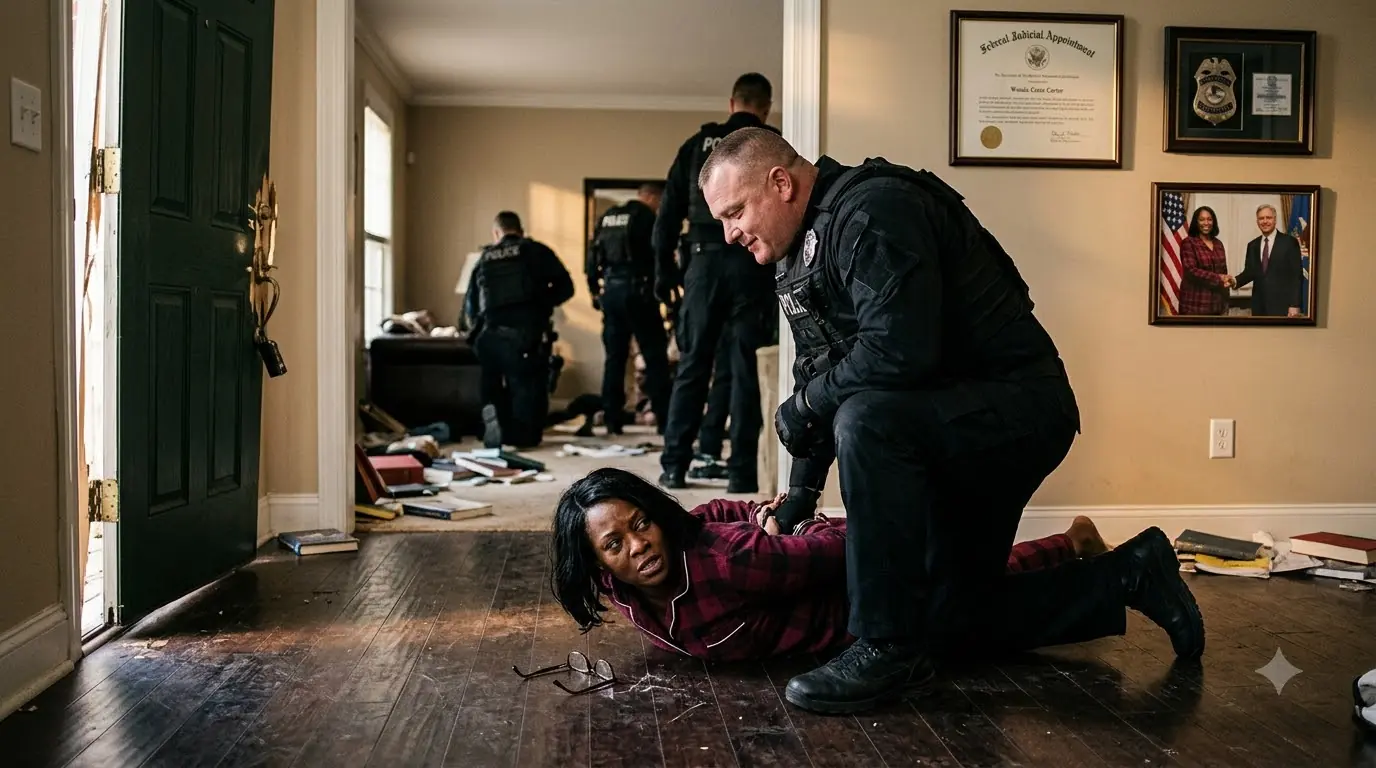
A knee drove into her spine.
Her cheek hit cold hardwood.
“Sweetheart, every criminal in this neighborhood thinks they’re somebody. You’re nobody.”
She did not scream.
She did not cry.
She just whispered, “You have the wrong house.”
At 6:05 on a Saturday morning, thirty cops broke down this woman’s door. Rifles, SWAT vans, a helicopter, all aimed at one woman in pajamas pinned to her own floor.
But their chief was already on his way.
And when he walked in and saw what was hanging on her wall, he went pale.
They did not even stop to check.
That was the scary part.
Let me take you back about ten hours.
Friday evening. Maple Lane, Cedar Hill neighborhood, Collinsworth, Georgia.
A mid-size Southern city where old barbershops still sat next to brand-new coffee shops, and “For Sale” signs popped up on porches that had been in the same family for decades.
Number 414 sat halfway down the block. A brownstone with a dark green door, a porch lined with potted ferns, and a welcome mat that read, Justice lives here.
It was a quiet joke.
The woman who lived there had spent her entire career making sure that was true.
Her name was Wanda Carter.
She was forty-two years old, , a former federal judge, and currently a senior advisor to the United States Department of Justice Office of Civil Rights.
The kind of title that made powerful people sit up straight.
But you would not know any of that looking at her right now.
Right now, she was sitting at a kitchen table in reading glasses and an old Howard University sweatshirt. Case files were spread across the table. A mug of chamomile tea had gone cold beside her elbow. Miles Davis played low from a speaker on the counter.
She was not reviewing budgets or writing speeches.
She was reading complaint after complaint from families across four states who said police had kicked in their doors, tossed their homes, roughed them up, and never once said sorry.
Civil rights violations. Pattern and practice cases. The kind of work that kept her up past midnight most nights.
The irony of what was about to happen to her would be almost poetic if it were not so cruel.
Wanda rubbed her eyes, took off her glasses, and stretched. She picked up her phone and called her mother in Savannah.
“Hey, Mama. You eat dinner?”
“Girl, I had catfish and greens. Are you still at that table working?”
“Just finishing up.”
“Wanda Louise Carter, go to bed.”
She smiled.
“Yes, ma’am.”
She locked the front door and checked it twice. Old habit.
She rinsed her mug in the sink, blew out the cinnamon candle on the kitchen counter, and started toward the bedroom.
On her way there, she passed through the living room.
If you had been standing there, you would have noticed the wall. Not the whole wall, just one section behind her reading chair.
Framed pieces were neatly arranged. Not flashy. Not boastful. Just there, like a quiet archive of a life built on service.
A federal judicial appointment certificate signed by a sitting president of the United States.
A DOJ senior advisor credential with her photo and a gold seal.
A photograph of Wanda shaking hands with the United States Attorney General, both of them smiling.
Her law degree from Howard University.
And a commendation from the FBI for her contributions to federal civil rights investigations.
Wanda did not put those frames up to impress anyone. Most visitors never even noticed them.
They were just reminders for her of how far a girl from Savannah could go if she kept her head down and her standards high.
She turned off the living room light.
That wall disappeared into darkness.
She set her alarm for eight o’clock Saturday morning.
She planned to sleep in for once.
She pulled the covers up to her chin, and within minutes, the house was silent.
Just the hum of the refrigerator, the tick of the hallway clock, and a dog barking somewhere far down the block.
Peace.
But let me tell you about the neighborhood she was sleeping in.
Cedar Hill had been a proud community for over sixty years. Teachers, nurses, postal workers, retirees, people who kept their lawns clean and their doors open.
Wanda had bought her brownstone there fifteen years earlier, back when she was still a public defender making a fraction of what she earned now.
She loved this block.
She knew every name on every porch.
But Cedar Hill had a problem.
And that problem wore a badge.
The Collinsworth Police Department had been in the local news for months. Aggressive stop-and-frisk operations targeting young men. A wrongful arrest lawsuit quietly settled out of court. Complaints about officers treating the neighborhood like occupied territory.
They rolled through in convoys, questioned people for walking to the store, and ran plates on every car that looked too nice.
Wanda knew all of this.
She had read the reports at her DOJ desk. She had flagged the department for possible federal review.
She just never imagined she would become the case file herself.
At 414 Maple Lane, Wanda Carter slept.
The house was dark.
The street was still.
It would not stay that way for long.
At 5:50 a.m., three blocks east of Cedar Hill, a convoy assembled in the parking lot of an abandoned gas station.
Twelve patrol cars. Two matte- SWAT vans with engines idling. One unmarked command SUV. And a helicopter already circling high, its blades chopping the pre-dawn air into a low, steady pulse.
Thirty officers stood in formation under yellow streetlights, body armor strapped tight, helmets on, rifles checked, less-lethal tools clipped to belts. A battering ram sat propped against the lead van like a blunt promise.
This was not a routine drug bust.
This was a full-scale tactical operation, the kind you would roll out for a cartel warehouse or a terrorist cell.
The target was a single house on Maple Lane.
Sergeant Ray Caldwell stood at the hood of the command SUV, a printed map spread under his flashlight.
Late forties, white, built like a man who peaked in high school football and never forgave the world for moving on. Buzz cut. Jaw working on a piece of gum. Toothpick behind his ear.
He jabbed a finger at the map.
“Listen up. Anonymous tip came in yesterday. Stash house, Maple Lane. Large quantity. Expect resistance.”
He looked around at his team.
Thirty faces stared back.
“You know how these blocks are. Stay sharp. Stay aggressive. Anyone moves wrong, you put them on the ground. We go in hard, we come out clean. Questions?”
No one spoke.
Officer Brenda Holland sat in the passenger seat of the SUV checking her vest straps. Early thirties, white, blonde ponytail pulled tight under her helmet.
She had been in Caldwell’s unit for three years.
She admired him. She never questioned him.
That was the deal.
You followed Caldwell, you got commendations.
You pushed back, you got transferred.
She glanced at the warrant on the dashboard.
The address read 412 Maple Lane.
She did not double-check it.
Neither did anyone else.
Caldwell slapped the hood twice.
“Let’s move.”
The convoy rolled out.
No sirens.
Just silent red and blue lights pulsing across sleeping houses as twelve cruisers and two SWAT vans snaked through the empty streets of Collinsworth toward Cedar Hill.
At 6:02, they turned onto Maple Lane.
The helicopter dropped lower. Its spotlight swept across rooftops, cutting through the gray pre-dawn light.
Dogs started barking.
A curtain moved in a window down the block.
Thirty officers poured out of their vehicles like a wave, boots on asphalt, rifles up. They surrounded the house, covering every window, every door, every possible exit.
A tactical team set up position on the roof of a house across the street.
The house they surrounded was number 414.
Not 412.
The numbers were right there, brass digits screwed into the porch post, catching the glow of a streetlight.
But nobody looked.
Nobody checked.
Because Caldwell did not look.
And if Caldwell did not look, nobody else would either.
Inside that house, Wanda Carter was asleep.
Caldwell walked up to the front porch. He stepped right past those brass numbers.
He stepped on the welcome mat that read, Justice lives here.
He did not read that either.
He raised his megaphone.
“Open this door now, or we’re coming through. We know what you people are doing in there.”
His voice cracked through the silence of the entire block.
Lights flickered on in houses up and down the street.
A child started crying somewhere.
Inside 414, Wanda’s eyes snapped open.
Her heart slammed against her ribs. She sat up in the dark, confused, her brain scrambling to process the noise.
More pounding.
Fists on wood.
The whole door frame shook.
“Collinsworth PD. Open up. You’ve got three seconds.”
She threw the covers off. Her bare feet hit the cold floor. She reached for her glasses on the nightstand and stumbled toward the hallway.
She never made it.
The battering ram hit at 6:05.
Two hundred pounds of steel swung by two officers who had done this enough times to make it look easy.
The green door did not just open.
It exploded.
Hinges ripped from the frame. Wood splintered across the hallway floor. The welcome mat flew inward like a leaf in a storm.
Then they came.
Thirty officers poured through the doorway.
Flashlights blinding. Boots shaking the floor. The noise overwhelming.
Shouting from every direction.
Radios crackling.
The helicopter thundering directly overhead.
“Get on the ground.”
“Get on the ground now.”
Wanda stood in her hallway in flannel pajamas. Barefoot. Hands raised. Blinking against the blinding white light.
She opened her mouth.
“I’m a federal…”
A hand grabbed her shoulder and spun her around.
Another hand shoved her face first toward the floor.
Her knees buckled.
She hit the hardwood.
The same hardwood she had refinished herself three summers ago, sanding every plank by hand.
A knee pressed into her spine.
Her arms were wrenched behind her back.
Steel handcuffs clicked shut around her wrists so tight the metal immediately bit into her skin.
Her reading glasses, the ones she had grabbed from the nightstand, were knocked from her face. They skittered across the floor.
A boot came down on them.
The left lens cracked with a small, clean sound that somehow cut through all the chaos.
She lay there.
Cheek against cold wood.
A knee on her back.
Thirty armed strangers in her home.
“Please,” she said.
Her voice was steady even now.
“You have the wrong house. Check the warrant. This is 414.”
Caldwell crouched beside her, close enough that she could smell the spearmint gum on his breath.
“Sweetheart, every criminal in this zip code has an excuse. Yours ain’t special.”
He stood, stepped over her like she was furniture, and barked orders at his team.
“Fan out. Every room. Basement, attic, backyard. I want every inch of this place opened up. If it’s locked, force it. If it’s sealed, open it.”
They obeyed.
Officers stormed through the living room, flipping couch cushions, pulling books off shelves, sweeping framed pictures off surfaces.
A ceramic vase on the kitchen counter, a gift from Wanda’s mother, hand-painted and thirty years old, was knocked to the tile floor.
It shattered into a hundred pieces.
In the bedroom, officers tore the sheets off the bed, emptied the closet, and dumped drawers onto the floor.
Underwear.
Jewelry.
Personal letters.
All of it scattered like trash.
In the kitchen, they opened every cabinet, every drawer. They pulled out pots, pans, spice jars. They ripped open cereal boxes and emptied the refrigerator shelf by shelf.
They found nothing.
No drugs.
No weapons.
No contraband of any kind.
Not a single item that justified even one officer being there, let alone thirty.
Because this was the home of a DOJ senior advisor.
A woman who spent her days prosecuting exactly the kind of thing that was being done to her right now.
Across the street, Tanya Givens had already been awake for two minutes.
The helicopter had woken her first.
Then the lights.
Red and blue flashing across her bedroom ceiling like a nightmare.
She ran to the window, and what she saw made her stomach drop.
An army.
There was no other word for it.
Police vehicles lined the entire block. Officers swarmed around Wanda’s house like ants on a wound.
She could see the broken door.
She could see the SWAT vans.
She could hear the shouting.
Then she saw Wanda.
Through the shattered doorway, she saw her friend, her neighbor, the woman she waved to every single evening.
Face down on the floor in pajamas.
Hands cuffed behind her back.
A knee on her spine.
“Oh my God,” Tanya whispered.
Her hands were shaking, but she grabbed her phone off the charger, opened the camera, and hit record.
She did not know it yet, but that trembling, tear-blurred footage would change everything.
Back inside 414, Wanda Carter lay still on her hallway floor.
Her wrists throbbed.
Her cheek ached against the wood.
She could hear her house being torn apart.
Every crash.
Every slam.
Every drawer hitting the floor.
She closed her eyes and waited.
Because Wanda Carter understood something Sergeant Ray Caldwell did not.
He thought he had all the power.
He was wrong.
Ten minutes in, nothing had been found.
Caldwell was getting angry.
Not worried.
Not cautious.
Angry.
Because the house was clean, and a clean house made him look stupid in front of thirty officers he was supposed to be leading.
So he did what men like him always do when reality does not match their assumptions.
He doubled down.
“Holland, take four officers and tear that basement apart. Every box. Every shelf. If there’s a loose brick, check it.”
“Copy, Sarge.”
“Davidson, backyard. Check the shed. Check under the deck. Bring the dog.”
A German Shepherd was led through the broken front door. Its claws clicked against the hardwood as it sniffed its way past Wanda.
Still face down.
Still cuffed.
Still silent.
The dog’s nose brushed against her bare foot.
She did not flinch.
Caldwell stood in the middle of the living room and turned in a slow circle.
His eyes swept across the bookshelves, the polished furniture, the framed art.
His jaw tightened.
“This place is way too nice for this block,” he said, loud enough for everyone to hear. “She’s not running some corner operation. She’s holding for somebody bigger. Somebody with real money.”
One of the younger officers shifted uncomfortably.
He said nothing.
Caldwell walked over to where Wanda lay. He stood directly above her, feet planted on either side of her body.
She could see his boots.
Scuffed leather, inches from her face.
“Who do you work for?”
“I work for the Department of Justice.”
He snorted.
“Right. And I’m the president.”
He crouched again, elbows on his knees.
“Let me explain how this works, sweetheart. The more you lie, the longer you stay on this floor. The more you cooperate, the faster this ends. Your choice.”
“I’m not lying. My credentials are on the wall behind you.”
He did not turn around.
“Everyone in cuffs thinks they’re important.”
He stood back up.
“Search the office.”
Two officers entered the small study off the hallway.
Wanda’s briefcase sat on the desk. Brown leather, worn soft at the corners.
One officer flipped it open.
Inside were sixteen active case files from the DOJ Office of Civil Rights. Federal documents. Confidential materials. Witness protection information. Investigation notes covering police departments in four states.
Including one file with Collinsworth PD written on the tab.
The officer picked up the files, glanced at the headers, and stacked them on the desk like they were takeout menus.
“Got a bunch of paperwork in here, Sarge. Looks official.”
“Bag it.”
“Sir,” Wanda’s voice came from the hallway, louder now, still controlled but sharper, “those are protected federal documents. You are not authorized to handle them. You are obstructing an active federal investigation.”
Caldwell did not even look at her.
“She wants to play lawyer, we’ll play lawyer.”
In the bedroom, Officer Holland found a laptop. Silver. Sitting on the nightstand. Plugged into its charger.
She opened it.
Password screen.
“Laptop here, Sarge. It’s locked.”
“Bring it.”
Wanda’s composure cracked, just slightly.
“That laptop contains active federal investigation data. Protected witness names. If you remove it from this house, you are committing a federal crime.”
Holland hesitated.
She looked toward the hallway, then back at Caldwell.
Caldwell shrugged.
“She can tell it to the judge.”
He did not know he was talking to one.
Holland unplugged the laptop and tucked it under her arm.
Now, let me tell you what was happening on the wall.
Three feet from where Caldwell had been standing, three feet, hung everything he needed to see.
The appointment letter.
The DOJ credential.
The photograph with the Attorney General.
It was all right there.
If he had turned around once, just once, this entire thing would have stopped.
But he never turned around.
Because Caldwell did not come there to investigate.
He came there to dominate.
And men like that do not look at walls.
They do not check addresses.
They do not read names.
They kick doors and ask questions later.
Twenty minutes had passed.
Wanda had not moved from the floor.
Her wrists had gone from red to purple. The cuffs were too tight. She told them twice. Both times were ignored.
Her left shoulder was screaming from the angle of her arms pinned behind her back. The knee that had been on her spine was gone now, but the bruise it left was blooming deep under her skin.
She had not been read her rights.
She had not been shown a warrant.
She had asked for both four times.
Each request was met with silence, or a laugh, or, “You’ll get it when we’re done.”
Caldwell keyed his radio.
“Command, this is Caldwell. Residence secured. One suspect detained. Search ongoing. Requesting authorization to extend and transport.”
Transport.
He wanted to take her in.
Book her.
Photograph her.
Put a former federal judge in a holding cell at Collinsworth PD on a Saturday morning.
All because she lived two doors down from the right address.
Outside, the helicopter still circled. Its spotlight panned across the rooftops in wide, lazy arcs.
The noise was relentless, a deep, rhythmic thudding that vibrated in your chest and rattled the windows of every house on the block.
Across the street, Tanya Givens was still recording.
Twenty-two minutes of footage now.
Her phone battery was at thirty-one percent.
Her hands were still trembling.
Tears ran down her cheeks, but she did not wipe them.
She did not lower the phone.
She had captured everything.
The broken door.
The SWAT vans.
Officers carrying boxes out of the house.
The helicopter.
And through the shattered doorway, Wanda, face down, cuffed, motionless on her own floor while a man with a badge stood over her like he owned the place.
Tanya whispered to herself, barely audible on the recording.
“This ain’t right. Lord, this ain’t right.”
She did not know what that footage would become.
She just knew she could not stop filming.
At that point, the cruelty of it was hard to watch.
A man was calling a former federal judge “sweetheart” while she was face down in her own house.
Nobody had thought to check the address.
Nobody had thought to look at the wall.
Nobody had thought to listen.
Back inside 414, something was about to shift.
Not inside the house.
Outside of it.
Four houses down, an elderly man named George Booker had been watching from his front porch since the helicopter woke him.
George was seventy-eight years old, a retired postal worker who had lived on Maple Lane for forty-one years.
He knew every single person on this block.
And he knew exactly whose house those officers were tearing apart.
George walked inside, picked up his landline, because he did not trust cell phones, and dialed the Collinsworth PD main number.
A desk sergeant answered.
“Collinsworth Police non-emergency line.”
“Son, I’m calling from Maple Lane in Cedar Hill. You got about thirty officers and a helicopter outside Judge Wanda Carter’s house right now. I don’t know what y’all think you’re doing, but you got the wrong house.”
The desk sergeant’s fingers stopped moving on his keyboard.
“I’m sorry. Did you say Judge Carter?”
“That’s what I said. 414 Maple Lane. Judge Wanda Carter. Former federal judge. Works for the Department of Justice right now. And your boys just broke her front door down.”
Silence on the line.
A long, sickening silence.
The desk sergeant pulled up the active raid warrant on his screen.
Address on file, 412 Maple Lane.
He checked the caller’s report.
414 Maple Lane.
Two digits.
Two small, stupid digits.
His stomach dropped straight through the floor.
He did not call Caldwell.
He did not radio the tactical team.
He picked up the internal line and went straight to the top.
Chief Donald Elmore’s personal cell phone rang at 6:31 a.m. on a Saturday morning.
He was at home, asleep.
He answered on the fourth ring, voice thick and irritated.
“Chief, it’s Sergeant Dawson at the desk. Sir, we have a situation on the Maple Lane operation.”
“What kind of situation?”
“Caldwell’s running point.”
“I know Caldwell’s running point.”
“Sir, they hit the wrong house.”
Pause.
A mattress creaking as Elmore sat up.
“Which house are they at?”
“414, sir.”
“That’s…”
“I know whose house that is.”
Another pause, longer this time.
The silence on the line felt like a held breath.
When Elmore spoke again, the sleepiness was gone. His voice was flat and cold, the voice of a man who had just realized his entire career might be over.
“Nobody leaves that scene. Nobody touches anything else. Nobody talks to the press. I’m on my way right now.”
He hung up, threw on his uniform, and did not button it all the way.
For the first time that morning, the clock started ticking.
Not for Wanda Carter.
For every officer standing inside her house.
At 6:41 a.m., a town car tore down Maple Lane doing twice the speed limit.
It screeched to a stop at an angle, cutting across two patrol cars. The driver’s door flew open before the engine fully died.
Chief Donald Elmore stepped out.
His uniform shirt was half tucked. His badge was crooked. He had not shaved.
He looked like a man who had aged ten years in ten minutes, and the walk to the front door had not even started yet.
He moved fast.
Past the cruisers.
Past the SWAT vans.
Past the cluster of officers standing around drinking coffee from thermoses like this was a tailgate party.
None of them saluted.
None of them noticed the look on his face.
At the porch, he stopped.
The green door, or what was left of it, hung off one hinge.
Splinters covered the welcome mat.
The brass numbers, 414, caught the early morning light.
Elmore stared at those numbers.
His jaw clenched so hard a vein pulsed in his temple.
He stepped inside.
The hallway was a wreck.
Scuff marks on the hardwood. A shoe rack overturned. Wanda’s cracked reading glasses still lying on the floor where they had been stepped on.
He moved into the living room.
Couch cushions slashed open.
Books scattered across the rug.
The ceramic vase shattered.
A picture frame face down in the debris.
Then he saw the wall.
He did not see it all at once.
It hit him in pieces.
Each one worse than the last.
First, the Howard University law degree.
His steps slowed.
Then the FBI commendation for civil rights work.
He stopped walking.
Then the DOJ senior advisor credential.
Her photograph.
Her name.
A gold federal seal.
His lips parted.
No sound came out.
Then the photograph.
Wanda Carter standing in the West Wing, shaking hands with the United States Attorney General.
Both of them smiling.
Elmore’s face lost its color.
Not slowly.
All at once, like someone had pulled the plug and drained the blood straight out of him.
Finally, at the center of the wall, the federal judicial appointment certificate signed by the President of the United States.
The name in elegant script.
Wanda Louise Carter.
He turned around.
Caldwell was standing right behind him, grinning, chest puffed. He had seen the chief arrive and came to report like a dog bringing a bone.
“Chief, glad you’re here. Got the place locked down. One suspect detained. She’s been running her mouth, but nothing we can’t…”
“Where is she?”
It was not a question.
It was a blade.
Caldwell blinked.
“She’s, uh, in the hallway. Cuffed. Secured.”
“Take me to her. Now.”
Caldwell led him around the corner.
There she was.
Wanda Carter face down on the hardwood, flannel pajamas, bare feet, wrists purple and swollen inside steel handcuffs, a bruise darkening across her left cheekbone where it had been pressed into the floor for over thirty minutes.
Elmore’s voice came out barely above a whisper, but every officer in that hallway heard it.
“Uncuff her.”
Caldwell tilted his head.
“Chief, we haven’t finished the…”
“Uncuff her right now.”
Something in that voice made Caldwell’s hands move before his brain could argue.
He knelt, fumbled with his key, and released the cuffs.
The steel fell away from her wrists, leaving deep red grooves in her skin.
Wanda did not jump up.
She did not rush.
She pressed her palms flat against the hardwood, the same floor she had refinished by hand. She pushed herself up slowly, steadily.
She rose to her full height.
She rubbed her wrists, one then the other.
She rolled her left shoulder where the joint had been screaming for half an hour.
She bent down, picked up her cracked reading glasses, and put them on.
One lens was spiderwebbed.
She looked through it anyway.
Then she looked at Caldwell.
Not with anger.
Not with tears.
With something far worse.
Absolute, ice-cold clarity.
“Sergeant,” she said.
Her voice was level and measured, every word placed like a brick.
“I am Senior Advisor Wanda Carter of the United States Department of Justice, Office of Civil Rights. I am a former federal judge of the United States of America.”
She paused, let it land.
“You entered my home without verifying the address on your warrant. You assaulted me. You restrained me for over thirty minutes without reading my rights or presenting a warrant. Your officer seized protected federal documents and a laptop containing protected witness information.”
Another pause.
The hallway was so quiet you could hear the helicopter blades outside.
“Every single thing you and your thirty officers have done in this house is now a federal matter. And I promise you, every single one of you will answer for it.”
Caldwell’s mouth opened.
Nothing came out.
His face had gone white. His hands hung limp at his sides. The gum he had been chewing had stopped moving in his jaw.
Behind him, Holland quietly set the laptop down on the nearest table and took two steps back.
Elmore stood frozen.
He was not looking at Wanda.
He was staring at the floor.
A man doing math in his head, calculating exactly how destroyed his career was about to become.
Wanda turned away from both of them.
She picked up her cell phone from the hallway table where it had been knocked aside during the raid.
She dialed one number.
Speed dial.
It rang once.
Twice.
“Philip? It’s Wanda.”
Deputy Attorney General Philip Sutton answered on the other end.
“Wanda? It’s six in the morning. What’s…”
“It happened to me.”
Three words.
A pause on the line that lasted an eternity.
Then Sutton’s voice came back, sharp, awake, all business.
“I’m activating the Civil Rights Division. Don’t let anyone leave that scene.”
Wanda hung up.
She set the phone down gently.
Then she turned back to face Caldwell and Elmore.
She did not say another word.
She did not need to.
The silence after Wanda’s phone call lasted maybe ten seconds, but it felt like ten years.
Caldwell was the first to break.
“Chief, listen. The tip was solid. The informant gave us the address. This was a good-faith…”
“Good faith?” Elmore turned on him.
His voice was low, but it shook.
“You brought thirty officers, a helicopter, and a battering ram to a federal judge’s house. You cuffed her on her own floor for thirty minutes. Your people seized protected DOJ documents, and you’re standing here talking to me about good faith?”
Caldwell’s mouth opened, closed, then opened again.
“I… we didn’t know.”
“You didn’t know because you didn’t check.”
Elmore stepped closer.
“Badge. Weapon. Now.”
“Chief…”
“Now.”
Every officer in that hallway watched Sergeant Ray Caldwell unclip his badge from his belt.
They watched him pull his service weapon from its holster, clear it, and set both on the hallway table.
His hands were trembling.
Elmore turned to Holland.
She was already pale, pressing her back against the wall like she was trying to disappear into it.
“You too.”
“Sir, I was just following Sergeant Caldwell’s…”
“Badge and weapon, Holland. Don’t make me ask twice.”
She surrendered them without another word.
Wanda watched all of this from the doorway of her living room, arms crossed, silent.
She did not gloat.
She did not react.
She just watched the way a judge watches from the bench.
By 7:15 a.m., three additional officers involved in the physical restraint and the handling of protected materials were also suspended.
All five, Caldwell, Holland, and three others, had badges confiscated, weapons logged, and precinct access revoked immediately.
They were escorted out one by one.
Caldwell walked out last.
He stepped through the broken door frame, the same one he had smashed through an hour earlier like a conquering hero.
Now he walked through it with his head down, hands empty, stripped of everything that had made him feel powerful.
Neighbors lined their porches. A dozen, maybe more.
The same people Caldwell had spent years treating like suspects watched in silence as he was led to a cruiser.
Nobody said a word.
They did not need to.
By 9:00 a.m., Tanya’s video had reached a local investigative reporter at the Collinsworth Tribune.
By noon, the story was on their website.
By evening, it had gone national.
The footage was devastating.
A woman in pajamas. Handcuffed. Thirty armed officers. SWAT vans. A helicopter. A shattered front door.
And one caption shared across every platform.
She was a federal judge. They didn’t even check the address.
One frame burned hotter than the rest.
Wanda’s reading glasses, cracked, lying on the hallway floor in the debris of her own ransacked home.
That single image ended up on protest signs, magazine covers, and late-night television.
It said everything words could not.
Saturday afternoon, Chief Elmore held a press conference at City Hall.
Uniform pressed. Badge straight. Two deputy chiefs flanking him like men who would rather be anywhere else.
“This morning’s operation on Maple Lane was an isolated procedural incident. The department is conducting a full internal…”
“Chief Elmore,” a reporter cut him off. “You deployed thirty officers and a helicopter to raid a federal judge’s home on an unverified tip. How is that procedural?”
Sweat beaded on his forehead.
“Our protocols are under review.”
“Did anyone verify the address?”
“That is part of the ongoing…”
“Was Judge Carter read her rights at any point?”
Elmore gripped the podium, knuckles white.
He had no answers.
While Elmore drowned behind that podium, attorney Reginald Cole released a single paragraph to every major outlet in the country.
It confirmed that a DOJ senior advisor’s home had been unlawfully raided by thirty officers, that protected federal materials were mishandled, and that federal civil rights charges were being considered.
It ended with one line.
My client will let the legal process speak for itself.
Wanda said nothing publicly.
She did not need to.
The whole country was already speaking for her.
Monday morning, forty-eight hours after the raid, Deputy Attorney General Philip Sutton stood behind a podium at the Department of Justice in Washington, D.C.
American flags on either side.
The DOJ seal behind him.
A wall of cameras in front.
He did not mince words.
“On Saturday morning, thirty officers of the Collinsworth Police Department executed a raid on the private residence of a senior federal official. The address on the warrant did not match the address of the home they entered. The official was physically restrained, denied her constitutional rights, and subjected to degrading treatment. Protected federal materials were unlawfully seized.”
He paused, looking directly into the cameras.
“Effective immediately, the Department of Justice is opening a formal federal investigation into the Collinsworth Police Department, not only into Saturday’s incident, but into a pattern of systemic civil rights violations spanning multiple years.”
The room erupted with questions.
Sutton did not take a single one.
He turned and walked off the stage.
The investigation moved fast.
Federal agents descended on Collinsworth within the week, and what they found was worse than anyone expected.
Sergeant Ray Caldwell had made one mistake on Saturday morning.
He had made the same mistake over and over for eight years.
Investigators pulled his service record.
Fourteen incidents.
Fourteen times Caldwell had led operations that resulted in wrong-address raids, excessive force, or unlawful detainment, all in predominantly neighborhoods.
All fourteen had generated formal complaints from citizens.
All fourteen complaints had been filed, reviewed by Internal Affairs, and quietly buried.
One family in Cedar Hill had their door broken down in 2019.
Wrong house.
No apology.
No follow-up.
The father filed a complaint.
It disappeared.
A twenty-year-old college student was pulled from his car during a traffic stop in 2021. Thrown onto the hood. Searched without consent. Nothing found.
He filed a complaint.
It disappeared.
A sixty-three-year-old grandmother was handcuffed in her own kitchen during a raid in 2022.
Wrong apartment.
Caldwell was the commanding officer.
She filed a complaint.
It disappeared.
Fourteen times.
Fourteen families.
Fourteen complaints.
All gone.
Officer Brenda Holland had participated in six of those incidents.
She knew the pattern.
She followed it.
She never once raised a concern.
But the rot went deeper than Caldwell and Holland.
Investigators discovered that Caldwell’s unit consistently deployed disproportionate force in neighborhoods.
Tactical gear. SWAT teams. Helicopters. K9 units.
Operations that would have received two patrol officers and a polite knock in white neighborhoods across town were treated like military raids in Cedar Hill.
The same drug tip that triggered Saturday’s thirty-officer raid had a nearly identical counterpart in a white suburb three months earlier.
That one had been handled by four officers.
No SWAT.
No helicopter.
No battering ram.
They knocked on the door, asked questions, and left.
The double standard was not subtle.
It was policy.
Internal emails showed supervisors joking about complaint files from residents.
One email from a lieutenant read, Another Cedar Hill special. Filed it where it belongs.
The attachment was a complaint form.
The file path led to a folder labeled circular file, department slang for the trash.
The media firestorm that followed made the first weekend look like a preview.
Tanya’s video, already viral, became the centerpiece of every news segment. Cable networks played it on loop. Legal analysts broke it down frame by frame. Civil rights organizations from across the country issued statements.
Protests gathered outside Collinsworth City Hall.
And one image kept coming back over and over on every screen, every front page, every protest sign.
Wanda’s cracked reading glasses on the hallway floor.
It became the symbol of everything wrong with a system that saw a woman and assumed the worst.
Six weeks after the raid, a federal grand jury returned an indictment against Sergeant Ray Caldwell.
The charges were heavy.
Violation of civil rights under color of law.
Unlawful search and seizure.
Destruction of property.
Mishandling of protected federal documents.
Filing a false operational report, because Caldwell had listed the target address as confirmed in his paperwork when it had never been verified.
Combined, the charges carried a maximum sentence of twenty years in federal prison.
Caldwell hired a private attorney. He told reporters outside the courthouse that he was a good cop who made an honest mistake.
Nobody bought it.
Not anymore.
Holland did not fight.
She took a plea deal within days of the indictment.
Full cooperation.
In exchange for a reduced sentence, she agreed to testify against Caldwell and provide detailed accounts of the department’s internal culture.
Her testimony was devastating.
She described how Caldwell selected raid targets based on neighborhood demographics, not evidence.
How he routinely skipped address verification because “they’re all the same houses anyway.”
How officers were rewarded with commendations for aggressive operations in communities.
And how complaints from residents were treated as jokes, literally laughed at during roll call.
One line from her testimony made national headlines.
“We knew. Everyone knew. Nobody cared.”
Chief Donald Elmore tried to survive.
He could not.
The investigation revealed that Elmore had personally received nine formal complaints about Caldwell’s conduct over five years.
He had signed off on every Internal Affairs dismissal.
His “isolated incident” press conference was replayed side by side with the evidence of fourteen prior incidents.
The contrast was damning.
The Collinsworth City Council held an emergency session.
They voted unanimously, every single member, to demand Elmore’s resignation.
He resisted for three days.
On the fourth day, he was escorted from the building by city marshals.
A formal public apology was issued to Wanda Carter and the Cedar Hill community.
The mayor read it on the steps of City Hall, flanked by council members.
Some of them were crying.
Then came the trial.
Caldwell sat in a federal courtroom for nine days.
He showed no remorse.
His defense argued procedural confusion, good-faith reliance on an anonymous informant, and the fog of a fast-moving tactical operation.
The prosecution dismantled every argument.
They showed he never verified the address.
They showed he ignored Wanda’s repeated identification.
They showed he deployed thirty officers for a tip that warranted a four-person team at most.
They played Tanya’s video for the jury, all twenty-two minutes of it.
And they played the audio of Caldwell’s own voice calling a former federal judge “sweetheart” while she lay face down in handcuffs.
The jury, eight women and four men, diverse in every way, deliberated for four hours.
Guilty.
All counts.
Sentencing came two weeks later.
The courtroom was packed.
Wanda sat in the third row. She wore a dark blue suit. Her glasses had been replaced. New frames, clear lenses.
She sat with her hands folded in her lap.
The judge, a colleague who knew her by reputation, sentenced Caldwell to twelve years in federal prison.
The courtroom erupted.
Applause.
Tears.
Reporters scrambling.
Caldwell stared at the table in front of him. His attorney put a hand on his shoulder. He did not react.
Wanda did not applaud.
She did not cry.
She closed her eyes for a long moment.
Then she opened them, stood up, and walked out of the courtroom.
Outside, sunlight hit her face.
Cameras flashed.
Reporters shouted questions.
She did not answer a single one.
As a direct result of the federal investigation, the Collinsworth Police Department was placed under a federal consent decree, the most severe form of federal oversight a local department can face.
The mandates were sweeping.
Mandatory body cameras for every officer on every shift.
An independent civilian oversight board with subpoena power.
Mandatory de-escalation training, quarterly, not annual.
Address verification protocols requiring two-officer confirmation before any warrant is executed.
Proportionality requirements. No more thirty-officer raids for single-house tips.
And community review panels with real authority over use-of-force complaints.
The department that had terrorized Cedar Hill for years was being rebuilt from the ground up.
It all started because one woman refused to scream, refused to cry, refused to break.
She just lay on her own floor, looked a man in the eye, and said, “You have the wrong house.”
Three months after the trial, a contractor arrived at 414 Maple Lane.
He replaced the front door.
Solid oak this time.
Heavier.
Stronger.
A door that would not break so easily.
Not that it should have ever needed to.
Wanda stood on the porch and watched him work.
When he finished, she ran her hand across the wood.
Smooth.
Warm from the afternoon sun.
She reached into a small paper bag and pulled out a brass plaque, four inches wide.
She screwed it into the wall beside the new door herself.
Two screws.
A Phillips head.
Three minutes.
The plaque read, Justice doesn’t knock. It lives here.
She stepped back, looked at it, and smiled.
Just barely.
Then she went inside, sat down at her kitchen table, and opened a new case file.
Wanda Carter did not move.
She did not sell the brownstone.
She did not transfer to another city.
She stayed at 414 Maple Lane, the same block, the same neighborhood she had loved for fifteen years.
Cedar Hill was her home.
No man with a badge and a battering ram was going to change that.
She went back to work at the DOJ within weeks.
But something had shifted.
Her work was no longer abstract. Reports, files, pattern and practice analysis from a distance.
Now it was personal.
She had felt the knee on her spine.
She had felt the handcuffs bite.
She knew what the families in those complaint files went through.
Not as a lawyer.
As a woman who had lain on her own floor and been called “sweetheart” by a man who thought she was nobody.
And she used every ounce of it.
Six months after the raid, Wanda testified before a United States Senate Subcommittee on Police Reform.
Standing room only.
Cameras everywhere.
Senators leaning forward.
She spoke for eleven minutes.
No notes.
Her opening line made every headline the next morning.
“I had credentials on my wall. Most people don’t. The law should protect them just the same.”
That line was printed on T-shirts, shared millions of times, and quoted in law school classrooms across the country.
Across the street, Tanya Givens still lived in her little blue house with the wind chimes on the porch.
The woman who grabbed her phone at six in the morning with trembling hands had become something she never expected.
A symbol of civic courage.
She was invited to speak at community events and journalism panels.
She always said the same thing.
“I didn’t do anything brave. I just didn’t look away.”
She and Wanda still waved to each other every evening.
Some nights they sat on the porch, drank tea, and said nothing.
Some things do not need words.
Sergeant Ray Caldwell was serving twelve years at a federal facility in South Carolina.
Appeals denied twice.
Pension revoked.
His wife filed for divorce five weeks after sentencing.
The house he had bought with twenty years of salary was sold to cover legal fees.
He would not wear a badge again.
Officer Brenda Holland lost her law enforcement certification permanently.
She could never serve as a police officer anywhere in the United States again.
Three years of blind loyalty to Caldwell had cost her everything.
Chief Donald Elmore moved out of state.
No department would hire him.
No firm would touch him.
His name became a textbook case study in what happens when leadership chooses silence over accountability.
Cedar Hill was quieter now.
Not from fear.
From peace.
For the first time in years, no convoys rolled through at dawn. The oversight board met monthly. Officers wore body cameras. Complaints were answered.
It was not perfect.
But it was different.
And different was a start.
This story may be fiction, but that feeling, being judged before you even say anything, is real.
Most people do not have credentials or titles on the wall to force the world to look twice.
That is the part that stays with you.
Because the law should never depend on who you can prove yourself to be after the damage is already done.