A six-year-old boy in a red shirt walked out of a farmhouse at 7:52 in the morning and started down a frozen Georgia highway.
Barefoot.
January.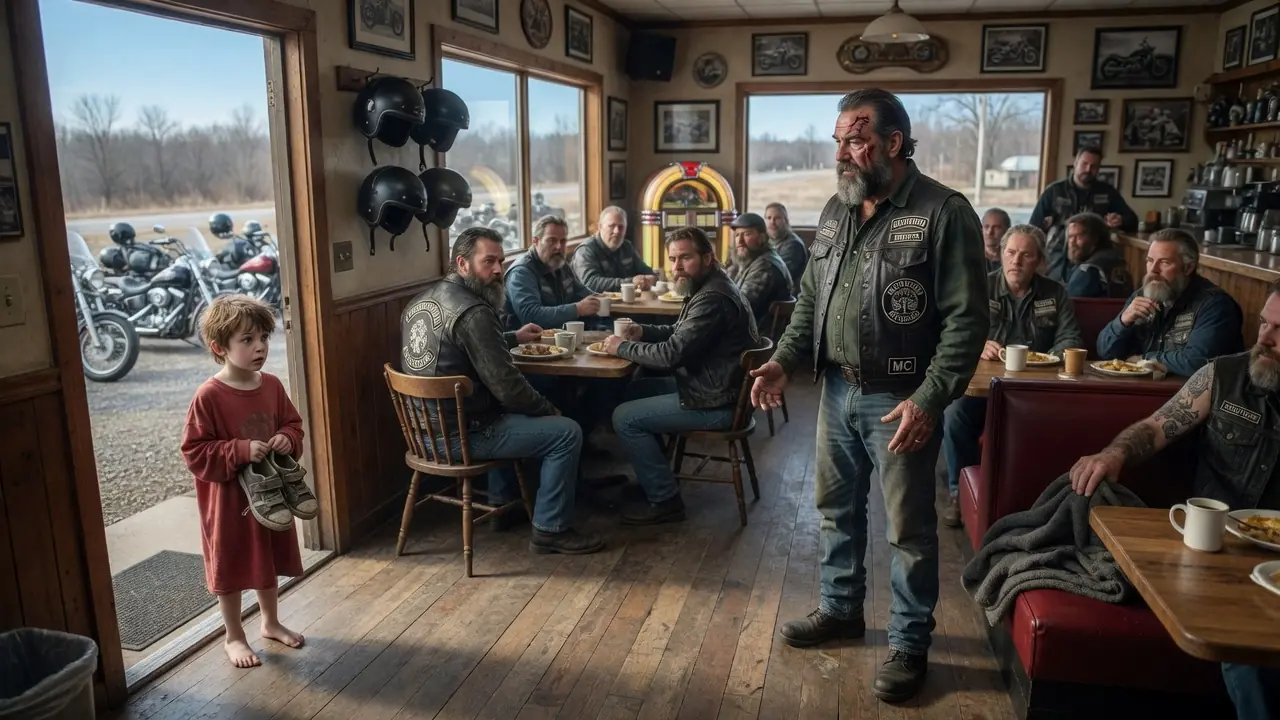
Nobody knew he was gone.
For nine months, four separate adults had seen what was happening to Noah Calloway. A teacher. A neighbor. A mail carrier. A doctor. Every single one of them had looked away, or told themselves someone else would handle it, or accepted the answer they had been given and filed it under resolved.
Nine months.
Four people.
Zero calls that mattered.
He walked 2.9 miles on asphalt that had not warmed above thirty-four degrees, wearing a shirt sized for a four-year-old, with no coat and no shoes, toward a building he had glimpsed once from the back window of a pickup truck and decided was his only option.
What Raymond Castellano discovered when that boy sat down across from him in a corner booth of the Ironwood Grill would not just expose one man’s cruelty. It would uncover a pattern, a cold financial calculation, and a previous life that had already been taken before anyone thought to look.
This is Noah’s story.
And Craig Voss did not plan for it to end this way.
“I think someone is trying to hurt me until I’m gone.”
He said it quietly, almost without inflection, the way a child says something rehearsed over a very long time while lying in the dark alone, waiting for the exact right moment to say it out loud.
The Ironwood Grill sat seven miles outside Calhoun, Georgia, on Route 136 North. It was a roadside diner and gas stop that smelled like bacon grease, propane heat, and the particular sweetness of maple syrup that had been sitting on a warming plate too long.
Country radio played low from a mounted TV above the counter. A truck idled in the parking lot outside, its engine turning in that slow, patient rhythm that meant the driver had nowhere urgent to be.
Eleven people sat scattered across booths and stools on that Saturday morning. Mostly long-haul truckers, two older couples with newspapers, and a young woman working on a laptop who had not looked up since she arrived.
Nobody noticed the boy come in.
He came through the door at 8:41 a.m., and the only evidence of his arrival was the soft creak of the hinge and the two faint red smears his feet left on the linoleum near the entrance.
He moved heel-to-toe with careful deliberateness. It was the walk of a child who had learned, over a long time, to make himself take up as little space as possible in a room.
Shoulders pulled inward. Head down until he cleared the door.
Then eyes up, scanning.
Wide-set brown eyes that did not blink at normal intervals. Eyes that tracked movement the way a small animal tracks it. Not because he was dangerous, but because he had spent nine months learning that the difference between a bad moment and a worse one was how quickly you saw it coming.
His shirt was red, long-sleeved, size 4T on a body that should have fit a size six. The collar fell off one shoulder. The hem reached his knees.
His sneakers, Velcro, no laces, the left sole separating at the toe and taped with gray electrical tape that was coming undone, were not on his feet.
He was carrying them.
His feet were bare.
The pads of both feet showed the deep redness that comes from sustained cold surface contact. Early frostbite, though he did not know that word.
He weighed thirty-four pounds.
A healthy six-year-old should have weighed closer to forty-eight.
He had walked 2.9 miles to get here.
He looked at the diner the way someone looks at a room they have been trying to reach for a very long time.
Then he looked for an empty chair.
The first man he approached sat at the counter. A trucker in his mid-fifties, plate half cleared, coffee at his elbow. Noah stood beside him and asked in a voice barely above breath if he could sit there.
The trucker looked him up and down.
“Kid, where are your parents?”
“I came alone.”
The man picked up his coffee mug and moved to the far stool.
He was not unkind about it. He simply relocated to a place where this would remain not his concern.
It took four seconds.
He did not look back.
The second table belonged to the young woman with the laptop and the man across from her, both in their late twenties, both working through eggs they had let go cold.
Noah stood beside them for forty-seven seconds, long enough that the woman finally looked up from her screen. She saw the shirt, the bare feet, the circles under his eyes dark enough to look bruised.
She leaned toward her partner and said something low.
He shook his head without looking up.
She returned to her screen.
They did not speak to him.
They did not call anyone.
They made a choice, and then they continued their morning.
The diner owner came around the counter at the third approach.
Linda Marsh was fifty-eight, wearing an apron with reading glasses pushed up on her forehead. To her credit, she knelt briefly to Noah’s level and asked his name and where he lived.
“Noah,” he said. “412 Gravel Ridge Road.”
“Honey,” Linda said, straightening up, “I’m going to call your folks to come get you.”
She walked to the phone behind the counter.
She called Craig Voss because Noah had given her Craig’s number before she even finished asking. He had given that number to every adult who had asked for it so many times that it came out of him automatically, a reflex.
She told Noah to sit on the bench by the door and wait.
She meant well.
She genuinely believed she was helping.
That was the part that was hardest to hold on to.
Two women from Calhoun First Baptist occupied the table nearest the bench. Dolores Fanning, sixty-two, and Marta Gibb, sixty-seven, were in for their Saturday morning ritual.
Dolores spotted Noah on the bench and crossed the room. She asked why he was not wearing shoes.
He said he could not find any he was able to get to.
She clicked her tongue.
She turned to Marta.
“This is exactly what happens when the state lets anybody be a parent.”
Then she turned back to Noah and patted his hand.
“Do you go to church, sweetheart?”
Noah shook his head.
“Well,” Dolores said, “that explains it.”
And she returned to her table.
Four people. Four separate moments. Four decisions.
Each one small enough to feel justifiable in the moment.
Each one leaving a six-year-old boy alone on a bench, waiting for the man he had walked three miles to escape.
What he did not know was that there was one more table he had not tried.
The corner booth.
Raymond Castellano was fifty-seven years old and built the way quarry stone is built: heavy, deliberate, shaped by force over time.
He had a gray-streaked black beard, kept but never trimmed, a scar running from the corner of his left eye toward his ear, road rash from a 2009 accident he did not discuss. His left pinky finger was fused permanently straight, broken on his second Marine deployment and never properly reset.
His Hells Angels cut was worn open over a flannel shirt, and the watch on his wrist had a cracked face he had replaced exactly never.
He always took the corner booth.
Old habit from two combat tours. You put your back to the wall, and you see every door.
He was reading a folded newspaper and eating eggs when the bench by the door creaked. He did not look up immediately, but he was aware of the boy.
Had been aware of him since the door opened and the room failed to respond the way a room should respond.
Rook had a particular sensitivity to rooms that were failing to respond correctly. Nineteen years of this kind of work had refined it into something close to instinct.
He set down his fork.
He did not move toward Noah.
He turned his body slightly, making himself appear smaller than he was, a thing he did without thinking when a child was involved.
He made eye contact from across the diner.
Just that.
Just, I see you.
Noah got up from the bench. He walked to the corner booth, moving heel-to-toe, near silent, right shoulder angled slightly inward, protecting his ribs on that side, though Rook did not know yet why.
Noah sat down in the chair across from him and placed both hands flat on the table.
He looked at Rook’s hands first. The size of them. The scars.
Then he looked up.
“I think someone is trying to hurt me until I’m gone.”
Eleven words.
No drama. No tears.
The flat, careful precision of a child who had been rehearsing those words in the dark for a very long time and was saying them now because this was the moment.
And he was terrified the moment would close before he finished.
Rook looked at him for three full seconds.
“Nobody’s going to hurt you in here.”
His voice came out lower than his natural register, a thing that happened automatically, without decision.
“You’re safe right now. Can you tell me your name?”
“Okay, Noah.”
He moved one hand to the center of the table.
Palm up.
Not reaching. Just available.
“I’m not going to make you do anything. I just want to listen.”
Noah looked at the hand.
His own thumb pressed against his wrist, finding his pulse, a habit he had developed over nine months of lying on a cot in an eight-by-nine room, counting his own heartbeat to keep calm.
He counted to six.
Then he exhaled.
It was the first time in nine months he had exhaled completely.
“I haven’t eaten since Thursday. Craig said I didn’t deserve to eat because I made a sound when the door locked, and it woke him up.”
Rook kept his face still.
He had learned, across two deployments and nineteen years of moments like this one, that your reaction cannot become the child’s problem. You absorb what they tell you, and you do not let them see what it does to you.
“Craig is the man you live with?”
“My stepfather.”
“Okay. What else, Noah?”
What followed was not an interrogation.
Rook ordered orange juice and scrambled eggs and placed them in front of Noah without ceremony or explanation. He watched the boy look at the food for three full seconds before touching it.
Checking.
The way he checked everything.
Whether it was a trick.
It was not.
Noah ate.
And while he ate, he talked.
He talked about the door that locked from the outside every morning at 7:15 before Craig left for work and was not unlocked until Craig returned between six and seven at night. Sometimes later.
He talked about the refrigerator in the kitchen that had a bicycle lock threaded through both handles, Craig’s food behind it, nothing designated for Noah.
He talked about the pantry combination lock with a number Craig changed every month.
He talked about his mother, Diane, at a hospital in Dalton, where Craig said she did not want to hear from him, and how Craig had her phone and sent messages from it so Diane’s family believed she was recovering and just needed space.
He talked about the scabs on his shin, three of them, parallel, precisely spaced.
He described all of it in the careful, factual language of a child who had processed something so many times that it had become a kind of data.
Not because he was not in pain.
Because the pain had been there so long it no longer felt like information.
Then he told Rook about the vent in the floor.
“Eleven nights ago,” Noah said, “I heard him on the phone. I was on the cot. There’s a vent in the floor that goes to the hallway.”
He pressed his thumb against his wrist again.
“He was talking to someone. A man.”
“What did he say?”
Noah recited it word by word, the way he had been reciting it every night for eleven nights in the dark to himself so that he would not get it wrong.
“He said kids his age, you don’t see the body failing until around twenty-eight to thirty pounds. He said I was at thirty-four. He said we’ve got some road left.”
A pause.
“He said by March at the latest, if he tightens things up.”
Another pause.
“He said the same policy structure as last time. He said two hundred eighty-seven thousand dollars. He said nobody’s going to question a sick kid with a mother in a psychiatric facility.”
Another pause.
“He said it’s not like with Amber. He said that one had risk. This one just takes patience.”
He said it the way a child recites a multiplication table.
Accurately. Completely.
Without fully understanding what it meant.
Rook understood what it meant.
He sat with that understanding for exactly three seconds.
“Noah. Look at me.”
He waited until Noah’s eyes came up.
“I’m going to make sure you are safe. I’m going to make sure your mom is safe. And Craig Voss is not going to get to do this to anyone else.”
He placed both hands flat on the table. Deliberate. Still.
Like laying down something heavy he had been carrying.
“I keep my word. I always have.”
Noah looked at the hands.
Then he nodded.
What Rook did next was not what someone might expect from a man who looked like Raymond Castellano.
He did not stand up in a rage.
He did not raise his voice.
He did not make a scene that the eleven people in the Ironwood Grill would be telling their families about at dinner.
He made four phone calls.
The first went to Stitch.
Victor “Stitch” Odom was fifty-two years old, with three Army combat medic tours before he came home to Georgia and found his way to the Northwest chapter.
When Rook described Noah’s condition, the weight, the feet, the days without food, Stitch was pulling on his cut before Rook finished the sentence.
“How far are you?”
“Twenty minutes.”
“I’ll be there in fifteen.”
The second call went to Badge.
Luther “Badge” Haynes was sixty-one, with twenty-two years as a Gordon County sheriff’s deputy before a back injury retired him. He knew every name in the county attorney’s office. He knew which judge answered calls on Saturday mornings.
When Rook told him what Noah had overheard, the exact words — “two hundred eighty-seven thousand,” “Amber,” “patience” — Badge went quiet for four seconds.
“That’s premeditation,” he said. “That’s not a custody dispute. That’s federal.”
“I know what it is.”
“I’ll call Marlene at the county attorney’s office. She picks up on weekends.”
The third call went to Ghost.
Trey “Ghost” Solis, thirty-four, the youngest officer in the chapter, had spent six years as a cybersecurity analyst in Atlanta before his nephew was trafficked and he decided a keyboard inside a corporation was not enough anymore.
He did not need context.
He needed two things.
“Voss. Craig Allen. Southeastern Claims Solutions,” Rook said.
“Give me forty minutes.”
The fourth call went to Cannon.
Harold “Cannon” Reese, sixty-eight, founding member of the Northwest Georgia chapter, said almost nothing in most conversations. When he spoke, the conversation was over.
Rook told him about the grandmother in Chattanooga, Evelyn Marsh, and about what Craig had been sending her on Diane’s stolen phone for nine months. He told him what she did not know.
“She will in an hour,” Cannon said.
The line went dead.
Rook made one final call, to his chapter sergeant, Reyes.
“Reyes, it’s Rook.”
“Yeah.”
“Every brother within eighty miles. Ironwood Grill on 136. Now.”
A pause.
Not hesitation.
Just the weight of the thing settling in.
“What’s going on?”
“Six-year-old boy. No coat, no shoes. Walked three miles in January to find someone who’d listen. His stepfather has a two-hundred-eighty-seven-thousand-dollar policy on him and a dead first wife everyone says was afraid of water. We’re not waiting for the system to get around to this one.”
“Say no more. We’re coming.”
The line went dead.
And that was it.
No debate about jurisdiction. No questions about liability. No request for verification or procedure or a second opinion.
Just the sound of a man putting down his phone and starting to make his own calls.
Because that was what brotherhood meant.
Not the pedigree or the patches.
The part where you did not ask twice before you moved.
Stitch came through the diner door fourteen minutes and forty seconds later.
Quietly, the way he did everything.
Medics learn early that sound is something you manage, not produce.
He sat beside Noah and placed a clean blanket across his shoulders without asking, because asking would transform a given into a decision, and Noah had been making too many decisions alone for too long already.
He looked at Noah’s feet with the brief, efficient assessment of someone who had evaluated injuries in considerably less comfortable circumstances.
“Early frostbite on the pads. We’ll need warm water and a proper examination. Not urgent, but soon.”
He reached into the bag he had brought. He always had the bag. From it, he produced a pair of clean socks.
He looked at Noah.
“Is it okay if I help with your feet?”
Noah looked at Stitch’s hands. Large. Steady. Completely still.
He looked at the socks.
“Okay,” he said.
Now, someone might imagine what happens when 147 Hells Angels decide a child needs protecting. They might picture engines and leather and something that ends in noise and broken things. Maybe years ago, in a different version of this story, that would have happened.
But the first thing that happened in the Ironwood Grill on Route 136 that January morning was this:
A former Army combat medic pulled a bowl of warm water from a diner server who had not been asked, but had figured it out, and began carefully warming the feet of a six-year-old boy, while a second man sat across the table and kept his hands exactly where the boy could see them at all times.
That was the thing people always got wrong about this kind of protection.
They thought it looked like force.
Sometimes it looked like socks.
While Stitch worked, Rook sat with Noah and did what he had been doing since the boy first sat down.
Listening.
“The vent,” Rook said quietly. “You heard him eleven nights ago.”
“Yes.”
“And you remembered every word.”
Noah looked at him.
“I counted the words, the same way I count ceiling tiles, so I wouldn’t forget.”
Rook was quiet for a moment.
There was something happening in his chest that he had spent nineteen years learning to keep perfectly still.
“My daughter,” he said, “was around your age once. Seven, actually. Something happened to her while I was overseas. A teacher saw it and made a call.”
He paused.
“I never met that teacher, but I think about her all the time.”
He looked at Noah.
“You’re going to be okay. That’s not a guess. That’s a fact.”
Noah looked at the blanket on his shoulders.
“Who is Amber?” he asked. “He said it’s not like with Amber.”
Rook did not answer immediately.
Because the answer was the thing that was going to take the next several hours to fully unravel. The thing that meant Craig Voss had done a version of this before. Had done it precisely enough, and to a person isolated enough, that the system had looked at what happened to Amber Voss and decided there was nothing worth reopening.
What Ghost was finding right now on a laptop forty minutes away was that Amber Voss’s name was attached to a $213,000 insurance payout, a life policy issued eleven weeks after a wedding, and a drowning ruled accidental for a woman her two closest friends had described consistently, independently, to anyone who ever asked, as someone who had never learned to swim and was afraid of open water.
Nobody had asked them in the context of an investigation.
Not really.
Not in any way that produced a file that stayed open.
“Amber is someone we’re going to learn about,” Rook said, “together. But right now, the only thing I need you to do is let Stitch finish with your feet. Can you do that?”
Noah looked at Stitch’s hands moving carefully around his left foot and nodded.
Outside, the first engines were beginning to arrive.
Low and distant still, coming down Route 136 from the north.
The rumble of motorcycles moving with purpose.
Not fast. Not chaotic.
The measured pace of men who had ridden together long enough that discipline had become automatic.
And now, armed with eleven words from a six-year-old boy and four phone calls made from a corner booth, Raymond Castellano was about to find out exactly how deep Craig Voss’s calculation ran.
By 10:14 a.m., the parking lot of the Ironwood Grill held forty-one motorcycles.
They had come from three directions: south on Route 136, north off the county road, and east from the interstate exchange.
They arrived in staggered formation, not a single roaring mass, but a coordinated sequence that spoke to years of riding together. They parked in disciplined rows in the overflow lot across the highway, engines cutting off in clusters.
The sudden silence after each group arrived felt heavier than the rumble that preceded it.
Forty-one bikes.
Forty-one men in cuts standing beside their machines, not moving, not raising voices.
Just present.
The two older couples inside the diner watched through the window glass. One of the women, the one from the far booth who had pulled her coat tighter when the first bikes arrived, leaned toward her husband and said something.
He shook his head.
She looked at the parking lot.
The men there were not doing anything that could be called threatening. They were standing. They were waiting.
But the size and the stillness of the thing, forty-one people who had arrived within the same hour responding to one call, produced an effect that the woman at the window could not quite name.
Someone might think they knew what happened next.
One hundred forty-seven Hells Angels converging on a quiet Georgia county. Someone might picture the version of this story that becomes a problem instead of a solution. Engines revving at a courthouse. Confrontation outside a house. Men in leather jackets doing the kind of thing that makes the news for the wrong reasons.
That is not what happened.
It is not what happened because Raymond Castellano had been running this chapter for eleven years, and the lesson he had been applying for all eleven of them was the same one he had learned on a deployment in 1994, when a young officer explained to him that the most powerful demonstration of strength is not the one that makes the most noise.
It is the one that achieves the objective with the least amount of collateral damage.
What the forty-one men in the parking lot were doing was waiting for instructions.
What happened next would be precise.
It would be documented.
It would withstand scrutiny.
Because Craig Voss had been very careful to construct a version of himself that could survive scrutiny.
And the only way to dismantle it was to be more careful than he was.
Badge was already on the phone.
Luther Haynes had spent twenty-two years as a Gordon County deputy learning what evidence looked like, what it needed to be, and who needed to touch it in what order for it to mean something later.
He stood outside the diner with his phone to his ear, speaking to Marlene Castro at the county attorney’s office. The conversation that followed was brisk and specific, and it resulted in a judge being reached before eleven o’clock on a Saturday morning, which Badge told Rook afterward was something that took either an exceptional case or a very particular kind of asking.
This was both.
“We have a minor child, six years old, presenting with signs of ongoing neglect and physical harm consistent with deliberate deprivation,” Badge said into the phone. “We have a current guardian with a documented financial motive. Two-hundred-eighty-seven-thousand-dollar term policy, beneficiary himself, taken out six weeks after guardianship was established. We have a child who overheard a planning conversation with a timeline. And we have reason to believe this pattern was previously executed against the guardian’s first wife.”
He listened.
“No. We are not at the address. The child came to us. We need an emergency welfare warrant for 412 Gravel Ridge Road and an emergency custody order before anyone makes contact with the guardian.”
He listened again.
“I understand it’s Saturday. I understand that. That is why I’m calling you instead of waiting until Monday.”
A pause.
“Marlene? He said March at the latest. It is January eleventh. You tell me whether we have time.”
Inside the diner, Ghost had his laptop open.
Trey Solis worked in silence, the kind of focused quiet that made him appear not to be working at all to anyone who did not know what rapid sourcing looked like.
He had pulled Craig Voss’s employment history, his insurance licensing records through Southeastern Claims Solutions, his property records in Gordon County, and a chain of financial transactions running from a $213,000 wire in October 2019, the Amber Toliver Voss estate settlement, to a down payment on a property at 412 Gravel Ridge Road, a vehicle purchase, and a third transaction currently held in the name of Lawrence Voss, Craig’s younger brother in Dalton.
He pulled a second file.
He set it to one side and said nothing for three minutes.
Then he said, “Rook.”
The first witness came to them.
Ruth Candler was seventy-one years old and had lived at 408 Gravel Ridge Road for thirty-four years. When Badge’s call went out through the chapter network asking for anyone with direct knowledge of the Voss property, Ruth called back within twelve minutes.
She drove herself to the Ironwood Grill in a 2008 Civic with a cracked left taillight, parked badly across the white line, and walked in carrying a plastic bag.
She had been watching the house, she said, since November. Since the morning she had seen Noah at the back fence eating something from the compost pile, something dark and wet that she still could not think about directly. She had called Gordon County DFCS and heard nothing for six days, then received a form letter saying the matter had been reviewed and found not to meet the threshold for intervention.
Her hands shook slightly when she spoke.
She kept her eyes on the table.
“I saw him,” she said. “Every Tuesday and Thursday morning when Craig drove him to school, I watched from my kitchen window. And every week there was less of him, and I told myself the county had looked. I told myself I must have been wrong about what I saw.”
She placed the plastic bag on the table.
Inside was a manila envelope.
Inside the envelope were eleven photographs taken on her phone through her kitchen window, time-stamped and dated, showing Noah at the fence, at the side yard, once at the back door in what appeared to be a too-large shirt.
Not the red one. An earlier one.
Gray.
Standing very still while Craig Voss spoke to someone at the front of the property.
In the gray shirt photo, Noah’s right arm was visible. The bruise was already there, yellow-green, four inches, the wrong angle for a fall.
“I was afraid,” Ruth said. “I was afraid if I pushed harder, he’d know it was me, and then I’d have to live next door to that man with him knowing.”
She looked up.
“I knew something was wrong. I just didn’t want to be the one who made it worse.”
She could not meet Rook’s eyes when she said it.
Her voice broke on the word worse.
Badge photographed each image.
Ghost documented the metadata.
The photos were time-stamped across an eight-week period. The progression in Noah’s physical state was clear and specific and undeniable.
Ruth Candler sat at the diner counter for the next two hours, drinking the coffee Linda Marsh brought her without being asked. She did not leave until she answered every question Badge needed answered.
Patricia Horn arrived twenty minutes after Ruth.
She was forty-four years old and Noah’s kindergarten teacher. She had driven herself to the Ironwood Grill after a call from a number she did not recognize, from a woman who identified herself only as calling on behalf of someone helping Noah Calloway.
That was enough.
She had been waiting since October for a call that justified what she had written in her notes and then watched get absorbed by a system that moved at a speed incompatible with what she was witnessing in her classroom.
“In October,” she said, “Noah told me Craig doesn’t let him eat at dinner. He said it very quietly, the way he says everything. I wrote it down. I filed it internally.”
She clasped her hands in her lap.
“The counselor called Mr. Voss. The following Monday, Mr. Voss brought Noah in with a McDonald’s bag and sat in the hallway with him while Noah ate, so the front office staff could see.”
She had noticed other things.
The way Noah’s desk held a habit she had never seen in twenty years of teaching.
Counting.
He counted floor tiles before he sat down. Ceiling panels when he was anxious. The number of windows during outdoor fire drills.
The way his participation in class, which had been tentative in September, dropped to nothing by November. The way his lunch, when he had one, was smaller each week. The way he flinched if someone approached from his right side.
“I should have called someone else when the county visit went nowhere,” she said. “I kept thinking the system had it. That it just needed time. I kept telling myself I was a teacher, not an investigator, not a social worker, not the person whose job it was to handle this.”
Her voice was steady, but her hands were not.
She did not look away from that fact.
Ghost had her complete statement on record before she finished her coffee.
The school counselor who had taken Craig’s call in October and marked the case resolved had a name in the file, too.
He had not driven to the Ironwood Grill.
He would answer different questions in a different setting at a later time.
The emergency custody order came through at 11:47 a.m.
Badge took the call outside, walked back in, and placed his phone face down on the table with the specific quietness of a man who has been waiting for something to become official and is now processing that it has.
“We’ve got the welfare warrant and the emergency custody order,” he said. “Judge Alderman signed both. Gordon County sheriff’s deputies are fifteen minutes out.”
Rook looked around the table.
Badge.
Stitch, who had moved Noah to a quieter booth with a second blanket and a plate of pancakes, real ones, because Linda Marsh had decided this particular Saturday warranted her full effort.
Ghost, laptop open.
Cannon, who had not sat down since he arrived, standing with his arms folded near the door.
“All in favor of what comes next?” Rook said.
The room went quiet in the specific way a room goes quiet when every person in it already knows the answer and is simply allowing the gravity of the moment its due.
Then every head nodded.
Not a moment’s hesitation.
Not a single dissenting voice.
Eight men in that diner, plus thirty-three more waiting in the parking lot, all of them in agreement that they were going to see this through exactly the right way.
Not because it was easy.
Because it was the only way the result would hold.
Craig Allen Voss was mowing his lawn when they arrived.
January in North Georgia is not mowing season, but the grass had grown unevenly in the front yard, and Craig Voss was precise about appearances.
And so, on this Saturday morning, a morning when his stepson had been missing for over three hours, a morning when a barefoot child had walked nearly three miles down a frozen highway and sat down across from a stranger, Craig Voss was in his front yard with a push mower, working in methodical rows, wearing a fleece vest and clean khakis, smelling like fabric softener.
The deputies arrived first.
Two patrol units.
Badge had called ahead to Deputy Karen Finch, twenty-nine, who had worked under Luther Haynes and trusted his judgment the way you trust the judgment of someone who has never sent you somewhere wrong.
She arrived with her partner at 12:08 p.m.
Craig Voss looked up from his mower and turned it off.
“Can I help you?”
Completely even.
The voice of a man who had answered unexpected questions before and found them manageable.
What happened next requires understanding what Craig Voss was.
He was not a man who lost control in public. He was a man who had spent fourteen months maintaining a version of himself in this town that was meticulous, cooperative, and slightly self-deprecating in exactly the right amounts.
The coaches-flag-football, attends-Rotary, waves-at-neighbors version.
He had survived two DFCS visits on that version.
He had managed a pediatrician’s concern on that version.
He believed, standing in his front yard with his mower off and two deputies at his fence line, that the version could survive this, too.
His shoulders dropped from ready to relaxed.
His hands opened, palms up.
His head tilted just slightly.
Approachability signal.
Entirely practiced.
“I’ve been worried sick about Noah,” he said. “He wasn’t in his room this morning when I went to check. I’ve been about to call this in. Honestly, ask anyone in this neighborhood. They’ll tell you I’ve been outside for the last two hours trying to figure out—”
“Mr. Voss,” Deputy Finch said, “I need you to come with me, please.”
“Of course. Of course. Whatever I can do to help. I have to say, though, Noah has been struggling emotionally since his mother’s hospitalization. I’ve consulted with a therapist. I can give you that name. And the behavior we’ve been seeing is consistent with what the therapist described as—”
“Mr. Voss.”
Finch’s voice did not change.
“The welfare warrant covers the property as well. I need you to step away from the mower.”
Something shifted in Craig Voss’s face.
Not collapse. Not yet.
The charm layer thinned for exactly one second, like light going behind a cloud, and what was under it had no particular expression at all.
Then the charm came back, slightly reconfigured, its new shape being the legal threat.
“I want to be clear,” he said, “that what you’re doing constitutes intrusion. I have an attorney, Marcus Greer in Calhoun. He can be reached on weekends, and I want it documented that I am cooperating under protest, and that I intend to—”
“Your attorney is welcome to contact the county attorney’s office,” Finch said. “The warrant was signed this morning by Judge Alderman. Mr. Voss, step away from the mower.”
When Badge had relayed to Rook what would happen at that fence line, he had said it simply.
“The FBI connection is what ends the charm.”
He had been right.
“The FBI,” Deputy Finch said, “has been notified.”
Craig Voss’s face changed.
Not gradually.
The performance of easy confidence he had maintained since the mower cut off — the open hands, the tilted head, the self-deprecating voice — went still all at once, the way a screen goes dark.
For three seconds, nothing replaced it.
Then it was replaced by something smaller and more honest.
The appeal.
“I want you to understand,” he said, his voice dropping to a register designed to create intimacy, to suggest that what was happening was between reasonable people and could be resolved between reasonable people, “that I am aware of how this looks. I know what Noah may have said. I know what it sounds like from the outside. But that child has been through significant emotional distress since Diane’s hospitalization. And the things he believes are happening—”
He stopped.
Because Rook had stepped forward from behind the deputies.
Craig Voss looked at him.
At the cut.
At the size of him.
At his face, which held no anger.
Which was worse somehow than if it had.
“I’m not interested in what it looks like from the outside,” Rook said quietly. “Neither is Noah.”
Seven words.
They landed without heat and settled into the air like concrete.
Craig Voss opened his mouth.
Closed it.
And that was the break.
Not explosive. Not dramatic.
The performance simply stopped, and what remained underneath was a forty-one-year-old man who had, for the first time, run out of versions of himself to deploy.
His hands, which had been open and gestural and practiced, curled slowly at his sides. His shoulders dropped. Not the practiced relaxation from before, but the actual drop of someone whose architecture had given way.
He looked, just for a moment, like someone who could not believe the patience had not been enough.
The deputies moved forward.
Miranda rights were read at 12:14 p.m. in the driveway of 412 Gravel Ridge Road, while Craig Voss stood between two patrol units with the lawn still half mowed behind him and the mower still sitting where he had left it.
He asked once, quietly, whether someone could call his neighbor about his mail. He had a package coming on Monday, and he did not want it sitting on the porch.
As if that were the thing that needed handling.
As if the world he had constructed, and the world he had methodically taken apart, could hold until he sorted out his correspondence.
He was transported to the Gordon County Sheriff’s Office at 12:19 p.m. and booked on charges of child endangerment, felony neglect of a dependent, fraudulent manipulation of insurance instruments, and unlawful restraint of a minor.
It was the beginning of the charge list, not the end.
At 12:31 p.m., Ghost found the folder.
It was not hidden.
That was the thing.
It was not sophisticated concealment. It was a manila folder inside a file cabinet drawer in the back bedroom Craig Voss used as a home office, sitting between a folder labeled vehicle and a folder labeled property.
The label on it read Insurance Miscellaneous.
Inside were two insurance documents.
The one on top was the policy on Noah James Calloway. $287,000. Twenty-year term. Beneficiary: Craig Allen Voss. Issued April fourteenth of the previous year, six weeks after the wedding.
Policy number. Agent name. Contact information for Southeastern Claims Solutions.
All present.
Beneath it was an older document.
Different letterhead. Different policy number. Different name on the covered party line.
The covered party was Amber Lynn Toliver Voss.
The value was $213,000.
Issued January 2018, eleven weeks after their wedding.
Beneficiary: Craig Allen Voss.
The date on the claim settlement document, the page confirming payout, was October 14, 2019. Six weeks after the official date of accidental drowning at Lake Allatoona.
Ghost set down the folder.
He did not say anything for a moment.
Outside the house, two brothers who had accompanied the deputies inside stood in the hallway, and neither of them said anything either.
The refrigerator hummed.
Somewhere on the property, a bird was calling from the tree line, indifferent and steady.
Ghost picked up his phone.
“Rook, we need the war room. Now.”
The Northwest chapter’s nearest secure location was a property twenty minutes from the Ironwood Grill, a workshop and meeting space the chapter had maintained for eleven years. Unremarkable from the road. Entirely functional inside.
By 1:15 p.m., nine brothers were assembled around a wide table.
Ghost had his laptop connected to the secondary screen on the wall. The manila folder sat in the center of the table inside an evidence bag Badge had produced from his kit.
Badge stood first.
“Here is what we have,” he said, the measured cadence of a man who had briefed cases many times. “Craig Allen Voss, forty-one, insurance adjuster, nine-year employee at Southeastern Claims Solutions. He knows how insurance products are structured. He knows how claims are processed. He knows how the documentation has to read.”
He paused.
“He has used that knowledge twice.”
Ghost walked through the financials in real time.
Layer one: Craig Voss’s personal accounts, which Ghost had accessed through publicly available records and cross-referenced with property and vehicle filings.
In 2018, Craig Voss had carried $94,000 in personal debt. Credit lines. A vehicle note. Past-due accounts.
By late 2019, everything was current.
No employment change. No inheritance.
The only significant financial event in that period was the $213,000 payout from Amber Toliver Voss’s life insurance.
Layer two: the transactions from that payout.
$43,000 to a down payment on the Gravel Ridge property.
$38,500 to a Ford F-150.
$31,000 to a boat purchase held in the name of Lawrence Voss, Craig’s younger brother in Dalton.
Total accounted for: $112,500 of the $213,000.
The remainder absorbed into accounts, moved in amounts below automatic reporting thresholds.
Ghost paused.
He pulled up a third screen.
Layer three: the browsing history on Craig Voss’s personal laptop, which the deputies had seized under the warrant.
Fourteen searches over a four-month period.
The search terms included child malnutrition death timeline. Refeeding syndrome risks. How long can a child survive without adequate caloric intake. Georgia DFCS response window.
The first search was dated September seventeenth.
The most recent was December twenty-eighth, two weeks ago.
The room was quiet.
Badge said, “That is not someone managing a child’s health condition. That is someone running a timeline.”
“He knew exactly what he was doing,” Ghost said. “And he knew exactly how long it would take.”
He pulled up a final document, a draft email saved in Craig Voss’s personal drafts folder, never sent, addressed to Lawrence Voss in Dalton.
The body of the email contained one paragraph.
If something happens to the kid, I’m finally clear. The thing with Amber worked. Nobody asked twice.
Nobody in the room moved.
The refrigerator in the corner hummed.
One of the brothers near the window shifted his weight.
Cannon, standing at the back of the room as he always stood, said nothing.
Which, from Cannon, was as loud as anything.
Badge said, “The Amber Voss case was ruled accidental in October 2019. Floyd County, Georgia. The investigating detective retired eight months after the case closed. There was a request to reopen filed in 2020 by Amber’s sister, Donna Toliver. The request was declined at the county level. There was no formal review.”
He paused.
“Amber Toliver told two friends she was afraid of open water. She did not know how to swim. The official story is that she took a solo kayak out on Lake Allatoona.”
“Her sister,” Rook said, “has a voicemail left two nights before Amber died. We have her number.”
Rook looked at the manila folder and its evidence bag sitting on the center of the table.
“How many?” he said.
“Two confirmed victims,” Ghost said. “One deceased. One alive.”
“So far,” Badge said.
The word sat there.
Nobody spoke.
The clock on the wall marked seconds.
Outside, a motorcycle idled briefly in the lot and cut off.
Every man in that room understood, without saying it aloud, that they were not just trying to protect a six-year-old boy.
They were trying to stop something that had already run its calculation once before, had collected, and had found a new target.
Lawrence Voss was Craig’s younger brother.
Thirty-seven years old.
He lived in a rental house on the east side of Dalton.
Ghost had found him in the financial records through the boat purchase. Cannon had made the call to the Chattanooga chapter, and two brothers had driven down to Dalton in a pickup rather than on bikes, in plain jackets, because the goal was a conversation, not an arrival.
They met Badge at the rental property at 2:40 p.m.
Lawrence Voss opened the door in a Patriots sweatshirt and the expression of a man who had been waiting for something for a long time and was not entirely surprised it had come.
Badge showed him the draft email, held it up, and let him read it through the screen of Ghost’s phone.
“Tell me everything,” Badge said. “From the beginning. Or I make one call, and you sit across from people with considerably less patience than I have.”
Lawrence Voss lasted approximately forty seconds.
What he said, the full version, recorded on Ghost’s phone with Lawrence’s consent and signed to a witness statement within the hour, filled in the gaps the documents could not.
He had known about Amber.
Not everything.
Not precisely.
He had told himself not precisely in the way people construct deniability for themselves when they sense that knowing precisely would require them to do something.
But he had known about the policy.
He had known about the financial situation before the payout.
He had received the call after Amber died, and Craig had said, very calmly, “It worked out.”
He had not called anyone.
He had accepted the boat, which Craig had given him because Craig needed the asset out of his immediate name. He had accepted the explanation that it was a gift. He had continued accepting that explanation for five years.
About Noah, Craig had told him in December that things were going according to plan. That the kid was sick. That it was a matter of waiting.
Lawrence had told Craig he did not want to know any more details.
Badge let Lawrence finish.
He looked at him for a long moment with the expression of a man who had seen this exact thing many times across twenty-two years of law enforcement.
The person who was not the predator, but was not uninvolved.
“You could have called,” Badge said. “Any of the years between then and now, you could have called.”
Lawrence Voss did not answer.
His hands were on the table, and they were shaking. He did not appear able to make them stop.
He was not a monster.
That was the part that made Rook’s chest feel heaviest on the drive back.
The villain was straightforward. A predator who made a calculation and pursued it coldly.
Lawrence was something harder to hold. A person who knew and convinced himself that knowing was different from doing, who told himself the distance between those two things was wide enough to live on.
He was someone who could have stopped it.
He had years to stop it.
He had chosen not to because the cost of choosing felt too high, and the cost of not choosing felt manageable right up until it was not.
Lawrence Voss was placed in custody at 3:15 p.m. on charges of accessory after the fact, obstruction of a law enforcement investigation, and complicity in financial fraud.
He cried when the cuffs went on.
Not for Amber.
Not for Noah.
Rook could tell the difference.
At 3:48 p.m., a woman in practical clothes and a federal lanyard walked into the chapter’s workshop location and asked for Raymond Castellano.
“Special Agent Diane Morales, Atlanta Field Office.”
She introduced herself in two sentences and waited.
Rook nodded once and did not extend his hand.
“I’m told you have material relevant to an active federal investigation,” she said.
“Depends on what you’re investigating.”
A short pause.
“Craig Allen Voss and the financial instrument scheme connected to Southeastern Claims Solutions.”
Rook looked at his brothers.
Badge gave him a single nod.
Something passed between them without words.
“How long has your office known about Voss?” Rook asked.
Agent Morales met his eyes.
“Eight months. We’ve been building the financial case. Legally. By the book.”
Rook let that sit for a moment.
“We got the boy out this morning. You had eight months.”
Morales had no good response.
She did not construct one.
She absorbed the statement with the expression of someone who had been living with a version of that equation for some time and did not expect anyone outside the office to receive it charitably.
She was right.
Ghost laid out what they had on the table.
Documents first, placed one at a time.
The policy on Noah.
The policy on Amber.
The draft email.
The browsing history printout.
The Lawrence Voss witness statement.
Then his phone face up with the financial transaction mapping pulled onto the screen.
Then Ruth Candler’s photographs, time-stamped.
Agent Morales stopped writing halfway through.
She set her pen down.
She leaned forward.
“The Amber Toliver case,” she said. “We had the financial trail. We did not have the prior victim connection documented this clearly.”
“You have it now,” Badge said.
“If this is authenticated, and it will be, this expands the scope of the federal charges significantly.”
She looked at Rook.
“We’ll need full cooperation.”
“One condition,” Rook said.
She waited.
“Noah’s mother is at Ridgecrest Behavioral Health in Dalton. We believe her admission was not voluntary. We believe she was placed there. She gets a patient advocate and an independent evaluation before anyone from your office or any other office makes contact with her. She has been managing on information Craig Voss fed her for nine months. She does not find out what has been happening to her son from a federal interview.”
Morales was quiet for three seconds.
“That’s reasonable.”
“And it happens today. Not after the weekend.”
“I’ll make the call on my way out.”
She gathered the evidence copies Ghost had prepared. Originals remained in Badge’s custody under documented chain of evidence.
At the door, Rook said, “Agent Morales.”
She turned.
“You do right by him.”
She held his gaze for a moment.
“That’s the job.”
The door closed.
The truth was, the system was not simply broken.
That was the thing people got backwards.
A broken system could be repaired. You could find the fracture, replace the component, run the test.
What had failed Noah was not only a failure of mechanics.
It was a system doing what systems do. Moving carefully. Requiring proof. Protecting every right, including the rights of the accused.
Nobody built it to fail children.
But sometimes it turned out that way, when the child inside it needed saving faster than the documentation could accumulate.
The brothers had not replaced the system.
They had bought the twelve hours the system needed to become dangerous to Craig Voss instead of safe for him.
At 4:22 p.m., with the full picture assembled, Ghost read the scope into the record.
Two victims confirmed.
Amber Lynn Toliver Voss, deceased. October 2019. $213,000 collected.
Noah James Calloway, six years old. $287,000 policy, active.
Total financial motive across both targets: $500,000.
Operation timeline: January 2018 to present. Six years. Two targets. One completed. One interrupted.
Federal charges to be filed in addition to state charges already lodged: wire fraud, financial instrument manipulation, conspiracy to commit fraud, and a potential enhancement charge on the Amber Voss investigation pending reclassification of cause of death following a petition for autopsy review.
State charges already filed: child endangerment, felony neglect, unlawful restraint of a minor.
Total charges across state and federal jurisdictions: nine.
Rook stood at the window of the workshop, looking at the parking lot.
Forty-seven bikes now.
They had kept arriving through the afternoon from the Atlanta chapter, from the Chattanooga chapter, the full 147 either present or accounted for in secondary deployment.
Cannon had reached Evelyn Marsh in Chattanooga at 10:30 a.m. Two brothers had sat with her while she processed what Craig Voss had been doing in her daughter’s name for nine months on a stolen phone.
They stayed with her until she stopped shaking enough to make the call to Ridgecrest Behavioral Health herself.
Diane Calloway received the call from her mother at 11:15 a.m. The patient advocate was present per the arrangement now confirmed with Agent Morales’s office.
Diane was alive.
She was not, it turned out, there voluntarily.
She was there because Craig Voss had told the admitting physician that Diane had expressed severe instability. There was paperwork. Craig had known exactly how to file it.
She asked, through the advocate, one question.
“Is Noah safe?”
The answer was yes.
She did not ask anything else for a while after that.
Nine children through Southeastern Claims Solutions had been insured under policies structured identically to Noah’s, Ghost found when he pulled the full company records that Agent Morales’s warrant would now open.
Most had living parents.
Three did not.
The policy structures on the three without living parents had been flagged internally in 2022 by a junior compliance officer.
The flag was overridden by a senior manager.
The senior manager’s name was in Craig Voss’s contact list under the entry D. Don’t call before 8.
The network was not vast, but it was not just Craig Voss either.
It never was.
Justice had been served, someone might have said here, and it would have been true. But the word served suggests something that arrives complete, plated, finished.
What was actually happening at 4:22 p.m. in a workshop on a rural Georgia road was closer to the beginning of a long procedure.
The justice was real.
It would hold.
It would produce consequences that were specific and permanent.
But it was not the ending.
It was only the beginning of what came next.
At 5:03 p.m., Stitch drove Noah to Gordon County Medical Center in the passenger seat of Badge’s truck.
Noah sat with the blanket Linda Marsh had given him still around his shoulders. He had asked once whether the blanket needed to go back. Stitch told him it was his to keep.
Noah looked at the blanket for a moment, then folded the edge down so the pattern showed. A dark plaid, worn soft, and held it in his lap the rest of the drive.
The examination took fifty-one minutes.
Stitch sat in the waiting room with a cup of coffee he did not drink and a magazine he did not open.
When the attending physician, Dr. Sandra Okafor, came out to the hallway, she looked at him with the expression of someone who had just spent fifty-one minutes cataloging something that needed to be seen and was now deciding what to do with that.
“You’re the one who brought him in?” she said.
“Yes.”
She looked at him.
At the cut.
She had seen the news alerts beginning to come through on the department’s feed, and she had put certain things together.
“He’s malnourished,” she said. “Significant, but not yet at a critical organ stage. BMI 12.6. He has early-stage frostbite on both feet, minor, caught in time. Bruising on the right forearm consistent with grip force. Three lacerations on the left shin consistent with a belt edge, healing at different rates.”
She paused.
“Old wrist imaging shows a healed fracture on the left side, approximately four to six months old. Never treated.”
Stitch absorbed this.
His face did not change.
“Prognosis?” he said.
“With consistent nutrition, appropriate rest, and follow-up care, full physical recovery. Ninety days, more or less, to restore baseline weight. The feet will be fine within a week.”
She paused.
“The other things take longer. The things you can’t see on imaging.”
She looked at her clipboard, then back at him.
“Thank you for getting him here when you did.”
Stitch nodded once.
He went back to his seat and sat down and looked at the magazine he was not reading for a long moment.
Then he took out his phone and typed a message to Rook.
Physical recovery full. 90 days. He’s okay. He’s going to be okay.
He set the phone face down on his knee and sat with that for a while.
The first safe meal happened at 6:14 p.m.
Linda Marsh had kept the Ironwood Grill open two hours past closing. She had not announced she was doing it. She simply stayed, turned the closed sign over, and kept the kitchen running.
When Badge called ahead to say they were coming back through, she put on a pot of soup. Vegetable, because Stitch had mentioned that reintroducing nutrition needed to be gentle. She cut bread into pieces the size Noah could manage without effort.
Noah sat in the corner booth.
Rook’s booth.
He had asked to sit there.
The soup came in a blue ceramic bowl too large for the table’s corner space, and Linda placed it in front of Noah without ceremony.
A piece of bread on the side.
A glass of milk.
Noah looked at the bowl.
He looked at Linda.
She had her hand on her apron, and she was watching him with the expression of someone who had spent the entire day carrying something she was not yet sure how to set down.
She did not say anything.
She just waited.
Noah picked up the spoon.
He ate.
No one took the bowl away.
No one set a timer.
No one told him he had not earned it, that this was conditional, or that the kitchen closed at a specific hour that would determine whether he finished.
The propane heater near the door was still on, still throwing that particular warmth that smelled faintly of mineral heat and the bacon grease that had been part of this building for probably twenty years.
Country radio still low on the mounted TV.
The chunk-chunk of a truck outside.
Different truck. Same patience.
Noah ate the entire bowl.
Then he looked up.
Stitch was across the table, not watching him, looking at his phone, giving Noah the particular gift of not making the eating into a performance.
Badge was at the counter talking to Linda.
Rook was outside with Ghost, going over something.
Noah picked up the piece of bread.
He ate that, too.
Outside, in the parking lot, forty-seven motorcycles waited in the January dark.
Some of the brothers had left for their home chapters.
Some had stayed.
The ones who stayed were not doing anything dramatic. They were standing around, talking in small groups, the low murmur of men who had done a hard thing together and were now in the specific peace that follows.
It was not a victory celebration.
It was quieter than that.
It was the sound of people who had been somewhere terrible and had come back from it with the person they had gone for.
The housing solution came through Cannon, as most permanent things did.
Margaret Aldridge was sixty-three years old and had been a licensed foster parent in Gordon County for sixteen years. She had fostered twenty-two children. She answered Cannon’s call on the second ring, and when he explained the situation, not all of it, the relevant parts, in the particular concise way Cannon explained everything, she said three words:
“Bring him here.”
Her house on Tillman Street, four miles from the Ironwood Grill, had a second bedroom that had belonged to a teenage girl named Rosa for three years before Rosa’s aunt secured custody and took her to Savannah.
Margaret had painted the room in the months since. Soft yellow. A bookshelf with children’s paperbacks arranged by spine color. A window facing the backyard where three oak trees stood.
Ghost drove Noah at 7:45 p.m., with Stitch in the back seat and a bag of basic supplies. Clothes in Noah’s size, assembled by three brothers who had gone to the nearest Walmart in shifts, choosing without assistance from anyone who worked in children’s clothing, but managing collectively to get it approximately right.
Margaret Aldridge opened the front door before they reached the porch.
She was small, white-haired, and had the particular stillness of someone who had seen many children arrive at her door in many conditions and had learned to make her face the first calm thing they encountered.
She looked at Noah.
“I made chicken and rice,” she said. “You don’t have to eat again if you don’t want to, but it’s there.”
Noah looked at her.
At the house behind her, warm-lit.
At the three oak trees visible through the side window.
“Okay,” he said.
Ghost handed Margaret an envelope.
Inside was $4,200, the first month plus security plus sundry costs assembled through the chapter’s emergency support fund and matched by contributions from the Atlanta and Chattanooga chapters within three hours of Cannon making a single call.
Total raised by 7:00 p.m.: $14,800, held in a dedicated account Badge had set up that afternoon, dispersed in structured installments for Noah’s ongoing care, medical follow-up, and eventual family reunification support.
Margaret looked at the envelope.
She looked at Ghost.
“Tell them thank you,” she said.
“Tell them yourself,” Ghost said. “They’re not hard to find.”
He meant it as a practical statement.
Margaret took it as the thing it also was: an invitation into something ongoing.
She tucked the envelope under her arm and looked at Noah.
“Want to see the room?”
Noah looked at the door, at the warm light inside, at Margaret.
He stepped over the threshold.
Ghost stood on the porch for a moment after the door closed.
He was thirty-four years old and had left a six-figure career because his nephew had not had someone on the porch of the right house on the right evening, and the outcome of that had been the specific kind of permanent a career salary could not touch.
He had been in the chapter six years.
He had not regretted the decision once.
He put his helmet on.
He walked to his bike.
He sat on it for a moment without starting it, looking at the lit window of the house.
Then he started the engine and rode.
The brothers said goodbye the next morning.
They came to Margaret’s house in ones and twos, not a convoy, not an event, just men arriving and departing the way men do when they have a relationship with someone that does not require performance.
Stitch came first at 8:00 a.m. with a specific list of nutritional guidelines for Margaret that he had written out by hand on a notepad from the chapter and annotated with starred items and question marks where he wanted the pediatrician to weigh in.
He gave Margaret the list, then crouched to Noah’s level in the kitchen doorway.
“You’re going to see a doctor next week,” he said. “A good one. She’ll check your feet and your weight and all of it. You don’t have to do anything except show up.”
Noah nodded.
“You were brave,” Stitch said. “I want you to know that. What you did yesterday was one of the bravest things I’ve ever seen. And I’ve seen a fair number of things.”
Noah considered this.
“I was scared.”
“That’s what brave is,” Stitch said. “Scared and doing it anyway.”
Badge came at 9:30.
He sat at Margaret’s kitchen table with a folder of legal documents and walked Margaret through each one with the patience of a man who had explained legal procedures to non-lawyers many times and understood that the details mattered.
“Emergency custody confirmed. Restraining order filed and active. Craig Voss remanded without bail. Bail has been set at a level that a man whose primary liquid asset was a boat held in his brother’s name is not going to be posting from a holding cell. Lawrence Voss is similarly held pending arraignment. Federal charges expected within seventy-two hours per Agent Morales’s office.”
He looked at Margaret.
“He’s not coming home,” Badge said simply. “Not to that house. Not to any house near this boy.”
Margaret nodded.
She had heard similar things before and knew the documents that made them real. She filed everything in a folder of her own, organized, labeled, date-stamped.
Sixteen years of fostering had taught her that paperwork was a form of protection, and she treated it accordingly.
Ghost came last at 11:00 a.m.
He had Noah’s mother’s contact information at Ridgecrest, Diane Calloway, who had been moved to voluntary status that morning following the independent evaluation Agent Morales’s office had arranged, and who had asked through her patient advocate to speak with Noah when Noah was ready.
Not before.
When he was ready.
Ghost sat on the porch steps with Noah and showed him how to use the tablet he had brought, a basic one, preloaded with a video call application and nothing else. Margaret’s Wi-Fi password was already entered.
“When you’re ready to talk to your mom,” Ghost said, “you press this.”
He pointed to the green icon.
“You don’t have to do it today or tomorrow. When you’re ready.”
Noah looked at the tablet.
He held it in both hands. His thumbs found the edges of it the way his thumbs found his own wrist, something to press against that was solid and real.
“Is she okay?” he asked.
“She’s going to be,” Ghost said. “She knows you’re safe. She’s been asking about you.”
He paused.
“She said to tell you she’s sorry. That’s the first thing she said when they told her.”
Noah looked at the green icon.
“I’m going to be ready soon,” he said.
“I know,” Ghost said.
He stood.
He gave Noah his phone number, written on a folded piece of paper, because Noah did not have a phone yet, but Margaret did, and the number was for both of them.
“Anytime. I mean it.”
He went down the porch steps.
He got to the end of the walk, then stopped, not turning around.
“Hey, Noah.”
“Yeah?”
“You counted seven ceiling tiles in Margaret’s kitchen. I saw you.”
A pause.
“Eight,” Noah said. “There’s one behind the cabinet.”
Ghost smiled.
It was small, and it was for himself. The particular smile that comes from encountering a child who is already quietly taking inventory of the safe space he has been placed in, counting it, making it knowable.
He walked to his bike.
Cannon did not come to the house.
He sent one thing through Badge.
A card.
Plain.
No printed design.
Inside, in handwriting that was cramped and angular and entirely legible, it said:
The door is open. It doesn’t close.
Margaret read it aloud to Noah.
He asked her to put it on the bookshelf.
She put it between a green paperback and a blue one, where he could see it from the bed.
At 9:47 a.m. on Monday morning, Gordon County Prosecutor Elaine Shaw filed additional charges: attempted homicide, deliberate harm to a minor through systematic deprivation, fraud by exploitation of a position of trust, and conspiracy.
The case file ran to 340 pages.
The federal docket would run longer.
Craig Allen Voss entered a not guilty plea at his arraignment, flanked by Marcus Greer, who had arrived in a good suit and left looking considerably less certain about a number of things than he had been when he arrived.
The judge looked at the bail recommendation, looked at Craig Voss, and said, “Not in this jurisdiction.”
He remained in custody.
The school board of Gordon County convened an emergency session on Tuesday.
Patricia Horn’s October report, which had been marked resolved in the system, was reviewed alongside twelve other similar reports from the same academic year, eight of which had been closed at the counselor level without further action.
The school counselor who had called Craig Voss rather than DFCS was placed on administrative leave pending review.
The board announced a policy overhaul the following Thursday. It was, one board member said in a statement that made the local paper, long overdue.
That was true.
It did not make the twelve other children in the other files any less real.
But this story is not really about one man’s cruelty.
It never was.
It is about every system that existed between Craig Voss and a six-year-old boy that chose the easier path when the harder one was what was actually needed.
It is about what happens when enough of those systems fail in sequence and a single child has no remaining option except to put on shoes he cannot find and walk three miles in January toward a stranger he has never met.
And it is, finally, about what that stranger chose to do.
Three weeks after January eleventh, Raymond Castellano drove past Margaret Aldridge’s house on Tillman Street.
He was not planning to stop.
He had driven this route to the chapter’s workshop location twice a week for six years. It was not a detour exactly, more a routing choice he had started making without consciously deciding to.
He slowed as he passed.
The backyard was visible through the gap between the house and the fence.
Three oak trees, bare in January, their branches holding the particular graphic clarity that winter gives to things.
And beneath them, Noah.
He was wearing a blue coat, clean, fitted correctly, the collar up around his neck the way a child wears a collar when the coat is warm enough to make the cold a choice rather than a condition.
He was standing at the base of the middle tree with something in his hand.
A stick, roughly the length of his forearm.
He was drawing in the frost-softened mud around the roots. Methodical. Careful. A pattern Rook could not make out from the road.
He counted something.
Rook could see the slight movement of his lips.
Then he added something to the pattern.
Satisfied with it, apparently, Noah stepped back and looked at what he had made.
Rook sat on his idling bike at the edge of the road and looked at the boy in the blue coat standing under the oak tree in Margaret Aldridge’s backyard.
He felt something that was not quite pride and not quite relief and not quite grief, but carried elements of all three.
He felt it in the specific way you feel things you have no adequate word for. The awareness that something irreversible has occurred. That the timeline of a child’s life has been redirected at a critical moment.
And that the distance between what happened and what could have happened by March exists because of a Saturday morning, a corner booth, and eleven words spoken quietly across a table.
He also felt the thing underneath that.
The part he did not say to anyone.
That there were others. That there had been others before Noah. That there would be others after. Not from Craig Voss, but from the architecture Craig Voss had operated within. From the systems that moved at paper speed while children moved at child speed. From every Lawrence Voss who told himself that not knowing precisely was different from knowing.
That the work was not finished because the case was closed.
He stayed at the edge of the road for thirty seconds.
Noah did not look up.
Rook had not expected him to.
He did not want Noah to know he had been there.
This was not for Noah.
This was for himself.
A kind of accounting.
He put the bike in gear.
He rode.
Fourteen months after January eleventh, on a March morning warm enough to hold the first real suggestion of spring, Diane Calloway sat in the office of a patient advocate coordinator at the Dalton Community Health Network and signed paperwork formalizing her position as a peer support specialist.
She had been out of Ridgecrest for eleven months. She had been in individual therapy for ten. She had completed a nine-week certification program at the community college in cognitive behavioral support facilitation, completing the coursework while Noah was in school, finishing assignments at Margaret Aldridge’s kitchen table, where she and Noah had been living together since Diane’s discharge in the spring.
Margaret had made the particular quiet decision that a reunification worth supporting was worth supporting in full.
The peer support role was specific.
Diane worked with patients at Ridgecrest and two affiliated facilities who had been admitted under circumstances that warranted review.
She did not use the word involuntary in her intake conversations, because the word created defensiveness.
She used the word complicated.
Because it was.
She knew the difference between those two things from the inside. That, the coordinator had told her during her interview, was the most valuable qualification she had.
She signed the last form.
She looked at it for a moment.
She had stopped counting the days since she had left. Somewhere around month nine, the daily accounting, which she had done at first unconsciously, the way a person who has been held somewhere counts the days since they have been free, had simply stopped.
She did not know which day it had stopped.
She had noticed only its absence, the way you notice the absence of a sound that has been constant for so long you stopped hearing it.
She had started counting different days.
The day Noah laughed at something on television without covering his mouth first.
The day he left a half-finished glass of juice on the counter because he did not finish it and was not worried about what happened to things that were left unfinished.
The day he told a story about something that happened at school and used the word we.
We were doing this thing in class.
The word of a child who has located himself inside a group that includes him.
Those days, she counted.
In Gordon County, the school board’s policy overhaul, the one announced the previous January, had been implemented across all twenty-three schools in the district.
The new reporting protocol required any child welfare concern to be escalated directly to an external DFCS liaison, rather than filtered through school administration.
Eleven other cases had been identified and opened in the first six months of the new protocol’s operation.
Four of those cases had resulted in emergency custody actions.
Patricia Horn had been appointed to the district’s child welfare advisory committee. She attended every meeting. She brought a folder to each one containing the internal report she had filed in October of the previous year, the one marked resolved, not as an accusation, but as a reminder of what resolved could conceal.
One morning in February, three weeks before Diane signed her paperwork, Stitch stopped by Margaret’s house to drop off Noah’s latest blood work results.
Weight now 46.5 pounds, within normal range, the number marked in green by Dr. Okafor with a note that said simply:
Great work. See you in 3 months.
Stitch handed the paper to Noah directly, folded.
Noah unfolded it, read the numbers, and looked up.
“Is green good?” he said.
“Green is great,” Stitch said.
Noah put the paper on the bookshelf between Cannon’s card and a drawing he had made of the three oak trees in Margaret’s backyard.
Then he went back to his homework.
Stitch stood in the kitchen for a moment, looking at the bookshelf.
Then he said goodbye and drove away.
The next morning, he was at the chapter’s workshop location as usual, coffee in hand, doing the next thing that needed doing.
Four years and two months after January eleventh, Noah Calloway was ten years old and in the fourth grade at Calhoun Elementary, where the new student advocacy program had been operating for three years under a name the school board had assigned at the program’s founding.
The Noah Protocol.
He had been told about the name on his eighth birthday by Patricia Horn, who drove to Margaret’s house with a cake and a laminated copy of the program’s founding document.
Noah read the document sitting on the porch steps in the particular way he read things he wanted to understand fully.
Slowly.
Lips moving slightly on the harder words.
One finger moving along the line.
The document reproduced in full the handwritten note he had placed in the mailbox in January of the year he was six.
The single word in a child’s unsteady printing occupied the center of the page.
Help.
It had been introduced into evidence at Craig Voss’s trial.
Dennis Park, the mail carrier who had left it on his dashboard and told himself it was a child’s game, testified about finding it.
He cried on the stand.
The note was returned to Noah after the trial. The original in an archival sleeve.
Noah looked at it for a long time, then asked Margaret if they could send it to the school.
Margaret asked if he was sure.
He said yes.
He understood at ten what he had not fully understood at six.
That the note was not just his.
It belonged to every child who had put something in a mailbox and watched someone drive past without stopping.
The school had made it theirs.
That seemed correct to him.
On a Tuesday morning in March, four years and two months after he had walked three miles on a frozen road in a shirt that was two sizes too large, Noah was waiting outside the school counselor’s new office.
A dedicated room now, with its own entrance, its own sign, its own direct line to the external DFCS liaison.
He was waiting for a younger student who was having trouble that Noah had noticed.
Her name was Lily.
She was seven.
She was new to the school, had arrived in January, and she had the particular way of holding herself in hallways that Noah recognized from the inside.
The shoulders slightly forward. The eyes tracking movement. The habit of finding exits.
She came out of the counselor’s room and stopped when she saw him.
He did not approach her.
He stayed where he was, leaning against the wall, backpack over one shoulder.
“Hi,” he said.
She looked at him the way small children look at older ones they do not know. Assessment. Wariness. A thin wire of something that could become hope if nothing went wrong.
“I used to go here,” Noah said. “When I was your age, it was hard for a while.”
She looked at him.
“But I’m okay now,” he said simply. “Just so you know.”
She did not say anything, but she did not look away.
He recognized it.
He had worn that same expression. Terror and hope and exhaustion. The face of someone who has been failed enough times to stop expecting anything, but has not quite closed the door on it.
He knew what it felt like from the inside.
The weight of it. The exhaustion of it. The way it became its own kind of normal after long enough.
He also knew what it felt like when someone did not walk past.
He reached into the front pocket of his backpack and pulled out a folded piece of paper.
He had written his name on it, and below his name, two words.
I’m here.
He held it out.
Lily looked at the paper.
Then she looked at him.
Then she reached out and took it.
On a Saturday morning in April, five years after the January morning in question, Raymond Castellano drove his motorcycle out to Route 136 North and parked in the Ironwood Grill parking lot.
The diner looked the same.
Same mounted TV.
Same propane heater, not on today because it was spring, finally, genuinely.
Same counter.
Same booths.
Same corner table with the best sight lines in the room.
Linda Marsh was still behind the counter.
She had put up a small framed photograph on the wall near the register in February of the previous year. A photograph of the diner on January eleventh, five years ago, taken from the parking lot by one of the brothers.
Forty-seven bikes in the overflow lot across the highway.
The diner lights on.
The January dark all around.
It looked, in the photograph, like exactly what it was.
Something happening in the light.
Rook sat in the corner booth and ordered eggs and toast and coffee. He read a folded newspaper and put his back to the wall the way he always did.
His daughter Mia was thirty-one now, living in Savannah with her husband and a daughter of her own. Three years old, serious-faced and curious, who called Rook by a version of Grandpa she had invented herself and he had accepted without negotiation.
Mia called him on the second Sunday of every month, and the conversations were long and ordinary and full of small details about the child that Rook received like reports from a deployment he had missed and was still catching up on.
His phone held, in a folder he had labeled Why We Ride, 214 messages.
From brothers in eight states.
From social workers and attorneys and pediatricians who had taken numbers from Badge or Ghost and found reasons to use them.
From a twenty-two-year-old woman in Chattanooga whose custody situation had resolved because Cannon made a call at three in the morning.
From a man in Nashville whose son had come home.
From Noah.
Twice a year, on the anniversary of January eleventh and on Rook’s birthday in September, dates Rook had never told Noah he had noted, a short message came. It said something slightly different each time, but always arrived and always meant the same thing.
Still here.
Still counting.
Still okay.
Rook looked at the corner of the diner where Noah had sat that morning five years ago.
Bare feet. Red shirt. Collar off one shoulder. Both hands on the table. Thumb against his wrist, counting.
He had thought for years about what the teacher who had helped Mia must have felt. The unknown woman who had made the call when he was overseas and could not. He had never been able to ask her.
She existed in his life as a shape rather than a person, someone who had done the thing that changed everything and then returned to her own ordinary morning while the effects of her choice rippled outward into a future she would never see.
That, he thought, was what it actually was.
Not the leather. Not the 147 bikes or the FBI warrant or the nine charges or the verdict.
Three days of trial. One hour and forty-three minutes of jury deliberation. Guilty on all counts. Sentencing to follow.
All of that mattered.
All of it was real and necessary and right.
But underneath it was this:
Someone sitting in a room and choosing not to move to a different seat.
Someone leaving their hands where a child could see them.
Someone listening until the child had said everything he had been holding for nine months in a dark room above a floor vent.
He had not done anything on January eleventh that he could not have done without a cut or a chapter or a road name or twenty-two brothers and a contact at the county attorney’s office.
He had done the first thing.
The only thing everything else required.
With no more equipment than a corner booth and the decision to turn his body slightly to make himself smaller and to wait.
The rest had followed.
The rest always followed when someone made the first decision correctly.
He finished his eggs.
He left the newspaper folded on the table.
He walked out into the April morning, put on his helmet, and started his bike.
This story is about a six-year-old boy and a man who found him.
On the surface.
Underneath, it is about the distance between what we see and what we choose to do with what we have seen.
If you have ever noticed a child and told yourself it was probably fine, this story is for you.
Not as an accusation.
As an invitation.
You were not a bad person in that moment. You were a person in a moment with competing reasons, with uncertainty, with the entirely human calculation that says someone else is better qualified, someone else is already on it, someone else is the one whose job it is to act.
Craig Voss survived for fourteen months on the certainty that people would make that calculation.
He had built his entire architecture on it.
And he was right about most rooms.
Most rooms he walked through made that calculation, accepted his answer, filed his paperwork, and moved on.
He was wrong about one corner booth.
There is someone in your life, or there will be on one unremarkable Saturday morning, who needs you to be wrong about that calculation.
They will not arrive dramatically. They will not announce themselves. They may be small and quiet and moving carefully, the way someone moves when they have learned that noise brings consequences. They may look, at first glance, like someone else’s concern.
They are not.
Ask the uncomfortable question.
Stay in the conversation an extra five minutes.
Make the call you have talked yourself out of making.
You do not need 147 motorcycles.
You need the decision that comes before any of that.
The decision to leave your hands where they can be seen and to say, “Nobody’s going to hurt you here. Tell me your name.”
Noah Calloway is ten years old.
He is in the fourth grade.
He is forty-six and a half pounds and growing.
He counts things when he is nervous.
Always has. Probably always will.
But the things he counts have changed.
He counts the tiles in rooms he likes. He counts the books on Margaret’s shelf. He counts the days since certain good things happened.
And he is running out of fingers for them.
He put a note in a mailbox once.
A single word in unsteady printing.
The world drove past it for eight days before someone finally stopped.
The note is framed now in a school that bears his name, and every teacher who walks past it on the way to class walks past the reminder that sometimes the entire difference between what happens and what could have happened fits on a torn piece of notebook paper.
One word.
Enough.
On Route 136 North, on a January morning five years in the past, a little boy in a red shirt pushed open the door of a roadside diner and stood for a moment in the warmth of the place, smelling bacon grease and maple syrup and propane heat.
He looked at the room.
He found the corner booth.
He walked toward it.
That walk, thirty feet, thirty seconds, heel-to-toe, near silent, right shoulder inward, was the bravest thing he would ever do.
But when he was ten, it would not be the thing he was most proud of.
By ten, what he was most proud of was the note he had left on the shelf beside Cannon’s card and his drawing of the oak trees.
I’m here.
Not a cry for help anymore.
Something else.
A statement.
A door held open.
The same door that was held open for him once in a corner booth by a man who simply did not move to a different seat.