“Sir… would you mind tying my shoes for me?”
The question was so quiet that Dean Mercer almost believed he had imagined it. He had just stepped out of Riverstone Corner Café in Cleveland, Ohio, carrying a paper cup of coffee and arguing with three other riders about whether the rain would clear before sunset, when he noticed the tiny woman standing beside the curb. She leaned heavily against an old aluminum walker, her back bent beneath a faded blue cardigan with a tear near one elbow. One gray shoelace dragged through a shallow puddle beneath her foot.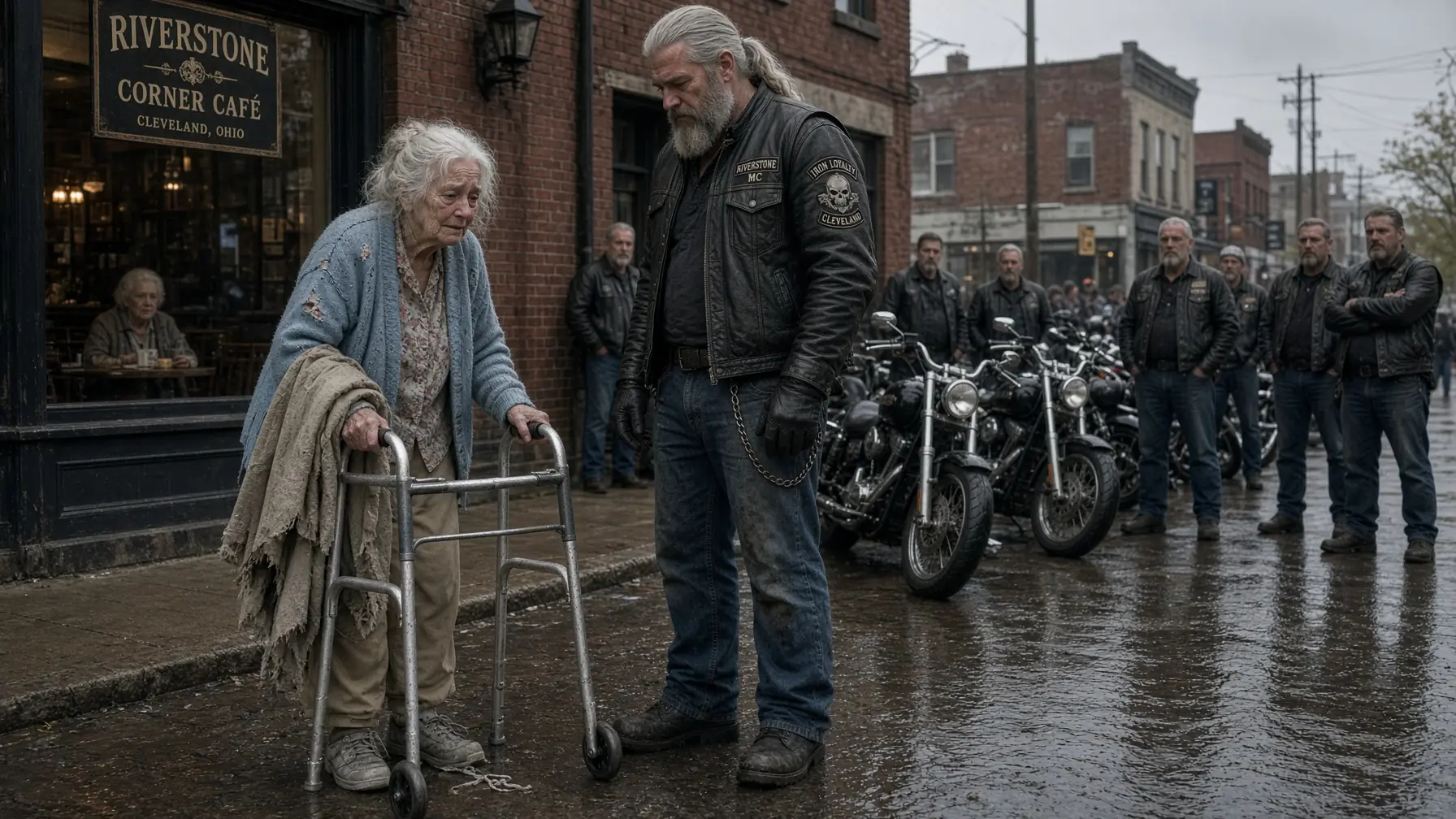
Dean stopped.
At fifty-eight, he was six-foot-three and broad enough that strangers sometimes crossed the street when they saw him approaching. Long silver hair was tied behind his head, a thick gray beard covered most of his face, and years on the road had left lines around eyes that looked harder than they actually were. His black leather vest carried the patches of Iron Haven Riders, but his first reaction to the woman was not suspicion.
It was worry.
“Of course, ma’am.”
He placed his coffee on the café windowsill and lowered himself carefully onto one knee.
Up close, she looked even more fragile. Her name, he would soon learn, was Evelyn Parker, and she had turned eighty only three weeks earlier. Her floral blouse was washed nearly colorless, one sleeve of her cardigan had been stitched with thread that did not match, and the frayed coat hanging over her walker looked too thin for the wet October afternoon.
Dean picked the muddy lace out of the water.
“Double knot?”
Evelyn gave him a small embarrassed smile.
“If it isn’t too much trouble.”
“No trouble.”
His gloved fingers looked enormous beside her narrow shoe.
Behind Dean, Tommy Graves, Ray Collins, and Mason Pike stopped talking. They had known Dean for decades, and none of them said anything as he carefully tied the first shoe and moved to the second.
Evelyn watched him.
“I used to do this myself.”
Dean looked up.
“I figured.”
“My fingers don’t listen anymore.”
She tried laughing, but the sound carried too much sadness.
“Getting old is mostly discovering which parts of you have started making their own decisions.”
Dean smiled.
“My knees joined a union years ago.”
That earned him a real laugh.
It lasted only a second.
Then Evelyn looked across the street.
Dean followed her eyes.
A dark sedan was pulling away from a small pharmacy parking lot.
Nothing unusual.
Except Evelyn’s face changed when she saw it.
Her mouth opened slightly.
She lifted one trembling hand.
“David?”
The car continued.
Evelyn tried stepping forward.
Her walker caught on the edge of the sidewalk.
Dean immediately stood and steadied it.
“Careful.”
She stared at the disappearing sedan.
“David!”
The driver did not stop.
The taillights vanished around the corner.
Evelyn became very still.
Dean looked at her.
“Was that someone you know?”
She did not answer.
Her eyes remained fixed on the empty intersection.
Finally she whispered:
“My son.”
Tommy glanced at Dean.
Dean lowered his voice.
“Your son was driving that car?”
Evelyn nodded.
“He said he was parking.”
Dean looked toward the street.
“When?”
She hesitated.
“I don’t know.”
“How long have you been standing here?”
Evelyn looked toward the café clock visible through the window.
Dean could tell she was trying to calculate.
“He brought me around eleven.”
Dean checked his phone.
2:46 p.m.
Nearly four hours.
His expression changed.
“He left you here at eleven?”
“He said he needed to pick up my prescription.”
Dean looked across the street.
The pharmacy was still open.
“And then?”
“He said I should wait by the café because there were chairs.”
“There aren’t any chairs outside.”
Evelyn looked down.
“No.”
Dean felt something cold settle in his chest that had nothing to do with the weather.
“Did he come back?”
She shook her head.
“Maybe that wasn’t him.”
Dean knew it had been.
She knew too.
Neither wanted to say it.
Tommy walked toward the pharmacy.
“I’m checking something.”
Dean nodded.
Evelyn gripped the walker.
“I shouldn’t have bothered you.”
“You didn’t.”
“I can call someone.”
“You got a phone?”
She searched her cardigan pockets.
Nothing.
Then her coat.
Nothing.
Her face tightened.
“My purse.”
“Where is it?”
“In David’s car.”
Dean closed his eyes for a second.
Wallet.
Phone.
Probably identification.
All gone with the sedan.
He kept his voice gentle.
“What about your house keys?”
Evelyn touched her pocket.
A small key ring was there.
“At least I have those.”
“Good.”
She nodded as though that solved everything.
It did not.
Tommy returned from the pharmacy carrying a small paper bag.
“The prescription was filled at eleven-thirty.”
Evelyn looked surprised.
“David picked it up?”
Tommy shook his head.
“No.”
He held out the bag.
“It was still waiting.”
Dean stared across the street.
Then back at Evelyn.
“Do you know why your son would leave?”
She immediately defended him.
“He’s busy.”
Dean said nothing.
“He works.”
Still nothing.
“He has children.”
Dean nodded.
“I understand.”
Evelyn’s voice became smaller.
“I’ve been difficult lately.”
“How?”
“I forget things.”
Dean looked at her.
“What things?”
“Where I put glasses.”
He waited.
“Sometimes appointments.”
Dean continued waiting.
“Names.”
She looked ashamed.
“My son says I ask the same question more than once.”
Dean’s jaw tightened.
“So?”
“He gets tired.”
“That doesn’t make you difficult.”
“You don’t know me.”
“No.”
Dean looked toward the café door.
“But I know forgetting your glasses isn’t a reason to leave an eighty-year-old woman outside for four hours.”
Evelyn looked down.
Her eyes filled.
For several seconds, nobody spoke.
Rain tapped softly against the awning.
People entered and left the café.
Traffic moved along the street as if nothing important had happened.
Dean picked up his coffee.
It was cold.
He threw it away.
“Have you eaten?”
Evelyn shook her head.
“I had toast.”
“When?”
“This morning.”
Dean looked toward Tommy.
Tommy already knew.
He opened the café door.
“Table for five.”
Evelyn immediately protested.
“No, no, I can’t.”
Dean turned.
“Why?”
“I don’t have money.”
“Good.”
She blinked.
“What?”
“Tommy hates splitting checks.”
Tommy called from the doorway.
“I absolutely do.”
Evelyn almost smiled.
Dean held out his arm.
“Come inside.”
She looked at four bikers.
Then at the warm café.
“I don’t want to be charity.”
Dean’s face softened.
“Then don’t be.”
“What?”
“Have coffee with us.”
She hesitated.
“You’d be doing us a favor.”
“How?”
Dean nodded toward Tommy.
“He tells the same six stories.”
Tommy looked offended.
“Seven.”
Evelyn laughed.
And for the first time that afternoon, she allowed someone to help her through the door.
Riverstone Corner Café was old enough that nobody remembered exactly when the first cup of coffee had been served there. Red vinyl booths ran beneath windows overlooking the wet street, old photographs of Cleveland hung on brick walls, and the counter still had spinning stools with chrome bases polished by generations of shoes. The owner, Maria Delgado, knew the Iron Haven riders because they stopped there almost every Saturday.
She also noticed Evelyn immediately.
Maria approached with menus.
“You need something warm, sweetheart?”
Evelyn looked embarrassed.
“Just coffee.”
Dean opened a menu.
“You like soup?”
“I do.”
“Soup?”
She hesitated.
“Maybe.”
Maria smiled.
“Chicken noodle’s fresh.”
Evelyn nodded.
Then Dean said:
“And pie.”
Evelyn looked at him.
“I did not say pie.”
“I heard pie.”
“My hearing is still excellent.”
“That makes one of us.”
She laughed again.
Maria walked away smiling.
The other bikers joined them.
Nobody asked Evelyn invasive questions while she ate.
That was deliberate.
Ray talked about the weather.
Mason complained about road construction.
Tommy described a motorcycle repair that became more exaggerated every time Dean corrected him.
Slowly, Evelyn relaxed.
She ate half the soup.
Then the other half.
When Maria brought apple pie, Evelyn stared at it.
“I really shouldn’t.”
Dean lifted his fork.
“Then I’ll take it.”
Evelyn immediately pulled the plate closer.
“No.”
The bikers laughed.
Something changed in her expression.
For a moment, she seemed less like an abandoned woman and more like the person she might have been before life taught her to apologize for needing anything.
Dean waited until she finished before returning to the difficult question.
“Where do you live?”
“Westbrook Avenue.”
“What number?”
“Four twenty-seven.”
Dean typed it into his phone.
Eleven minutes away.
“Apartment?”
“House.”
“You live alone?”
Evelyn’s fingers stopped around the coffee cup.
“Not exactly.”
Dean looked at her.
“David stays there.”
“Your son?”
“Yes.”
“How long?”
“Since spring.”
That interested him.
“He moved in with you?”
“He had trouble.”
“What kind?”
Evelyn looked uncomfortable.
“Money.”
Dean did not judge.
“Okay.”
“He lost his apartment.”
“And his kids?”
“They stay with their mother most of the time.”
“So David moved into your house.”
“Yes.”
Something about the sentence bothered Dean.
Not because adult children sometimes needed help.
Life went wrong.
People lost jobs.
Marriages ended.
Family was supposed to catch one another.
But Evelyn had been left outside while the son she was housing drove away with her purse.
That was different.
“Does David help you?”
She nodded quickly.
“Yes.”
“With what?”
“Driving.”
Dean waited.
“Bills.”
Another pause.
“He helps with bills?”
Evelyn’s eyes shifted.
“Well…”
Dean recognized the answer.
“He handles them?”
She nodded.
“Since my eyesight got worse.”
Ray exchanged a glance with Dean.
Dean continued carefully.
“Your bank account too?”
Evelyn became defensive.
“He’s my son.”
“I know.”
“He would never hurt me.”
Dean kept his voice gentle.
“I’m not saying he would.”
Evelyn stared into her coffee.
“People think old women are stupid.”
Dean said nothing.
“They talk loudly even when I tell them I can hear.”
She looked toward him.
“They ask my son questions about me while I’m sitting right there.”
Dean nodded slowly.
“That happen a lot?”
“Yes.”
“Then I’ll ask you.”
Evelyn looked surprised.
Dean continued.
“What do you want to do now?”
She stared at him.
Nobody had asked that all day.
“I want to go home.”
“Okay.”
“And I want my medicine.”
Tommy pushed the pharmacy bag toward her.
“You have it.”
She touched the bag.
“And my purse.”
Dean nodded.
“We’ll figure that out.”
“I don’t want police.”
Nobody had mentioned police.
That told Dean something.
“Why not?”
“David will get angry.”
“With you?”
She looked away.
Dean felt the same cold sensation return.
“Does your son scare you?”
“No.”
Too fast.
Dean knew it.
Ray knew it.
Evelyn knew they knew.
She looked embarrassed.
“He gets loud.”
Dean leaned back.
“Okay.”
“Sometimes he says things.”
“What things?”
“That nobody else would put up with me.”
Dean’s eyes changed.
Evelyn continued before he could respond.
“He doesn’t mean it.”
“Does he apologize?”
“Sometimes.”
“When?”
“When he needs something.”
The sentence came out before Evelyn realized what she had said.
She covered her mouth.
Dean looked toward the window.
The rain had stopped.
His anger was beginning to build, but he knew anger could make Evelyn retreat.
So he did the hardest thing.
He stayed calm.
“Let’s take you home.”
Four motorcycles and Maria’s old SUV traveled toward Westbrook Avenue.
Evelyn rode with Maria.
Dean insisted.
He did not want an eighty-year-old woman climbing onto a motorcycle just because hundreds of online stories might make that look poetic.
Real kindness did not need theatrics.
When they reached number 427, Dean understood immediately why Evelyn had fought so hard to stay there.
The house was tiny.
White siding.
Green shutters.
A narrow porch.
Rose bushes sleeping beneath autumn leaves.
Nothing expensive.
But maintained lovingly.
Evelyn pointed.
“My husband built that porch.”
She smiled faintly.
“Frank.”
“Your husband?”
“Forty-nine years.”
“When did he pass?”
“Seven years ago.”
Maria parked.
Evelyn stared through the windshield.
Her smile faded.
A moving box sat near the front door.
Then another.
Dean parked and approached.
“Those yours?”
Evelyn looked confused.
“I don’t know.”
The front door was unlocked.
That made Dean uncomfortable.
He entered only after Evelyn asked him to.
Inside, several drawers stood open.
Papers covered the dining table.
A bedroom door was open at the end of the hallway.
Evelyn moved slowly behind her walker.
“David?”
No answer.
She entered the living room.
The photograph of Frank that usually sat on the mantel was gone.
Evelyn froze.
“Where is it?”
Maria stepped closer.
“What?”
“My husband.”
Dean looked at the empty rectangle in the dust.
Someone had removed the framed picture.
Evelyn started breathing faster.
“David?”
She turned toward the hallway.
Dean followed.
The spare bedroom was mostly empty.
Closet cleared.
Dresser drawers open.
David had moved out.
On the kitchen counter sat an envelope.
MOM
Evelyn saw it.
Her hands began trembling.
Dean picked it up only after she nodded.
Inside was a single sheet.
The message was short.
Mom,
I can’t do this anymore. I’ve arranged for someone from Golden Pines to contact you. It’s better if professionals handle things from here. The house is too much for you. I took care of what I could. I’ll call when things settle down.
David
Evelyn stared at the page.
“What is Golden Pines?”
Maria already knew.
“Assisted living.”
Evelyn shook her head.
“No.”
Dean looked around.
“You didn’t agree to move?”
“No.”
“Did you sign anything?”
“No.”
“I’m staying here.”
Dean nodded.
“Okay.”
“My husband built the porch.”
“I heard you.”
“He planted the maple.”
Dean looked through the window at the large tree shading the front yard.
“Beautiful tree.”
“My children grew up here.”
Her voice cracked.
“I am not leaving because David is tired.”
Dean held out the note.
“You don’t have to decide anything tonight.”
Evelyn took it.
Then remembered something.
“My purse.”
Dean looked around.
“Not here?”
She shook her head.
“My cards are inside.”
“Bank card?”
“Yes.”
“Credit card?”
“One.”
“Identification?”
“Yes.”
Dean’s concern deepened.
“Do you have bank statements?”
Evelyn pointed toward a small desk.
Dean did not open anything himself.
Maria sat beside Evelyn while she searched.
Eventually she found a folder.
Statements.
Evelyn handed them to Dean.
“Can you read these?”
Dean hesitated.
“You sure?”
“Yes.”
He sat at the table.
The most recent statement showed several large withdrawals.
Dean frowned.
“Evelyn.”
“What?”
“Did you withdraw twelve thousand dollars last month?”
She stared.
“No.”
Ray came closer.
Dean showed him.
Another withdrawal.
Eight thousand.
Then two electronic transfers.
Evelyn looked confused.
“That can’t be right.”
Dean felt his anger return.
This time it was harder to hide.
“Did David have access?”
“He paid bills.”
Maria reached for Evelyn’s hand.
“Sweetheart, we need somebody who understands this.”
Evelyn immediately panicked.
“No police.”
Dean shook his head.
“Not police first.”
“Then who?”
“A lawyer.”
“I don’t have lawyer money.”
Ray sat across from her.
“We know somebody.”
Evelyn frowned.
“You bikers know lawyers?”
Tommy answered:
“We keep them employed.”
Even Evelyn laughed.
The fear loosened slightly.
Dean called Rebecca Sloan, an attorney who had helped Iron Haven with charity organizations and elder-care paperwork.
Rebecca answered after two rings.
Dean explained only the basics.
Elderly woman.
Potential unauthorized withdrawals.
Son gone.
Possible assisted-living placement she had not consented to.
Rebecca’s voice became serious.
“Don’t move any documents.”
“We won’t.”
“Does she feel safe staying there tonight?”
Dean looked at Evelyn.
She nodded.
“Yes.”
“Then I’ll be there at eight tomorrow.”
Dean glanced at the clock.
“You’re coming personally?”
Rebecca responded:
“Dean, she’s eighty and someone may have moved her money. Yes.”
Evelyn heard.
Her eyes filled again.
“Why are all these people helping me?”
Dean looked at her.
“Because you asked me to tie your shoes.”
She laughed through tears.
“That makes no sense.”
“No.”
He smiled.
“Life rarely does.”
Nobody left Evelyn alone that night.
Maria stayed until midnight.
Ray and Tommy repaired the loose back-door latch.
Mason brought groceries.
Dean found Frank’s photograph inside a cardboard box in the garage and returned it to the mantel.
Evelyn touched the frame with both hands.
“Thank you.”
Dean shrugged.
“He looked uncomfortable in the garage.”
She smiled.
Later, after everyone else left, Dean stayed on the porch.
Evelyn came outside wearing the thin frayed coat.
“You’re still here.”
“Apparently.”
“You have a home?”
“Somewhere.”
“A wife?”
Dean shook his head.
“Divorced long time ago.”
“Children?”
“One daughter.”
“Do you see her?”
Dean looked toward the maple tree.
“Not enough.”
Evelyn nodded.
“Fix that.”
Dean looked at her.
“You barely know me.”
“I’m eighty. We skip unnecessary chapters.”
He laughed.
Then became serious.
“Does David know what today is?”
“What?”
“Nothing.”
Dean shook his head.
“Never mind.”
Evelyn lowered herself into the porch chair.
“He wasn’t always like this.”
Dean listened.
“When his father died, David changed.”
“How?”
“Angry.”
“At you?”
“At everything.”
“He lost his business later.”
“What kind?”
“Roofing.”
Evelyn looked toward the street.
“He came here ashamed.”
“I told him he could stay as long as he needed.”
Dean nodded.
“That’s what mothers do.”
“I kept giving him money.”
“How much?”
“I don’t know.”
That frightened her.
Dean did not say it.
Evelyn continued.
“Maybe I made things worse.”
“No.”
“I never made him stand on his own.”
“That still doesn’t make today your fault.”
“He’s my son.”
“Being his mother doesn’t make you responsible for every choice he makes at forty-eight.”
Evelyn looked toward him.
“How old is your daughter?”
“Thirty-one.”
“Does she make mistakes?”
“Professional-level mistakes.”
“Are they all yours?”
Dean smiled.
“No.”
“Then stop being smarter with me than you are with yourself.”
He laughed.
“Fair.”
Evelyn’s voice softened.
“I don’t want my son destroyed.”
Dean understood.
“You want him stopped.”
She nodded.
“Yes.”
“And maybe helped.”
Another nod.
Dean looked at her.
“That’s harder.”
“Most important things are.”
Rebecca arrived at 7:55 the next morning.
She wore jeans instead of a business suit and carried two folders plus coffee for everyone.
By nine, she understood enough to act.
David had been using a power of attorney Evelyn signed three years earlier after a minor surgery.
The document was legitimate.
His recent conduct might not be.
Rebecca explained carefully.
“A power of attorney lets someone assist you. It does not make your money theirs.”
Evelyn nodded.
“And he cannot simply put you into assisted living because he wants the house?”
“That depends on many legal and medical details, but based on what I’m seeing, he does not have the authority he seems to think he has.”
Evelyn exhaled.
Rebecca continued.
“We can revoke the power of attorney immediately.”
“Do it.”
“We can notify the bank.”
“Yes.”
“Freeze questionable transactions pending review.”
“Yes.”
“And I want an independent physician to evaluate you.”
Evelyn stiffened.
“Why?”
“So nobody can later claim you don’t understand your own decisions.”
That made sense.
Evelyn agreed.
Rebecca looked toward Dean.
“Now the unpleasant part.”
“What?”
“Finding David.”
They did not have to.
At 10:32, a dark sedan pulled into the driveway.
Evelyn saw it through the window.
Her hands began shaking.
Dean stood.
Rebecca stopped him.
“Sit.”
Dean stared at her.
She pointed.
“You are six-foot-three wearing a leather vest. You sitting down is already intimidating.”
Tommy laughed.
Dean sat.
David entered using his key.
He stopped when he saw the room.
Rebecca.
Dean.
Ray.
Tommy.
His mother.
“What is this?”
Evelyn stood with her walker.
“Where is my purse?”
David’s face changed.
“Mom.”
“My purse.”
“I have it.”
“Give it back.”
He looked toward Rebecca.
“Who are you?”
“Rebecca Sloan. I represent your mother.”
David laughed nervously.
“This is ridiculous.”
Evelyn repeated:
“My purse.”
David dropped it onto the table.
Dean’s hands tightened beneath the table.
Rebecca noticed.
Evelyn opened the purse.
Wallet.
Phone.
Cards.
Everything appeared there.
She looked toward David.
“Why did you leave me?”
He immediately defended himself.
“I didn’t leave you.”
Four bikers stared.
David looked uncomfortable.
“I had to handle something.”
“For four hours?”
“I came back.”
Dean finally spoke.
“We saw you drive away.”
Rebecca looked at him.
Dean stopped.
Evelyn stared at her son.
“You drove past me.”
David’s face hardened.
“You don’t understand.”
“Then explain.”
“I had a meeting at Golden Pines.”
“I’m not going.”
“Mom—”
“No.”
“You can’t live alone.”
“I wasn’t alone until you decided to leave.”
David looked toward the bikers.
“They’re filling your head with nonsense.”
That sentence changed Evelyn.
Her back seemed straighter.
“These men tied my shoes.”
David blinked.
“What?”
“They fed me.”
“Mom—”
“They brought me home.”
She pointed toward Rebecca.
“She explained my bank statements.”
David’s expression froze.
Rebecca opened a folder.
“We need to discuss several withdrawals.”
David immediately became defensive.
“That money was for her care.”
Evelyn stared.
“What care?”
“Repairs. Bills.”
“Show me.”
David looked away.
Rebecca continued.
“Some payments went to an account connected to your former roofing company.”
Silence.
Evelyn’s face crumpled.
“David.”
He sat.
For the first time, his arrogance disappeared.
What remained looked tired.
“I was trying to rebuild.”
“With my retirement?”
“I was going to replace it.”
“How much?”
He could not answer.
Evelyn whispered:
“How much?”
“Twenty-seven thousand.”
She closed her eyes.
Dean looked away.
Tommy stared at the floor.
Nobody wanted to witness a mother hearing that number.
David continued quickly.
“I had contracts coming.”
“Did you?”
“No.”
Evelyn looked toward him.
“Then why Golden Pines?”
David’s face broke.
“Because I couldn’t keep doing everything.”
“Doing what?”
“Driving you. Shopping. Appointments. Listening to you ask the same questions.”
Evelyn flinched.
David realized too late.
He lowered his voice.
“I’m sorry.”
“No.”
Evelyn’s eyes filled.
“Finish.”
He stared.
“You started telling the truth. Finish.”
David covered his face.
“I thought if you moved somewhere, I could sell this house.”
Silence.
“Pay back the money.”
Evelyn looked toward Frank’s photograph.
Then at the maple outside.
Her voice became almost inaudible.
“You were going to sell your father’s house.”
David cried.
“I didn’t know what else to do.”
Evelyn answered:
“You could have asked me.”
“I was ashamed.”
“So you made me ashamed instead.”
That sentence destroyed whatever defense remained.
David lowered his head.
Nobody spoke for nearly a minute.
Then Evelyn made the choice everyone would remember.
She did not scream.
She did not tell Dean to throw David into the street.
She did not ask Rebecca to destroy him.
She simply said:
“You cannot live here anymore.”
David looked up.
“Mom.”
“You cannot handle my money.”
He swallowed.
“I know.”
“You will repay what you took.”
“Yes.”
“And you will get help.”
His expression changed.
“What?”
“You are angry. You are drowning. And you nearly dragged me under because you were too proud to admit it.”
David stared at his mother.
Evelyn continued.
“I love you.”
He began crying again.
“But love is not permission.”
Dean looked toward the floor.
Those words landed in him too.
David eventually nodded.
“I’ll leave.”
Rebecca explained the next steps.
No drama.
No threats.
Bank review.
Revoked authority.
Formal repayment agreement if appropriate.
Independent assessment.
Documentation.
David agreed to cooperate before the situation became something larger.
It did not erase what he had done.
But it gave Evelyn what she wanted most.
Control over her own life.
The story could have ended there.
Instead, Iron Haven kept returning.
At first, Evelyn suspected they were checking on her.
They were.
She hated it.
Then she started expecting them.
Tuesday became Tommy’s day.
Thursday belonged to Ray.
Dean appeared whenever he claimed he was “passing through,” despite living twenty-seven minutes in the opposite direction.
Maria came Sundays.
Rebecca stopped billing Evelyn after the first consultation through a local elder-law assistance program and connected her with legitimate services she qualified for.
A home-health aide visited twice a week.
Meals became easier.
Transportation was arranged.
The front steps received a safer railing.
Nobody tried to take over her life.
That mattered.
They asked.
Always.
“Can we fix this?”
“Do you want a ride?”
“Would groceries help?”
Sometimes Evelyn said no.
They listened.
That was the greatest difference between help and control.
David entered counseling.
He found work with a roofing contractor that did not belong to him.
That humbled him more than any punishment could.
His wages were partly directed toward repaying his mother through an agreement Rebecca helped structure.
For three months, Evelyn refused to see him.
Dean never pushed.
Then one Saturday, she asked:
“Do you think I’m cruel?”
“No.”
“I miss him.”
“That isn’t weakness either.”
“What would you do?”
Dean smiled.
“Bad person to ask.”
“Why?”
“I held a grudge against my brother for sixteen years over a boat.”
Evelyn stared.
“A boat?”
“Long story.”
“Was it a nice boat?”
“No.”
She laughed.
Dean continued.
“You can forgive somebody without handing them the keys again.”
Evelyn became quiet.
A week later, she invited David for coffee.
Rebecca advised that money stay completely separate.
Evelyn agreed.
David arrived without excuses.
That mattered.
He apologized.
Not once.
Repeatedly.
For leaving her.
For taking money.
For using her memory lapses as justification.
For treating care like a burden instead of admitting he could not manage it.
Evelyn listened.
Then asked:
“Are you sorry because you were caught?”
David thought before answering.
“At first, yes.”
She appreciated the honesty.
“What about now?”
“Now I’m sorry because I finally understand what I made you feel like.”
“What?”
“Disposable.”
Evelyn cried.
So did David.
Reconciliation did not happen in one afternoon.
It happened over months.
Short visits.
Clear boundaries.
No access to accounts.
No keys.
No control over medical decisions.
Trust grew slowly because that was the only kind worth having.
One year after the day outside Riverstone Corner Café, Evelyn turned eighty-one.
Dean asked what she wanted.
“Nothing.”
“That answer is rejected.”
“I already have too much.”
“Also rejected.”
She thought.
Then smiled.
“I want lunch.”
“Where?”
“The café.”
So Iron Haven organized lunch.
They expected twenty riders.
Nearly one hundred appeared.
Evelyn arrived wearing a new blue cardigan Maria had given her.
She immediately complained.
“My old one was fine.”
Dean pointed toward the repaired tear.
“You still have it.”
“Of course.”
“You’re impossible.”
“That’s why you keep visiting.”
Outside the café, Dean helped her from Maria’s SUV.
Evelyn looked down.
One shoelace had come loose.
She smiled.
“Dean.”
He looked.
“Oh, come on.”
“Would you mind?”
Nearly one hundred bikers started laughing.
Dean dropped to one knee.
“Double knot?”
“Always.”
He tied it.
Evelyn looked down at the huge silver-haired man crouched before her.
“Do you remember what you said the first time?”
“No.”
“You said nobody should ask twice for something that small.”
Dean tightened the lace.
“Sounds intelligent.”
“It was.”
“Definitely somebody else.”
She put one hand gently on his shoulder.
“Something small saved me.”
Dean looked up.
“No.”
She smiled.
“It did.”
“You saved yourself.”
“I asked.”
“That’s different.”
Evelyn shook her head.
“No, Dean.”
She looked toward the riders.
“Sometimes asking is the bravest part.”
Nobody joked after that.
Evelyn lived in her house for another six years.
The maple continued growing.
Frank’s photograph stayed on the mantel.
David eventually repaid everything he had taken.
More importantly, he became her son again instead of her manager.
He visited every Sunday but never handled her accounts.
When Evelyn forgot a question and asked twice, he answered twice.
Sometimes three times.
Once, when she apologized, David said:
“Mom, you answered my questions for forty-eight years. I can repeat myself.”
Dean heard about that and decided David might finally be learning.
Iron Haven adopted Evelyn completely.
She became the unofficial grandmother of the club.
She hated their tattoos.
Loved their motorcycles.
Complained that their coffee was terrible.
Attended charity events.
Carried peppermints in her purse for everyone despite insisting grown men did not need candy.
When riders argued, Evelyn sometimes solved the dispute with a sentence nobody dared challenge.
“Stop acting twelve.”
It worked surprisingly often.
At eighty-seven, Evelyn’s health declined.
Not suddenly.
Quietly.
More fatigue.
Shorter walks.
Longer naps.
Eventually, she moved not because David ordered it, but because she chose a small assisted-living community five miles away.
Dean helped her pack.
When he picked up Frank’s photograph, Evelyn stopped him.
“That goes in my bag.”
“Yes, ma’am.”
“The blue cardigan too.”
“The torn one?”
“Yes.”
“You have six better cardigans.”
“That isn’t the point.”
Dean smiled.
“Of course it isn’t.”
She moved with dignity because the decision belonged to her.
That was everything.
Evelyn died peacefully eight months later.
David held one hand.
Dean held the other.
Her last lucid conversation with Dean happened two days before.
“You tied my shoes.”
Dean laughed softly.
“Apparently that’s going on my tombstone.”
“You looked across the street.”
His smile disappeared.
“Yes.”
“What did you think?”
Dean considered lying.
Then remembered she had always preferred truth.
“I wanted to chase the car.”
Evelyn laughed weakly.
“I knew it.”
“But you didn’t need that.”
“No.”
“You needed somebody to stay.”
She squeezed his hand.
“That is usually what people need.”
Dean looked down.
Evelyn continued.
“Promise me something.”
“Anything.”
“When somebody asks for something small, look for the bigger question.”
Dean swallowed.
“I will.”
“Sometimes ‘tie my shoes’ means ‘please notice me.’”
He nodded.
“And sometimes ‘I’m fine’ means the opposite.”
“Yes.”
She closed her eyes.
“You’re learning.”
“Slowly.”
“Men usually do.”
Dean laughed through tears.
At Evelyn’s funeral, motorcycles lined three blocks.
David stood beside Dean outside the church.
He looked toward hundreds of riders.
“She really became part of all this.”
Dean nodded.
“She bossed most of us.”
David smiled.
Then became serious.
“I used to hate you.”
“I know.”
“I thought you took my place.”
Dean looked toward him.
“No.”
David nodded.
“I understand that now.”
Dean said nothing.
“You gave her something I wasn’t giving her.”
“What?”
“Choice.”
Dean looked toward the church doors.
“Then keep giving her that in the way you remember her.”
David nodded.
Iron Haven created a small program the following spring.
They called it Evelyn’s Laces.
The name sounded ridiculous until Dean explained it.
Members partnered with local senior organizations to help elderly residents with small practical needs that often went unnoticed.
Changing lightbulbs.
Tying shoes.
Moving groceries.
Fixing walkers.
Replacing batteries.
Driving someone to a pharmacy.
Sitting through a doctor’s appointment.
Listening.
Especially listening.
The rule was simple.
Never assume the small request is the whole request.
Ask one more question.
“Anything else?”
Sometimes the answer was no.
Sometimes it changed a life.
Years later, Dean still visited Riverstone Corner Café.
His beard became completely white.
His knees complained more.
He rode less.
One rainy afternoon, he sat near the window drinking coffee when a young waiter approached an elderly man struggling with his coat zipper.
The waiter quickly helped.
Then asked:
“Anything else?”
Dean smiled.
Maria, now older herself, noticed.
“You thinking about Evelyn?”
“Always.”
“She would hate that.”
“Why?”
“She’d say you should think about something useful.”
Dean laughed.
Outside, rain covered the sidewalk where he had once knelt before a frightened eighty-year-old woman.
People later told the story as though the important moment was when he looked across the street and realized her son had abandoned her.
It was not.
The important moment happened seconds earlier.
A woman who had been taught to feel like a burden saw a massive stranger in a leather vest and somehow found enough courage to ask:
“Can you tie my shoes?”
Dean said yes.
Then he looked again.
At her torn cardigan.
Her shaking hands.
The empty sidewalk.
The car disappearing.
The purse that was gone.
The fear she kept defending.
One small request opened the door to everything else.
And for the rest of Dean Mercer’s life, whenever someone asked for something small, he remembered Evelyn Parker.
He remembered that people rarely announce heartbreak properly.
Sometimes they whisper it.
Sometimes they hide it behind embarrassment.
Sometimes they simply stand outside a café in old clothes, leaning on a walker with one shoelace dragging through the rain.
And sometimes the kindest thing another human being can do is kneel down, tie the shoe, and stay long enough to notice what the person is really asking for.