A sixteen-year-old boy had spent nearly two years pushing a dented food cart through the crumbling streets of Northwood, selling cheap hot meals before school, after school, and every weekend just to help keep the lights on at home.
His name was Malik Coleman.
Most people in Northwood only knew him as the quiet kid with the food cart. 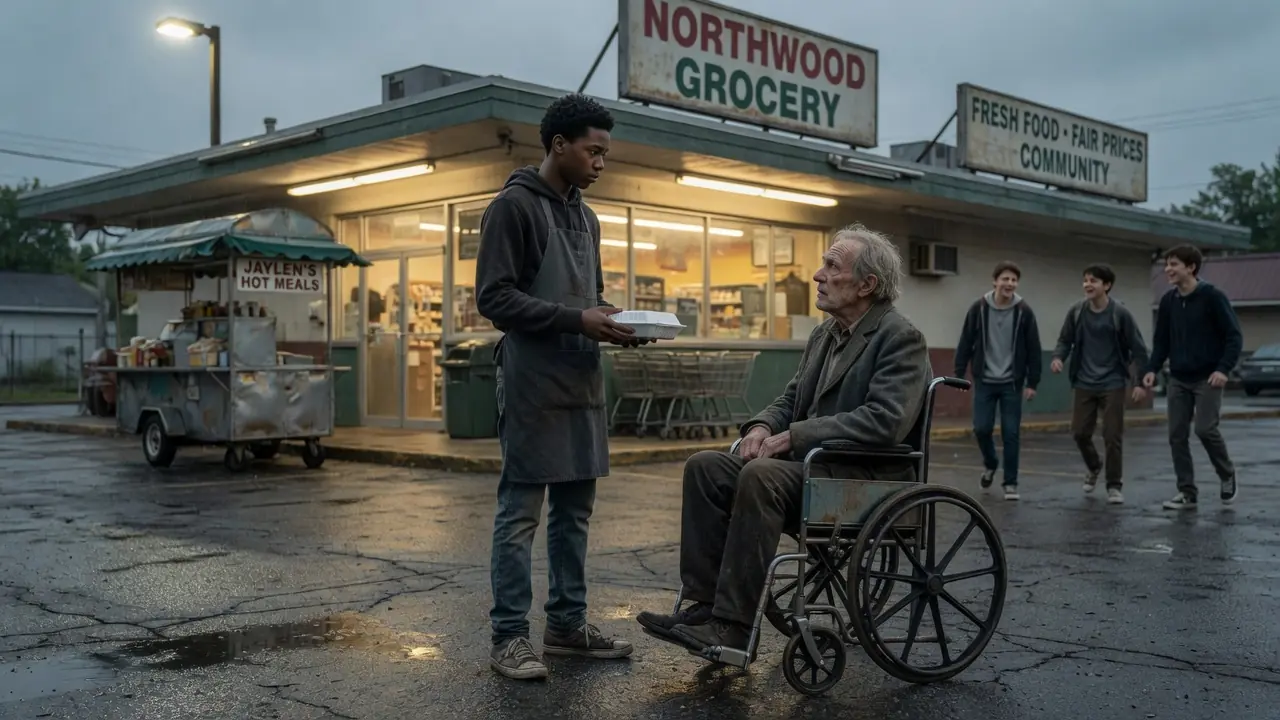
The boy who always wore the same faded hoodie, the boy who counted change twice, the boy who looked too young to be working that hard but too serious for anyone to tell him to stop.
But Malik never let hardship harden his heart.
So when he saw an old man in a battered wheelchair being mocked by a group of teenagers in the parking lot of a grocery store, he did not hesitate. He stepped in, shielded the old man, and gave him the last plate of food he had for the day.
What Malik did not know was that the disabled old man was actually a billionaire who had vanished from the world years earlier.
And Malik’s quiet act of kindness was about to pull him into a life he never imagined and change both of their futures forever.
Northwood District was the kind of place nobody put on postcards.
Cracked sidewalks. Sagging porches. Faded billboards that should have been taken down years ago. Storefronts with metal grates pulled over the windows even during the day. Bus stops with broken benches. Streetlights that flickered like they were tired of trying.
Everything about Northwood looked worn out.
Even the air felt tired, carrying the smell of fried oil, old buses, wet concrete, and the steady struggle of people trying to survive another day.
Right in the middle of all that noise, Malik Coleman pushed his food cart toward the Northwood Market corner like he did almost every morning.
He was sixteen, slim, with deep brown skin, serious eyes, and shoulders that had learned responsibility too early. His hair was cut short because he did not have time or money for anything fancy. He wore an old hoodie under a faded denim jacket, dark jeans, and sneakers with soles that were starting to pull away at the edges.
To strangers, he looked like a kid who should have been worrying about homework, basketball, girls, or getting his driver’s license.
But folks in the neighborhood knew better.
Malik was not lazy. He was not trouble. He was not one of those boys people whispered about when they saw them standing too long on a corner.
He was the boy who woke up before sunrise to cook with his grandmother.
He was the boy who went to school with the smell of beans and spices clinging to his hoodie.
He was the boy who worked every afternoon because rent did not wait for childhood to be over.
His grandmother, Della Coleman, had raised him since he was nine.
His mother had left town after too many broken promises and too many men who took more from her than they gave. His father had never been anything but a name on an old birth certificate. Della was the one who took him in, taught him how to season rice, how to stretch a chicken, how to count money, and how to stand up straight when the world wanted him to bend.
Della used to run a small soul food counter before arthritis and diabetes forced her to slow down. When the bills started swallowing their tiny apartment piece by piece, Malik took the recipes, fixed an old food cart a church had donated, and started selling meals on the street.
Della hated it at first.
“You are a child,” she told him.
Malik looked at the shutoff notice taped to the refrigerator and said, “I’m also family.”
She did not argue after that.
Every morning before school, Malik boiled rice on a shaky stove, stirred beans in a dented pot, and fried chicken in careful batches so the oil would last. Della sat at the small kitchen table with her medicine bottles lined up beside her, correcting his seasoning like a general inspecting troops.
“Not that much pepper,” she would say.
“It sells better spicy.”
“It sells better when people can still taste tomorrow.”
Malik always smiled at that.
But beneath the jokes, the math was serious.
Rice. Beans. Chicken. Oil. Propane canister. Napkins. Plastic containers. Bus fare when the weather was too bad to walk. Della’s medicine. Rent. Electricity. School supplies. Everything had a number, and most days the numbers were bigger than what they had.
Still, Malik always prepared one extra meal.
Not for sale.
Not for himself.
Not even for Della, though she pretended not to notice when he skipped dinner and said he had eaten earlier.
Hidden beneath the cart, wrapped in a towel to keep it warm, Malik always kept one container set aside.
Rice, beans, and whatever piece of chicken he could spare.
People assumed it was for a late customer. Some thought it was for himself. Some joked he was saving food for a girlfriend.
Nobody knew the truth.
Malik kept it for whoever looked hungrier than he felt.
That morning, as he pushed the cart toward Northwood Market, a bus sped past and splashed muddy water across his shoes.
He stopped.
Closed his eyes.
Let out one sharp breath.
Then kept pushing.
He did not have time to be angry. Northwood did not slow down for anybody, especially not for a sixteen-year-old boy trying to act grown because life had left him no choice.
When he reached his usual corner, he set up under a rusted awning beside an abandoned pawn shop.
Same place every day.
Same crack in the sidewalk.
Same loose wheel on the cart he kept meaning to repair.
Same old man across the street selling phone chargers that probably stopped working the second you opened the package.
But that day, something felt off.
The market was louder than usual. People moved with a nervous edge, glancing over their shoulders as if waiting for trouble. A siren wailed somewhere in the distance, echoing off brick walls before fading toward the river.
Malik lit his portable stove and looked around.
A woman hurried past holding her child’s hand too tightly.
Two men argued near the bus shelter, then suddenly stopped when a police cruiser rolled by.
A vendor who usually shouted jokes all morning was quiet.
The city felt tense, alive in a way Malik did not like.
But he pushed the feeling aside.
He had no luxury for intuition. Survival did not leave room for standing around wondering why the air felt strange.
He wiped his counter, forced a smile when his first customer approached, and got to work.
By lunchtime, the line had stretched halfway down the block.
“Two rice bowls, extra sauce.”
“Chicken if you got it.”
“Malik, you still doing that student discount?”
“I am a student too,” Malik said.
The man laughed and dropped three dollars into the tray anyway.
People liked Malik’s food because it was cheap, warm, and made with care. But they also liked the way he remembered names.
Miss Carla liked extra beans.
Mr. Ruiz could not have too much salt.
The twins from Roosevelt High always split one plate and pretended they were not still hungry after.
Malik noticed everything.
That was part of surviving Northwood.
You noticed who looked angry before they raised a hand. You noticed who was pretending not to be cold. You noticed which police cars slowed down for no reason. You noticed which kids laughed too loudly because they were trying not to cry.
And sometimes, noticing was the only kindness a person had to give.
That evening, by the time Malik closed up, the sky over Rivershore had turned the color of wet steel.
A cold drizzle drifted across Northwood District. Not heavy enough to clear the streets, but cold enough to slip under his jacket and settle into his bones.
Malik pulled his cart toward the old supermarket lot across from the bus station. He usually avoided that lot at night, but business had been better than expected, and he wanted to drop off leftover cardboard boxes at the recycling bin behind the store before heading home.
His fingers were numb.
His shoes were soaked.
All he could think about was how cold the apartment would be when he got back and how Della would pretend she had not turned the heat on because she was “comfortable under a blanket.”
He was tired.
Really tired.
But tired was not the twist that night.
The twist was what he saw when he turned into the parking lot.
Under the flickering streetlamp at the far end, three teenage boys were circling someone.
They were not robbing him.
No, it was worse in a different way.
They were bored.
Careless.
Cruel.
They were kicking the front wheel of a twisted, rusty wheelchair every time the old man in it tried to pull away. Each kick made a metallic squeal echo across the empty lot. The old man, a white man with wild silver hair and a rain-soaked coat hanging loosely from his shoulders, sat hunched in the chair with both arms lifted toward his chest.
He did not yell.
He did not fight back.
He just absorbed it like he had been through this before.
People walked past.
A couple rushed into the supermarket and pretended not to see.
A car slowed down, then kept going.
No one wanted to get involved.
Of course they did not.
Northwood had trained people to look away.
Malik froze beside his cart.
For half a second, fear moved through him. Not because the boys looked unbeatable, but because he knew how quickly situations could turn. He was sixteen. . Poor. Standing in a parking lot at night. If police came and everyone started shouting, who would they believe first?
Then the tallest boy kicked the wheelchair again.
The old man’s hand slipped from the wheel, and his body jerked sideways.
Something in Malik’s chest tightened.
Della’s voice came back to him.
“If you can stand there and watch somebody be hurt, then you already picked a side.”
Malik pushed his cart near the wall, stepped forward, and before he could second-guess himself, planted his body between the boys and the old man.
The rain hit his face, cold and sharp.
He did not blink.
“Leave him alone,” Malik said.
Not loud.
Not dramatic.
Just firm.
The three boys stared at him, surprised someone had actually stepped in.
Then the tallest one laughed.
He was maybe seventeen, wearing a red hoodie and a crooked grin that did not reach his eyes.
“Look at this,” he said. “Northwood got itself a little superhero.”
Another boy snorted.
“Food cart Batman.”
The third boy stepped closer.
“You trying to get hurt over some old man?”
Malik’s heart pounded, but he kept his voice steady.
“I said leave him alone.”
The tallest boy looked him up and down.
“You sell rice on the corner and think you’re tough?”
“No,” Malik said. “I sell food. That has nothing to do with this.”
The boy’s grin faded a little.
Behind Malik, the wheelchair squeaked as the old man shifted.
“Boy,” the old man whispered. “You don’t need to do this.”
Malik did not look back.
“Yes, sir,” he said quietly. “I do.”
The words changed the air.
Not because they were loud.
Because they were true.
The boys hesitated.
Five seconds.
Ten.
Long enough for the smallest one to mutter, “Man, forget this. This is boring.”
The tallest boy shoved his hands into his hoodie pocket, trying to make walking away look like a choice instead of retreat.
“Whatever,” he said. “Keep your grandpa.”
They walked off toward the dumpsters, laughing too loudly, pretending they had not just lost interest because one skinny sixteen-year-old refused to move.
Malik waited until their footsteps faded.
Then he turned.
The old man’s face was wet from rain, but his eyes were dry. Sharp. Tired. Deep in a way that made Malik feel like he was not looking at a helpless man, but a man who had survived so much that helplessness had become another disguise.
“I’m fine,” the old man said.
His voice was thin, unsteady, shaking more from exhaustion than fear.
Malik looked at the bent wheelchair, the trembling hands, the rain dripping from the man’s chin.
“You don’t look fine.”
The old man almost smiled.
Almost.
Malik stepped behind the chair.
“Come on. Let’s get you out of the rain.”
He pushed the wheelchair toward the covered loading area beside the supermarket. The wheels squeaked with every rotation, metal grinding against metal. One front wheel dragged slightly inward, making the chair fight him the whole way.
When they got under the awning, Malik knelt and checked the wheel.
“Needs a new bearing,” he muttered. “Maybe a whole bracket.”
The old man looked down at him.
“You know wheelchairs?”
“I know broken things.”
The old man did not answer.
Malik stood and went back to his cart. He unlocked the small compartment underneath and pulled out the container wrapped in a towel.
The extra meal.
The one he had been saving.
Rice, beans, and the last piece of fried chicken from the day.
The piece he had planned to eat later while doing homework at the kitchen table.
He brought it back and placed it in the old man’s lap.
The man stared at the container for a long second.
Then he lifted his eyes to Malik.
No smile.
No thank you.
Just a small nod, tired and meaningful.
A nod that said more than words could.
Malik understood.
Some people were too proud to receive help easily.
Some were too wounded to say thank you without feeling like something inside them had cracked open.
So Malik did not make him say it.
He did not ask his story.
He did not ask his name.
Northwood had taught him that pain did not always unpack itself under a supermarket awning.
“If you’re hungry tomorrow,” Malik said softly, “I’ll be around Northwood Market.”
The old man swallowed slowly.
He nodded again, smaller this time.
Malik pushed his cart toward the street, but looked back once when he reached the sidewalk.
The old man was still there, holding the warm container with both hands, watching Malik as if he could not decide what kind of boy would give away his last meal to a stranger.
Malik did not know what to make of him either.
But as he stepped into the cold night, he felt something shift.
Not big.
Not clear.
Just a quiet click somewhere in the machinery of fate.
For now, it was only a rainy parking lot.
A boy who had almost nothing giving food to a man who seemed to have even less.
Neither of them understood that this small choice was the moment their two broken worlds began moving toward each other.
The next afternoon, Malik rolled his cart back to Northwood Market like nothing unusual had happened.
He did not expect to see the old man again. Honestly, he thought maybe someone had found him shelter, or maybe he had moved on to another block.
People drifted through Northwood like shadows.
Here one day.
Gone the next.
But when Malik turned the corner, he froze.
There he was.
The old man from the parking lot sat under the rusted metal awning of the abandoned pawn shop, right where the shade cut across the sidewalk in a crooked diagonal.
Same wiry gray hair.
Same hunched posture.
Same broken wheelchair with the front wheel turned slightly inward like it was tired too.
He was not looking for Malik.
He was not looking at anything.
He just sat there, still and quiet, like the world had left him on pause.
Malik unlocked his cart and tried to act normal.
He lit the stove.
Set out the containers.
Counted his change.
But every few minutes, his eyes drifted toward the awning.
The old man did not move much. He watched the street with a patient stillness that made him look less like a person waiting and more like a person measuring how much of the world was worth trusting.
When the lunch crowd thinned and Malik finally scooped the last serving of rice and beans into a container, he glanced over.
The old man was watching him now.
Not begging.
Not asking.
Just waiting.
Malik walked over and placed the warm meal beside him without a word.
The old man looked at it.
Then at Malik.
Then gave that same small nod.
And that was how it started.
One day became two.
Two became three.
Then a week.
Then two.
Rain or heat, busy or slow, the old man people around Northwood casually nicknamed Mr. Grant appeared under that awning. Same hour. Same posture. Same silence.
He did not ask for food.
He did not try to get close.
He did not ask Malik personal questions.
He accepted each meal like people accept medicine they know they need, carefully and quietly, almost gratefully, but never out loud.
And Malik, even though he tried not to, started noticing things.
Small things.
Things that did not fit the image everyone else had built around the man.
His posture, for one. Even in the busted wheelchair, he sat straight when he was not in pain. Not like someone who had always lived on the street, but like someone who had been taught discipline in another lifetime.
His hands too.
Rough and weathered, yes, but his nails were trimmed. Cleaner than many men who worked at the mechanic shop down the road.
His speech was another thing.
He did not talk often. But when he did, the words were precise. Educated. Not fancy, not showing off, but shaped by a life that had clearly not begun under a rusted awning.
And then there was the scar.
Malik noticed it one afternoon when the old man leaned forward to pick up a dropped spoon. His collar shifted, revealing a long pale surgical scar running from the base of his neck down under his shirt toward his shoulder blade.
Not a street wound.
Not a scratch.
Surgery.
Serious surgery.
The kind that required specialists, money, insurance, private rooms, follow-up care.
Nobody in Northwood got scars like that unless their story had taken a terrible detour from somewhere far away.
Every time curiosity pushed Malik to ask who the man really was, he stopped himself.
It was not his business.
He did not help to get answers.
He helped because the man was hungry.
Simple as that.
The rest of Northwood did not see it that way.
Vendors on both sides of Malik’s cart never missed a chance to comment.
“Boy, you too soft,” said Margot, the woman selling socks. “You feeding a man who won’t even look you in the eye.”
The phone charger vendor muttered, “That one dangerous. You can tell he hiding something.”
Two teenagers walked past laughing.
“Malik feeding his ghost again.”
Malik took it all in and did not argue.
He did not need their approval.
One afternoon, the fruit vendor asked, “Why you keep wasting food on him? You ain’t even got enough for yourself.”
Malik wiped his hands on his apron and said a sentence he had not planned but meant with his whole chest.
“If I stop giving, what does that make me?”
The fruit vendor rolled her eyes and walked away.
But the sentence stayed with Malik for the rest of the day.
Maybe because it was true.
Maybe because he needed to hear himself say it.
Or maybe because deep down, something about Mr. Grant pulled at him in a way he could not explain.
By the third week, Malik knew something was off.
Not dangerous.
Not wrong.
Just unfinished.
The old man was not who people thought he was.
That truth became impossible to ignore on a windy Wednesday afternoon.
Customers lined up for hot rice bowls because the weather made everyone crave something warm. Malik was serving a mother and her two kids when a sleek navy blue SUV rolled slowly into the street.
It did not belong in Northwood.
The car looked too clean, too polished, too expensive, like someone had driven a piece of the financial district into a neighborhood where people still taped plastic over broken windows.
The SUV parked across from the market, engine humming softly.
A man stepped out.
Tall.
Polished.
Wearing a deep blue suit that looked brand new.
Hair combed perfectly.
Shoes shining even under a gray sky.
He did not belong either.
He scanned the sidewalk once.
Twice.
Like he was searching for something he did not want to find.
Then his gaze locked on the old man under the awning.
His expression changed.
Shock first.
Then disbelief.
Then fear.
Not fear of danger.
Fear of recognition.
He took one step toward the old man, then stopped completely.
For a moment, it looked like he was about to call out a name.
But he did not.
Instead, he turned right back around, got into his SUV, and drove off like he had seen a ghost.
The whole encounter lasted less than a minute.
But the tension it left behind sat over the block like smoke.
When the lunch crowd faded and Malik walked over with a fresh plate, he could not stop himself.
He crouched beside the wheelchair.
“Do you know him?”
The old man did not look up.
He paused with the spoon halfway to his mouth.
Then he kept eating.
No answer.
No expression.
Silence heavy enough to say everything and nothing.
Malik did not push.
But he felt the shift.
Something bigger was going on.
Bigger than Northwood.
Bigger than a food cart.
Bigger than a boy giving meals to a man in a broken wheelchair.
For almost a month, Malik got used to seeing Mr. Grant under the same cracked awning every afternoon.
It became so normal that his eyes searched for him before he even unfolded the cart.
That was why the moment he did not see him, something tightened in Malik’s chest.
It began on a Thursday.
Cloudy.
Humid.
The kind of day when the air felt too heavy to breathe.
Malik arrived after school, pushing the cart fast because he had gotten out late from algebra. He set up, glanced toward the awning, expecting the familiar coat, the wheelchair, the stillness.
Nothing.
Only an empty patch of concrete and a shopping cart tipped over by last night’s wind.
Malik told himself Mr. Grant was late.
Maybe the wheelchair wheel finally gave out.
Maybe someone took him to a clinic.
Maybe he found a shelter.
He tried to focus on customers, on food, on counting change. But every few minutes, his eyes drifted back.
Left side of the market.
Under the rusted gutter.
Where the old man should have been.
Still nothing.
By the time Malik closed the cart, the spot had stayed empty for hours.
He walked home with a knot in his stomach.
The next afternoon, he arrived early.
Too early.
He told Della it was because he wanted to catch the after-school rush, but she looked at him over her glasses and did not believe him.
“You worried about that man.”
“No.”
“Mm-hmm.”
“I just want to make sure he’s okay.”
“That is called worried.”
Malik had no answer.
Again, the awning was empty.
No wheelchair.
No old coat.
No small nod.
The space looked wrong without him there, like a sentence missing its last word.
Malik went stall to stall asking questions.
“Margot, you seen Mr. Grant?”
“The white man in the busted chair? Haven’t seen him since Tuesday.”
The fruit seller had not seen him.
The spice vendor had not seen him.
The old man who sharpened knives shook his head and said, “People disappear all the time around here, son.”
That did not comfort Malik.
Not even close.
By noon, he could barely eat the peanut butter sandwich Della had packed him. His appetite was gone. His focus scattered.
Deep down, he knew something was not right.
If Mr. Grant could have shown up, he would have.
That was the kind of man he was.
Predictable.
Disciplined.
Routine-driven, even in brokenness.
On the third day, Malik was refilling a pot of rice when a shadow fell across his cart.
He looked up, expecting a customer.
It was not.
A man he had never seen before stood in front of him.
Tall.
Dark-skinned.
Clean-cut.
Wearing a gray jacket.
No expression.
No smile.
No greeting.
“You Malik Coleman?” he asked quietly.
Malik’s breath caught.
“Yeah. That’s me.”
The man slid a brown envelope onto the counter like he was dropping evidence.
“This is for you.”
Malik frowned.
“Who sent it?”
The man’s eyes moved once across the street, then back.
“Read it. Don’t tell anyone you got it.”
Then he walked away fast.
No turn back.
No hesitation.
Malik stared at the envelope.
His hands were not shaking until he opened it.
Inside was one line typed clean and centered.
Harbor View Hotel. Room 1911. 5:00 p.m. Don’t tell anyone.
That was it.
No name.
No explanation.
No signature.
Harbor View Hotel.
Malik knew that place.
Everyone in Rivershore did.
A luxury tower by the river. A building for people who lived in a universe where nobody counted quarters for propane or reused plastic bags until they tore.
A place where a boy like him had no business standing near the doors.
But the second Malik saw the room number, he knew.
He did not have proof.
He did not have logic.
But he knew.
Mr. Grant.
The man who never asked for anything.
The man he had fed for weeks.
The man who had vanished overnight.
Malik closed the envelope slowly.
Whatever this was, it was not random.
And there was no way he was not going.
He called Della from the pay phone outside the market because his own phone had died.
“I need to go somewhere,” he said.
“Where?”
“The Harbor View.”
Silence.
“Malik Coleman, why would you need to go to the Harbor View?”
“I think it’s about Mr. Grant.”
Another silence.
Longer.
Then Della sighed.
“You are sixteen. You do not go walking into rich people hotels alone because a note tells you to.”
“I know.”
“I’m coming.”
“Grandma, your knees.”
“My knees been hurting longer than you been alive. They can hurt in a fancy lobby too.”
At 4:58 p.m., Malik and Della stood outside the Harbor View Hotel.
He had never been this close before. The building looked unreal up close. Massive glass walls. Polished stone. Bellboys in uniforms that probably cost more than his cart.
Everything gleamed.
Even the air felt cleaner, like the place was built for people who floated through life instead of fought through it.
Malik adjusted his faded jacket.
Della adjusted her church hat even though it was not Sunday.
“You stand straight,” she whispered.
“I am.”
“Straighter.”
A security guard moved in front of them as they approached.
Not aggressively.
But firmly.
“Can I help you?”
His eyes lingered on Malik’s shoes, then on Della’s cane.
Malik swallowed.
“We’re here to see someone. Room 1911.”
The guard blinked slowly.
“Do you have a reservation?”
“No. We were invited.”
The guard’s polite smile did not reach his eyes.
“I’ll need a name.”
Before Malik could answer, the revolving door turned behind them and a man in a suit stepped out.
“Mr. Coleman. Mrs. Coleman. This way.”
The security guard straightened immediately.
Della’s eyes narrowed.
“Funny how fast manners show up when someone important is watching.”
The man in did not react.
He led them inside.
The lobby was another planet.
Marble floors. Golden lights. A fountain spilling water so smoothly it looked fake. People in tailored suits walked past without seeing them.
The elevator ride was silent.
Malik’s heart pounded so hard he could feel it in his throat.
When they reached the nineteenth floor, the man led them down a hall lined with art pieces Malik did not understand.
They stopped at a tall wooden door with a gold 1911 plaque.
The man knocked twice.
Then opened it.
“He’s waiting.”
Malik stepped inside first.
Della followed, cane tapping softly against the floor.
The suite was bigger than their apartment building’s entire second floor. Floor-to-ceiling windows looked over the wide Rivershore River, catching orange sunset light. Everything looked expensive. Rugs, furniture, lamps, even the silence felt costly.
At the center of the room sat a sleek modern wheelchair with its back turned.
For a moment, Malik froze.
Then the chair rotated slowly.
His breath caught.
It was him.
Mr. Grant.
Except not the man he knew.
The messy beard was gone. His hair was trimmed. His skin was clean. His clothes were a crisp white shirt with neat cuffs and tailored pants. The wheelchair was not twisted and rusted now, but , silver, modern, smooth.
He did not look like a homeless man anymore.
He looked like power that had been wounded but not destroyed.
Only his eyes were the same.
Tired.
Heavy.
Deep.
“Malik,” he said gently. “Mrs. Coleman. Thank you for coming.”
Della stepped forward.
“I like knowing a man’s name before I decide whether to thank him.”
The old man nodded.
“Fair.”
He looked at Malik.
“My name is not Grant.”
A long pause.
“My name is Lawrence Keaton.”
The name hit Malik like cold air.
Because he knew that name.
Everybody did.
Lawrence Keaton.
The businessman from the headlines.
The billionaire who vanished after one of the biggest financial collapses in the Northeast.
The man newspapers called a thief.
The man TV anchors said had destroyed pensions, families, companies.
The man people said ran away.
Malik stared at him, caught between confusion and disbelief.
“You’re him,” Malik whispered. “The Lawrence Keaton.”
Lawrence nodded once.
“Yes.”
Della’s grip tightened on her cane.
“Then you better start talking.”
Lawrence’s mouth twitched.
“I intended to.”
He gestured to the chairs.
Malik sat slowly.
Della remained standing.
Lawrence noticed and accepted it.
“I did not lie about being tired,” he said. “Or broken. But I did not end up on that street by accident.”
He took a breath.
“My fall came in pieces.”
And then the story began.
Not dramatic.
Not polished.
Raw.
Lawrence told them about the board members he trusted, men he mentored, people he believed would protect the company they had built together. Instead, they pushed him out. They framed him for decisions he did not make, deals he never approved, scandals he did not benefit from.
The media turned him into a monster.
A greedy billionaire.
A thief.
A cold-hearted man who destroyed working families.
“Every statement I made sounded like another rich man making excuses,” Lawrence said. “Every lie spread faster than the truth. My lawyers wanted war. My family wanted distance. My friends wanted silence.”
He looked toward the window.
“My wife left. My son stopped answering my calls. Then the accident happened.”
He told them about the car crash.
The spinal damage.
The surgery.
The pain.
The wheelchair.
The scar Malik had noticed.
“I became a man who had nothing that mattered,” Lawrence said. “No name I could use without hatred. No home that felt like mine. No one who cared whether I lived or died.”
Della’s face softened, just a little.
Lawrence continued.
“So I disappeared. No press. No statements. No lawyers. I wanted to see if kindness still existed somewhere without money attached to it. Kindness without cameras. Without strategy. Without someone checking whether helping me would benefit them.”
His eyes settled on Malik.
“And for weeks, you were the only person who looked at me like I was human.”
Malik looked down.
“I just gave you food.”
“No,” Lawrence said. “You gave me proof.”
Malik did not know what to say.
Lawrence leaned forward.
“I did not ask you here only to thank you. I asked because I want to build something with you.”
“With me?”
“Yes.”
“I’m sixteen.”
“I am aware.”
“I can’t even sign half the paperwork adults sign.”
“That is why your grandmother is here. And why my lawyers are in the next room, waiting to explain everything in language that does not insult anyone’s intelligence.”
Della finally sat.
“Now you have my attention.”
Lawrence nodded.
“I want to start a foundation. A real one. Focused on feeding people, rebuilding neighborhoods like Northwood, creating jobs, apprenticeships, and training programs. Not charity for cameras. Infrastructure for dignity.”
He paused.
“The Keaton-Coleman Foundation.”
Malik froze.
“Coleman as in...”
“As in your name,” Lawrence said. “You will not be the legal director until you are old enough. Your grandmother will serve on the founding board as your guardian, and you will be the youth founder and community voice. When you turn eighteen, if you still want the role, there will be a formal position waiting.”
Malik stared.
Della stared too.
For once, neither had a quick answer.
“Why me?” Malik whispered.
“Because you gave to someone you thought had nothing,” Lawrence said. “And that makes you exactly the kind of person money should listen to.”
Malik felt something unfamiliar rise in his chest.
Not fear.
Not suspicion.
Hope.
Real hope.
Lawrence was not finished.
“I do not want pity. I do not want redemption polished for public relations. I want purpose. And I want to build it with someone who understands what hunger looks like from both sides of the counter.”
Della leaned forward.
“You trying to buy my grandson?”
Lawrence did not flinch.
“No, ma’am. I am trying to invest in him.”
“He is not a symbol.”
“I agree.”
“He is not some poor boy you can hold up at a gala to make rich people cry.”
“I agree.”
“He goes to school. He eats. He sleeps. He gets to be sixteen when he can.”
Lawrence’s eyes softened.
“That is part of the plan too.”
Della studied him.
Long.
Hard.
Then she said, “You better have good lawyers.”
“For the first time in years,” Lawrence said, “I believe I do.”
The next week moved fast.
Too fast for Malik to understand what he had agreed to.
One minute he was a sixteen-year-old selling rice bowls for five dollars each.
The next, he was sitting beside Lawrence Keaton in a conference room while lawyers explained trusts, guardianship approvals, youth advisory roles, nonprofit boards, scholarship structures, and protection from exploitation.
Della asked questions nobody expected.
“What happens if he wants out?”
“What happens if you die?”
“Who controls his name?”
“Who keeps rich folks from using him as a poster child?”
Lawrence’s lawyers answered every one.
If they dodged, Della asked again louder.
Malik sat between them, mostly quiet, feeling like his life had jumped tracks.
The hardest part was not the paperwork.
It was stepping into Lawrence’s world.
It began at the Rivershore government building, a place Malik had only seen on TV when politicians held press conferences. The entrance alone was intimidating. Glass walls. Metal detectors. Guards who looked through people before looking at them.
Malik walked in wearing his cleanest shirt and a school backpack with a broken zipper. Della came beside him, cane in one hand, purse in the other.
A receptionist eyed them from behind the counter.
“Can I help you?”
The tone was not curious.
It was doubtful.
“We have an appointment,” Malik said. “With the community development office.”
“For what?”
“The Keaton-Coleman Foundation.”
Her eyebrow rose.
“Do you have paperwork? Identification? An adult sponsor?”
Della’s chin lifted.
“I am the adult sponsor.”
The receptionist’s smile tightened.
“Ma’am, these offices are not open for walk-ins.”
“We are not walking in. We are arriving.”
Before the receptionist could answer, Lawrence rolled through the entrance flanked by two assistants. Charcoal suit. Clean cuffs. Calm authority.
The shift was instant.
Faces softened.
Voices changed.
The same receptionist straightened.
“Mr. Keaton, we were not told you’d be joining today.”
“Yes, you were,” Lawrence said. “And I expect Mr. Coleman and Mrs. Coleman to be treated with the same respect as anyone else in this building.”
Malik looked down.
It did not fix everything.
But it was the first time he watched a room rearrange itself around his dignity.
The real test came three nights later at the Rivershore Annual Gala.
Malik almost backed out twice in the car.
The venue glowed under chandeliers the size of small cars. Guests arrived in tuxedos, gowns, jewelry, watches, and confidence. Every inch polished. Every smile practiced.
Malik wore a dark suit Lawrence had insisted on buying, tailored so well it made him uncomfortable. He looked good, but not like himself. His sneakers had been replaced with dress shoes that pinched his toes. Della wore a deep purple dress and looked like she was prepared to fight anyone who looked at him wrong.
Inside, Malik barely made it ten steps before someone tapped his shoulder.
“Excuse me,” a woman said. “The youth volunteers are checking coats near the back.”
Malik blinked.
“I’m not a volunteer.”
The woman flushed.
“Oh. Sorry. I just assumed.”
He forced a smile.
“It’s fine.”
But it was not fine.
Over the next twenty minutes, variations kept happening.
“Are you with the catering students?”
“Can you tell the valet to bring my car around?”
“Is this a scholarship program thing?”
Each comment was polite enough to deny harm and sharp enough to leave a mark.
Malik felt smaller with every correction.
He was seconds away from stepping outside when the lights dimmed and a spotlight hit the stage.
Lawrence rolled to the podium.
The crowd fell quiet.
He spoke about loss, betrayal, and the cost of believing power could protect truth. He spoke about being stripped of reputation, family, mobility, and pride.
Then his voice changed.
“But in the darkest season of my life, one person treated me like I still mattered. Like I was still human.”
Heads turned.
“That person was not a CEO, not a donor, not a politician. He was a sixteen-year-old boy from Northwood who gave me food when most adults would not give me eye contact.”
The spotlight shifted.
Straight onto Malik.
The room erupted.
People stood.
Applauded.
Cameras turned toward him.
Malik froze.
He was not used to eyes on him. Not like that. Not with admiration. Not with expectation.
Della reached over and squeezed his hand.
“Stand up straight,” she whispered.
Malik did.
Not because the crowd deserved it.
Because Della did.
Because Lawrence did.
Because every boy in Northwood who had ever been mistaken for trouble needed to see one of their own treated like possibility.
Lawrence continued.
“Tonight, I am announcing the Keaton-Coleman Foundation. It will begin in Northwood District. It will fund meals, apprenticeships, small businesses, youth training, neighborhood kitchens, and community repair programs. And it begins because Malik Coleman reminded me that kindness is not weakness. It is infrastructure.”
The applause grew louder.
Malik looked at Lawrence.
Not pity.
Not charity.
Respect.
Partnership.
In that moment, Malik realized something huge.
He was not being invited into Lawrence’s world.
He was helping change it.
When the gala lights faded and the cameras stopped chasing his name, Malik did something nobody expected.
Not even Lawrence.
He went straight back to Northwood.
He did not move into a fancy office. He did not stop pushing the food cart right away. He did not buy chains, sneakers, watches, or any of the things other boys at school said they would buy if a billionaire knew their name.
He came back to the cracked sidewalk, the broken lights, the people who had watched him work for years.
Except this time, he came back with a plan.
The first project of the Keaton-Coleman Foundation was a small building three blocks from where Malik used to park his cart. It was a worn-down bakery that had been closed for almost ten years. The sign was faded. The windows were dusty. The walls peeled. The whole place looked like it had given up hope before Northwood did.
To Malik, it was perfect.
“We can fix it,” he told Lawrence’s team. “We don’t need luxury. We need warmth.”
Della added, “And proper plumbing. Warmth don’t matter if the bathroom backs up.”
So the renovation began.
No marble.
No gold.
No chandeliers.
Just good lighting, clean floors, sturdy tables, fresh paint, a real kitchen, and windows that let the neighborhood see inside.
When the doors opened, the sign read:
Coleman’s Table.
A place where meals were affordable if you could pay, free if you could not, and served the same way either way.
No separate line for people without money.
No public shame.
No questions designed to make poverty prove itself.
Malik worked behind the counter on opening day, apron on, hair freshly cut, Della supervising the kitchen like she had been born to command a battalion.
Lawrence sat near the window, watching quietly.
People came slowly at first.
Construction workers.
Nurses.
Bus drivers.
Teachers.
Mothers with children.
Teenagers pretending they were not hungry.
Men who had slept outside.
City officials who looked uncomfortable until Della handed them plates and told them to stop standing around like statues.
Malik greeted each person the same way.
“Good to see you.”
“What can I get you?”
“You want extra beans?”
“Sit anywhere.”
People felt it.
They felt safe.
Equal.
Human.
And that was the point.
But Malik did not stop.
A month after Coleman’s Table opened, he pitched his next idea.
“A food truck,” he told Lawrence during a planning meeting. “But not one of those trendy ones. It goes where people can’t get to us. Shelters, underpasses, alleys, bus stations, school blocks after practice.”
Lawrence did not hesitate.
“Do it.”
They bought an old truck and turned it into a clean traveling kitchen.
The name painted on the side was simple.
Coleman Outreach Line.
Hot meals with dignity.
Not charity.
Not handouts.
Dignity.
Malik was not allowed to drive it yet, which annoyed him deeply. A former bus driver named Mr. Alvarez drove while Malik served from the window after school, on weekends, and during school breaks. Della insisted on strict hours.
“You are not dropping out to save the world,” she said. “The world can wait until your homework is done.”
So Malik learned to balance both.
School in the morning.
Foundation meetings in the afternoon.
Food service in the evening.
Homework at night.
He was tired, but not the old kind of tired.
This tired had purpose.
He showed up quietly with steam rising from the serving window. Under overpasses. Behind abandoned malls. Near bus stations where people slept on benches.
No cameras unless the people being served asked for them.
No staged videos.
No pity captions.
Just food.
Warmth.
Socks.
Water.
Names.
Every time someone thanked Malik, he shook his head and said, “Eat first. That’s all.”
The higher Malik climbed, the more grounded he became.
He never stopped being the boy who had pushed a dented food cart. He never forgot what it felt like to be invisible. He never let the attention change the way he saw people.
Reporters asked for interviews.
Podcasts called.
Major networks wanted him sitting beside Lawrence under bright lights, explaining how kindness saved a billionaire.
Malik turned most of them down.
“I’m not trying to be famous,” he said. “I still got algebra homework.”
Della loved that line so much she repeated it for weeks.
Still, whispers spread through the city.
“Have you been to Coleman’s Table?”
“Did you see that food truck?”
“That kid used to sell food on the street.”
“Now he’s changing the whole district.”
Malik did not chase attention.
Attention chased him.
And Lawrence, watching quietly from the back of meetings and the corner table at Coleman’s Table, could not hide the small proud smile on his face.
This was exactly why he had chosen Malik.
Success did not erase the past.
If anything, the higher the foundation grew, the more Malik noticed the shadows still clinging to Lawrence.
In public, Lawrence looked strong. Confident. Like a man rebuilding his life brick by brick.
But in private, Malik could see the cracks.
He saw it in the way Lawrence paused mid-sentence sometimes, staring at nothing like he was replaying something he did not want to remember.
He saw it in the way Lawrence avoided one place more than any other.
The old Keaton Tower.
It sat across the river, a massive steel and glass building that once carried his name in gold letters. Now the letters were gone, replaced by a new corporate logo that looked colder and sharper, like it had something to prove.
One evening, after a long foundation meeting, Malik found Lawrence by the window staring at the tower’s distant outline.
“You okay?” Malik asked.
Lawrence exhaled slowly.
“I spent half my life in that building.”
Malik moved beside him but did not crowd him.
“Made decisions I thought would protect people,” Lawrence said. “Built a company I thought would outlast me.”
His eyes tightened.
“Turns out it did not even outlast the lies.”
Malik did not know what to say.
He was sixteen. There were wounds in adults he did not pretend to understand.
So he did what he knew how to do.
He stayed.
Quietly.
Sometimes presence was the only language pain respected.
After a while, Lawrence said, “I’m not angry anymore. Just tired.”
Malik believed him.
His shoulders were not tense from rage. They were tense from grief that had overstayed its welcome.
But Lawrence was not the only one struggling.
Malik struggled too.
Success was not simple.
At school, some kids treated him like a celebrity. Others said he thought he was better than everyone now. Teachers praised him in ways that made him uncomfortable. Adults who had ignored him for years suddenly wanted photos.
Some nights, Malik felt like he was living two lives.
In one life, he was the founder of a foundation with his name on the sign.
In the other, he was still a sixteen-year-old boy who had grown up worrying about electricity, food, and whether Della’s medicine would last.
So he started writing late at night after the restaurant closed and the food truck returned.
He wrote in an old notebook at the kitchen table while Della watched court shows in the living room.
He wrote about kindness that did not come with conditions.
About how he never helped Lawrence because of pity, guilt, or wanting to be seen as good. He helped him because when he looked at him, he saw someone hurting.
One sentence stayed on the page.
Kindness is not a transaction. It is a way to remind someone they still belong in this world.
Malik stared at the words for a long time.
Then he closed the notebook.
He did not need Lawrence to read it.
He needed to understand it himself.
The universe was not done testing them.
Early one morning, before school, Malik walked past Coleman’s Table and saw Lawrence across the river.
Alone.
No assistant.
No driver close by.
Just Lawrence in his wheelchair on the sidewalk facing the old Keaton Tower.
He did not go inside.
He did not get closer.
He just looked at it.
Steady.
Calm.
Almost peaceful.
For the first time since Malik had met him, the past did not look like it was dragging Lawrence backward.
It looked like he was letting it pass.
Not with anger.
Not with revenge.
With acceptance.
It was a quiet victory.
A small one.
But powerful.
Because sometimes the bravest thing a person can do is stand in front of what hurt them and no longer beg it to explain why.
That spring, Malik’s life circled back to Birch Street.
The Coleman Outreach Line was parked near the old brick alley where people cut through when the bus station got too crowded. Malik was serving meals while Mr. Alvarez checked inventory in the back.
The sun was dropping low, casting orange light across cracked sidewalks.
Malik was tired.
Good tired.
The kind that came after a long day of school, service, and meetings.
He was about to close the window when he saw a boy near the alley.
Small.
Thin.
Maybe seven or eight.
His clothes were too big.
His shoes were torn.
His arms were wrapped around himself like he was trying to disappear inside his own skin.
His eyes darted everywhere, full of silent panic.
Malik’s chest tightened.
He knew that look.
He had seen it in Lawrence.
He had seen it in mirrors when he was younger and hungry and trying not to ask Della for more than she could give.
Malik stepped down from the truck slowly.
He kept his hands visible.
“Hey,” he said softly. “You hungry?”
The boy stiffened, ready to run.
Malik crouched, staying a few feet away.
“It’s okay. I’ve got warm food and socks. You look cold.”
The word socks made the boy look up.
That was the crack.
Just enough space for hope to slip through.
Malik walked back to the truck and grabbed a hot meal, macaroni and cheese with roasted chicken, plus a fresh pair of thick wool socks. When he returned, the boy was still there, trembling, but he had not run.
That alone felt like a miracle.
Malik handed him the meal first.
“Eat,” he said. “Then socks.”
The boy took the container with both hands, as if afraid it might be taken back. The smell hit him, and tears rolled down his cheeks before he took a bite.
Malik sat on the curb nearby.
Not too close.
Not too far.
He did not ask questions. He did not demand a story. He did not pry into whatever pain had pushed the boy into that alley.
He stayed.
When the boy finally looked up, eyes wet, Malik smiled gently.
“Someday,” Malik said, voice calm and steady, “you’ll give to someone else. That’s how we survive.”
The boy did not fully understand.
Not yet.
But something in his eyes changed.
A seed planted.
A first flicker of safety.
He whispered, “Thank you.”
Barely audible.
But it hit Malik straight in the chest.
The next morning, Northwood felt different.
Not enough for headlines.
Not enough for politicians.
Just lighter.
People whispered around the market.
“Did you hear about that kid?”
“Which kid?”
“The one who ran off from Miller’s Laundry block.”
“They found him?”
“Somebody fed him. Gave him socks.”
“Who?”
“Who you think? Malik.”
Kindness had its own rumor network.
By lunchtime, people came to the truck not just to buy food but to talk.
A woman in a faded denim jacket approached.
“You Malik?”
“Yes, ma’am.”
“That boy last night is my nephew. My sister’s in the hospital. He ran because he thought he was being a burden.”
Her voice shook.
“He kept repeating what you told him. Someday you’ll give to someone else.”
Malik swallowed.
“I didn’t know.”
“That’s why it mattered,” she said. “You didn’t know and you still helped.”
She grabbed his hand.
“Thank you for seeing him.”
The words followed Malik all day.
Thank you for seeing him.
That evening, Lawrence came to Northwood.
His driver held an umbrella, but Lawrence waved it away once they reached the sidewalk.
He wanted to feel the place as it was.
Malik was parked near Birch Street, watching neighbors organize blankets, bottled water, socks, and donated meals. Two teenagers from Roosevelt High swept the sidewalk. An older man fixed the hinge on a community pantry box. Someone had taped a handwritten sign to the wall.
If you need food, ask. No shame here.
Lawrence rolled up beside Malik.
“You did this,” he said.
Malik shook his head.
“No. They did.”
“They did it because you reminded them they could.”
Malik looked at the people moving around the block.
“I just gave a kid food.”
Lawrence smiled softly.
“That is how most revolutions begin. Someone does one human thing and refuses to call it small.”
Malik did not answer.
His eyes were on the boy from the night before, now standing beside his aunt, holding a broom too big for him but sweeping anyway.
Lawrence followed his gaze.
After a moment, he said, “You know what saved me?”
“The food?”
“No.”
“The parking lot?”
“No.”
“What then?”
Lawrence looked at him.
“You didn’t ask what I was worth before deciding I was worth helping.”
Malik looked down.
Della’s voice echoed in his mind.
If you can stand there and watch somebody be hurt, then you already picked a side.
Lawrence continued.
“I spent my life around people who calculated value. Net worth. Market value. Social value. Strategic value. You saw a man in the rain and decided human value was enough.”
Malik’s throat tightened.
“I don’t know if I’m good enough for all this.”
Lawrence nodded as if he had expected the confession.
“Good. Stay that way.”
Malik looked at him, confused.
“People who are too sure they are good become dangerous. Keep questioning. Keep listening. Keep serving. But do not mistake humility for smallness.”
The words settled into Malik like something he would understand more with age.
That summer, Coleman’s Table expanded.
Not bigger in luxury.
Bigger in reach.
They added a youth kitchen program where teenagers learned cooking, budgeting, food safety, basic business, and repair skills. Della taught seasoning and dignity with equal intensity. Mr. Alvarez taught truck maintenance. Margot from the sock stall became volunteer coordinator after insisting she had “always known Malik was special,” which everyone knew was only half true.
The boy from Birch Street joined the Saturday program.
His name was Jonah.
He was quiet at first, always sitting near the door, always eating fast like someone might take the plate back. Malik never rushed him.
One Saturday, Malik found Jonah staring at the big pot of beans.
“You want to stir?”
Jonah nodded.
Malik handed him the spoon.
“Not too fast. Food can tell when you’re scared.”
Jonah looked up.
“Food can tell?”
“My grandma says it can.”
“Is she right?”
“She usually is.”
Jonah stirred slowly.
After a while, he whispered, “Someday I’ll give to someone else.”
Malik looked at him.
“Yeah,” he said. “You will.”
By the end of the year, the Keaton-Coleman Foundation had fed thousands, funded four small businesses, created apprenticeships for twenty-three teenagers, and opened two more community meal sites.
Lawrence’s name slowly changed in the news.
Not erased.
Not cleaned.
Changed.
Investigations reopened. Documents surfaced. Former board members turned on one another. Some of the truth finally came out.
But Lawrence cared less than people expected.
When a reporter asked whether he wanted revenge, he said, “No. I want the money that was used to harm people redirected toward helping them. Revenge is too small.”
Malik watched that interview from the kitchen at Coleman’s Table.
Della stood beside him.
“He learned that from you,” she said.
“No, he didn’t.”
“Yes, he did.”
“I learned it from you.”
Della smiled.
“Then I taught both of you. That sounds about right.”
Months later, on Malik’s seventeenth birthday, Lawrence invited him and Della back to the Harbor View, the same hotel where the truth had first been revealed.
This time, no guard questioned them.
This time, the staff knew their names.
This time, Malik wore a suit without feeling like he had stolen it from someone else’s life.
In room 1911, Lawrence handed Malik a small wrapped box.
Malik opened it carefully.
Inside was a key.
Not a hotel key.
Not a car key.
A small brass key attached to a tag that read:
Coleman Youth Kitchen - Northwood Branch
Malik stared.
Lawrence said, “The building next to Coleman’s Table is ours now. When you turn eighteen, the youth program becomes your official department if you want it. Until then, you design it. You build the model. You choose the first class.”
Malik’s eyes burned.
“I don’t know what to say.”
Della sniffed.
“Say thank you before I say it for you.”
Malik laughed and wiped his face.
“Thank you.”
Lawrence smiled.
“No. Thank you.”
Years later, people would tell the story differently depending on where they heard it.
Some said a billionaire disguised himself as a homeless man to test people.
That was not true.
Lawrence did not set out to test anyone. He set out to disappear.
Some said Malik Coleman became famous because he helped the right rich man.
That was not true either.
Malik became known because he helped a man before knowing he was rich.
Some said kindness changed Northwood overnight.
That was the most wrong of all.
Kindness did not change Northwood overnight.
It changed one moment.
Then another.
Then another.
A meal under an awning.
A wheelchair pushed out of the rain.
A foundation named after a boy who still had homework.
A restaurant where no one had to prove they were hungry.
A truck with hot meals and socks.
A little boy in an alley learning he was not invisible.
A community remembering how to look at one another again.
Years later, when Malik stood at a podium as the official executive director of the Keaton-Coleman Foundation, he was twenty-three and still looked uncomfortable in expensive suits.
Della sat in the front row, cane across her lap, daring anyone to speak while her grandson spoke.
Lawrence sat beside her, older now, weaker, but peaceful.
Malik looked out at the crowd of donors, volunteers, students, families, and former street kids who now ran kitchens, businesses, repair shops, and outreach routes of their own.
He did not talk about himself much.
He never liked that part.
Instead, he told them about a rainy parking lot.
About three boys kicking a wheelchair.
About being scared.
About stepping in anyway.
About the last meal under the cart.
About a man everyone thought had nothing.
Then Malik paused.
“I was sixteen,” he said. “I thought kindness meant giving away something I needed. I was wrong. Kindness gave me something too. It gave me direction. It gave me purpose. It gave me proof that even when you are young, broke, tired, scared, and overlooked, you can still be the person who changes the next moment.”
He looked toward Lawrence.
Then toward Della.
Then back at the crowd.
“Kindness is not small. It only looks small at first because it starts in ordinary hands.”
The room stood in applause.
Malik did not smile for the cameras.
He smiled at Jonah, now fourteen, standing near the back in a Coleman Youth Kitchen apron, holding a tray of food for the volunteers.
Jonah lifted one hand.
Malik lifted his back.
A quiet signal.
A full circle.
A promise still moving.
Because kindness, real kindness, never ends where it begins.
It travels.
It echoes.
It survives in the people who pass it forward.
A sixteen-year-old boy once gave his last meal to an old man in a broken wheelchair because he could not stand there and watch someone be hurt.
He thought it was just one plate of food.
He thought it was just one rainy night.
He had no idea he was feeding the future.
And that future, once it found him, made sure Northwood would never have to be invisible again.