At sixteen years old, Evelyn Hartley walked into the Millbrook County tax auction carrying eight hundred dollars in a wrinkled brown envelope.
It was every dollar she owned.
The auction room occupied the rear half of an aging agricultural hall outside a small Oklahoma town where nearly everyone knew everyone else’s business before breakfast.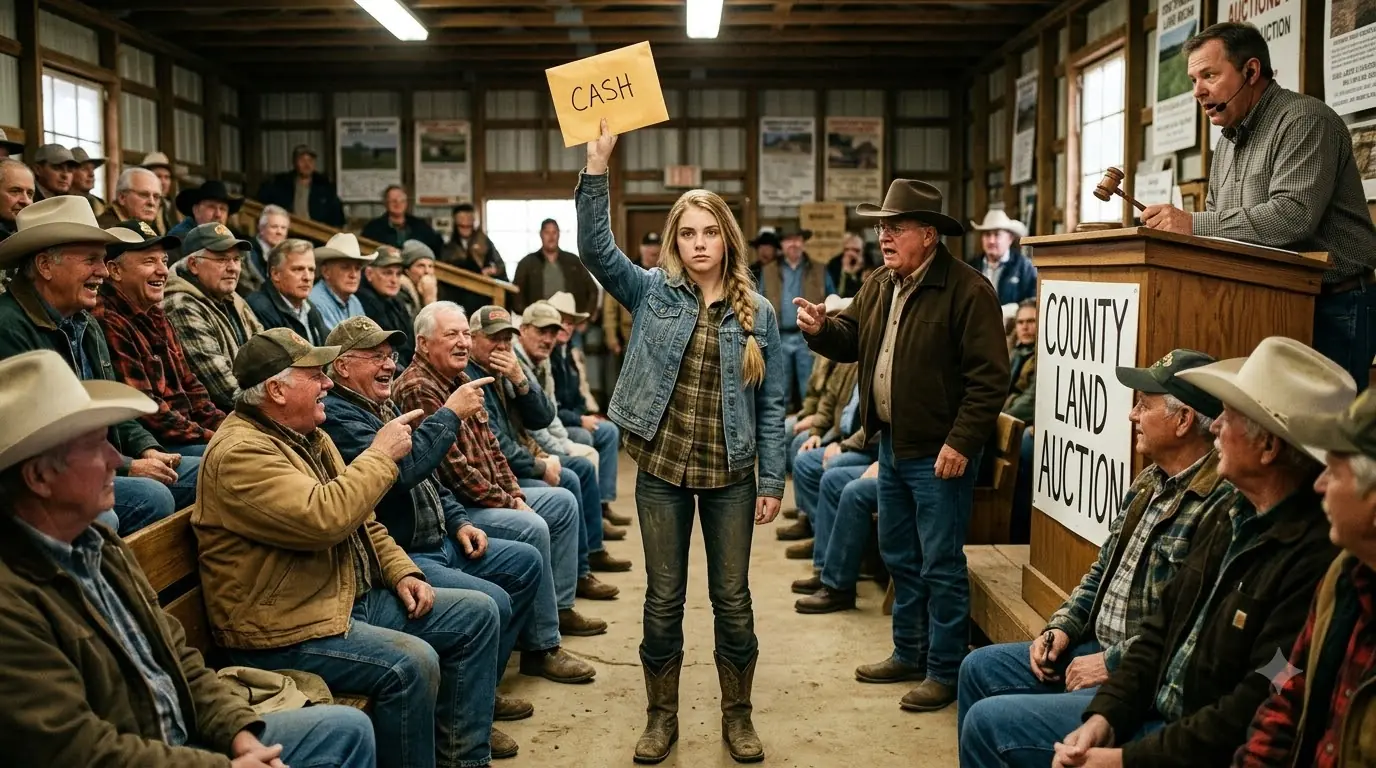
Wooden folding chairs filled the floor.
Farmers in dusty boots leaned against the walls.
Land investors occupied the front rows with catalogs folded across their knees.
Near the podium, County Property Administrator Harold Vance sat behind a folding table stacked with files nobody seemed interested in reading.
Evelyn stood near the center aisle wearing her late mother’s faded blue denim jacket over a brown plaid shirt.
Her long honey-blonde hair was braided over one shoulder.
Her boots had belonged to her father before he bought himself a new pair years earlier, and they were still slightly too large.
She looked painfully young among the ranchers surrounding her.
That was precisely why the laughter came so easily.
Auctioneer Bud Willis lifted the catalog.
“Next parcel.”
He flipped one page.
“County Lot 117.”
“Forty acres, eastern Millbrook County.”
A few men began smiling before he finished.
“Former Cranmer agricultural tract.”
“Current classification: unproductive wetland.”
The smiles became chuckles.
Bud cleared his throat.
“Minimum bid, eight hundred dollars.”
Nobody moved.
A rancher near the front called:
“Throw in a boat.”
The room laughed.
Another man said:
“You’d need dynamite to make dirt out of that mess.”
More laughter.
Evelyn’s father, Thomas Hartley, sat in the rear row.
He had come to the auction because the county was selling several parcels bordering farmland he had once rented.
He did not know why his daughter was there.
He certainly did not know what was inside her envelope.
Bud waited.
“Eight hundred?”
Silence.
“Anybody?”
Evelyn raised her hand.
The room stopped.
Bud stared.
“Evelyn?”
“Eight hundred.”
For one extraordinary second, nobody reacted.
Then every head turned toward her.
The laughter returned harder.
Not cruel in every case.
Some men laughed because the situation seemed impossible.
A sixteen-year-old girl bidding her college savings on the worst forty acres in Millbrook County sounded like a joke whose ending wrote itself.
Thomas stood.
“Evelyn.”
She did not look at him.
Bud shifted behind the podium.
“You understand the parcel?”
“Yes.”
“Forty acres of wetlands.”
“Yes.”
“Sold as-is.”
“I know.”
“No county drainage guarantee.”
“I know.”
Thomas pushed past two chairs.
“Baby.”
Evelyn kept her hand raised.
“Please sit down.”
His face went pale.
“Where did you get eight hundred dollars?”
“My savings.”
“That’s for school.”
“It’s mine.”
“You cannot spend your future on a swamp.”
Now the whole room was listening.
A wealthy local landowner named Carlton Graves leaned backward in his chair.
He pointed toward Evelyn.
“Listen to your daddy.”
His friends smiled.
“That bog has eaten two tractors and one drunk surveyor.”
More laughter.
Carlton continued.
“A pretty farm girl like you has better things to do than play land baron.”
Evelyn finally looked toward him.
“If it’s worthless, why do you care whether I buy it?”
Carlton’s smile disappeared slightly.
“I don’t.”
“Then stop talking.”
Several younger farmers laughed at him.
That changed the mood.
Bud raised his gavel.
“Eight hundred once.”
Thomas stared helplessly.
“Evelyn.”
“Twice.”
She squeezed the envelope.
Her mother’s voice lived inside her memory.
Not literally.
Through twelve journals Evelyn had discovered in the attic three weeks earlier.
The journal from 2003 had contained a page about the Cranmer Bog.
Clara Hartley had written that the land was not naturally worthless.
It had once been a working cranberry operation.
The old Cranmer family had maintained drainage channels, sluice gates, and raised peat beds dating back decades.
More importantly, Clara had recorded something nobody at the auction seemed to remember.
Old cranberry vines might still exist beneath the overgrowth.
Her final line had been impossible for Evelyn to forget.
If I had eight hundred dollars and a daughter old enough to swing an axe, I’d bring that bog back to life.
Bud Willis looked toward the county table.
Harold Vance shrugged.
The property had failed to attract a buyer for three consecutive years.
Eight hundred dollars was better than nothing.
Bud brought down the gavel.
“Sold.”
The sound echoed.
“To Evelyn Hartley.”
The room erupted.
Evelyn lowered her hand.
Thomas sat down slowly.
She walked toward the county table.
Harold Vance slid the paperwork toward her.
He looked amused.
“You understand there are no refunds.”
Evelyn placed the envelope in front of him.
“I’m not planning on asking for one.”
He counted the cash three times.
Then handed her a pen.
She signed.
At sixteen years old, Evelyn Hartley became the owner of forty acres Millbrook County had officially valued as agriculturally worthless.
Thomas did not speak during the drive home.
His old Ford rattled along the county highway while Evelyn held the photocopied deed across her knees.
Five miles passed.
Then ten.
Finally Thomas said:
“You threw away your future.”
Evelyn looked toward him.
“No.”
He gripped the wheel.
“Eight hundred dollars.”
“I know.”
“Your grandmother gave you that for college.”
“She gave it to me for my future.”
“That means education.”
“That means my future.”
Thomas shook his head.
“You are sixteen.”
“I know.”
“You don’t know what debt feels like.”
Evelyn looked out the window.
She had watched him sell acreage after her mother died.
Sixty acres for medical bills.
Forty after the combine failed.
Twenty to cover operating expenses.
She had watched notices pile up on the kitchen table.
Watched her father stand over the sink at midnight believing she was asleep.
“I know exactly what debt feels like.”
Thomas flinched.
Evelyn regretted the sentence immediately.
But she continued.
“You think I bought mud.”
“You did.”
“I bought Mom’s plan.”
Thomas stared ahead.
His jaw tightened.
“Don’t use your mother to justify this.”
“I found her journals.”
His hands shifted on the wheel.
“What journals?”
“The attic.”
He went quiet.
“All twelve.”
Thomas’s face changed.
“She wrote about Cranmer.”
Evelyn opened her backpack.
She pulled out Clara’s journal.
Thomas glanced.
Evelyn opened the marked page.
“She knew about the original cranberry beds.”
“She knew the old sluice system.”
“She thought vines were still there.”
Thomas’s voice softened.
“Your mother thought many things.”
“She was usually right.”
That nearly made him smile.
Almost.
Evelyn looked down at the deed.
“I didn’t throw away my future, Daddy.”
She folded the paper carefully.
“I bought yours back.”
Thomas did not answer for the rest of the drive.
The next morning Evelyn walked two miles to the Cranmer Bog.
The first sight of it almost destroyed her confidence.
From the auction catalog, forty acres had sounded manageable.
Standing at the edge felt different.
Brown water extended between cattails and dead trees.
Duckweed covered entire sections like green paint.
Mosquitoes gathered around her immediately.
A rusted gate leaned against the northern embankment.
The old equipment shed had collapsed into a heap of rotten lumber.
The smell was worse.
Sulfur.
Decay.
Standing water.
Black mud.
Evelyn swallowed.
“So.”
A heron stood twenty yards away watching her.
“You’re ugly.”
The bird did not argue.