The Texas Panhandle wind did not carry the promise of rain.
It carried red dust, diesel fumes, the dry rattle of chain-link fences, and the particular loneliness of a place that had stopped expecting the future to arrive.
When it came across Amarillo from the west, it moved like something with teeth. It scraped along the cracked earth, worried loose tin roofs, pushed plastic bags across empty lots, and filled the mouths of working people with the taste of rust and distance.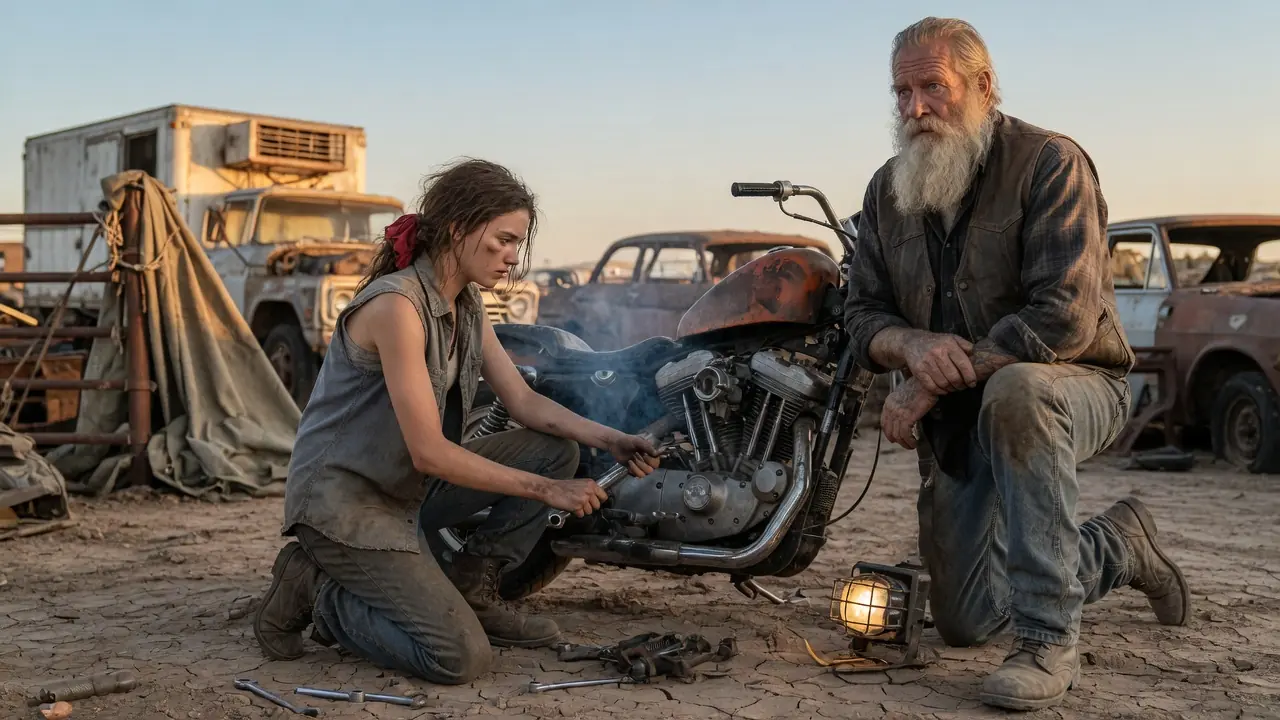
On that wind, everything sounded older than it was.
A screen door.
A freight train.
A dog barking three lots away.
A girl breathing hard as she dragged a dead motorcycle out from under fifteen years of collapsed sheet metal and dust.
That girl was seventeen-year-old Lyra Mae Carter, and she did not yet know that the machine beneath her hands had once carried a boy named Tommy Callahan down the same lonely roads where his father had tried to outrun grief.
She did not know that the bike had been buried in the far corner of Hector’s Salvage and Scrap like a secret nobody in Amarillo wanted to remember.
She did not know that by waking its engine, she would wake a broken old man who had spent eleven years disappearing while still technically alive.
All Lyra knew, in that first moment, was chrome.
Dull, scratched, nearly swallowed by debris, but still unmistakable.
And Lyra Mae Carter knew machines the way some people knew prayer.
Amarillo, Texas was a town that existed the way old scars do.
Quietly.
Permanently.
Without apology.
The heat pressed down on the cracked earth like something with a grudge, and the sky opened wide above everything, merciless and bright. On the ragged western edge of town sat Hector’s Salvage and Scrap, a sprawling graveyard of crushed steel, shattered windshields, dead refrigerators, stripped engines, cracked dashboards, twisted bumpers, and everything the world had decided was no longer worth saving.
Most people drove past without looking twice.
They saw junk.
Lyra saw inventory.
She saw possibilities hiding under rust.
A carburetor someone else had given up on.
A working alternator inside a car with no doors.
A length of chain still good enough to use.
A copper wire tucked behind a dashboard.
A set of bolts that matched if you knew where to look.
For most people, Hector’s Salvage was invisible.
For Lyra, it was the only home she had ever had.
She had no family name that meant anything.
Lyra Mae Carter had been named by a social worker who never met her mother and never would. The name stuck the way junkyard names stick, not because it fit, but because nobody bothered changing it.
She had gone through six foster homes before she was fourteen.
One had too many kids and not enough food.
One had clean towels but cold eyes.
One had a woman who prayed loudly over every meal and locked the pantry at night.
One had a man who never touched her but looked at her in a way that taught her to sleep with a chair under the doorknob.
At sixteen, she aged out of the system with a garbage bag of clothes, forty dollars, a bus pass, and a referral to a shelter she never used.
Shelters had rules.
Shelters had questions.
Shelters had people who wanted you to say thank you for a cot when all you wanted was not to owe anyone anything.
Instead, she found Hector’s Salvage.
Hector Ybarra was sixty-three, bowlegged from bad knees, with a sun-browned face and a white mustache that made him look kinder than he sometimes wanted people to know he was.
Lyra walked through the gate one afternoon with nothing but a backpack, a socket wrench she had stolen from a foster garage years earlier, and the ability to identify a bad starter by sound.
Hector told her he did not hire kids.
She fixed the starter on his yard truck before he finished refusing her.
He told her he did not let people sleep on the property.
She cleaned out a gutted Airstream trailer in the back corner and patched the cracked window with sheet plastic before he finished refusing that too.
Hector told her he did not need trouble.
Lyra said, “Then don’t make any.”
That made him laugh.
After that, he paid her cash on Fridays and looked the other way the rest of the week.
It was not adoption.
It was not charity.
It was not even kindness, at least not in the words either of them would have used.
It was an arrangement.
Lyra trusted arrangements more than promises.
The Airstream had no running water. The air conditioner did not work. In summer, it became an oven by three in the afternoon. In winter, the wind pushed through the seams and lifted her blanket at the edges.
But it had a door.
It had a lock.
It was hers, more or less.
That mattered.
The only other warm place in Lyra’s world was Martha Lou’s Diner, four blocks down the road.
Martha Lou Jenkins owned it, ran it, cleaned it, argued with it, and occasionally threatened to burn it down if the freezer quit one more time. She was sixty-eight, with a wide body, sharp eyes, and hair she dyed a shade of red not found in nature but somehow perfect for her.
Her diner had red vinyl booths, chipped white mugs, and coffee so strong it made your back teeth ache.
Martha Lou fed Lyra on credit and asked questions Lyra deflected like stripped bolts.
“You eat today?”
“Some.”
“Some is not an answer.”
“It is if you stop asking.”
“Girl, I been asking questions since before you were a thought.”
“And yet here we are.”
Martha Lou would snort, put a plate in front of her, and pretend not to notice when Lyra ate like somebody afraid food could be taken back.
Lyra did not do conversation.
She did carburetors.
She did timing chains.
She did torque sequences, cracked fuel lines, stripped heads, rusted calipers, seized pistons, and the specific patient language of machines that had given up but had not yet decided to die.
She understood broken things.
She just did not know she was one of them.
The far corner of Hector’s yard was called Section D, though nobody had officially named any other section.
Section D was where things went after even the scrap men lost interest. Collapsed shelving racks, motorcycle frames, old farm equipment, cracked boat hulls, tire stacks that had fused together in the heat, and appliances from houses long since demolished.
Hector had not sent anyone back there in years.
“It’ll fall on somebody,” he would say.
“It already fell on itself,” Lyra replied once.
“Then it’s busy. Leave it alone.”
But on a Tuesday afternoon in late August, Section D gave up a little more.
Lyra was across the yard sorting alternators when she heard the crash.
A long metallic groan came first, like an old animal waking angry.
Then came the flat percussion of corrugated steel meeting hard Texas ground.
Dust lifted into the air.
Birds scattered off the fence.
Hector yelled something from near the office that was mostly profanity and partly concern.
Lyra was already walking.
That was what she did.
She moved toward collapse.
Not because she was brave.
Because collapse usually meant salvage.
In the far corner, a rusted shelf rack had folded inward under its own accumulated weight. Sheets of tin slid off the side. A busted engine block lay half-exposed. A stack of warped doors had cracked apart.
Lyra almost walked past the glint.
Almost.
But the August sun caught something beneath the debris at a particular angle.
Chrome.
Dull.
Scratched.
Stubborn.
Refusing to stay buried.
Lyra stopped breathing.
She crouched.
Pulled one sheet of tin aside.
Then another.
A rounded edge appeared.
A bent handlebar.
The curve of a tank.
Her pulse changed.
She spent the next two hours excavating by hand.
Sheet metal sliced one knuckle open. She wrapped it in a strip torn from her T-shirt and kept going. Sweat ran into her eyes. Dust stuck to her arms. The heat pressed against her back. She ignored all of it.
Finally, she stepped back.
What she had uncovered stole the words right out of her.
A motorcycle.
Or what was left of one.
A 1989 Harley-Davidson Sportster 1200.
The engine was seized solid. The tank was dented deep and scorched black along one side. The frame had been warped by years of pressure and Texas heat into something that looked like a spine that had taken too many hard falls.
One mirror was gone.
One foot peg hung loose.
The front fender had been crushed.
The tires were dead, cracked open along the sidewalls.
Most people would have called it junk.
Lyra called it possible.
Hector shuffled over near sundown, squinted at it, wiped his face with a handkerchief, and shrugged.
“You can keep whatever you can carry.”
Lyra looked at the Sportster.
“I can’t carry that.”
“Then I guess you can’t keep it.”
She turned her head and gave him a flat look.
Hector sighed.
“I already regret saying that.”
She crouched to drag the bike free and stopped.
Hanging from the ignition was a small leather key ring, cracked and sun-bleached.
Stamped into the hide in faded letters were five words.
For Tommy. Ride free.
Lyra touched the key ring with one grease-blackened finger.
She did not know who Tommy was.
She could not stop reading it.
The next day, she built a workspace.
Four canvas tarps lashed between a dead refrigerator truck and a rusted fence post. A workbench made from two doors across oil drums. A single work light on an extension cord running back to the Airstream. A box fan that moved hot air from one place to another without cooling any of it.
Not pretty.
Functional.
Lyra’s kind of architecture.
She pulled parts from every wrecked bike in the yard.
A carburetor off a junked 1991 Sportster.
Brake lines from a crushed Kawasaki nobody wanted.
A starter relay from a bike that had burned down to the frame.
A headlight bucket from a Honda she had to cut loose with a hacksaw.
She found a water-damaged Harley service manual in a dumpster behind the auto parts store on Sixth Street. Its pages were swollen and stuck together. She dried them page by page on the Airstream roof and read the book like scripture.
Some nights she fell asleep with the manual open on her chest, her fingers still curled around a wrench.
The physical cost was honest and relentless.
Skinned knuckles that never fully healed before she skinned them again.
A sprained left wrist she wrapped in electrical tape and ignored.
Burns along her forearm from hot metal.
Weeks of three-hour nights, her eyes burning under the work light while Amarillo went silent around her.
But something about this bike was different from every other machine she had touched.
With the others, she worked.
With this one, she talked.
Quietly.
Under her breath.
In the private language of someone who had stopped expecting to be heard.
“Come on.”
“Give it up.”
“I’ve got time.”
“Don’t be stubborn. That’s my job.”
Sometimes, when a bolt would not turn, she talked to Tommy without meaning to.
“Your bike’s got attitude.”
“Whoever you were, you were hard on clutches.”
“Ride free, huh? Right now it can’t even roll straight, but we’re working on that.”
She did not know why this one felt like it was listening.
It just did.
Deputy Ryan Holt came by on a Thursday, the way he always did.
Slow roll through the gate, window down, one arm resting on the door like he had nowhere better to be. Holt was fair enough, as lawmen went. Suspicious in the way decent men become when they have seen enough bad things and do not want to be surprised by more.
He was thirty-eight, square-jawed, with sun lines around his eyes and a habit of looking at a person’s hands before their face.
He had known Lyra since she started sleeping at Hector’s.
He knew she was underage.
He knew Hector was bending rules.
He knew the Airstream was not exactly legal housing.
He also knew that if he forced the issue, the girl would vanish into something worse than a salvage yard.
So he checked in without calling it checking in.
“You eating?”
“Occasionally.”
“You sleeping?”
“Sometimes.”
“You got ID?”
“Do you ask everybody personal questions before lunch?”
He never smiled much, but the corner of his mouth would move.
That Thursday, Holt noticed the Sportster immediately.
Lyra watched his expression change from twenty feet away.
Something tightened behind his eyes.
Recognition.
The kind a person does not want to have.
He climbed out of the cruiser, walked over, and crouched beside the frame without touching it.
“Where’d you find this?”
“Section D,” Lyra said. “Collapsed shelf.”
“Who else knows you have it?”
“Hector.”
Holt’s jaw flexed.
“Anybody come asking?”
“No.”
He looked at the leather key ring hanging from the ignition.
For Tommy. Ride free.
The silence stretched.
Lyra wiped her hands on a rag.
“You know it.”
Holt stood.
“I know enough.”
“That’s not an answer.”
“It’s the only one you’re getting.”
He adjusted his hat, looked once more at the bike, then at her.
“Be careful with that one.”
“Because it’s dangerous?”
“Because it belongs to a ghost.”
Then he got in the cruiser and drove away.
He did not tell her to stop.
He did not tell her anything useful.
That bothered her more than a direct warning would have.
That night, Lyra went to Martha Lou’s.
The diner was nearly empty, just a trucker at the counter and a retired school secretary eating lemon pie in the corner. Martha Lou set a plate of chicken-fried steak in front of Lyra before she ordered.
Lyra picked up the fork.
“Do you know somebody named Tommy?”
Martha Lou went still.
Not dramatically.
Just enough.
The coffee pot in her hand hovered above the counter.
“What Tommy?”
“Bike I found has a key ring. Says, ‘For Tommy. Ride free.’ Deputy Holt acted weird about it.”
Martha Lou set the coffee pot down slowly.
“Where’d you find that bike?”
“Section D.”
Martha Lou looked toward the window, past her own reflection to the flat dark edge of town.
When she spoke, she kept her voice low, as if the name itself carried weight.
“Tommy Callahan.”
Lyra said nothing.
“His daddy was Jack Callahan,” Martha Lou continued. “Most folks called him Grave.”
“Grave?”
“Biker name. Club name. Some names you earn. Some names get put on you and never come off.”
Lyra kept her face blank, though something in her chest had shifted.
“What happened?”
Martha Lou leaned on the counter.
“You sure you want to know?”
“No.”
“But you’re asking.”
“I asked.”
Martha Lou sighed.
“Jack was a soldier once. Vietnam. Came home with more ghosts than language. Then he rode with the Angels for years. Not the weekend kind. The kind mothers warn daughters about and sons secretly admire.”
Lyra listened.
“He had one boy. Tommy. Sweet kid, though he tried hard not to be. Wanted to be just like his daddy. Jack tried to keep him away from club life, but kids want the thing you tell them they can’t have.”
“What happened to him?”
Martha Lou looked down.
“Wrong night. Wrong argument. Wrong men. A club dispute turned ugly. Tommy got caught in it.”
Lyra’s fork stopped.
“Did Jack—”
“No,” Martha Lou said sharply. “Jack didn’t do it. But grief doesn’t care how blame gets divided. It takes everything anyway.”
She picked up the coffee pot again, though no one needed coffee.
“Jack brought Tommy’s bike to Hector’s after the funeral. Walked home. Stopped riding. Cut the patches off his vest. Shut his whole life down.”
“Where is he now?”
“Outside town. Old trailer on County Road 19. Doesn’t see people unless he has to.”
“Is he mean?”
Martha Lou looked at Lyra then, really looked.
“No, honey. He’s something worse. He’s broken all the way down.”
Lyra looked at the plate in front of her.
Suddenly, she was not hungry.
Martha Lou saw it.
“Don’t go stirring what you don’t understand.”
“I’m fixing a bike.”
“That bike is not just a bike.”
Lyra’s jaw tightened.
“Nothing broken is just what it looks like.”
Martha Lou’s eyes softened.
“No,” she said. “I suppose it isn’t.”
For the next six weeks, Lyra worked harder than she had ever worked in her life.
The Sportster resisted her like it had opinions.
The engine was seized so tight she had to soak the cylinders in diesel and transmission fluid for weeks, turning the crank a fraction at a time until something inside finally admitted movement was possible.
The fuel tank had rust inside like dried blood. She cleaned it with gravel, vinegar, chain, and profanity.
The wiring harness looked as if rats had held a convention in it. She rebuilt it wire by wire, using diagrams from the warped manual and parts stripped from three dead bikes.
The brakes took two days.
The clutch took four.
The carburetor nearly made her throw a wrench through the Airstream window.
Hector watched from a distance most afternoons, pretending not to care.
“You could sell it once it runs,” he said one evening.
Lyra did not look up from the rear wheel.
“Not yours to sell.”
“Not yours either.”
She tightened a bolt.
“No. But it found me.”
Hector scratched his mustache.
“Things don’t find people.”
“Sure they do.”
He grunted.
“What’s that supposed to mean?”
Lyra looked at him.
“I found this place, didn’t I?”
Hector had no answer for that.
So he left her a new box of shop towels the next morning and said nothing.
Deputy Holt came by twice more.
Each time, he looked at the bike.
Each time, he looked like he wanted to say something.
Each time, he did not.
On the third visit, Lyra lost patience.
“You going to warn me again?”
Holt leaned against his cruiser.
“You listen to warnings?”
“No.”
“Then why waste one?”
She almost smiled.
He nodded toward the Sportster.
“You know whose it was now?”
“Tommy Callahan.”
“And you know who his father is?”
“Jack. Grave.”
Holt looked toward the far horizon.
“Jack was the scariest man in three counties once.”
“Was?”
“Grief changes the shape of scary.”
Lyra wiped grease from her hand with a rag.
“You think he’ll come?”
“If he hears it run, yes.”
“How will he hear it?”
Holt looked at the flat open land.
“Sound carries out here.”
Then he got in the cruiser and drove away.
Lyra stood beside the Sportster until sunset, thinking about a man in a trailer three miles away and a bike buried for eleven years because grief could not decide whether to destroy it or keep it.
The first time the engine almost caught, Lyra laughed.
It surprised her.
The sound came out sharp and rusty, like something dragged from storage.
She had not laughed like that in years.
The Sportster coughed once, spat smoke, and died.
She patted the tank.
“Yeah. Me too.”
On a Wednesday evening in late September, the sun bled out across the flat horizon in shades of copper and dying red.
The air had cooled just enough to feel like mercy.
Lyra stood over the Sportster, wiped her hands on her jeans, and checked everything one more time.
Fuel.
Spark.
Battery.
Oil.
Throttle.
Chain.
She looked at the key ring.
For Tommy. Ride free.
“Okay,” she whispered. “Let’s see if you remember.”
She kicked the starter.
Nothing.
She kicked it again.
The engine coughed once, a wet, phlegmatic sound, then went silent like it was embarrassed by the attempt.
Lyra reset her weight.
Her wrist hurt.
Her knee hurt.
Everything hurt.
She kicked it a third time with everything she had.
The engine caught.
It ran ragged at first, misfiring in an uneven, lurching rhythm that rattled the canvas tarp overhead. Smoke coughed from the exhaust. A bolt somewhere vibrated loose and pinged onto the dirt.
Lyra did not move.
She held the throttle carefully.
“Come on,” she whispered. “Come on.”
Then something inside the machine found its footing.
The misfires smoothed.
The rhythm deepened.
And the Sportster settled into a rolling, chest-level thunder that filled every corner of the junkyard and pushed through the chain-link fence and carried itself flat across the Texas plain on the evening wind.
Lyra sat down on the bike, both hands on the bars, not going anywhere.
She just let it run.
The vibration moved through her palms, her arms, her ribs.
It was the loudest silence she had ever sat inside.
Three miles away, on the ragged edge of town, Jack Callahan sat in a battered recliner beneath a ceiling fan that turned too slowly to matter.
His trailer smelled of dust, old coffee, and the kind of neglect that comes from a man who stopped inviting the world in.
A television flickered without sound.
A half-empty bottle sat on a table near his left hand, though he had not touched it in hours.
Jack was staring at nothing when the sound reached him.
Low.
Familiar.
Impossible.
His whole body went still.
The engine note rolled across the plain like a voice from a grave.
His eyes opened wide and fixed on the trailer ceiling.
He had not heard that sound in eleven years.
For a moment, he was not seventy years old.
He was fifty-nine again, standing in Hector’s yard the morning after the funeral, hands numb, the Sportster beside him, Tommy’s key ring swinging from the ignition.
He was watching his boy at nineteen, grinning like trouble in the driveway, telling him, “Dad, she rides better when you don’t act afraid of her.”
He was hearing Tommy laugh.
Then the sound faded.
The trailer returned.
The ceiling fan turned.
Jack sat in the chair until the room went dark.
He did not sleep that night.
He came at dawn two days later, when the light was still thin and the yard smelled of cold iron and overnight dust.
Lyra was on her back beneath the Sportster, adjusting the drive chain by feel, when the shadow fell across her.
Long.
Still.
Unhurried in the way only very large or very certain men can manage.
She slid out from under the bike and stood.
He was massive.
Six foot three at least, maybe taller before age bent something from him. White-bearded, broad-shouldered, built like the years had compressed him rather than diminished him. His arms were covered in ink blurred and bled with age until the tattoos looked less like pictures and more like weather.
He wore a faded leather vest over a dark flannel shirt.
No patches.
Just pale ghost outlines where patches had been cut away, shapes in the leather like scars.
He did not introduce himself.
He did not look around the yard.
He looked only at the Sportster.
Then at Lyra.
His eyes held the particular flatness of a man who had already survived everything he was afraid of.
When he spoke, his voice was gravel dragged slow over broken pavement.
“That bike killed my son.”
Lyra did not move.
“Step off it.”
She held the wrench in both hands and looked back at him without flinching.
“Then why does his key chain say ride free?”
The silence between them lasted long enough to become its own kind of conversation.
Hector watched from near the office door.
Deputy Holt’s cruiser sat outside the gate, engine idling, though Lyra had not seen when he arrived.
Jack’s jaw tightened.
“The bike belonged to him.”
“I figured.”
“I want it back.”
“Okay.”
The answer seemed to surprise him.
His eyes narrowed.
“Okay?”
“Yeah. If it’s yours, take it.”
She stepped aside.
For one second, Jack looked like a man who had pushed against a locked door and found it open.
Then Lyra added, “But you should know what I did to it first.”
His expression hardened again.
“I don’t care what you did.”
“You should.”
She did not raise her voice.
She almost never did.
She simply began talking in the only language she fully trusted.
Mechanical work.
Precise.
Sequential.
Honest.
She told him about finding the bike under the collapsed rack in Section D. About the tank, the frame, the seized pistons. About the six-week soak in diesel and transmission fluid. About the carburetor sourced from a junked 1991 Sportster and the rotors she had re-machined with borrowed equipment after midnight at a machine shop where Hector knew a guy.
She told him about the brake lines, the wiring harness, the chain, the wheel alignment, the cracked service manual, the nights under the work light, the parts that fought her, the ones that gave in, the bolts she saved because original metal mattered when you could keep it.
She accounted for every hour.
Every part.
Every morning she showed up before sunrise.
Every night she worked past the point where her hands stopped cooperating.
Jack stood with his arms crossed and his eyes giving away nothing.
Until she reached the key ring.
“It was in the ignition when I found it,” Lyra said. “Not in a pocket. Not in a box. In the ignition.”
She paused.
“Like whoever left the bike here wanted it found one day.”
Jack looked away.
It was the first time since he had walked through the gate that his eyes had moved off her face.
The wrench was still in Lyra’s hands.
Neither of them mentioned it.
Nobody invited Jack to sit.
He simply folded himself down onto the dirt beside the Sportster as if his legs had finally settled a long argument with the rest of him.
For a while, he said nothing.
Then he reached toward the key ring but stopped before touching it.
“Tommy was nineteen when he bought it,” he said.
His voice was low.
Lyra stayed standing, but something in her loosened enough to listen.
“Had no business owning a 1200. Too much bike for a kid who thought fear was an insult.”
He almost smiled.
Almost.
“Saved every dollar for it. Worked at a tire shop. Washed trucks. Sold an old dirt bike I gave him when he was fourteen. Showed up one day with this thing like he’d stolen the sun.”
Lyra looked at the Sportster.
“I hate that color,” Jack said.
“What color?”
“Used to be blue.”
Lyra glanced at the blackened tank.
“Not anymore.”
“No.”
The word fell heavy.
Jack’s hands rested on his knees, fingers curled like they were holding something invisible.
“He wanted to ride with me. Always did. I told him no. Told him the life wasn’t for him.”
“But he did anyway.”
Jack gave her a sharp look.
Lyra did not apologize.
People in her world rarely got rescued by silence.
After a moment, Jack looked back at the bike.
“He begged to prospect at nineteen. I refused twice. Then I spent a year trying to build a wall high enough.”
“Tommy climbed it.”
“Yeah,” Jack said. “He did.”
The yard was quiet.
Even Hector had disappeared back into the office, granting the old man the privacy of being heard.
Jack talked slowly, the way men do when they have kept something compressed so long that releasing it requires careful pressure.
Tommy had grown up watching his father ride, had idolized the life completely, stubbornly, without room for reason. He loved the engines, the brotherhood, the leather, the road, the way men seemed larger when they rode in formation. He did not understand the debts that came with those things. Not fully. Not until he was already close enough to get burned.
Jack had been a hard father. He knew that now. He thought hardness could protect a boy from wanting what hurt him. But all it had done was make Tommy more determined to prove he was not soft.
The night it ended had started as an argument between men who should have been old enough to know better.
A club dispute.
Money.
Pride.
Old grudges.
A meeting that should never have happened where it happened.
Tommy was in the wrong place, standing beside the wrong man when the situation broke beyond anyone’s control.
Jack got the call forty minutes too late.
He did not describe what he saw.
Lyra did not ask.
Some stories had edges sharp enough without details.
“I drove the Sportster here the morning after the funeral,” Jack said. “Didn’t know what else to do with it. Couldn’t destroy it. Couldn’t look at it. Couldn’t sell it. Couldn’t keep it.”
“So you buried it.”
“I left it.”
“Same thing.”
His eyes cut to her.
This time there was anger.
Not much.
Enough.
“You got a mouth on you.”
“I’ve been told.”
“You don’t know anything.”
“I know what it looks like when somebody leaves something behind because they can’t decide if they love it or hate it.”
Jack stared at her.
Lyra looked away first.
Not because she was afraid.
Because she had said more than she meant to.
He studied her then, not the way men sometimes did, not sizing up weakness or threat, but seeing past the grease and split knuckles and hard mouth to the girl who slept in a gutted trailer because she had nowhere else to go.
“What’s your name?”
“Lyra.”
“Last name?”
“Carter, I guess.”
“You guess?”
“Social worker wrote it down. Nobody argued.”
Jack’s face shifted in a way she could not read.
“You got people?”
“Hector pays me Fridays.”
“That’s not what I asked.”
“I know.”
The answer sat between them.
Jack looked toward the Airstream in the back corner.
“You live there?”
She did not answer.
He did not need her to.
For the first time since he entered the yard, something other than grief moved across his face.
Recognition, maybe.
Or the old memory of a boy standing in a driveway, desperate to belong somewhere.
“You’re seventeen,” he said.
“Good counting.”
“You should be in school.”
“You should be riding, but here we are.”
His mouth twitched.
It was not a smile.
Not yet.
But it was the ghost of one.
Then the ghost vanished.
He turned back to the Sportster.
“Tommy would’ve liked you.”
Lyra did not know what to do with that.
Compliments made her suspicious.
Kindness made her want to run.
So she said, “His bike’s rude.”
Jack huffed once.
The sound startled them both.
He put his face in his hands.
At first, Lyra thought he was angry.
Then his shoulders moved once.
Then again.
The huge old man folded forward, palms pressed to his eyes, and made a sound that seemed torn from somewhere too deep for language.
It was not loud.
It was worse than loud.
It was the sound of eleven years ending all at once.
Lyra stood frozen.
No one had ever taught her what to do with a crying man, especially one built like a collapsed mountain.
She looked toward the office.
No Hector.
No Holt.
Just her.
The bike.
The old man.
The morning light.
Finally, she lowered herself onto the dirt beside him.
Not too close.
Close enough.
“He sounds like he was worth grieving,” she said.
Jack’s shoulders shook harder.
The sun rose above the fence and lit the ruined machines around them. Cars without wheels. Trucks without engines. The dead and half-dead inventory of other people’s endings.
In the middle of it, beside a resurrected motorcycle, Jack Callahan cried for the first time in eleven years.
He came back the next morning.
Lyra was tightening the front brake when his truck rolled through the gate. He parked near the office, climbed out slowly, and walked toward her with something folded in one hand.
He looked worse than the day before.
Or maybe better.
Sometimes crying does that. It leaves a person wrecked and lighter at the same time.
He held out the folded paper without explanation.
Lyra wiped her hands before taking it.
It was the Sportster’s title.
Signed over to Lyra Mae Carter in handwriting that moved across the line like a man who had not held a pen in a long time but had decided to mean it anyway.
Her name was written carefully.
Too carefully.
Like he had copied it from Hector after making him spell it twice.
Lyra stared at the paper.
“No.”
Jack’s eyebrows lifted.
“No?”
“You came to get it back.”
“I changed my mind.”
“Why?”
“Tommy would’ve wanted it to go. Not sit still and rust.”
Lyra looked at the bike.
Her knuckles lived in every bolt.
Jack’s grief lived in every weld.
Tommy’s name hung from the ignition.
“You don’t know what he would’ve wanted,” she said.
Jack’s voice softened.
“No. But I know what he didn’t want. He didn’t want me dead in a chair for eleven years while still breathing.”
Lyra looked at him then.
He did not look away.
“I heard it run,” Jack said. “First time in eleven years, I felt something move that wasn’t pain.”
She swallowed.
“This is too much.”
“It’s a title.”
“It’s not.”
“No,” he agreed. “It’s not.”
She held the paper with both hands.
The word for what she was being given sat just outside her vocabulary. It was not payment. Not charity. Not exactly trust.
Maybe inheritance.
Maybe permission.
Maybe family, though that word was too dangerous to touch directly.
“I don’t have anywhere to go,” she said, and immediately hated herself for saying it.
Jack nodded slowly.
“You ever been west?”
“Everything is west from here.”
“I mean past New Mexico.”
“No.”
“You want to?”
Lyra looked at the Sportster.
For months, maybe years, leaving had been an idea with no machine attached to it. Now there was a bike. A title. A road.
A way out.
She should have been excited.
Instead, something hurt.
She looked toward the Airstream.
Then the salvage yard.
Then Martha Lou’s in the distance beyond the fence, though she could not see it from here.
Then Jack.
The old man seemed to understand.
“You don’t have to leave today.”
“If I don’t, I might not.”
“That so bad?”
She looked at him sharply.
He raised both hands.
“Not trapping you, girl. Just saying the road ain’t the only way to be free.”
That sentence bothered her for the rest of the day.
At Martha Lou’s that night, Lyra placed the signed title on the counter.
Martha Lou put on her reading glasses, looked at it, and whispered a word she would have scolded anyone else for using in her diner.
“He gave it to you?”
“Yeah.”
“Just like that?”
“No.”
Martha Lou looked at her.
Lyra’s face stayed hard, but her eyes had gone somewhere vulnerable.
“He cried,” Lyra said.
Martha Lou’s expression changed.
“Oh, Jack.”
“Men like him aren’t supposed to cry.”
“Men like him die early when they don’t.”
Lyra looked out the window.
“He told me the road isn’t the only way to be free.”
Martha Lou smiled softly.
“Maybe he’s remembering how to be wise.”
“I don’t know what to do.”
“With the bike?”
“With any of it.”
Martha Lou poured her more coffee.
“Then don’t decide tonight.”
“That your advice?”
“That and eat your meatloaf.”
Lyra stayed in Amarillo three more weeks.
Not because she had changed her mind about leaving.
Because the Sportster still needed work, and because Jack started showing up.
At first, he came in silence.
He would park his truck by the fence, walk over, and stand near the tarp without asking to help. Lyra ignored him until she needed someone to hold the rear wheel straight. He did it without comment.
The next day, he brought tools.
Old tools.
Good tools.
A torque wrench wrapped in cloth. A set of sockets in a dented metal box. A timing light. A leather roll of hand tools that smelled like oil and history.
“These were Tommy’s?” Lyra asked.
“Some.”
She touched the leather roll carefully.
“I shouldn’t—”
“Use them.”
So she did.
They worked side by side in the blunt, awkward silence of people who had both survived by needing little.
Jack knew motorcycles the way Lyra knew broken things. He did not explain unless she asked. He did not take over unless she got something dangerously wrong. When he corrected her, he did it with the kind of precision that insulted neither her intelligence nor the machine.
“Not like that.”
“Then how?”
“Feel the resistance before you trust the wrench.”
“That sounds like old-man poetry.”
“It’s torque.”
“Same thing.”
This time, he smiled.
A real one.
Small.
But real.
Martha Lou noticed the change before either of them admitted it.
Jack began coming into the diner again.
Not every day.
Not at first.
He sat at the counter with Lyra and ordered black coffee. Martha Lou put pie in front of him without asking. He stared at it like it might accuse him of something.
“You used to like peach,” Martha Lou said.
“I used to like a lot of things.”
“And now?”
Jack picked up the fork.
“Now I’m trying.”
That was enough.
Deputy Holt came by one afternoon and found Jack teaching Lyra how to adjust the clutch properly.
Holt leaned against the fence.
“Never thought I’d see this.”
Jack glanced up.
“You see a lot you don’t understand.”
“That’s true.”
Lyra looked between them.
“You two friends?”
Both men answered at the same time.
“No.”
Which meant yes, in the language of men like them.
The final repair was the tank.
Lyra wanted to leave the scorch mark.
Jack wanted to repaint the whole thing.
They argued for thirty minutes.
“It looks ugly,” Jack said.
“It looks honest.”
“It looks damaged.”
“It is damaged.”
“You always this sentimental about burnt paint?”
“You always this afraid of scars?”
Jack’s mouth closed.
The argument ended there.
They left the scorched mark.
But Lyra painted the rest of the tank a deep blue after Martha Lou found an old photograph of Tommy standing beside it in the same color.
At the bottom edge of the tank, small enough that someone would have to look closely, Lyra painted two words in white.
Ride free.
The morning she finally packed, the whole town seemed to know.
Hector pretended he had business near the gate.
Martha Lou arrived with a paper sack of food large enough for three riders and said it was “just a little something.”
Deputy Holt came by in the cruiser and gave her a prepaid gas card.
“Confiscated from criminals?” Lyra asked.
“Bought at a station like normal people do.”
“Disappointing.”
“You got a license?”
“Mostly.”
Holt sighed.
“Lyra.”
“I have one.”
“Insurance?”
“Hector helped.”
Hector coughed near the office.
“I did paperwork against my religion.”
Jack arrived last.
He wore the old leather vest.
No patches still.
Just the pale outlines.
But he had cleaned it.
That mattered somehow.
Lyra stood beside the Sportster with one bag strapped to the back.
It did not take long to pack when you had never owned much.
A change of clothes.
The service manual.
A few tools.
A photograph Martha Lou forced into her hand of the diner with Lyra scowling in the corner.
The title.
A map.
Before she rolled the Sportster through the gate, she reached back and pulled Tommy’s key ring from the ignition.
Jack saw it and went still.
Lyra walked over and pressed it into his palm.
Then she closed his fingers around it.
“So you have something to hold on to,” she said.
Jack looked down at the cracked leather.
For Tommy. Ride free.
His hand shook.
“I gave you the bike.”
“I know.”
“That was part of it.”
“No,” Lyra said. “That stays with you.”
He looked at her.
She held out a new key ring.
A strip of leather she had cut from an old belt, stamped clumsily by hand.
For Lyra. Keep going.
Jack stared at it.
“You made that?”
“Hector helped. Poorly.”
Hector muttered something from the gate.
Jack threaded it onto the ignition key with fingers that were not steady.
For a moment, none of them spoke.
Then he said, “You don’t disappear.”
Lyra’s jaw tightened.
“I’m good at disappearing.”
“I know. Don’t.”
The words struck harder than she expected.
Nobody had ever asked her not to vanish.
Not like that.
Not as if her absence would matter.
“I don’t have a phone,” she said.
Jack pulled one from his pocket.
It was cheap, prepaid, already activated.
Lyra looked offended.
“No.”
“Yes.”
“I’m not taking a phone from you.”
“You’re taking it from Martha Lou.”
Martha Lou crossed her arms.
“Don’t drag me in as if I’m not standing right here. You’re taking it from all of us, and you’re calling every Sunday.”
“I didn’t agree to that.”
“You did by being seventeen near adults with opinions.”
Lyra looked at Hector.
He shrugged.
“Don’t look at me. I just own the dirt.”
Deputy Holt cleared his throat.
“Sunday calls would be wise.”
Lyra stared at all of them.
Her throat tightened in a way she hated.
“Fine,” she said.
Martha Lou smiled.
Jack did not.
His eyes were wet.
“You got road money?”
“Yes.”
That was a lie.
Everyone knew it.
Hector handed her an envelope.
She did not open it.
“Hector.”
“Cash from your last weeks.”
“You already paid me.”
“I miscounted.”
“You never miscount.”
“I’m old. Let me have this.”
She took it.
Then she stepped toward the Sportster.
Jack followed.
At the bike, he placed one hand on the tank where the scorched mark remained.
For a moment, Lyra thought he might take it back.
Instead, he leaned close and whispered something she could not hear.
A goodbye, maybe.
Or an apology.
Or a father saying his son’s name into the only thing that still carried it.
Then he stepped back.
Lyra swung one leg over the bike.
The seat was worn but solid beneath her.
She turned the key.
For Lyra. Keep going.
The engine caught on the second kick.
The sound rolled across Hector’s yard, through the fence, over the road, out toward the flat Texas morning.
Jack closed his eyes.
This time, the sound did not break him.
It held him up.
Lyra looked at him.
He nodded once.
She nodded back.
Then she rode out.
The Sportster’s thunder carried flat across the Texas morning until distance swallowed it whole.
The silence that followed was wide.
Absolute.
Pressing in from every direction.
But for the first time in eleven years, Jack Callahan did not mistake silence for grief.
It felt like room.
It felt like beginning.
Lyra rode west for three months.
New Mexico.
Arizona.
A corner of Nevada.
Back roads, cheap motels, diner counters, gas station coffee, odd jobs paid in cash, and long stretches of highway where the sky looked too big to belong to anybody.
She called every Sunday.
Sometimes for two minutes.
Sometimes for twenty.
At first, she only said practical things.
“Bike’s fine.”
“Need a rear tire soon.”
“Arizona is rude.”
“Lost the map. Found the road anyway.”
Jack listened.
Martha Lou demanded details.
Hector pretended not to care and asked about mileage.
Deputy Holt occasionally checked whether she had been arrested.
She had not.
Mostly.
As weeks passed, the calls changed.
Not much.
Enough.
She told them about seeing the Grand Canyon at sunrise and hating that it made her feel small in a good way. About a waitress in Gallup who gave her free pie because she looked “haunted and underfed.” About fixing a stranger’s bike outside Flagstaff and getting paid more than she asked.
One Sunday, she called from a pay-by-the-week motel outside Tucson.
“I think I want to come back,” she said.
No one spoke at first.
Jack was the one who answered.
“Then come back.”
“That easy?”
“No. But do it anyway.”
She came back in December.
The Sportster rolled into Hector’s yard under a sky the color of old pewter. Her face was windburned. Her hair was shorter. Her eyes looked older and less cornered.
Jack was waiting by the gate.
He did not hug her.
Neither of them would have survived that much feeling in front of Hector.
He just looked at the bike, then at her.
“Still runs?”
“Better than you.”
He nodded.
“Probably.”
Then he handed her a key.
She looked down.
“What’s this?”
“Shop on the edge of town. Used to be a transmission place. I bought it.”
“Why?”
“Needs work.”
“That’s not an answer.”
“It’s the only one you’re getting.”
Martha Lou later explained the rest.
Jack had sold a piece of land he no longer used. Hector had found equipment. Holt had helped with permits. Martha Lou had threatened three contractors until they stopped overcharging.
The shop was small, half-empty, dusty, and real.
A sign leaned against the wall, unfinished.
Carter & Callahan Motorcycle Repair.
Lyra stared at it for a long time.
“My name’s first?”
“You found the bike,” Jack said.
“You bought the building.”
“You’re younger.”
“That doesn’t explain anything.”
“No.”
She swallowed.
“I don’t know how to run a shop.”
“Neither do I anymore.”
“That’s not comforting.”
“No.”
But she smiled.
And so, in a town that carried dust instead of promises, a girl who had grown up expecting to disappear opened a shop with an old biker who had spent eleven years trying to do the same.
They fixed motorcycles.
Not fast.
Not fancy.
But right.
They became known for taking machines other shops would not touch. Burned wiring. Seized engines. Bent frames. Bikes abandoned by men who had run out of patience, money, or faith.
Lyra treated each one like it still had an argument left to make.
Jack taught her what he knew and learned what she already understood.
Hector came by to complain about their tool organization.
Martha Lou brought lunch and told customers embarrassing stories.
Deputy Holt pretended to inspect licenses and ended up drinking coffee in the back.
The first dollar they earned together, Lyra taped above the workbench.
The first time a customer called her “ma’am,” she looked so offended that Jack had to walk outside to laugh.
On the anniversary of Tommy’s death, Jack did not stay in his recliner.
He rode.
Not far.
Just out past County Road 19 with Lyra beside him on the Sportster and the morning wind pressing against them.
At the old overlook west of town, he stopped.
Lyra killed the engine.
For a long time, they stood looking out over the Panhandle.
Flat land.
Wide sky.
Red dust.
The world as open and unforgiving as ever.
Jack took Tommy’s key ring from his pocket.
The old leather had been cleaned and oiled. The letters were still faded but readable.
For Tommy. Ride free.
He held it in his palm.
Then he looked at Lyra.
“You saved me,” he said.
She frowned.
“I fixed a bike.”
“No,” he said. “You fixed what I left buried with it.”
She looked away.
“You saved me too,” she said, so quietly the wind nearly stole it.
Jack heard.
He did not make her repeat it.
They rode back as the sun climbed.
The Sportster’s engine thundered across the open road, no longer a ghost calling from the dead, but a living sound.
A sound with grief in it, yes.
But also motion.
And years later, when people in Amarillo told the story, they never told it exactly right.
Some said a foster girl found a dead Harley and restored it from scrap.
Some said old Grave Callahan gave his dead son’s bike to a kid with no family.
Some said the motorcycle had saved them both.
Lyra would hear versions of it at gas stations, diners, parts counters, and once from a customer who had no idea he was telling the story to the girl herself.
She never corrected anyone.
But if you asked her privately, late at night, when the shop was closed and the tools were cleaned and the Sportster sat under the light near the back wall, she would tell you the truth.
“The bike didn’t save us,” she would say. “It just made enough noise for us to find each other.”
And maybe that was all a miracle ever was in the Texas Panhandle.
Not rain.
Not rescue coming clean and easy.
Just a sound crossing the flat land at the right time.
A dead engine waking.
An old man listening.
A girl with grease under her fingernails refusing to leave broken things buried.
And somewhere inside all that thunder, two people who had been forgotten by almost everyone learning, slowly and stubbornly, that they were still worth saving.