The Desert Rose Diner sat on the corner of Indian School Road and 32nd Street in Phoenix, Arizona, its faded pink stucco walls weathered by decades of desert sun.
Inside, the air conditioning hummed against the October heat, and the smell of coffee and fresh-baked pie created an atmosphere of safety that regulars had come to depend on.
The red vinyl booths were patched with duct tape in places, and the black-and-white checkered floor showed the wear of thousands of footsteps.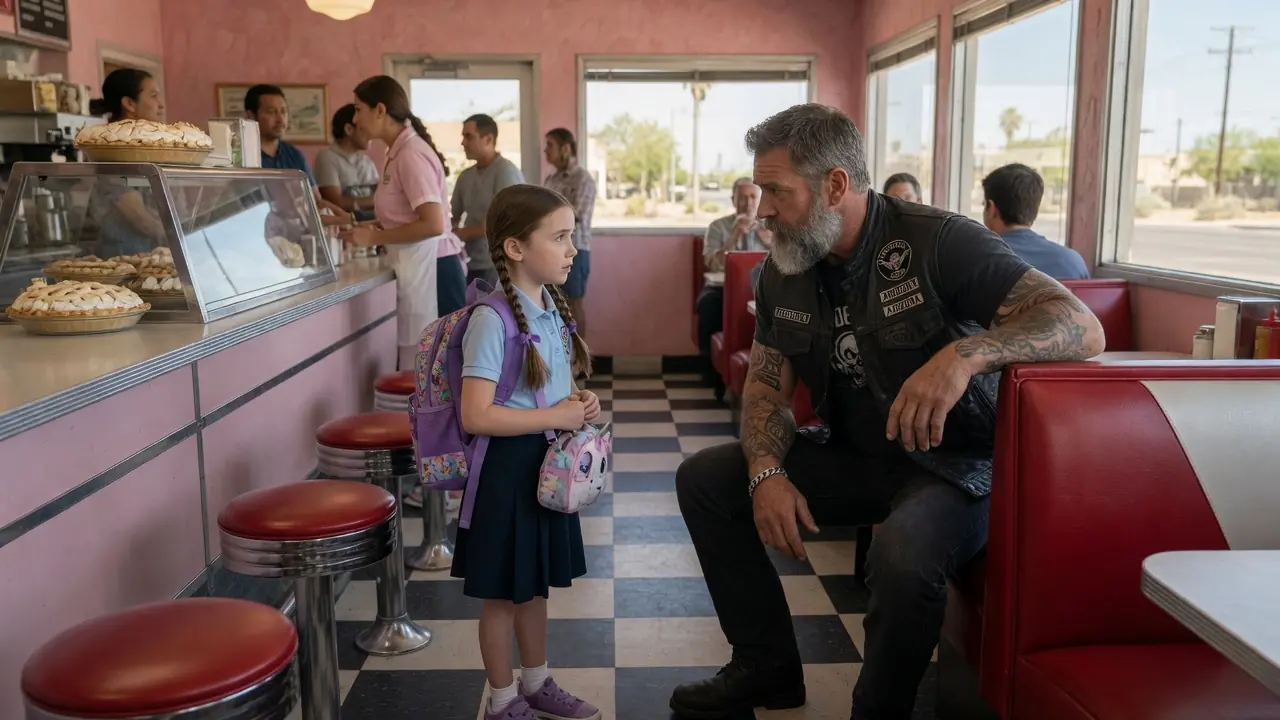
But none of that mattered to the people who considered this place a second home.
It was 4:15 on a Tuesday afternoon when six-year-old Ember Callahan pushed through the glass door with both hands, her purple backpack decorated with cartoon ponies bouncing against her small shoulders.
The little bell above the entrance chimed, and Willa Brennan looked up from behind the counter, where she had been refilling salt shakers for the dinner rush.
Willa had worked at the Desert Rose for thirty-two years. She had seen just about everything that could happen in a neighborhood diner.
But something about this child, alone and trying very hard to look brave when she was clearly terrified, made Willa’s heart contract with immediate concern.
Ember walked to a booth near the window, the same booth where her grandmother Maeve sat every Thursday afternoon for tea and apple pie.
The child’s movements were careful and deliberate, like someone following a script she had memorized for exactly this kind of emergency. She climbed onto the cracked vinyl seat, her feet dangling several inches above the floor, and placed her backpack beside her with the precision of someone much older.
Then she pulled out a small purse shaped like a unicorn, rainbow mane and all, and began counting coins onto the scratched Formica table.
Three quarters, five dimes, one nickel.
Ember counted them twice, her small fingers trembling just enough to make the coins click against each other. She was doing the math her teacher had been working on with the class, addition and subtraction, making sure she had enough for a cookie.
The sugar cookies at the Desert Rose cost one dollar even.
She had exactly one dollar and five cents.
Willa approached the booth slowly, the way you might approach a wounded bird. She had known the Callahan family for six weeks now, ever since they had moved into the apartment complex four blocks away.
Maeve came in regularly, always with Ember after school on Thursdays, and occasionally Colleen would stop by after her nursing shift at the hospital.
Good people.
Quiet people who were clearly making the best of difficult circumstances.
“Ember, sweetie,” Willa said gently, sliding into the booth across from the child. “Where’s your grandma Maeve?”
Ember looked up, and Willa saw the fear the little girl had been fighting so hard to hide. Her brown eyes were glassy with tears she refused to let fall, and her lower lip trembled before she caught it between her teeth.
“I don’t know,” Ember whispered. “She didn’t come to school. She always comes to school. Always.”
“What time did school let out, honey?”
“Two forty-five.”
Ember’s voice was barely audible.
“I waited and waited. Mrs. Patterson said we could call Grandma, but nobody answered. Mrs. Patterson wanted to call my mama, but Mama works at the hospital, and she can’t leave when she’s with patients. She told me that. Never call her at work unless it’s a real emergency.”
Willa glanced at the clock above the cash register. It was 4:17 now.
That meant this child had been waiting, terrified and alone, for ninety minutes.
“Did you walk here by yourself?” Willa asked, already knowing the answer but needing to hear it confirmed.
Ember nodded.
“Mama said if I’m ever scared or lost, I should come to the Desert Rose. She said it’s a safe place, and you know our family. So I walked here. It’s six blocks. I counted.”
Six blocks through a Phoenix neighborhood that was not particularly dangerous, but was not exactly safe for a six-year-old girl walking alone. Six blocks of busy intersections and strangers and all the things that could go wrong.
And this child had been brave enough, desperate enough, to make that journey because her world had suddenly become unstable and she needed to find solid ground.
“You did exactly right,” Willa assured her, reaching across the table to pat Ember’s hand. “You were very smart and very brave. Now, let me make some phone calls, okay? We’re going to find your grandma and your mama, and we’re going to make sure everything is all right.”
Willa returned to the counter and picked up the landline phone, the same avocado-green rotary model that had been there since 1987.
She dialed the number Maeve had written on a napkin weeks ago, emergency contact information provided just in case.
The phone rang eight times before going to voicemail.
“Maeve, this is Willa at the Desert Rose. Ember is here with me, and she’s safe, but she says you didn’t pick her up from school and we’re worried. Please call the diner as soon as you get this message.”
Next, she tried the hospital, navigating through the automated system until she reached the nurses’ station on the surgical floor where Colleen Callahan worked.
“This is Phoenix General Surgical Floor. This is Bryn speaking.”
“Hi, Bryn. This is Willa Brennan from the Desert Rose Diner. I need to reach Colleen Callahan. It’s about her daughter.”
There was a pause.
“Colleen is in surgery right now with Dr. Morrison. They’re in the middle of an emergency appendectomy. I can take a message, but I can’t pull her out unless it’s absolutely critical.”
Willa looked at Ember, who was watching her with enormous eyes full of desperate hope, still sitting in that booth with her dollar and five cents counted out in front of her like an offering to the universe.
“Tell her to call the Desert Rose Diner the moment she’s out of surgery. Tell her Ember is here and she’s safe, but we need to talk to her right away.”
Willa hung up and returned to Ember’s booth.
“Your mama is helping a patient right now, but she’ll call us as soon as she’s done. And I’m sure your grandma is fine. Maybe she fell asleep or her phone died. These things happen.”
But Ember shook her head with the certainty of a child who knows when adults are trying to make them feel better with pretty lies.
“Something’s wrong,” she said quietly. “Grandma Maeve is never late, never ever. Not even one time since we moved here. She walks me home from school every single day at two forty-five exactly. She wouldn’t forget. She wouldn’t.”
And in that moment, Willa realized that Ember was probably right.
Across the diner, in his usual booth by the window with a view of the parking lot, Jackson Sullivan had been watching this entire exchange while pretending to read the Arizona Republic.
At fifty-nine years old, president of the Phoenix chapter of the Hells Angels Motorcycle Club, Reaper had learned long ago that the world judged you on appearance first and character never. He had made peace with that reality decades ago.
He was a big man, six feet two and two hundred forty pounds of muscle earned through years of manual labor and riding motorcycles across the American Southwest. His gray beard was full and neatly trimmed, his arms covered in tattoos that told the story of thirty-five years in the club, and his leather vest displayed the patches that marked him as someone most people crossed the street to avoid.
The death’s head insignia. The Phoenix rocker. The president’s patch that meant he led seventy-three men who had sworn brotherhood to each other and loyalty to a lifestyle that existed outside the boundaries of polite society.
But Reaper had been coming to the Desert Rose Diner every Tuesday and Thursday for twenty years, long enough that Willa knew his coffee order and his usual slice of pie, long enough that the regular customers had learned he was just another human being looking for a quiet place to think and a decent meal.
He had noticed the little girl the moment she walked in.
Hard not to notice a six-year-old entering a diner alone in the middle of the afternoon, moving with the kind of careful determination that suggested she was following an emergency plan.
He had watched her count her coins.
He had seen the fear she was trying so hard to hide.
And he had heard enough of her conversation with Willa to understand that this child was in trouble.
Reaper thought about his own daughter, Sloane, who was twenty-seven now and living somewhere in Seattle. He had not spoken to her in ten years, not since the court had decided that a Hells Angels president was not a suitable guardian for a teenage girl.
Never mind that he had never raised a hand to her.
Never mind that he had worked two jobs to keep her fed and clothed after her mother left.
Never mind that he had loved her more than his own life.
The judge had looked at his patches and his record and decided that being an outlaw biker was incompatible with being a father.
Sloane had gone to live with her mother’s sister in Oregon, and she had made it clear through her silence that she agreed with the court’s decision.
Ten years without a phone call.
Ten years without knowing if she was happy or safe or even alive.
Ten years of carrying the weight of that failure.
So when Reaper saw Ember Callahan sitting alone in that booth, counting coins with trembling hands and trying not to cry, he saw every child who had ever needed protection and had not received it.
He saw every father who had failed.
And he made a decision that would change several lives in ways none of them could have predicted.
He stood, left three dollars on the table for his coffee and pie, and walked over to where Willa was standing behind the counter.
“The little girl,” he said quietly. “She in trouble?”
Willa looked at him for a long moment. She had known Jackson Sullivan for two decades. She had served him coffee through three presidents, four economic recessions, and the death of his father.
She had watched him handle drunk customers with patient firmness and leave generous tips for the young waitresses trying to work their way through community college. She trusted him in a way that had nothing to do with appearances and everything to do with character proven over time.
“Her grandmother didn’t pick her up from school,” Willa said. “She’s been alone for ninety minutes, scared out of her mind. Her mom is in surgery and can’t be reached. I don’t know what else to do except wait.”
Reaper nodded slowly.
“Mind if I talk to her? Not trying to overstep. Just thinking maybe I can help.”
“You’re going to scare her,” Willa said, not unkindly. “You know what you look like.”
“I do know.”
Reaper glanced at Ember, who was watching them with wide eyes.
“But scared of me is better than scared and alone. At least scared of me has company.”
Willa considered this, then nodded.
“Go slow. And Jackson, she’s six.”
“I remember six,” Reaper said quietly.
He walked over to Ember’s booth and crouched down on one knee so his eyes were level with hers.
Up close, he could see that she had freckles across her nose and a small scar on her chin, probably from learning to ride a bike or climbing a tree. The kind of scar that marked childhood adventures.
Her school uniform was neat but worn, the kind of clothes bought carefully on a budget and washed with care to make them last.
“Hi, Ember,” he said, keeping his voice gentle. “My name is Jackson. I’m a friend of Willa’s, and I come to this diner all the time. I couldn’t help but hear that you’re waiting for your grandma.”
Ember looked at him, taking in the leather vest with his patches, the gray beard, the tattoos visible on his forearms where his sleeves were rolled up.
She had clearly been taught about stranger danger, about not talking to people she did not know. Everything about her body language said she was uncertain about this scary-looking man who had approached her table.
“I’m not supposed to talk to strangers,” she said carefully.
The words were obviously rehearsed from parental safety lessons that had been drilled into her with the seriousness they deserved.
“That’s very smart,” Reaper replied, approval genuine in his voice. “Your mama taught you good rules. Those rules keep you safe, and you should always follow them.”
He paused, letting her see that he respected her boundaries, that he was not going to push or pressure or violate the trust she had been taught to protect.
Ember’s lip trembled.
“Mama said never to bother her at work unless it’s a real emergency. She works really hard, and if she gets in trouble, she might lose her job, and then we won’t have money for rent.”
The matter-of-fact way she said this, the adult concerns carried in a six-year-old voice, made Reaper’s chest tighten with a mixture of admiration and heartbreak.
This was a child who understood financial precarity, who carried the weight of her family’s struggles even as she counted coins for cookies.
“I think your grandma not showing up for ninety minutes counts as an emergency,” Reaper said gently. “And your mama needs to know what’s going on. She’s going to want to know because if something happened to your grandma, your mama would want to help her. Right?”
Ember nodded slowly, considering this logic.
Then she looked at Willa, who had returned to stand nearby, providing the adult supervision that made this conversation acceptable.
“Miss Willa,” Ember said, “do you think Mr. Jackson is right? Should we call my mama?”
“I think he’s exactly right, sweetie,” Willa confirmed. “And I’ll make the call so you can hear everything I say. How does that sound?”
“Okay,” Ember whispered.
Willa picked up the phone again and redialed the hospital. This time, when the surgical floor answered, she was more insistent.
“This is Willa Brennan again. I need you to get a message to Colleen Callahan immediately. Even if she’s still in surgery, tell her that her daughter Ember has been stranded for ninety minutes, that her mother Maeve did not pick Ember up from school, and that we cannot reach Maeve by phone. Tell Colleen to call the Desert Rose Diner the absolute second she can step away. This is urgent.”
There was a pause, then the sound of pages being turned and someone writing down the message.
“I’ll get this to her as soon as the surgery is finished,” the nurse promised. “They’re closing up now. Should be another ten or fifteen minutes.”
“Thank you,” Willa said, and hung up.
She turned to Ember.
“Your mama will call very soon, honey. In the meantime, how about that cookie you were saving up for?”
Ember looked at her coins, then back at Willa.
“I have exactly one dollar and five cents.”
“Well, lucky for you, we’re running a special today. Cookies are free for brave girls who walk six blocks to a safe place when they’re scared.”
Willa went to the display case and pulled out the biggest sugar cookie, the one decorated with rainbow sprinkles. She placed it on a small plate and set it in front of Ember.
“There you go, sweetheart. On the house.”
Ember looked at the cookie but did not touch it.
“I don’t want to be rude, but I’m not very hungry right now. My stomach feels funny.”
“That’s because you’re worried,” Reaper said, still crouched by her booth. “Worry makes your stomach feel strange. But later, when your mama gets here and everything is sorted out, you might want that cookie. So we’ll just save it for you. Okay?”
“Okay,” Ember said quietly.
The minutes ticked by.
Reaper returned to his booth but kept watching Ember, who sat very still, her hands folded in her lap, her eyes fixed on the door as if she could will her grandmother to walk through it.
Every time the bell above the entrance chimed, Ember’s whole body tensed with hope, then sagged with disappointment when it was someone else.
At 4:47, the phone rang.
Willa grabbed it on the first ring.
“Desert Rose Diner, this is Willa.”
“Willa, it’s Colleen Callahan. What happened? Where’s Ember? Where’s my mother?”
The panic in her voice carried across the diner.
Willa gestured to Ember, who slid out of her booth and came to the counter, reaching up on her tiptoes to take the phone Willa held down for her.
“Mama,” Ember’s voice cracked on the word.
“Baby, are you okay? Where are you?”
“I’m at the Desert Rose. Grandma Maeve didn’t come to school. I waited and waited and waited, but she didn’t come. So I walked to the diner like you told me to do if I’m ever scared. But Mama, where’s Grandma Maeve? What if something bad happened?”
Through the phone, Reaper could hear Colleen taking deep breaths, fighting to stay calm for her daughter’s sake even though she was clearly terrified herself.
“Ember, listen to me. You did exactly right. You were so smart and so brave to go to the diner. I’m so proud of you. Now, I need you to stay there with Miss Willa, and I’m going to come get you right away. I’m leaving the hospital right now. It’s going to take me about thirty minutes to get there because of traffic, but I’m coming. Can you wait for me?”
“I can wait,” Ember said, though her voice shook.
“Good girl. Now let me talk to Miss Willa again.”
Ember handed the phone back, and Willa walked to the far end of the counter, speaking in low tones that were not meant for the child to hear.
But Reaper heard every word.
“Colleen, I tried calling your mother multiple times. No answer. And you know Maeve. She’s never late, not once in the six weeks I’ve known her.”
“Oh God.” Colleen’s voice was tight with fear. “I need to check on her, but I can’t leave Ember alone, and I can’t take her with me if something’s wrong. Willa, I don’t know what to do. I don’t know anyone in Phoenix. We just moved here. I don’t have friends here yet. I don’t have neighbors I trust. I don’t have anyone who can help me.”
The desperation in her voice was raw and real.
This was a single mother facing every parent’s nightmare, the moment when your support system fails and you are forced to make impossible choices.
Willa glanced at Reaper, a question in her eyes.
He nodded slowly.
“Colleen,” Willa said carefully, “there’s someone here who might be able to help. His name is Jackson Sullivan. He’s been coming to this diner for twenty years, and I trust him. He’s been very kind to Ember, very respectful. He could stay with her while you go check on your mother. Just until you figure out what’s happening.”
“A stranger?” Colleen’s voice rose. “You want me to leave my six-year-old daughter with a stranger?”
“Not a stranger to me,” Willa said firmly. “Someone I’ve known for two decades. Someone who’s never given me a moment’s concern. Colleen, I wouldn’t suggest this if I didn’t believe it was safe.”
There was a long silence.
Reaper could almost hear Colleen Callahan’s thoughts, the impossible calculation she was being forced to make. Trust a stranger with her daughter, or leave her daughter alone, or bring her daughter to a potentially traumatic scene at her grandmother’s house, or abandon her mother who might be lying hurt somewhere.
No good options.
Just choices between bad and worse.
“Let me talk to him,” Colleen said finally.
Willa handed the phone to Reaper.
He took it, aware that the next sixty seconds would determine whether he could help this family or whether Colleen’s entirely justified caution would mean Ember stayed alone and scared while her mother faced a crisis without support.
“Ms. Callahan, this is Jackson Sullivan.”
“Willa says you want to help my daughter.” Colleen’s voice was sharp, protective, challenging him to prove himself worthy of trust he had not earned.
“I want to help your family,” Reaper corrected. “Your little girl has been alone and terrified for two hours. You’re facing an emergency with your mother and no support system. I’m offering to provide a safe place for Ember while you handle what you need to handle. That’s all.”
“Why would you do that? You don’t know us.”
“No, ma’am, I don’t. But I know what it’s like when the world goes sideways and there’s nobody to call. I know what it’s like to be alone in a crisis, and I know what it’s like to watch a scared child and wish someone had been there when your own child was scared.”
There was a pause.
“You have children?”
“A daughter. Twenty-seven now. I haven’t seen her in ten years.”
The admission cost him something, but it was true and relevant.
“I failed her in ways that matter. I can’t fix that. But maybe I can help another father’s daughter get through a hard afternoon. No strings. No expectations. Just help.”
Another silence followed, longer this time. Reaper could hear hospital sounds in the background, paging systems and distant voices, the controlled chaos of medical professionals handling their own emergencies.
“I’m going to come to the diner first,” Colleen said finally. “I need to see you. I need to see my daughter with my own eyes. And then I’ll decide. But Mr. Sullivan, if you’re planning anything, if you’re not what Willa says you are, I will make sure you regret it. Do you understand me?”
“Yes, ma’am,” Reaper said simply. “I understand completely, and I respect your caution. It’s what keeps your daughter safe.”
“I’ll be there in twenty-five minutes,” Colleen said, and hung up.
Reaper handed the phone back to Willa and returned to Ember’s booth. The little girl was watching him with those enormous brown eyes, trying to understand what the adults were arranging, trying to figure out if this scary-looking man was someone she should trust.
“Your mama’s on her way,” Reaper told her gently. “She’ll be here very soon. Then we’ll figure out what to do about your Grandma Maeve together.”
“Do you really think Grandma’s okay?” Ember asked, her voice small and desperate for reassurance, even if it was a lie.
Reaper thought about all the pretty falsehoods adults tell children to spare them from fear.
He thought about all the ways honesty could be cruel, and he made a choice to give this child the truth she was brave enough to ask for.
“I think something happened that made your grandma unable to get to the school,” he said carefully. “Maybe she fell and hurt herself. Maybe her car broke down. Maybe something went wrong that’s going to be scary for a little while. But your grandma loves you, and your mama loves you, and a lot of people are working together right now to make sure everyone’s going to be okay. Can you be brave for a little longer?”
Ember nodded, blinking back tears.
“I’m trying to be brave, but it’s hard.”
“Being brave is supposed to be hard,” Reaper said. “If it was easy, it wouldn’t be called brave. It would just be called regular.”
That made Ember smile, just a little, just for a second.
And in that moment, Reaper felt something shift in his chest, some door he thought was permanently closed creaking open just an inch.
Twenty-three minutes later, a silver Honda Civic pulled into the Desert Rose parking lot, and a woman in blue scrubs practically ran through the diner entrance.
Colleen Callahan was thirty-two years old with dark hair pulled back in a ponytail and the kind of exhaustion in her eyes that spoke of too many double shifts and too many worries carried alone.
She swept Ember into her arms with the desperation of a mother who had been terrified for her child, checking her over with the thoroughness of her medical training, running hands over Ember’s arms and back and head as if to confirm through touch that her daughter was truly safe.
“You’re okay,” Colleen murmured over and over. “You’re safe. You did so good, baby. So, so good.”
Then she looked up and saw Reaper for the first time.
He watched her face change as she took him in. The leather vest with its patches identifying him as not just a Hells Angel, but the president of the Phoenix chapter. The tattoos covering both arms. The size of him, the rough edges of him, everything about him that screamed danger to a woman who had been taught her whole life to recognize threats.
Her body language shifted immediately, positioning herself slightly between Ember and this man who looked like every warning she had ever been given about stranger danger made flesh.
“You’re Jackson Sullivan,” she said. It was not a question.
“Yes, ma’am.”
Reaper stayed where he was, making no move that could be interpreted as aggressive or threatening.
“And you must be Colleen.”
“Mama, that’s Mr. Jackson,” Ember said quickly, her small voice trying to bridge the gap between her mother’s fear and the kindness the stranger had shown. “He helped me call you. And he stayed with me while I waited so I wouldn’t be scared. He’s nice even though he looks scary.”
Colleen looked at her daughter, then at Reaper, then at Willa, who nodded confirmation.
“He’s been nothing but respectful,” Willa said. “Kind to Ember. Patient. Exactly what I would have done myself if I could have left the counter.”
Colleen took a deep breath, clearly running through every warning about trusting strangers, every horror story she had ever heard, every reason to grab her daughter and run.
But she was also a single mother who had just gotten a call from the hospital saying her mother was in an ambulance, and she had nowhere to put her daughter while she dealt with what might be a crisis.
“I need to call about my mother,” Colleen said. “Ember, sit here with Miss Willa for one minute, okay?”
She stepped outside, phone to her ear, and Reaper watched through the window as she paced the parking lot, gesturing with her free hand, her face cycling through emotions he recognized.
Fear.
Frustration.
Exhaustion.
Desperation.
She came back inside five minutes later, and her face was tight with barely controlled panic.
“My mother fell down the basement stairs,” she said, her voice shaking. “A neighbor heard her calling for help and found her. She’s being taken to Phoenix General right now. Possible hip fracture. The paramedics think she’d been down there for hours.”
Ember made a small sound, and Colleen pulled her close.
“Grandma Maeve is going to be okay, baby. The doctors are going to take care of her. But I need to go to the hospital and be with her. And I don’t know what to do about you.”
This was it.
The moment where Reaper’s offer would be accepted or rejected, where Colleen Callahan would decide if a Hells Angel was trustworthy enough to watch her daughter or if the risk was too great.
Before he could speak, Ember said something that surprised everyone in the diner.
“Mama,” she said quietly, “when you go to the hospital, you’re going to be there for a long time, right? Taking care of Grandma?”
“Probably, yes.”
“And then after, we’ll need to go home. But it’s getting dark outside.”
Ember looked out the window, where the October sun was starting to sink toward the horizon, painting the Phoenix sky in shades of orange and purple.
“And I’m really scared to walk home by myself when it’s dark.”
She turned to look at Reaper, and in her eyes was a courage so profound it made him want to weep.
“Mr. Jackson,” Ember said, her voice stronger now, carrying a determination that had been building since she counted her coins and decided to be brave. “You look really scary. Like nobody would mess with you. Like if you walked with someone, they’d be safe because everyone would be too afraid to bother them.”
She took a deep breath.
“So I was thinking, would you maybe walk me home when my mama comes back from the hospital? I know you’re a stranger, but Miss Willa knows you, and you were nice to me when I was scared. And I think if you walked with us, I wouldn’t be scared of the dark.”
The entire diner went silent.
Willa stopped mid-pour of coffee for another customer. An elderly couple in the corner booth stared. And Colleen Callahan’s mouth fell open as she looked at her six-year-old daughter, who had just asked a Hells Angel for protection.
Reaper felt his heart break and heal simultaneously at this child’s courage, at her logical assessment that the scariest-looking person in the room was exactly who she needed, at her brave willingness to ask for help even though everything about him should have made her run in the opposite direction.
“Ember,” he said carefully, his voice rough with emotion he was fighting to control. “That’s very brave of you to ask. But sweetie, your mama told you not to go with anyone except her. That’s a good rule, and you shouldn’t break it. Not even for me.”
“But what if Mama says it’s okay?” Ember persisted, turning to Colleen. “What if I ask her and she says you can walk with us? Would you do it then, please?”
Colleen stared at her daughter like she was seeing her for the first time.
Then she looked at Reaper.
Really looked at him, trying to see past the patches and the tattoos to whatever Willa and Ember saw that made them willing to trust him.
“You’d walk us home?” Colleen asked slowly. “Both of us, not just Ember?”
“Whatever makes you comfortable,” Reaper replied. “If you want me to walk ten feet behind you the whole way, I’ll do it. If you want to call a friend to follow us in a car, I’ll wait while you arrange it. If you want my driver’s license number and a photo to send to someone as insurance, I’ll provide it. Ma’am, I’m offering help on your terms. You set the boundaries, and I’ll respect them.”
Colleen was quiet for a long moment.
Then she said, “I need to be at the hospital right now. My mother is hurt and probably terrified, and she needs me. But I can’t take Ember to the emergency room if this is serious. I can’t make her sit in a waiting room watching her grandmother be in pain. She’s six.”
“I understand.”
“So here’s what’s going to happen.”
Colleen’s voice took on the firmness of a nurse who had made difficult decisions in crisis situations before.
“You’re going to walk both of us to my apartment right now, four blocks from here. You’re going to see where we live. You’re going to let me show you around. And you’re going to give me your full name, your phone number, and some form of identification I can photograph. Then I’m going to leave Ember with you for exactly two hours while I go to the hospital and assess my mother’s situation. You will stay in my apartment where I know exactly where you are. You will not take Ember anywhere. You will not have friends over. You will follow every single rule I set. And if anything, anything at all, seems wrong when I come back, I will call the police immediately. Am I making myself clear?”
“Crystal clear, ma’am.”
“And one more thing.”
Colleen’s eyes were fierce with protective intensity.
“Willa, I need you to vouch for this man one more time because I’m about to make a decision that goes against every instinct I have, and I need to know I’m not crazy.”
Willa came around the counter and stood next to Colleen, putting a hand on her arm.
“Colleen, I’ve known Jackson Sullivan for twenty years. In all that time, I’ve never seen him be anything but respectful and kind. He tips well. He’s patient with new waitresses. And when drunk customers get aggressive, he de-escalates instead of fighting. He looks scary, yes, but looking scary and being dangerous aren’t the same thing. If I didn’t trust him, I wouldn’t suggest this. And honey, you need help right now. Let him provide it.”
Colleen closed her eyes for a moment, and Reaper could see her cycling through every other option, trying to find an alternative that did not involve trusting a Hells Angel with her daughter’s safety.
But there were no alternatives.
There was only this choice, right now, in this moment.
“Okay,” she said, finally opening her eyes. “Okay, but we do this my way.”
“Absolutely,” Reaper agreed.
“Then let’s go right now before I lose my nerve.”
The walk from the Desert Rose Diner to the Callahan apartment took twelve minutes.
Ember walked between her mother and Reaper, holding Colleen’s hand tightly, but chattering away to the Hells Angel about school and her teacher Mrs. Patterson and the new friend she had made named Sophie, who had a dog named Biscuit.
“We’re not allowed to have pets in our apartment,” Ember explained, “but Mama said maybe when we save enough money, we can move somewhere that lets us have a cat. I want an orange cat. I’d name her Pumpkin.”
“Pumpkin is a good name for an orange cat,” Reaper said seriously, treating her words with the gravity they deserved.
“Do you have any pets, Mr. Jackson?”
“I have a motorcycle. Does that count?”
Ember giggled. “No, silly. Motorcycles aren’t pets. They’re vehicles.”
“Well, I take care of my motorcycle like some people take care of pets. I make sure she’s clean and well maintained, and I talk to her sometimes when I’m working on her.”
“You talk to your motorcycle?” Ember’s eyes were wide with fascination.
“Sure do. Tell her she’s doing a good job. Thank her for getting me where I need to go safely. Your mama probably talks to her car sometimes, don’t you, Miss Callahan?”
Colleen, who had been listening to this exchange with visible tension, surprised herself by laughing.
“I do, actually. Especially when it’s making weird noises and I’m praying it starts.”
They reached a small apartment complex that had seen better days but was clean and well maintained.
Colleen led them to a ground-floor unit and unlocked the door, then immediately began showing Reaper around like a realtor giving a tour.
“This is the living room. This is the kitchen. That’s Ember’s bedroom. That’s my bedroom, and that’s the bathroom. You are not to enter my bedroom for any reason. Ember’s homework is on the kitchen table. She needs to finish her math worksheet and read for twenty minutes. She can have a snack from the cabinet, nothing with sugar. TV is allowed, but only educational programs. The channel guide is on the coffee table. Bedtime is eight if I’m not back, which I will be, but just in case.”
She pulled out her phone and took a photo of Reaper’s driver’s license when he handed it over.
Then she took a photo of him standing in her living room. She typed his phone number into her contacts and sent him a text so he would have hers.
“I’m texting three people your information right now,” she said. “My friend from nursing school, my neighbor at my old apartment in Flagstaff, and my cousin in Denver. If anything happens to me or Ember, they all have your name and face.”
“Good,” Reaper said. “That’s smart.”
Colleen knelt down in front of Ember and gripped her shoulders gently.
“Baby, I need to go help Grandma Maeve. Mr. Jackson is going to stay here with you, and you’re going to follow all the normal rules. If anything feels wrong or scary, you call me immediately. I don’t care what I’m doing. You call. Understand?”
“I understand, Mama.”
“I’ll be back as soon as I can. Two hours at most. And Ember, you were so brave today. I’m so proud of you.”
“I love you, Mama.”
“I love you too, baby. So much.”
Colleen stood, looked at Reaper one more time with eyes that promised consequences if he betrayed this trust, and then left, closing the door behind her with a soft click that sounded impossibly loud in the sudden quiet.
Reaper found himself alone in a modest apartment with a six-year-old girl who was trying very hard to be brave despite having had the scariest afternoon of her young life.
He could see her fighting tears now that her mother was gone, fighting the fear that came with being left with a stranger who looked like monsters in storybooks.
“Okay, Ember,” he said gently, keeping his voice calm and steady. “Your mama said you have homework. Want to show me what you’re working on?”
Ember nodded and went to the kitchen table, where a purple folder held her schoolwork.
She pulled out a math worksheet covered in addition problems.
“We’re learning about carrying,” she explained, her voice small but determined to be normal, to pretend this was not terrifying. “When the numbers get too big for one column, you have to carry them to the next column. It’s hard.”
“Can I see?”
She handed him the worksheet.
The problems were simple double-digit addition, the kind that required carrying the one when numbers summed to more than nine. Reaper could see she had completed about half of them, some correct and some with small mistakes that suggested she did not quite have the concept down yet.
“Okay,” he said, pulling out the chair beside her and sitting down, making himself less imposing by being at her level. “Let me show you a trick. You know how a motorcycle has different parts? Like the engine and the wheels and the handlebars?”
“Yes.”
“Well, numbers are kind of like that. They have different places, the ones place and the tens place. And when you’re adding, you have to make sure each part goes in the right place, just like making sure motorcycle parts fit together correctly.”
For the next forty minutes, Reaper sat at the Callahan family’s kitchen table helping a six-year-old girl understand carrying in mathematics, explaining it through analogies about motorcycle parts and tools until the concept clicked.
When Ember solved a problem correctly, her whole face lit up with pride, and she insisted on showing him every single answer to make sure she had gotten it right.
“I did it!” she exclaimed when she finished the last problem. “I really did it!”
“You sure did,” Reaper confirmed. “Your teacher is going to be impressed.”
After homework came reading time.
Ember selected a picture book from a small shelf in her bedroom, a story about a girl who found a magical forest and had to be brave to explore it. She read aloud with careful concentration, sounding out unfamiliar words and asking Reaper what they meant when she encountered something she did not recognize.
“You’re a good reader,” Reaper observed when she finished the chapter they had agreed on.
“Mama says reading is important because it lets you go anywhere even when you have to stay home,” Ember replied. “Like we can’t afford to go on vacations, but I can read about girls who go on adventures, and it’s almost like I’m going too.”
The simple wisdom of that statement, the acceptance of economic limitations combined with finding joy in what was available, made Reaper’s chest tighten with respect for this child and her mother, who were clearly making the best of difficult circumstances.
By 6:30, Ember was getting quieter, her earlier bravery starting to crack under the weight of exhaustion and worry. She kept glancing at the door, waiting for her mother to come back, getting more anxious with each passing minute.
“Is my grandma going to be okay?” she asked finally, her voice trembling.
Reaper thought about lying, about offering easy reassurances he could not guarantee.
But Ember had been brave enough to ask for truth, and she deserved honesty.
“Your grandma hurt her hip,” he said carefully. “That’s painful, and it’s going to take time to heal. The doctors are taking care of her right now, doing tests and making sure she gets the help she needs. She might need surgery, and she might need to stay in the hospital for a little while. But hip injuries aren’t usually life-threatening. They just require rest and healing time.”
“But who’s going to pick me up from school if Grandma can’t walk?” Ember asked.
And there it was, the real fear underlying everything.
Not just worry about her grandmother’s injury, but the existential terror of a six-year-old realizing that the structure of her world was fragile, that the systems she depended on could break without warning.
“Your mama will figure something out,” Reaper assured her. “That’s what parents do. They solve problems so their kids feel safe.”
“What if there’s no solution?” Ember asked with a child’s direct confrontation of worst-case scenarios.
“Then people who care about you help find new solutions,” Reaper replied. “Like how you went to the diner today because you knew it was safe. Like how Willa called your mama. Like how I’m here now. Solutions don’t always look like what we expected, but they exist.”
Ember thought about this, her small face serious with concentration.
Then she said something that would change several lives in ways none of them could have predicted.
“Would you pick me up from school sometimes? If Grandma can’t and Mama is working? You’re really scary looking, so nobody would bother me. And I trust you now.”
Before Reaper could answer, his phone rang.
Colleen was calling with updates.
“Mr. Sullivan, it’s Colleen Callahan. How’s Ember?”
“She’s safe and fed, and her homework is done. We read together. She’s been brave as hell. Pardon my language.”
“Thank you.” Colleen’s voice was thick with relief and exhaustion. “I’m calling because the situation here is more complicated than I thought. My mother has a severely fractured hip. She needs surgery tonight. She’s going into the OR in about twenty minutes, and the surgery could take two to three hours. Which means I won’t be back to the apartment until nine at the earliest, maybe later.”
She paused, and Reaper could hear the barely controlled panic underneath her words.
“I don’t know what to do. I can’t leave my mother alone for this surgery. But that means Ember is going to be with you for five hours, not two. And I just don’t know if I can ask that of you.”
“You’re not asking,” Reaper said gently. “I’m offering. I’ll stay with Ember as long as you need me to stay. She’ll be safe. I promise you that.”
“Why are you doing this?” Colleen asked, and he could hear tears in her voice now. “Why would you help people you don’t even know?”
“Because I have a daughter,” Reaper said quietly, aware that Ember was listening but needing to say this anyway. “And I remember what it was like raising her alone when unexpected emergencies happened and support systems failed. Sometimes you need help from unexpected sources. Miss Callahan, sometimes the solution doesn’t look like what you imagined, but it’s still a solution.”
There was a long silence on the other end of the line.
“Okay,” Colleen said finally. “Okay, but Mr. Sullivan, if my daughter isn’t exactly as I left her when I get home, if there’s even the smallest thing wrong, I will make your life hell. Do you understand me?”
“I understand completely,” Reaper replied. “And I respect your protectiveness. It’s what makes you a good mother.”
After he hung up, Ember looked at him with wide eyes.
“You have a daughter?”
“I do. Her name is Sloane. She’s twenty-seven now.”
“Does she live with you?”
“No, sweetheart. She lives far away, and I don’t get to see her. But I think about her every day.”
“That’s sad,” Ember said with the uncomplicated empathy of childhood.
“It is sad,” Reaper agreed. “But you know what makes it less sad? Getting to help other people’s daughters when they need help. Like getting to help you today.”
Ember considered this, then reached out and patted his hand with her small one, the gesture so innocent and kind that it nearly undid him.
“I’m glad you helped me today, Mr. Jackson,” she said seriously. “I was really scared, but you made it better.”
And in that moment, sitting in a modest apartment in Phoenix with a six-year-old girl who had been brave enough to ask a Hells Angel for protection, Jackson Sullivan felt something he had not felt in ten years.
He felt like maybe, just maybe, he might be worthy of the trust a child had placed in him.
Like maybe redemption was not something you earned through grand gestures, but through small moments of showing up when someone needed you to show up.
Like maybe the scariest-looking people could have the biggest hearts if they chose to open them.
Outside, the Phoenix sun finally set completely, painting the sky in deep purples and blues.
Inside, a six-year-old girl and a fifty-nine-year-old biker who looked like nightmares sat together at a kitchen table, and Ember asked if maybe they could read one more chapter before bedtime.
And Reaper said yes.
Because sometimes that is all courage really is.
Saying yes when a child asks for help.
Showing up when the world goes sideways.
Being the solution that does not look like anyone expected.
Colleen Callahan returned to her apartment at 9:47 that Tuesday night, exhausted and emotionally wrung out from four hours at the hospital, watching her mother be prepped for emergency surgery.
She opened the door expecting chaos, or at minimum the awkward tension of a stranger trying to manage a scared child in unfamiliar territory.
Instead, she found her six-year-old daughter asleep on the couch, covered with the knitted blanket Maeve had made last Christmas, while Jackson Sullivan sat in the nearby armchair reading aloud from one of Ember’s chapter books in a low, steady voice that had lulled the child into sleep somewhere around page forty-seven.
The sight was so incongruous that Colleen actually stopped in the doorway, her keys still in her hand, trying to reconcile the image before her with every warning she had ever received about dangerous men and stranger danger and protecting your children from people who looked exactly like this Hells Angel reading about magical ponies in her living room.
Reaper looked up when he heard the door, carefully marked his place in the book with a receipt from his wallet, and stood slowly so as not to wake Ember.
“She was worried about you,” he said quietly, his voice barely above a whisper. “Kept asking when you’d be home. I told her the story would help pass the time, and she fell asleep about twenty minutes ago.”
Colleen set her purse down and walked over to the couch, kneeling beside her daughter and checking her over with the automatic thoroughness of maternal instinct.
Ember was fine.
More than fine.
She looked peaceful, her face relaxed in sleep, one hand curled under her cheek.
“Thank you,” Colleen said, and was surprised to find her voice thick with emotion. “My mother is out of surgery. They repaired the hip fracture. She’ll need to be in the hospital for at least three days, then rehab, then she’ll be on a walker for probably eight to ten weeks. But she’s going to be okay.”
“That’s good news,” Reaper said. “I’m glad she’ll recover.”
“Mr. Sullivan, I need to be honest with you. When I left here five hours ago, I was terrified. Not just about my mother, but about leaving Ember with you. I’ve been checking my phone every ten minutes, half expecting a call that something had gone wrong. But nothing did.”
“No. Nothing did.”
“And I don’t know how to process that because everything I’ve been taught about safety and strangers and protecting my daughter says I made a reckless choice tonight. But you proved me wrong.”
Reaper nodded slowly.
“You made the choice you had to make with the options available. That’s not reckless. That’s survival.”
Colleen looked at him for a long moment, really seeing him for the first time beyond the patches and the tattoos and the intimidating exterior.
She saw the careful way he had placed the book so it would not disturb Ember, the respectful distance he had maintained, the fact that her apartment was exactly as she had left it.
Nothing disturbed.
Nothing out of place.
“I’m going to need help,” she said quietly. “For the next two months at minimum while my mother recovers. I can’t afford after-school programs. I don’t know anyone in Phoenix well enough to ask for this kind of favor. And I’m a single mother working fifty-hour weeks trying to keep us fed and housed.”
She took a breath, making a decision that scared her but felt somehow inevitable.
“If you’re willing, I’d like you to keep picking up Ember from school. Two forty-five every weekday. Stay with her until I get home at five-thirty. Same rules as today. And Mr. Sullivan, I’ll pay you whatever I can afford.”
“No payment,” Reaper said immediately. “This isn’t a job. This is just help.”
“I can’t accept charity.”
“It’s not charity. It’s community. It’s what people do when other people need help. You’d do the same if positions were reversed.”
Colleen wanted to argue, but she was too tired and too desperate. And something in his steady gaze told her that arguing would be pointless anyway.
“Okay,” she said finally. “But I’m making you dinner. Every day you help with Ember, you stay and eat with us. That’s non-negotiable.”
“Deal,” Reaper agreed.
And that was how it started.
The next morning, Wednesday, October 16, Jackson Sullivan arrived at Saguaro Canyon Elementary School at precisely 2:45 p.m. on his Harley-Davidson Road King.
He had stopped at the motorcycle shop on his way and picked up a child-size helmet, black with purple flames that he thought Ember might like, properly DOT certified and fitted to keep a six-year-old safe on the back of a bike.
The school pickup zone was chaos at dismissal time, a carefully orchestrated dance of minivans and SUVs piloted by mothers in yoga pants and fathers in business casual, all of them trying to collect their children and escape before traffic got worse.
Reaper pulled his motorcycle into the designated pickup area and immediately became the center of attention.
Parents stared.
Some moved their children slightly behind them.
Protective instincts triggered by the sight of a Hells Angel in full colors waiting among the family vehicles.
Teachers at the dismissal station exchanged glances, clearly uncertain about what to do with the situation.
Then the doors opened and children streamed out, and Ember Callahan came running across the pickup zone, her purple backpack bouncing against her shoulders, her face lit up with pure joy.
“Mr. Jackson!” she shouted loud enough that half the parents turned to stare. “You came?”
“Of course I came,” Reaper said, crouching down as she barreled into him for a hug that surprised them both. “I told you I would. I keep my promises.”
He helped her put on the new helmet, adjusting the straps carefully and making sure it fit properly.
“This is for me?” Ember asked, her eyes wide with wonder as she took in the purple flames.
“Can’t ride without proper safety gear,” Reaper told her seriously. “Rule number one of motorcycles, always protect your head.”
Ember climbed onto the back of the bike, small enough that Reaper had installed special foot pegs lower down so she could reach them comfortably.
He showed her where to hold on, made her promise to keep holding on the entire ride, and then started the engine.
The sound of the Harley’s engine turning over made several parents jump, but Ember just squeezed tighter and laughed with delight as Reaper pulled carefully out of the parking lot, going slower than he normally would, hyper-aware of his precious cargo.
Behind them, parents were already pulling out phones, already texting each other about the Hells Angel who had just picked up the Callahan girl.
The whispers would start that night and spread through the school’s parent network like wildfire, but Reaper did not know that yet.
And Ember did not care.
She was too busy feeling safe.
The routine they established that first week was simple but stable.
Reaper would arrive at 2:45, pick up Ember, ride the four blocks to the apartment, and spend the next two hours and forty-five minutes providing the steady adult presence every child needed after school.
Homework came first, always.
Then reading time.
Then a healthy snack.
Then either educational television or quiet play while Reaper sat nearby reading his own book or working on small motorcycle maintenance tasks he brought with him.
He never overstepped, never tried to discipline or parent or take authority that was not his to take.
He was simply there, a constant and reliable presence in Ember’s afternoon world, someone she could count on to show up when he said he would.
And Ember blossomed under that stability.
By Friday of the first week, she was chattering away to him about everything and nothing, telling him about her day at school, about the boy who had eaten glue during art class, about how her friend Sophie had lost a tooth and the tooth fairy had brought her two whole dollars.
She asked Reaper questions about motorcycles and tattoos and what it was like to be in a club, questions he answered honestly but carefully, always age-appropriate, always mindful that he was talking to a six-year-old whose understanding of the world was still forming.
On Thursday evening, Colleen came home to find them in the kitchen together, Ember sitting on the counter while Reaper made sandwiches for a simple dinner.
“You’re cooking?” Colleen asked, surprised.
“Just sandwiches,” Reaper replied. “Figured you’d be tired after your shift, and Ember was hungry. Hope that’s okay.”
“More than okay.”
Colleen hung up her coat and joined them, accepting the sandwich Reaper offered and sitting at the table with her daughter.
“How was school today, baby?”
“Good. We learned about butterflies in science, and I got a hundred on my spelling test, and at recess, Sophie and I played on the swings and I went really high, and Mr. Jackson taught me how to make a proper grilled cheese with butter on the outside so it gets crispy.”
The words tumbled out in a rush of enthusiasm that made Colleen’s chest tighten with relief.
This was her daughter, happy and secure and excited about her day, not the scared child who had been stranded at a diner just four days ago.
“Sounds like a good day,” Colleen said, smiling.
“It was the best day,” Ember confirmed.
That night, after Ember was asleep and Reaper was getting ready to leave, Colleen walked him to the door.
“Thank you,” she said quietly. “Not just for today. For all of this. You’ve given me something I haven’t had in a very long time.”
“What’s that?”
“Peace of mind. The ability to focus at work knowing my daughter is safe and cared for. That’s worth more than you know.”
“I’m glad I can help,” Reaper said simply.
“My mother is asking about you,” Colleen added. “She’s still pretty out of it from the pain medication, but she keeps wanting to know about the man who stayed with Ember. I told her you’re a good person who happened to be in the right place at the right time.”
“That’s accurate enough.”
“She wants to meet you when she’s more coherent. Is that okay?”
“Of course,” Reaper agreed. “Family should know who’s around their children.”
The second week brought new developments.
On Monday afternoon, as Reaper was picking up Ember from school, a boy from her class approached cautiously. He was small for seven, with red hair and freckles and the kind of nervous energy that suggested he had been working up courage for this conversation.
“Excuse me,” the boy said, directing his words at Ember rather than the intimidating adult. “Is that really your friend who picks you up?”
“This is Mr. Jackson,” Ember said proudly. “He helps take care of me after school.”
“But he’s in a motorcycle gang,” the boy said, lowering his voice on the last two words like they were curse words he had been taught not to say.
“He’s in a motorcycle club,” Ember corrected with the authority of someone who had learned the distinction. “And just because he looks scary doesn’t mean he is scary. He’s actually really nice. He helps me with math and reads me stories and makes really good grilled cheese sandwiches.”
The boy considered this, then looked up at Reaper with wide eyes.
“Are you nice?”
“I try to be,” Reaper said.
“Do you know how to fight bad guys?”
“I know how to protect people who need protecting.”
The boy nodded, satisfied with this answer, and ran off to join his mother, who was waiting nearby with visible anxiety.
But the interaction had been observed by other parents, and the whispers grew louder.
By Wednesday of the second week, Principal Roderick Flynn called Colleen in for a meeting.
Flynn was fifty-three, a career educator who had been principal at Saguaro Canyon Elementary for twelve years. He was known as fair but cautious, someone who prioritized student safety above all else.
He gestured for Colleen to sit in one of the chairs across from his desk, his expression carefully neutral.
“Ms. Callahan, thank you for coming in. I wanted to talk to you about Ember’s pickup arrangements.”
Colleen felt her spine straighten defensively.
“Is there a problem?”
“Not exactly, but I’ve received some concerns from other parents about the individual who’s been collecting Ember from school. They’re worried about having a Hells Angels member on campus during dismissal time.”
“His name is Jackson Sullivan,” Colleen said firmly, “and he has every legal right to pick up my daughter. I provided written authorization. He’s passed a background check. What exactly are parents concerned about?”
Flynn sighed.
“Ms. Callahan, I’m not trying to create problems for you. I understand you’re in a difficult situation with your mother’s injury, but you have to understand how this looks. A motorcycle club member picking up a six-year-old girl. Parents are asking if this is safe, if this is appropriate.”
“And what are you telling them?”
“I’m telling them that you’ve provided proper documentation and that Mr. Sullivan has been nothing but respectful during pickup. But Colleen, I have to ask, is this arrangement permanent? Is this going to continue?”
Colleen met his eyes steadily.
“For the next eight to ten weeks at minimum, yes. My mother needs that long to recover before she can walk again. I work full-time at the hospital. I can’t afford after-school programs. Mr. Sullivan is providing care for my daughter, and he’s doing it well. So yes, this will continue.”
“And you’re comfortable with this? With a Hells Angel watching your daughter?”
“I’m comfortable with a kind, patient man who has proven himself trustworthy watching my daughter,” Colleen corrected. “The fact that he’s in a motorcycle club doesn’t change the quality of his character.”
Flynn was quiet for a moment, then nodded slowly.
“Okay. I needed to ask. And I need you to know that if any actual safety concerns arise, not just parental anxiety but real problems, I’ll have to address them.”
“That’s fair,” Colleen agreed. “But Principal Flynn, I’d appreciate it if you helped calm some of the parent panic. My daughter’s arrangement is nobody’s business but ours.”
“I’ll do what I can.”
That evening, Colleen told Reaper about the meeting while Ember was in her room playing. They were sitting at the kitchen table, coffee cooling in mugs between them.
“I can stop picking her up at school if this is causing problems,” Reaper offered. “Maybe I could meet you somewhere else, somewhere less public.”
“Absolutely not,” Colleen said firmly. “You’re doing nothing wrong. If people want to judge based on appearance, that’s their problem, not ours.”
“People have been judging me based on appearance for thirty-five years,” Reaper said with a slight smile. “I’m used to it.”
“Well, I’m not used to it, and I don’t accept it. You’ve been nothing but respectful and kind to my daughter. You’ve helped our family through a crisis. Anyone who has a problem with that can take it up with me directly.”
Reaper felt something warm settle in his chest, something he had not felt in a very long time.
Someone was defending him.
Someone saw past the patches and the reputation to the person underneath.
“Thank you,” he said quietly.
“Don’t thank me. Just keep being exactly who you are.”
The third week brought the moment that would transform everything from a personal arrangement into something larger.
It was a Tuesday afternoon in early November, and Reaper was at the school for pickup as usual. He was helping Ember with her helmet when a woman approached hesitantly.
She was in her mid-thirties, wearing hospital scrubs identical to Colleen’s, with exhaustion written in every line of her face.
“Excuse me,” she said, her Irish accent still thick despite years in America. “You’re Jackson Sullivan, aren’t you? The man helping Colleen with Ember?”
“That’s right,” Reaper confirmed, immediately cautious.
“I’m Deirdre O’Malley. I work with Colleen at Phoenix General. Night shift, seven p.m. to seven a.m.”
She twisted her hands together nervously.
“I have a son, Finn. He’s seven, in second grade here, and I’m in the same situation Colleen was in. No family nearby, can’t afford after-school care, and I’m barely keeping my head above water.”
She looked at Ember, then back at Reaper.
“Colleen told me what you’ve been doing for her, how you’ve helped with Ember. And I know this is going to sound crazy, and you have every right to say no, but I was wondering, is there any chance, any possibility at all, that you might be willing to help Finn too? Just two days a week, Tuesdays and Thursdays, when my shifts run late. I can’t pay much, but I could give you something.”
Before Reaper could respond, Ember tugged on his sleeve.
“You should help Finn, Mr. Jackson,” she said earnestly. “He’s in my class, and he’s really nice. His mama probably feels scared like my mama felt scared. And you helped us.”
Reaper looked down at this six-year-old girl who had been brave enough to ask a stranger for protection, who was now advocating for another child to receive the same help she had received.
The empathy in her young voice, the instinct to extend kindness to others, made him understand something important about what he was teaching her through his actions.
Children learn by watching, and Ember was learning that helping people was what you did when you had the ability to help.
“I don’t want payment,” Reaper said to Deirdre. “But yes, I can help with Finn. Same arrangement as with Ember. You provide written authorization. I pick him up on Tuesdays and Thursdays and watch him until you’re off shift.”
Deirdre’s eyes filled with tears.
“You’re serious. You’d do this?”
“I’m serious.”
“But why? You don’t know us. Why would you help a stranger’s child?”
Reaper glanced at Ember, who was watching this exchange with bright, hopeful eyes.
“Because someone asked,” he said simply, “and I decided to say yes.”
That Thursday, Reaper picked up two children from Saguaro Canyon Elementary.
Ember and Finn O’Malley, a seven-year-old boy with red hair and nervous energy, who spent the entire motorcycle ride clutching Reaper’s jacket and whispering, “This is so cool,” over and over.
The routine expanded naturally.
Two kids meant more homework help, more snacks prepared, more stories read aloud. It meant teaching Finn the same math tricks he had taught Ember, mediating the occasional disagreement over which educational show to watch, and learning to juggle the different needs and personalities of children at different developmental stages.
But it worked.
More importantly, it worked so well that other people noticed.
Mrs. Bronwyn McLeod had lived in the apartment complex for forty-two years. She was seventy-six years old, a widow whose children lived in different states and rarely visited.
She had watched the neighborhood change over the decades, seen it get rougher and more dangerous, seen families struggle and sometimes fail.
When the Hells Angel had started coming around to the Callahan apartment, Mrs. McLeod had been terrified.
She had grown up in Glasgow, where motorcycle gangs meant violence and drugs and territory wars. She had locked her doors extra carefully and avoided walking past the Callahan unit if she could help it.
But her apartment window faced the small courtyard where the complex children had sometimes played.
And from that window, she had started watching.
She watched Jackson Sullivan help Ember Callahan with homework, visible through the apartment’s sheer curtains, his large frame bent over the kitchen table while he patiently explained math problems.
She watched him read to the children, his voice carrying through the thin walls with the rhythm of storytelling.
She watched him play simple games in the courtyard on warm evenings, teaching the kids to throw a ball properly and making them laugh.
She watched, and what she saw shamed her for her prejudice.
On the third Tuesday of November, Mrs. McLeod did something that took considerable courage for a woman her age.
She baked chocolate chip cookies using her mother’s recipe from Scotland, arranged them on a plate, and knocked on the Callahan apartment door at 5:15 p.m., when she knew the Hells Angel would be there.
Reaper answered, surprise evident on his face when he saw the elderly woman holding a plate of cookies.
“Mrs. McLeod,” he said carefully.
He knew who she was, had seen her watching from her window, had noticed how she always locked her door when he passed in the hallway.
“Can I help you?”
“I, uh, you can accept these cookies,” Mrs. McLeod said, her Scottish accent thickening with nervousness. “They’re an apology and a thank you.”
“An apology for what?”
“For being afraid of you when I should have been grateful. I’ve been watching you with these children, young man. I’ve seen how patient you are, how kind. And I was wrong to judge you based on how you look. Wrong to assume the worst. My Malcolm would have been ashamed of me.”
She held out the plate, and Reaper took it carefully.
“These children are lucky to have you,” Mrs. McLeod continued, “and this neighborhood is safer because you’re here. So thank you for keeping them safe, for being the kind of man who shows up when he’s needed.”
“Mrs. McLeod, you don’t have to thank me.”
“I do, though, because not enough people do the right thing anymore. But you are, and that matters.”
She turned to leave, then paused and looked back.
“If you ever need anything, you just knock on my door. Number 4B. I may be old, but I can still watch children if you need an extra pair of hands. It would be nice to feel useful again.”
That night, Ember ate three of Mrs. McLeod’s cookies and declared them the best she had ever tasted.
And Reaper sat at the kitchen table thinking about how prejudice could dissolve in the face of consistent kindness.
How bridges could be built through simple acts repeated over time.
By the fourth week of November, Reaper was watching four children regularly.
Ember five days a week, Finn O’Malley two days a week, and now twins named Aiden and Cora Walsh, whose mother Greta was a widow working two jobs to support them.
The Walsh kids were eight years old, energetic and loud, constantly testing boundaries in the way of children who had lost structure when they lost their father.
The apartment was too small for four kids, so Reaper started taking them to the complex’s small courtyard when weather permitted. He taught them to play catch, helped them with homework at the picnic table, and supervised while they burned off energy running and playing.
Other residents started coming out to watch, started nodding greetings, started seeing this Hells Angel not as a threat but as someone who cared for their community’s children.
The word spread.
Other working parents began approaching, asking quietly if there was any possibility of help. A night-shift nurse named Siobhan Murphy with a five-year-old daughter. A construction worker named Declan Brennan, Willa’s nephew, with a six-year-old son who needed watching three afternoons a week while Declan worked late jobs.
And every time someone asked, Ember was there encouraging Reaper to say yes.
“You should help them, Mr. Jackson. You’re really good at taking care of kids, and they need help just like I needed help.”
By early December, Reaper was watching six children on a rotating schedule, and he had reached the limit of what one man could handle alone.
Six children meant six different homework assignments, six different personalities, six different sets of needs and preferences. It meant more hands needed for supervision, more adults to maintain safety ratios, more structure than he could provide by himself.
He needed help.
But asking for help meant involving the one organization he had kept carefully separate from this endeavor.
His brothers.
The Phoenix chapter of the Hells Angels.
The charter meeting was held on a Thursday night in early December at the clubhouse on Van Buren Street. Seventy-three men gathered in the main room, some sitting at tables, others leaning against walls, all of them wearing the patches that marked their brotherhood.
These were men who had ridden together, fought together, survived together. Men who had sworn loyalty to each other above all other obligations.
Jackson Sullivan stood at the front of the room, president’s patch visible on his chest, and felt the weight of what he was about to ask.
“Brothers,” he began, “I need to talk to you about something that’s going to sound crazy, but I’m asking you to hear me out.”
The room quieted.
When Reaper spoke, people listened.
“Ten weeks ago, a six-year-old girl asked me to walk her home because she was scared. Her name is Ember Callahan. Her grandmother had been hurt, her mother was at the hospital, and this little girl was alone and terrified. She looked at me, patches and all, and she asked me for protection.”
He paused, letting that sink in.
“I said yes. And that yes turned into picking her up from school every day, which turned into helping other kids whose parents work impossible hours and can’t afford child care. I’m currently watching six children on a rotating schedule, and I’ve got three more families asking for help. I can’t do this alone anymore. So I’m here to ask if the charter would be willing to establish a formal after-school program.”
The silence that followed was heavy with disbelief.
Finally, a member named Tommy “Brick” Henderson spoke up.
“You want the Hells Angels to run a daycare?”
“Reaper, are you serious?” Oso asked.
“Not a daycare,” Reaper said. “A community program. Safe after-school care for working families who can’t afford traditional options.”
“We’re an outlaw motorcycle club,” Brick continued. “We’re not social workers. This isn’t what we do.”
“What do we do, Brick?” Reaper challenged. “We protect people who need protection. We stand up for those who can’t stand up for themselves. How is this different?”
“Because these are children,” another member interjected. “You know what people are going to say? You know the problems this could cause.”
“I know exactly what people will say,” Reaper agreed. “They’ll judge us based on our patches before they see what we’re actually doing. But that’s nothing new. We’ve been judged our whole lives. The question is whether we’re going to let that judgment stop us from doing something good.”
Malcolm “Chains” Donovan stood up slowly.
He was fifty-one, had been in the club for twenty-eight years, and carried scars both visible and invisible from a life lived on the margins.
“I want to tell you all something,” Chains said quietly. “Twenty years ago, my daughter needed help. She was eleven years old, and her mother had left us, and I was working three jobs trying to keep us fed. She needed someone to pick her up from school, help with homework, just be there in the afternoons. But I couldn’t be there, and nobody else came. Nobody helped.”
His voice cracked slightly.
“She ended up in the wrong crowd because she was alone too much. Made bad choices because there was no adult guidance. By fourteen, she was using. By sixteen, she dropped out of school. By eighteen, she was gone. I failed her because I couldn’t be everywhere at once, and nobody stepped up to help when we needed it.”
Chains looked at Reaper.
“So when our president stands here and says working families need help, when he says children are being left alone because parents are working impossible hours just to survive, I hear him. And I’m asking myself what my daughter’s life would have looked like if someone had said yes when we needed help.”
He looked around the room at his brothers.
“Maybe we’re outlaws. Maybe we’re not what society expects to see helping children. But maybe that’s exactly why we should do it. Because who else is going to help the families that fall through the cracks? Who else is going to show up for the kids whose parents are trying their best but need support?”
Another silence fell, but this one was different.
This one was thoughtful.
A member named Kieran “Ghost” Murphy spoke next.
“If we do this, we do it right. Legal structure, background checks, insurance, proper procedures. We can’t half-do something involving kids.”
“Agreed,” Reaper said. “Full transparency. Full accountability.”
“And we make it clear this isn’t about PR or trying to clean up our image,” added Ronan “Axel” McCarthy. “This is about actually helping people who need help.”
“Absolutely.”
The discussion continued for another hour.
Concerns were raised about liability, about public perception, about the time commitment required. But slowly, consensus began to build.
These were men who understood struggle, who remembered being young and unsupported, who knew what it was like to need help and not receive it.
Finally, Reaper called for a vote.
“All in favor of establishing a formal after-school program under charter sponsorship, raise your hand.”
Hands went up around the room.
Reaper counted quickly.
Fifty-nine out of seventy-three members voted yes.
The measure passed.
“Then it’s decided,” Reaper said. “We’ll call it Angels After Hours. And brothers, thank you for being willing to be more than what people expect of us.”
That night, Reaper called Colleen and told her what had happened.
Her response was silence for a long moment, then a sound that might have been laughter or crying or both.
“A formal program?” she asked. “The Hells Angels are creating an actual after-school program?”
“We are. With proper structure and oversight and everything legal.”
“Your daughter inspired it, Colleen. Ember’s bravery, her willingness to ask for help, that’s what started all of this.”
“I don’t know what to say.”
“You don’t have to say anything. Just know that you’re not alone anymore. None of the families who need help are alone.”
The next afternoon, when Reaper picked up Ember from school, she immediately knew something had changed. She could see it in his face and the way he smiled as he helped her with her helmet.
“What happened, Mr. Jackson?” she asked. “You look happy.”
“I am happy,” he confirmed. “You know how I’ve been helping you and Finn and the Walsh twins and all the other kids?”
“Yes.”
“Well, now I’m going to have help doing that. My friends from the motorcycle club are going to help too. So we can help even more families who need it.”
Ember’s face lit up with understanding and joy.
“Really? Your friends are going to help kids like you helped me?”
“Really.”
“That’s the best thing ever.”
Ember threw her arms around his waist in an enthusiastic hug.
“You’re going to help so many people, Mr. Jackson. You’re like a superhero, except real.”
Reaper crouched down to her level, his eyes suspiciously bright.
“Ember, I need you to understand something. None of this would have happened if you hadn’t been brave enough to ask me for help that day at the diner. You started this. Your courage, your willingness to trust someone who scared you, that’s what made everything else possible.”
“I just asked you to walk me home,” Ember said, confused by the weight he was giving her words.
“You did more than that, sweetheart. You showed me that the scariest-looking people can have the biggest hearts if they choose to open them. And you taught me that sometimes the most important thing you can do is say yes when someone asks for help.”
Ember considered this with the seriousness of a six-year-old trying to understand adult concepts.
“Mr. Jackson?”
“Yes?”
“I’m really glad you said yes.”
“Me too, Ember. Me too.”
As they rode back to the apartment that December afternoon, Reaper thought about the chain of events that had started with one scared child and one simple question.
He thought about how Ember’s bravery had created ripples that were spreading wider than anyone could have predicted. He thought about the families who would be helped, the children who would be safe, the community that was being built from unexpected materials.
And he thought about his daughter Sloane, somewhere in Seattle, living a life he was not part of.
He wondered what she would think if she knew what her father was doing.
If she would be proud or skeptical or indifferent.
He wondered if she would ever know that a six-year-old girl’s trust had given him a chance at redemption he had stopped believing was possible.
Behind them, the Phoenix sun was setting over the desert, painting the sky in shades of orange and gold.
And ahead of them, still invisible on the horizon but approaching steadily, was a future where seventy-three Hells Angels would transform the lives of dozens of families through one simple principle.
When someone asks for help, you say yes.
When someone needs protection, you provide it.
When children need safety and care and stability, you show up every single day without fail.
Because that is what real strength looks like.
Not the ability to intimidate or dominate or control, but the courage to be gentle with those who need gentleness.
The willingness to serve those who need service.
The choice to say yes when everyone expects you to say no.
Ember held on to Reaper’s jacket as they rode through the Phoenix streets, secure in the knowledge that the scary-looking man who had walked her home was keeping her safe.
And somewhere in that simple trust was everything that mattered.
The first Monday of December arrived cold and clear, one of those rare Phoenix mornings where the temperature dropped low enough that breath misted in the air and children needed jackets for the walk to school.
Ember Callahan stood in the parking lot of the Phoenix Community Center on McDowell Road, holding her mother’s hand and watching with wide eyes as five Hells Angels motorcycles pulled into the lot in formation.
She recognized Mr. Jackson’s bike immediately, the Road King she had ridden on countless times over the past eight weeks.
But the others were new, ridden by men whose patches and beards and intimidating size made them look like characters from the action movies her mother would not let her watch.
“Are those all Mr. Jackson’s friends?” Ember asked, her voice a mixture of awe and nervousness.
“Those are the men who are going to help run the program,” Colleen confirmed, squeezing her daughter’s hand reassuringly. “Remember what we talked about. They look scary, but they’re helpers, just like Mr. Jackson.”
The community center had donated space for Angels After Hours, three rooms on the ground floor that could accommodate up to twenty children safely.
The rooms were basic but clean, with tables for homework, shelves for books, and enough open space for active play when Arizona weather drove everyone indoors.
The Hells Angels had spent the previous week setting everything up, installing safety equipment, organizing supplies, and making the space as welcoming as possible for children who might be frightened by men covered in leather and tattoos.
Reaper was the first off his bike, followed by Chains, Ghost, Axel, and a massive man Ember had not met yet whose vest identified him as Bear.
They approached slowly, clearly aware that a six-year-old girl and her mother were watching them with careful attention.
“Morning, Ember,” Reaper said, crouching down to her level as he always did. “Morning, Colleen. Everyone ready for the big day?”
“I think so,” Colleen replied. “Ember has been excited all weekend.”
“Is that true?” Reaper asked Ember directly.
She nodded enthusiastically.
“I told Sophie and Finn and the Walsh twins all about it. They’re excited too. Sophie’s mama cried when she heard there would be a place for Sophie to go after school that wouldn’t cost money.”
Chains stepped forward, and Ember instinctively moved closer to her mother.
He was even bigger than Reaper, with a gray beard that reached his chest and hands that looked like they could crush stones.
But his voice, when he spoke, was gentle.
“Hi, Ember. My name is Malcolm, but everyone calls me Chains. Your Mr. Jackson has told us a lot about you, about how brave you were asking for help when you needed it.”
“Hi, Mr. Chains,” Ember said politely, remembering her manners even though she was nervous.
“I have a question for you, if that’s okay.”
“Okay.”
“We’re about to open this program, and we’re going to have a lot of kids coming who don’t know us yet. Kids who might be scared because we look different than what they’re used to. And I was thinking maybe you could help us. Maybe you could talk to the other kids, help them understand that we’re here to help, not hurt. Would you be willing to do that?”
Ember considered this request with the seriousness it deserved. She looked up at her mother, who nodded encouragement, then back at Chains.
“I can do that,” she said firmly. “I can tell them that looking scary and being scary are different things, and that Mr. Jackson helped me when I was really scared, so they can trust you too.”
“That would mean a lot to us,” Chains said. “Thank you, Ember.”
The other men introduced themselves one by one.
Ghost, who was quieter than the others but had kind eyes behind his rough exterior.
Axel, who had been a mechanic before joining the club and still carried the grease-stained hands of someone who worked with engines.
And Bear, whose nickname was justified by his size but who spoke with surprising softness when addressing the child.
“We’re all going to work together to keep kids safe,” Bear explained. “And if you ever feel uncomfortable or scared about anything, you tell us right away. Our job is to make sure you feel safe, not scared. Understand?”
“I understand,” Ember confirmed.
By three that afternoon, eight children had arrived at the Angels After Hours program.
Ember and Finn O’Malley, whom she knew well. The Walsh twins, Aiden and Cora, who were loud and energetic but fundamentally good kids. A five-year-old girl named Moira Murphy, whose mother worked night shifts and had been leaving her with an elderly neighbor who could barely keep up with a kindergartner’s energy. And three new siblings from a family Colleen knew from the hospital, whose father had died six months earlier and whose mother was working two jobs to keep them fed.
The children arrived with varying degrees of apprehension.
Some clung to their parents.
Some stared at the Hells Angels with fear.
And some, like the Walsh twins, were immediately fascinated by the motorcycles and wanted to know everything about them.
Ember appointed herself the unofficial greeter.
She met each new child at the door, introduced herself, and explained in her six-year-old way what this place was and who these men were.
“This is Angels After Hours,” she told Moira Murphy, who was hiding behind her mother’s legs and crying. “It’s a safe place for kids whose mamas and papas have to work. These men look really scary with all their tattoos and beards, but they’re actually nice. Mr. Jackson helped me when my Grandma Maeve got hurt and I was all alone and scared. He stayed with me and helped me with my homework and read me stories. And now all his friends are helping too.”
“But they’re so big,” Moira whispered.
“I know, but being big doesn’t mean being mean. My grandma always says you can’t judge a book by its cover. That means you have to look inside people to see who they really are.”
Ember took Moira’s hand and led her inside, showing her where the books were kept, where the art supplies were stored, where they did homework together.
She introduced Moira to Reaper, who crouched down and offered the frightened five-year-old a stuffed bear that Ghost had brought from home.
“This is Mr. Buttons,” Reaper said seriously. “He’s been my friend’s bear for a long time, but he thought maybe you might need a friend today. Would you like to hold him while you get used to this place?”
Moira took the bear hesitantly, hugged it to her chest, and nodded.
“See?” Ember said triumphantly. “They’re helpers.”
That first day set the pattern for everything that followed.
The Hells Angels handled homework help, organized activities, and maintained structure and safety, while Ember moved between the children like a tiny ambassador, translating between their fear and the reality of the kindness these men were offering.
She explained to seven-year-old Declan Brennan why the patches on the vest were important symbols of brotherhood.
She showed eight-year-old Cora Walsh how Axel could fix anything that broke, turning a mechanical repair into a teaching moment about how things worked.
She sat with the three siblings whose father had died and told them about how Mr. Jackson had lost his daughter but was still capable of caring for other people’s children with gentleness.
By the end of that first week, the eight children who had arrived frightened had become eight children who ran to the community center after school with genuine enthusiasm.
They learned that homework came first, but that the Hells Angels made it fun with creative teaching methods and patient explanations.
They discovered that these scary-looking men would play games with them, read to them, and listen when they needed to talk about their days.
And they learned through Ember’s consistent example that bravery sometimes meant trusting people who looked different than what you expected.
The second week of December brought snow to the Phoenix mountains, visible in the distance like a promise of winter that rarely reached the valley floor.
Angels After Hours expanded to twelve children, adding four more kids whose parents had heard about the program through word of mouth and were desperate for reliable after-school care they could afford.
The addition of more children meant more structure was needed.
The Hells Angels established clear routines.
Three-fifteen to four was homework time, with each adult responsible for helping two or three children.
Four to four-thirty was snack time, with healthy options provided through donations from local businesses that Willa had organized.
Four-thirty to five-thirty was activity time, rotating between educational games, outdoor play when weather permitted, and quiet reading for kids who needed downtime.
And through it all, Ember remained the heart of the program.
She was not the oldest child. That was Aiden Walsh at eight.
She was not the most outgoing. That was Finn O’Malley, who never met a stranger.
But she was the one who had started everything, the one whose bravery had inspired grown men to create something beautiful from unlikely materials, and everyone knew it.
The other children looked to her for reassurance when they were uncertain.
Parents asked her questions about the program because they trusted a child’s perspective in ways they did not always trust adults.
And the Hells Angels themselves treated her with a special respect, recognizing that this six-year-old girl had seen something in them that the rest of the world had missed.
On Thursday of the second week, a local parent brought concerns directly to the community center.
Her name was Margaret Sheffield, and she was the kind of woman who organized bake sales and sat on the PTA board and believed strongly in proper procedures and appropriate supervision.
She arrived at 4:45 p.m. with a clipboard and a determined expression.
“I’d like to speak to whoever is in charge of this operation,” she announced to the room at large.
Reaper, who had been helping Declan with multiplication tables, stood slowly and approached.
“That would be me, ma’am. Jackson Sullivan, president of the Phoenix charter and director of Angels After Hours. How can I help you?”
Margaret looked him up and down, taking in the patches and the tattoos and everything about him that confirmed her worst assumptions about motorcycle clubs supervising children.
“I’m here on behalf of several concerned parents,” she said crisply. “We have questions about the safety protocols in place here, about background checks and training and insurance coverage. These are our children, Mr. Sullivan, and we need assurances that they’re being properly cared for.”
Before Reaper could respond, Ember appeared at his side.
She had been reading in the corner with Moira, but she had heard the confrontational tone in Margaret’s voice and recognized it as the same skepticism she had been fighting since the program started.
“Excuse me,” Ember said politely. “Are you worried that Mr. Jackson and his friends aren’t taking good care of us?”
Margaret looked down at the child, her expression softening slightly.
“Sweetheart, I’m sure these men mean well, but grown-ups need to make sure proper safety measures are in place.”
“They are in place,” Ember said with confidence. “Everyone who works here passed background checks. My mama made sure because she’s very protective. And there are rules about how many grown-ups have to be here for how many kids. And we have first-aid kits and emergency numbers and fire drills just like at school.”
“That’s good, but—”
“And Mrs. Sheffield, can I ask you something?”
“I suppose.”
“When you were a kid, did anyone ever help you when you really needed it? Like when you were scared, or alone, or didn’t know what to do?”
The question clearly caught Margaret off guard.
“Well, yes. My grandmother helped me quite a lot when my parents divorced.”
“And was your grandmother exactly the kind of person other people expected to be helpful? Or was she maybe different than what people thought someone helpful should look like?”
Margaret was quiet for a moment, processing the unexpected wisdom from a six-year-old.
“My grandmother was different,” she admitted. “She was very unconventional. People thought she was too old to take care of a child, too set in her ways. But she was exactly what I needed.”
Ember nodded seriously.
“Mr. Jackson and his friends are like that. They look like people who shouldn’t be around kids, but they’re exactly what we need. They show up every single day. They help us with homework and make sure we’re safe and listen when we need to talk. And they do it because they want to help, not because they have to.”
She gestured around the room, where twelve children were engaged in various activities, all supervised, all safe, all clearly comfortable in this space.
“So maybe instead of worrying about what they look like, you could watch what they do. Because what they do is help kids whose families need help. And that seems like something we should be grateful for, not suspicious of.”
Margaret Sheffield stared at this small child who had just delivered a lecture on prejudice and gratitude with the moral clarity that only children possessed.
Around the room, several of the Hells Angels were watching the exchange with barely concealed amusement, impressed by Ember’s articulate defense of the program she had helped create.
“You’re Ember Callahan,” Margaret said slowly. “The girl who started all this.”
“I just asked Mr. Jackson to walk me home when I was scared,” Ember replied. “He’s the one who decided to keep helping. Him and all his friends.”
Margaret looked at Reaper, then back at Ember, then around the room one more time.
When she spoke again, her voice had lost its confrontational edge.
“All right,” she said. “I’ll report back to the other parents that everything seems to be in order. And perhaps I’ll share with them that judging a program by the appearance of its volunteers rather than the quality of their care is exactly the kind of prejudice we should be teaching our children to avoid.”
She nodded to Ember.
“Thank you for the lesson, young lady. I think I needed to hear it.”
After Margaret left, Chains approached Ember with undisguised admiration.
“Kid, that was the best defense of this program I’ve ever heard. Where did you learn to talk like that?”
Ember shrugged.
“Mr. Jackson taught us that people are more than what they look like. I just explained it to Mrs. Sheffield the same way he explained it to me.”
“Well, you explained it pretty damn well.”
Chains caught himself.
“Sorry. Pretty darn well.”
That evening, when Colleen came to pick up Ember, Reaper pulled her aside to tell her about the Margaret Sheffield incident and Ember’s impressive handling of the confrontation.
“Your daughter is remarkable,” Reaper said. “She’s got courage and wisdom that most adults don’t develop in a lifetime.”
“She learned it from you,” Colleen replied. “You showed her what real courage looks like. Not the absence of fear, but doing the right thing despite fear.”
“I just walked her home.”
“No, Jackson. You did a lot more than that. You changed her understanding of the world. You taught her to see past appearances to character. You modeled kindness and reliability and service. Don’t diminish what you’ve given her.”
Reaper was quiet for a moment, thinking about his own daughter, Sloane, wondering if he had given her anything worth having before the courts had taken her away.
“I hope Ember grows up to be proud of what she started here,” he said finally.
“She already is,” Colleen assured him. “And so am I.”
The third week of December brought unexpected national attention.
A reporter from the Arizona Republic had heard about Angels After Hours and wanted to do a feature story about the Hells Angels running a free after-school program.
She arrived on a Wednesday afternoon with a photographer, both of them clearly expecting to find something newsworthy in the contradiction between outlaw bikers and child care.
What they found instead was twelve children doing homework while five Hells Angels patiently explained fractions and spelling words and the difference between reptiles and amphibians.
They found Ember teaching younger kids how to read with the same patient encouragement Reaper had shown her.
They found a community of families supporting each other through the simple mechanism of showing up.
The reporter, a woman named Katherine Wells who had been covering Phoenix news for fifteen years, interviewed several parents and children. But it was her conversation with Ember that would form the emotional center of the article that would eventually be picked up by national wire services.
“Ember, can you tell me how this program started?” Katherine asked, notebook ready.
“My grandma Maeve got hurt and couldn’t pick me up from school,” Ember explained. “I was really scared because I didn’t know what to do. So I walked to the Desert Rose Diner by myself because my mama had taught me that was a safe place to go if I ever needed help.”
“Were you afraid of him?”
“Yes,” Ember said honestly. “He looks really scary. All the patches and tattoos, and he’s so big. But I needed help, and he was there, so I was brave and asked him to walk me home.”
“That was very brave.”
“It was scary brave,” Ember corrected. “That’s what Mr. Jackson calls it when you’re scared, but you do the thing anyway because it’s the right thing to do.”
“And now you’re here every day.”
“Every day. And it’s the best because I get to see my friends and do homework together. And Mr. Jackson and his friends teach us stuff. Like yesterday, Mr. Axel showed us how engines work with a model he brought. And Mr. Bear is teaching us about butterflies because he knows everything about them.”
Katherine smiled.
“What would you say to people who think Hells Angels shouldn’t be working with children?”
Ember thought about this carefully, her young face serious.
“I’d say they’re wrong,” she said finally, “because they’re judging people by what they look like instead of who they are. Mr. Jackson looks like someone scary in a movie, but he’s actually kind and patient, and he shows up every single day to help kids whose mamas and papas have to work. That’s what matters. Not the patches. Not the motorcycles. What matters is that when I asked for help, he said yes. And he keeps saying yes every single day.”
The article ran on Sunday, December 21.
The headline read: “Phoenix Hells Angels Create Free After-School Program: How One Child’s Bravery Inspired Community Change.”
The piece featured photos of Ember helping younger children with reading, of Reaper patiently explaining math problems, and of twelve children who had found safety and structure in the most unlikely place.
By Monday morning, the story had been picked up by the Associated Press.
By Tuesday, it was running in newspapers across the country.
By Wednesday, Angels After Hours had received donation offers from three local businesses, inquiries from parents in neighboring Phoenix districts about expanding the program, and interview requests from morning talk shows that wanted to feature the little girl who trusted a Hells Angel.
Colleen declined all media requests on Ember’s behalf.
This was not about fame or attention.
This was about helping families who needed help.
But the publicity did something important.
It shifted the narrative around the Hells Angels from dangerous outlaws to community servants. It made people question their assumptions about who could be trusted with children’s care.
And it reached someone in Seattle who had been avoiding news about her father for ten years.
Sloane Sullivan was twenty-seven years old, worked as a social worker for Washington State’s Child Protective Services, and had spent a decade trying to forget that her father was president of a Hells Angels charter.
She had legally changed her last name to her mother’s maiden name, Martin, when she turned eighteen. She had built a life carefully separate from motorcycle clubs and the chaos she had associated with her childhood.
But on December 23, while scrolling through news on her lunch break, she saw a headline that stopped her cold.
“Phoenix Hells Angels Leader Helps Dozens of Children After Girl, Six, Asked for Protection.”
The article included a photo of her father, older now, more gray in his beard, but unmistakably Jackson Sullivan.
And he was crouching beside a small girl, helping her with what looked like homework, his expression patient and gentle in ways Sloane remembered from her own childhood before everything fell apart.
She read the article three times, absorbing details about Angels After Hours, about Ember Callahan’s brave request, about how her father had transformed one moment of saying yes into a program serving dozens of families.
She read parent testimonials about his reliability and kindness.
She read quotes from Ember about how Mr. Jackson had taught her that scary-looking people could have the biggest hearts.
And something inside Sloane, something that had been frozen solid for ten years, began to crack.
She thought about her own childhood, about how her father had tried so hard after her mother left. How he had worked multiple jobs to keep them housed and fed. How he had helped with homework and attended school events and been present in all the ways that mattered until the court decided his lifestyle was incompatible with raising a teenage girl.
She thought about how she had blamed him for losing her, never considering that maybe he had lost her because society could not see past his patches to the man underneath.
She thought about the social work she did now, helping children in crisis situations, and how often she wished there were more stable adults willing to step up and provide the kind of care these children desperately needed.
And she thought about how her father was doing exactly that.
Being exactly the kind of person her profession desperately needed, while she had spent ten years refusing to acknowledge his existence.
That afternoon, Sloane called the Desert Rose Diner.
A woman named Willa answered, and when Sloane explained who she was, there was a long pause.
“Sloane Sullivan,” Willa said slowly. “Jackson’s daughter.”
“Yes. I was wondering if I could get his phone number. I’d like to talk to him.”
“Honey, are you sure about this? He’s going to want to see you, and if you’re not ready for that, it’s going to break his heart all over again.”
“I’m sure,” Sloane said, though her voice shook. “I’ve been wrong for a long time. I need to tell him that.”
Willa gave her the number, and Sloane sat in her car in the CPS parking lot for twenty minutes before she found the courage to dial.
Reaper answered on the third ring.
“Hello?”
“Dad?”
Sloane’s voice cracked on the word.
“It’s me. It’s Sloane.”
The silence on the other end was so complete she thought the call had dropped. Then she heard her father’s breath catch, heard him trying to speak and failing, heard ten years of grief and hope colliding in a single moment.
“Sloane,” he managed finally. “Baby, is it really you?”
“It’s really me. I saw the article about what you’re doing in Phoenix, about the little girl and the after-school program and everything.”
“You saw that?”
“I did. And Dad, I need to say something. I need to tell you that I was wrong. I was seventeen and angry, and I blamed you for everything that went wrong. But you were trying. You were always trying, and I should have seen that.”
“Sloane, you don’t have to—”
“I do have to because I work in Child Protective Services now, and I see so many kids who have nobody. Nobody who shows up. Nobody who cares. And here you are showing up for dozens of kids who need you. Being the person I needed you to be but couldn’t appreciate because I was too young and too hurt to understand.”
Reaper was crying now, not even trying to hide it.
“Where are you?” he asked.
“Seattle. But I was thinking maybe I could come to Phoenix for Christmas if that would be okay.”
“Okay, Sloane. Nothing in the world would make me happier.”
“I have a daughter,” Sloane said. “Quinn. She’s four. You have a granddaughter you’ve never met.”
The sound Reaper made was somewhere between a laugh and a sob.
“I’d love to meet her. I’d love to meet both of you. When can you come?”
“Tomorrow. Christmas Eve, if that’s not too soon.”
“It’s not too soon. It could never be too soon.”
They talked for another hour, bridging ten years of silence with words that were awkward and emotional and desperately needed.
Sloane told him about her life, her work, her daughter.
Reaper told her about Angels After Hours, about Ember’s bravery, about the community they were building.
And when they finally hung up, Reaper sat in his apartment and wept with a relief so profound it felt like being released from prison after a decade of confinement.
Christmas Eve arrived bright and cold, the kind of Phoenix winter day where the sky was impossibly blue and the air smelled clean.
Angels After Hours was closed for the holiday, but Reaper had arranged for a special gathering at the Desert Rose Diner. All the families from the program, all the Hells Angels who volunteered, all the people who had become part of this unlikely community.
Ember arrived with Colleen and Maeve, who was walking again with just a cane now, her recovery nearly complete. Ember wore a red dress her mother had bought special for the occasion, and her excitement was barely containable.
“Is your daughter really coming today, Mr. Jackson?” she asked for the fifth time. “And your granddaughter?”
“They really are,” Reaper confirmed, his own nervousness visible despite his attempts to hide it.
At 2:30 p.m., a rental car pulled into the diner parking lot.
Reaper watched through the window as a woman he barely recognized got out. Sloane had her mother’s features but his height, her dark hair pulled back in a practical ponytail, wearing jeans and a sweater and carrying a small girl on her hip.
He walked outside to meet them, and for a moment father and daughter just stared at each other, ten years of separation written in the lines on both their faces.
Then Sloane said, “Hi, Dad,” and set Quinn down.
“Hi, baby girl,” Reaper replied, his voice rough with emotion.
They came together in a hug that lasted a long time, both of them crying, both of them trying to say sorry and I love you and I missed you all at once.
Quinn, four years old with her mother’s dark eyes and her grandfather’s stubborn chin, watched this reunion with fascination.
“Mama, why are you crying?” she asked.
“Because I’m happy, sweet girl. These are happy tears.”
Sloane pulled back and looked at her father.
“Dad, this is your granddaughter, Quinn. Quinn, this is your Grandpa Jackson.”
Reaper crouched down the way he always did with children, making himself less intimidating.
“Hi, Quinn. I’m very happy to meet you.”
Quinn studied him seriously, taking in the beard and the tattoos and the leather vest.
“You look scary,” she announced.
“I know I do,” Reaper agreed. “But you know what? Looking scary and being scary are different things. I’m actually very nice, especially to smart girls like you.”
“Mama says you help kids.”
“I do. I have a lot of friends who help me help kids whose mamas and papas have to work.”
“That’s nice,” Quinn decided.
Then, with the abrupt subject changes of four-year-olds, she asked, “Do you have cookies?”
Reaper laughed, the sound genuine and full of joy.
“I bet we can find some cookies inside. Want to come meet some people?”
He took Quinn’s hand and led both his daughter and granddaughter into the diner, where a community was waiting.
Ember saw them first.
She had been watching for Mr. Jackson’s daughter with the intensity of someone who understood the importance of this reunion.
When she saw the woman and the little girl, she ran over immediately.
“You must be Sloane,” Ember said with the confidence of a child who had gotten very good at welcoming nervous newcomers. “I’m Ember. I’m the one who asked your dad to walk me home.”
Sloane knelt down.
“Ember, I read all about you. You were very brave.”
“Your dad taught me about scary brave,” Ember explained. “That’s when you’re really scared, but you do the thing anyway because it’s important. He’s good at teaching people things.”
“He is,” Sloane agreed, her eyes misting again. “He always was.”
“And Quinn,” Ember continued, addressing the four-year-old, “I’m six, so I’m older than you, but that’s okay. You can play with the younger kids. We have toys and books, and Mr. Bear brought his collection of stuffed animals.”
Quinn’s eyes lit up.
“Stuffed animals?”
“So many stuffed animals. Come on, I’ll show you.”
Ember took Quinn’s hand and led her toward where the other children were gathered, launching into an explanation of the Angels After Hours program that made it sound like the most exciting thing in the world.
Sloane watched them go, then turned to her father.
“She’s amazing,” she said. “That little girl, the way she talks, the confidence she has, the kindness. You did that.”
“She did that,” Reaper corrected. “She was brave first. I just said yes.”
“But you kept saying yes, every single day. That’s what makes the difference.”
The afternoon passed in a blur of introductions and stories and healing.
Sloane met all the families from Angels After Hours and heard testimonial after testimonial about how the program had changed their lives.
She met Colleen and Maeve, heard the full story of that first day when Ember had walked to the diner alone and scared.
She met the other Hells Angels who volunteered and saw how they interacted with the children with patience and genuine care.
And she watched her father.
Really watched him.
And saw someone she had forgotten existed.
Not the Hells Angels president.
Not the outlaw biker.
Just a man who had found redemption through service, who had discovered that the scariest-looking people could have the biggest hearts if they chose to open them.
That evening, after most families had left and only the core group remained, Sloane found Ember sitting in a booth coloring.
“Can I talk to you for a minute?” Sloane asked.
“Sure,” Ember said, making space on the bench.
Sloane sat down and chose her words carefully.
“Ember, I want to thank you for what you did. For being brave enough to ask my dad for help. Because in helping you, he found one way back to being the person I needed him to be. The person he always was, but that I had stopped seeing.”
Ember thought about this seriously.
“I think your dad was always this person,” she said. “I think maybe you just had to remember. Like how I had to remember that scary-looking doesn’t mean bad. Sometimes we forget important things when we’re hurt or scared.”
“You’re very wise for six years old.”
“Mr. Jackson teaches me stuff, and my mama, and my Grandma Maeve. And now I get to help teach other kids. That’s how it works. Someone teaches you, and then you teach someone else, and the good stuff spreads around.”
Sloane hugged this child who had saved her father and, in doing so, helped save a broken relationship between father and daughter.
“Thank you, Ember. For everything.”
“You’re welcome. And Sloane, I think Quinn is going to be really happy having a grandpa like yours.”
Three years later, on a bright December afternoon in 2028, the Phoenix Community Center hosted an award ceremony honoring community service organizations that had made significant impact on working families.
Angels After Hours was receiving the mayor’s Community Excellence Award, and the program had been asked to provide a speaker.
They chose Ember.
She was nine years old now, taller and more confident, but still recognizably the brave six-year-old who had walked into a diner alone and asked a Hells Angel for protection.
She stood at the podium in front of two hundred people, wearing a blue dress her mother had helped her pick out, and looked across an audience that included city officials, community leaders, journalists, and all the families whose lives had been touched by Angels After Hours.
The program now served fifty-three children across Phoenix.
It had expanded to Tucson, Flagstaff, and Prescott, with plans for further Arizona growth.
Thirty-seven Hells Angels volunteered regularly across all locations, providing free after-school care for working families who fell through the cracks of traditional support systems.
And it had all started with one question from one scared child.
Ember cleared her throat and began to speak, her voice clear and strong.
“When I was six years old, my Grandma Maeve got hurt and couldn’t pick me up from school. I was really, really scared. I didn’t know what to do. So I walked to the Desert Rose Diner by myself because my mama had taught me that was a safe place to go if I ever needed help.”
She paused, remembering that October afternoon that felt simultaneously like yesterday and a lifetime ago.
“At the diner, there was a man named Jackson Sullivan. Most people call him Reaper because he’s the president of the Phoenix Hells Angels Motorcycle Club. When I first saw him, I was scared. He had tattoos everywhere and a big beard, and he wore a leather vest with patches that looked like a skull. He looked like someone from a scary movie.”
A few people in the audience shifted uncomfortably, but Ember continued with confidence.
“But I needed help. My mama was at the hospital, my grandma was hurt, and I was alone. So I was brave. I asked this scary-looking man if he would walk me home so I wouldn’t be afraid. And you know what he said?”
She looked directly at Reaper, who was standing in the back of the room with Sloane and Quinn.
“He said yes. Not because he had to, not because anyone made him, but because a little girl asked him for help, and he decided to be the kind of person who says yes when someone needs help.”
Ember’s voice grew stronger, more passionate.
“That one yes changed everything. Mr. Jackson didn’t just walk me home that day. He came back the next day to pick me up from school. And the next day. And the next day. Every single day for weeks. Then other kids needed help, and he said yes to them too. Then he asked his friends from the Hells Angels to help, and they said yes. And that’s how Angels After Hours started.”
She gestured to where many of the Hells Angels stood together, their presence still intimidating to people who did not know them.
“A lot of people judge the Hells Angels because they look tough and have a reputation. People see the leather and the patches and the motorcycles, and they assume these men are dangerous. But I learned something important when I was six years old, something that changed my whole life.”
Ember paused for emphasis.
“I learned that the scariest-looking people can have the biggest hearts. I learned that you can’t judge people by what they look like. You have to judge them by what they do. And what these men do is show up every single day for kids whose parents are working impossible hours trying to survive. For families who need help but can’t afford traditional child care. For children who just need someone safe and reliable in their lives.”
Her voice softened, becoming more personal.
“Mr. Jackson taught me about something he calls scary brave. That’s when you’re really scared but you do the thing anyway because it’s the right thing to do. I was scary brave when I asked him to help me. And he was scary brave when he said yes because he knew people would judge him. He knew people would doubt him. But he did it anyway.”
Ember looked around the room, making eye contact with people in the audience.
“Three years ago, I was a six-year-old girl who needed help. Today, I’m a nine-year-old girl who helps other kids feel safe at Angels After Hours. I help the younger kids with reading. I explain to new kids that Mr. Jackson and his friends are helpers, not scary people. I get to pass on everything I learned because someone was brave enough to help me when I needed it most.”
She turned to face Reaper directly.
“Mr. Jackson, I want to say thank you. Thank you for saying yes when I asked for help. Thank you for teaching me that brave means doing the right thing even when you’re scared. Thank you for showing me that real family isn’t always who you’re born with. Sometimes it’s who shows up when you need them.”
Ember’s eyes were bright with emotion now.
“And I want everyone here to know something important. Angels After Hours exists because one Hells Angel decided that a scared little girl deserved protection. It exists because people who society says shouldn’t be around children proved that they could provide exactly what children need: safety, stability, patience, and care. It exists because sometimes the solutions to our problems don’t look like what we expect them to look like.”
She took a breath, preparing for her conclusion.
“So when you see people who look different, who seem scary, who don’t match your idea of what helpers should look like, I want you to remember my story. Remember that I was six years old and terrified, and the scariest-looking man I had ever seen became my protector. Remember that the Hells Angels, people who society fears, created a program that serves fifty-three children and has changed dozens of families’ lives.”
Ember’s voice rang out clear and strong.
“Remember that sometimes the most important thing you can do is be brave enough to ask for help. And sometimes the most important thing you can do is be brave enough to say yes when someone asks.”
She looked out at the audience one final time.
“Thank you for this award. Thank you for recognizing that Angels After Hours matters. But mostly, thank you to Mr. Jackson and all the Hells Angels who volunteer. You taught me that courage comes in unexpected packages. And you taught me that one small act of kindness can change the whole world.”
The applause started slowly, then built to a standing ovation that lasted three full minutes.
People were crying.
Parents were hugging their children.
And in the back of the room, Jackson Sullivan was being embraced by his daughter while his granddaughter tugged on his vest, asking why everyone was clapping.
After the ceremony, Ember found Reaper in the crowd.
She hugged him tightly, this nine-year-old girl who had become taller and more articulate, but who still saw him as the person who had protected her when she needed protection most.
“Did I do okay?” she asked.
“You did perfect,” Reaper assured her. “You told the truth, and you told it with courage. I’m proud of you, Ember.”
“I’m proud of you too, Mr. Jackson, because you’re the one who taught me that being brave doesn’t mean not being scared. It means being scared and doing the right thing anyway.”
That evening, the core group gathered at the Desert Rose Diner for what had become their traditional celebration dinner after any major Angels After Hours event.
Ember sat between her mother and Maeve, surrounded by the families who had become their extended community.
Across the table, Sloane and Quinn sat with Reaper, three generations of Sullivans reunited and rebuilding what had been broken.
Around them, Hells Angels mingled with working parents and children, all of them part of something that had started with one simple question and one simple answer.
All of them connected through the principle that when someone asks for help, you say yes.
When children need protection, you provide it.
When communities need support, you show up.
Willa brought out pie for everyone on the house, as always for Angels After Hours gatherings.
As Ember ate her apple pie with vanilla ice cream, she thought about that October afternoon three years ago, when she had been six years old and terrified, counting coins for cookies while trying not to cry.
She thought about how scared she had been to approach the scary-looking man in the leather vest, how her heart had pounded when she asked him to walk her home, how that fear had almost stopped her from getting exactly what she needed.
And she thought about how one moment of courage had created ripples that were still spreading, touching lives in ways she could not have imagined back when she was small and alone and desperately in need of someone to say yes.
Outside, the December sun set over Phoenix, painting the desert sky in shades of purple and gold.
Inside the Desert Rose Diner, a community gathered around tables that had seen thousands of meals and conversations and connections built from unexpected materials.
A six-year-old’s bravery had become a nine-year-old’s mission.
A Hells Angel’s yes had become a community’s transformation.
And fifty-three children across Arizona went to sleep that night knowing that someone would pick them up from school tomorrow, would help with their homework, would keep them safe until their parents finished work.
Because sometimes the most powerful force in the world is not violence or fear or intimidation.
Sometimes it is just the courage to ask for help and the kindness to say yes.