On a crisp, chilly morning in the small town of Cedarwood, Vermont, the scent of fresh bread drifted through the streets as the sun peeked over the rooftops. In a modest brick building at the corner of Maple Street, Henry Lawson, a seventy-year-old baker with graying hair and a lined, weathered face, stood behind the counter of Lawson’s Bakery. His hands, calloused and slightly stiff from decades of kneading dough, moved with precision as he packed loaves into paper bags. His bakery had been a staple in town for over forty years, known not for fancy pastries or extravagant cakes, but for honest, hearty bread that warmed both stomachs and hearts.
That morning, however, Henry’s stock was unusually low. The previous day’s unexpected rush had left the shelves nearly empty, and the remaining loaves were few. He counted them carefully: three rye, two sourdough, and one small white loaf—the very last bread he had baked. He sighed, feeling the pang of worry. With rent due and utility bills stacking up, every loaf mattered.
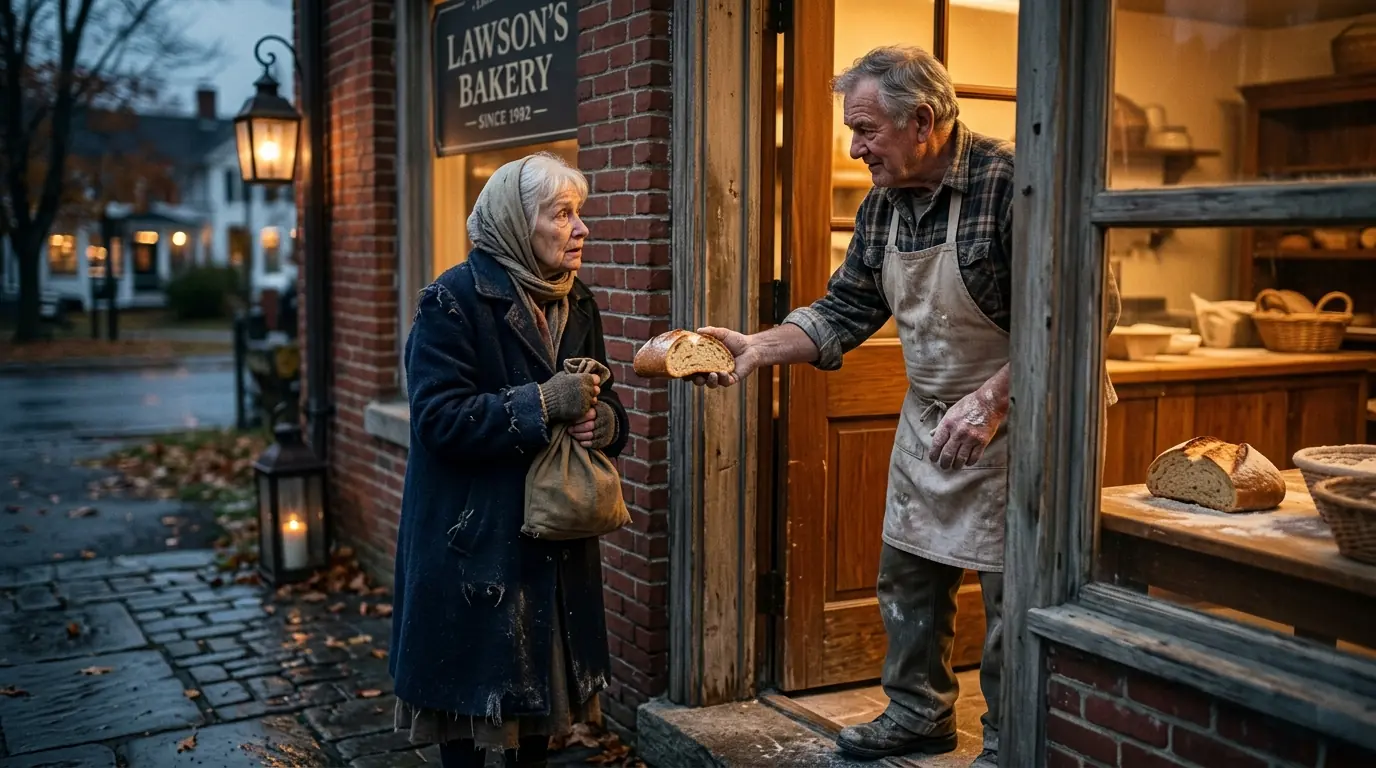 Just as he placed the last loaf on the counter, the bell above the door jingled softly. A small figure shuffled in, hunched against the cold wind. It was Mrs. Clara Whitman, an elderly woman in her late seventies, with thin white hair tucked beneath a faded scarf. Her coat, patched in several places, had seen better days, and her hands were red from the frost. She carried nothing but a small canvas bag, and her eyes, weary yet gentle, darted toward the counter.
“Good morning, Mrs. Whitman,” Henry said warmly, masking the worry in his chest. “Can I help you?”
The woman’s lips trembled as she tried to speak, but no words came out. She reached into her bag, fumbling for coins, but Henry noticed her hands were shaking so violently that she struggled to hold anything.
“I… I just wanted…” she began, voice barely audible.
Henry’s gaze softened. He glanced at the last loaf of white bread on the counter. His stomach twisted. He had to make a choice. It was all he had left, the last bread to feed himself for the day until he baked again. Yet, looking at Mrs. Whitman’s frail figure, he felt an immediate pang of responsibility, of empathy.
“Here,” he said gently, breaking off the loaf. “Take it. It’s fresh. It’s all yours.”
Mrs. Whitman’s eyes widened, tears welling up. “I… I can’t…” she whispered, shaking her head.
“Please,” Henry urged softly. “I insist.” He tore the bread in half and handed it to her. “You need it more than I do right now.”
She clutched the bread like it was a treasure, bowing her head in gratitude. “God bless you,” she murmured.
Henry nodded, a quiet warmth spreading in his chest despite the chill of the bakery. Watching her shuffle out into the street with the bread, he felt a strange mixture of emptiness and contentment. He had given away his last loaf, and yet, the act made the day feel fuller than any profit could.
The rest of the morning passed slowly. Henry cleaned the bakery, swept the floor, and stared out the window as townspeople went about their routines, some stopping to wave or exchange greetings. Word of his kindness had yet to spread, and for now, he remained just a baker with empty shelves.
By mid-afternoon, a soft knock came at the door. Henry opened it to find no one standing there. Confused, he stepped outside, only to see a small envelope pinned to the bakery door with a string. He untied it carefully, unfolding the paper inside. It read, simply:
"Thank you. Your kindness will never be forgotten. – C.W."
Henry smiled faintly, folding the note and tucking it into his apron pocket. He did not know if she had money, or even a way to repay him. But the simple acknowledgment warmed him more than any customer ever could.
The week dragged on. Henry continued to bake daily, carefully replenishing his stocks, though he never again had a loaf go unclaimed. Each morning, he would glance at the door, half-expecting to see Mrs. Whitman, but she did not appear. Yet, Henry felt the connection lingering in the back of his mind, the quiet reminder that small gestures could have profound impact.
One Friday afternoon, just as Henry was wiping flour off his hands and preparing to close the bakery, the bell above the door jingled. This time, the visitor was unmistakably familiar. Mrs. Whitman entered, but she was not alone. Behind her walked a young man, dressed neatly in a tailored coat, carrying a small gift bag. His presence was confident, his eyes kind.
“Good afternoon, Mr. Lawson,” he said, his voice steady. “I hope I’m not intruding.”
Henry blinked, startled. “Mr…?”
“I’m Daniel Whitman,” the young man said, offering a hand. “Clara is my grandmother.”
Henry’s mind raced. “Oh… yes, yes, of course. How are you?”
Clara Whitman stepped forward, leaning lightly on Daniel’s arm. Her eyes sparkled with an unusual brightness. “I wanted you to meet my grandson,” she said. “And to thank you properly.”
Daniel placed the gift bag on the counter and opened it carefully. Inside were several freshly baked loaves, carefully wrapped, and a small handwritten note:
"For the baker who shared his last bread with my grandmother. Your kindness fed more than hunger—it fed hope."
Henry felt his eyes sting. He shook his head, chuckling softly. “You didn’t have to do this. Really, it was nothing.”
“Nothing?” Clara said, her voice firm yet gentle. “It was everything. That loaf of bread… you reminded me that people care. That kindness exists. And you gave it without expecting anything in return.”
Daniel smiled. “Grandmother has told me many times about your generosity. I wanted to show you that it mattered, that it changed her week, and it changed mine. We’ve come to offer something in return—not because you need it, but because we believe acts of kindness should be acknowledged and carried forward.”
Henry shook his head, overwhelmed. The bakery, which had seemed so ordinary for decades, suddenly felt alive with meaning. The gift, the presence of Clara and Daniel, and the knowledge that his small act had rippled outward, stirred something deep in him.
“Please,” Daniel continued, “consider this a token of gratitude. And also… if you ever need help with supplies, or a place to deliver bread to those in need, we would like to support you.”
Henry’s voice caught in his throat. “I… I don’t know what to say. Truly, I don’t.”
“You don’t need to say anything,” Clara said, taking his hand briefly. “Just keep baking. Keep being kind. That’s all anyone asks.”
The following week, Henry found himself delivering extra loaves to the local shelter, to families struggling through the winter. Daniel helped, and Clara often joined, smiling as she watched Henry hand bread to those whose eyes widened with surprise and gratitude. The bakery, once a quiet corner of Cedarwood, had become a small hub of community kindness.
Henry realized that giving away his last loaf had not only filled the stomach of a hungry old woman—it had sparked a chain of goodwill, bringing strangers together, reconnecting family, and reaffirming the power of compassion in a world that so often seemed indifferent. That day, he understood fully that even the smallest act of generosity could echo far beyond the moment, changing lives in ways he might never see but could always feel.
And as he closed the bakery each evening, brushing flour from his apron, Henry smiled, knowing that kindness, like bread, was meant to be shared—and that sharing it could bring blessings in forms both expected and wonderfully surprising.