“I hope you know whose space you’re standing in,” Big Jack said, leaning across the motorcycle until his face was inches from the soldier’s.
Elijah Carter kept one hand wrapped around the fuel nozzle beside his silver sedan. Six motorcycles surrounded the pump island, their engines growling beneath the harsh white lights of the lonely Mississippi gas station. Big Jack’s riders watched from behind dark visors, waiting for the quiet Black man in Army fatigues to become frightened.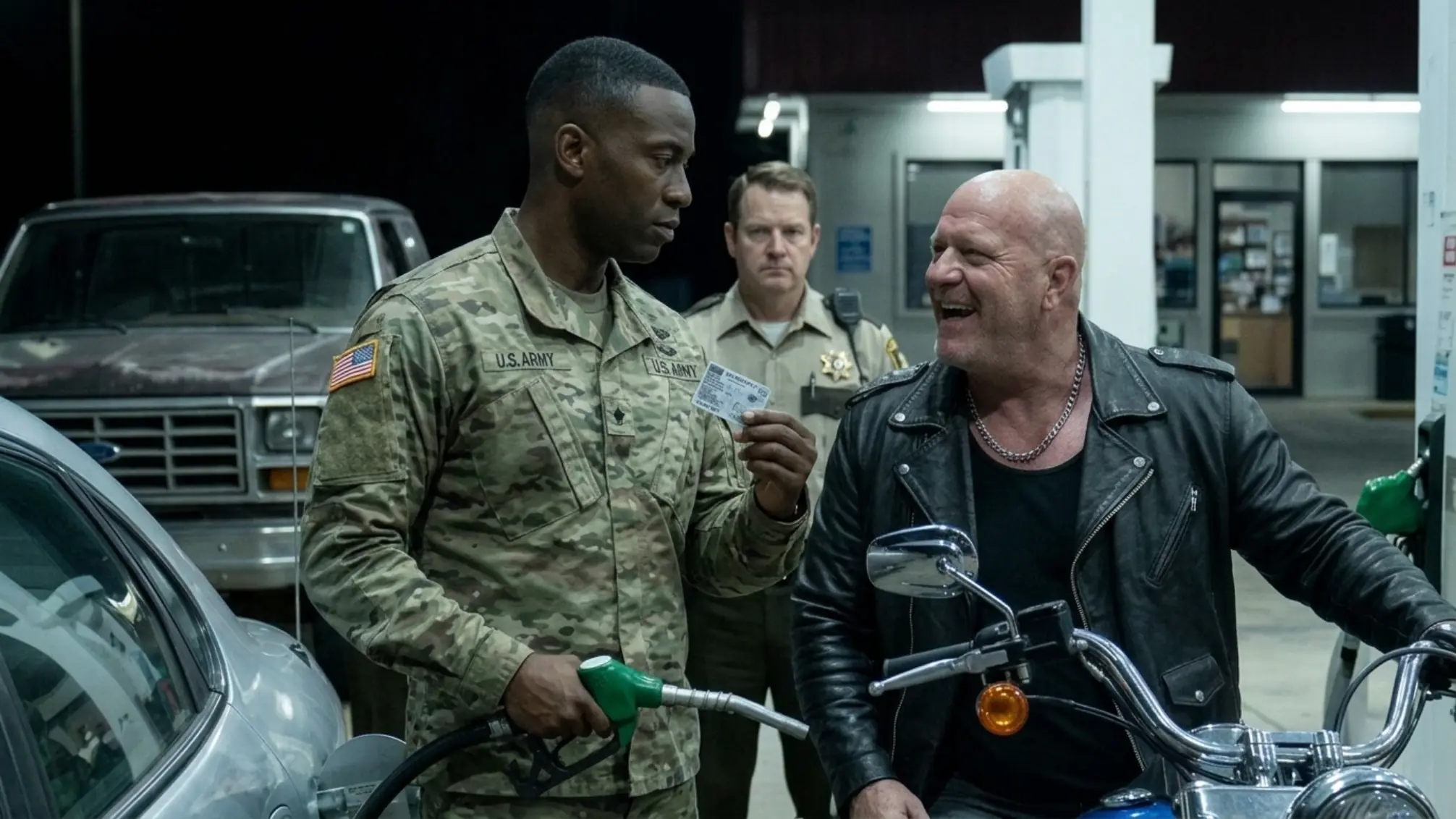
Elijah reached into his breast pocket and removed a thin silver card. “I know exactly whose space this is.”
Jack looked down at the card and laughed. “Then kneel before I break those weak legs again.”
A voice came from behind the parked pickup truck. “Touch my former commander, Jack, and your whole club leaves in cuffs.”
Sheriff Thomas Hale stepped into the light with one hand resting near his duty belt. His weathered face remained stern as he looked past the biker and directly at Elijah.
Then the sheriff straightened his back and saluted.
The motorcycles fell silent one by one.
Big Jack’s smile vanished.
Elijah returned the salute without ceremony, holding it for only a second before lowering his hand. He did not appear surprised to see Thomas, but something heavy passed between the two men—recognition, memory, and a history no one else at the station understood.
Jack looked from the sheriff to Elijah. “You know this fraud?”
Thomas took another step forward. “That man commanded my unit for four years.”
The biker stared at Elijah’s soft black running shoes and worn uniform. “He looks like he came from a costume store.”
Thomas’s expression hardened. “He pulled me out of a burning vehicle while half his leg was open to the bone. Choose your next words carefully.”
The other riders shifted uneasily.
Elijah replaced the silver card in his pocket. It was not an identification card, a rank credential, or a decoration meant for public display. The polished metal carried only a number, an eagle crest, and the insignia of Task Force Sentinel, a joint special-operations logistics unit that officially no longer existed.
Every member of the unit had received one after its final mission.
Only eleven cards had been made.
Four belonged to men who never returned home.
Thomas had recognized the edge of the card before Elijah fully removed it.
Big Jack climbed off his motorcycle. He was fifty-one, bald, broad through the shoulders, and heavy enough that the leather beneath his arms creaked when he moved. A silver chain hung across his chest, and his steel-toed boots struck the concrete with slow, deliberate force.
“This pump belongs to us tonight,” Jack said. “Sheriff or no sheriff.”
Thomas glanced toward the five riders. “The station belongs to Mrs. Dawson.”
“She closed early.”
“She closed because your men threatened her grandson.”
Jack smiled again, but there was no humor in it. “You got proof?”
“Not yet.”
“Then maybe you should drive away.”
Elijah studied the arrangement around the station. The motorcycles blocked the register entrance, the public road, and both exits from the pump island. One rider stood near the electrical panel beside the ice machine. Another watched the security camera mounted above the door.
This was not a random group stopping for fuel.
They had taken control of the property.
Elijah replaced the nozzle in the pump and tightened the cap on his sedan. “Thomas, how long has this been happening?”
The sheriff did not answer immediately.
That hesitation told Elijah enough.
“Three months,” Thomas finally said. “Maybe longer.”
Jack stepped closer. “This isn’t your command post, soldier.”
Elijah looked at him calmly. “No. But you’ve positioned your riders like an outer security ring, blocked both vehicle exits, and placed one man beside the camera controls. Either you’re the most organized group of tourists in Mississippi, or you came here to prevent someone from leaving.”
Big Jack’s eyes narrowed.
One of the riders near the store quietly moved his hand beneath his jacket.
Thomas saw it. “Keep your hands visible.”
Jack ignored the warning. “You think because the sheriff saluted you, we’re supposed to be impressed?”
“No.”
“Then what are we supposed to do?”
“Cut the engines and move away from the entrance.”
Jack laughed loudly. “You still giving battlefield orders?”
Elijah met his eyes. “Only when men mistake noise for control.”
The laughter stopped.
Jack lunged.
His right hand shot toward Elijah’s throat while his left shoulder drove forward with the force of his entire body. He expected the soldier’s damaged knees to make him slow.
Elijah shifted his weight onto his right foot, caught Jack’s thick wrist, and rotated beneath the attack. Years of training moved through him before pain had time to interfere. Jack’s momentum carried him across the concrete, and Elijah redirected it with a compact twist.
The biker hit the ground hard.
Elijah pinned his wrist behind his back and placed one knee between Jack’s shoulder blades. He applied enough pressure to control him without striking once.
“Tell your boys to cut the engines,” Elijah said.
The five riders froze.
Jack tried to rise, but Elijah increased the pressure by less than an inch. The larger man stopped moving.
Thomas drew his weapon but kept it pointed toward the pavement. “Engines off. Hands visible.”
One rider obeyed.
Then another.
Within seconds, the station became quiet except for the electrical hum of the pumps and Jack’s angry breathing against the concrete.
Porch lights began appearing across the road. Residents who had spent weeks pretending not to see the motorcycles were now standing behind curtains and screen doors.
Jack turned his face enough to speak. “You just assaulted me in front of witnesses.”
“You attacked him,” Thomas said.
“He threw me down.”
“You reached for his throat.”
“My men saw different.”
Elijah looked toward the security camera. Its indicator light was dark.
Jack smiled despite his position. “Camera’s been broken for weeks.”
Elijah’s gaze moved toward the station canopy. A second camera sat above the diesel pumps, angled toward the road rather than the store. Its small infrared light remained active.
“Not that one,” he said.
Jack’s smile disappeared.
Thomas looked upward. “Mrs. Dawson told me that system was dead.”
“It isn’t connected to the store system,” Elijah replied. “It has a separate power feed running through the canopy.”
“How can you tell?”
“The cable is newer than the others.”
Elijah released Jack only after Thomas had placed him in handcuffs.
The biker rose slowly, humiliation burning across his face. “You’re making the worst mistake of your life, Hale.”
Thomas secured the second cuff. “I’ve already made worse mistakes by waiting this long.”
The riders were searched one by one. Deputies arrived within ten minutes and found three concealed handguns, two bags of methamphetamine, a set of bolt cutters, and more than twelve thousand dollars in cash.
Jack claimed the money belonged to the motorcycle club.
Elijah looked at the bills. Each bundle was wrapped with a narrow yellow bank strap.
“Where did you get these?” he asked.
Jack turned away.
Thomas picked up one bundle. “Why?”
“The Farmers Trust branch in Canton uses yellow currency straps for business deposits.”
Thomas looked toward the locked gas station.
Every Friday night, Mrs. Dawson prepared the week’s cash deposit and placed it inside a floor safe beneath the register. She normally drove it to the bank on Saturday morning.
That night was Friday.
The motorcycles had not surrounded the station to claim a pump.
They were waiting for someone to open the safe.
Thomas ordered a deputy to find Mrs. Dawson.
They discovered the seventy-two-year-old owner and her grandson hiding inside the stockroom. The rear door had been chained from the outside, preventing them from escaping.
Mrs. Dawson’s hands shook as Thomas cut the chain.
She looked at Big Jack through the glass and whispered, “He said he’d burn the store if I called you.”
“Why didn’t you tell me sooner?”
Her eyes filled with tears. “Because one of your deputies works for him.”
The sentence changed everything.
Thomas closed the stockroom door and asked which deputy.
Mrs. Dawson pointed toward the road.
Deputy Calvin Pierce had arrived with the second patrol vehicle. He stood near Elijah’s sedan, speaking quietly with one of Jack’s riders.
When he noticed Thomas watching, his hand moved toward his radio.
Elijah saw the change in his posture.
“Thomas,” he said.
Pierce ran.
He crossed the pump island and headed for the wooded drainage ditch behind the station. Thomas shouted for him to stop, but Pierce accelerated, pulling something from his jacket as he reached the darkness.
Elijah moved before the deputies.
His knees protested violently as he crossed the concrete, but he shortened his stride and used the pump columns as cover. Pierce turned with a pistol in his hand.
“Stay back!”
Elijah stopped behind the last concrete barrier.
Thomas approached from the opposite side. “Calvin, lower the gun.”
“You don’t know what’s happening.”
“I know you’re pointing a weapon at an unarmed man.”
“Jack said nobody would get hurt.”
From the ground beside the motorcycles, Big Jack shouted, “Shut your mouth!”
Pierce looked toward him.
That moment of distraction was enough.
Elijah stepped forward, seized the deputy’s wrist, and drove the pistol upward before Pierce could fire. Thomas closed the distance and forced him to the ground.
The gun discharged once into the station canopy.
No one was injured.
Pierce began speaking as soon as the cuffs closed.
He had joined Jack’s operation eighteen months earlier after accumulating gambling debt. At first, he provided patrol schedules and warned the club when state investigators entered the county. Later, he began redirecting emergency calls away from the roads Jack used to transport stolen weapons and narcotics.
The gas station was only one target.
Jack’s group had been extorting small businesses throughout three counties. Owners paid monthly “security fees” to prevent vandalism, theft, and fires. Those who refused suddenly failed inspections or found deputies arriving too late to stop crimes.
Pierce was not the only officer involved.
He named two deputies, a county evidence clerk, and the former undersheriff.
Thomas listened with increasing disbelief.
He had trusted some of those men for years.
Big Jack watched him from beside the motorcycles. “You think he’ll admit his own part, Sheriff?”
Thomas turned slowly. “What part?”
Jack leaned against the patrol vehicle. “Ask him why my club operated for three months without a single arrest.”
“I was building a case.”
“You were protecting an election.”
Thomas’s jaw tightened.
Sheriff Hale faced voters in six weeks. Publicly acknowledging that armed bikers controlled businesses inside his county could destroy his campaign. He had delayed requesting state assistance because he believed his department could manage the problem quietly.
That delay gave Jack time to expand.
Elijah looked at his former soldier and saw the same flaw Thomas had carried into combat. He was brave in immediate danger but often tried to bear responsibility alone until silence became its own form of failure.
“You knew something was wrong,” Elijah said.
Thomas looked toward Mrs. Dawson. “I suspected Pierce was leaking information. I didn’t know how deep it went.”
“So you waited.”
“I needed proof.”
“You needed control.”
Thomas lowered his eyes.
Elijah’s voice remained firm. “Those are not the same thing.”
The sheriff stood beneath the bright station lights, surrounded by deputies, residents, bikers, and the woman whose business had nearly been robbed because he delayed asking for help.
“You’re right,” he said.
Big Jack laughed. “There goes the election.”
Thomas removed his campaign pin from his coat and dropped it into his pocket. “Then it goes.”
He called the Mississippi Bureau of Investigation and requested immediate outside control of the scene. He also asked state police to secure every sheriff’s department computer, evidence locker, and radio log before anyone could destroy records.
The request placed his own office under scrutiny.
Elijah nodded once.
That was the decision he had been waiting to see.
State investigators reached the gas station before midnight. They recovered the canopy-camera footage, which showed Jack’s men arriving two hours earlier, chaining the rear door, and forcing Mrs. Dawson’s grandson away from the register.
It also recorded Pierce meeting Jack beside the pumps and receiving an envelope.
The cash inside Jack’s saddlebag was traced to three local businesses. Each owner had withdrawn matching amounts shortly before paying protection money.
Investigators found a handwritten ledger hidden beneath the motorcycle seat.
The book listed payments, threats, stolen shipments, and initials belonging to county employees. Beside each name appeared a percentage.
Pierce received eight percent.
The evidence clerk received five.
The former undersheriff received fifteen.
A final set of initials—T.H.—appeared beside several entries.
State investigators looked at Sheriff Thomas Hale.
Big Jack smiled from the back of the patrol car. “Told you.”
Thomas did not protest when investigators temporarily took his badge and phone.
Elijah asked to see the entries.
The payments marked T.H. did not occur on dates Thomas was in the county. During each one, he had been attending state training or medical appointments in Jackson.
Someone used his initials to create protection.
Elijah examined the descriptions beside them. They referred to “route approval,” but no money amount appeared.
“Those aren’t payment records,” he said.
The lead investigator frowned. “What are they?”
“Authorization codes.”
Thomas looked at the ledger. “I never authorized routes.”
“No,” Elijah said. “But someone wanted the riders to believe you had.”
The initials belonged to Timothy Hayes, the former undersheriff.
Hayes had deliberately chosen the same initials as Thomas Hale when writing the ledger, ensuring suspicion would fall on the sheriff if the records were discovered.
He was arrested the next morning while attempting to cross into Louisiana.
Searches of his property uncovered firearms, narcotics, stolen vehicle parts, and more than four hundred thousand dollars in cash. Investigators also found campaign documents suggesting Hayes planned to expose the biker operation immediately before the election, blame Thomas, and run for sheriff after his resignation.
Big Jack’s club was not simply paying Hayes.
It was helping him manufacture a political collapse.
Thomas was cleared of taking bribes, but the state report did not excuse his delays. It concluded that his reluctance to request outside assistance allowed intimidation to continue and placed witnesses at risk.
He accepted the finding publicly.
“I believed asking for help would make me look weak,” he told reporters. “Instead, waiting made innocent people less safe.”
He withdrew from the election.
The county expected him to fight for his position.
He chose accountability instead.
Elijah remained in Mississippi longer than planned.
His mother waited for dinner until nearly two in the morning, then reheated the food without asking why his uniform was torn or why mud covered his running shoes.
She was seventy-eight and had learned years earlier that her son spoke when he was ready.
“You found trouble again,” she said.
“It found a gas station.”
“And you happened to be standing there?”
“Yes, ma’am.”
She placed cornbread on his plate. “Trouble has excellent timing around you.”
Elijah smiled faintly.
He had returned home because doctors at Walter Reed told him the damage in his knees would never fully heal. Two surgeries had restored movement but not strength. Cold weather brought pain, long drives caused swelling, and the soft running shoes Big Jack mocked were the only footwear he could tolerate for more than an hour.
The Army offered him a ceremonial position.
He declined.
For twenty-two years, Elijah led people through logistics failures, ambushes, evacuations, and disasters in places most civilians would never visit. He knew how to command under pressure.
He did not know how to live without being needed.
The silver card in his pocket reminded him of the unit he lost.
Task Force Sentinel had protected emergency supply routes during a deployment that officially never occurred. During its final mission, an armored transport struck an explosive device while carrying medical supplies toward an isolated field hospital.
Thomas had been inside the vehicle.
Elijah entered the fire twice.
The first time, he pulled Thomas free.
The second time, he returned for the driver.
A secondary explosion damaged both knees and killed two soldiers behind him.
Elijah spent years wondering why he survived when they did not.
The Army called the mission heroic.
He remembered only the names of the people he could not bring home.
Thomas visited the next evening.
He arrived without his uniform or badge, carrying two cups of coffee. Elijah sat on his mother’s porch with his legs extended beneath a blanket.
“You still drink it black?” Thomas asked.
“Unfortunately.”
Thomas handed him a cup and sat nearby.
For several minutes, neither spoke.
Then Thomas said, “I failed Mrs. Dawson.”
“Yes.”
“I expected you to tell me I did my best.”
“You knew better than your best.”
Thomas nodded. “That sounds like you.”
“You came here for comfort?”
“No.”
“Good.”
Thomas stared across the dark yard. “The state offered to let me remain until the end of my term.”
“What did you say?”
“I resigned.”
Elijah looked at him.
Thomas continued, “Not because Jack accused me. Because the people here needed a sheriff who would ask for help before someone got hurt.”
“That may be the first intelligent thing you’ve done since Afghanistan.”
Thomas laughed quietly.
Then his expression turned serious. “The county board asked whether I knew anyone qualified to oversee the emergency reform team.”
“No.”
“I didn’t finish.”
“You didn’t need to.”
“You would not be sheriff. You would advise the state investigators, rebuild procedures, and train deputies.”
“I came home to have dinner with my mother.”
“She said you’ve been home three weeks and repaired every broken hinge in her house twice.”
Elijah looked through the window.
His mother smiled from behind the curtain and disappeared.
“She invited you inside?” he asked.
“She gave me coffee and your medical schedule.”
“Betrayal.”
Thomas leaned forward. “You told me once that command does not end when the uniform comes off.”
“I was younger and dramatic.”
“You were right.”
Elijah looked at his damaged knees. “I cannot run anymore.”
“The job requires judgment, not running.”
“The gas station required both.”
“You still caught Pierce.”
“I’ll be paying for that for a week.”
Thomas placed the silver Task Force Sentinel card on the porch rail. Elijah had not realized it fell from his pocket during the confrontation.
“I saluted because you were my commander,” Thomas said. “But that card was never about rank.”
“No.”
“It was about the promise.”
The eleven surviving members of Task Force Sentinel made that promise after the final mission: if one of them saw danger being ignored, silence being rewarded, or authority being abused, he would act before waiting for permission.
The card was a reminder.
Four years later, Thomas had nearly forgotten.
Elijah picked it up.
“What happened to Jack?”
“He is talking. His attorney thinks cooperation may reduce the federal charges.”
“And the riders?”
“Two were new and claim they did not know about the extortion. Three appear in the ledgers. One is connected to a weapons shipment from Alabama.”
“Mrs. Dawson?”
“Reopened this morning.”
Thomas smiled slightly. “She placed a photograph of you beside the register.”
Elijah closed his eyes. “Take it down.”
“She refuses.”
“What photograph?”
“The one from the canopy camera. You have Jack facedown beside the motorcycles.”
“My mother cannot see that.”
“She already ordered three copies.”
Elijah sighed.
The investigation lasted fourteen months.
Big Jack pleaded guilty to racketeering, armed robbery, drug trafficking, unlawful imprisonment, and conspiracy with public officials. He attempted to describe himself as a businessman who merely provided security where law enforcement failed.
The video of him chaining an elderly woman inside her own store destroyed that defense.
Pierce testified against the network and received a reduced sentence, though he permanently lost his badge. The former undersheriff received decades in federal prison for organizing the corruption scheme and attempting to frame Thomas.
Seven businesses received restitution.
The gas station received new cameras, reinforced doors, and a direct emergency line funded through seized criminal assets.
Elijah accepted the reform position for six months.
He remained for three years.
He redesigned evidence procedures, required outside review of officer complaints, and created a rule preventing deputies from closing reports involving colleagues without state oversight. He also established a confidential system allowing small-business owners to report intimidation without routing complaints through local deputies.
The department initially resisted him.
Elijah did not care.
When one captain said civilians would never understand the pressure officers faced, Elijah placed the Task Force Sentinel card on the table.
“Pressure does not excuse corruption,” he said. “It reveals preparation.”
Thomas later returned to public service as the county emergency-management director. He never sought another law-enforcement position. He and Elijah rebuilt their friendship slowly, not through old war stories but through difficult conversations neither man could avoid.
Mrs. Dawson kept Elijah’s photograph beside the register.
Beneath it, she placed a handwritten sign:
The quiet man at Pump Three ended the loudest problem in the county.
Elijah hated the sign.
Everyone else loved it.
Years later, travelers still stopped at the station and asked about the Black soldier in the photograph, the bald biker beneath him, and the sheriff standing nearby with his hand raised in salute.
Mrs. Dawson always told the same story.
She explained that Big Jack saw running shoes, damaged knees, and a man traveling alone. He thought injury meant weakness and silence meant fear.
He never asked why the soldier carried a silver card.
He never wondered why the sheriff recognized it from across the station.
Most importantly, he never understood that the man standing in front of him had already survived enemies far more dangerous than a motorcycle club.
“I hope you know whose space you’re standing in,” Jack had warned.
Elijah knew.
It was a frightened woman’s gas station.
It was a compromised sheriff’s county.
It was a place where good people had remained silent long enough for criminals to mistake fear for ownership.
Elijah did not claim the space for himself.
He simply refused to leave it to them.
Then the biker lunged.
The soldier moved.
The sheriff stepped from behind the truck and saluted the commander who had once carried him out of fire.
By sunrise, the motorcycles were gone, the corrupt deputy was in handcuffs, the hidden ledger belonged to state investigators, and the entire county finally understood the chilling truth about the lone soldier:
His knees were broken.
His command was not.