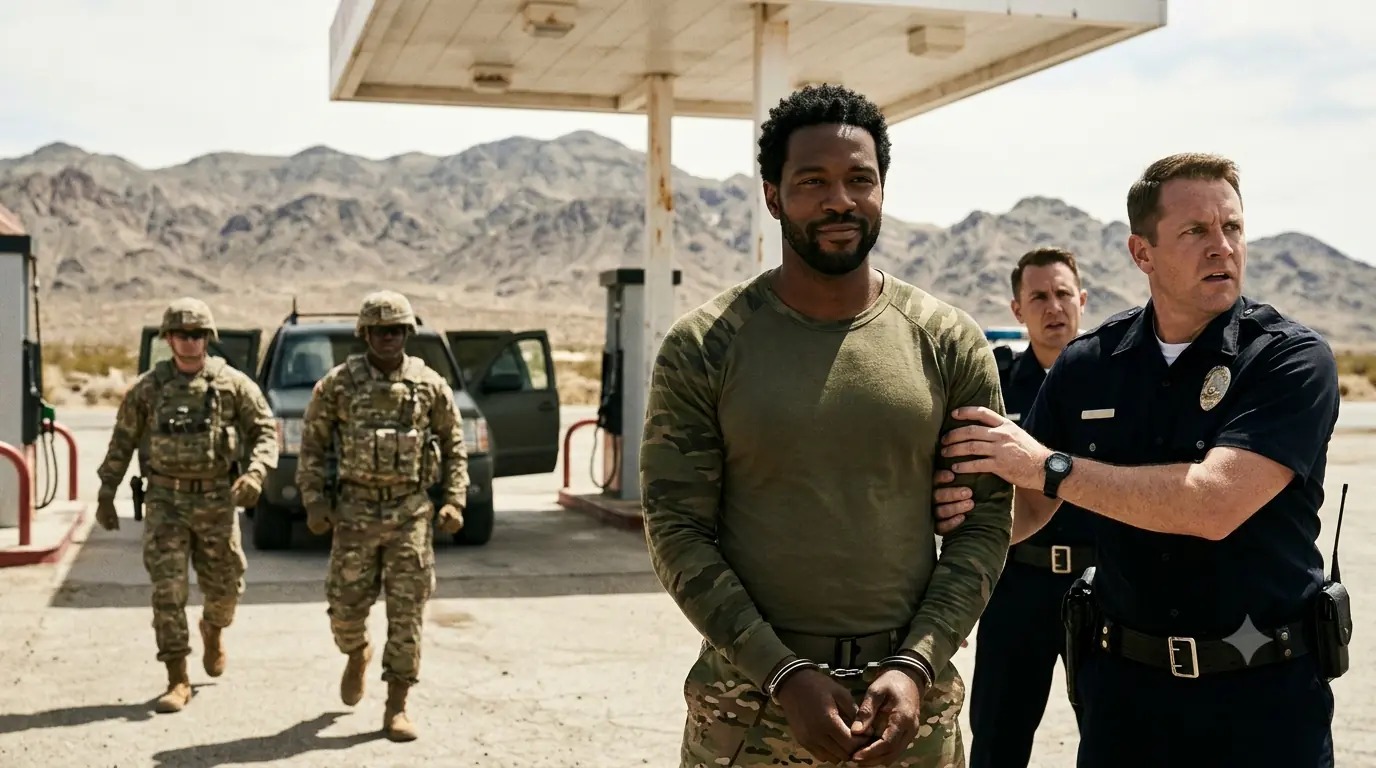
The first officer gripped the handcuffed man's upper arm hard enough to make the metal links bite into his wrists.
"You think you're some kind of soldier?" the officer asked.
The man stood beneath the white canopy of a gas station on a bright afternoon, surrounded by dusty cars, sun-bleached pavement, and distant mountains that looked blue through the heat. He wore a fitted olive-green camouflage shirt, camouflage trousers, and tan military boots. Short black curls framed his forehead, and his neatly trimmed beard did nothing to soften the anger gathering behind his calm expression.
He was thirty-eight years old. He had spent much of his adult life learning that the best answer to a foolish question was sometimes silence.
The other officer, older and broader through the shoulders, pointed toward the man's chest. "Bought that outfit online?"
"You need to check your information," the man said.
"No," the first officer replied. "You need to check your attitude."
The man lifted his cuffed wrists just enough for them to see the double-locked bracelets.
"You're making a big mistake."
Both officers laughed.
A semi hissed along the two-lane road behind the station. Somewhere near the convenience-store door, an ice machine rattled. The woman behind the counter had stopped pretending to stock cigarette cartons. She was watching from the glass.
Then an engine sounded from the eastern road, deeper than the pickups that usually stopped for fuel. The man's eyes shifted past the two officers.
A large camouflage military SUV pulled beneath the edge of the canopy. Three uniformed service members climbed out. They did not hurry, but there was something unmistakably purposeful about the way they looked from the gas pumps to the handcuffs.
The two officers stopped laughing.
The cuffed man kept his eyes on the approaching soldiers. For the first time since the confrontation began, he allowed himself a small, tired smile.
He had been trying to prevent this exact moment for forty-seven minutes.
And the mistake he had warned them about was only part of what the three soldiers had come to uncover.
Six days earlier, he had stood inside a maintenance building on an Army installation in southern Arizona, reading a shipping ledger while an overhead fan pushed warm air around the room. A lieutenant beside him was nervous enough to turn the pages twice before speaking.
"The serial numbers don't match the destination receipts," she said.
"I can see that."
"Someone signed for equipment that wasn't there."
"Maybe," the man replied. "Or someone entered the wrong number in a bad system. We establish which before we accuse anybody."
His name was Isaiah Bennett. He was thirty-eight, grew up in eastern North Carolina, and had entered the Army after two years of community college because he wanted a future wider than the mill town where his mother still lived. He had learned logistics the way other men learned weather: by knowing that tiny changes could become dangerous when nobody paid attention.