 He said the land kept records, and that if you watched long enough, you could learn to read them.
Maren Holloway was fourteen years old, and she had been reading them her whole life.
The Holloway farm sat on the eastern bend of the Cottonwood River in a stretch of Montana that most people drove through without stopping.
It covered three hundred acres of hayfield, pasture, and timber that had been there before anyone came with a deed.
The house had been built in 1911. The barn leaned a little to the south now, and her father said it had been leaning that way since before he was born.
Some things settled into their tilt and stayed there.
That spring, the river ran lower than it should have. It was not much, only three or four inches below the high-water mark on the Cottonwood near the ford.
Most people would not have noticed. Maren noticed.
She noticed that the killdeer were nesting twenty yards farther from the bank than they had the year before. She noticed that the cattails on the south slough had thinned out.
She also noticed that the wet patch at the base of the lower pasture, the one that had been wet every May since she could remember, was dry on top and soft underneath.
You could push a stick through it and feel nothing for the first six inches, then meet something cold and yielding below.
She wrote it all down in a green spiral notebook she kept in the kitchen drawer.
She recorded dates, water levels, where the deer were drinking, which gates the cattle refused to walk through, and which ones they crowded toward in the afternoon.
Her grandfather had kept the same kind of notebook for fifty-three years.
They were stacked in a wooden crate in the loft, all of them filled with his small, neat handwriting. Maren had read every one.
She was not a strange child. She simply listened more than she talked.
The trucks came in late April.
Three white pickups arrived with a logo on the doors, a stylized shield above the words Continental Trust Bank, Commercial Real Estate Division.
Behind the trucks came a low loader carrying a yellow survey rig. Behind that came a black SUV that did not look as though it belonged on a gravel road.
They stopped at the fence line where the Holloway property ended and the old Pruitt place began.
The Pruitt place covered five thousand acres.
The Pruitts had sold the previous fall after the last brother died and the heirs decided that none of them wanted to return to Montana.
Continental Trust had bought the parcel outright through its commercial division.
The feed store called it a long-term hold, with plans to develop and lease the property.
The land had sat quiet through the winter. Now it was not quiet anymore.
Maren watched from the kitchen window while she rinsed her cereal bowl.
“They started early,” her father said behind her as he pulled on his canvas jacket.
He was forty-six and looked older. He had been running the farm alone since her grandfather’s stroke two summers earlier.
“It’s the bank’s land now,” he continued. “They’re putting in some kind of logistics hub, distribution center, or agricultural processing facility.”
“On the Pruitt land?”
“On all of it.”
She set the bowl in the rack. “All five thousand acres?”
“That’s what the man at the feed store said. The bank flew its people in from Denver.”
She dried her hands on the towel and looked out at the white trucks again.
Three men had gotten out and were standing near the corner post. One held a tablet and gestured toward the slope that ran down to the river bottom.
It was the slope where the ground went soft in May.
“Dad?”
“Mm-hmm?”
“That’s a bad place to build.”
He looked at her for a long second.
He knew what she meant. He had grown up on that land, too.
But he was tired, and eight hundred dollars in veterinary bills sat on the kitchen table.
“It’s not our land, Maren,” he said. “The bank can do what it wants with it.”
She nodded because she understood. Then she went and got her notebook anyway.
The first time she met the bank team was on a Tuesday.
She was walking the fence line the way she did every week, checking for breaks in the wire and studying the ground where the Holloway cattle crossed.
The three men in the white trucks had become four men and one woman.
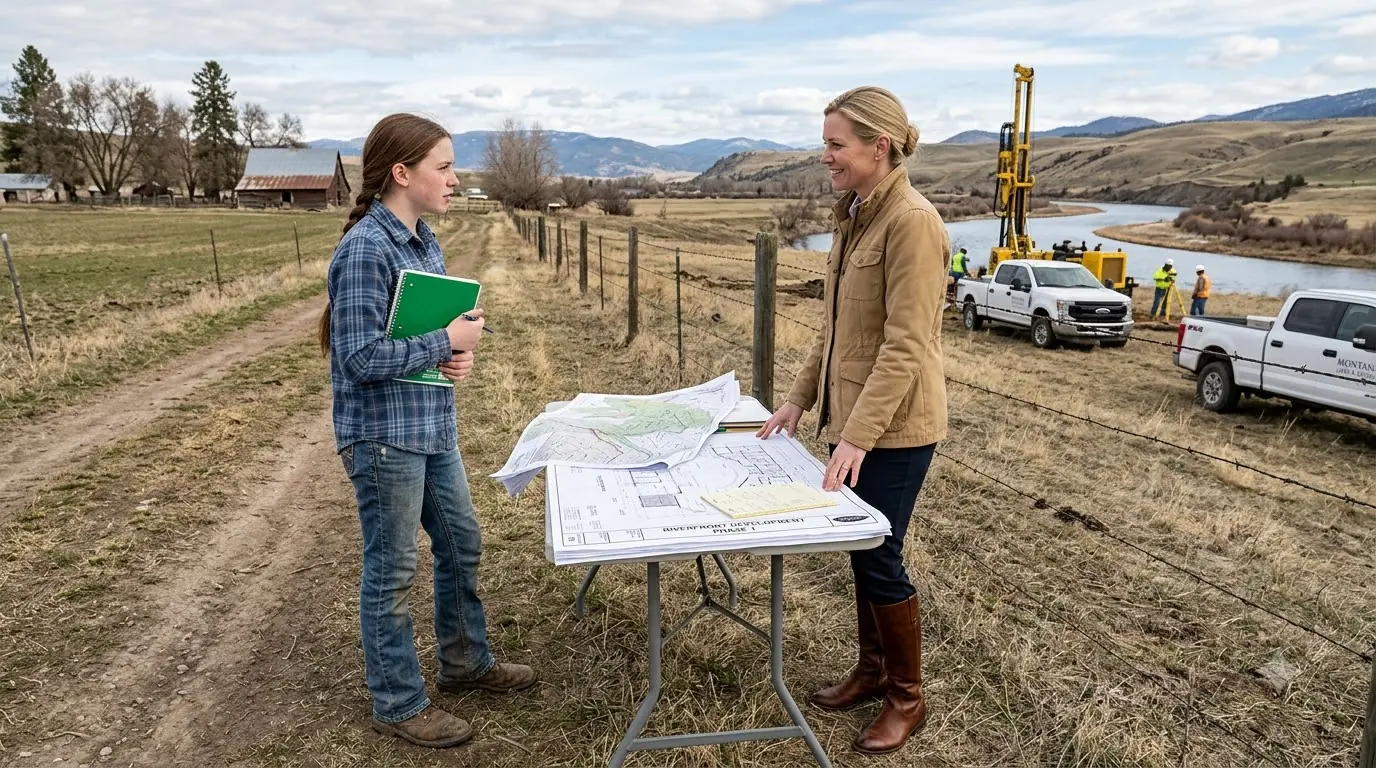
They stood around a folding table on the bank’s side of the fence, with a roll of plans weighted down by river stones.
The woman saw her first.
She was about forty, with blonde hair pulled back and expensive boots that had not yet been broken in.
“Hey there,” the woman said. “Do you live around here?”
Maren pointed across the fence. “Right there.”
“Oh, perfect. We’re going to be neighbors, sort of.”
She smiled, and it was a real smile, not an unkind one.
“I’m Lauren Castille. I’m with Continental Trust, the bank that owns this parcel now.”
“We’re managing the development project.”
Maren looked at the plans on the table.
She could not read them upside down, but she could see the layout.
A long rectangular building labeled Phase One sat near the river bottom, with what appeared to be parking and a holding yard above it.
Two more phases stretched up the slope toward the timber.
“You’re putting the main building down there?” Maren asked.
Lauren glanced at the plans. “The processing facility, yes.”
“We need rail access, and the spur line runs along the bottom.”
“Why?”
Maren considered her words.
Her grandfather had taught her that you only got one chance to be heard by people who were not listening, and you should not waste it on the wrong sentence.
“The river doesn’t stay where you think it does,” she said.
Lauren tilted her head, still smiling. “What do you mean?”
“It moved twice in my grandfather’s lifetime. There’s an old channel under that bottom.”
“You can see it in the spring. The grass comes in differently, and the ground stays soft a long way down.”
“It runs from the high pasture toward our spring.”
One of the men looked up from his tablet.
He was older and wore a fleece vest with the bank’s shield on the chest.
“We have a geotechnical survey scheduled for next week,” he said. “They’ll drill test pits across the entire footprint.”
“We appreciate the warning, though.”
He said it kindly. That was the part that hurt.
He was not sneering. He was being polite to a child.
“The pits won’t be in the right places,” Maren said. “The channel curves.”
“It doesn’t run straight.”
The man smiled. “We use a licensed firm out of Billings.”
“They know what they’re doing.”
“The bank would not approve the project otherwise.”
She nodded because there was nothing else to say.
She put her hands in her jacket pockets and walked back along the fence.
Behind her, she heard Lauren say something quietly. One of the younger men laughed.
It was only a small laugh, the kind people make when they believe something is harmless.
That night, Maren opened her grandfather’s notebook from 1987.
She found the entry dated May 14 of that year.
“Bottom field flooded again. Third time in eleven years.”
“Old channel running. Cattle wouldn’t drink at the south trough.”
Maren wrote her own entry beneath it.
The drilling rig came on a Thursday.
It set up on the high ground first and drilled three test pits along the upper slope where the timber thinned.
The samples came up dry and firm.
The geotechnical engineer, a man named Patel, moved the rig down the slope in stages.
He pulled cores every two hundred feet on the grid the bank’s architects had given him.
When they reached the bottom, the rig brought up samples that looked normal at every drilling point.
There was brown silt, some clay, and a few river stones.
Patel marked the samples, bagged them, and photographed them.
He drilled to twelve feet at each location because that was the depth specified in the contract.
At each point, he reached firm ground at about eleven feet.
What the grid did not account for was the curve.
Maren knew, while watching him, that the buried channel curved through the bottom land like a lazy letter S.
Patel’s grid points were falling on either side of it without ever crossing it.
Her grandfather had walked her along the curve during the summer she was nine, pointing out where the grass changed color in dry years.
Patel missed the channel laterally by twenty feet in one place and thirty feet in another.
To him, the bottom looked solid because the grid said it was solid.
Maren did not say anything. She had already said her piece.
They broke ground in June.
The graders came first, stripping topsoil from the building footprint and pushing it into long berms along the eastern edge.
Then the excavators arrived and began digging the foundation pad.
They had to go down eight feet for the slab and the loading-dock pits.
At six feet on the riverside, they hit water.
It was not much, only a seep, a wet darkening in the wall of the excavation.
Patel returned and examined it.
He took readings and told the foreman it was within tolerance.
There was groundwater in any river bottom, he explained. They would install a drainage course and vapor barrier and continue.
The foreman, who had built projects in many places, agreed.
The bank’s project office in Denver approved the variance that same afternoon.
The footings were poured on a Wednesday in late June. The slab went down the following Tuesday.
Maren wrote it all down because she did not know what else to do.
The first hairline crack appeared in late August, eight weeks after the pour.
It crossed the northeast corner of the slab and looked like the kind of flaw a finishing crew might notice and call within tolerance.
By the middle of October, it had widened to a quarter of an inch.
Two more cracks had appeared beside it, all running in the same direction on the riverside of the building.
The steel frame went up that month, and the loading on the slab increased.
The engineers returned and argued about the cause.
One blamed the concrete mixture. Another blamed the curing process.
A third engineer, a younger woman with a master’s degree from the Colorado School of Mines, walked the perimeter for two hours.
Then she asked the foreman whether anyone had drilled deeper than twelve feet anywhere on the bottom or outside the grid.
Nobody had.
She returned to her car and made several phone calls.
By November, the exterior cladding was halfway installed.
That was when Maren noticed that the cattle had stopped drinking from the south trough.
The trough was fed by a spring at the base of the slope on the Holloway side of the fence.
The spring sat lower than the construction site.
The bottom land sloped gently south-southwest, and the spring emerged at the toe of the slope on the Holloway property, down-gradient from the bank’s construction footprint.
The spring had run clean for Maren’s entire life.
Her father tasted the water that morning and spat it out.
It had a faint but unmistakable metallic edge.
He called the county extension office. An employee came out and collected a sample.
Two weeks later, the report arrived.
It showed elevated turbidity, trace petroleum compounds, and suspended sediment consistent with disturbance of an upstream aquifer.
Her father read the report twice.
Then he went outside and stood on the porch for a long time.
When he returned, he said, “Get your notebook.”
The meeting was held at the county extension office on a Thursday in early December.
Maren’s father drove her there.
She wore a blue flannel shirt and her good boots. Her notebook rested on her lap.
Lauren Castille was there, along with the older man in the fleece vest.
His name was Derek Holm, vice president of commercial real estate.
Patel attended, as did the younger engineer from the Colorado School of Mines, whose name was Ms. Aguilar.
A representative from the Department of Environmental Quality was there, along with the county commissioner and a lawyer for Continental Trust who said very little.
The meeting concerned the spring, the contamination, and what would happen next.
Ms. Aguilar spoke first.
She had conducted her own analysis and reviewed historical aerial photographs dating back to 1954.
She had also found the original soil survey from the 1970s.
On her own initiative, she had identified a buried paleochannel running diagonally beneath the building site.
It curved through the footprint in a long S, oriented in places forty degrees away from the test grid.
The channel was filled with permeable alluvium to a depth of forty-four feet.
Patel’s twelve-foot test pits had landed on either shoulder of the channel and missed it laterally.
The foundation had been placed across the deepest part of the channel rather than parallel to it.
The slab cracks were caused by differential settlement.
The contamination of the Holloway spring was caused by construction runoff entering the buried channel at the excavation.
The runoff then traveled downhill through the gravel and emerged at the spring outlet on the Holloway property.
Ms. Aguilar had prepared a map and placed it on the table.
Maren looked at it.
The channel on Ms. Aguilar’s map, drawn in red, ran exactly where her grandfather had walked her when she was nine.
The room went silent.
Derek Holm cleared his throat.
“I’d like to ask whether anyone mentioned the existence of this channel before construction began,” he said.
Patel looked at his hands. Lauren Castille looked at Maren.
Maren did not say anything because she did not need to.
Her father spoke quietly. “My daughter told you in April.”
Things moved quickly after that.
The Department of Environmental Quality issued a formal notice.
Continental Trust had to stop construction and commission a complete hydrogeological study.
The cost estimate came in at just over four million dollars, in addition to the seventeen million dollars the bank had already spent on the project.
The slab would have to be removed.
The building would need to be redesigned, relocated, or both.
The Holloway spring would be remediated at the bank’s expense.
The family would also receive a settlement for the loss of use.
But that was not the part that mattered most.
The part that mattered was the second meeting, held in January at the same extension office.
Ms. Aguilar was there.
Derek Holm was there, too.
A man named Vance had flown in from the bank’s regional headquarters in Denver.
He introduced himself to Maren by name and shook her hand.
He brought a roll of new plans and spread them across the table.
Then he asked Maren to explain what she knew about the bottom land.
He was not asking about the channel because they understood the channel now.
He wanted to know about the other things, including frost pockets, drainage patterns, and the places her grandfather had marked.
Maren looked at her father. He nodded.
She opened her notebook and talked for one hour and ten minutes.
They took notes.
Ms. Aguilar asked questions, and Maren answered in the short, calm sentences her grandfather had taught her to use.
At one point, she pointed to a proposed retention pond and explained why the ground there would not hold water in August.
Vance wrote down her warning without arguing.
When the meeting ended, Derek Holm stayed behind.
He stood for a moment, looking at the green spiral notebook in Maren’s hands.
“How long have you been keeping that?” he asked.
“Since I was eight.”
“And before that?”
“My grandfather. He started in 1971.”
Derek nodded slowly.
He looked tired in a way he had not looked in April.
“We should have asked you,” he said.
“In the spring?”
“When you came to the fence.”
Maren thought about it.
Then she gave him the small, even nod her grandfather used when there was nothing more to say.
Derek held out his hand. Maren shook it.
By the following spring, the new plans had been finalized.
The processing facility was rebuilt on the upper bench, three hundred yards east of the original site, on firm ground that drained naturally to the north.
The bottom land was left untouched.
The bank placed it under a conservation easement, partly as a gesture of goodwill and partly because the engineers finally understood that no amount of money could make the ground suitable for construction.
The buried channel continued to run where it had always run.
The killdeer returned to nest in their old places.
Maren turned fifteen in May.
In June, she came home from school and found a thick envelope on the kitchen table.
Inside was a professionally bound copy of the new site plan.
A note from Ms. Aguilar had been clipped to the cover.
“We named the watershed feature after your grandfather: the Holloway paleochannel.”
“It will be in the county records now. A.”
Her father read the note over her shoulder.
He did not say anything.
After a while, he went outside and stood on the porch in the blue hour, watching the mist crawl out of the low places.
Maren joined him there, the way she always had.
The river ran where it ran.
The land kept its records.
Somewhere in a bank office in Denver, a hand-drawn map of a Montana valley hung on the wall behind a vice president’s desk.
A young girl’s name was written in one corner, where everyone who entered the room could see it.
Some knowledge does not appear in reports.
Sometimes, however, if you listen long enough, it finds its way into them anyway.The valley remembers things people forget.
That was what her grandfather used to say, standing on the porch in the blue hour before sunrise and watching the mist crawl out of the low places like something breathing.
He said the land kept records, and that if you watched long enough, you could learn to read them.
Maren Holloway was fourteen years old, and she had been reading them her whole life.
The Holloway farm sat on the eastern bend of the Cottonwood River in a stretch of Montana that most people drove through without stopping.
It covered three hundred acres of hayfield, pasture, and timber that had been there before anyone came with a deed.
The house had been built in 1911. The barn leaned a little to the south now, and her father said it had been leaning that way since before he was born.
Some things settled into their tilt and stayed there.
That spring, the river ran lower than it should have. It was not much, only three or four inches below the high-water mark on the Cottonwood near the ford.
Most people would not have noticed. Maren noticed.
She noticed that the killdeer were nesting twenty yards farther from the bank than they had the year before. She noticed that the cattails on the south slough had thinned out.
She also noticed that the wet patch at the base of the lower pasture, the one that had been wet every May since she could remember, was dry on top and soft underneath.
You could push a stick through it and feel nothing for the first six inches, then meet something cold and yielding below.
She wrote it all down in a green spiral notebook she kept in the kitchen drawer.
She recorded dates, water levels, where the deer were drinking, which gates the cattle refused to walk through, and which ones they crowded toward in the afternoon.
Her grandfather had kept the same kind of notebook for fifty-three years.
They were stacked in a wooden crate in the loft, all of them filled with his small, neat handwriting. Maren had read every one.
She was not a strange child. She simply listened more than she talked.
The trucks came in late April.
Three white pickups arrived with a logo on the doors, a stylized shield above the words Continental Trust Bank, Commercial Real Estate Division.
Behind the trucks came a low loader carrying a yellow survey rig. Behind that came a black SUV that did not look as though it belonged on a gravel road.
They stopped at the fence line where the Holloway property ended and the old Pruitt place began.
The Pruitt place covered five thousand acres.
The Pruitts had sold the previous fall after the last brother died and the heirs decided that none of them wanted to return to Montana.
Continental Trust had bought the parcel outright through its commercial division.
The feed store called it a long-term hold, with plans to develop and lease the property.
The land had sat quiet through the winter. Now it was not quiet anymore.
Maren watched from the kitchen window while she rinsed her cereal bowl.
“They started early,” her father said behind her as he pulled on his canvas jacket.
He was forty-six and looked older. He had been running the farm alone since her grandfather’s stroke two summers earlier.
“It’s the bank’s land now,” he continued. “They’re putting in some kind of logistics hub, distribution center, or agricultural processing facility.”
“On the Pruitt land?”
“On all of it.”
She set the bowl in the rack. “All five thousand acres?”
“That’s what the man at the feed store said. The bank flew its people in from Denver.”
She dried her hands on the towel and looked out at the white trucks again.
Three men had gotten out and were standing near the corner post. One held a tablet and gestured toward the slope that ran down to the river bottom.
It was the slope where the ground went soft in May.
“Dad?”
“Mm-hmm?”
“That’s a bad place to build.”
He looked at her for a long second.
He knew what she meant. He had grown up on that land, too.
But he was tired, and eight hundred dollars in veterinary bills sat on the kitchen table.
“It’s not our land, Maren,” he said. “The bank can do what it wants with it.”
She nodded because she understood. Then she went and got her notebook anyway.
The first time she met the bank team was on a Tuesday.
She was walking the fence line the way she did every week, checking for breaks in the wire and studying the ground where the Holloway cattle crossed.
The three men in the white trucks had become four men and one woman.
They stood around a folding table on the bank’s side of the fence, with a roll of plans weighted down by river stones.
The woman saw her first.
She was about forty, with blonde hair pulled back and expensive boots that had not yet been broken in.
“Hey there,” the woman said. “Do you live around here?”
Maren pointed across the fence. “Right there.”
“Oh, perfect. We’re going to be neighbors, sort of.”
She smiled, and it was a real smile, not an unkind one.
“I’m Lauren Castille. I’m with Continental Trust, the bank that owns this parcel now.”
“We’re managing the development project.”
Maren looked at the plans on the table.
She could not read them upside down, but she could see the layout.
A long rectangular building labeled Phase One sat near the river bottom, with what appeared to be parking and a holding yard above it.
Two more phases stretched up the slope toward the timber.
“You’re putting the main building down there?” Maren asked.
Lauren glanced at the plans. “The processing facility, yes.”
“We need rail access, and the spur line runs along the bottom.”
“Why?”
Maren considered her words.
Her grandfather had taught her that you only got one chance to be heard by people who were not listening, and you should not waste it on the wrong sentence.
“The river doesn’t stay where you think it does,” she said.
Lauren tilted her head, still smiling. “What do you mean?”
“It moved twice in my grandfather’s lifetime. There’s an old channel under that bottom.”
“You can see it in the spring. The grass comes in differently, and the ground stays soft a long way down.”
“It runs from the high pasture toward our spring.”
One of the men looked up from his tablet.
He was older and wore a fleece vest with the bank’s shield on the chest.
“We have a geotechnical survey scheduled for next week,” he said. “They’ll drill test pits across the entire footprint.”
“We appreciate the warning, though.”
He said it kindly. That was the part that hurt.
He was not sneering. He was being polite to a child.
“The pits won’t be in the right places,” Maren said. “The channel curves.”
“It doesn’t run straight.”
The man smiled. “We use a licensed firm out of Billings.”
“They know what they’re doing.”
“The bank would not approve the project otherwise.”
She nodded because there was nothing else to say.
She put her hands in her jacket pockets and walked back along the fence.
Behind her, she heard Lauren say something quietly. One of the younger men laughed.
It was only a small laugh, the kind people make when they believe something is harmless.
That night, Maren opened her grandfather’s notebook from 1987.
She found the entry dated May 14 of that year.
“Bottom field flooded again. Third time in eleven years.”
“Old channel running. Cattle wouldn’t drink at the south trough.”
Maren wrote her own entry beneath it.
The drilling rig came on a Thursday.
It set up on the high ground first and drilled three test pits along the upper slope where the timber thinned.
The samples came up dry and firm.
The geotechnical engineer, a man named Patel, moved the rig down the slope in stages.
He pulled cores every two hundred feet on the grid the bank’s architects had given him.
When they reached the bottom, the rig brought up samples that looked normal at every drilling point.
There was brown silt, some clay, and a few river stones.
Patel marked the samples, bagged them, and photographed them.
He drilled to twelve feet at each location because that was the depth specified in the contract.
At each point, he reached firm ground at about eleven feet.
What the grid did not account for was the curve.
Maren knew, while watching him, that the buried channel curved through the bottom land like a lazy letter S.
Patel’s grid points were falling on either side of it without ever crossing it.
Her grandfather had walked her along the curve during the summer she was nine, pointing out where the grass changed color in dry years.
Patel missed the channel laterally by twenty feet in one place and thirty feet in another.
To him, the bottom looked solid because the grid said it was solid.
Maren did not say anything. She had already said her piece.
They broke ground in June.
The graders came first, stripping topsoil from the building footprint and pushing it into long berms along the eastern edge.
Then the excavators arrived and began digging the foundation pad.
They had to go down eight feet for the slab and the loading-dock pits.
At six feet on the riverside, they hit water.
It was not much, only a seep, a wet darkening in the wall of the excavation.
Patel returned and examined it.
He took readings and told the foreman it was within tolerance.
There was groundwater in any river bottom, he explained. They would install a drainage course and vapor barrier and continue.
The foreman, who had built projects in many places, agreed.
The bank’s project office in Denver approved the variance that same afternoon.
The footings were poured on a Wednesday in late June. The slab went down the following Tuesday.
Maren wrote it all down because she did not know what else to do.
The first hairline crack appeared in late August, eight weeks after the pour.
It crossed the northeast corner of the slab and looked like the kind of flaw a finishing crew might notice and call within tolerance.
By the middle of October, it had widened to a quarter of an inch.
Two more cracks had appeared beside it, all running in the same direction on the riverside of the building.
The steel frame went up that month, and the loading on the slab increased.
The engineers returned and argued about the cause.
One blamed the concrete mixture. Another blamed the curing process.
A third engineer, a younger woman with a master’s degree from the Colorado School of Mines, walked the perimeter for two hours.
Then she asked the foreman whether anyone had drilled deeper than twelve feet anywhere on the bottom or outside the grid.
Nobody had.
She returned to her car and made several phone calls.
By November, the exterior cladding was halfway installed.
That was when Maren noticed that the cattle had stopped drinking from the south trough.
The trough was fed by a spring at the base of the slope on the Holloway side of the fence.
The spring sat lower than the construction site.
The bottom land sloped gently south-southwest, and the spring emerged at the toe of the slope on the Holloway property, down-gradient from the bank’s construction footprint.
The spring had run clean for Maren’s entire life.
Her father tasted the water that morning and spat it out.
It had a faint but unmistakable metallic edge.
He called the county extension office. An employee came out and collected a sample.
Two weeks later, the report arrived.
It showed elevated turbidity, trace petroleum compounds, and suspended sediment consistent with disturbance of an upstream aquifer.
Her father read the report twice.
Then he went outside and stood on the porch for a long time.
When he returned, he said, “Get your notebook.”
The meeting was held at the county extension office on a Thursday in early December.
Maren’s father drove her there.
She wore a blue flannel shirt and her good boots. Her notebook rested on her lap.
Lauren Castille was there, along with the older man in the fleece vest.
His name was Derek Holm, vice president of commercial real estate.
Patel attended, as did the younger engineer from the Colorado School of Mines, whose name was Ms. Aguilar.
A representative from the Department of Environmental Quality was there, along with the county commissioner and a lawyer for Continental Trust who said very little.
The meeting concerned the spring, the contamination, and what would happen next.
Ms. Aguilar spoke first.
She had conducted her own analysis and reviewed historical aerial photographs dating back to 1954.
She had also found the original soil survey from the 1970s.
On her own initiative, she had identified a buried paleochannel running diagonally beneath the building site.
It curved through the footprint in a long S, oriented in places forty degrees away from the test grid.
The channel was filled with permeable alluvium to a depth of forty-four feet.
Patel’s twelve-foot test pits had landed on either shoulder of the channel and missed it laterally.
The foundation had been placed across the deepest part of the channel rather than parallel to it.
The slab cracks were caused by differential settlement.
The contamination of the Holloway spring was caused by construction runoff entering the buried channel at the excavation.
The runoff then traveled downhill through the gravel and emerged at the spring outlet on the Holloway property.
Ms. Aguilar had prepared a map and placed it on the table.
Maren looked at it.
The channel on Ms. Aguilar’s map, drawn in red, ran exactly where her grandfather had walked her when she was nine.
The room went silent.
Derek Holm cleared his throat.
“I’d like to ask whether anyone mentioned the existence of this channel before construction began,” he said.
Patel looked at his hands. Lauren Castille looked at Maren.
Maren did not say anything because she did not need to.
Her father spoke quietly. “My daughter told you in April.”
Things moved quickly after that.
The Department of Environmental Quality issued a formal notice.
Continental Trust had to stop construction and commission a complete hydrogeological study.
The cost estimate came in at just over four million dollars, in addition to the seventeen million dollars the bank had already spent on the project.
The slab would have to be removed.
The building would need to be redesigned, relocated, or both.
The Holloway spring would be remediated at the bank’s expense.
The family would also receive a settlement for the loss of use.
But that was not the part that mattered most.
The part that mattered was the second meeting, held in January at the same extension office.
Ms. Aguilar was there.
Derek Holm was there, too.
A man named Vance had flown in from the bank’s regional headquarters in Denver.
He introduced himself to Maren by name and shook her hand.
He brought a roll of new plans and spread them across the table.
Then he asked Maren to explain what she knew about the bottom land.
He was not asking about the channel because they understood the channel now.
He wanted to know about the other things, including frost pockets, drainage patterns, and the places her grandfather had marked.
Maren looked at her father. He nodded.
She opened her notebook and talked for one hour and ten minutes.
They took notes.
Ms. Aguilar asked questions, and Maren answered in the short, calm sentences her grandfather had taught her to use.
At one point, she pointed to a proposed retention pond and explained why the ground there would not hold water in August.
Vance wrote down her warning without arguing.
When the meeting ended, Derek Holm stayed behind.
He stood for a moment, looking at the green spiral notebook in Maren’s hands.
“How long have you been keeping that?” he asked.
“Since I was eight.”
“And before that?”
“My grandfather. He started in 1971.”
Derek nodded slowly.
He looked tired in a way he had not looked in April.
“We should have asked you,” he said.
“In the spring?”
“When you came to the fence.”
Maren thought about it.
Then she gave him the small, even nod her grandfather used when there was nothing more to say.
Derek held out his hand. Maren shook it.
By the following spring, the new plans had been finalized.
The processing facility was rebuilt on the upper bench, three hundred yards east of the original site, on firm ground that drained naturally to the north.
The bottom land was left untouched.
The bank placed it under a conservation easement, partly as a gesture of goodwill and partly because the engineers finally understood that no amount of money could make the ground suitable for construction.
The buried channel continued to run where it had always run.
The killdeer returned to nest in their old places.
Maren turned fifteen in May.
In June, she came home from school and found a thick envelope on the kitchen table.
Inside was a professionally bound copy of the new site plan.
A note from Ms. Aguilar had been clipped to the cover.
“We named the watershed feature after your grandfather: the Holloway paleochannel.”
“It will be in the county records now. A.”
Her father read the note over her shoulder.
He did not say anything.
After a while, he went outside and stood on the porch in the blue hour, watching the mist crawl out of the low places.
Maren joined him there, the way she always had.
The river ran where it ran.
The land kept its records.
Somewhere in a bank office in Denver, a hand-drawn map of a Montana valley hung on the wall behind a vice president’s desk.
A young girl’s name was written in one corner, where everyone who entered the room could see it.
Some knowledge does not appear in reports.
Sometimes, however, if you listen long enough, it finds its way into them anyway.