“I said check my balance.”
The elderly woman’s voice was calm, but it carried across the marble lobby with enough authority to silence the nearby conversations. She placed a black metal card on the polished reception counter and rested one hand on the carved walnut cane beside her. Across from her, bank president Charles Langley looked down at the card, then at her modest black coat, silver curls, and weathered hands.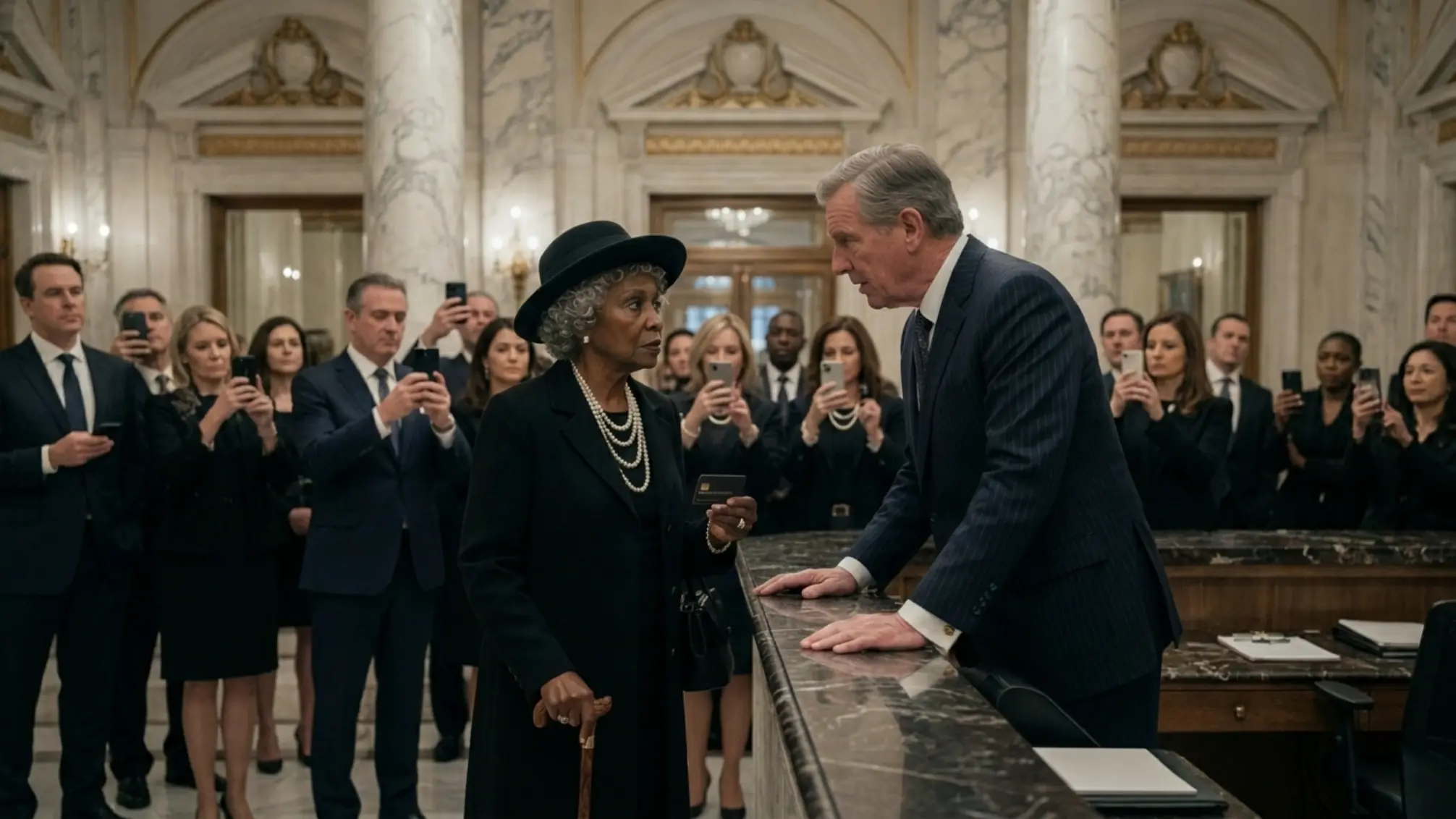
His mouth twisted into a dismissive smile.
“That card is fake,” Charles said. “Women like you do not hold accounts in my bank.”
The young teller seated behind the counter stopped typing. Several employees looked up from their desks while wealthy clients turned toward the confrontation beneath the enormous crystal chandelier. The elderly woman did not lower her eyes or remove her hand from the card.
“Your bank?” she asked.
Charles leaned closer. “This institution manages the assets of executives, political families, and international investors. We do not entertain confused pensioners presenting counterfeit cards.”
A security officer moved away from the entrance.
The woman looked at the approaching guard, then returned her gaze to Charles.
“Read the ownership line before security reaches me.”
Charles laughed. “There is no ownership line.”
“Then perhaps your training was as incomplete as your manners.”
A few people near the waiting area raised their phones. Charles noticed the growing audience and straightened his navy suit, clearly deciding that public humiliation would remind everyone who controlled the room.
He turned toward the teller.
“Melissa, confiscate the card and flag the account for fraud.”
The teller hesitated. “Sir, I have not entered it yet.”
“You do not need to. Look at her.”
Melissa’s expression changed.
She was twenty-six, recently promoted, and still new enough to believe banking rules applied equally to every customer. She looked at the elderly woman’s dignified posture, her layered pearl necklaces, and the quiet certainty in her dark eyes.
“I should verify it first,” Melissa said.
Charles’s face hardened. “Are you questioning me?”
“No, sir. I am following authentication procedure.”
“Then follow my instruction.”
The elderly woman slowly lifted the card from the counter.
Charles reached for it.
She moved it beyond his hand.
“You have already mistaken authority for ownership once today,” she said. “Do not make the mistake physical.”
The security officer stopped several feet away.
Charles looked around the lobby and saw dozens of people watching. His humiliation was becoming public, and he responded the way insecure men often did when witnesses made cruelty harder to disguise.
He raised his voice.
“Security, remove this woman.”
The guard approached cautiously. “Ma’am, I need you to step away from the counter.”
She did not move.
“My name is Evelyn Montgomery,” she said. “I have maintained an account here for forty-seven years. I asked for a balance inquiry. No one has completed it.”
Charles rolled his eyes. “Anyone can memorize a wealthy client’s name.”
Melissa suddenly stared at the black card.
Montgomery.
She had seen that name during orientation, printed across documents new employees were never permitted to copy. The Montgomery Family Trust appeared in the bank’s historic records, though junior staff were told its accounts were managed only through the executive office.
Melissa extended her hand.
“Ms. Montgomery, may I authenticate the card?”
Charles turned sharply. “Do not touch it.”
The elderly woman looked at Melissa. “Yes.”
Melissa inserted the card into the secure terminal.
The screen requested biometric confirmation.
Evelyn placed one finger against the small glass reader beside the keyboard. A green light appeared, followed by a security prompt Melissa had never seen before.
EXECUTIVE TRUST ACCESS — LEVEL OMEGA
Melissa’s breathing changed.
Charles noticed.
“What does it say?”
She did not answer immediately.
The account profile opened.
Rows of holdings filled the screen: property funds, municipal bonds, private equity positions, cash reserves, voting shares, and restricted trusts. The numbers continued beyond the visible window.
At the top appeared one line in bold letters:
PRIMARY BENEFICIARY: EVELYN ROSE MONTGOMERY
Below it was another:
CONTROLLING INTEREST IN LANGFORD PRIVATE BANK: 51.4%
Melissa stared at the percentage.
Charles stepped behind the counter and read over her shoulder.
His face emptied of color.
“Wait,” he whispered. “Fifty-one percent?”
Evelyn placed both hands over the handle of her cane.
“Correct.”
The security officer took one step backward.
A murmur swept through the lobby. Phones rose higher. Employees exchanged terrified glances as they realized the woman their president had called a confused pensioner was the controlling owner of the institution.
Charles attempted to recover.
“There must be a system error.”
Melissa shook her head. “The biometric authentication passed.”
“Call information security.”
“The account is executive-authorized.”
“I said call them.”
Evelyn turned toward the glass doors.
Three black vehicles had stopped outside.
Men and women in formal business attire entered the lobby, led by silver-haired attorney Nathaniel Grant. Behind him walked six members of the bank’s board of directors.
Charles recognized them one by one.
His breathing became shallow.
Nathaniel approached Evelyn and inclined his head respectfully. “Mrs. Montgomery, the board is assembled.”
She looked at Charles.
“Then your termination vote begins now.”
Forty-seven years earlier, Evelyn Montgomery had entered the same bank holding her husband’s hand.
The lobby looked different then. The marble was darker, the chandelier smaller, and the institution operated under the name Langford & Pierce Savings House. Evelyn was twenty-five, recently married, and accustomed to being ignored whenever her husband discussed money.
Her husband, Thomas Montgomery, came from a family that owned rail facilities, warehouses, farmland, and regional insurance companies. Unlike many men raised around wealth, Thomas never assumed financial intelligence belonged exclusively to him.
He taught Evelyn how to read balance sheets, evaluate debt, and identify businesses made fragile by vanity. When advisers addressed only him, he redirected every question toward her until they learned she was not decoration.
Within ten years, Evelyn understood their holdings better than most professionals hired to manage them.
She also understood how quickly people changed when they believed a Black woman had money.
Salesmen became flattering.
Bankers became careful.
Politicians became curious about her family.
But when Evelyn dressed plainly and arrived without Thomas, the respect disappeared. Employees asked whether she was a domestic worker. Guards followed her through private buildings her family owned. Receptionists explained basic policies before asking her name.
Thomas grew furious whenever it happened.
Evelyn grew observant.
“Do not waste every insult,” she once told him. “Some reveal exactly whom we should never trust.”
The Montgomery family invested in Langford Private Bank during the financial crisis of the early 1980s. The institution was close to collapse after reckless commercial loans left it vulnerable to failure.
Thomas and Evelyn provided capital on one condition: the family trust would receive voting shares and permanent oversight rights.
The bank recovered.
Its leaders praised Thomas publicly.
They almost never mentioned Evelyn.
After Thomas died from cancer eighteen years later, advisers expected Evelyn to sell the shares or transfer control to a male relative. Instead, she became the sole trustee and quietly increased the family’s ownership whenever other investors withdrew.
By the time Charles Langley became president, the Montgomery trust controlled more than half the bank.
Charles knew the trust existed.
He had never met Evelyn.
That was not an accident.
For six years, reports reached her about aggressive fees, discriminatory lending decisions, and customer complaints disappearing before board review. Charles produced impressive profits, and several directors dismissed the problems as isolated misunderstandings.
Evelyn did not.
She ordered an independent audit without informing management.
The results were disturbing.
Loan officers approved favorable rates for wealthy clients while charging struggling small-business owners unexplained risk premiums. Elderly customers were pushed into products they did not understand. Complaints involving racial discrimination were categorized as service disagreements and removed from executive summaries.
Charles received bonuses every year.
The customers harmed by his policies received apology letters written by junior staff.
Evelyn decided to visit the bank without announcing herself.
She wore the black coat Thomas purchased for her decades earlier, carried her ordinary cane, and took no limousine. Her driver left her one block away, and Nathaniel Grant waited with the board at a nearby hotel.
The plan was simple.
Evelyn would request access to her personal account and observe how the institution treated a customer it did not recognize.
She expected delay.
She expected questions.
She did not expect the bank president himself to call her black card fake in front of the entire lobby.
Now Charles stood motionless as the board members entered the private conference room overlooking the reception area.
Evelyn walked past him.
Nathaniel paused beside Charles. “The board requests your immediate attendance.”
Charles looked toward the employees.
“Clear the lobby.”
Evelyn stopped.
“No.”
He stared at her.
“The clients and staff witnessed the accusation,” she said. “They may witness the beginning of accountability.”
“This is an internal governance matter.”
“You made it public.”
Charles followed the board into the conference room while phones continued recording through the glass walls. Evelyn sat at the head of the long table, her cane resting against the chair Thomas once used during investor meetings.
Charles remained standing.
Board chair Margaret Sloan opened a leather folder.
“Mr. Langley, this emergency session has been called under the controlling shareholder provision. Mrs. Montgomery has requested a vote regarding your suspension pending investigation.”
Charles looked around the table. “Because of one misunderstanding in the lobby?”
Evelyn’s expression remained still.
“This is not about one insult.”
Nathaniel distributed copies of the independent audit.
Charles scanned the first page.
His jaw tightened.
“You investigated management without notifying me.”
“The investigation concerned management,” Evelyn said. “Notifying you would have defeated the purpose.”
“These figures lack context.”
“Then provide it.”
Charles flipped through the report.
It documented discriminatory loan patterns, unauthorized account fees, misleading investment transfers, and the suppression of more than three hundred customer complaints. Internal messages showed Charles personally instructing staff to discourage customers he considered “low-value.”
One email referred to elderly walk-in clients as “time drains.”
Another instructed security to remove anyone who appeared unable to maintain at least $250,000 in deposits.
Evelyn looked through the glass wall toward the teller station.
“Your treatment of me was not an unusual mistake,” she said. “It was the culture you created.”
Charles closed the report.
“Our responsibility is to profitable clients.”
“Our responsibility is to every client whose money we accept.”
“Private banking requires standards.”
“Standards are not permission to humiliate people.”
He pointed toward the lobby. “She came in without identification, presenting a card unavailable to ordinary customers.”
Evelyn answered calmly. “I provided my name and requested authentication.”
“You concealed your identity.”
“I withheld my wealth. Those are not the same thing.”
One director lowered his eyes.
Charles turned toward the board. “Removing me today will destabilize the bank. Our quarterly earnings are the strongest in its history.”
Margaret opened another file.
“They are also misleading.”
The audit discovered that Charles had moved future fee income into current earnings to increase performance bonuses. He delayed recording losses on commercial real estate and pressured analysts to reclassify troubled loans.
The bank was profitable.
It was not as profitable as Charles claimed.
His compensation was tied to the false numbers.
Charles’s confidence finally cracked.
“This is retaliation.”
Evelyn leaned forward.
“For what?”
“For the lobby incident.”
“You believe I created six years of records during the fifteen minutes since you insulted me?”
Silence followed.
Margaret called for the vote.
Nine board members supported immediate suspension.
Two abstained.
None opposed.
Charles remained standing after the result was announced.
“You cannot discard me after everything I built.”
Evelyn looked around the bank bearing another family’s name but supported for decades by her family’s capital.
“You built profit on the belief that dignity was optional.”
“I made this bank powerful.”
“No. Clients made it powerful. Employees made it function. Investors kept it alive. You were paid to lead it, and you confused compensation with ownership.”
Security entered the conference room.
This time, the guards did not approach Evelyn.
Charles looked toward the lobby, where employees watched him through the glass.
“You are humiliating me.”
Evelyn’s voice softened, though not with sympathy.
“I asked you to check a balance. You chose humiliation.”
The guards escorted him to his office to collect personal belongings under supervision.
Evelyn returned to the lobby.
The clients remained.
Some pretended to examine phones, while others openly watched her. Melissa stood behind the counter, shaken by everything that had happened.
Evelyn approached her.
“You followed procedure when your superior ordered you not to.”
Melissa swallowed. “I should have entered the card sooner.”
“You hesitated because he controlled your job.”
“That does not make it right.”
“No. But acknowledging fear is how you stop calling it obedience.”
Melissa nodded.
Evelyn looked toward the security officer. “And you?”
He straightened. “Ma’am?”
“You were prepared to remove me without asking what occurred.”
“I received an order from the president.”
“You work for the bank, not one man.”
“Yes, ma’am.”
“Remember that when the next person has no board waiting outside.”
Evelyn then asked for a chair in the middle of the lobby.
For the next two hours, she listened to customers.
An elderly widower described being pressured into an investment carrying fees he had never understood. A restaurant owner said the bank denied her expansion loan after years of perfect payments, then approved a larger loan for a newly opened business owned by a director’s nephew.
A retired teacher revealed that unexplained charges had drained nearly $9,000 from an account she shared with her disabled sister.
Employees began speaking too.
One loan officer admitted that managers ordered staff to rate customers differently based on ZIP codes. A customer-service representative showed Evelyn a hidden spreadsheet tracking complaints management wanted erased.
Each story added weight to the audit.
By evening, the bank’s problems were no longer statistics.
They had faces.
Evelyn appointed Margaret Sloan temporary president and ordered an immediate freeze on executive bonuses. Every disputed fee from the previous six years would be reviewed. A restitution fund would return money to affected customers, and an independent civil-rights firm would examine lending patterns.
She also created a policy preventing security removal without documented cause, except in immediate safety emergencies.
The changes cost millions.
Several directors worried about the effect on earnings.
Evelyn answered with one sentence.
“If dignity damages our business model, the model deserves to fail.”
The story spread overnight.
Videos of Charles calling Evelyn’s card fake appeared across social media. Commentators focused on the dramatic moment the screen revealed her 51.4 percent ownership stake.
Evelyn disliked the coverage.
Headlines celebrated a wealthy woman defeating an arrogant banker, but most missed the point. She had survived the humiliation because she possessed power Charles could not ignore.
Thousands of other customers had endured the same treatment without controlling shares, attorneys, or board members waiting nearby.
During her only television interview, the host asked how it felt to reveal her balance.
“The number was never the important part,” Evelyn said.
“Then what was?”
“He believed respect depended on the number.”
The host paused.
Evelyn continued. “I could have held ten dollars or ten billion. His responsibility at that counter would have remained the same.”
The audit lasted nine months.
Investigators found that Charles’s policies harmed more than two thousand customers. The bank returned over $36 million in fees, interest, and improper investment charges.
Several executives resigned.
Two faced criminal investigation after records suggested intentional financial manipulation. Charles was later charged with falsifying reports and receiving bonuses based on inaccurate earnings.
He claimed the board turned him into a scapegoat.
The emails bearing his instructions said otherwise.
Melissa remained at the bank.
Evelyn promoted her to customer-protection manager after she completed additional compliance training. Some senior employees complained that one act of defiance should not create a career.
Evelyn disagreed.
“Character is often revealed in one moment,” she said. “Especially when obedience would be safer.”
One year after the confrontation, the marble lobby looked almost identical. The chandelier remained, the counters still shone, and wealthy clients continued arriving in dark cars.
But a simple brass plaque now rested beside every service desk:
Every account deserves accuracy. Every person deserves respect.
Evelyn returned on the anniversary without announcing herself.
She wore the same black coat and carried the same cane.
Melissa recognized her immediately but completed the identification procedure before greeting her personally. Evelyn smiled at the discipline.
“Mrs. Montgomery, how may I assist you?”
“I would like to check my balance.”
Melissa inserted the card.
A nervous young employee beside her glanced at the screen and nearly stopped breathing when the holdings appeared.
Evelyn noticed.
“Large numbers make people careless,” she told him.
He looked confused. “Careless, ma’am?”
“They tempt you to become kinder to the balance than the person.”
The young man nodded.
Near the waiting area sat an elderly customer wearing a worn wool coat. She struggled with a form while other clients shifted impatiently around her.
Melissa stepped from behind the counter and offered assistance.
She did not know the woman’s balance.
She did not ask before helping.
Evelyn watched quietly.
That was the change she had wanted.
Not fear of insulting another hidden owner.
Not employees treating every modest customer as a potential billionaire.
Respect without calculation.
Before leaving, Evelyn paused beneath the portrait of Thomas Montgomery hanging inside the private corridor. He looked young in the painting, his expression serious and hopeful.
“You would have enjoyed the vote,” she whispered.
Then she reconsidered.
“No. You would have interrupted him before I did.”
She smiled and continued toward the lobby.
Charles Langley had looked at her cane, coat, age, and skin and decided the card in her hand could not be real. He believed wealth had a face, authority had a uniform, and ownership always announced itself before entering the room.
He was wrong.
Evelyn had walked into the bank asking for a simple balance inquiry.
He mocked her.
He called security.
He claimed women like her did not hold accounts inside his institution.
Then the screen revealed the truth.
Her family trust controlled the bank.
Her signature controlled the board.
And the elderly woman he tried to throw onto the sidewalk possessed enough voting power to end his presidency before the lobby closed.
But Evelyn never remembered the moment as revenge.
She remembered the teller who hesitated, then chose procedure over fear.
She remembered the customers who finally told their stories.
She remembered the employees who stopped protecting a powerful man and began protecting the people whose money kept the doors open.
The balance exposed her ownership.
His behavior exposed everything else.