“Where’d you get this?” Chelsea Morgan demanded, snatching the check from the elderly woman’s hand. “Women like you don’t carry fifty grand.”
Dr. Evelyn Carter stood on the other side of the polished black-marble counter, too exhausted to react with the anger the insult deserved. Her silver-gray hair was secured in a neat low bun, and the navy cardigan over her modest blouse still carried the faint sterile scent of the hospital. She had spent nearly forty-eight hours treating children after a ventilation failure flooded a South Side apartment building with carbon monoxide. The check in Chelsea’s hand was meant to help those children recover.
“Verify it before accusing me,” Evelyn said.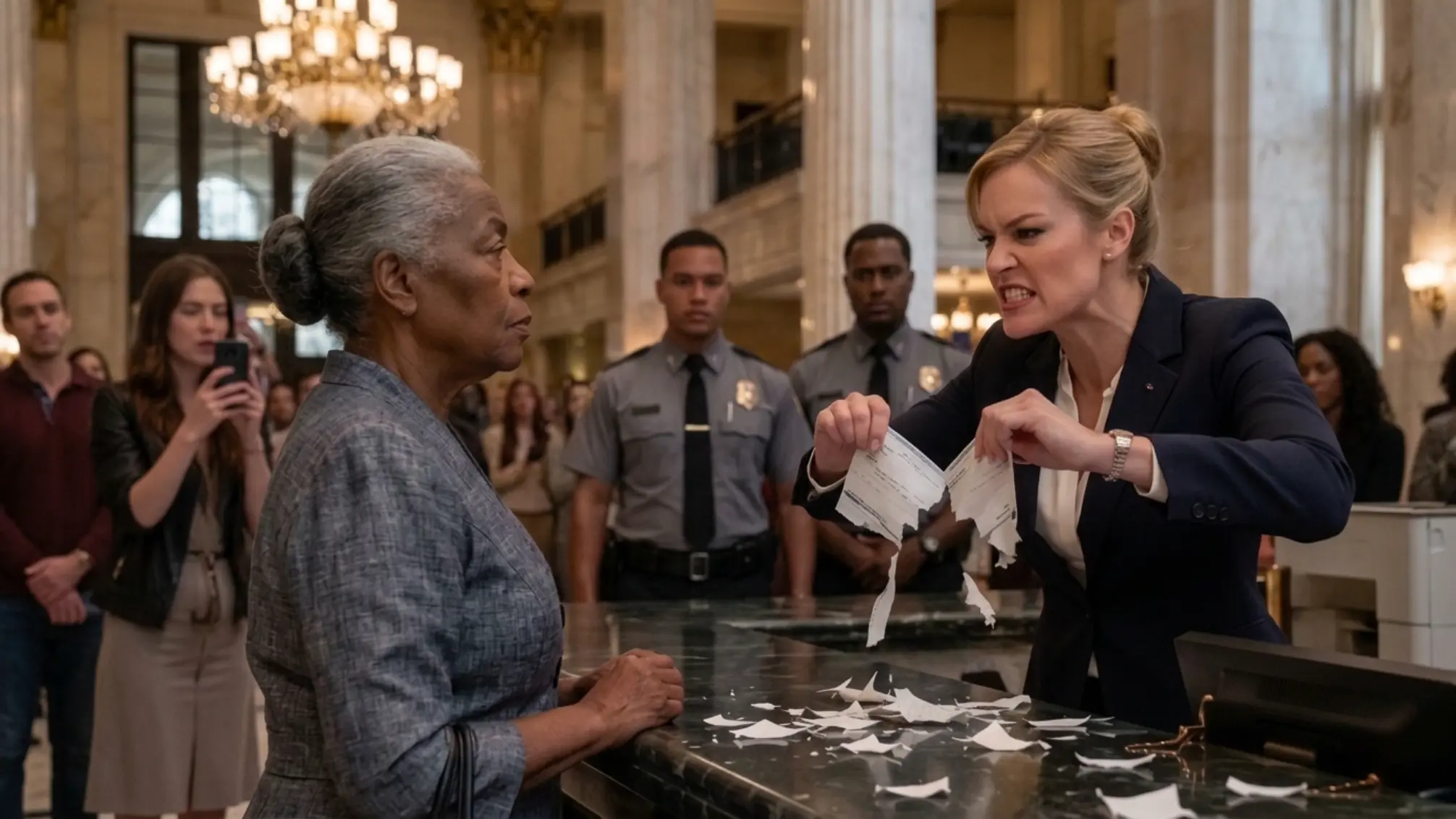
Chelsea held the check beneath the bright counter lamp and examined it with theatrical suspicion. The luxury bank’s marble columns, crystal chandeliers, and brass railings surrounded them like symbols of a world Chelsea believed she had been appointed to protect. Several customers had already turned to watch, while two uniformed guards near the central staircase exchanged uncertain looks. Chelsea seemed pleased to have an audience.
The check was payable to the Carter Children’s Medical Foundation for exactly $50,000. It had been issued that morning by a respected Chicago real-estate firm whose owner had promised emergency support after hearing about the hospitalized families. Evelyn had personally carried it to Metropolitan Crown Bank because the foundation’s account had been opened there more than a decade earlier. The funds needed to clear quickly so families could receive temporary housing, medication, and specialist care.
Chelsea did not scan the check or enter the account number.
She looked at Evelyn’s simple clothing, worn leather handbag, and tired face, then decided the paper must be fraudulent. Her judgment required no evidence because prejudice had already supplied the conclusion. When Evelyn quietly requested a supervisor, Chelsea’s mouth tightened as though the request itself were proof of guilt.
“Save the act,” the teller said. “You’ll leave in handcuffs before you touch my counter again.”
Evelyn glanced toward the security guards. “Am I being detained?”
Chelsea answered for them. “You brought a forged instrument into a federally insured bank.”
“You have not verified the signature, the issuing account, or my identity.”
“I don’t verify obvious fraud.”
Chelsea seized both ends of the check.
The tearing sound cut through the marble lobby.
Once.
Then again.
She ripped the check into four pieces and allowed them to fall across the counter like confetti. One fragment slid onto the floor while another landed near Evelyn’s clasped hands. A woman waiting behind the velvet rope gasped, but nobody stepped forward.
“Fraud doesn’t need verification,” Chelsea said.
A private brass elevator chimed behind her.
The doors opened, revealing a tall Black man in a tailored charcoal suit. Daniel Carter, chief executive officer of Metropolitan Crown Bank, stepped into the lobby with three senior officers behind him. He had been preparing for a board meeting upstairs when his executive assistant alerted him that security cameras showed an elderly woman being confronted at the main counter.
He saw the torn check before he saw her face.
Then Evelyn turned slightly.
Daniel stopped.
“Mom?”
The word crossed the lobby more forcefully than a shouted command.
Chelsea’s expression froze. One of the security guards lowered his hand from his radio, while the customers who had watched with curiosity suddenly understood that the quiet elderly woman was not alone. Daniel crossed the marble floor without acknowledging anyone else, his attention fixed entirely on his mother.
“Are you hurt?” he asked.
“No.”
“Did anyone touch you?”
“No, Daniel.”
Only then did he look at the shredded paper.
Chelsea’s lips parted. “Mr. Carter, I can explain.”
Daniel picked up one fragment. The foundation’s name was visible across it, followed by part of the issuing company’s authorized signature. He gathered another piece from the counter and placed it beside the first.
“Explain why you destroyed my mother’s check.”
Chelsea glanced toward the watching customers. “She presented a suspicious instrument and became confrontational when questioned.”
Evelyn’s eyes sharpened despite her exhaustion. “I asked you to verify it.”
“You refused to provide a reasonable explanation for possessing that amount.”
“I provided my identification and the foundation’s deposit information.”
Chelsea turned toward Daniel. “She never told me she was your mother.”
The lobby grew even quieter.
Daniel looked at her for several seconds. “Why should that have mattered?”
Chelsea’s face flushed. “It would have clarified the situation.”
“No. It would have clarified that humiliating her might threaten your career.”
“That is not what I meant.”
“Then tell me what you meant.”
Chelsea looked down at the torn check. Her confidence depended upon rapid obedience from customers and silence from coworkers. Daniel’s questions forced her to name assumptions she had always hidden beneath bank terminology.
“The transaction did not match the customer profile,” she said.
“What profile?”
“She did not appear to be someone who would carry a check of that value.”
Daniel’s voice became colder. “You looked at an elderly Black woman in modest clothing and decided fifty thousand dollars could only reach her through crime.”
Chelsea straightened. “I followed fraud-prevention instincts developed through years of experience.”
“Fraud prevention requires verification.”
“She was making a scene.”
Evelyn gave a weary, humorless laugh. “I spoke more softly than you did.”
A young woman near the velvet rope raised her phone. “She’s right. The teller started yelling.”
Chelsea turned toward her. “Recording inside the bank is prohibited.”
Daniel did not look away from Chelsea. “Preserve every security camera angle from the last thirty minutes.”
The bank’s chief security officer, who had followed him from the elevator, immediately spoke into his radio. “Footage preservation active.”
Chelsea’s posture changed.
Daniel noticed. “Is there a reason that concerns you?”
“No.”
“Good. Then the recording will support your account.”
He asked the nearest security guard whether Evelyn had threatened anyone, attempted to enter a restricted area, or refused a lawful instruction. The guard swallowed and answered no to every question. He admitted that Chelsea had ordered them to approach before any electronic verification took place.
Daniel looked toward the second guard.
“Did you believe my mother was dangerous?”
“No, sir.”
“Then why did you move toward her?”
“Ms. Morgan instructed us to.”
“That is not an answer about judgment.”
The guard lowered his eyes. “I followed the order.”
Daniel nodded once. “And that is how discrimination becomes a system instead of one person’s decision.”
Chelsea placed both hands on the counter. “I made a mistake. I apologize.”
Evelyn studied her. “You are apologizing to the CEO’s mother.”
“I am apologizing to you.”
“You did not know I was his mother when you tore the check.”
Chelsea had no response.
Daniel asked the branch operations director to come downstairs immediately. While they waited, he gathered every piece of the check himself. The gesture unsettled the room because the chief executive of one of Chicago’s most prestigious banks was kneeling on marble to recover paper his employee had destroyed.
Evelyn bent to help him, but Daniel stopped her.
“You have been standing for two days,” he said. “Please sit.”
“I am capable of picking up paper.”
“I know.”
He guided her toward a nearby chair anyway, not because he thought her weak, but because he recognized the exhaustion in the movement of her hands. Evelyn allowed it only after the final fragment had been recovered.
A bank employee brought her water. Another offered coffee, but she declined. She checked her watch and asked how quickly the donor could issue a replacement.
Daniel looked at the torn pieces. “You came here directly from the hospital?”
“Yes.”
“You should have called me.”
“You were preparing for the acquisition meeting.”
“I would have made time.”
Evelyn’s tired expression softened. “That is precisely why I did not call.”
She had raised Daniel alone after his father died when he was thirteen. During medical school, she worked nights in a public clinic and spent mornings attending classes before returning home to help him with homework. She never allowed sacrifice to become a weapon, and she refused to use her son’s position as a shortcut merely because others found ordinary procedures inconvenient.
Daniel had built his banking career partly because of her example.
Metropolitan Crown’s public image emphasized community lending, ethical finance, and equal access. Daniel had personally approved programs supporting minority-owned businesses and low-income medical clinics. Yet inside his own flagship branch, an employee had looked at the woman who taught him those principles and treated her as a criminal.
The contradiction filled him with more than anger.
It filled him with shame.
The branch operations director arrived, pale and breathless. His name was Stephen Lowell, and he had supervised Chelsea for four years. He looked at the torn check, then at Evelyn, and understood immediately that the afternoon had become dangerous.
“Mr. Carter,” he began, “I assure you we will investigate fully.”
Daniel looked at him. “How many complaints have been filed against Ms. Morgan?”
Stephen hesitated.
Chelsea’s eyes shifted toward him.
“That was not a difficult question,” Daniel said.
“There have been several customer-service concerns.”
“How many?”
“Seven formal complaints during the past eighteen months.”
Daniel’s jaw tightened. “What were the allegations?”
“Rudeness, inconsistent verification procedures, and inappropriate language.”
“Anything involving race?”
Stephen looked around the lobby. “Some customers suggested bias.”
“Suggested?”
“Two complaints alleged that Black customers were subjected to additional scrutiny.”
Chelsea stepped forward. “Those complaints were unsubstantiated.”
Daniel turned toward Stephen. “Who investigated them?”
“I did.”
“What evidence did you review?”
“Employee statements and transaction records.”
“Did you review security footage?”
Stephen’s silence answered.
“Were the customers interviewed?” Daniel asked.
“We attempted contact.”
“Did anyone call them?”
“Emails were sent.”
Daniel looked at the shredded check again. “And after receiving no reply to an email, you closed complaints alleging racial discrimination without reviewing video?”
Stephen’s shoulders dropped slightly. “That was consistent with branch practice.”
“Then branch practice is under review too.”
The words frightened him more than a direct threat.
Chelsea crossed her arms. “You cannot turn one misunderstanding into an accusation against the entire branch.”
Daniel faced her. “You have seven prior complaints, including two alleging racial bias. Your supervisor failed to review available footage. Today you destroyed a valid check without making one verification attempt.”
“We do not know it was valid.”
Evelyn opened her handbag.
She removed the donor agreement, the foundation’s account letter, and a copy of the issuing company’s authorization. Every document was organized inside a slim folder. Chelsea stared at them as Evelyn placed them carefully on the counter.
“You would have known within two minutes,” Evelyn said.
The branch’s senior fraud analyst reviewed the documents at a nearby desk. He called the issuing bank, confirmed the account, verified the signature, and checked the foundation’s history. The process took less than four minutes.
“The check was legitimate,” he announced.
Chelsea’s face emptied.
Daniel asked whether any feature of the check should have raised suspicion.
“No, sir. It is professionally issued, fully funded, and matches the donor’s recorded signature.”
“What would standard procedure require?”
“Identity verification, account confirmation, and manager approval because of the amount.”
“Would standard procedure ever permit an employee to tear it?”
“Never.”
Daniel looked toward Chelsea. “You were not protecting the bank.”
She said nothing.
“You were protecting your belief that a woman who looked like my mother could not belong inside a fifty-thousand-dollar transaction.”
Chelsea’s voice became quieter. “I have worked for this company for nine years.”
“Then you knew the procedure.”
“I was under pressure. We received a fraud alert this morning.”
“Did the alert involve this donor?”
“No.”
“This foundation?”
“No.”
“Elderly women?”
“No.”
“Black customers?”
Chelsea’s eyes flashed. “That question is insulting.”
Evelyn stood.
The movement drew every eye back to her. She was not physically imposing, yet decades of speaking over emergency-room panic gave her voice quiet authority.
“You want to know what was insulting?” she asked. “Standing here after two sleepless nights while you asked where I stole money intended for sick children.”
Chelsea looked away.
“You tore the check because you believed nobody powerful would object,” Evelyn continued. “Now my son is standing here, and suddenly you want procedures, context, and understanding.”
“I said I was sorry.”
“You are sorry that you were wrong about who could punish you.”
Daniel watched his mother carefully. He knew her anger rarely arrived loudly. When Evelyn became quiet, every word had already survived examination.
She turned toward him. “Do not fire her because I am your mother.”
Chelsea looked up with sudden hope.
Evelyn continued, “Decide what should happen if she did this to a woman whose child was not the chief executive.”
The hope disappeared.
Daniel understood. Immediate fury could satisfy the moment while allowing the institution to blame one teller and avoid examining everything that protected her. His mother wanted accountability, not revenge performed beneath chandeliers.
He instructed human resources to suspend Chelsea pending an independent investigation. Stephen was removed from branch supervision while prior complaints were reopened. Security access, internal messages, customer records, and camera footage from every reported incident were preserved.
Chelsea removed her teller badge and placed it on the counter.
“You have already decided I am guilty,” she said.
Daniel replied, “The footage will decide what you did. Your previous complaints will determine whether today was an exception or a pattern.”
“And if it was one mistake?”
“One mistake can still harm someone.”
Chelsea looked toward Evelyn. “Will you tell him I apologized?”
Evelyn lifted the donor documents from the counter. “I will tell the truth.”
Human resources escorted Chelsea toward a private office while several customers continued filming. Daniel asked the lobby to stop recording employees who were not involved and promised the bank would issue a transparent account after the investigation.
The young woman near the velvet rope lowered her phone but approached Evelyn before leaving.
“I should have said something,” she whispered. “I watched her tear it.”
Evelyn regarded her gently. “Remember that feeling next time you see someone standing alone.”
The donor company issued a replacement check electronically within the hour. Daniel ordered the bank to credit the full amount to the foundation immediately while verification completed, but Evelyn refused special treatment.
“Follow the proper process,” she said.
“The children need the funds.”
“They need institutions that function properly more than they need favors from executives.”
The verified transfer cleared that afternoon.
Emergency housing payments went out before sunset. Three children received specialist appointments the next morning, while another family obtained an oxygen concentrator their insurance had delayed approving. The destroyed paper did not prevent the donation from helping anyone, but Evelyn refused to let the absence of financial harm erase the humiliation.
The internal investigation lasted three weeks.
Reviewers examined ninety days of lobby footage and reopened every complaint linked to Chelsea. What they found revealed a consistent pattern. Black customers were asked for additional identification more often than white customers completing comparable transactions, while elderly customers in inexpensive clothing were frequently questioned about the source of their money.
In one recording, Chelsea refused to accept a certified check from a retired Black schoolteacher until a white customer behind him confirmed that they knew each other. In another, she called security after a young Black business owner attempted to withdraw money for payroll. Both transactions were legitimate.
Chelsea had not acted alone.
Stephen repeatedly rewrote complaint summaries to remove references to race and protect the branch’s performance scores. He instructed employees to describe discriminatory confrontations as “communication failures,” allowing the bank to report lower misconduct numbers. Other managers knew the complaints existed but assumed strong revenue justified leaving the problem alone.
Chelsea was terminated for discriminatory conduct, destruction of customer property, failure to follow verification procedures, and falsification of an incident report. Stephen lost his position for suppressing complaints and failing to conduct required investigations. Two additional supervisors received disciplinary action for ignoring employee warnings.
Daniel refused to announce the outcome as proof that the bank had solved discrimination.
Instead, he held a company-wide meeting inside the same lobby.
Employees stood beneath the chandeliers while the repaired check—carefully taped together and placed inside a clear frame—rested on an easel beside him. Evelyn attended only after Daniel promised she would not be treated as a symbol without being allowed to speak.
Daniel addressed the staff first.
“This check was valid before anyone knew who carried it,” he said. “The customer deserved respect before anyone learned she was my mother.”
He explained that Metropolitan Crown would create an independent complaint-review office outside branch management. No discrimination complaint could be closed without footage review, direct customer contact, and written findings. Security would no longer approach customers based solely on an employee’s claim that someone looked suspicious.
The bank also began analyzing verification patterns by race, age, neighborhood, and account type. Daniel knew prejudice rarely announced itself openly in official reports. It appeared through extra questions, unexplained delays, additional identification demands, and selective suspicion disguised as instinct.
Then Evelyn stepped forward.
She wore the same navy cardigan she had worn on the day of the confrontation.
“People will tell you this story is about a teller who failed to recognize the CEO’s mother,” she said. “That is the least important part.”
The employees listened.
“It is about what happened before my son entered the lobby. A woman looked at my age, my clothing, and my skin, then decided evidence was unnecessary. Every person who watched had a few seconds to decide whether my dignity mattered without knowing my connections.”
She glanced toward the security guards.
“Some were afraid for their jobs. Others thought it was not their business. A few enjoyed the spectacle. Institutions become cruel when enough people decide someone else will object.”
After the meeting, Daniel placed the framed check near the employee entrance rather than the customer lobby. Beneath it, a plaque carried one sentence chosen by Evelyn:
VERIFY FACTS BEFORE JUDGING PEOPLE.
Six months later, an elderly white man entered the branch wearing paint-stained overalls. He carried a large check from the sale of farmland he had inherited. A newly hired teller greeted him, verified his identification, called the issuing bank, and requested the required manager approval.
Nothing unusual happened.
Later that afternoon, a Black home-care worker arrived with a cashier’s check collected for her employer. She received the same questions, in the same order, delivered with the same courtesy. The branch manager reviewed both transactions during routine monitoring and found no difference in the process.
That ordinary consistency mattered more to Daniel than any public apology.
Evelyn continued running the medical foundation while working fewer hospital shifts, though retirement remained a subject she refused to discuss seriously. The children affected by the apartment poisoning recovered gradually. Several families later attended the foundation’s annual dinner, where photographs showed children smiling beside parents who had once feared they might never leave intensive care.
The real-estate executive who issued the donation offered to replace the check for the framed display.
Evelyn declined.
“The torn one tells the truth better.”
A year after the incident, she returned to Metropolitan Crown carrying another donation. The amount was smaller, and the check came from a neighborhood bakery that had raised money through weekend sales.
A young teller welcomed her.
“Good morning. How may I help you?”
“I would like to deposit this into the Carter Children’s Medical Foundation.”
The teller requested identification, verified the account, scanned the check, and completed the transaction without recognizing her. There was no nervous manager, private elevator, or chief executive waiting nearby.
Evelyn thanked her and turned to leave.
Daniel had been watching from the mezzanine.
He came downstairs and caught up with her near the doors. “You did not tell me you were coming.”
“That would defeat the purpose.”
“How was the service?”
“Professional.”
He smiled. “No one called you Mom.”
“I consider that progress.”
They walked through the revolving doors into a cold Chicago afternoon. Daniel offered his arm, and Evelyn accepted—not because she needed assistance, but because he was her son and the gesture belonged to both of them.
Behind them, Metropolitan Crown’s marble lobby remained as grand as ever. The chandeliers still glittered, executives still crossed polished floors, and customers still carried transactions large enough to change lives.
But the building’s true value was no longer measured only by the money passing through it.
It was measured by what happened when someone entered without wealth written across their clothing.
Chelsea had believed a quiet elderly Black woman carrying fifty thousand dollars needed to prove she belonged before receiving ordinary respect. She learned too late that the woman was a physician, philanthropist, and mother of the bank’s chief executive.
Yet none of those titles were the reason tearing the check was wrong.
The check belonged to Evelyn.
The donation belonged to sick children.
And dignity had belonged to her before the elevator doors ever opened.