“Filthy women like you belong outside—not digging through my bank’s private accounts.”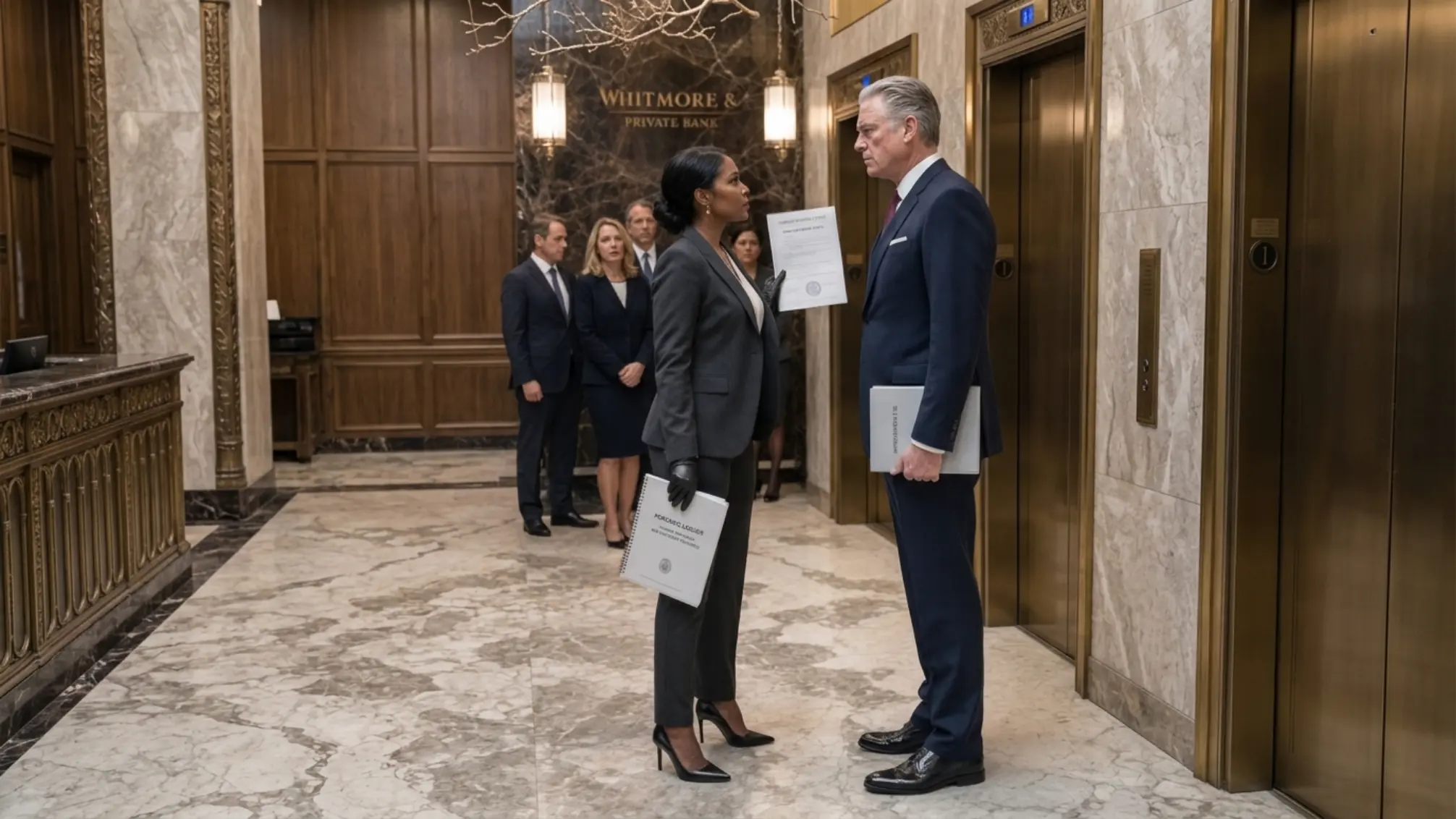
Bank President Charles Whitmore threw the investigation file onto the marble floor of Whitmore & Cole Private Bank. Pages slid across the executive lobby while employees stood frozen beside the brass elevators, pretending not to stare. Across from him, forty-three-year-old forensic accountant Dr. Camille Brooks remained perfectly still, holding a sealed federal court order in one gloved hand.
Camille’s sharply tailored charcoal pantsuit contrasted with the gold, marble, and polished wood surrounding her. Her glossy black hair was secured in an elegant low bun, and her calm expression revealed none of the anger moving beneath her skin. She had spent twenty years following money powerful people believed nobody would ever find.
“The accounts stopped being private,” Camille said, “when you used them to hide stolen money.”
Charles stepped closer, his expensive shoes crushing one of the scattered pages. At fifty-six, he carried himself like a man who had never entered a room without expecting obedience. His silver hair was slicked back, his burgundy tie sat perfectly against his white shirt, and his narrow gray eyes showed open contempt.
“Security will drag you out before you freeze a single dollar.”
Camille looked toward the phone vibrating inside his hand.
“Check your screen,” she replied. “Every account you own froze before you finished insulting me.”
Charles glanced down.
The color left his face.
A red warning covered the banking application on his screen:
ACCESS RESTRICTED BY FEDERAL COURT ORDER.
He tried another account.
Blocked.
Then the executive trust.
Blocked.
The private investment portfolio connected to his wife.
Blocked.
Across the lobby, phones began ringing almost simultaneously. Employees rushed between desks as computer monitors flashed restriction notices. The executive elevators locked, transfer systems stopped responding, and outgoing wires worth hundreds of millions of dollars were automatically suspended.
Charles stared at Camille as though she had personally reached into his pocket and stolen something.
“What did you do?”
“I preserved evidence.”
“You froze the entire institution.”
“I froze every account connected to the laundering network.”
“This bank handles the assets of senators, judges, executives, and foreign investors.”
“And several of them are about to receive uncomfortable calls.”
Charles turned toward the security officers near the entrance. “Remove her.”
Neither man moved.
The older guard looked toward Camille’s court order, then toward the federal agents entering through the revolving doors. Dark jackets appeared beneath long coats, each marked with the same three letters Charles had spent years believing he could outmaneuver.
FBI.
Camille lifted the sealed order.
“Anyone who interferes with this investigation may be charged with obstruction.”
Charles lowered his voice. “You have no idea whose money you’re touching.”
Camille finally smiled.
“That is why I’m here.”
Six months earlier, Camille had been sitting inside a small federal conference room in Manhattan when a junior bank analyst placed a flash drive on the table. The analyst’s hands shook so badly that the plastic device clicked against the wood.
Her name was Rachel Kim, and she had worked in Whitmore & Cole’s compliance division for fourteen months. She was twenty-seven, recently married, and terrified that coming forward would destroy her career before it properly began.
Camille did not touch the drive immediately.
“Tell me what’s on it.”
Rachel looked toward the closed door. “Accounts that shouldn’t exist.”
“That could mean several things.”
“They belong to dead clients.”
Camille’s attention sharpened.
Rachel explained that several wealthy customers had died years earlier, yet their private holding companies continued moving money through the bank. The transfers appeared legitimate because the accounts remained connected to trusts and corporate entities, but the authorization codes had been issued after the account holders’ deaths.
“Who approved them?” Camille asked.
“The executive office.”
“Whose executive office?”
Rachel swallowed.
“Charles Whitmore’s.”
The bank president was one of New York’s most respected financial figures. He appeared regularly on business programs, donated to hospitals, funded university scholarships, and advised government committees on financial integrity. His bank managed more than $40 billion for wealthy families, private companies, charities, and international clients.
Publicly, he promoted transparency.
Privately, Rachel believed he had created a hidden system for moving money beyond regulatory oversight.
She discovered the first suspicious transfer while reviewing the estate of an elderly client. A $6.2 million payment had moved into a consulting company registered in Delaware two years after the client’s death.
The supporting documents carried an electronic signature.
The signature belonged to the dead man.
Rachel reported the discrepancy to her supervisor.
He told her the file had already been reviewed.
When she raised the issue again, she received a formal warning for “disruptive conduct and failure to respect executive authorization.”
One week later, someone entered her apartment.
Nothing valuable was taken.
The intruder left a printed photograph of Rachel and her husband walking outside their home.
She stopped reporting concerns inside the bank.
Instead, she copied what she could and contacted federal investigators.
Camille examined the flash drive inside a secured laboratory. It contained account ledgers, approval histories, internal messages, shell-company records, and a partial list of private trusts.
The files revealed irregularities but not yet a complete crime.
Charles Whitmore had not built a simple theft operation. He had created layers.
Money moved from dormant trusts into charitable foundations. The foundations paid consulting firms. Those firms invested through offshore holding companies, which then purchased property, art, insurance products, and private equity interests.
Each movement appeared ordinary when viewed alone.
Together, they formed a machine designed to erase ownership.
Camille had built her career finding machines like that.
She began as an auditor inside a regional accounting firm, where senior partners routinely assigned her minor expense reports while less experienced colleagues received major corporate investigations. One partner once told her that wealthy clients would feel more comfortable discussing sensitive finances with “someone who looked traditional.”
Camille asked what traditional meant.
He never answered directly.
She left the firm, earned a doctorate in forensic accounting, and joined a federal financial-crimes unit. Over the next fifteen years, she traced stolen pension funds, uncovered procurement fraud, exposed charity embezzlement, and helped recover hundreds of millions of dollars.
Her greatest advantage was the same thing arrogant people considered her weakness.
They underestimated her.
Executives spoke carelessly around her.
Bankers assumed she lacked authority.
Powerful men explained elementary finance while she studied the evidence they failed to hide.
Charles Whitmore made that mistake before they ever met.
Camille’s team spent three months rebuilding the hidden network. Every transaction required independent verification because one incorrect assumption could destroy the investigation in court.
They followed payments through fourteen states and six countries. They compared death records with digital authorization logs, examined trust amendments, and reviewed years of internal communications.
The deeper they looked, the worse it became.
Charles had not merely stolen from dead clients.
He had targeted accounts belonging to elderly customers whose families lacked financial knowledge. Small portions were moved first, often disguised as advisory fees. If nobody objected, the transfers increased.
One victim was an eighty-two-year-old widow named Margaret Hayes.
Her husband had left her a $19 million trust managed by Whitmore & Cole. Margaret believed the money would fund her medical care and eventually support her grandchildren.
Over four years, nearly $7 million disappeared.
The statements remained convincing because the bank reported investments at inflated values. Margaret did not discover the loss until a nursing facility informed her that one of her payments had failed.
She called the bank.
Charles’s office classified her as confused and financially incompetent.
The bank then petitioned to gain greater control over her trust.
Camille visited Margaret inside a modest assisted-living apartment. The elderly woman sat beside a stack of statements she no longer trusted.
“Mr. Whitmore said the market changed,” Margaret explained.
“The market did change,” Camille replied. “But not in the way he described.”
“Did he take it?”
“We are still proving exactly where it went.”
Margaret looked toward a framed photograph of her late husband.
“He trusted that bank for thirty years.”
Camille had learned that financial crimes rarely looked violent from a distance. There were no shattered windows, visible bruises, or police tape. But the damage could still remove homes, medical care, education, and entire futures.
Charles’s polished office concealed victims who would never recover the years his theft had taken.
The investigation finally uncovered the central ledger inside a backup server disconnected from ordinary compliance systems. The server listed every diverted account, shell company, participating executive, payment, and personal benefit.
Rachel had been right.
Charles approved the operation personally.
His profits funded a Manhattan penthouse, a private aircraft share, vacation homes, art purchases, and trusts for his children. He also transferred money to judges, regulators, politicians, and corporate officers who protected the bank.
Some payments were bribes.
Others purchased silence.
One account disturbed Camille more than the rest.
It belonged to the Whitmore Family Education Foundation, publicly presented as a scholarship charity for low-income students. The foundation had raised more than $30 million.
Less than twenty percent reached students.
The remaining money paid for private travel, political donations, luxury events, and consulting contracts awarded to Charles’s relatives.
Camille’s team prepared a request for a comprehensive asset-freeze order. The proposed action would restrict more than two hundred accounts simultaneously, preventing Charles and his associates from moving funds after learning of the investigation.
Timing mattered.
If even one insider received advance warning, money could disappear across international jurisdictions within minutes.
Only six people knew when the freeze would occur.
The operation was scheduled for 9:30 on a Monday morning.
At 8:50, Camille entered Whitmore & Cole carrying the signed court order and forensic ledger. Federal teams waited outside every major branch, data center, executive residence, and storage facility connected to the case.
She expected Charles to receive her inside a conference room.
Instead, he met her in the lobby.
He had learned that a Black forensic accountant was asking to access the executive floor, and he came down personally to stop her.
Camille introduced herself and displayed her federal credentials.
Charles barely looked.
“You’re the accountant?”
“I lead the financial investigation.”
He glanced at her gloves, suit, and ledger. “You people have become very ambitious.”
The phrase carried enough contempt that nearby employees lowered their eyes.
Camille requested access to the executive records room.
Charles refused.
She showed him the court order.
He accused her of stealing confidential information.
Then he called her filthy.
Every word entered the microphone hidden inside Camille’s lapel.
Charles believed he was humiliating a powerless investigator in front of his employees. In reality, he was documenting his own obstruction while the freeze moved silently through the banking system.
At 9:30 precisely, the order activated.
No warning.
No countdown.
Every identified account stopped.
The president’s phone lost access first.
Then the bank’s internal alarms began.
Federal agents secured the building. Technology specialists entered the data center and disconnected external transfer channels. Investigators sealed records rooms while employees were instructed to remain at their desks.
Charles attempted to walk toward the executive elevator.
Camille blocked him.
“You ordered me away from your accounts,” she said. “Now you’re going to watch us open every one.”
His composure finally cracked.
“You cannot seize an entire bank because one frightened employee misunderstood internal transfers.”
“Rachel Kim did not misunderstand anything.”
Charles’s eyes changed when he heard the name.
That reaction confirmed he knew exactly who had spoken.
“She stole proprietary data.”
“She preserved evidence after your supervisors buried her report.”
“She signed confidentiality agreements.”
“Confidentiality does not protect crime.”
Charles leaned closer. “You think a court order makes you powerful?”
“No.”
“What does?”
“Evidence.”
Camille opened the forensic ledger.
She showed him a transfer originating from Margaret Hayes’s trust, moving through three shell companies, and arriving inside the account that purchased his Aspen vacation property.
Charles did not speak.
She turned another page.
The scholarship foundation had paid $1.8 million to a consulting company controlled by his brother.
Another page connected dead clients’ trusts to his family investment fund.
The bank president slowly looked toward the employees watching him.
For the first time, they were not afraid of him.
He was afraid of them.
Federal agents escorted Charles to his office while executing search warrants. He was not immediately arrested because prosecutors wanted to preserve the opportunity for cooperation.
Charles mistook restraint for uncertainty.
Inside the executive conference room, he sat at the head of the table and demanded his attorneys. Three arrived within forty minutes.
By then, investigators had already found two encrypted phones, false passports, and documents outlining an emergency transfer plan.
The plan was dated that morning.
Someone had warned him.
The circle of people aware of the operation was small. Camille ordered an internal review and discovered that a court clerk had searched the sealed case file shortly before dawn.
The clerk’s brother worked for Charles’s legal team.
Federal agents arrested both men before noon.
Charles watched the information appear on television inside the conference room. News helicopters circled the bank while reporters gathered beyond the barricades.
His attorney requested a private conversation.
An hour later, Charles offered to provide names in exchange for immunity.
Prosecutors refused immunity.
He then offered offshore account codes, political payment records, and information about other banks.
They agreed only to discuss a reduced sentence.
Charles’s arrogance became negotiation the moment wealth stopped protecting him.
By evening, he was taken into federal custody.
His wrists were handcuffed beneath his suit jacket as agents led him through the lobby. The employees who once stepped aside whenever he approached now watched him pass in silence.
Charles stopped near Camille.
“You enjoyed this.”
“No.”
“You destroyed my family.”
“You used stolen money to build their comfort.”
“You’ll never understand what it takes to run an institution like this.”
Camille held his gaze.
“You’re right. I would never understand why someone trusted with billions decided that vulnerable people were easier to rob.”
The investigation expanded quickly.
Three bank executives agreed to cooperate. The compliance supervisor who threatened Rachel admitted that Charles ordered him to erase complaints and reclassify suspicious transfers.
A trust attorney confessed to creating false amendments.
Two regulators were charged with accepting payments to ignore examination findings.
A state judge resigned after investigators found money hidden through a real-estate partnership.
The government recovered more than $600 million in cash, property, securities, artwork, and insurance assets.
Not every loss could be repaired.
Some victims had died believing they mismanaged their own money. Families had argued, blamed one another, and sold homes because the bank’s lies appeared more credible than their memories.
Camille created a restitution team dedicated to rebuilding each account. They examined original trust terms, investment performance, stolen principal, and missed growth.
Margaret Hayes recovered enough to pay for her medical care and restore the inheritance intended for her grandchildren.
When Camille delivered the news, Margaret held her hand for several seconds.
“Will he go to prison?”
“Yes.”
“For calling you that word?”
“No. For everything he believed he could hide behind it.”
Rachel entered federal witness protection temporarily after threats appeared online. She later testified before a grand jury and described the fear surrounding Charles’s executive floor.
“Everyone knew something was wrong,” she said. “But knowing and proving were different things.”
Camille sat behind the prosecutors during the testimony.
Rachel looked toward her.
“She believed me before anyone else did.”
Charles’s trial began fourteen months later.
His defense argued that subordinates manipulated the accounts without his full knowledge. Attorneys portrayed him as an aging executive overwhelmed by a complex institution.
The forensic ledger destroyed that strategy.
Camille testified for three days, walking the jury through each layer of the laundering system. She explained transactions clearly, refusing to let complicated language make theft appear sophisticated.
The defense attorney attempted to challenge her credentials.
“You are an accountant, not a banker.”
“I am both a certified forensic accountant and a former bank auditor.”
“You have never managed a private institution worth $40 billion.”
“No.”
“Then you cannot understand the decisions required at that level.”
Camille looked toward Charles.
“Moving a dead woman’s money into your vacation property is not a difficult banking decision.”
Several jurors reacted.
The attorney changed direction.
“Isn’t it true that you entered Whitmore & Cole intending to embarrass my client?”
“I entered with a sealed court order.”
“You allowed him to speak before revealing that the freeze had occurred.”
“He had already seen the order.”
“Why didn’t you leave when asked?”
“Because your client does not overrule a federal judge.”
The defense played the lobby recording, apparently hoping Charles’s insults would make Camille seem personally motivated.
Instead, the jury heard his contempt.
They heard him call her filthy, threaten removal, and claim nobody could touch his accounts.
Then they saw the timestamp showing that the freeze had already begun.
The prosecutor displayed Charles’s emergency transfer plan beside the recording.
He had not been defending client privacy.
He was attempting to move stolen money.
The jury convicted him on racketeering, bank fraud, wire fraud, money laundering, obstruction, conspiracy, and theft from protected trusts.
The judge sentenced him to thirty-two years in federal prison.
Before sentencing, Charles stood and apologized to clients, employees, and his family. He never apologized directly to Camille or Rachel.
The judge noticed.
“You continue to view accountability as something done to you,” she said. “The evidence shows it is something you avoided for decades.”
Whitmore & Cole did not survive under its original name.
Federal regulators separated legitimate client assets from the fraudulent operation and transferred management to an independent institution. Employees uninvolved in the crimes retained their jobs, while compliance protections were rebuilt from the beginning.
Rachel eventually became director of ethics and financial transparency at a nonprofit organization. She traveled across the country teaching young analysts how to document concerns safely.
Camille returned to work.
There were always more ledgers, shell companies, and powerful people who believed money could create privacy beyond the law.
One year after the conviction, she visited the former Whitmore & Cole building. The gold name had been removed from the marble wall. In its place stood a smaller sign representing the institution that took control of the surviving accounts.
A young Black intern recognized Camille near the elevators.
“You’re Dr. Brooks.”
Camille smiled. “I am.”
“I watched your testimony in college.”
“I hope your professor skipped the boring sections.”
The intern laughed nervously. “You made me choose forensic accounting.”
“That sounds like something I should apologize for.”
“I wanted to ask you something.”
Camille waited.
“Were you scared when he threatened to throw you out?”
“Yes.”
The answer surprised the young woman.
“You didn’t look scared.”
“Looking calm and feeling safe are not the same thing.”
“What made you stay?”
Camille looked toward the elevators Charles once believed belonged entirely to him.
“The order in my hand was signed because hundreds of people had already been harmed. Leaving would have protected my comfort and abandoned their evidence.”
The intern nodded slowly.
Camille continued. “Courage is not entering a room without fear. It is remembering who cannot afford for you to walk away.”
They stepped into the elevator together.
The doors closed where Charles had once blocked Camille’s path.
He called her filthy because he believed humiliation would make her retreat. He threatened security because power had always moved when he demanded it. He assumed her presence in his bank required his permission.
Then the court order activated.
Every hidden transfer stopped.
Every offshore account froze.
Every executive trust became evidence.
And the Black forensic accountant he tried to throw onto the sidewalk remained in the marble lobby while his empire lost access to every stolen dollar holding it together.