“Crush that relic,” Victor Langford said, lifting the foreclosure order. “The bank sells land, not your grandfather’s failures.”
Thirty-four-year-old Caleb Warren stood beside the idling bulldozer with the demolition chain wrapped around his fist. His faded red plaid shirt was dark with sweat, his jeans were powdered with Wisconsin dust, and his exhausted blue eyes moved between the banker and the circular concrete tank buried behind the dairy barn. Seventy-two-year-old retired engineer Amos Bell stood several feet away, holding stained blueprints beneath one arm while the morning wind pulled at his faded denim coat.
Caleb stepped forward and seized Victor by the collar.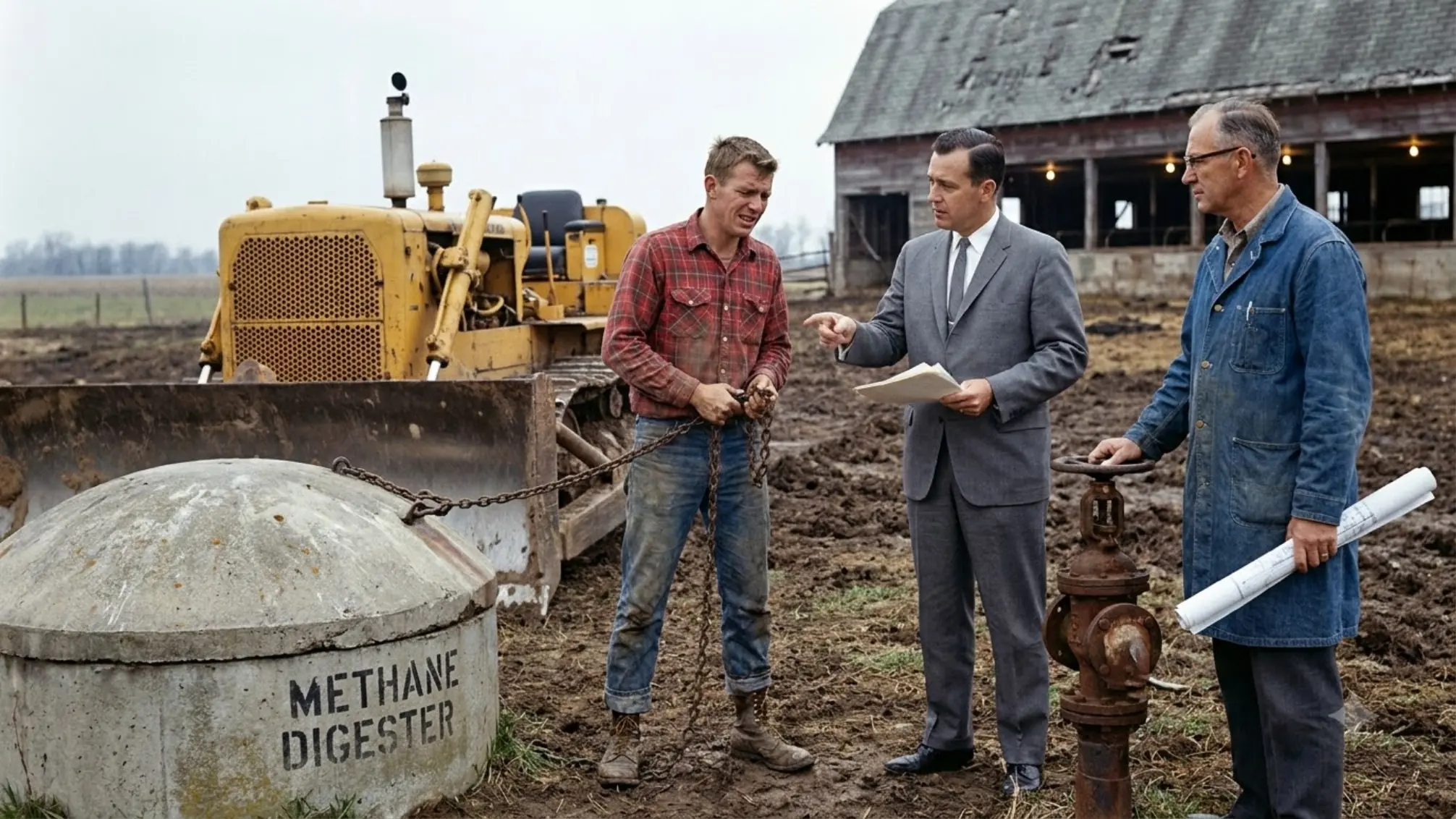
“Touch that tank, and I’ll bury your order under it.”
Victor’s polished shoes slid across the loose gravel, but he did not drop the papers. He was forty-eight, clean-shaven, and dressed in a gray suit too expensive for a farm already marked for auction. His expression carried no fear, only the cold certainty of a man protected by debt, contracts, and the knowledge that Caleb had eleven days before the bank legally took the property.
Amos walked toward the rusted control pipe protruding from the ground.
“Back away,” he said. “This dead system is still producing gas.”
Victor laughed. “That concrete grave hasn’t operated since Kennedy was president.”
Amos turned the main valve.
An underground pipe shuddered violently. A deep mechanical groan traveled beneath the farm, followed by a sharp ignition from inside the old generator room. One by one, every yellow bulb inside the barn flickered on, bathing the stalls, rafters, and stunned cattle in warm light.
Caleb released Victor.
The bank officer stumbled backward, staring at the illuminated windows.
Caleb looked toward Amos. “Who restarted it last night?”
A metallic clang answered from beneath the concrete tank.
Then someone shouted from underground.
“Shut the north valve before the pressure spikes!”
Caleb ran toward the service hatch beside the digester. The circular steel cover was partly open, though he had welded it shut three years earlier after a calf nearly stepped onto it. Amos reached the valve first and turned it halfway closed as steam and sour gas escaped through the emergency vent.
A hand appeared from the darkness.
Caleb grabbed it and pulled.
A thin Black American man in stained coveralls climbed from the underground chamber, breathing hard. He appeared to be in his early forties, with dark brown skin, close-cropped black hair, and a bleeding cut above one eyebrow. A leather tool bag hung from one shoulder, while a folder wrapped in waxed cloth remained pressed against his chest.
Victor’s face changed immediately.
“You.”
The stranger looked at him.
“That’s right.”
Caleb stepped between them. “Who are you?”
“Isaiah Freeman. Agricultural systems technician.”
Victor pointed toward the road. “He is trespassing. Call the sheriff.”
Isaiah opened the waxed folder.
“I was hired by Langford Agricultural Holdings to inspect this farm before foreclosure.”
Caleb looked at Victor. “Your company?”
“The bank uses independent contractors.”
Isaiah shook his head. “He didn’t hire me to inspect the farm. He hired me to prove the digester could never run again.”
The morning became unnaturally quiet.
Even the bulldozer operator shut down the engine.
For six months, Caleb had believed foreclosure was the result of bad milk prices, equipment debt, and two difficult winters. His herd had fallen from one hundred twenty cows to seventy-four. The bulk tank compressor failed in January, veterinary costs climbed after an infection moved through the calves, and the bank refused another extension.
Victor had visited three times.
Each time, he photographed the abandoned digester.
Caleb assumed the banker saw it as worthless concrete occupying valuable ground.
Now Isaiah placed the folder on the bulldozer track and unfolded a collection of pressure charts, gas measurements, handwritten calculations, and company memoranda.
“This system isn’t dead,” Isaiah said. “It was sealed, not destroyed.”
Amos knelt beside the pages.
His hands trembled as he examined the diagrams.
“Where did you find these readings?”
“I took them over the last four nights.”
Caleb stared toward the glowing barn.
“You’ve been hiding under my farm?”
“Only since yesterday. Langford’s men caught me copying the inspection file. They followed me from the county office, so I came here through the old drainage tunnel.”
Victor stepped closer. “This is absurd.”
Isaiah looked directly at him.
“You knew the tank was producing methane.”
“I knew nothing of the kind.”
“You knew enough to order the demolition before the foreclosure was final.”
Victor raised the court papers. “The bank has authority to protect the property from hazardous structures.”
Amos stood slowly.
“You called it obsolete, not hazardous.”
“It is both.”
“No,” Amos said. “It is valuable.”
The digester had been built in 1958 by Caleb’s grandfather, Henry Warren, with help from Amos, then a twenty-three-year-old agricultural engineering student. It consisted of a sealed underground tank where manure decomposed without oxygen, producing methane that could be burned for heat or electricity. The remaining material emerged as concentrated fertilizer with less odor than raw manure.
For four years, the system powered the milking equipment, heated water, and supplied part of the farmhouse electricity.
Then cheap natural gas reached the county.
Rural electric rates fell.
Dealers told farmers that digesters were backward, unreliable, and unnecessary. Henry disconnected the generator in 1963 but never demolished the tank. He believed energy prices would rise again and that manure would someday become more valuable than people realized.
Everyone laughed at him.
Caleb had grown up hearing the story as a family embarrassment.
His father called the digester Henry’s concrete mistake. Neighbors used it as a landmark when giving directions. Children dared one another to touch the rusted lid because they believed poisonous gas remained trapped inside.
Amos never laughed.
He left Wisconsin in 1964 and spent decades designing waste-treatment systems in Denmark and Germany, where farm-scale methane technology continued developing after American projects disappeared. When he returned to the United States, he discovered that modern dairy operators were paying foreign companies to install systems based on principles American farmers had tested generations earlier.
He had visited Caleb three months before the foreclosure.
Amos asked permission to inspect the old structure.
Caleb refused.
At the time, he was too exhausted to listen to another story about the past.
“I should have let you look,” Caleb said now.
Amos shook his head. “You had no reason to trust a seventy-two-year-old man carrying fifty-year-old drawings.”
Victor gathered the loose documents.
“These papers belong to the bank’s contractor.”
Isaiah placed one boot on the folder.
“They document attempted fraud.”
Victor’s eyes hardened. “Move your foot.”
“No.”
“You signed a confidentiality agreement.”
“I did not sign away evidence of a crime.”
Caleb stepped toward Victor again, but Amos raised one hand.
“Do not give him the fight he came here to create.”
Caleb stopped.
The banker wanted anger. An assault charge would make the foreclosure easier and Caleb’s testimony less credible.
Isaiah explained what he had discovered.
Langford Agricultural Holdings had already negotiated a private sale of the Warren farm to NorthStar Energy Development. The company planned to build one of the region’s first commercial manure-to-gas facilities using waste collected from surrounding dairies.
The Warren property was ideal.
It had road access, clay soil suitable for containment, existing utility connections, and an underground digester that could be restored as a pilot unit.
NorthStar’s internal valuation placed the land at nearly five times the foreclosure price.
Victor’s bank planned to seize it for unpaid debt, sell it quietly to the development company, and receive an ownership stake in the future energy operation.
The digester was proof that the site could work.
It was also a problem.
If Caleb learned that the old system remained functional, he might attract investors, restructure his debt, or challenge the bank’s claim that the property held no value beyond ordinary farmland. Victor therefore ordered Isaiah to issue a report declaring the tank structurally unsound and incapable of restoration.
Isaiah refused.
“They told me to revise the report,” he said. “When I still refused, Langford sent another inspector.”
Victor’s mouth tightened. “A qualified inspector.”
“A man who never opened the hatch.”
Amos examined the pressure figures again.
“You restarted it with the original generator?”
Isaiah nodded. “The bearings were dry, the fuel mixture was wrong, and half the wiring had been eaten. But the main vessel is sound. Henry Warren overbuilt everything.”
Caleb looked at the warm lights inside the barn.
“How much power can it produce?”
“With seventy-four cows, not enough to run the entire farm continuously. But enough to heat water, power part of the dairy, and cut your fuel costs.”
“And if we collect manure from nearby farms?”
Isaiah glanced at Victor.
“Then this becomes exactly what his partners wanted to build after taking your land.”
Victor folded the foreclosure order.
“Even if the tank operates, Mr. Warren remains in default. A few barn lights do not erase two hundred eighty-six thousand dollars in debt.”
Caleb felt the number settle against his chest.
The banker was right.
Evidence of value was not cash.
The digester could save future energy expenses, but the bank auction was eleven days away. Caleb did not have time to create a business, obtain permits, build contracts, and satisfy the loan.
Victor saw the realization.
His confidence returned.
“Disconnect the generator,” he told the bulldozer operator. “We proceed under the hazardous-structure clause.”
The operator remained inside the cab but did not restart the engine.
Caleb walked toward him.
“Tom, that tank is not bank property yet.”
Tom Avery removed his hands from the controls. He had known Caleb since high school.
“I’m not touching it.”
Victor raised his voice. “Your company accepted the demolition contract.”
“Your contract called it abandoned concrete.”
“It is abandoned.”
Tom pointed toward the glowing barn. “Doesn’t look abandoned.”
Victor reached for the bulldozer door.
Caleb blocked him.
This time, he did not threaten or touch the banker.
“You step into that machine, I call the sheriff and report destruction of active equipment.”
Victor stared at him.
“You think one morning of theater changes the law?”
“No,” Caleb said. “The documents change the law.”
Isaiah had already sent copies.
Before entering the drainage tunnel, he mailed the inspection file to the state agricultural department, the county prosecutor, and a reporter named Claire Benton who had been investigating predatory farm foreclosures. He also sent the records to twenty-three dairy farmers whose land had been evaluated by Victor’s bank.
The first car arrived before noon.
Claire stepped out holding a camera and recorder. Behind her came County Sheriff Harold Meeks and a state environmental engineer. Two neighboring farmers followed in pickups after receiving Isaiah’s messages.
Victor tried to leave.
Sheriff Meeks stopped him beside his sedan.
“You are not under arrest,” the sheriff said. “But I need the demolition order and every document authorizing work on this property.”
Victor refused.
The sheriff placed one hand on the car door.
“Then wait for a warrant.”
By afternoon, the Warren farm had become an active investigation site.
The state engineer inspected the concrete vessel, valves, generator, and underground chamber. He found no immediate structural danger. Methane levels required controlled operation, but the system was not the collapsing hazard described in the bank’s report.
The false report contained Isaiah’s typed name but not his signature.
Victor had submitted it anyway.
Claire photographed the lit barn while Amos stood beside the rusted controls. She asked how a system abandoned in the 1960s could still operate.
“Because it was never superstition,” Amos said. “It was engineering that became unfashionable when fuel was cheap.”
He explained that anaerobic digestion turned manure into combustible gas while leaving nutrient-rich fertilizer behind. American farms experimented with the technology long before large energy markets considered it valuable, but many projects were abandoned when natural gas and rural electricity became inexpensive. Europe continued developing the systems, and decades later American companies returned to the same principles with imported expertise and modern branding.
Claire looked toward Victor’s sedan.
“So the bank called this worthless while preparing to sell the land to an energy developer?”
“That is what the documents suggest.”
The story reached the evening news.
The headline was not about Caleb’s debt.
It was about a banker ordering the demolition of a working methane system before purchasing the land through a private partner.
NorthStar Energy released a statement denying knowledge of any improper conduct. Two hours later, leaked emails showed company executives discussing the importance of “removing the legacy unit before the owner understands its demonstration value.”
The bank suspended Victor.
It also postponed the foreclosure.
Not canceled.
Postponed.
Caleb had gained time, not freedom.
For the next four days, Amos and Isaiah worked inside the generator room while state technicians monitored safety. They cleaned the gas line, installed modern pressure regulators, replaced damaged wiring, and connected the system to a temporary meter.
The numbers were modest but real.
The digester produced enough fuel to heat the dairy’s wash water, supply the farmhouse furnace, and generate electricity for several hours daily.
The processed manure retained valuable nutrients.
Caleb spread a small test batch across a depleted field.
“So my grandfather was right,” he said.
Amos tightened a regulator.
“Your grandfather was early. People often confuse those two conditions.”
The neighboring farmers came to watch.
Most had manure problems of their own. Storage pits overflowed during wet seasons. Fertilizer prices had risen, and odor complaints threatened dairies near growing suburbs.
Isaiah drew a plan.
The Warren digester alone could not process every farm’s waste, but its successful restart could support a cooperative facility owned by the farmers rather than an outside corporation. Each dairy could contribute manure, receive processed fertilizer, and share revenue from gas or electricity.
The idea spread quickly.
Six farmers signed letters of interest.
Then twelve.
Within a week, twenty-one farms joined.
A rural electric cooperative agreed to evaluate purchasing excess power. A university agricultural department offered technical assistance. The state announced a renewable-energy grant program that had previously seemed irrelevant to Caleb’s small dairy.
The bank’s president arrived on the eighth day.
He came without Victor.
Caleb met him beside the digester with Amos and Isaiah present.
“We are prepared to restructure the loan,” the president said.
Caleb remained silent.
“The foreclosure will be withdrawn if the cooperative financing is approved.”
“You were ready to take this property for less than its real value.”
“We relied on reports submitted by Mr. Langford.”
“You profited from those reports.”
The president looked toward the operating generator.
“We are reviewing every transaction.”
Isaiah placed the false inspection beside the bank documents.
“Review begins with admitting your employee submitted my name on a report I refused to sign.”
The president adjusted his tie.
“The bank is willing to forgive all foreclosure fees.”
Caleb almost laughed.
“You created the fees.”
“We are attempting to resolve the matter.”
“No,” Caleb said. “You are attempting to survive it.”
He demanded full cancellation of penalty interest, reimbursement of legal costs, release of the demolition lien, and an independent review of every farm Victor had targeted.
The bank initially refused.
Then Claire’s second article appeared.
It identified nine farms purchased below market value and later transferred to companies connected to Victor. Three properties were already being evaluated for renewable-energy, water, or commercial-storage projects.
The state attorney general opened an investigation.
The bank agreed to Caleb’s terms the following morning.
Victor Langford was arrested two weeks later on charges related to forged reports, financial fraud, and conspiracy. NorthStar executives claimed he had acted alone until internal messages showed they had promised him an ownership percentage after the Warren property transferred.
The bulldozer contract became crucial evidence.
It was scheduled before the bank legally possessed the land.
Victor had not merely planned to take the farm.
He planned to destroy the one machine capable of proving why the farm was worth taking.
One year later, the Warren County Agricultural Energy Cooperative opened beside Caleb’s south field.
The facility was modern, enclosed, and carefully regulated. It processed manure from thirty-seven farms, produced renewable gas, reduced odor, and returned stabilized fertilizer to members.
The original 1958 digester remained in place.
It was not demolished or polished into a museum decoration. Amos insisted the stains, patched pipes, and rough concrete remain visible.
A small plaque carried Henry Warren’s name.
Below it were the words:
Built when the idea was called impractical. Restarted when forgetting it became profitable.
Caleb paid off the farm three years ahead of the restructured schedule.
His dairy did not become enormous. He still woke before sunrise, repaired fences, worried about sick calves, and checked milk prices more often than he admitted.
But the manure no longer represented only waste.
It heated water, produced energy revenue, reduced fertilizer costs, and tied local farmers together through a cooperative they controlled.
Isaiah became the facility’s technical director.
Amos visited every Tuesday until his knees made the underground stairs impossible. He trained younger engineers to read pressure by sound, inspect biological activity, and distrust any report written to satisfy a financial outcome.
On the fifth anniversary of the restart, Caleb stood beside the original valve while a group of agricultural students toured the farm.
One student asked why America abandoned systems like Henry’s.
“Because cheap energy made them look unnecessary,” Amos answered from a chair near the generator room. “When something costs less today, people stop measuring what dependence costs tomorrow.”
Another student pointed toward the concrete tank.
“Was this really almost destroyed?”
Caleb nodded.
“The bulldozer was running.”
“What stopped it?”
Caleb looked toward Isaiah.
“Someone refused to sign a lie.”
Isaiah shook his head.
“That only delayed it.”
Caleb looked toward Amos.
“Someone remembered what the machine was built to do.”
Amos smiled.
Caleb rested one hand on the rusted valve.
“And someone finally listened before it was too late.”
The barn lights turned on automatically as evening settled across the farm.
Their glow looked ordinary now.
That was the victory.
Five years earlier, those lights had exploded into darkness like a warning. They exposed a banker’s scheme, saved a farm, and brought forgotten technology back from beneath the ground.
Now they simply illuminated cattle eating calmly in their stalls.
Victor had called the digester a relic.
The bank had called it worthless.
The development company had called it valuable only after they believed they could own it.
Henry Warren had called it preparation.
His grandson finally understood the difference.
A forgotten technology had not been waiting for the future to rescue it.
It had been waiting for people to remember what it already knew.