“You lost the farm in court,” Richard Mercer sneered. “Playing farmer in this rotting barn will not make it yours again.”
Clara Vance tightened both arms around the locked steel box pressed against her chest. Rain hammered the failing roof of the North Barn while freezing wind tore through gaps in the gray boards. Behind Mercer, his broad-shouldered enforcer raised an iron tire bar and blocked the only open doorway.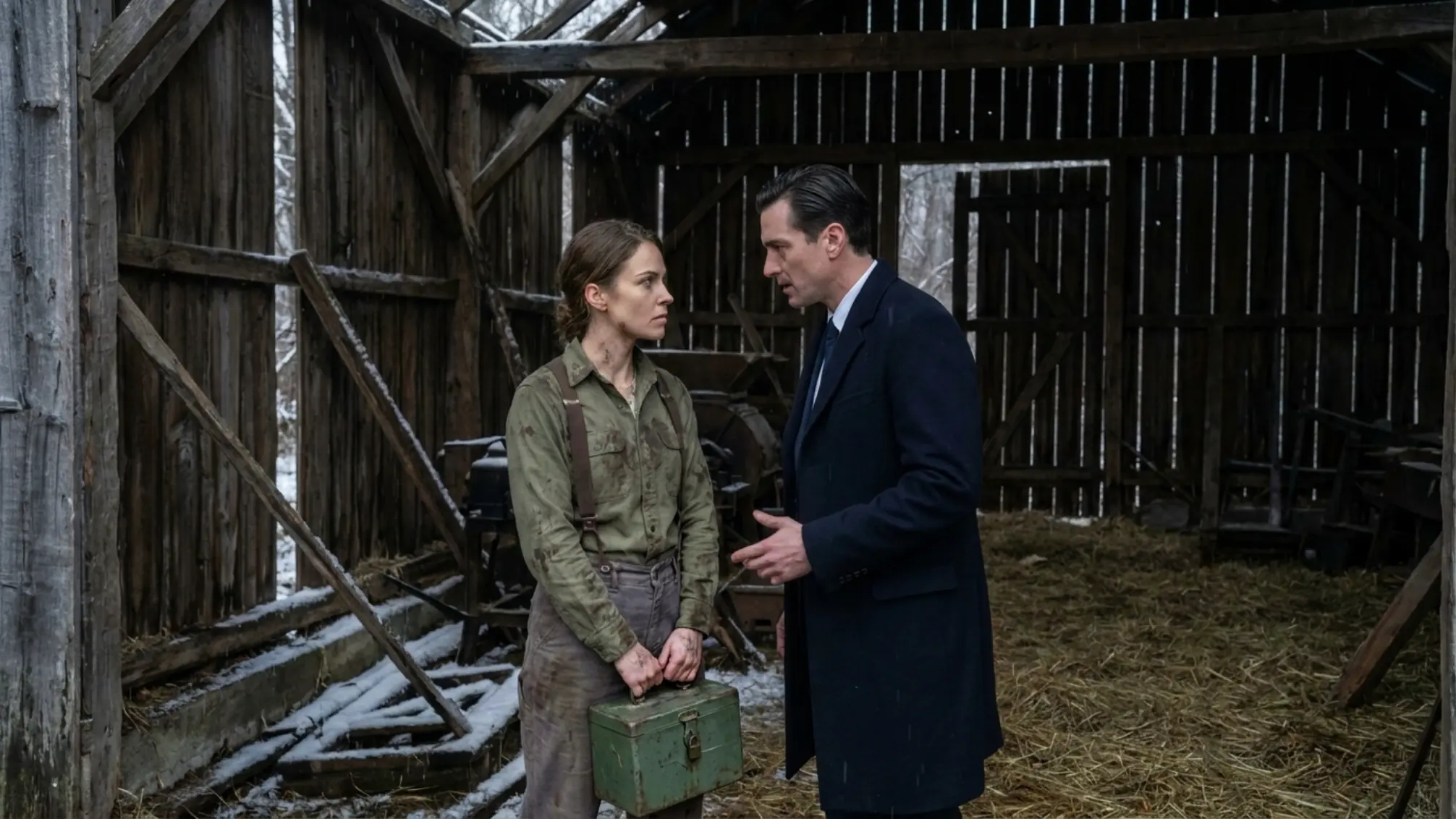
“Then explain why you forged my uncle’s signature,” Clara said, “and scheduled bulldozers before anyone could search this floor.”
Mercer’s polished expression disappeared. “Hand over the box, or they will find you buried beneath the barn you were too stupid to surrender.”
Clara backed toward the hayloft rope, her mud-covered farming boots scraping across the exposed oak planks. “Come take it,” she replied. “Then watch what falls when this farm finally gives up your secret.”
Only twelve hours earlier, Clara had sat inside the Crawford County Courthouse and watched the only home she had ever loved sell for $95,000.
The November rain struck the courthouse windows in hard, cold sheets. Farmers, creditors, bank employees, and curious townspeople filled the wooden benches while an auction clerk read the legal description of the Vance farm in a voice stripped of all emotion. Eighty-four acres, a farmhouse, two barns, an orchard, Willow Creek, and every childhood memory Clara possessed were reduced to an item number.
Her uncle Samuel had raised her there after her parents died in a highway collision. He taught her how to repair fences, graft apple branches, deliver calves, sharpen tools, and recognize a storm by the smell of the air. He had lived carefully, avoided unnecessary debt, and distrusted bankers who wore shoes too clean for the land they claimed to understand.
Yet Mercer Regional Bank produced a second mortgage bearing Samuel’s signature.
The documents claimed that three years earlier he had borrowed $110,000 against the farm. Clara knew the loan was impossible because Samuel had kept detailed records of every purchase and refused to finance even a replacement tractor without discussing it for months. But intuition was not evidence, and the court accepted the bank’s paperwork as valid.
Richard Mercer sat beside his attorney in a navy suit worth more than Clara’s savings.
He was the vice president of Mercer Regional Banking, though farmers across the county called him the Vulture King. During three poor harvest years, his bank had acquired land from families who missed payments, refinanced equipment, or trusted Mercer’s promises of temporary relief. He always arrived after weakness appeared and called the destruction that followed ordinary business.
“Minimum bid is $95,000,” the auctioneer announced. “Do I hear ninety-five?”
Mercer lifted one well-manicured finger.
No one else bid.
Several neighboring farmers wanted to help Clara, but Mercer held mortgages on their farms too. Challenging him could mean sudden inspections, canceled credit lines, or new demands on loans that had seemed safe the day before. They kept their heads down while the auctioneer called for another offer.
Clara rose from the third bench. “Your Honor, the mortgage is fraudulent. My uncle never borrowed this money.”
Judge Timothy Higgins looked over his glasses. “Ms. Vance, this matter has already been reviewed.”
“The signature is wrong.”
“A handwriting examiner retained by the bank disagreed.”
“The bank paid that examiner.”
The judge’s face hardened. “Unless you possess the original unencumbered title or evidence that the debt was fabricated, the foreclosure stands. Sit down.”
The gavel struck seconds later.
The farm belonged to Mercer Regional Bank.
Richard waited until the courtroom began emptying before approaching Clara. He stood close enough for her to smell his expensive cologne and lowered his voice so the farmers nearby could pretend they had not heard.
“You have until midnight tomorrow to remove your belongings,” he said. “After that, the sheriff will treat you as a trespasser.”
Clara stared at him. “Why do you want eighty-four acres of poor soil so badly?”
Mercer smiled. “Land is land.”
“Then why are you sending men to the North Barn?”
The smile flickered.
Clara saw it.
“The structure is dangerous,” he answered. “My crews will secure it tonight and demolish it Thursday morning.”
“The roof has been failing for fifteen years. You suddenly care about safety?”
Mercer stepped closer. “Stay away from that barn.”
He left with his attorney, Gregory Hayes, but not before the two men exchanged a brief, anxious glance. Clara had spent years studying livestock and weather, but she understood fear in human faces just as easily.
Mercer was not protecting an abandoned barn.
He was trying to destroy something inside it.
By nine that evening, sleet had replaced the rain. Clara packed Samuel’s clothes, photographs, tools, and notebooks into old cardboard boxes while the farmhouse slowly became an empty shell. Each room felt less like a home and more like the scene of a life being erased.
Inside the kitchen, she found a photograph of Samuel standing beside her father when both men were young. They wore military jackets and rested their hands on the same fence post near Willow Creek. On the back, Samuel had written a single sentence.
Brothers in arms, brothers in soil. Willow Creek belongs to the Vances, root and stem, forever.
Root and stem.
The words reminded Clara of something Samuel had told her when she was twelve. They had been stacking firewood beside the North Barn when she asked why he never tore the decaying structure down.
“A house holds people,” Samuel had said. “But a barn holds the weight of the farm. If you ever need to learn what this land is worth, look inside its bones.”
At the time, Clara thought he was being sentimental.
Now the words felt like instructions.
She walked to the window and saw a black pickup truck parked near the distant tree line. Its headlights were off, but the shape belonged to Lyle Briggs, Mercer’s head of farm security. The banker had posted a guard before the legal deadline had even expired.
Clara pulled on an olive work shirt, dark suspenders, waterproof trousers, a heavy parka, and her strongest leather farming boots. She placed a flashlight and multi-tool inside one pocket and took a steel crowbar from the mudroom. Then she slipped out the back door into the storm.
The freezing rain struck her face like thrown gravel.
She moved behind the hedges, crossed the orchard, and used the old silo to hide from the truck. Mud pulled at her boots with every step, but she knew the property well enough to follow drainage ditches invisible beneath the darkness.
Voices reached her before she arrived at the barn.
Clara pressed herself against the wet exterior wall and listened.
Gregory Hayes stood beneath the front awning with Lyle Briggs. The attorney’s expensive coat was soaked, and panic sharpened every word he spoke.
“Are you sure Samuel did not move it?”
“I searched the house while he was in the hospital,” Briggs replied. “It was not in the safe, the desk, or his bedroom.”
“If Clara finds the original grant, the entire foreclosure collapses.”
Briggs spat into the mud. “She is packing photographs. She does not suspect anything.”
“Mercer’s signature is on the altered deed. Federal auditors will trace the collateral accounts.”
“That is why the bulldozers arrive Thursday. By noon, this barn will be firewood.”
Their truck pulled away several minutes later.
Clara remained against the wall until the engine disappeared beyond the gate. Her fear had transformed into something colder and more useful. The bank had not merely invented a loan; it had altered the farm’s legal history and planned to destroy the original document before anyone could challenge it.
She forced open a narrow rear door and slipped inside.
The North Barn smelled of old oil, wet soil, decaying hay, and timber that had carried a century of winter storms. Her flashlight revealed a rusted tractor, broken crates, hanging chains, and hand tools covered beneath thick gray dust.
She searched the workbench first.
Drawers held nails, wrenches, seed packets, old invoices, and mouse-chewed gloves. The tractor’s storage compartment contained nothing but a cracked belt and a grease gun. She searched beneath hay bales, inside grain bins, and along rafters low enough to reach.
Forty minutes passed.
Cold entered her gloves and numbed her fingertips. For one terrible moment, Clara wondered whether the evidence had already been removed. Perhaps Briggs had found it and lied to Hayes, planning to sell the secret for himself.
Then she remembered Samuel’s words.
Look inside its bones.
Clara lowered the flashlight toward the floor.
Most planks were thick white oak fixed with hand-forged square nails blackened by age. Near the old grain chute, however, one five-foot section looked slightly different. The wood grain failed to match the boards around it, and four recessed hex screws had been used instead of antique nails.
She knelt.
Fresh scratches marked each screw head.
Using the multi-tool, Clara backed them out one by one. The last screw resisted until she pressed both hands against the handle and felt it break free. She wedged the crowbar beneath the plank and lifted.
A dark cavity appeared between the floor joists.
Inside rested an olive-drab military dispatch box secured with a brass padlock. Beside it lay a black leather journal with Samuel Vance’s name written across the cover.
Clara opened the journal first.
The final pages were dated three weeks before his death.
October 12. Mercer returned and doubled his offer for the northern acreage. When I refused, he warned me that a man can lose land without agreeing to sell it. His surveyors found something near Willow Creek, and he thinks I do not know.
Clara turned the page.
October 19. Mercer Regional created a false 1999 deed transfer and tied the farm to a commercial bond my father never signed. The original 1922 federal land grant is inside the dispatch box with certified university core samples. If anything happens to me, Clara must find them. The deposit beneath Willow Creek may be worth more than $45 million. Mercer is not collecting a debt. He is stealing the mineral rights.
Clara stopped breathing.
The farm sat above lithium and rare-earth minerals used in batteries, electronics, and modern energy systems. Mercer had forged a mortgage, forced a foreclosure, and purchased a $45 million deposit for $95,000.
A high-powered beam suddenly flashed through the cracks in the barn wall.
Truck doors slammed outside.
“I saw a light!” Briggs shouted. “Check the back entrance!”
Clara lifted the heavy dispatch box and shoved Samuel’s journal beneath her parka. Before she reached the rear door, it exploded inward.
Briggs filled the doorway, gripping an iron tire bar.
Richard Mercer entered behind him wearing a long wool overcoat, his face pale with fury. Rainwater ran from his hair, and the polished businessman Clara knew from court had vanished.
“I underestimated you,” Mercer said. “I expected tears, not burglary.”
“The farm is still legally mine until midnight.”
“Not that barn.”
Clara held the box tighter. “I know about the forged deed, the false collateral bond, and the mineral deposit.”
Mercer looked toward Briggs.
“Take it.”
Briggs raised the iron bar. “Hand it over, girl.”
“The original federal grant is inside this box,” Clara said. “So are Samuel’s geological reports.”
Mercer moved closer. “Knowledge matters only if you live long enough to show it to someone.”
Clara glanced toward the hayloft ladder.
Briggs followed her eyes and smiled. “There is nowhere to run.”
He stepped forward.
Clara hurled her metal flashlight into his face.
The flashlight struck his cheekbone, and he stumbled with a roar. Clara sprinted to the ladder, clutched the dispatch box beneath one arm, and climbed before he recovered.
Briggs followed.
His boots shook every rung.
The loft contained rows of dry hay bales stacked beneath the rafters. Clara pushed between them, searching for another exit while Briggs climbed into view with blood running down his face.
“You just made this worse,” he growled.
Beside Clara rested an eight-hundred-pound round hay bale positioned dangerously close to the loft edge. An old grain shovel leaned against the railing.
Briggs raised the tire bar and charged.
Clara seized the shovel and drove its flat blade against the hay bale. It shifted only a few inches.
Briggs laughed.
She struck it again.
The bale rolled.
Briggs turned too late. The enormous weight hit him across the chest and carried him backward over the loft edge. His body crashed onto the lower floor amid splintered boards and falling straw.
Mercer screamed his name.
Clara found the old hay trolley rope hanging from the ridge beam. She wrapped one arm through the line, held the dispatch box with the other, and stepped over the edge.
The rusted pulley shrieked.
She descended rapidly and landed several feet from the main doors. Mercer lunged toward her, one hand reaching inside his coat.
Clara swung the steel box into his chest.
The impact sent him backward into the mud outside.
She ran.
Rain blinded her as she crossed the eastern pasture toward Walter Ross’s farm. Walter had been Samuel’s closest friend and served thirty years as a sheriff’s deputy before retiring. If anyone could keep Mercer from burying the evidence, it was him.
Clara reached Walter’s porch nearly twenty minutes later.
Her arms were numb, her lungs burned, and blood covered one palm where the box handle had cut through her glove. She pounded on the door until the porch light came on.
Walter opened it carrying a shotgun.
“Clara?”
“Mercer forged the mortgage,” she gasped. “He tried to take the box and kill me.”
Walter pulled her inside.
He wrapped her in a wool blanket, called Deputy Mark Henderson, and retrieved a pair of bolt cutters. The brass lock snapped with one hard movement.
Inside the dispatch box lay the original 1922 federal land grant, university geological assays, bank correspondence, survey maps, and printed emails bearing Mercer Regional letterhead.
The deed granted the Vance family unencumbered ownership in perpetuity and prohibited local collateral seizure without federal oversight. The mineral report confirmed a lithium and rare-earth deposit valued at more than $45 million.
The internal emails were even more devastating.
They described bribery payments to a county registrar, the creation of a false commercial bond, the forged mortgage, and a plan to purchase the farm through foreclosure before anyone learned what lay beneath Willow Creek.
Deputy Henderson arrived while Clara and Walter were still reading.
He examined the papers, listened to the account of the barn attack, and immediately contacted the county sheriff, state police, and federal authorities.
“This is not a property dispute,” he said. “This is bank fraud, racketeering, forgery, attempted murder, and theft of federally protected land.”
By dawn, a convoy surrounded Mercer Regional Banking.
Clara stood across the street wearing Walter’s wool coat as agents entered the glass-fronted headquarters. Employees gathered outside, whispering while investigators carried boxes of records through the doors.
Richard Mercer emerged in handcuffs.
Mud stained his expensive suit from the barn confrontation, and the confidence that had silenced half the county was gone. Gregory Hayes followed him, weeping openly while state police escorted him toward another vehicle.
Briggs was removed from the hospital and charged under guard.
Mercer saw Clara in the crowd.
She did not shout or smile.
She simply held his gaze long enough for him to understand that the farm woman he dismissed had carried his empire out of the barn in her own hands.
The federal investigation uncovered far more than Samuel’s foreclosure. Mercer had used the same method against twelve other farming families. His bank created false liens, altered property records, engineered defaults, and purchased valuable land at controlled auctions.
Several county officials were arrested.
Judge Higgins was removed after investigators discovered payments routed through a consulting company owned by his brother. The handwriting examiner admitted that Mercer paid him to validate signatures without examining original samples.
The fraudulent auction was overturned.
Every lien against the Vance farm was erased, and title returned to Clara. The twelve other families also recovered land or received compensation from the bank’s liquidated assets.
Richard Mercer received thirty-five years in federal prison.
Hayes and Briggs received long sentences for conspiracy, fraud, assault, and attempted murder. The county registrar pleaded guilty and revealed additional records investigators had not yet found.
Clara could have sold Willow Creek to the highest bidder.
Mining companies offered millions for immediate ownership of the entire farm. Instead, she negotiated a tightly controlled lease covering only a small section of the underground deposit. The agreement required environmental monitoring, protection of the orchard and creek, and annual payments large enough to preserve the farm for generations.
One year after the storm, Clara stood beside the restored North Barn.
She had repaired the roof, replaced damaged beams, and preserved the section of oak flooring where Samuel hid the dispatch box. The old steel container rested inside a glass case near the entrance, beside copies of the federal grant and his journal.
A carved wooden sign hung above the doors:
VANCE HOMESTEAD — ESTABLISHED 1922
ROOT AND STEM, FOREVER
Clara wore the same olive farming shirt and brown suspenders she had worn the night she entered the barn. The fabric was clean now, but she had kept the tear in one sleeve as a reminder.
Walter joined her near the doorway.
“Samuel knew you would find it,” he said.
“I nearly did not.”
“He never needed you to be certain. He only needed you to keep looking.”
Clara watched the wind move through the apple trees.
Mercer believed power belonged to the person holding the mortgage, controlling the courtroom, and commanding the men with weapons. He never understood the strength of a woman who knew every fence line, loose floorboard, and hidden path across the land he tried to steal.
He bought the farm for $95,000.
He expected the bulldozers to erase the evidence before sunrise.
Instead, Clara broke through the barn floor and found the original deed, the $45 million secret beneath Willow Creek, and the proof that returned an entire valley to the families who had worked it.
The house held her memories.
The orchard held her childhood.
But Samuel had been right all along.
The bones of the barn held the truth.