Constance Whitmore had spent twelve years building a hotel empire around one principle: no guest should ever see uncertainty. Every corridor of the Whitmore Grand was polished, measured, and carefully controlled, from the marble lobby to the private executive floor above it. Yet on that Tuesday afternoon, the thirty-two-year-old CEO crossed her own lobby with fear hidden behind her pale-green eyes. Beside her walked Adrian Vale, the executive she had once trusted with access to nearly every secret inside her company.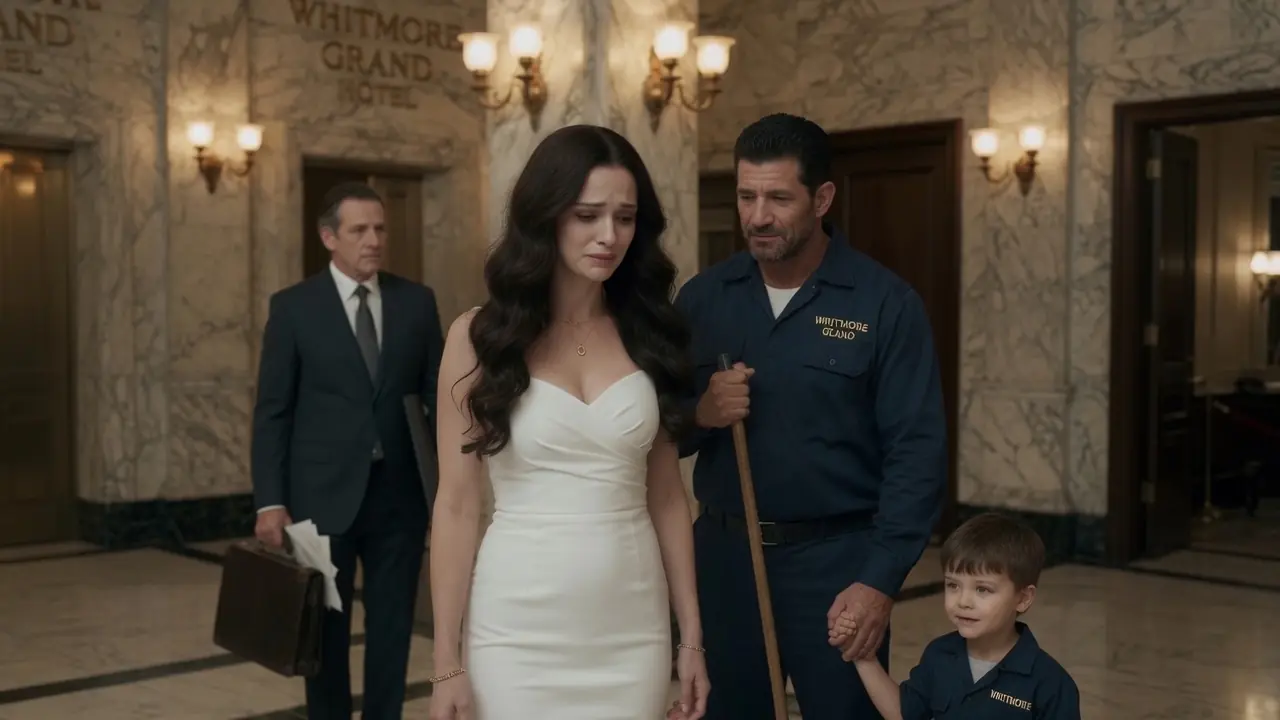
Adrian’s fingers were wrapped tightly around Constance’s wrist beneath the sleeve of her white coat. He had taken her phone, disabled her security credentials, and replaced her digital signature with a forged copy designed to survive a routine inspection. Inside the black leather briefcase in his other hand were falsified financial reports suggesting Constance had hidden millions in company losses. Unless she signed twelve pages transferring temporary control of Whitmore Hospitality to his investment group, Adrian promised to deliver the documents to the board, the press, and federal regulators before sunset.
“You’ll smile until we reach the executive conference room,” he murmured. “Anyone watching must believe this is a scheduled negotiation.”
Constance kept her expression calm. “And when the truth comes out?”
“The truth will be whatever the board sees first.”
“You worked for my family for fourteen years.”
“And your family treated me like a well-dressed servant for fourteen years.”
Adrian tightened his grip. Constance felt his expensive ring press painfully into her skin, but she did not react. Her staff moved around them carrying luggage, answering telephones, and welcoming guests who had no idea their employer was being marched toward a corporate execution. The security officers near the entrance never looked twice because Adrian had already sent them a false notice claiming Constance had requested privacy during a sensitive acquisition.
Then she saw Silas Henry.
The thirty-six-year-old janitor stood near the concierge desk, guiding a mop across the gleaming marble. He wore a navy maintenance uniform with his name stitched above the pocket, and his broad shoulders were slightly bent from years of work that most guests never noticed. Constance knew almost nothing about him except that he arrived before sunrise, never missed a shift, and sometimes brought a little girl with dark curls through the service entrance before school.
That child was the reason Constance risked everything on a language made without sound.
Three years earlier, the Whitmore Foundation had sponsored a program for deaf children. Constance had attended several classes, learning enough American Sign Language to greet students, understand basic needs, and participate in the ceremony without relying entirely on an interpreter. She had not practiced consistently afterward, but fear sharpened forgotten knowledge.
As she passed Silas, Constance kept her face turned forward. Her hand moved near her hip, hidden from Adrian’s view.
Help me. He stole my phone. Forced contract. Forged evidence.
Silas’s mop stopped for less than a second.
He saw her hands reflected in the marble.
Constance added one final sign.
Do not look up.
Silas resumed mopping.
Adrian guided her past him without slowing. “Your staff is remarkably disciplined.”
“They know how to do their jobs.”
“Especially the invisible ones.”
Constance’s jaw tightened. She wanted to tell him that the man he had dismissed with three words might be her only hope, but she kept walking. Behind her, Silas pushed the mop through the water as though nothing had happened. Only the tightening of his hands around the handle revealed that the ordinary afternoon had just ended.
Silas had learned sign language because his seven-year-old daughter, Matilda, had been born deaf. Her mother, Rachel, began learning with him before illness took her life when Matilda was four. After the funeral, Silas promised their daughter that she would never have to struggle alone in a hearing world because her father had been too tired to understand her.
Every morning, Matilda corrected his clumsy grammar over breakfast. Every evening, they sat on the floor of their small apartment and told each other about their day with their hands. A tap against the chest meant courage. Two fingers crossing beneath the chin meant promise. Their private sign for home was a fist resting gently inside an open palm.
Silas kept his head lowered until Constance and Adrian entered the hallway leading toward the private elevators.
Then he released the mop and moved.
He did not shout for security. Adrian controlled Constance’s phone and access card, which meant he probably understood the hotel’s response systems. A sudden alarm could frighten him into releasing the forged records online before anyone stopped him. Silas needed proof, time, and a way to separate Constance from the man gripping her wrist.
He rolled his cleaning cart into the supply closet and called the internal security extension.
Audrey Finn answered immediately. “Security.”
“This is Silas Henry from day maintenance. The CEO is under coercion.”
There was a pause. “Explain.”
“She signed to me in the lobby. Adrian Vale stole her phone and access credentials. He is forcing her to sign company documents, and he has forged evidence prepared against her.”
“Are you certain that is what she signed?”
“My daughter is deaf. I’m certain.”
Audrey’s voice became colder. “Where are they going?”
“Executive conference floor.”
“I received a notice from Ms. Whitmore requesting no interruptions.”
“He sent it.”
Another pause followed, shorter this time. “Do not confront him. I’m opening the camera feeds and contacting legal counsel.”
“Check whether the feeds were altered first.”
“Why?”
“Because he chose a route with fewer cameras.”
Audrey stopped speaking for several seconds. When she returned, the certainty in her voice had hardened into alarm. “Three camera streams are looping old footage.”
Silas looked through the narrow glass pane in the supply-room door. “Then someone in technology is helping him.”
“I’ll isolate the system.”
“Don’t shut it down completely. Let him believe he still controls it.”
Audrey hesitated. “You’ve done this before.”
“Private security, years ago.”
“Then tell me what you need.”
Silas studied the floor plan fixed to the wall. “Delay the elevators without making them appear broken. Alert general counsel and the board chair through private numbers. Record everything locally. I’ll keep him moving slowly.”
“And Constance?”
“I’ll get her away from him.”
Silas ended the call and returned to his cart.
Near the elevator bank, he pressed the maintenance switch hidden behind a service panel. The elevators remained operational, but every executive-floor request now required manual approval. Adrian pressed the button twice before turning toward Constance.
“Is this normal?”
“Temporary delays happen.”
“In your flagship hotel?”
“Luxury does not make machinery immortal.”
His mouth tightened. “We’ll use the stairs.”
Silas appeared around the corner pushing his cart. He placed a yellow caution sign across the stairwell entrance and began wiping water from the floor.
Adrian stopped. “Move that.”
Silas glanced up for the first time. “The tile is wet, sir.”
“I didn’t ask about the tile.”
“Then I misunderstood.”
“You work here?”
“For three years.”
“Then you understand that when an executive tells you to move, you move.”
Silas slowly lifted the sign. “Of course.”
For one brief moment, his eyes met Constance’s. He signed with one hand against the cart, the movement hidden behind a folded towel.
Keep walking. Let him believe nobody noticed.
Constance’s breathing steadied.
They entered the stairwell.
Silas waited until the door closed, then removed a small radio from his pocket. “They’re taking the west stairs.”
Audrey responded through the earpiece. “Our legal counsel confirms the transfer documents are fraudulent. The board chair is joining remotely. We need Adrian to reveal his leverage and accomplices on record.”
“He’ll make her speak first.”
“Can you delay him another five minutes?”
“Yes.”
Silas wheeled the cart toward the executive floor using the service elevator. When he arrived, he opened a janitorial cabinet and removed a portable floor polisher. The machine was loud, inconvenient, and entirely ordinary. He positioned it outside the private conference room just as Adrian and Constance emerged from the stairwell.
Adrian stared at him. “You again.”
Silas switched off the polisher. “Apologies, sir. Scheduled maintenance.”
“Clear this hallway.”
“I’ll need three minutes to move the equipment safely.”
“You have thirty seconds.”
Silas looked at Constance while pretending to adjust a cable. Her wrist was reddened where Adrian had held it. She had kept her composure, but the fear in her eyes was growing. Silas signed beside his thigh.
When the bucket falls, run to me.
Constance gave no visible response.
Adrian pushed open the conference-room door and guided her inside.
The room overlooked the city through wide windows. A leather folder waited at the center of the table, surrounded by carefully arranged pens, tablets, and glasses of water. Adrian locked the door and finally released her wrist.
“Sit.”
Constance remained standing. “Your forged evidence will collapse under examination.”
“Not before the board removes you.”
“You cannot transfer control with one coerced signature.”
“Coercion requires proof.”
He placed her stolen phone on the table. The screen displayed a scheduled message addressed to every board member and several financial journalists. Attached were the falsified reports, fabricated emails, and an edited recording that made Constance appear to admit hiding losses.
“If you refuse to sign,” Adrian said, “this sends automatically in twenty-two minutes.”
Constance sat without touching the papers. “And if I sign?”
“I cancel it.”
“You expect me to trust you?”
“No. I expect you to understand mathematics. One signature preserves your name. Refusal destroys it.”
Constance opened the folder and began reading.
Outside, Silas crouched beside the fallen electrical cable while Audrey listened through his radio. A hidden conference microphone had been activated by hotel counsel and was transmitting every word to a secure recorder. The board chair, Miriam Whitmore, was listening from another city. So was Samuel Price, the company’s general counsel.
“Twenty-two minutes,” Audrey whispered. “We need access to the phone before the message sends.”
“Can technology stop it remotely?”
“Our analyst says the device is using an external encrypted network.”
“Then we take the phone.”
“We cannot enter without warning him.”
Silas looked through the conference-room glass. Adrian stood near the table, keeping the phone within reach. Constance was slowly turning pages, forcing him to wait.
“Create a fire-system test on the floor below,” Silas said.
“That could trigger evacuation.”
“Not an alarm. A pressure warning. Something that requires maintenance to inspect the panel inside this room.”
Audrey understood. “Give me sixty seconds.”
Inside, Adrian’s patience was failing.
“You’ve read that clause three times.”
“I do not sign contracts I haven’t understood.”
“You are not negotiating.”
“I built this company by reading what arrogant men assumed I would ignore.”
His expression sharpened. “Your beauty has always made people underestimate how cruel you can be.”
“And your resentment made you mistake access for ownership.”
Adrian leaned toward her. “Your father promised me a partnership. Then he died and left the company to his spoiled daughter.”
“My father left it to the person who had spent ten years rebuilding it.”
“I protected him.”
“You protected your salary.”
He slammed one hand onto the table. “Sign.”
A warning tone sounded from the wall panel.
Adrian looked toward it. “What is that?”
Constance glanced at the display. “Fire-pressure fault.”
The door handle moved.
Adrian quickly unlocked the door and opened it only a few inches. Silas stood outside holding a diagnostic device.
“Maintenance,” he said. “The panel must be checked.”
“Come back later.”
“The system automatically reports unresolved faults to the fire marshal.”
Adrian’s eyes narrowed. “How long?”
“Thirty seconds.”
He opened the door and stepped aside.
Silas entered without looking at Constance. He approached the wall panel, keeping his body relaxed and his hands visible. Adrian remained between him and the table.
Silas removed the panel cover. “The alert may have been caused by a pressure drop.”
“Fix it.”
“I am.”
Constance shifted slightly in her chair.
Silas signed against the wall where only her reflection in the window could reveal his hand.
Ready.
Adrian turned toward her. “What are you looking at?”
“The city.”
“You won’t own much of it after today.”
Silas closed the panel. “The system is stable.”
Adrian gestured toward the door. “Leave.”
Silas lifted his tool case, deliberately catching the handle against the metal bucket beside him. The bucket struck the floor with a violent crash, scattering cleaning cloths across the carpet.
Adrian instinctively turned toward the sound.
Constance moved.
She seized the phone from the table and ran toward Silas. Adrian caught the back of her white coat, but the fabric slipped from her shoulders as she pulled free. Silas stepped between them, one arm drawing Constance behind him.
Adrian froze.
The janitor he had mocked now stood nearly a head taller than him, shoulders squared, expression cold.
“Give me the phone,” Adrian said.
“No.”
“You have no idea what you’re interfering with.”
Silas handed the device behind him to Constance. “I understand a thief is trying to steal a company because he thinks the people cleaning its floors are too insignificant to stop him.”
Adrian moved closer. “You’ll be unemployed by sunset.”
Silas did not step back. “You’ll be explaining forged records before then.”
The hallway doors opened behind them.
Audrey approached with two security officers, followed by Samuel Price and three members of the executive board connected through a live tablet. Adrian’s confidence vanished when Miriam Whitmore’s voice came from the screen.
“We heard every word.”
Adrian looked at Constance. “This is entrapment.”
“No,” Samuel replied. “It is documentation.”
“You cannot prove the reports are forged.”
“Our auditors already did.”
Adrian reached for the phone, but Silas blocked him with one forearm. Security restrained Adrian and removed the briefcase from his hand. Inside were the false contracts, copied security codes, internal financial files, and a second phone containing messages between him and Raymond Cole, the hotel’s technology director.
Constance held her stolen phone with trembling fingers.
The scheduled message had eight minutes remaining.
Samuel canceled it using Adrian’s access key while Audrey’s team arrested Raymond downstairs. By the time the police arrived, the evidence had been copied, secured, and witnessed by the board. Adrian continued shouting that the company belonged to him by right, but no one listened.
Only after he was taken away did Constance’s strength leave her.
Her knees weakened.
Silas caught her before she reached the floor.
For several seconds, the beautiful CEO remained in the janitor’s arms, one hand gripping his uniform as she fought to breathe. Her dark-brown hair had fallen across her face, and the red marks around her wrist were now clearly visible. Silas did not ask her to move or explain.
“You’re safe,” he signed with one hand.
Constance understood.
Her eyes filled with tears. “I thought nobody would see me.”
“My daughter taught me never to ignore a silent cry.”
Constance looked toward his hands. “She saved me too.”
Silas slowly helped her stand.
The investigation lasted six weeks. Adrian and Raymond were charged with extortion, fraud, unlawful access to protected systems, and conspiracy to seize corporate control. Auditors discovered they had been manipulating internal reports for nearly eighteen months, creating weaknesses they intended to blame on Constance after removing her.
The board publicly cleared her name.
Constance could have returned to business as usual, but the experience made that impossible. She reviewed the security footage and saw how often Silas passed through the lobby without a single executive acknowledging him. She learned that he had previously worked in private risk assessment but abandoned the profession after his wife died so he could raise Matilda alone.
Three days after the incident, she asked him to come to her office.
Silas arrived wearing his navy uniform. Constance stood beside the window in a fitted white dress similar to the one she had worn that afternoon, though the bruising around her wrist remained faintly visible.
“I owe you an apology,” she said.
“You don’t owe me anything.”
“I owned a building where you worked for three years and never learned your name.”
“That is different from what happened.”
“No. It is part of what happened.” She faced him. “Adrian believed you were invisible because I helped create a culture where people in your position were treated that way.”
Silas said nothing.
“I am establishing an employee safety office,” she continued. “It will have authority independent of department heads and direct access to the board.”
“That sounds necessary.”
“I want you to lead it.”
He looked at her carefully. “Because I helped you?”
“Because you identified a threat, protected evidence, coordinated with security, and prevented panic while keeping everyone safe. The position will begin with a ninety-day paid trial. Your performance will be reviewed by an independent committee, not by me.”
“You researched my background.”
“I did.”
“I left security for a reason.”
“Matilda.”
Silas’s expression changed.
“The schedule is flexible,” Constance said. “You would be home before her school day ends unless there is a genuine emergency. I will not ask a father to sacrifice his daughter to prove loyalty to my company.”
The words struck him harder than the offer.
He accepted the trial.
Silas proved better at the role than anyone expected. He created silent emergency signals, anonymous reporting channels, and training that included every employee from executives to dishwashers. He insisted that safety was not merely preventing crime; it was ensuring workers could speak without fearing retaliation.
Constance began attending his meetings.
At first, their conversations remained professional. Then Matilda visited the hotel one afternoon, carrying a notebook filled with drawings of buildings that had hands instead of doors. She signed rapidly to her father before looking at Constance.
Silas smiled. “She says your signs were understandable, but your grammar needs work.”
Constance knelt beside the girl. “Will you teach me?”
Matilda considered the question, then signed a price.
“One hot chocolate every lesson,” Silas translated.
Constance smiled for the first time in weeks. “That is aggressive negotiation.”
“She has been studying your company.”
Lessons became a weekly ritual. Constance sat with Matilda in the hotel café while Silas watched his daughter transform the CEO’s stiff hand movements into natural conversation. Matilda teased Constance without fear, corrected her constantly, and eventually gave her a private sign name shaped from the gesture for strength and the letter C.
Silas saw a different woman during those afternoons.
Constance was still demanding, intelligent, and fiercely controlled in meetings. Yet with Matilda, she laughed easily and listened without looking at a clock. She began remembering employees’ names and visiting departments without assistants.
Months passed before Silas allowed himself to notice how beautiful she was.
Not merely her luminous skin, long dark hair, pale-green eyes, or the graceful confidence that made strangers turn when she entered a room. He noticed the way she lowered herself to Matilda’s eye level. He noticed that she now signed thank-you to the janitors each morning. He noticed how carefully she protected his time whenever someone tried scheduling him after Matilda’s school pickup.
Constance noticed him too.
She saw how Silas waited outside Matilda’s classroom every afternoon with a snack and a new question about her day. She saw his patience with frightened employees and his refusal to use authority as humiliation. Most of all, she saw that he never treated her rescue as a debt she had to repay.
One evening, they stood alone near the concierge desk where she had first signed for help.
“I used to believe leadership meant never letting people see fear,” Constance said.
Silas leaned against the marble counter. “Fear is useful. It tells you what matters.”
“What did yours tell you that day?”
“That I wanted to go home to my daughter.”
“Yet you stayed.”
“She deserves a father who does not ignore someone else’s danger simply because helping is difficult.”
Constance looked down at their reflections in the floor. “You changed how I see this building.”
“You changed it yourself.”
“I would not have known where to begin without you.”
He signed gently.
You began when you asked for help.
She looked at his hand, then into his eyes. “And what happens when I ask for something that has nothing to do with the hotel?”
“That depends.”
“On what?”
“Whether you are asking as my CEO.”
Constance stepped closer. “I am asking as the woman who still remembers the moment she ran into your arms.”
Silas’s breathing changed.
“I want to have dinner with you,” she said. “Somewhere that does not belong to my company.”
“Matilda comes with me.”
“I hoped she would.”
Their first dinner took place in a small Italian restaurant where Matilda declared the bread superior to every luxury hotel meal she had ever eaten. Constance laughed until tears formed in her eyes. Afterward, the three of them walked through the city while Matilda held one of Constance’s hands and one of her father’s.
A year after Adrian’s arrest, the Whitmore Grand unveiled a new emergency communication system designed around Silas’s recommendations. Beside the control panel was a small plaque honoring Matilda Henry for teaching the language that had saved a life.
During the ceremony, Constance stood before the employees who once knew her only from distant photographs. She signed her entire speech before speaking it aloud.
“No person in this hotel is invisible,” she said. “No title makes one life more valuable than another, and no silent request for help should ever go unseen.”
After the crowd left, Constance found Silas and Matilda standing beneath the plaque.
Matilda hugged her.
Silas waited until his daughter ran toward the dessert table before speaking. “Your grammar was perfect.”
“I had a ruthless teacher.”
“She likes you.”
“I love her.”
The words came naturally, but their meaning settled heavily between them.
Constance’s expression softened. “And her father?”
Silas reached for her hand. “Her father has spent a year trying not to fall in love with his boss.”
“I am no longer responsible for your review.”
“That was not the only problem.”
“What was the other?”
He stepped closer. “I needed to know you wanted me, not the man who saved you.”
Constance placed his hand against her heart. “The frightened woman needed you that afternoon. The woman standing here chooses you now.”
Silas kissed her beneath the lights of the hotel she had once believed she controlled alone.
In the marble floor below them, their reflections stood side by side—the beautiful CEO and the single father everyone had overlooked. Not rescuer and victim. Not executive and janitor.
Two people who had finally learned to see each other clearly.
And between them, Matilda ran back carrying three slices of cake, signing that no love story should ever begin without dessert.