Everyone thought Brittany Lane was perfect.
She remembered birthdays, arrived with homemade cookies, volunteered at charity events, and spoke with the gentle patience of someone who never lost her temper. My son Jason adored her, our neighbors praised her, and even distant relatives told me how fortunate I was to be gaining such a thoughtful daughter-in-law. But seconds before she tried to kill me, Brittany leaned over my wheelchair with that same beautiful smile and whispered, “Everyone will believe you fell.”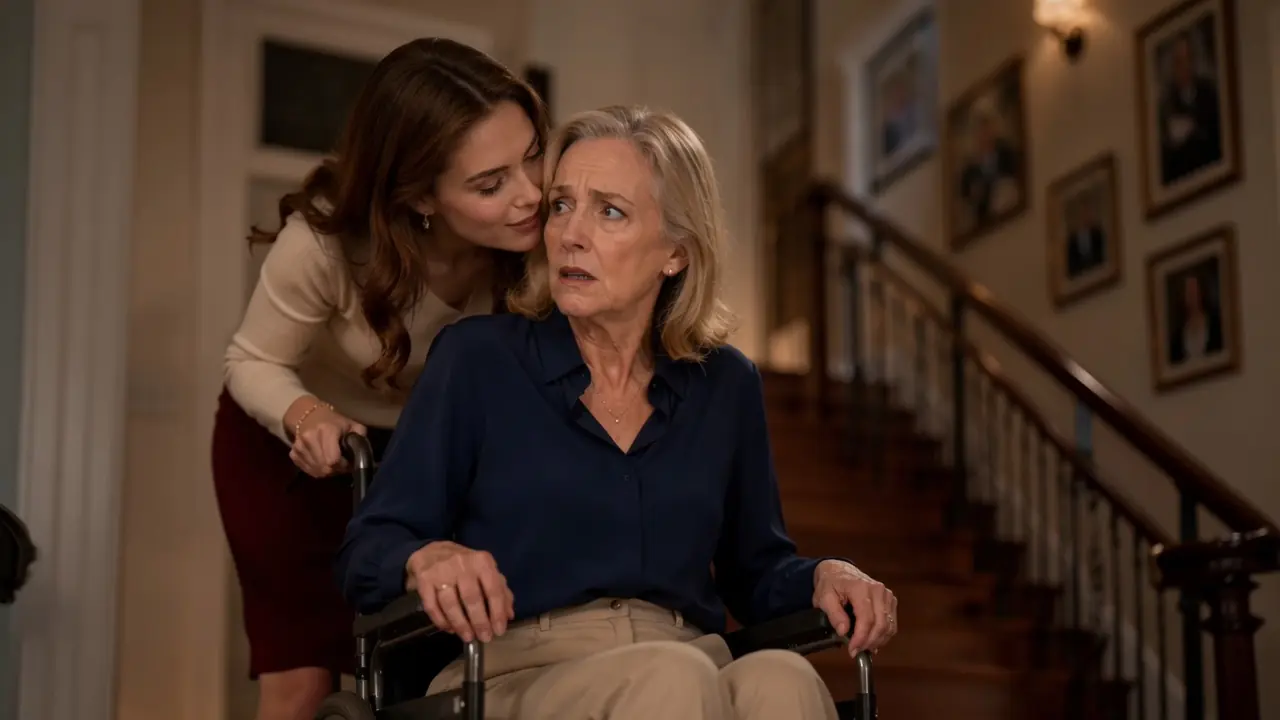
I was sixty-two and temporarily confined to a wheelchair after spinal surgery. My doctors expected me to walk again, but for several months I needed help moving safely through the large house my late husband, Paul, and I had built outside Raleigh. A platform lift near the rear entrance allowed me to avoid the main staircase, and I never brought the wheelchair near the upper landing without assistance. Brittany knew that better than anyone because she had spent weeks presenting herself as my most devoted caregiver.
That afternoon, she arrived carrying chamomile tea.
Jason was still at work, and my housekeeper had gone home early. Brittany said Jason had left a document in the upstairs study that required my signature before the bank closed. When I reminded her that I should use the lift, she smiled and said the upstairs hallway was perfectly safe if she pushed the wheelchair.
I trusted her enough to let her stand behind me.
At the top of the staircase, she stopped.
“Where is the document?” I asked.
Her hands tightened around the wheelchair handles.
Then her lips moved close to my right ear.
“Everyone will believe you fell down the stairs.”
Before I could turn, she shoved me.
The front wheels crossed the edge, and the floor disappeared beneath me. My shoulder struck the wall first, followed by the metal frame of the wheelchair twisting sideways. The steps became a violent blur of polished wood, cold steel, and unbearable pain as my body crashed downward.
I reached for the railing but caught only air.
The wheelchair slammed into the bottom landing and threw me against the floor. Something cracked inside my chest, and my left wrist folded beneath me. For several seconds, I could neither breathe nor scream.
At the top of the stairs, Brittany stood perfectly still.
She did not gasp.
She did not call for help.
She simply looked down at me as though she were inspecting something she had already finished.
Then the front door opened.
“Mom?”
Jason’s voice echoed through the house.
Brittany transformed instantly.
She screamed, dropped her handbag, and ran down the staircase with tears already shining in her eyes. By the time Jason reached me, she was kneeling beside the wheelchair, sobbing so convincingly that even I might have believed her if my body had not been broken beneath her hands.
“She insisted on going upstairs herself,” Brittany cried. “I offered to help, but she told me she could manage. I only turned away for one second.”
Jason dropped beside me, his face white with fear.
“Mom, what happened?”
I forced air through the pain.
“She pushed me.”
The room became silent.
Brittany turned toward me slowly, heartbreak arranged perfectly across her face.
“Helen,” she whispered. “Why would you say something like that?”
I looked at Jason.
I did not expect him to understand every detail immediately. I only needed him to believe that his injured mother would not invent an accusation while lying at the bottom of a staircase.
Instead, uncertainty entered his eyes.
It lasted only a moment.
But one moment was enough.
Brittany had spent a year building the woman everyone wanted to believe. She brought me flowers after surgery, organized my medication, cooked family dinners, and told Jason privately that she worried about my memory. I had become an older woman recovering from anesthesia and pain medication, while she had become the beautiful fiancée who never raised her voice.
Brittany leaned closer under the pretense of checking my breathing.
Her smile returned for the briefest second.
“No one is going to believe you,” she whispered.
The ambulance arrived within minutes.
By then, Brittany had repeated her version to Jason, the emergency dispatcher, a neighbor, and the paramedics. Every sentence remained identical. I had insisted on moving without help, she had warned me, and the accident occurred while her back was turned.
Real panic creates gaps.
Brittany’s story had none.
When a paramedic asked what happened, I repeated that she had pushed me. Brittany cried harder, asking everyone to forgive me because the pain medication had left me confused since surgery.
That word frightened me more than the fractures.
Confused.
She had used it before.
For weeks, small things in my home had moved. Appointments disappeared from my calendar. My morning medication appeared inside the evening compartment. Brittany always found an explanation and gently suggested that recovery had affected my memory.
She had not been helping me.
She had been preparing witnesses.
At the hospital, doctors discovered three fractured ribs, a dislocated shoulder, a broken wrist, and internal bleeding near my spleen. Because I took blood thinners, they rushed me into surgery before the bleeding became fatal. Jason stood beside the bed while nurses prepared me, but his questions revealed that Brittany’s story had already begun replacing mine.
“She says you were upset about the wedding,” he said.
“I congratulated you.”
“She thinks you believe we’re moving too quickly.”
“You are moving quickly. That does not mean I imagined being pushed.”
Jason rubbed his forehead. “She also said you’ve been misplacing things.”
“She moved them.”
“Mom—”
“She placed the wrong pills in my organizer.”
“She told me you did that yourself.”
The heart monitor accelerated.
A nurse stepped closer and told him I needed calm, but I no longer cared about calm. Brittany had built a false version of me and placed it inside my son’s mind before she ever rolled me toward the staircase.
When I woke after surgery, Jason was asleep in a chair beside the bed. Hope rose inside me because he had stayed. Perhaps police had found fingerprints on the wheelchair or discovered that the hallway camera had been disabled.
Instead, he told me the security system had stopped recording nearly an hour before the fall.
“That proves she shut it off,” I said.
“It proves the camera went offline.”
“It does not go offline by itself.”
“The detective says they need evidence.”
“My statement is evidence.”
“It’s one statement against another.”
I stared at him.
His words wounded more deeply than the fall because he believed neutrality made him fair. But fairness did not mean weighing a calculated performance and an injured victim’s statement as though they were equal.
Detective Sofia Ruiz arrived later that evening.
She was calm, observant, and careful not to reveal what she believed. She asked about previous threats, Brittany’s access to the house, and whether anyone knew I would be alone.
Then she asked whether Brittany had shown interest in my finances.
The answer was yes.
Brittany had asked who controlled the Mercer Family Trust, whether Jason inherited immediately if I died, and what happened to my company shares if doctors declared me unable to make decisions. She always wrapped the questions in concern about wedding planning and future family responsibilities.
Ruiz wrote everything down.
Then she told me my blood contained an unusually high level of zolpidem, a sleeping medication prescribed after surgery but discontinued five weeks earlier.
“I didn’t take it,” I said.
“Could someone have placed it in your drink?”
I remembered the tea.
Chamomile, honey, and a faint bitterness I had ignored.
“She drugged me.”
“Did you see her add anything?”
“No.”
The detective’s expression remained neutral, but her pen moved faster.
I told her about Brittany’s whisper. Ruiz then asked whether I wore a hearing aid.
My right ear held a small digital device connected to an application on my phone. The hearing aid was missing, probably thrown from my ear during the fall. Ruiz explained that some models preserved brief diagnostic audio when detecting sudden impact.
Hope appeared for the first time.
Then Brittany came to the hospital carrying flowers.
I ordered her to leave, but Jason asked me not to create another scene. Brittany stood in the doorway looking wounded and forgiving, telling me she understood that trauma could distort memory.
As she turned, I saw something beige inside her open handbag.
My hearing aid.
After she left, I told Jason.
He said perhaps she had found it and planned to return it. I demanded that he call her immediately and ask for the device.
He did.
When he returned, he said Brittany had taken it to a repair specialist because the casing was cracked.
“What specialist?”
“She didn’t say.”
“Tell her to bring it back.”
“She has already left.”
“Did you see it?”
“No.”
Even then, he searched for an innocent explanation.
Detective Ruiz did not.
When questioned, Brittany claimed she had delivered the hearing aid to an electronics shop. The shop had no record of receiving it. She then said it may have fallen from her purse inside a taxi.
Her perfect story finally changed.
The next crack came from a man named Evan Crowley.
Jason learned from investigators that Brittany had once been engaged to Evan. His mother, Marjorie, died after falling down a staircase three months before their wedding.
Brittany had claimed she arrived after the accident.
Before Marjorie’s death, Brittany had told relatives that the older woman suffered from confusion and vertigo. She moved medication, changed appointments, and suggested Marjorie could no longer manage her property.
The pattern was identical.
Jason contacted Evan privately.
Evan told him Brittany moved into his mother’s home after their engagement and pressured him to sell it. After Marjorie’s death, she tried to persuade Evan to invest the proceeds through her uncle. When he refused, Brittany disappeared with ninety thousand dollars from their joint account.
Evan had always suspected his mother’s fall was not accidental.
The police had lacked proof.
That evening, Jason called me.
His voice no longer carried the careful neutrality that had protected Brittany.
“Mom, I think something is wrong.”
“Something was wrong when I told you she pushed me.”
“I know.”
“No, Jason. You are beginning to know.”
My attorney, Rebecca Shaw, arrived the next morning with documents from the Mercer Family Trust. Paul and I had built a successful home-design business, and the trust protected our properties, company shares, and investments.
Before marrying Jason, Brittany would be required to sign a prenuptial agreement. If they divorced, she would receive no claim against family assets. If Jason died, his inheritance would pass to future children rather than his spouse.
Brittany had accessed the trust portal nine times from my home network.
She had downloaded the final prenuptial agreement four days before pushing me.
Rebecca also discovered a temporary incapacity provision. If two doctors declared me unable to manage my affairs, Jason could receive emergency control over my shares.
Brittany had already spent weeks portraying me as confused.
“She may have planned to place you under guardianship first,” Rebecca said. “The prenup may have changed the timetable.”
Jason arrived later carrying a box from Brittany’s apartment.
Inside were copies of my trust records, the missing zolpidem bottle, a wireless camera jammer, and a forged emergency guardianship petition bearing my signature. The documents claimed I suffered from cognitive decline, medication abuse, and paranoid delusions focused on Brittany.
A physician named Dr. Lawrence Venn had signed a preliminary incapacity evaluation.
He had never examined me.
Brittany had collected my medical information while accompanying me to appointments, then paid him to turn ordinary post-surgical symptoms into evidence of dementia.
Jason sank into the chair beside my bed.
“I’m sorry.”
“For what?”
“For doubting you.”
“That is not enough.”
His face tightened.
“You did not merely doubt me,” I said. “You helped her question whether I understood what happened to my own body.”
“I was trying to be fair.”
“You were trying to keep the woman you loved without facing what believing me would cost you.”
He looked away because he knew I was right.
Detective Ruiz planned to arrest Brittany, but she disappeared before officers reached her apartment. She continued texting Jason, unaware that he had found the evidence.
Ruiz asked him to pretend he still believed her.
During a recorded call, Brittany told Jason the guardianship hearing would solve everything. She planned to move me into a private care facility in Vermont, sell my house, and place my company shares under his temporary control.
“What happens after Mom is moved?” Jason asked.
“You take control,” Brittany replied.
“And the house?”
“We sell it. It’s dangerous for her.”
“What about the trust?”
“You sign what Dr. Venn prepared.”
Her voice contained no uncertainty.
She had already planned my disappearance from my own life.
Brittany agreed to meet Jason at my house the following evening. She believed the original trust certificates remained inside the study safe and that Jason would help her retrieve them before investigators secured the property.
Police hid nearby.
Jason entered wearing a recording device.
Brittany arrived in a pale-blue dress carrying a box of cookies, still performing the role of the perfect fiancée while hiding from an attempted-murder investigation.
Inside the kitchen, Jason confronted her about Marjorie Crowley.
Brittany dismissed Evan as unstable.
He asked about the forged guardianship papers, the sedatives, and the trust files. She insisted every action had been necessary to protect their future from a controlling mother.
Finally, Jason asked the question that mattered.
“Did you push her?”
Brittany smiled sadly.
“She has always made you feel guilty for loving me.”
“Answer me.”
“I saved you from spending twenty years waiting for her approval.”
“Did you push my mother?”
Her voice became cold.
“She was supposed to fall cleanly. She grabbed the railing, and the chair twisted. That’s why she survived.”
Jason stared at her.
“You tried to kill her.”
“I tried to free you.”
“She is my mother.”
“She is a signature standing between us and everything we deserve.”
Police began moving toward the house.
Brittany heard something outside and noticed the wire beneath Jason’s collar. She struck him, ran upstairs, and opened the study safe using a code she had watched me enter months earlier.
By the time Jason reached her, she held the metal document box in one hand and a fireplace lighter in the other.
“Tell them to leave,” she demanded.
“It’s over.”
“They have nothing if these disappear.”
“They have your confession.”
Brittany poured alcohol over the papers and raised the lighter.
Then she heard the quiet motor of my wheelchair.
I entered the study.
Her face lost all color.
“You.”
“I knew you would come for the trust.”
Jason looked horrified. “You’re supposed to be at the rehabilitation center.”
“I’m tired of people deciding where I’m supposed to be.”
Brittany flicked the lighter, but Jason lunged before the flame reached more than one corner of the top document. The box fell, scattering papers across the floor.
She ran toward the hallway.
At the top of the staircase, she stopped.
Police officers filled the entrance below.
Behind her stood Jason.
Beside him, I remained in the wheelchair she had once pushed.
For the first time, Brittany understood how it felt to face that staircase with nowhere safe to go.
She looked at me.
“No one is going to believe you,” I said.
Her own words.
The smile disappeared.
Detective Ruiz placed her in handcuffs.
Three days later, a city worker found my crushed hearing aid inside a storm drain near the hospital. Brittany had destroyed the casing, but the internal memory survived.
My audiologist recovered eleven seconds of sound.
First came the faint hum of the wheelchair.
Then Brittany’s voice.
“Everyone will believe you fell down the stairs.”
The recording captured the movement of the wheels and the first impact.
No attorney could explain those words as concern.
Investigators found messages proving Brittany paid Dr. Venn forty thousand dollars for the false evaluation. One email instructed him that I needed to appear impaired only long enough for the transfer of control.
Marjorie Crowley’s case was reopened.
Toxicology testing found a sedative she had never been prescribed. A pharmacist confirmed Brittany collected the medication shortly before the fall.
Brittany had not invented a new method for me.
She had repeated the crime that worked before.
At trial, she still looked composed and elegant. She wore soft colors, spoke gently to her attorneys, and occasionally glanced toward the jury with carefully controlled sadness.
Then prosecutors played the hearing-aid recording.
They presented the camera jammer, forged guardianship petition, drug evidence, trust records, and Jason’s conversation inside the house. Dr. Venn testified against her in exchange for a reduced sentence.
Jason took the stand.
“Why did you initially believe the defendant?” the prosecutor asked.
“Because she spent a year teaching me that my mother was unreliable.”
“Was your mother confused?”
“No.”
“What did Brittany gain from your doubt?”
“Time to hide evidence and take control of my mother’s assets.”
The defense accused Jason of manipulating a frightened woman into making statements she did not mean.
Jason remained calm.
“She said my mother was supposed to fall cleanly.”
The jury convicted Brittany of attempted murder, elder abuse, forgery, fraud, conspiracy, and evidence tampering. She later accepted responsibility for drugging Marjorie Crowley, though she never admitted pushing her.
The judge sentenced her to decades in prison.
Two years after the fall, I stood again at the top of the staircase.
I no longer needed the wheelchair, though a cane supported my right side. My physical therapist remained nearby, and Jason waited at the bottom.
Recovery had not arrived in one triumphant moment. It came through thousands of painful repetitions—standing, balancing, lifting one foot, trusting the floor beneath me.
“Ready?” the therapist asked.
“No.”
She smiled. “That has never stopped you.”
I placed the cane on the first step.
At the fourth, pain tightened through my hip. Jason raised his hands instinctively, then lowered them.
“I’m here,” he said.
Not let me carry you.
Not I know what is best.
Just the truth.
He was there.
When I reached the bottom, tears filled his eyes.
“I wish I had believed you immediately,” he said.
“So do I.”
“Will you ever forgive me completely?”
I rested one hand on his shoulder.
“I don’t know what completely means. But I trust the man asking that question more than the man who stood beside me after the fall.”
He nodded.
The damaged trust document remained framed inside my study. One corner was blackened from Brittany’s lighter, but I refused to replace it with a clean copy.
Some things could not return to the condition they held before harm.
Neither could some relationships.
But survival did not require pretending the damage never happened. It required ensuring the damage no longer controlled the future.
Brittany entered our family wearing kindness like a flawless mask. She remembered every birthday, baked every cookie, and spoke every correct word.
She believed goodness was an image other people could be trained to see.
But goodness was never the beautiful smile at the top of the staircase.
It was what someone did when belief became difficult.
When truth demanded sacrifice.
When love required courage instead of comfort.
Brittany once whispered that no one would believe me.
For a few terrible hours, she was almost right.
But lies built on perfection are fragile. They require every victim to remain silent, every witness to ignore one detail, and every piece of evidence to disappear.
I survived.
Evan spoke.
Jason finally listened.
And the tiny hearing aid Brittany tried to destroy remembered every word.