The laughter started before Elijah Hayes finished filling the tank.
He stood beneath the harsh fluorescent lights of a lonely gas station off Highway 61 outside Vicksburg, Mississippi, one hand wrapped around the fuel nozzle while six motorcycles idled behind him. The pumps vibrated beneath the low thunder of engines, chrome flashed beneath the canopy lights, and the smell of gasoline mixed with hot exhaust in the humid night air. Elijah kept his eyes on the numbers climbing across the pump display and tried to ignore the men watching him.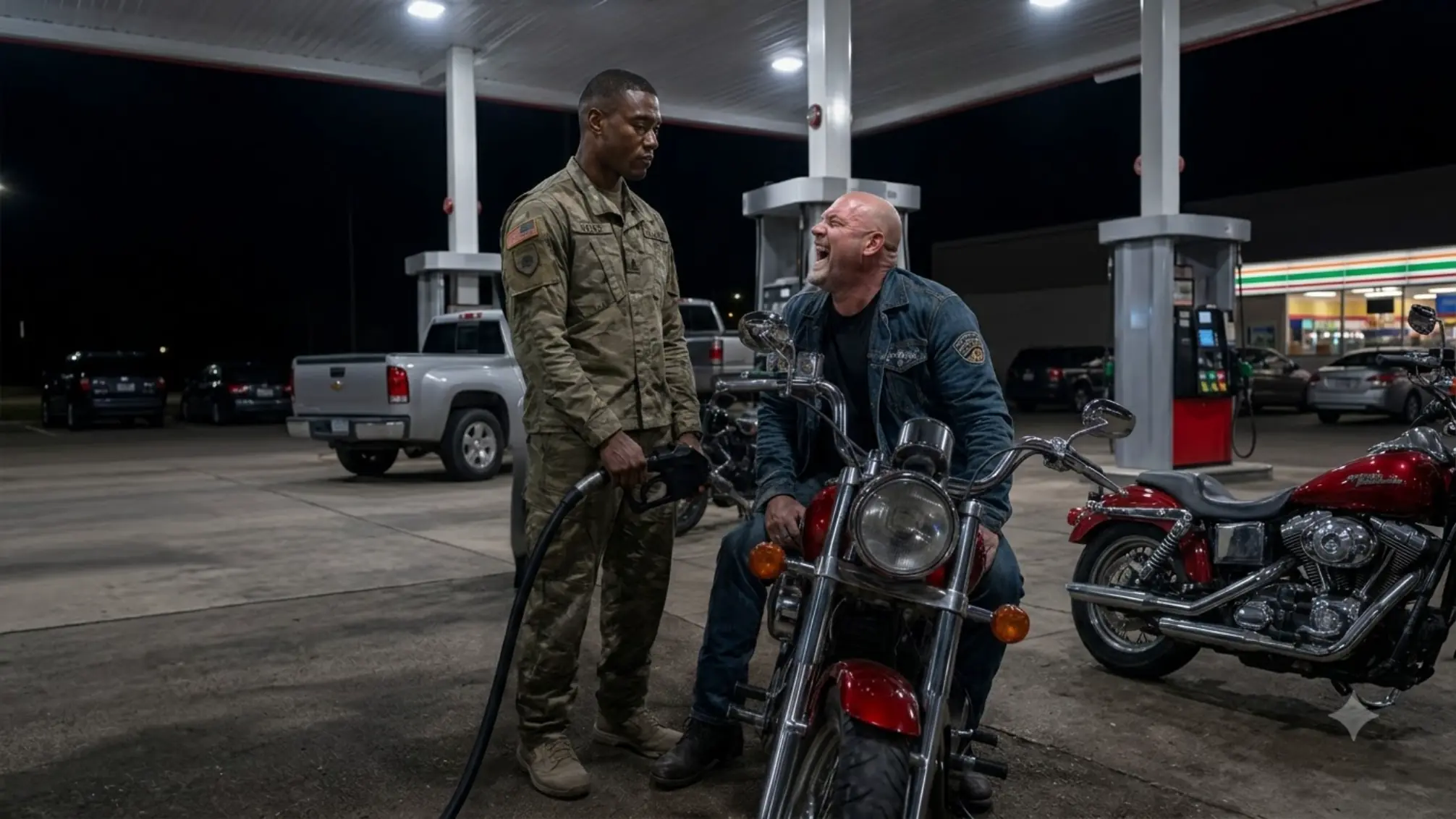
He had been driving for almost six hours.
All he wanted was fuel, a cup of coffee, and another forty miles of highway before reaching his mother’s house.
His uniform made ignoring attention difficult.
Elijah was thirty-four, tall and lean, with close-cropped black hair, deep-brown skin, and the controlled posture of a man accustomed to being observed. His Army combat uniform was dusty from travel, his duffel bag sat inside the gray pickup beside the pump, and instead of standard combat boots he wore soft running shoes.
Those shoes were the first thing the bikers noticed.
The largest rider sat sideways on a red-and-black motorcycle near the next pump. He was a broad white man in his late forties with a shaved head, rough gray stubble, and a faded denim biker jacket stretched over thick shoulders.
Everyone called him Big Jack Mercer.
Elijah did not know that yet.
Jack looked down at Elijah’s running shoes and laughed.
“Hey, soldier.”
Elijah kept filling the truck.
Jack raised his voice.
“I’m talking to you.”
The other riders turned.
Elijah finally looked over.
Jack pointed at his shoes.
“What kind of soldier wears those?”
Elijah said nothing.
One biker chuckled.
Another leaned against his motorcycle.
Jack slid off the seat and approached.
“You deaf?”
“No.”
“Then answer.”
Elijah returned his attention to the pump.
Jack’s smile disappeared.
The five other bikers shut off their motorcycles one by one.
That changed the atmosphere.
The engines disappeared.
Silence settled across the station except for the clicking fuel pump and the distant hum of highway traffic.
Jack walked closer.
Elijah finished fueling.
The pump clicked off.
He returned the nozzle to its cradle.
Then Jack stepped directly between Elijah and the driver’s door.
“Where’d you buy the costume?”
Elijah looked at him.
“This isn’t a costume.”
“Sure.”
Jack glanced toward the patches on Elijah’s uniform.
“You know how many fake soldiers I’ve seen?”
Elijah remained calm.
Jack leaned closer.
“Men who actually served don’t walk around looking like they’re headed to a jogging club.”
Several bikers laughed.
Elijah’s expression did not change.
His shoes had been recommended by an Army orthopedic specialist after surgeries on both knees.
He could have explained that.
He did not.
He had learned years earlier that explanations offered to people determined not to listen only became additional material for argument.
“I’m leaving,” Elijah said.
Jack moved sideways again.
“No.”
Elijah looked toward the convenience store.
The clerk stood behind the glass watching nervously.
Jack noticed.
“Don’t worry about him.”
Elijah looked back.
“Move.”
The word was quiet.
That irritated Jack more than shouting would have.
He expected fear.
He got instruction.
Jack laughed again.
“That uniform don’t fool me, soldier. One more step and I’ll drag you off this pump myself.”
Elijah’s gaze hardened.
“Take your hand off my space before you learn why I’m still the calm one here.”
The bikers stopped laughing.
Jack stared at him.
Then he jabbed a finger toward Elijah’s chest.
“You think those little shoes and that badge scare me? I can put you on the concrete before your tank fills.”
Elijah looked down at the finger.
Then back into Jack’s eyes.
“Your first problem is thinking calm means scared.”
Jack’s jaw tightened.
Behind him, one biker named Wallace muttered, “Jack, leave it.”
Jack ignored him.
“What’d you say?”
Elijah’s tone remained level.
“I said move.”
Jack stepped closer.
Their shoulders were nearly touching.
“You going to make me?”
Elijah exhaled slowly.
He had seen this moment many times in different forms.
Two men.
An audience.
Pride.
The dangerous belief that backing away meant losing something.
Elijah had no interest in proving anything.
But Jack needed an audience.
That made him unpredictable.
Elijah glanced toward the five bikers.
None appeared eager to escalate.
Good.
Then headlights turned into the station.
A sheriff’s pickup rolled slowly beneath the canopy.
Jack glanced back.
The truck stopped beyond the pumps.
Nobody got out.
Elijah noticed.
So did Jack.
“Friends of yours?” Jack asked.
“No.”
Jack smiled.
“Good.”
He pushed lightly against Elijah’s shoulder.
Not enough to injure.
Enough to challenge.
Elijah stepped back once.
Jack mistook it for retreat.
He reached again.
This time Elijah caught his wrist.
The movement was so quick that two bikers never saw exactly what happened.
Elijah turned Jack’s arm downward and guided him against the side of the motorcycle without striking him.
Jack grunted.
Elijah released immediately.
“Stop.”
Jack stared in shock.
His friends straightened.
The sheriff’s pickup door opened.
A man in a tan uniform stepped out.
Sheriff Thomas Keegan was fifty-three, broad through the chest, with silver hair beneath his campaign hat.
He walked toward them slowly.
Jack rubbed his wrist.
“Sheriff.”
Keegan looked around.
“What’s going on?”
Jack answered first.
“Fake soldier causing trouble.”
The sheriff looked at Elijah.
Then at his uniform.
“Fake?”
Jack pointed.
“Look at the shoes.”
Keegan did.
Then looked back at Jack.
“That’s your evidence?”
Jack frowned.
“You know what I mean.”
“No.”
The sheriff’s tone flattened.
“I don’t.”
Elijah remained silent.
Keegan looked at him.
“Sir, identification?”
“Of course.”
Elijah reached toward his pocket.
Jack stepped forward.
“Careful, Sheriff.”
Elijah stopped.
Keegan raised one hand toward Jack.
“Back up.”
Jack stared.
“Sheriff—”
“Back up.”
Jack obeyed reluctantly.
Elijah removed a slim silver identification case from his pocket.
He opened it.
Sheriff Keegan looked down.
His expression changed immediately.
He straightened.
Then he saluted.
The entire gas station went silent.
Jack’s face emptied.
Elijah returned the salute.
“At ease, Sheriff.”
Keegan lowered his hand.
“Colonel Hayes.”
Jack blinked.
“Colonel?”
Elijah closed the card.
The silver case contained identification establishing him as Colonel Elijah Hayes, attached to an Army logistics command responsible for emergency transportation coordination across several southeastern states.
Nothing classified.
Nothing theatrical.
But absolutely legitimate.
Keegan knew the name.
Two years earlier, a hurricane had flooded several Mississippi counties and washed out highway access to rural communities. Elijah’s logistics unit had coordinated delivery routes for generators, water purification systems, medical supplies, and fuel.
Keegan had worked beside those teams for nine days.
He remembered Elijah.
The haircut had changed.
The running shoes had not mattered.
The name did.
Keegan looked toward Jack.
“You accused Colonel Hayes of stolen valor?”
Jack swallowed.
“I didn’t know who he was.”
Elijah’s eyes settled on him.
“That was the point.”
Jack frowned.
“What?”
“You didn’t know.”
Elijah slipped the silver card back into his pocket.
“And you decided you knew enough anyway.”
One of the bikers looked away.
Jack’s humiliation turned quickly into anger.
“You could’ve just said who you were.”
Elijah nodded.
“I could have.”
“Then why didn’t you?”
“Because I shouldn’t need rank to buy gasoline without being cornered.”
Keegan watched Jack.
The biker opened his mouth.
Then closed it.
The sheriff stepped closer.
“Did you touch him?”
Jack answered immediately.
“He grabbed me.”
“After you touched him?”
Silence.
Elijah spoke.
“He pushed my shoulder.”
Keegan looked toward the convenience store.
“Cameras?”
The clerk inside nodded through the glass.
Jack’s face tightened.
“Come on, Sheriff. Nobody got hurt.”
“That’s fortunate.”
“You arresting me?”
“Not unless Colonel Hayes wants to make a complaint or the footage shows something else.”
Jack looked at Elijah.
For the first time, the threatening confidence was gone.
Elijah could have pressed the situation.
Part of him wanted to.
He had spent years watching people become suddenly respectful after discovering a title.
He disliked that transformation.
Respect that appeared only after status was revealed did not feel like respect.
It felt like calculation.
“No complaint,” Elijah said.
Jack looked surprised.
Sheriff Keegan did too.
“You sure?”
“Yes.”
Elijah looked directly at Jack.
“But I want five minutes.”
Jack frowned.
“For what?”
“To talk.”
One biker laughed nervously.
Jack glared at him.
Elijah walked toward a concrete barrier beside the station.
He sat.
His knees protested immediately.
That was why he wore running shoes.
Keegan noticed the movement.
Jack noticed too.
Elijah stretched one leg carefully.
“You wanted to know about the shoes.”
Jack said nothing.
“Two surgeries.”
The biker’s expression shifted.
Elijah continued.
“First injury happened during training. Second happened years later.”
Jack looked toward the ground.
“So yeah. I wear running shoes when I travel.”
Nobody laughed.
Elijah leaned forward.
“You saw one thing that didn’t match the version of a soldier in your head.”
Jack crossed his arms.
“You don’t know why I reacted.”
“You’re right.”
That answer disarmed him slightly.
Elijah waited.
Jack looked toward his motorcycle.
“My brother served.”
Elijah said nothing.
Jack continued reluctantly.
“Afghanistan.”
One of the bikers lowered his head.
“He came home messed up.”
Jack’s voice became rough.
“Couldn’t sleep. Couldn’t keep a job. Guys would buy military jackets online and walk around pretending.”
Elijah understood more now.
Not enough to excuse the behavior.
Enough to understand its source.
“Your brother alive?”
“No.”
The answer hung between them.
“I’m sorry.”
Jack nodded once.
“He died six years ago.”
Elijah looked toward the highway.
“My younger cousin came back different too.”
Jack studied him.
“For a long time, I thought being angry on his behalf meant defending him.”
Elijah looked back.
“It didn’t.”
Jack was silent.
Sheriff Keegan remained several feet away, deliberately giving them space.
Elijah continued.
“You can care about your brother without deciding every stranger owes you proof.”
Jack’s jaw moved.
“That easy for you to say.”
“No.”
Elijah’s voice sharpened.
“It isn’t.”
Jack finally looked at him.
Elijah tapped one knee.
“You think these came from a heroic moment?”
Jack said nothing.
“One was a training accident.”
He tapped the other.
“The second happened because I ignored pain too long trying to prove I could keep up.”
A faint bitter smile crossed his face.
“Turns out pride doesn’t make ligaments stronger.”
One biker chuckled.
Even Jack nearly smiled.
The tension dropped.
Then headlights appeared again.
A black SUV entered the station.
Two men stepped out.
They wore civilian clothes.
One approached Elijah.
“Colonel, everything all right?”
“Yes.”
Jack looked toward the sheriff.
“How many people know this guy?”
Keegan smiled slightly.
“More than you expected.”
Elijah stood.
The pain in his knees sharpened.
He ignored it.
He looked toward Jack’s red-and-black motorcycle.
“Nice bike.”
Jack blinked.
“What?”
“Indian?”
“Harley.”
Elijah looked closer.
“My mistake.”
That almost offended Jack more than anything else.
“It’s a customized Road King.”
Elijah smiled.
“There’s the anger again.”
The bikers laughed.
This time Jack did too.
Only briefly.
Then his expression became serious.
“I was wrong.”
Elijah waited.
Jack continued.
“About you.”
“Maybe.”
“And the way I handled it.”
“Yes.”
Jack exhaled.
“I’m not good at apologies.”
“I noticed.”
Another laugh.
Jack extended his hand.
Elijah looked at it.
Then shook.
The sheriff watched.
No dramatic forgiveness.
No instant friendship.
Just two men recognizing that the night could have ended differently.
Elijah turned toward his truck.
Keegan followed.
“You headed north?”
“Mother lives outside Yazoo City.”
“Still cooking enough food for twelve people?”
Elijah smiled.
“You remember her?”
“After that hurricane operation? Your mother fed half my deputies.”
“She claims starving law enforcement is bad emergency management.”
Keegan laughed.
Elijah opened the truck door.
Then Jack called after him.
“Colonel.”
Elijah turned.
Jack looked uncomfortable.
“If somebody actually was pretending to be military…”
Elijah waited.
“What should I do?”
“Nothing dramatic.”
Jack frowned.
“Nothing?”
“Ask yourself whether it actually affects you.”
Elijah leaned against the door.
“If someone is committing fraud, report it. If somebody’s wearing a jacket you don’t like, keep riding.”
Jack nodded.
Fair enough.
Elijah drove away at 10:43 p.m.
He reached his mother’s house forty minutes later.
The porch light was on.
So was every light in the kitchen.
His mother opened the door before he reached the steps.
“You’re late.”
“Gas station.”
She narrowed her eyes.
“What happened?”
Elijah kissed her cheek.
“Nothing.”
She knew immediately that something had happened.
“You have exactly ten seconds before I start asking detailed questions.”
Elijah smiled.
“Can I eat first?”
“No.”
He laughed.
That was the first normal sound he had made all evening.
Over dinner, he told her a softened version.
A biker misunderstood something.
Sheriff Keegan happened to arrive.
Everything ended peacefully.
His mother stopped eating.
“Did the man put his hands on you?”
Elijah looked down at his plate.
“Technically?”
She slapped the table.
“Elijah.”
“He pushed my shoulder.”
“I knew it.”
“Mom.”
“You should have called me.”
He stared.
“What would you have done?”
She lifted her chin.
“I would have told him some things.”
Elijah laughed so hard his knees hurt.
Two days later, Sheriff Keegan called.
“Thought you might want to know.”
“About Jack?”
“Gas station clerk gave me the footage.”
Elijah stiffened.
“Problem?”
“No.”
Keegan paused.
“Jack came back.”
Elijah waited.
“He apologized to the clerk.”
“For what?”
“Scaring customers.”
Elijah smiled slightly.
“That’s something.”
“Then he paid for the bent barrier by Pump Four.”
Elijah frowned.
“I didn’t see a bent barrier.”
“That happened before you arrived.”
Keegan laughed.
“Apparently Jack has a complicated relationship with gas stations.”
Elijah shook his head.
“That all?”
“No.”
Keegan sounded amused now.
“He asked whether the VFW needed volunteers.”
That surprised Elijah.
“Seriously?”
“His brother was a member before he died.”
Elijah leaned back.
“Good.”
“He also told me not to tell you.”
“Then why are you telling me?”
“Because I’m sheriff.”
“That isn’t an answer.”
“It’s the only one you’re getting.”
The call ended.
Life moved forward.
Elijah returned to duty.
Jack returned to construction work and weekend rides.
For several months, they had no contact.
Then Mississippi experienced another major storm season.
Flooding closed roads across three counties.
Emergency shelters opened.
Sheriff Keegan coordinated local response.
Elijah’s logistics command helped move supplies.
On the second morning of operations, Elijah stepped from a temporary command trailer and heard motorcycles.
Six of them.
Red-and-black Road King in front.
Jack stopped near the supply yard.
He removed his helmet.
Elijah stared.
“What are you doing here?”
Jack looked toward several trailers filled with bottled water.
“Sheriff said you needed drivers who know back roads.”
Elijah looked toward Keegan.
The sheriff smiled innocently.
Jack continued.
“We’ve got pickups too.”
Behind the motorcycles, three trucks arrived.
Members of Jack’s riding group began unloading blankets and bottled water.
Elijah crossed his arms.
“You volunteering?”
“Don’t make it weird.”
Elijah smiled.
“I wouldn’t dream of it.”
For the next four days, Jack’s group delivered supplies to rural families cut off by floodwater.
They never crossed closed roads.
They followed sheriff instructions.
They transported medicine to one elderly couple.
They helped relocate livestock feed.
They carried generators.
Jack complained constantly.
Elijah discovered that complaining appeared to be his natural communication style.
But he worked.
On the fourth evening, the two men sat on the tailgate of a supply truck drinking coffee.
Jack looked at Elijah’s shoes.
“Still hate those things.”
Elijah looked down.
“Comfortable.”
“They look ridiculous with the uniform.”
“My knees disagree.”
Jack nodded.
For a while, neither spoke.
Then Jack said quietly, “My brother’s name was Aaron.”
Elijah looked toward him.
Jack had never shared the name.
“He used to wear these awful sandals after he came home.”
Elijah smiled.
“How awful?”
“Gray straps. Looked like something a retired geography teacher would wear.”
Elijah laughed.
“I made fun of him every time.”
Jack stared into his coffee.
“He said his feet hurt.”
Elijah understood where the thought was going.
Jack continued.
“The night at the gas station, when I saw your shoes…”
He stopped.
“I wasn’t thinking about you.”
“You were thinking about him.”
Jack nodded.
“Maybe.”
Elijah took a drink.
“You miss him.”
“Every day.”
“That doesn’t disappear.”
Jack looked over.
“You miss people?”
Elijah thought about men whose numbers still lived in his phone because deleting them felt too final.
“Yes.”
Jack nodded.
Nothing else needed saying.
Months later, the gas-station story became exaggerated around Vicksburg.
Some versions claimed Elijah had been a general.
Others claimed five sheriff’s vehicles surrounded the bikers.
One version somehow included federal agents arriving by helicopter.
Elijah hated all of them.
The real story was smaller.
A tired soldier wanted gasoline.
A grieving biker saw something that triggered old anger.
Pride escalated faster than judgment.
A sheriff arrived before anything irreversible happened.
An identification card changed the power dynamic.
But the card was never the important part.
That lesson bothered Elijah.
People loved the moment Keegan saluted.
They loved Jack’s shocked face.
They loved the reversal.
Quiet stranger becomes important man.
Bully suddenly realizes mistake.
But whenever Elijah heard somebody tell the story that way, he corrected them.
“You’re missing it.”
“What?”
“He shouldn’t have needed the card.”
The listener usually frowned.
Elijah would explain.
“If I had been a private, the way he acted would still have been wrong.”
If Elijah had been a mechanic traveling home, still wrong.
A teacher.
A truck driver.
A homeless veteran.
A civilian wearing running shoes.
Still wrong.
Rank did not create dignity.
The silver card only revealed how quickly people changed once they discovered status.
That was not the lesson Elijah wanted remembered.
One year after the gas-station encounter, he stopped at the same place again.
Daytime this time.
The old clerk recognized him.
“So you came back.”
“Needed fuel.”
“Dangerous habit.”
Elijah laughed.
A motorcycle engine approached.
He turned.
Red-and-black Road King.
Jack.
The biker removed his helmet.
“You following me?”
Elijah asked.
“My station.”
“You own it?”
“No.”
“Then apparently it’s mine too.”
Jack grinned.
He dismounted.
His denim jacket was still faded.
His head was still shaved.
But something had changed.
A small patch had been added near his chest.
It showed his brother Aaron’s name.
Below it were three words.
RIDE WITH HONOR.
Elijah noticed.
Jack noticed him noticing.
“New rule.”
“What?”
“We don’t bother people at gas pumps.”
Elijah nodded seriously.
“Revolutionary leadership.”
“Shut up.”
They laughed.
Jack filled his motorcycle.
Elijah filled his truck.
No audience.
No sheriff.
No threat.
When they finished, Jack extended his fist.
Elijah bumped it.
“Tell Keegan he still owes me twenty bucks,” Jack said.
“For what?”
“He knows.”
“I’m absolutely not becoming your debt collector.”
“You’re Army logistics. Move things from one place to another.”
“Apparently boundaries aren’t among them.”
Jack started the motorcycle.
The engine thundered.
Before pulling away, he looked back.
“Colonel.”
“Yes?”
Jack pointed toward Elijah’s running shoes.
“Still ugly.”
Elijah smiled.
“Still comfortable.”
Jack laughed and rode away.
Elijah watched the red taillight disappear onto Highway 61.
Then he climbed into his truck.
The silver identification card remained in his pocket.
He did not take it out.
He did not need to.
The first night, that card had made a sheriff salute and a biker suddenly reconsider everything he thought he knew.
But the more important change had happened afterward.
Jack Mercer eventually learned that respect given only after discovering a man’s title was not respect at all.
And Elijah Hayes learned that sometimes the strongest response to aggression was not winning the confrontation.
It was refusing to let the confrontation decide what kind of man you became after it ended.