“You picked the wrong place to play hero, boy.”
Ray Mercer slammed Marcus Jackson against the community center wall hard enough to rattle the framed children’s drawings taped beside the bulletin board.
Then Ray swept his arm across the front desk and knocked the donation jar to the floor.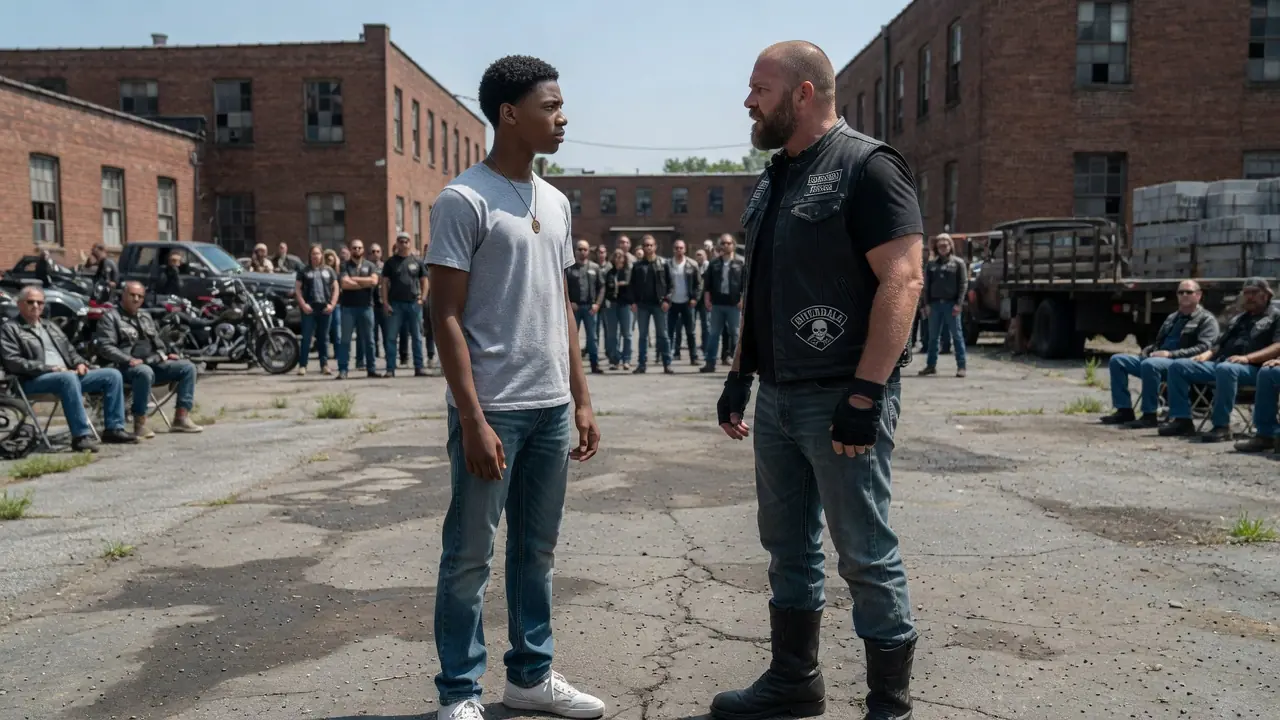
Glass cracked.
Coins exploded across the wooden floor in every direction, rolling under chairs, beneath the snack table, and toward the old basketball rack near the back of the room. For one terrible second, the sound filled the community center like a broken promise.
Nickels, dimes, and quarters spun across the floor.
A few dollar bills fluttered down afterward, landing near Marcus’s shoes.
Those coins had come from bake sales, tip jars, retired teachers, parents working two jobs, and children who dropped in their spare change because Marcus told them every little bit mattered.
Ray Mercer smiled down at the mess.
Marcus did not flinch.
He was sixteen years old, six foot one, lean but strong, with calm brown eyes and the controlled breathing of someone who had been taught never to let fear control the body. He stood with his back against the wall, shoulders squared, counting every exit, every child, every adult frozen in the room.
Four counts in.
Four counts hold.
Four counts out.
His father’s training moved through him like a second heartbeat.
The five massive men of the Sovereign Riders circled loosely around him, their leather vests creaking as they moved. Their boots thudded against the floor. Their faces carried contempt, but Marcus saw something else too.
Expectation.
They expected anger.
They expected panic.
They expected a scared teenager to swing wildly or back down completely.
Marcus gave them neither.
Ray stepped closer, his tobacco breath hot and sour against Marcus’s face.
“This center isn’t for your kind,” Ray said. “You understand me? Know your place.”
Behind a table near the far wall, ten-year-old Deshaawn Garcia stared with wide eyes, one hand clutching his homework folder against his chest.
Marcus saw him.
Ray did not.
That was the difference.
Marcus kept his voice low.
“Deshaawn, go to the office.”
The boy did not move.
“Now,” Marcus said, not sharply, but with the tone he used during fire drills and basketball practice when obedience mattered more than questions.
Deshaawn ran.
Ray laughed and shoved Marcus again.
“What’s a boy like you going to do now?”
Marcus’s shoulder hit the wall a second time.
He absorbed it.
He breathed.
He looked at the coins scattered across the floor, the children’s drawings shaking on the wall, the frightened faces outside the windows, and Ray Mercer’s boot grinding slowly into a pile of nickels as if he could crush the center’s hope under his heel.
Ray had no idea this moment would echo through Riverdale forever.
No idea that by trying to humiliate one sixteen-year-old boy, he was about to expose the fear that had ruled a town for too long.
No idea that before the weekend was over, broken pride, buried courage, and quiet truth would change all of them.
Riverdale’s community center had once been a forgotten municipal building at the edge of Maple Street, two blocks from the old factory lot and one block from the bus stop where kids waited after school because there was nowhere better to go.
The paint had peeled in long strips near the front steps. Two windows had cracked during a winter storm and stayed taped for months. The basketball court behind the building had one bent rim and no net. Inside, the old meeting rooms smelled like dust, floor wax, and tired fluorescent lights.
Then Marcus Jackson arrived.
He would never have described it that way.
If someone gave him credit, he redirected it immediately.
“Mrs. Wilson handles the money.”
“Miss Garcia organizes the snacks.”
“Mr. Collins donated the bookshelves.”
“The kids did most of the painting.”
All of that was true.
But it was also true that the center began changing after Marcus walked through the front door at fifteen years old and asked if they needed volunteers.
At first, Mrs. Wilson, the seventy-year-old retired librarian who served as the center’s treasurer, assumed he needed service hours for school.
“Court requirement?” she asked before she could stop herself.
Marcus did not look offended.
“No, ma’am. My father says if you complain about a place, you should be willing to help fix it.”
Mrs. Wilson studied him over her glasses.
“You planning to fix the whole town?”
“No, ma’am. Just whatever is in front of me.”
She handed him a broom.
“Start with the gym.”
He did.
Then he kept coming back.
By the end of the year, Marcus was volunteering twenty hours a week. He organized tutoring sessions, coached basketball, helped younger children with reading, cleaned classrooms, repaired shelves, painted walls, and convinced three teachers from Riverdale High to offer homework help twice a week.
He started a Friday evening dinner program with donated food from local churches and the grocery store.
He made sign-in sheets.
He created reading groups.
He turned the old storage closet into a quiet corner for kids who needed a break from noise.
Most importantly, he learned every child’s name.
Not just the easy ones.
Not just the kids who behaved.
He knew who needed extra patience with math, who got quiet when adults raised their voices, who hid food in backpacks, who lied about having rides home, and who laughed too loudly when they were about to cry.
Deshaawn Garcia was one of those kids.
He was ten years old, skinny, quick, and smart enough to pretend he was not smart because trying and failing had embarrassed him too many times. His mother, Rosa Garcia, worked double shifts at Riverdale Memorial Hospital. His grandmother watched him when she could, but on days when schedules collapsed, Deshaawn came to the center and stayed until someone picked him up.
Marcus had spent three months helping him with fractions.
“Great job, Deshaawn,” Marcus said that Friday afternoon, pointing to the worksheet on the table. “You’re getting these down perfect.”
Deshaawn beamed.
It was a rare expression for a boy who had learned not to expect praise.
“I did the butterfly method like you showed me.”
“You did. And you didn’t rush.”
Deshaawn sat straighter.
Marcus checked his watch.
Five o’clock.
Most of the children had already left, picked up by parents, older siblings, neighbors, or the center’s volunteer van. Only Deshaawn and two others remained in the main activity room.
“Miss Garcia running late again?” Marcus asked, though he already knew the answer.
Deshaawn shrugged.
“She said five-thirty. Hospital was short today.”
Marcus nodded.
“Then we’ll wait.”
Deshaawn stacked his papers neatly, another habit Marcus had taught him.
“Can we shoot hoops?”
“Let me lock the front first, then we’ll go out back.”
The center’s front door crashed open before Marcus finished the sentence.
Five men strode in, leather boots heavy against the floor.
The Sovereign Riders.
Marcus knew who they were before anyone said a word.
Everyone in Riverdale knew.
They were not the largest biker group in Pennsylvania, not even close. But in Riverdale, they carried weight because their leader, Ray Mercer, had grown up there, owned an auto repair business, donated to certain council campaigns, and had a talent for making people uncomfortable without quite doing enough to bring consequences down on himself.
His cousin worked in the mayor’s office.
Two police officers rode with the group on weekends.
Several business owners owed him favors.
Most people avoided him.
That was how Ray liked it.
He was in his early forties, broad through the chest, with a shaved head, a thick beard, and heavy hands. His black leather vest bore the Sovereign Riders patch across the back. The men behind him spread out as they entered, taking up space like they had practiced making rooms smaller.
Ray surveyed the center with thinly veiled disgust.
Marcus stepped between the bikers and the remaining children.
“We’re closing soon,” he said evenly. “Can I help you with something?”
Ray ignored the question.
He walked slowly around the room, dragging his fingers across tabletops, examining the bookshelves, the donated laptops, the snack shelf, and the children’s art hanging from twine along the wall.
“So this is where all the city council’s money is going these days,” Ray said. “Interesting priorities.”
One of the bikers picked up a basket of crayons and shook it like he was inspecting stolen goods.
The children moved closer to Marcus without being told.
“The center operates mostly on donations,” Marcus said. “Private citizens who care about the community’s future.”
Ray laughed.
“That so? Heard differently. Heard my tax dollars are funding this place instead of fixing the roads my business depends on.”
He picked up a children’s book from the reading table, flipped through it dismissively, then dropped it on the floor.
Marcus felt anger rise in his chest.
He pressed it down.
His father’s first lesson: never let them see what affects you until you decide it serves a purpose.
“Mr. Mercer,” Marcus said, stepping forward to retrieve the book, “if you have concerns about the town budget, council meetings are every Tuesday evening. I’d be happy to help you find the public reports.”
Ray stepped into his path.
“You’d be happy to what exactly?”
Marcus stopped.
Ray leaned closer.
“Tell me how things work in my own town? I’ve lived here thirty years, boy. My father before me. My grandfather before him.”
The children watched with wide eyes.
Marcus could feel their fear like a physical presence.
At the side doorway, a volunteer named Andrea appeared with her coat half on.
“Mrs. Washington is here for Tamika and Jerome,” she said, her voice nervous.
Marcus did not break eye contact with Ray.
“Take them out the side door, please.”
Andrea nodded quickly.
Two children hurried after her.
Only Deshaawn remained, shrinking behind a table with his homework folder pressed to his chest.
“This is a community space,” Marcus said. “Everyone is welcome during operating hours, but we’re closing now.”
“Everyone is welcome,” Ray repeated. “That right?”
He smiled, but there was nothing warm in it.
“Funny. I don’t remember seeing your face around here growing up. Where’d you come from exactly?”
Marcus recognized the implication.
He had faced versions of this question his entire life.
He was Black.
He was tall.
He was young.
He had lived in Riverdale for three years, which was apparently long enough to serve people but not long enough to belong.
“I’ve lived here three years,” Marcus said. “My father moved us here after he retired.”
“Retired from what?” one biker asked. “Welfare office?”
Another man snickered.
Marcus did not rise to the bait.
“Military,” he said. “Special operations.”
Something flickered across Ray’s face.
Uncertainty, maybe.
It vanished quickly.
“Well, isn’t that perfect,” Ray said. “A military brat running the community center.”
From across the room, Deshaawn spoke up before Marcus could stop him.
“Marcus doesn’t let us run wild. He helps us with homework and teaches us respect.”
Ray’s head snapped toward the boy.
“Nobody asked you, kid.”
Deshaawn flinched.
Marcus’s voice softened.
“Deshaawn, wait in the office.”
“But Marcus…”
“Office.”
After Deshaawn reluctantly left, Marcus turned back to Ray.
“Mr. Mercer, I understand you have concerns, but this isn’t the way to address them.”
“Don’t tell me what’s what in my own town.”
Ray moved closer, invading Marcus’s space.
“You know what I see? I see an outsider trying to make a name for himself, taking resources that belong to people who’ve been here generations.”
Through the front windows, people had begun gathering on the sidewalk.
Parents.
Neighbors.
A few teenagers who volunteered at the center.
Nobody came inside.
No one ever did when the Sovereign Riders were involved.
Marcus glanced at them once.
Ray saw it and smiled.
“Where are all your supporters now? All these community members you claim to serve?”
“They’re good people,” Marcus said. “They’re just afraid.”
“As they should be.”
Ray’s smile hardened.
“See, that’s the difference between you and me. I understand this town. People here know their place.”
“And what place is that exactly?”
“The natural order. People like me built this town. People like you…”
Ray let the sentence hang in the air.
Marcus breathed.
Four counts in.
Four counts hold.
Four counts out.
“The children who come here deserve better than fear,” he said. “They deserve a chance to grow without being told where they belong before they even get started.”
Ray laughed, but the sound carried a crack of uncertainty.
The boy before him showed none of the fear he was used to seeing.
“Big words,” Ray said. “Words are cheap.”
He stepped forward and shoved Marcus into the wall.
Then he knocked the donation jar to the floor.
The coins scattered.
Deshaawn gasped from the office doorway.
Ray ground his boot lightly into the coins.
“What’s a boy like you going to do now?”
Marcus looked at the broken jar.
Then at Deshaawn.
Then at the people outside the windows.
He knew if he struck Ray, the story would become simple by morning.
Angry teenager attacks local business owner.
Community center unsafe.
Program leadership questionable.
Kids exposed to violence.
Ray wanted that version.
Marcus refused to give it to him.
He bent down slowly and picked up one coin.
A quarter.
He placed it on the front desk.
Then he picked up another.
Ray stared at him.
The room held its breath.
Marcus kept picking up coins.
One by one.
Deshaawn moved first.
He came out of the office, dropped to his knees, and picked up a dime.
Ray barked, “Stay out of this.”
Deshaawn froze.
Marcus did not look at Ray.
“Thank you, Deshaawn.”
The boy picked up another coin.
Then Mrs. Wilson, who had just arrived at the front entrance, stepped inside. She was seventy years old, five foot two, and walked with a slight stoop from decades of shelving library books, but her eyes were sharp as broken glass.
She knelt slowly and picked up a nickel.
Ray turned to her.
“Stay out of it, old woman.”
Mrs. Wilson placed the nickel on the desk.
“No.”
One word.
Plain.
Unshaking.
That did something to the room.
Two parents came in.
Then Andrea.
Then Mr. Collins from the hardware store.
People were still afraid. Marcus could see that. But they came inside anyway. They began gathering the coins from the floor, quietly undoing the humiliation Ray had tried to create.
Ray looked around.
For the first time, his control slipped.
“This isn’t over,” he said.
Marcus stood, holding the last quarter in his palm.
“You’re right.”
Ray’s eyes narrowed.
Marcus met them calmly.
“This center will be open Monday.”
Ray stepped close again.
“Three days,” he said. “Fundraiser, right?”
Marcus said nothing.
“I’ll come back then. Maybe the whole town should see what kind of leader they’ve put in charge.”
Then he turned and walked out.
His men followed.
The engines outside started a minute later, roaring so loudly that two children covered their ears. The Sovereign Riders pulled away from the curb, leaving behind exhaust, scattered fear, and a broken jar on the floor.
Marcus looked at Deshaawn.
“You okay?”
The boy nodded, though his eyes were wet.
Mrs. Wilson came to Marcus’s side.
“You should have let him hit empty air.”
Marcus looked down at her, surprised.
She lifted an eyebrow.
“I was a librarian for forty-two years, Marcus. I’ve seen boys trained to fight and boys pretending. You are not pretending.”
Marcus did not answer.
Mrs. Wilson squeezed his arm.
“Careful what you reveal. People love heroes until they realize heroes make them responsible.”
Three days later, the community center bustled with unusual activity.
The annual fundraiser was usually modest: homemade cookies, small donated baskets, local crafts, a raffle for a grocery store gift card, and Mrs. Wilson giving a speech that lasted too long because she believed fundraising was a moral art.
But this year, the crowd was larger.
Much larger.
News of the confrontation between Marcus and the Sovereign Riders had spread through Riverdale like wildfire. Some people came to support the center. Some came out of curiosity. Some came because they wanted to see whether Ray Mercer would make good on his threat.
Marcus moved efficiently between tables, helping volunteers arrange donated items.
He noticed familiar faces missing too.
Families who regularly benefited from the center’s programs had stayed away, afraid association might bring unwanted attention. That hurt more than the shove.
Fear was not theoretical when it kept hungry children from free meals.
“We’ve already raised three hundred more than last year,” Mrs. Wilson reported, holding a clipboard against her chest. “People are showing up who’ve never set foot in here before.”
Marcus nodded.
“Let’s make sure they see the work, not the spectacle.”
A display board showed photographs of the center’s programs: reading circles for elementary students, job application workshops for teens, English classes for immigrant families, basketball practice, art night, and a food table from the Friday meal program.
Each image represented small changes.
A child reading one grade higher.
A teenager filling out a first job application.
A mother learning enough English to talk to her son’s teacher without needing him to translate.
The front door swung open with deliberate force.
Conversations faltered.
Ray Mercer entered, flanked by his usual men and several others Marcus did not recognize. The bikers’ leather vests stood in stark contrast to the sweaters, work shirts, and church clothes of the other attendees.
Ray surveyed the room slowly.
His gaze landed on Marcus.
A smile spread across his face.
Not friendly.
Satisfied.
Like a man who believed he had cornered his prey.
“Well, look at this,” Ray announced. “Quite the operation you’ve got here.”
Marcus set down the box he was carrying and approached.
“Welcome to our fundraiser, Mr. Mercer. Donations are completely voluntary.”
Ray laughed.
“Oh, I’m not here to donate. I’m here to observe. Public space, right?”
“As long as you respect our guests.”
“Your guests,” Ray said. “Interesting how you talk like you own this place.”
He raised his voice and turned toward the room.
“How many of you know your community center is being run by someone barely old enough to drive? Someone with no real connection to Riverdale’s history?”
A few uncomfortable glances moved through the crowd.
Marcus could feel the room’s fear shifting again.
Ray knew how to do this.
He did not need to shout threats every time. Sometimes he only needed to plant doubt and let cowardice water it.
“Marcus has done more for this community in one year than most people do in a lifetime,” Mrs. Wilson said.
Her voice shook slightly.
But she spoke.
Ray turned to her with exaggerated politeness.
“With all due respect, ma’am, good intentions don’t equal qualifications. This town has real problems that need real solutions, not feel-good projects that drain resources.”
“The center operates on a balanced budget,” Marcus said calmly. “Every dollar is accounted for. The books are open for any resident to review.”
“Books can be made to say anything,” Ray replied. “Actions speak louder.”
He stepped closer.
“Tell me, what actual skills do you bring to this community? What life experience qualifies you to shape these kids’ futures?”
The question hung in the air.
Several attendees shifted uncomfortably.
Marcus took a measured breath.
“I bring dedication, consistency, and the belief that every person deserves respect regardless of their circumstances.”
Ray smirked.
“Pretty words. But this town wasn’t built on pretty words. It was built on hard work and proven ability.”
An older man stepped forward.
Mr. Collins, who owned the hardware store and rarely spoke at community events unless something needed fixing.
“Ray, you’ve made your point. This is supposed to be a fundraiser.”
“Have I made my point?” Ray asked. “I don’t think our young friend here gets it yet.”
He turned back to Marcus.
“You talk about respect, but do you respect our traditions? Our way of doing things?”
“If you have specific concerns about center programs, I’m happy to discuss them professionally,” Marcus said.
Ray’s eyes narrowed.
“Professionally, huh? Let’s talk professional. You claim to teach these kids discipline and respect. What do you actually know about those things?”
“More than you might think.”
“Prove it.”
The word cut through the room.
Ray smiled.
“Tomorrow. Old factory lot. Noon. Simple contest. Physical fitness. Leadership skills. Let the town see what their community center director is really capable of.”
Murmurs rippled through the crowd.
Marcus understood the trap immediately.
Refuse, and Ray would call him weak.
Accept, and Ray would claim authority to set the terms of Marcus’s belonging.
The center was not supposed to be about him.
But Ray had made the center’s survival depend on whether the town believed Marcus could stand.
“I don’t need to prove anything to you,” Marcus said. “These kids and their families know who I am.”
“Do they? Or do they just know what you want them to see?”
Ray lowered his voice so only Marcus could hear.
“Afraid people might find out you’re not what you pretend to be?”
Marcus held his gaze.
Something shifted in his posture, subtle enough that most people missed it.
Weight centered.
Shoulders relaxed.
Jaw unclenched.
His father would have recognized it.
Combat readiness disguised as calm.
“If it matters this much to you,” Marcus said, “I’ll be there.”
Ray’s smile widened.
“Good.”
“But this ends tomorrow,” Marcus added. “One way or another.”
Ray turned to the room.
“Folks, come see for yourselves. Tomorrow at noon. Old factory lot.”
As the bikers departed, the room erupted into nervous conversation.
Mrs. Wilson touched Marcus’s arm.
“You didn’t have to accept that.”
Marcus watched the door.
“Yes,” he said quietly. “I did.”
The fundraiser raised more money than expected, but the joy never fully returned. By the end of the night, volunteers cleaned up in silence. People avoided Marcus’s eyes, as if looking directly at him would require them to decide whether they were brave.
“You should call this off,” Mrs. Wilson said as she counted the day’s proceeds. “Nothing good comes from entertaining Ray’s nonsense.”
“If I back out now, he wins,” Marcus replied, stacking folding chairs. “And he’ll keep coming back.”
“This isn’t about winning or losing. It’s about safety.”
Her voice dropped.
“Ray Mercer has connections. The mayor is his second cousin. Two officers ride with his group on weekends. Some council members owe him favors.”
“I know.”
“Then you know the deck is stacked against you.”
Marcus gave a faint smile.
“Wouldn’t be the first time.”
After the final volunteer left, Marcus locked the community center doors and walked to his truck, a modest ten-year-old Ford his father had helped him buy after months of saving.
The evening air smelled like wet pavement and approaching rain.
He was halfway home when his phone rang.
The truck’s Bluetooth displayed Dad.
Marcus answered.
“Hey, Dad.”
“You’re late,” Michael Washington said.
No accusation.
Just observation.
“Fundraiser ran long.”
“Something happened.”
Marcus exhaled.
“The Sovereign Riders came back.”
A brief silence.
“Ray Mercer’s group?”
“You know them?”
“I know of them.”
Marcus should not have been surprised. His father made it his business to know everyone in Riverdale despite their relatively short time there.
“What happened?” Michael asked.
Marcus recounted the confrontation carefully.
He did not need to explain the racial undertones.
His father would understand that part without being told.
“And now you’ve agreed to this demonstration,” Michael said.
“Yes, sir.”
“Why?”
The simple question filled the truck.
Marcus turned onto their street before answering.
“Because walking away would hurt the center more than standing my ground. The kids would see it. The volunteers too.”
“When this is over,” Michael said quietly, “everyone will know more about you. And more about me.”
“I know.”
“Are you prepared for that?”
Marcus pulled into the driveway of their modest ranch-style home.
“Dad,” he said, “remember what you taught me about unavoidable engagements?”
Another pause.
“I think I’m in one.”
He ended the call as he parked, knowing his father would be waiting inside.
Michael Washington sat at the kitchen table when Marcus entered.
He was fifty-one, broad-shouldered and straight-backed, with deep brown skin, close-cropped gray hair, and the controlled stillness of a man who had spent decades learning that panic wastes oxygen. A cane rested against his chair. He used it because of the accident five years earlier.
The same accident that killed Marcus’s mother.
Sarah Jackson had been a literacy advocate, a teacher, and the reason Marcus carried her last name. She had believed names mattered, especially names passed down from women who fought hard to be remembered.
Michael had never argued.
“Your mother would have hated this,” Michael said.
Marcus sat across from him.
“She hated bullies more.”
“That too.”
They sat in silence for a while.
The kitchen was small. Clean. Ordinary. A bowl of apples sat in the center of the table. On the refrigerator, there was a photograph of Sarah smiling at a library fundraiser, one hand lifted mid-speech.
Marcus looked at it.
“I miss her.”
Michael’s face softened.
“Me too.”
Then the softness settled back into discipline.
“Tell me the terms.”
Marcus did.
Physical fitness. Public challenge. Leadership demonstration.
Michael listened without interruption.
When Marcus finished, his father stood carefully and walked to the living room bookshelf. He returned with a small wooden box, weathered with age and handling.
He placed it on the table.
“Your mother built her literacy program in a town that didn’t think she belonged either,” Michael said. “People questioned her qualifications, her motives, her tone, her place.”
Marcus nodded.
“I remember.”
“She never made the work about proving herself. She made it about the people she served.”
Michael opened the box.
Inside were photographs, medals, a folded American flag, and a worn journal. He removed a photograph and handed it to Marcus.
The image showed a younger Michael in uniform standing beside other soldiers in a desert landscape. Their faces were streaked with dust, but they were smiling with the exhausted satisfaction of people who had survived something together.
“Fallujah, 2004,” Michael said. “Second deployment. We had to extract a family targeted by insurgents.”
Marcus had seen the photograph before, but his father rarely discussed details.
“We went in expecting a fight,” Michael continued. “Intelligence said the compound was guarded. My commanding officer expected direct action. I made a different call.”
“What did you do?”
“I approached alone. Unarmed.”
Marcus looked up sharply.
“You never told me that.”
“It doesn’t make for a clean war story.”
Michael tapped the photograph.
“I spoke with the local elder. Turned out the guards were family members protecting their own people. They were as afraid of us as we were suspicious of them. We completed the extraction without firing a shot.”
Marcus studied his father.
“Were you scared?”
“Yes.”
The answer came instantly.
“Courage isn’t the absence of fear. It is discipline under fear.”
Michael removed something else from the box.
A small bronze medallion on a chain.
“Your grandfather carried this through Vietnam,” he said, placing it in Marcus’s palm. “He said it reminded him of his humanity when the world tried to strip it away.”
The medallion was simple.
A compass rose on one side.
On the back, an inscription:
Not all strength wears a uniform.
Marcus closed his fingers around it.
Michael leaned forward.
“Power is not about showing strength, son. It is about knowing when and how to use it.”
His words settled into Marcus’s mind, connecting with lessons taught over years of training.
The physical techniques had always been secondary to the discipline.
The discipline had always been secondary to the purpose.
“Ray expects a certain response from you tomorrow,” Michael said. “He is counting on it. The question is, what response serves your purpose instead of his?”
Marcus nodded slowly.
“A real fight isn’t about who is strongest. It’s about who maintains control.”
“Exactly.”
Michael’s expression grew serious.
“You have been trained differently than Ray expects. But revealing that training means revealing more about our family than we have chosen to share.”
This was the heart of their careful life in Riverdale.
Michael Washington was not just a retired soldier. His missions were classified, his methods studied in certain circles, his name known to veterans who understood what “the Ghost of Fallujah” meant. After the accident that killed Sarah and ended his active career, he had wanted anonymity.
A quiet place.
A place where Marcus could grow without being trapped in his father’s legend.
“When people learn who you are,” Michael said, “things will change.”
Marcus thought of Deshaawn.
Of the donation jar.
Of children watching a bully grind hope under his boot.
“Maybe Riverdale needs to change,” Marcus said. “And maybe we’ve been hiding too long.”
Michael studied his son’s face, pride and concern both present in his eyes.
“Then remember all your training,” he said. “Especially the parts about restraint.”
“I will.”
At dawn, Marcus was already awake.
He found his father in the backyard beside the old training post, cane leaning against the workbench.
Michael did not make him practice strikes.
He made him breathe.
Then balance.
Then move.
For an hour, Marcus worked through footwork drills, defensive angles, and redirection patterns. His father watched every shift of weight.
“Again,” Michael said.
Marcus moved.
“Too much shoulder.”
Again.
“Less reaction. More choice.”
Again.
“Do not fight Ray. Let Ray fight himself.”
Again.
By the time they finished, sweat darkened Marcus’s shirt despite the cool morning air.
Michael handed him a towel.
“Remember your mission.”
“Protect the center.”
“No.”
Marcus frowned.
Michael tapped the medallion against his son’s chest.
“Protect what the center represents.”
By 11:30, the old factory lot had transformed from abandoned industrial space into something resembling a crude arena.
Cars and motorcycles lined the perimeter. Nearly one hundred people gathered in loose clusters. Word had spread beyond expectations. Half of Riverdale had come to witness the confrontation.
Marcus parked his truck at the far edge of the lot.
He sat still for a moment, observing through the windshield.
The Sovereign Riders had established clear presence. Their motorcycles were lined up near a flatbed truck that served as a makeshift stage. Their supporters gathered around them, loud, confident, waiting for the show they had been promised.
Marcus stepped out wearing simple clothes: jeans, a plain gray T-shirt, and running shoes.
No special gear.
No intimidation.
Nothing to suggest he had prepared beyond what any ordinary person might wear.
He carried only his keys and the bronze medallion in his pocket.
Conversations quieted as he walked through the crowd. Some people nodded. Others looked away. He recognized parents from the center, volunteers, older teens, Mrs. Wilson, Miss Garcia, Deshaawn, Mr. Collins, and even a few city council members pretending they had simply been passing by.
Ray Mercer stood on the flatbed truck, holding court among his followers.
When he spotted Marcus, he smiled.
“Right on time,” Ray called. “Wasn’t sure you’d show.”
Marcus stopped a few feet away.
“I said I would be here.”
“So you did.”
Ray jumped down from the truck with theatrical confidence.
“Folks, for those who don’t know, this young man has been running our community center for the past year. Today, he’s going to demonstrate whether he’s actually qualified for that responsibility.”
Murmurs moved through the crowd.
Marcus remained still.
“We’ll keep this simple,” Ray continued. “Three challenges. Strength, endurance, leadership.”
He gestured toward concrete blocks stacked near an old loading dock.
“First one’s basic. Fifty push-ups followed by moving those blocks from point A to point B. Timed.”
Marcus understood immediately.
Ray had chosen tests that favored his own style: raw strength, public display, intimidation through physical dominance.
“After you,” Marcus said.
Ray grinned and dropped to the ground.
His supporters counted loudly as he completed fifty push-ups with practiced form. Then he stood and carried the concrete blocks twenty yards one by one, grunting with effort, veins rising along his neck.
When he finished, one of his men checked a phone timer.
“Four minutes, twelve seconds.”
Ray turned to Marcus, breathing hard but smiling.
“Your turn, boy.”
Marcus stepped forward.
He lowered himself into push-up position.
His form was exact. Back straight. Breath controlled. Movement steady. He did not rush, did not perform for applause, did not look at the crowd.
The counting started uncertainly.
By twenty, more voices joined.
By forty, the crowd had grown quiet in a different way.
When he rose, Marcus approached the blocks differently. Where Ray had muscled through, Marcus tested each block’s weight distribution before lifting, found the optimal grip, used his legs, kept his breathing even, and moved with economy rather than force.
“Three minutes, forty-seven seconds,” Mrs. Wilson announced.
She had appointed herself Marcus’s timekeeper and looked extremely pleased about it.
A murmur of surprise moved through the spectators.
Ray’s confident expression faltered.
“Beginner’s luck,” he said quickly. “Next challenge tests endurance.”
The second challenge involved a timed run around the factory perimeter while carrying a weighted sandbag. Ray demonstrated first, setting a punishing pace, relying on force and stubbornness. He finished strong but winded.
Marcus followed with measured strides, his breathing controlled, his shoulders relaxed, his foot placement careful over broken pavement. He did not sprint early. He did not waste energy. He finished seconds faster and showed far fewer signs of exertion.
The crowd’s energy shifted.
What had begun as a spectacle orchestrated for Ray’s benefit was becoming something unexpected.
People leaned forward.
They stopped whispering.
Ray’s jaw tightened.
“Final challenge,” he announced. “Leadership isn’t just physical. It’s about commanding respect, making quick decisions under pressure.”
He pointed toward a rusted factory ladder attached to an old water tower.
“Climb to the platform. Retrieve the flag.”
The ladder looked dangerous. Missing rungs. Visible corrosion at key joints. The platform stood about thirty feet above the ground.
High enough to injure someone badly.
Marcus studied it.
“You want us to climb that?”
Ray smirked.
“Worried?”
“It isn’t safe.”
“Leadership means taking risks.”
Marcus walked to the ladder and examined its attachments to the tower. He tested the lower rungs carefully and looked up at the platform.
Then he stepped back.
“This structure won’t safely hold an adult’s weight,” he said. “The responsible decision is to secure it before anyone climbs.”
Ray laughed.
“Convenient excuse. Looks like we have our answer about leadership. When faced with a challenge, our community center director backs down.”
Marcus turned toward the crowd.
“There is a difference between courage and recklessness. I would never send any of the kids from the center up that ladder. If I would not risk them, I will not pretend it is acceptable because people are watching.”
A few people nodded.
Then Mr. Collins stepped forward, squinting at the ladder.
“Boy’s right. That ladder isn’t up to code. Anyone with eyes can see it.”
Ray’s face darkened.
“Fine,” he snapped. “We’ll modify the challenge.”
What followed became increasingly desperate.
A mock debate about community priorities.
Marcus answered with specific budget figures, volunteer hours, reading improvement data, and food program numbers.
A challenge to recruit volunteers for a hypothetical town clean-up.
Marcus turned to the crowd and asked who would help repair the community basketball court if materials were donated. Twelve hands went up, including two people who had arrived with Ray.
A question about road repair funding.
Marcus acknowledged the issue, then suggested a youth work program that could partner teens with tradespeople to learn practical skills while improving public spaces.
Every time Ray tried to make him look unqualified, Marcus made the center look more useful.
The crowd’s perception shifted visibly.
People who had come for humiliation were now seeing leadership.
And Ray knew it.
“This is ridiculous,” Ray finally declared. “We’re not getting anywhere with these Boy Scout challenges.”
He stepped directly into Marcus’s space.
“You want to lead in this community? Show us you can handle yourself when things get real.”
He shoved Marcus hard.
The crowd fell silent.
The line had been crossed.
Marcus regained balance instantly, body adjusting to a subtle defensive stance.
Weight centered.
Hands relaxed.
Eyes focused.
“Don’t do this, Mr. Mercer,” he said quietly.
“Do what?”
Ray shoved him again, harder.
Marcus absorbed the force without giving ground.
“You think you’re tough because you can do push-ups?” Ray’s voice rose. “Real leadership in this town has always been about strength. About putting people in their place when they step out of line.”
“Is that what you’re doing?” Marcus asked. “Putting me in my place?”
“Someone has to.”
Ray swung suddenly, a heavy right hook aimed at Marcus’s jaw.
The crowd gasped.
Several people stepped forward.
The blow never landed.
Marcus shifted slightly.
Not dramatically.
Not with showy speed.
Just enough that Ray’s fist passed through empty air, momentum carrying him off balance.
Marcus did not strike back.
He did not grab Ray.
He simply was not where the punch expected him to be.
Ray stumbled, then recovered, face flushing.
“Lucky.”
He swung again.
And again.
Each time, Marcus moved with minimal effort, evading the attacks with precision that began to look less like luck and more like extraordinary training.
“Stand still and fight,” Ray demanded.
“This isn’t a fight,” Marcus replied. “This is a demonstration.”
Ray’s breathing grew heavier.
Marcus’s stayed even.
The crowd watched in complete silence.
It was not just physical skill holding their attention. It was the contrast. Ray’s anger grew louder and less controlled, while Marcus seemed to become calmer with every second.
“This is my town,” Ray snarled. “My rules.”
The declaration hung in the air, revealing more than Ray had intended.
Marcus did not answer.
Ray lunged with both hands, trying to tackle him.
This time, Marcus stepped forward instead of back.
His hand touched Ray’s shoulder.
Just a touch.
Placed with exact timing.
Ray’s own momentum turned against him. He stumbled forward, lost balance, and went down hard in the dirt.
A collective gasp rose from the spectators.
Ray had not been punched.
He had not been thrown in the way people expected.
He had simply met the consequence of his own force.
Marcus stepped back, hands open.
“Are you all right, Mr. Mercer?”
Ray lay in the dirt, breath knocked from him, pride cracked in front of the town he had tried to command.
“Who the hell are you?” he gasped.
Marcus extended one hand.
“The same person I was yesterday. Someone who cares about this community.”
Ray stared at the offered hand.
Pride warred with reality.
“A real leader protects people,” Marcus said. “Even when they don’t deserve it. That’s what my father taught me.”
The sound of a cane striking concrete interrupted the silence.
Heads turned as Michael Washington made his way through the crowd.
He wore no uniform. Just simple civilian clothes. But something in his posture commanded attention. Several veterans in the crowd straightened without thinking.
“Dad,” Marcus said quietly.
Michael stopped beside his son, then looked at the assembled townspeople.
“Seems I missed quite a show.”
An older man stepped forward.
Bill Henderson, owner of the hardware store.
His eyes widened with recognition.
“Washington,” he said. “Michael Washington.”
Michael’s expression remained neutral.
“Hello, Bill.”
Bill looked between father and son.
“Fifth Special Forces Group.”
Michael inclined his head slightly.
“That was a long time ago.”
Bill turned to the crowd.
“Do you people realize who this is? Captain Michael Washington. The Ghost of Fallujah. His unit saved my nephew’s entire platoon in 2004.”
Whispers spread through the gathering.
Ray sat up slowly.
His face shifted between disbelief and dawning comprehension.
“The training program you developed is still used,” Bill continued. “My nephew said you were one of the most respected officers in the region.”
Michael raised one hand, clearly uncomfortable.
“We came to Riverdale for a quieter life.”
“You kept quiet all right,” Bill said. “Three years and you never mentioned any of this.”
“There was no need.”
Michael’s gaze swept the crowd.
“A man should not be judged by his title or his past.”
The implication settled over the factory lot.
Marcus had not simply learned basic self-defense from his father. He had been trained by a man whose discipline had been forged in places most of them could not imagine.
Ray pushed himself to his feet, dust covering his vest.
He looked at Marcus.
“You could have taken me apart.”
Marcus did not deny it.
“Why didn’t you?”
Marcus reached into his pocket and removed the bronze medallion. He held it up, letting sunlight catch the inscription.
Not all strength wears a uniform.
“The uniform doesn’t make the soldier,” Marcus said. “Character does. Same goes for any person.”
Ray looked down.
For once, he had no quick answer.
Marcus turned to the crowd.
“The community center is not about me. It is not about Ray Mercer. It is not about proving who belongs by force. It is about creating a place where everyone has value, especially the kids who hear too often that they do not.”
Miss Garcia stepped forward from the back.
“My son improved two grade levels in reading this year because of that center,” she said. “He talks about college now. That is infrastructure too. Building futures.”
Other voices joined.
A grandmother whose grandson had stopped skipping school.
A teenager who had found a summer job through the center’s workshop.
An immigrant father who had learned enough English to speak at his daughter’s parent conference.
A retired nurse who taught health classes once a month.
Their stories were not loud.
They did not need to be.
Ray listened, jaw clenched, but he listened.
The public nature of the confrontation had backfired. He had tried to expose Marcus as an outsider. Instead, he exposed how much the center had become part of the town.
“Maybe,” Ray said finally, his voice rough, “we’ve been fighting the wrong battles.”
The words seemed to surprise even him.
Marcus extended his hand again.
“The center’s doors are open to everyone. Including you and your riders.”
Ray looked at the hand.
This time, after a long pause, he accepted it.
It was not friendship.
Not yet.
Too much had happened for that.
But it was acknowledgment.
A beginning.
In the days that followed, Riverdale changed in quiet ways.
Attendance at the community center increased. Families who had stayed away returned. Volunteers doubled. Donations filled a new jar, this one made of thick plastic with a handwritten label from Deshaawn that said:
For futures. Not for fear.
The Sovereign Riders did not become saints overnight.
Ray Mercer did not wake up gentle.
But his open hostility stopped.
More importantly, his influence no longer scared others away from supporting the center.
At the next city council meeting, Marcus presented a proposal for expanded services. He stood at the front of the room in a clean button-down shirt, the bronze medallion in his pocket, his father seated in the back row.
“The proposal includes vocational training,” Marcus said. “We have community members with valuable skills to share. Construction, mechanics, budgeting, business management.”
He glanced toward Ray, who sat near the back in a plain work shirt instead of his vest.
“Including motorcycle maintenance workshops for teens interested in transportation careers.”
Ray gave a slight nod.
The council approved the funding unanimously.
Afterward, outside under the courthouse lights, Michael rested a hand on Marcus’s shoulder.
“Your mother would be proud.”
Marcus looked at him.
“Because I won?”
“No,” Michael said. “Because you found a way to build a bridge without letting someone burn the place behind you.”
The following week, during afternoon homework session, a surprising visitor arrived.
Ray Mercer stood awkwardly in the doorway, holding a toolbox in one hand.
He wore jeans, boots, and a faded gray work shirt. No leather vest. No entourage.
The children went quiet.
Marcus looked up from Deshaawn’s math worksheet.
“Mr. Mercer.”
Ray shifted his weight.
“Heard the basketball hoop out back is busted.”
“It is.”
“Thought I’d take a look.”
Marcus studied him for a moment.
Then nodded.
“We’d appreciate that.”
Ray walked through the room slowly.
Children watched him with open suspicion.
He saw it.
He deserved it.
At the back door, Deshaawn stood and followed at a distance.
Ray looked at him.
“You the kid from the other day?”
Deshaawn lifted his chin.
“Yes.”
Ray seemed to struggle with the words.
“I shouldn’t have spoken to you like that.”
Deshaawn looked at Marcus.
Marcus said nothing.
This was not his apology to accept.
Deshaawn looked back at Ray.
“No, you shouldn’t have.”
Ray nodded.
“You’re right.”
Then he went outside and fixed the hoop.
It took two hours.
By the time he finished, three teenagers were helping him hold the ladder, hand him bolts, and ask questions about tools. Ray answered gruffly but honestly. He did not smile much. He did not try to make himself look kind.
That made it easier to believe he was trying.
A month later, Ray started coming every Thursday.
At first, just to repair things.
A loose door hinge.
A broken bike chain.
A cracked bench.
Then he agreed to teach a basic engine class for older teens. He was strict. Impatient sometimes. But he knew machines, and he did not talk down to the kids once he realized they were serious.
Marcus watched him carefully.
Trust did not mean forgetting.
But transformation had to be allowed room if it was ever going to become real.
One evening, Ray stayed after class while Marcus swept the gym.
“You know,” Ray said, “I hated this place because I thought it was taking from the town.”
Marcus kept sweeping.
“And now?”
Ray looked around the room.
Kids’ drawings on the walls.
Homework folders stacked in bins.
A repaired basketball hoop visible through the back window.
The donation jar on the desk.
“I think maybe I was mad because it was doing what I wasn’t.”
Marcus stopped sweeping.
Ray’s jaw worked.
“My old man built half the garages in this town. Then he drank away most of what he made. I spent years telling myself I was protecting Riverdale. Truth is, I liked people being afraid of me because fear felt close enough to respect.”
Marcus leaned on the broom.
“It isn’t.”
“I know that now.”
The words did not erase the damage.
But they were honest.
That mattered.
Ray looked at him.
“You ever get tired of being so controlled?”
Marcus smiled faintly.
“Every day.”
“How do you do it?”
Marcus touched the medallion in his pocket.
“Practice.”
A year later, Riverdale held the community center’s largest fundraiser in its history.
The old municipal building had fresh paint now. The windows had been replaced. The basketball court had two working hoops. A new workshop room held donated tools, bikes, small engines, and shelves of labeled supplies. The reading room had soft chairs and a mural painted by local teens.
The mural showed hands building a bridge over a river.
On one side stood children with books.
On the other stood adults with tools.
In the middle, a small bronze compass was painted into the bridge railing.
Not all strength wears a uniform.
Marcus stood near the front desk beside the donation jar. He was seventeen now, finishing his junior year, already receiving letters from colleges and service academies. Deshaawn was still there, taller now, reading two grades above where he had been. Mrs. Wilson was still treasurer and still corrected everyone’s grammar.
Ray Mercer arrived with three Sovereign Riders and a check from his auto shop.
He handed it to Mrs. Wilson.
She looked at the amount and raised both eyebrows.
“This is generous.”
Ray cleared his throat.
“Don’t make it weird.”
She smiled.
“I wouldn’t dream of it.”
Later that evening, Marcus stepped outside to get air.
Michael stood near the sidewalk, cane in hand, watching children chase each other under the center’s lights.
“You did good,” he said.
Marcus leaned against the railing.
“We did good.”
Michael smiled.
“You sound like your mother.”
“That a compliment?”
“The highest one.”
Inside, laughter rose from the activity room.
Ray was arguing with Deshaawn about whether an engine diagram looked like a heart.
Mrs. Wilson was telling someone not to tape decorations to freshly painted walls.
Miss Garcia was crying quietly near the food table because her son had just read a speech out loud without stumbling once.
Marcus looked at the building.
A year earlier, coins had scattered across that floor like shattered hope.
Now the center was louder, stronger, fuller than ever.
Not because Marcus had beaten Ray.
Because he had refused to become Ray.
That was the lesson his father had tried to teach him all along.
True strength was not dominance.
It was discipline.
It was restraint.
It was the courage to protect people without turning cruelty into your own language.
It was the ability to stand in front of fear and say, calmly, clearly, and without hatred, that the work would continue.
A little boy came outside holding a broken toy truck.
“Marcus?”
Marcus knelt.
“What’s up?”
“The wheel came off.”
Before Marcus could answer, Ray’s voice called from the doorway.
“Bring it here, kid. I got tools.”
The boy looked at Marcus for permission.
Marcus nodded.
The boy ran inside.
Michael looked at Ray, then at Marcus.
“Small steps,” he said.
Marcus watched the door close behind the child.
“Small steps can change a town.”
Inside, the repaired donation jar sat on the desk beneath the warm lights.
It was nearly full.
Not just with coins.
With proof.
Proof that fear could be challenged.
Proof that strength could be quiet.
Proof that a sixteen-year-old boy, standing calmly while the wrong man tried to make him feel small, could help an entire town remember what courage looked like.
And proof that sometimes, the strongest person in the room is not the one who throws the hardest punch.
It is the one who never has to throw one at all.