“Say that again, old man. I dare you.”
The biker leaned closer across the table, his jaw tight and his fists clenched at his sides.
His leather vest creaked as he planted both palms on the edge of the booth, forcing the plates and silverware to tremble beneath the pressure. 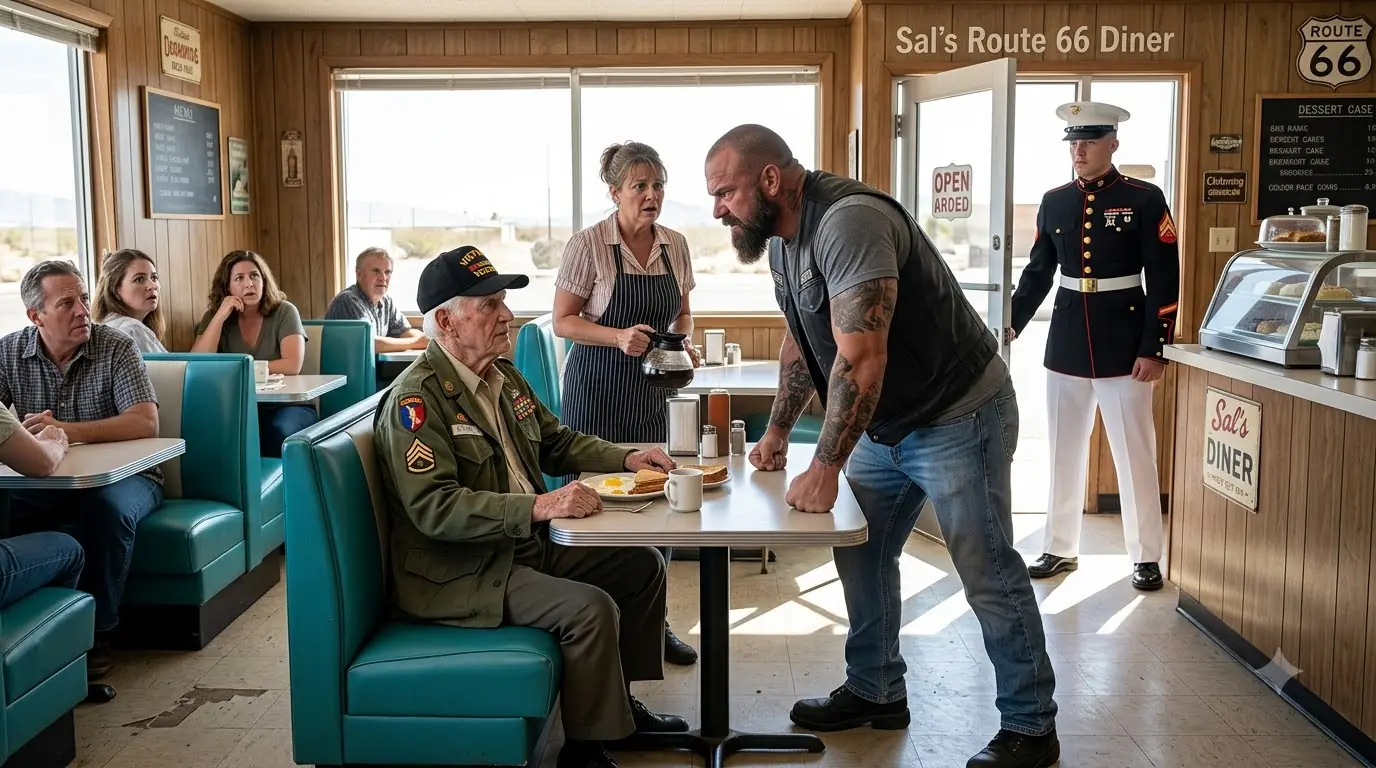
The tiny diner had gone completely silent, the kind of silence that does not come from peace, but from people holding their breath because something ugly has stepped into the room.
At the center booth, seventy-eight-year-old Harold Dawson sat with his breakfast growing cold in front of him.
He wore an old olive jacket, a faded Army cap, and a blue flannel shirt buttoned neatly beneath his collar. His hands were weathered and veined, the hands of a man who had spent a lifetime working, building, carrying, repairing, and surviving. His shoulders had narrowed with age, and his back did not stand quite as straight as it once had, but nothing about his posture suggested panic.
“I said,” Harold repeated evenly, “men who bark like dogs usually run like them, too.”
The biker shoved harder against the table.
The silverware jumped.
A coffee cup rattled in its saucer.
Across the room, a young waitress froze behind the counter with a glass pot in her hand, dark coffee steaming inside it. Near the kitchen window, the cook stopped flipping eggs and slowly looked up. In the corner booth, a father placed one protective hand across his son’s chest, though the boy was not moving anywhere.
The biker’s face reddened.
He was a large man in his early forties, heavy-shouldered, thick-necked, with a shaved head, a rough beard, and tattoos running down both arms. His name was Travis Bower, though most people around town called him Tank because he liked the way it sounded when smaller men stepped aside for him. He had built a reputation on noise, intimidation, and the kind of confidence that only works when everyone else agrees to be afraid.
“Or what?” Travis snapped. “You going to fight me, Grandpa?”
His voice rolled through the room, drawing uneasy looks from the other customers. A few people reached for their phones, though none seemed certain whether they were recording for safety, curiosity, or cowardice. Nobody spoke. Nobody stood.
Harold did not blink.
He lowered his fork slowly and looked up, not with fear, but with something closer to pity.
“I fought men twice your size, son,” he said. “But they had twice your honor, too.”
A quiet gasp moved through the diner.
Travis straightened, towering over the frail-looking man.
“Big talk for somebody who looks like a stiff breeze could knock him over.”
Behind them, a little boy sitting with his father whispered, “Daddy, is he going to hurt the soldier?”
The question slipped through the room more clearly than the child intended.
The father did not answer.
No one did.
Harold turned his eyes briefly toward the boy. The child was maybe seven, with dark hair, a blue jacket, and a pancake cut into small pieces on the plate before him. His fork sat untouched in his hand. Fear and curiosity battled openly across his face.
Harold gave him a tiny nod.
Not a smile.
Not reassurance exactly.
Just a signal.
I am all right.
Then he looked back at Travis Bower.
That was when the diner door opened.
The small bell above it rang once, cutting through the tension.
Every head turned.
A tall, broad-shouldered man stepped inside wearing Marine dress blues. Polished shoes clicked against the black-and-white tile floor, and medals caught the soft morning light as he crossed the threshold. Rainwater clung to the brim of his white cover and the edges of his shoulders, but he did not pause to shake it off.
He scanned the diner once.
His eyes passed over the biker.
Then they stopped on Harold Dawson.
The biker turned toward him with a scoff.
“What now?” Travis said. “You bringing in backup, old man?”
The Marine ignored him completely.
He walked straight toward Harold’s booth, stopped in front of the table, snapped to attention, and raised a crisp salute.
“Permission to sit, Sergeant Major?” he said clearly.
A murmur moved through the diner.
The title landed like a second bell.
Sergeant Major.
Harold’s expression softened by the smallest degree. He returned the salute with a slower hand, but there was nothing weak in the motion. His fingers touched the brim of his faded cap, and for a moment, the old diner seemed to hold two different times at once: the present with its coffee, rain, and fear, and some older world where discipline meant something heavier than noise.
“Granted,” Harold said.
The Marine slid into the booth beside him.
Travis tried to laugh.
“What is this, some kind of joke? You actually know this guy?”
The Marine turned toward him.
“That man is my grandfather,” he said. “His name is Harold Dawson. He served in Vietnam, earned a Bronze Star, and survived two years as a prisoner of war.”
His voice remained controlled.
“And you decided the best use of your morning was to stand over him and make yourself look important.”
Travis’s expression tightened.
“You think I’m scared of you just because you wear a uniform?”
The Marine stood again, slowly and without theatrics.
“I don’t need to scare you,” he said. “You already humiliated yourself.”
For the first time, Travis looked around the room.
Every face was turned toward him now.
The cook had stepped out from the kitchen with his arms crossed. The waitress stood behind the counter, no longer looking nervous so much as disappointed. Even the customers who had stayed quiet were watching him with open disapproval.
A woman near the window clapped once.
The sound cracked through the silence.
Another person joined her.
Then another.
Within seconds, the applause spread through the diner, not loud at first, but steady enough to make the room feel changed. Travis looked at the clapping hands, the phones, the old man, and the Marine standing before him. His face reddened deeper.
He stepped back, muttering, “Whatever. This place is ridiculous.”
Then he turned, pushed through the door, and disappeared into the gray morning light.
The applause continued for several seconds after he was gone.
Then it softened.
Then it faded.
The Marine sat back down beside his grandfather. The waitress approached with a fresh pot of coffee, her hands still unsteady from the confrontation.
“This one’s on the house,” she said softly.
Harold finally smiled.
It was small, almost reluctant, but real.
He placed one weathered hand on his grandson’s shoulder.
“Didn’t expect to need backup at breakfast,” he said.
The Marine chuckled.
“You always taught me to show up when it matters.”
But the story of that morning had not begun with Travis Bower leaning over a breakfast table.
It began seventy-eight years earlier, in a small house outside Topeka, Kansas, where Harold Dawson was born during a thunderstorm that shook the windows so badly his mother later claimed he came into the world already accustomed to noise.
His father worked rail yards. His mother cleaned offices at night and ironed shirts for families who never learned her first name. Harold grew up in a house where money came slowly and left quickly, but discipline stayed. His father believed a man’s word should be heavier than his wallet. His mother believed kindness did not count unless it cost you something.
Harold was not an easy boy.
He was stubborn, proud, quick to fight, and quicker to defend anyone smaller than himself. More than once, he came home with a split lip because he had stepped between some bully and a child who could not swing back. His mother would clean the blood with warm water and say, “Courage is good, Harold. But if pride is driving, courage is just trouble wearing a clean shirt.”
He did not understand that at twelve.
He understood it later.
At eighteen, Harold joined the Army.
Not because he loved war.
He did not know enough about war to love or hate it then.
He joined because he wanted structure, purpose, a paycheck, and a world larger than the roads he already knew by heart. He joined because young men often believe leaving home will explain who they are. Sometimes it does. Sometimes it breaks them first.
Vietnam changed Harold Dawson.
He rarely spoke of it.
Not because he had forgotten.
Because he had not.
There were memories that remained so clear they seemed less like memories than rooms he could still walk into if he closed his eyes too long. Rain hitting jungle leaves. The smell of wet canvas. The sound of men whispering prayers in the dark. Letters folded and refolded until the paper weakened at the creases.
He became a soldier because the Army trained him.
He became a leader because young men looked at him when they were afraid, and he realized someone had to stand still.
Years later, people would ask about the Bronze Star.
He would wave the question away.
“Medals are just metal,” he would say.
That was not exactly true.
He knew what medals represented.
But he also knew a medal could never capture the full truth of a moment. It could not show the fear in a man’s throat. It could not record the names of those who did not come home. It could not explain the weight of surviving when others had not.
The prisoner camp came later.
Two years.
That was how people summarized it.
Two years.
As if time could be folded small enough to fit inside a number.
Harold never told the full story, not even to his daughter, not even to his wife, not even to the grandson who loved him enough to ask gently and then stop asking when Harold’s eyes went distant. He carried those years quietly, not as a secret exactly, but as a territory no one else needed to enter.
What he did say was this:
“You learn what kind of man you are when no one can see you.”
He had learned hunger.
Cold.
Fear.
Pain.
Loneliness so complete it felt like the world had ended and forgotten to notify his body.
He had also learned that a man could survive without shouting. That calm could be an act of rebellion. That dignity did not require an audience. That sometimes the strongest thing a person could do was refuse to let cruelty decide his shape.
When he came home, America did not know what to do with men like him.
Some thanked him.
Some ignored him.
Some blamed him for things far above his pay grade.
Harold did not ask for parades. He took a job at a machine shop, married a woman named Linda who had eyes sharp enough to see through every wall he tried to build, and raised one daughter, Marlene, with more patience than anyone expected from the hot-headed boy he had once been.
Linda died nine years before the morning in the diner.
Cancer took her slowly, and Harold cared for her with the tenderness of a man who had never been good at saying soft things but had always been good at doing them. He cooked badly. She complained with affection. He learned to braid her hair when treatments made her too weak to lift her arms. She told him he pulled too tight. He kept trying until he got it right.
After she passed, Harold’s world became smaller.
The house grew quiet.
His daughter Marlene called often, but she lived two hours away and had her own family, her own work, her own complicated life. His grandson Marcus visited whenever he could, but the Marine Corps had a way of borrowing people from those who loved them.
So Harold developed rituals.
Tuesday mornings at the barbershop.
Thursday afternoons at the veteran center.
Saturday breakfast at Miller’s Diner.
Always the same booth if it was free.
Always coffee black.
Always eggs over medium, toast dry, bacon crisp.
Miller’s Diner had stood on the edge of Route 19 for forty-seven years. The sign outside was faded red and white, and one of the neon letters flickered whenever it rained. The floor tiles were old, the counter stools squeaked, and the coffee was better than it had any right to be.
To Harold, it was not just a place to eat.
It was a place where no one asked him to be anything other than present.
Maggie, the waitress with the coffee pot, had worked there since she was seventeen. She was forty-six now, with auburn hair usually tied in a messy knot and the kind of tired kindness common to people who spend their lives serving food to strangers. She knew Harold’s order. She knew not to call him “sweetie.” She knew that on the first Saturday of every November, he sat a little longer and stared out the window more than usual.
She never asked why.
That was why Harold liked her.
On the morning everything happened, rain had been falling since dawn.
Not a hard storm.
Just a cold, steady rain that turned the parking lot dark and slick and made the diner windows fog at the edges. Harold arrived at 7:38, as he always did, shook his umbrella twice outside the door, and stepped inside with water beading on his cap.
“Morning, Sergeant,” Maggie called from behind the counter.
“Morning, Maggie.”
“The usual?”
“Unless the chickens went on strike.”
She grinned.
“They considered it. I talked them down.”
Harold took his booth near the middle because the corner one was occupied by a young father and his son. He did not mind. The boy was carefully drowning pancakes in syrup, and Harold respected commitment.
He unfolded the local newspaper and read the first three pages without absorbing much of it.
At 8:04, the bikers arrived.
There were five of them.
They came in loud, laughing too hard, shaking rain off their jackets like dogs, bringing in the smell of wet leather, engine oil, and cold air. Most were harmless enough, men passing through on their way to a charity ride two counties over. Harold knew that type. Rough around the edges, loud in public, usually decent if sober and fed.
But Travis Bower was different.
He entered last, as if the room existed to receive him. He scanned the diner the way insecure men scan rooms, looking first for who might challenge him and second for who would not. His boots struck the tile heavily. His vest displayed patches from a riding club that had once meant something honorable before men like Travis started using it as armor.
Maggie greeted them.
“Sit anywhere open, gentlemen.”
Travis looked at Harold’s table.
It was not the largest booth.
It was not the best.
But it was in the center.
That seemed to matter to him.
He walked over and stood beside it.
“You done, old man?”
Harold glanced up from his paper.
“No.”
Travis smiled without warmth.
“We need the booth.”
“There are three empty tables.”
“I said we need this booth.”
Harold folded the newspaper once and set it beside his plate.
“Then you should have arrived before I sat down.”
One of the other bikers shifted uncomfortably.
“Come on, Tank. Let’s just sit over there.”
Travis ignored him.
His eyes moved to Harold’s faded Army cap.
“What is that, some old costume?”
The diner quieted slightly.
Harold picked up his coffee.
“No.”
“You one of those guys who wears a cap so everyone thanks you?”
Harold took a sip.
“No.”
Travis leaned closer.
“Then what?”
Harold set the cup down.
“It keeps my head warm.”
A few people chuckled.
Travis did not.
His face tightened.
“You think you’re funny?”
“No,” Harold said. “Just accurate.”
Maggie stepped closer, voice careful.
“Gentlemen, I’ve got a table ready right over here.”
Travis raised one hand without looking at her.
“We’re talking.”
Harold’s eyes moved to Maggie.
He saw the tension in her face. The fear of a scene. The fear of broken plates, bad reviews, trouble that would land on her shift even though she had not caused it. Harold had spent enough of his life reading rooms to know when someone needed help but could not ask for it.
He looked back at Travis.
“You heard the lady.”
Travis’s mouth curled.
“And if I didn’t?”
Harold’s voice remained quiet.
“Then you’re not as smart as you look.”
One of the bikers laughed before catching himself.
That was the first spark.
Travis turned on him.
“You think that’s funny?”
The man looked down.
“No, man.”
Travis turned back to Harold, now needing to win in front of everyone because his pride had found an audience.
“You got a real mouth on you for a fossil.”
Harold looked at him a long moment.
Then he said the line that started everything.
“Men who bark like dogs usually run like them, too.”
By the time Marcus Dawson walked through the door twenty minutes later, the room had already chosen silence too many times.
Marcus had not planned to be at the diner that morning in uniform.
He was thirty-two, a Marine gunnery sergeant, home for three days before reporting to his next assignment. He had arrived in town late the night before, exhausted, hungry, and carrying a garment bag with his dress blues because he had promised to attend a memorial ceremony at the county courthouse later that morning.
His grandfather did not know he was coming home early.
Marcus wanted to surprise him.
That had been the plan.
He would step into Miller’s Diner, find Harold sitting with his black coffee and dry toast, and say, “You still eating bacon like a man trying to negotiate with death?”
Harold would grunt.
Maggie would laugh.
Then Marcus would sit beside him, steal a piece of bacon, and endure a lecture about Marines being too loud and too polished compared to soldiers.
That was how it should have gone.
Instead, Marcus opened the diner door and found his grandfather sitting across from a large man who looked ready to turn fear into violence.
Marcus saw the room in pieces.
Maggie behind the counter, pale.
The father shielding his son.
Phones lifted.
Four bikers standing back, unwilling to follow Travis but not brave enough to stop him.
His grandfather’s plate untouched.
His grandfather’s face calm.
That calm frightened Marcus more than panic would have.
Because he knew what it meant.
Harold Dawson had left the room inside himself and gone somewhere older.
Somewhere he had learned not to tremble.
Marcus did not rush.
Rushing would feed the wrong energy.
He crossed the room with discipline, not drama. He saluted because Harold deserved respect before anything else. He asked permission to sit because their family had always handled honor with a little humor when emotion threatened to become too much.
And when Travis tried to turn the moment into another contest, Marcus did what Harold had taught him.
He did not bark.
He did not threaten.
He made the truth visible.
“That man is my grandfather,” Marcus said. “His name is Harold Dawson. He served in Vietnam, earned a Bronze Star, and survived two years as a prisoner of war. And you decided the best use of your morning was to stand over him and make yourself look important.”
The words changed the room because they gave shape to what had already been wrong.
Harold had not become worthy when Marcus named his history.
He had been worthy the entire time.
But now the room could no longer pretend not to know.
When Travis left, the door slammed behind him hard enough to rattle the bell.
The diner breathed again.
Maggie poured fresh coffee for Harold and Marcus, then placed a new plate of eggs in front of the old man without asking.
“Yours got cold,” she said.
Harold looked at the plate.
“You charging me twice?”
“Don’t make me regret being nice.”
Marcus grinned.
“She’s tougher than you, Grandpa.”
“She always has been.”
The little boy in the nearby booth continued staring.
His father whispered something, probably telling him not to bother people. But Harold noticed the boy’s eyes moving between his cap and Marcus’s uniform.
“What’s your name?” Harold asked.
The boy startled.
“Evan.”
“You like pancakes, Evan?”
He nodded.
“Good. A man should commit to breakfast.”
The boy smiled nervously.
“Were you really a soldier?”
“I was.”
“Were you scared?”
His father’s face tightened.
“Evan, don’t ask that.”
Harold lifted a hand.
“It’s all right.”
He looked at the boy.
“Yes,” he said. “I was scared many times.”
The boy seemed surprised.
“But you were brave.”
Harold picked up his fork.
“Brave does not mean you are not scared. Brave means you do what is right while fear is still sitting beside you.”
Evan thought about that.
Then he nodded, as if filing it away somewhere important.
Marcus watched his grandfather and felt something catch in his throat.
He had heard Harold say versions of that sentence his whole life, but it struck differently now, in this diner, after watching a room of adults freeze while one old man refused to lower his eyes.
The rest of breakfast passed quietly.
Some customers came to Harold’s booth before leaving. A woman thanked him for his service. An older man apologized for not speaking up sooner. Maggie refilled his coffee so often he finally told her he was old, not hollow.
When Harold and Marcus left the diner, the rain had stopped.
The parking lot shone under a pale morning sky.
Marcus held the door for his grandfather, though Harold gave him a look.
“I can manage a door.”
“I know.”
“Then why are you holding it?”
“Because Grandma told me manners were free.”
Harold paused.
“Fair.”
They stepped outside together.
At the edge of the lot, Travis Bower stood beside his motorcycle, helmet in hand. His four companions were already mounted, engines rumbling low. Travis looked toward Harold, then toward Marcus, then away.
For a second, Marcus thought the man might say something.
An apology.
Another insult.
Anything.
But Travis only put on his helmet, started his bike, and rode off.
Harold watched him go.
Marcus looked at his grandfather.
“You all right?”
Harold adjusted his cap.
“I’ve had worse breakfasts.”
“That’s not an answer.”
“It’s the one you’re getting.”
Marcus smiled despite himself.
They drove to Harold’s house in Marcus’s rented car because the courthouse ceremony was not until noon. Harold lived in a small white house with green shutters and a porch that sagged slightly on the left side. Linda’s roses still grew along the fence, though Harold claimed they survived only because they were too stubborn to die.
Inside, everything was exactly as Marcus remembered.
Framed photographs lined the hallway. His mother’s graduation. His grandmother in her garden. Marcus as a boy wearing Harold’s Army cap, the brim falling over his eyes. A younger Harold in uniform stood in one black-and-white photograph beside men whose names Marcus knew only because his grandfather spoke them once a year, on Memorial Day, while sitting alone on the porch.
Harold hung his jacket by the door.
Marcus stood in the kitchen.
“You want to talk about what happened?”
“No.”
“Grandpa.”
“Marcus.”
The old man put water on for coffee though they had already drunk enough to power a small town.
Marcus leaned against the counter.
“He was out of line.”
“Yes.”
“I should have gotten there sooner.”
Harold turned.
“No.”
Marcus went quiet.
Harold’s eyes sharpened.
“That is not yours to carry.”
“I know.”
“Do you?”
Marcus looked away.
Harold sighed and lowered himself into the kitchen chair.
“Sit down.”
Marcus obeyed.
For a while, neither spoke.
The kettle began to murmur on the stove.
Harold rested both hands on the table, fingers slightly bent from age and old injuries.
“When I was young,” he said, “I thought every insult required an answer. Every challenge was a hill to take. Every loud man needed to be put in his place.”
Marcus listened.
“Then life taught me something.”
“What?”
Harold looked toward the window, where Linda’s roses moved softly in the damp breeze.
“Some men are not challenging you. They are drowning in themselves and grabbing for anything nearby.”
Marcus thought of Travis.
“You think that biker was drowning?”
“I think a happy man does not spend breakfast trying to scare old people.”
Marcus was quiet.
“That does not excuse him,” Harold added.
“No.”
“But it explains why fighting him would not have fixed anything. He wanted me to become part of his noise. I declined.”
The kettle whistled.
Marcus stood to pour the coffee.
When he set the mug in front of his grandfather, Harold wrapped both hands around it.
“Your grandmother used to say my greatest improvement as a husband was learning when to shut up.”
Marcus laughed.
“She said that?”
“Often.”
“She was right.”
Harold smiled faintly.
“She usually was.”
By mid-afternoon, the video was online.
It started halfway through the confrontation, shaky and slightly tilted. The caption read:
Biker mocks elderly veteran in diner, then Marine grandson walks in.
At first, it spread through the town.
Then the county.
Then the state.
By evening, millions of people had watched Marcus enter the diner, salute Harold, and quietly change the balance of the entire room.
Comments poured in from across the country.
Some thanked Harold for his service.
Others shared stories about fathers, mothers, grandfathers, grandmothers, uncles, and neighbors who had served in silence and never asked for recognition.
Many focused less on Travis and more on the calm way Harold refused to be intimidated.
That old man did not move because he did not need to.
The Marine did not save him. He honored him.
Respect your elders before you learn who they are.
My grandfather was like this. Quietest man in the room, strongest man I ever knew.
Marcus showed Harold the video that evening after the courthouse ceremony.
Harold watched for eight seconds.
Then he handed the phone back.
“I was eating.”
Marcus blinked.
“What?”
“That angle makes it look like I ordered too much toast.”
“Grandpa, twelve million people have seen this.”
Harold frowned.
“Why?”
“Because it meant something.”
“It was breakfast.”
“It was not just breakfast.”
Harold sat in his recliner, the same one Linda had once threatened to throw away because the left arm was worn thin.
He looked out the window.
“I don’t need people to remember my name,” he said. “Just remember the values we fought for. Respect. Courage. And knowing when to keep your pride from making a fool out of you.”
Marcus smiled.
“That sounds like something you should put on a wall.”
Harold shook his head.
“Walls don’t listen.”
The next morning, reporters called.
Then veteran organizations.
Then a local television station.
Maggie called Harold at 9:00 and said the diner phone had not stopped ringing.
“People want to buy your breakfast,” she said.
“I already ate.”
“They mean future breakfasts.”
“I don’t need strangers buying my eggs.”
“They also want to send flowers.”
“To a diner?”
“To you.”
“I’m not dead.”
Maggie snorted.
“I told them that.”
By noon, someone had found Travis Bower’s social media pages.
People were angry.
Too angry.
The internet, Harold quickly learned, did not know how to hold a lesson without turning it into a weapon. Strangers called Travis names, threatened him, mocked his family, and dug into his life with the same appetite for humiliation they claimed to condemn.
Marcus showed Harold only part of it.
Harold’s face darkened.
“This is foolishness.”
“He deserves consequences.”
“Yes,” Harold said. “Consequences. Not a mob.”
Marcus looked at him.
“He scared people in that diner.”
“I know.”
“He tried to humiliate you.”
“He did.”
“And you’re defending him?”
Harold’s eyes sharpened.
“No. I am defending the line between justice and appetite.”
Marcus went still.
Harold leaned back.
“When people enjoy punishment too much, they stop caring whether it teaches anything.”
That evening, Harold asked Marcus to drive him back to Miller’s Diner.
“Why?”
“Because I want pie.”
“You hate pie.”
“I tolerate apple.”
“You want to talk to Maggie.”
“I want pie.”
Marcus drove him.
The diner was busier than usual. People turned as Harold entered. Some clapped. Harold looked deeply uncomfortable and immediately walked to his booth.
Maggie came over, eyes soft.
“You all right?”
“No one has let me be all right quietly.”
She smiled.
“That’s fame.”
“Then fame is a rash.”
She laughed.
Marcus sat across from him.
Halfway through the coffee, Travis Bower walked in.
The diner stiffened instantly.
He was not wearing his leather vest this time. He wore a dark hoodie, jeans, and a baseball cap pulled low. His face looked tired. Not frightened exactly, but stripped of the aggressive performance from the day before.
Maggie’s hand went still on the coffee pot.
Marcus straightened.
Harold lifted one hand slightly.
Wait.
Travis stood near the entrance for a long moment.
Then he walked toward the booth.
Every person in the diner watched him.
He stopped a few feet from the table.
His eyes went to Marcus first, then to Harold.
“I’m not here for trouble.”
Harold said nothing.
Travis swallowed.
“I saw the video.”
“I assumed.”
“People are saying a lot.”
“They are good at that.”
Travis looked down.
For a second, the tough mask tried to return. Harold could see it flicker across his face, that instinct to turn shame into anger because anger felt safer. But then it faded.
“My old man was a veteran,” Travis said quietly. “Korea. He never talked about it.”
Harold waited.
“He died last year. We were not close.”
“I’m sorry.”
Travis’s jaw tightened.
“He thought I was a screwup.”
Harold did not contradict him.
Travis let out a humorless breath.
“Yeah. Maybe he was right.”
The diner stayed silent.
Travis looked at the floor.
“Yesterday would have made him sick.”
Harold studied him.
“Yes,” he said.
The honesty hit Travis harder than comfort would have.
He nodded once, as if accepting a blow he had earned.
“I came to say I’m sorry.”
Harold held his gaze.
“For what?”
Travis looked confused.
“For what I did.”
“That is too vague.”
Marcus glanced at his grandfather, surprised.
Harold’s voice remained calm.
“What are you sorry for?”
Travis swallowed.
“I’m sorry I tried to take your table because I wanted to feel big.”
Harold waited.
“I’m sorry I mocked your cap.”
Again, Harold waited.
“I’m sorry I scared people. The waitress. That kid. You.”
“I was not scared.”
Travis looked up.
“No. I guess not.”
He rubbed one hand over his face.
“I’m sorry I disrespected you.”
Harold nodded slowly.
“That is an apology.”
Travis seemed almost relieved.
“I don’t expect you to forgive me.”
“Good.”
Travis blinked.
Harold picked up his coffee.
“Forgiveness is not a vending machine. You do not insert apology and receive absolution.”
Maggie looked away to hide a smile.
Harold continued.
“But apology is a start.”
Travis nodded.
“What should I do?”
Harold looked at him for a long moment.
“Your riding club still doing that charity run today?”
“Canceled. Because of me.”
“Uncancel it.”
Travis frowned.
“What?”
“You wanted attention. Use it. Ride for something worth riding for.”
Travis stared.
Harold looked toward Maggie.
“Maggie, what was that fundraiser for?”
“The veterans’ housing project in Clay County,” she said.
Harold turned back to Travis.
“There. Do that.”
Travis looked overwhelmed.
“You want me to show up after all this?”
“No,” Harold said. “I want you to stop hiding behind shame. Shame is only useful if it makes you repair something.”
Marcus looked at his grandfather.
He had heard another lesson take shape.
Travis nodded slowly.
“All right.”
“And Travis?”
The biker looked at him.
“Leave old men eating breakfast alone.”
For the first time, Travis almost smiled.
“Yes, sir.”
He left quietly.
The diner remained still for several seconds.
Then Maggie set an apple pie slice in front of Harold.
“On the house.”
“I did not order pie.”
“You came for pie.”
“I lied.”
“I know.”
She walked away.
Marcus shook his head, smiling.
“You are impossible.”
Harold picked up his fork.
“So was your grandmother. That is why we got along.”
The second video spread almost as quickly as the first.
This one showed Travis standing beside Harold’s booth, apologizing in plain words while the old veteran made him name exactly what he had done. People expected a second humiliation. Instead, they saw something stranger and harder.
Accountability without spectacle.
Mercy without softness.
A lesson given to a man who did not deserve it but clearly needed it.
By the end of the week, the charity ride had raised more money than it had in any previous year. Travis rode at the back, not the front. He did not give interviews. He did not post long statements about redemption. He showed up, helped load supplies, and spent most of the afternoon quietly carrying boxes into a temporary housing center for veterans transitioning out of homelessness.
Harold did not attend.
He had no interest in becoming a mascot.
But Marcus went.
He stood across the parking lot and watched Travis carry furniture into the building without looking around to see who noticed.
When Marcus told Harold about it later, the old man only nodded.
“Good.”
“That’s all?”
“That’s enough.”
Weeks passed.
The viral moment faded, as viral moments do.
Another outrage replaced it.
Then another.
People online moved on.
But in Miller’s Diner, something remained changed.
A framed photograph appeared on the wall near the counter. It showed Harold sitting in his booth, Marcus beside him in uniform, Maggie standing behind them with the coffee pot. Harold had protested the photograph. Maggie had ignored him.
Beneath it, someone had printed a quote from Harold:
Never mistake silence for weakness.
Harold grumbled when he saw it.
“Walls still don’t listen,” he said.
Maggie shrugged.
“Customers do.”
The little boy named Evan returned with his father two Saturdays later. He brought Harold a drawing made with crayons. It showed an old soldier, a Marine, a biker, a diner, and a very large plate of pancakes.
At the top, Evan had written:
Brave means doing right when scared.
Harold stared at the drawing longer than anyone expected.
Then he carefully folded it once and tucked it inside his jacket pocket.
Marcus noticed.
Harold pretended not to.
That afternoon, Harold placed the drawing on his refrigerator beneath a magnet shaped like a sunflower, one Linda had bought at a roadside stand twenty years earlier.
The house felt less quiet with it there.
Not full.
Nothing could make it full the way Linda had.
But less quiet.
That was something.
On Marcus’s last night before returning to duty, he and Harold sat on the porch while evening settled over the neighborhood. The air smelled of damp grass and distant woodsmoke. Linda’s roses climbed the fence, stubborn and alive.
Marcus held a mug of coffee.
Harold held one too, though his doctor had told him to cut back.
Neither mentioned that.
After a long silence, Marcus said, “Grandpa?”
“Hm.”
“When I walked in and saw that man standing over you, I wanted to break him in half.”
“I know.”
“I almost did.”
“I know.”
Marcus looked at him.
“You were not worried?”
Harold watched the street.
“I was worried.”
“You didn’t look it.”
“That was for everyone else.”
Marcus absorbed that.
Harold continued.
“You wear the uniform now. That means people will look at you when they are afraid. Your job is not always to be fearless. It is to give them something steadier than their fear.”
Marcus’s jaw tightened slightly.
“I don’t know if I can always do that.”
“You won’t.”
Marcus looked at him.
Harold shrugged.
“You’ll fail sometimes. Then you’ll learn. Then you’ll try again.”
The younger man looked down into his mug.
“Were you always that calm?”
Harold laughed once.
“No. Ask anyone who knew me at twenty.”
“I wish I had known you then.”
“No, you don’t. I was an idiot with good intentions.”
Marcus smiled.
Harold turned serious again.
“Listen to me. Strength is not volume. It is not size. It is not how fast you can make another man step back. Real strength is knowing who you are before someone tries to tell you different.”
Marcus nodded slowly.
Harold looked toward the window where Linda’s photograph sat inside on the piano.
“Your grandmother taught me most of that.”
“She taught everybody everything, according to you.”
“She did.”
They sat until the porch light came on automatically.
The next morning, Marcus left before sunrise.
Harold stood in the driveway wearing his faded cap and old olive jacket. Marcus wore civilian clothes now, his uniform packed carefully in the trunk. For a moment, they faced each other in the pale light without speaking.
Then Marcus saluted.
Harold returned it.
“Permission to depart, Sergeant Major?”
Harold’s mouth twitched.
“Granted.”
Marcus hugged him then, hard and fast, like he was still a boy and not a grown man with medals of his own.
“Love you, Grandpa.”
Harold patted his back twice.
“Love you too, son.”
Marcus drove away.
Harold stood in the driveway until the car turned the corner.
Then he went inside, made coffee, and looked at Evan’s drawing on the refrigerator.
The old man in the drawing stood very straight.
Much straighter than Harold actually stood now.
He smiled at that.
Children drew truth differently.
A month later, Miller’s Diner hosted a breakfast fundraiser for the veterans’ housing project.
Maggie organized it.
The cook complained the entire time and then arrived two hours early to prep.
Carlo from the hardware store donated lumber for a repair project. The local high school jazz band played in the corner. Evan and his father came. So did Travis Bower, who arrived alone, quietly paid for ten breakfasts for veterans, and sat near the back without causing trouble.
Harold saw him.
Travis nodded once.
Harold nodded back.
That was all.
Sometimes peace did not need a speech.
During the fundraiser, Maggie tried to make Harold stand and say a few words.
He refused.
Then Evan asked.
That made refusal harder.
So Harold stood near the counter, one hand resting on the back of a chair, his Army cap pulled low.
The diner quieted.
He looked uncomfortable.
Then he began.
“I do not have a speech.”
Maggie whispered loudly, “That is how all your speeches start.”
People laughed.
Harold waited.
Then he said, “Most of us will face moments where pride asks us to become louder than we need to be. Sometimes pride sounds like a man trying to scare an old soldier. Sometimes it sounds like a room staying silent because speaking up might cost comfort. Sometimes it sounds like a uniformed grandson wanting to solve everything with anger because love is scared.”
Marcus was not there, but Harold thought of him.
“So here is what I know,” Harold continued. “Respect costs less than regret. Courage is not the absence of fear. And a man who cannot apologize is weaker than a man who was wrong in the first place.”
Travis lowered his eyes.
Harold’s voice softened.
“We honor people best by living better, not by clapping for them once and forgetting what the applause meant.”
He sat down.
The diner remained quiet for a moment.
Then Maggie clapped.
This time, Harold did not glare at her.
He let the applause happen.
Later, when the breakfast rush ended and the rain began again outside, Harold sat in his usual booth with coffee and toast. The room smelled of syrup, bacon, wet coats, and old tile. The neon sign flickered in the window.
Maggie refilled his cup.
“You know,” she said, “for a man who says walls don’t listen, you sure gave everybody a line to put on one.”
Harold looked at the framed quote near the counter.
Never mistake silence for weakness.
Then he looked at Evan’s drawing, now copied and pinned beside it.
Brave means doing right when scared.
He took a sip of coffee.
“Kid’s line is better.”
Maggie smiled.
“It is.”
The moment had never been about proving that Harold Dawson was tougher than Travis Bower.
Harold had survived enough in his life to know real strength rarely needed to announce itself. He had learned that silence could come from fear, but it could also come from discipline, experience, and the certainty that not every challenge deserved a reaction.
Travis had mistaken Harold’s age for weakness and his calm for submission. He had assumed that because the old man did not rise, shout, or threaten him, there was nothing behind the quiet. What he failed to understand was that Harold had already lived through situations far more serious than a loud stranger in a diner.
And when Marcus walked through the door, the room did not change because a stronger man had arrived to fight.
It changed because someone who knew Harold’s history arrived and treated him with the respect he had quietly carried all along.
That was the deeper lesson.
Respect should not have required proof.
Harold should not have needed a grandson in dress blues, a list of medals, or a viral video to be treated with dignity. He should have been respected because he was a human being eating breakfast in peace.
But sometimes the world forgets simple truths until someone opens a door and reminds everyone what honor looks like.
By the end of that season, the viral clip had turned into something more lasting than a moment of online outrage. It became a story told in the diner, at the veteran center, in classrooms, and around kitchen tables. Some told it as a story about standing up to bullies. Some told it as a story about honoring veterans. Some told it as a story about a grandson arriving exactly when he was needed.
Harold told it differently.
When asked, he would shrug and say, “A man interrupted my breakfast. My grandson arrived overdressed. Maggie gave me cold toast. That’s the whole thing.”
But those who knew him understood the truth beneath the joke.
The story was about restraint.
About dignity.
About the kind of courage that does not need to fill a room with noise.
About the danger of judging someone by age, silence, clothing, or a body that no longer looks strong enough to carry what it once survived.
And most of all, it was about remembering that every quiet person has a history no stranger can see.
Harold Dawson continued eating breakfast at Miller’s Diner every Saturday.
Same booth when it was free.
Same black coffee.
Same dry toast.
Same faded Army cap.
Sometimes people recognized him and asked for photographs. He usually declined unless a child asked politely. Sometimes veterans stopped by his table and sat with him in silence. Sometimes Travis came in, sat near the back, and paid for someone else’s meal before leaving.
Harold never became comfortable with attention.
But he became patient with what the attention gave others.
A reason to remember.
A reason to teach.
A reason to ask whether they were the person who barked, the person who stayed silent, the person who showed up, or the person who quietly kept eating breakfast because he already knew who he was.
On the first anniversary of the incident, Marcus came home again.
Not as a surprise this time.
Harold was waiting.
Maggie had saved the center booth.
Marcus stepped into the diner wearing jeans and a plain jacket, no dress blues, no medals, no polished shoes catching the light.
Harold looked up from his coffee.
“You underdressed.”
Marcus smiled.
“Didn’t want to scare the toast.”
He slid into the booth.
Maggie brought coffee without asking.
For a while, grandfather and grandson sat quietly while rain streaked the windows.
Then Marcus looked at Harold.
“You know, people still talk about that day.”
Harold buttered his toast.
“People talk when weather is bad and television is worse.”
Marcus laughed.
“I’m serious.”
“So am I.”
Marcus leaned back.
“What do you want them to remember?”
Harold thought for a long moment.
He looked around the diner.
At Maggie pouring coffee.
At Evan, now a year older, helping his father carry plates for the fundraiser.
At Travis near the back, quietly repairing a loose chair leg because the cook had complained about it.
At the framed words on the wall.
Never mistake silence for weakness.
Then Harold looked back at his grandson.
“I want them to remember this,” he said. “Do not wait to learn a man’s history before treating him with respect. By then, you have already failed the test.”
Marcus nodded.
“That is better than the wall quote.”
“Most things are.”
They drank their coffee.
The rain continued.
The diner stayed warm.
And Harold Dawson, old soldier, grandfather, widower, survivor, and stubborn defender of dry toast, sat exactly where he belonged.
Not because he had proved himself.
He had done that long before anyone in that room was watching.
But because dignity had always belonged to him.
Quietly.
Completely.
Without needing permission from anyone loud enough to mistake silence for weakness.