“You have 12 minutes, Emily. Twelve minutes to make this right, or I start making calls. And trust me, sweetheart, you do not want me making calls.”
Victor Kaine said it softly. That was the worst part. Not yelling, not threatening, just quiet, certain, and cold, the way a man speaks when he has never once been told no.
Emily Carter stood in her own diner, wearing her dead father’s apron, and felt the walls close in. Then she looked down at the greasy receipt in her hand and picked up a pen.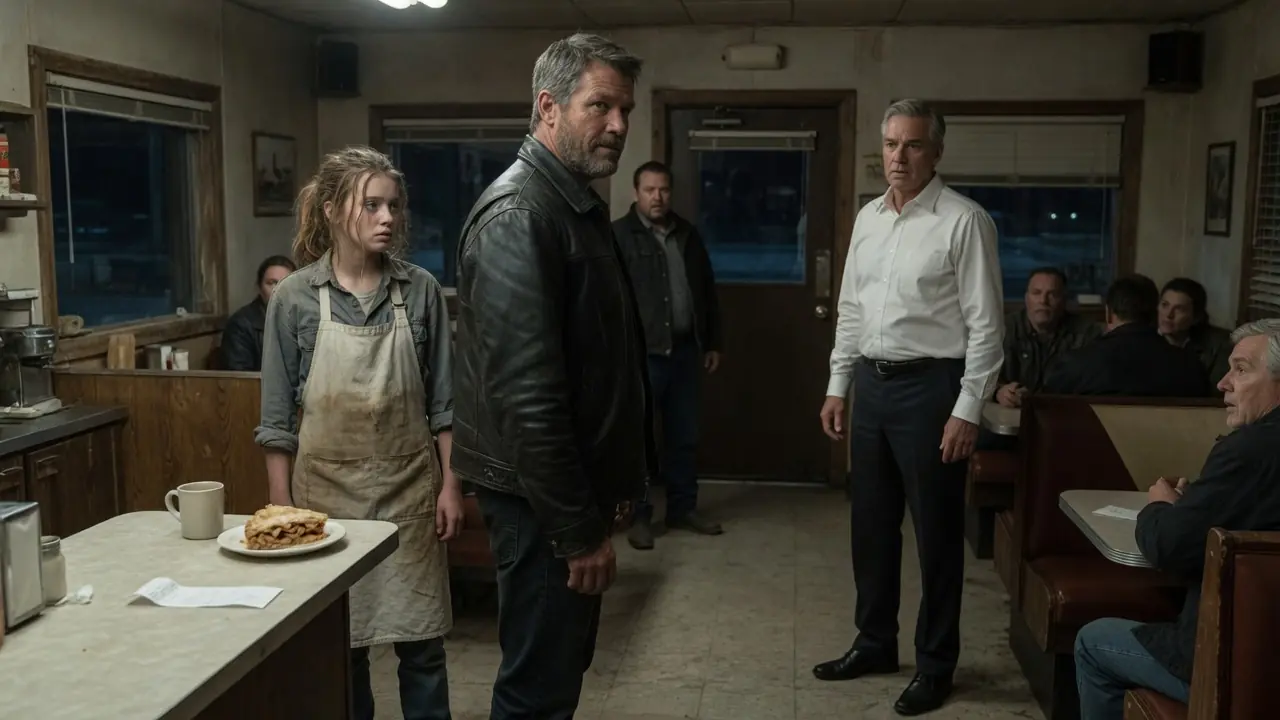
The clock above the pie case had been running three minutes slow for six years. Emily knew this because her father, Gerald Carter, had always said he would fix it, and he never did. Every Thursday night closing shift, she would look up at that clock and adjust the real time in her head, the way she adjusted everything in her life quietly, without complaint, without asking anyone for help.
Tonight, the clock read 11:44, which meant it was actually 11:47, which meant Victor Kaine had just cut her time down to twelve minutes.
She stood with her back against the kitchen door, her order pad pressed flat against her stomach like she was trying to hold herself together. The diner was nearly empty. Two truckers sat in the back booth, half asleep over coffee. Old Pete Rafferty, who came in every night just to have somewhere to sit, dozed in the corner with his baseball cap over his face.
And at the far end of the counter, on the last stool closest to the window, the biker sat with his black coffee and his slice of apple pie, same as every Thursday.
His name was Cole Maddox. Emily knew this because he had once paid with a credit card. Beyond that, she knew almost nothing about him. He came every Thursday, ordered the same thing, tipped twenty percent exactly, and left without saying much beyond thank you.
He was somewhere in his mid-forties, broad through the shoulders, with a Hell’s Angels patch on his jacket. Emily had tried not to stare at it the first few times he came in because she had grown up being told what that meant, and she was no longer sure she believed all of it.
He had never caused a single problem.
Victor Kaine stood in the middle of the diner like he owned it because, as far as he was concerned, he almost did. He was not a large man, which surprised people who met him for the first time. They expected someone who looked like a threat.
Instead, Victor was slim, in his fifties, silver at the temples, with a smile that almost reached his eyes. He wore a pressed shirt. He smelled faintly of something expensive. He looked like the kind of man who volunteered at charity auctions and coached Little League on weekends.
He was not that man.
“Emily,” he said, her name flat and practiced. “I’ve been more than patient. You know that.”
She swallowed. “Victor, I told you I need more time. The books won’t close positive until—”
“That’s not my problem.”
“It’s my father’s diner.”
“It was your father’s diner.” He tilted his head slightly. “Now it’s collateral, and the clock is ticking.”
She wanted to scream. She wanted to grab him by that pressed shirt, drag him through the front door, and tell him exactly what she thought of his patience, his paperwork, and his polished shoes. She wanted to call the police, a lawyer, someone, anyone.
But she had tried all of it.
The lawyer she contacted three months ago had reviewed Victor’s documents and gone very quiet before telling her apologetically that the transfer language was airtight. The local deputy, Hargrove, had explained carefully that it appeared to be a civil matter. Her bank had denied her loan request twice.
And her phone was sitting in the office in the back, where Victor’s associate, a stocky man named Dennis, stood with his arms crossed.
“Twelve minutes,” Victor said.
Emily looked at the truckers. They had not moved. Old Pete was still asleep. Then, without really deciding to, her eyes moved to Cole Maddox at the end of the counter.
He sat with both hands wrapped around his coffee mug, looking out the window at the dark Montana highway. He wasn’t watching her. He wasn’t watching Victor. He seemed like a man at peace with his Thursday night.
But something made Emily look at him. Maybe desperation. Maybe the particular clarity that comes when every other option is gone.
She reached under the counter and tore a receipt from the paper roll. She uncapped her pen, pressed the paper flat against the laminate, and wrote two words.
Her hand was shaking so badly the letters came out crooked and ugly.
Save me.
She folded the paper once, walked the length of the counter, set it down beside Cole’s coffee cup without a word, then walked back to the kitchen door and pressed her back against it.
Cole set down his mug. He picked up the folded paper and opened it slowly, the way a man opens something he has been half expecting.
He read it.
He was still for three, maybe four seconds.
Then he stood up, reached into his jacket, pulled out a folded bill, left it on the counter beside his unfinished pie, and walked toward the door.
He did not look at Emily. He did not look at Victor. He did not speak.
He just walked out.
The bell above the door rang once.
Emily felt something collapse inside her chest. She had been wrong. Of course she had been wrong. He was a stranger. He owed her nothing.
Victor glanced at the door, then back at her. He smiled, the real one, the one without warmth.
“Eleven minutes,” he said.
Emily thought about her son, Caleb. He was six, with his grandfather’s ears that stuck out just slightly and had always made Gerald Carter look perpetually surprised. Caleb was sleeping right now at her neighbor Linda’s house, tucked under the Spider-Man blanket he refused to sleep without, completely unaware that the diner his grandfather had built with twenty years of double shifts and tired hands was about to be taken by a man in a pressed shirt who called it collateral.
Gerald Carter had opened Carter’s Diner in 1987. He had saved for nine years to do it. He poured concrete himself on weekends, wired the lights with help from his brother, and hand-painted the sign out front in big careful letters that had faded over the decades into something softer and more beautiful than the original.
He had died eleven months ago. Lung cancer, stage four, discovered late because he kept saying he was fine.
He left Emily the diner. He also left behind boxes of paperwork, an espresso machine that had not worked since 2019, and a set of business documents she had not understood and had set aside for later.
Later had come at her like a freight train.
Three months after Gerald’s funeral, Victor Kaine came through the door and introduced himself as a representative of Meridian Capital Solutions. He explained, with the calm of someone explaining something simple to someone slow, that her ex-husband, Ryan Mercer, had entered into a business arrangement with Meridian six years earlier using Carter’s Diner as a secondary collateral anchor in exchange for a private loan.
The arrangement included a clause buried on page 18 of a 42-page document that transferred liability to the property’s inheritor in the event of the original borrower’s disappearance or incapacity.
Ryan had been gone for four years.
Emily had tried to explain that she had no knowledge of it, that she had signed nothing, that Ryan had forged documents before and that it had come up during their divorce proceedings before he vanished.
Victor had listened politely and said, “That’s a matter for the courts, Miss Carter.”
And then he started coming to the diner.
“Nine minutes,” Victor said.
Dennis shifted his weight by the office door.
Emily was so focused on not falling apart that she almost didn’t hear the sound at first. It started low, more vibration than sound, the kind you feel in your sternum before your ears register it.
The coffee in Victor’s cup rippled slightly.
Then the sound grew.
Old Pete Rafferty woke up and lifted the brim of his cap, confused. Then his eyes went to the window, and they went very wide.
The two truckers sat up.
Victor frowned and turned.
The sound had become a roar. Not chaotic. Not random. It had structure, weight, and rhythm. Dozens of engines moving together, slowing together, arriving together.
White light flooded through the windows. Headlights. So many headlights that the interior of Carter’s Diner went from dim to blazing in under four seconds, as if someone had thrown a switch and turned on the sun.
Victor walked slowly to the window. Emily followed without thinking.
She tried to count and lost track somewhere around forty.
They filled the parking lot. They lined the highway shoulder in both directions. They blocked the service road beside the kitchen. They wrapped around the diner the way a fist wraps around something it means to hold.
One hundred twenty motorcycles, engines idling low and steady, the sound of something patient and certain.
Every headlight aimed at the diner.
Victor said nothing for a long moment.
Then, “What is this?”
Emily couldn’t answer. She had written two desperate words on a receipt and handed them to a stranger. The stranger had walked out into the Montana night and somehow summoned a small army.
The door opened behind her.
The man who came through first was not Cole Maddox. Cole was behind him, standing just inside the doorway, arms at his sides, watching.
The man who entered first was older, barrel-chested, gray-bearded, and moved with the unhurried certainty of someone who had spent decades being the largest thing in any room. His jacket was worn in a way that spoke of years, not fashion. His eyes were dark, steady, and calm.
They found Victor immediately.
He crossed the diner floor in eight steps and stopped three feet from Victor.
“Jackson Ward,” he said by way of introduction. He did not extend his hand. “People call me Grizzly.”
Victor squared his shoulders carefully. “I’m in the middle of a private business matter.”
“No,” Jackson Ward said quietly. “Matter of fact, you’re not.”
Victor’s jaw tightened. “I don’t know who you think you are, but this is a legal proceeding. I have documentation.”
“I don’t doubt it.” Jackson glanced briefly over his shoulder at the wall of headlights beyond the window, then back to Victor. “A man like you always has documentation. That’s how men like you work. You don’t break anything. You just bend it so far that other people break.”
“You picked the wrong woman to corner,” Jackson Ward said. Not loud. Not as a threat. As a statement of fact.
Victor Kaine, who had spent twenty years making small business owners fold, who had survived three regulatory investigations, who had refined legal intimidation into something close to science, looked out at the wall of lights.
For the first time Emily could see, something moved behind his eyes.
Something that looked very much like fear.
Dennis had produced a phone and appeared to be trying to make a call. He looked up, frustrated.
“I’ve got no signal.”
“Yeah,” Cole Maddox said from the doorway.
He didn’t elaborate. He didn’t need to.
Victor turned back to Jackson. He was composing himself, doing the practiced reset of a man used to adjusting mid-confrontation.
“You understand that what you’re doing here is—”
“I understand a woman is scared,” Jackson said. “I understand a man put her in a position where she felt scared on her own property, in her own business, in her own diner that her father built. And I understand that 120 people outside this building drove a long way tonight because they heard that was happening.”
He paused.
“So I’m going to ask you once, politely, to take your friend and leave. Whatever paperwork you’ve got, whatever legal arrangement you think you have, that’s for courts and lawyers in daylight hours. Not for tonight. Not like this.”
The word once sat in the air.
Victor looked at the window again. Then he straightened his collar, picked up his jacket from the counter stool, and smoothed his shirt with deliberate care, the way a man tries to own the final moment of a room he is being forced to leave.
“We’ll finish this conversation through proper channels,” he said to Emily.
Not to Jackson Ward.
He couldn’t quite bring himself to address Jackson Ward anymore.
Emily looked at him. Her hands had stopped shaking. She wasn’t sure exactly when that had happened.
“Get out of my diner,” she said.
Two words, steady as stone.
Victor Kaine walked out.
Dennis followed.
The bell above the door rang twice.
For a moment, nobody moved.
Then Old Pete Rafferty pushed his baseball cap back on his head and said quietly, “Well, I’ll be damned.”
One of the truckers let out a long, shaking breath. The other started laughing, not cruelly, not at anything in particular, just the laugh of someone releasing pressure that had been building for a while.
Emily realized she was leaning against the counter. She straightened up, pressed her palms flat against the laminate, and breathed.
Jackson Ward watched her carefully.
“You okay?”
She almost said yes. The automatic, exhausted reflex of a woman who had been saying yes and fine and I’m managing for eleven months straight.
Instead, she said, “No.”
Her voice broke slightly.
Jackson nodded once, like that was the right answer, like no was what honesty sounded like and he respected it.
“Cole,” he said without turning around.
“Yeah,” Cole Maddox said from the doorway.
“Get her some coffee.”
Cole moved behind the counter with the ease of someone who had been in a lot of kitchens. He found the coffee pot, poured a mug, and set it in front of her.
She looked at it. Then she looked at him.
“You came back.”
“Made a call.”
“One call,” she said. “One call and 120 people showed up.”
He picked up his own coffee mug, the one he had left half full, and took a sip like none of this was particularly remarkable.
“People were available,” he said.
She laughed. Small, ragged, slightly hysterical around the edges. She pressed a hand over her mouth and thought she might cry.
“Thank you,” she said. To Cole, to Jackson, to the room, to the window, to the headlights still burning outside. “Thank you.”
Jackson reached into his jacket and produced a business card. He set it on the counter beside her coffee.
“Tomorrow morning, you call that number. Woman named Rebecca Sloan. She’s a lawyer. Knows exactly the kind of arrangement you’re dealing with. She’ll tell you what you are actually looking at.”
Emily picked up the card.
“I can’t afford—”
“You can afford to make the call,” Jackson said. “That’s all you need to do tomorrow.”
He looked at her for a moment longer. His expression was not soft exactly. It was something more durable than soft.
“Nobody should have to write a note like that,” he said quietly. “Nobody should be in a position where that’s all they’ve got left.”
Emily Carter stood in her dead father’s diner at 12:09 in the morning, holding a lawyer’s business card and a cup of coffee, surrounded by the low rumble of engines that were already beginning, one by one, to quiet.
She thought about Caleb, his Spider-Man blanket, his grandfather’s ears. She thought about Gerald Carter painting that sign by hand. She thought about twelve minutes, two words, and a stranger who had walked out without a word and come back with everything.
Outside, slowly, the motorcycles were leaving. Not all at once. Gradually, like a tide going out, the sound diminishing degree by degree until the highway was quiet again and the only light was the neon glow of the diner sign reflected in the dark pavement.
Cole Maddox finished his coffee, set down the mug, and reached for his wallet.
“Don’t,” Emily said.
He looked at her.
“Please,” she said. “Don’t pay tonight. Just don’t.”
He held her gaze for a moment, then put his wallet away.
“Thursday,” he said.
“Thursday,” she said.
He walked out.
The bell rang once.
Emily stood alone in Carter’s Diner in the quiet that came after a storm and looked up at the clock on the wall.
Still three minutes slow.
She thought, Dad, you would not believe this night.
Then she thought, Tomorrow I call a lawyer named Rebecca Sloan.
She set down her coffee, squared her shoulders, walked to the window, and looked out at the empty highway, at the dark, the stars, and the straight Montana road running through the night like a sentence waiting to be finished.
Behind her, the pie case hummed. The neon sign buzzed softly. Carter’s Diner breathed.
And Emily Carter, single mother, waitress, daughter, owner, a woman who had spent eleven months doing everything alone, stood in the middle of everything her father had built and understood for the first time what it felt like not to be.
She did not sleep that night. Not really.
She lay on Linda’s couch, not wanting to wake Caleb, holding Rebecca Sloan’s business card between both palms like something fragile that might disappear if she set it down.
Linda came out at 6:15 in the morning, found Emily already dressed and staring at the phone on the kitchen table, and didn’t ask questions. She just put the coffee on.
That was the thing about Linda Marsh. Twenty-three years of friendship, and she knew exactly when to talk and exactly when to just make coffee.
“You going to call?” Linda asked.
“At eight,” Emily said. “When offices open.”
“You don’t know that a lawyer’s office opens at eight.”
“Then I’ll call at eight and leave a message.”
Linda sat across from her and looked at her with the particular worry she had been too kind to say out loud for eleven months.
“What actually happened last night?”
Emily thought about Victor’s pressed shirt and his twelve-minute deadline. She thought about two words on a receipt and 120 headlights blazing through the window like something out of a dream she had not known she was allowed to have.
“Something changed,” Emily said.
She called Rebecca Sloan at 8:03.
Rebecca picked up on the second ring and said, “Emily Carter,” before Emily had finished introducing herself.
“Jackson called ahead,” Rebecca said. Her voice was direct, not cold. The voice of a woman who had learned that efficiency was its own form of kindness. “I’ve been waiting for your call. Can you come in today?”
“I have a lunch shift.”
“Before your lunch shift.”
Emily paused. “You know about my lunch shift?”
“I know you work doubles, you have a six-year-old, and you inherited a property with a debt attached to it that you did not create. I know quite a bit, Ms. Carter. Jackson gave me the broad strokes. What I need from you is the paperwork. Everything you have. Every document that came with that diner and anything with Ryan Mercer’s name on it.”
Ryan Mercer.
The name landed like a stone in still water.
Emily had trained herself not to say it, had carefully constructed a life in which Ryan existed only as a cautionary story she would someday tell Caleb when Caleb was old enough to understand what it meant when someone chose a bad bet over the people who loved him.
“I’ll bring everything,” Emily said.
She brought three grocery bags full of folders.
Rebecca’s office was on the second floor of a building downtown that smelled like old wood and printer toner. Rebecca herself was in her late forties, slim, dark-haired, with reading glasses pushed up on her head and the particular energy of a person who operated at a slightly higher speed than everyone around her.
She shook Emily’s hand once, hard, then immediately started going through the bags.
Emily sat across the desk and watched her read. The silence stretched one minute, then three, then five.
Then Rebecca said, without looking up, “Page 18.”
“I know,” Emily said. “The liability transfer clause.”
“Did you sign this?”
Rebecca held up one of the documents, a thick stack paper-clipped and covered in small type.
“No,” Emily said. “I’ve never seen that document before in my life.”
Rebecca looked up. Her expression had shifted. The efficient calm was still there, but underneath it, something had sharpened.
“Your signature is on page 22.”
Emily felt the floor tilt.
“That’s not my signature,” she said.
“I know it’s not your signature.”
Rebecca set the document down, took off her reading glasses, and looked at Emily with something that was almost excitement, the restrained excitement of a lawyer who has just found something she was looking for.
“It doesn’t match the signature on your driver’s license or the intake form you filled out this morning. The loop on the Y is completely different. The C is wrong. Whoever signed this was working from memory or a photocopy. They were close, but not close enough.”
Emily stared at the signature that wore her name but wasn’t hers.
“Ryan,” she said.
“Almost certainly. Or someone Ryan paid.” Rebecca leaned forward. “Miss Carter, I need you to understand something. If this signature is forged, and I am highly confident it is, then what Meridian Capital has been doing to you isn’t aggressive debt collection. It’s fraud. Potentially criminal fraud.”
“And if they knew about the forgery?”
“They had to have known,” Emily said, her voice steady in a way that surprised her. “They’re the ones who brought me the documents. If the signature is forged and they used it anyway—”
“Then they’re not a debt collection company,” Rebecca said. “They’re a predatory operation using fraudulent instruments to seize assets from people who can’t afford to fight back.”
She paused.
“This is not the first time I’ve seen this structure, Miss Carter.”
The room went very quiet.
“How many times?” Emily asked.
Rebecca looked at her for a moment, measuring something.
“Let me make some calls,” she said. “Then I want to tell you a story.”
She made Emily wait in the outer office for forty minutes. The receptionist, Theo, brought her coffee and a granola bar that she ate without tasting.
She sat there thinking about page 22, about a signature that wore her name, about a man she once loved who had apparently reached back across four years of silence to burn the last thing she had left.
When Rebecca came back, she closed the door and sat on the edge of her desk rather than behind it.
“Okay,” she said. “I need you to brace yourself.”
“How bad?”
“The debt attached to your diner is one of at least eleven. Eleven properties, Miss Carter. Eleven different people. Widows, veterans, small business owners, all connected to Meridian Capital Solutions through the same structure. A primary borrower who either disappeared or became incapacitated. A liability transfer clause buried in documents most people never read. A forged signature or a coerced one that nobody ever had the resources to challenge.”
She paused.
“The smallest amount they’ve extracted is forty thousand dollars. The largest is ongoing. A family in Idaho has been fighting them for three years.”
Emily said nothing.
Then she said, “And nobody caught this?”
“Nobody had the pieces in the same room at the same time,” Rebecca said. “You might be the first person who came in with enough documentation to connect the pattern. Your father kept everything, Miss Carter. Every receipt, every filing, every original copy.”
Emily pressed her lips together hard, looked at the ceiling, and breathed.
Gerald Carter had kept everything. Tax filings from 1989, equipment warranties from 2003, delivery receipts from suppliers who had been out of business for a decade. She had teased him about it and called it hoarding with a filing system.
He had always said mildly that you never knew what you would need.
“What do I do?” Emily asked.
“You let me build a case,” Rebecca said. “It will take time. It will not be easy or fast. Victor Kaine has resources, and he will use them. When he finds out you have engaged a lawyer, and he will find out, probably within 48 hours, he will accelerate whatever legal actions he has pending, and he will look for pressure points.”
She looked at Emily steadily.
“He’ll know the diner is your income. He may try to interfere with that directly. Suppliers, business contacts, anyone connected to the diner. He is going to try to make your life impossible.”
“My life is already impossible,” Emily said.
It came out flat. Not self-pitying. Just true.
Rebecca almost smiled.
“Good,” she said. “Women who are already impossible to break are harder to run off.”
Emily drove back to the diner with forty minutes before her lunch shift. She called Linda, then sat in the parking lot and did something she had not done in a long time.
She talked to her father.
Not out loud, just in the way you carry someone after they are gone. The conversation that runs underneath everything, in the space between thinking and speaking.
I found it, Dad.
Page 18. Page 22. The loop on the Y.
You kept everything.
I’ve got a lawyer now. I don’t know what else I’ve got, but it’s something I didn’t have two days ago.
She wiped her face, went inside, and put on the apron.
She had tables to run.
Victor Kaine did not come back the next day, or the day after. The absence was louder than his presence had been. Emily could feel pressure accumulating somewhere out of sight, like weather building before a storm you can’t see yet.
On the third day, her produce supplier called.
Tom Briggs had delivered to Carter’s Diner for sixteen years.
“Emily,” he said, his voice careful. “I got a call this morning.”
Her grip tightened. “From who?”
“Man didn’t give a name. Said there were regulatory questions about your business license. Said it might not be in my interest to maintain supply contracts with businesses under investigation.”
A pause.
“I’m not going to stop delivering, Em. I just thought you should know someone made the call.”
“Tom,” she said carefully, “thank you. Please document it. Date, time, everything you can remember.”
She called Rebecca before she had fully hung up.
“Three days,” Rebecca said. “He’s scared. Scared men move fast. He’s going to try to cut your legs out from under you before we get traction. Suppliers, business contacts. He’ll work the perimeter. Has he done anything direct yet?”
“No.”
“He will. When he does, call me immediately. Do not respond to him directly. Do not respond to any documents from Meridian. Do not sign anything. And do not let him engage you in conversation without a witness.”
Emily thought of twelve minutes of soft, certain cold.
“Rebecca, what if he escalates beyond business pressure?”
A brief pause.
“You mean physical.”
“I mean I’m a woman alone in a diner at midnight three nights a week.”
Another pause. This one heavier.
“Call Cole Maddox,” Rebecca said.
Emily stopped. “You know Cole?”
“I know Jackson Ward. Jackson knows Cole. Cole is the reason you called me. The people who sent you to me, Miss Carter, are not done. They’re watching. Call Cole and tell him what Tom told you today.”
She didn’t call Cole.
Not that day.
She was too proud, too stubborn, or, if she was being honest, too afraid of what it meant to need people regularly instead of just in moments of crisis.
Needing someone once felt like necessity.
Needing someone twice started to feel like dependency.
She lasted four more days.
Then the brick came through the window.
It was Tuesday, 10:20 p.m. Emily was cashing out the register. The diner was empty. Old Pete had gone home an hour ago. The parking lot was dark.
There was no note on the brick. There didn’t need to be. The message was the brick itself.
She stood in the middle of broken glass and looked at it, a plain construction brick sitting on the diner floor, and felt something older than fear.
The feeling of being hunted.
She picked up her phone and called Cole Maddox.
He answered on the second ring.
“Yeah.”
“Someone threw a brick through my window,” she said.
Her voice was almost completely steady.
A pause. Three seconds, maybe four.
“You hurt?”
“No.”
“Anybody else there?”
“No. I’m alone.”
“Okay. Don’t touch the brick. Call the sheriff. I know Hargrove hasn’t been useful, but you need this on record. Then turn on every light in the place.”
“The window is open. It’s forty degrees.”
“I know,” he said. “I’ll be there in twenty minutes.”
He was there in fourteen.
He came through the front door, stepping carefully around the glass, and looked at the brick, then at Emily with an expression she was beginning to understand was his version of fury. Very quiet. Very still. Barely visible unless you knew what to look for.
“Did Hargrove come?”
“He’s on his way. He sounded different on the phone. More serious.”
“Good.”
Cole crouched down and looked at the brick without touching it.
“Emily, I need you to hear me on something.”
She looked at him.
“This isn’t going to get easier before it gets harder. Kaine is not going to walk away quietly. He’s got too much to lose now, which means he’s got nothing left to moderate him. What happened the other night, the guys showing up and walking him out, bought you time and rattled him. But rattled men do things like this.”
He gestured at the brick.
“Then they do worse things.”
Emily sat down on a counter stool. She felt the weight of the past eleven months in her spine, in her knees, and behind her eyes.
“I don’t know how to keep doing this,” she said quietly.
Not a complaint. Just a fact.
“You don’t have to do it alone,” Cole said.
“You keep saying things like that. Everyone keeps saying things like that. But at eleven on a Tuesday night, it’s still just me and a brick on the floor.”
Cole was quiet for a moment.
“It’s not just you,” he said. “I know it doesn’t feel like that yet. I know you haven’t had reason to believe it. But it’s not just you, Emily.”
He stood up.
“Let Hargrove take the report. I’m going to make a call, and tomorrow morning some people will be here to board this window and do some other things. You don’t need to ask me to do it. You don’t need to thank me for it. You just need to let it happen.”
Deputy Hargrove arrived twelve minutes later with a notepad and a different look on his face than he had worn during their last conversation.
Someone had spoken to him.
Emily didn’t know who, but someone had, because the man who came through the door was paying attention in a way he hadn’t before. He took photographs. He bagged the brick. He took Emily’s statement with the care of a man who understood that what he wrote down mattered.
Before he left, he looked at Cole and said something quiet that Emily didn’t catch.
Cole nodded once.
After Hargrove left, Emily stood in the cold air coming through the broken window and said, “What did he say?”
Cole was quiet for a beat.
“He’s been getting calls from other businesses. Other people who’ve had visits from Meridian Capital.”
He paused.
“You’re not the only one in this county, Emily.”
The realization moved through her slowly, then all at once.
Victor Kaine had not come to Montana for just her diner. He had come for a territory, a systematic operation that had been running longer than she knew, touching more lives than she had imagined and hiding in the gap between what was legal and what was right.
She thought about Rebecca Sloan. Eleven properties.
Suddenly, the brick on the floor felt different. Not just an act of intimidation. An act of desperation.
The move of a man who had seen the first crack appear in something he had spent years building in the dark, and was now trying by whatever means necessary to stop the light from getting in.
“He knows,” Emily said slowly. “He knows I went to a lawyer. He knows something shifted.”
Cole looked at her.
“Yeah. He’s scared.”
Emily Carter stood in her father’s diner at 11:09 on a Tuesday night, in cold air and broken glass, and felt something she had not felt in eleven months.
Not safety. Not peace. Not even hope exactly.
Something harder than hope.
Something that doesn’t ask permission and doesn’t require reassurance and doesn’t need the outcome to be certain before it decides to stand its ground.
She looked at Cole Maddox and said, “Tell me what comes next.”
Cole told her what came next over two cups of bad coffee at 2:00 in the morning, sitting across from each other at the counter while the cold pushed through the boarded window like it was testing the repair job.
What came next was not dramatic.
That was the part nobody ever told you about fighting back. The actual texture of it was exhausting and slow and full of paperwork and phone calls and waiting.
“Rebecca is going to need time,” Cole said. “Weeks, maybe more. Building a case like this isn’t a single punch. It’s a hundred small things that add up to something the court can’t ignore. And while she’s doing that, Kaine is going to keep applying pressure because pressure is the only tool he has left.”
“So I just survive in the meantime,” Emily said.
“You keep the diner open,” Cole said. “You keep showing up. Every day you’re still standing is a day his strategy isn’t working.”
She looked at her coffee.
“That’s a very quiet way to fight a war.”
“Most real fights are quiet,” he said. “The loud ones are just the parts people see.”
The next morning, two men from the Hell’s Angels chapter showed up at 7:00 a.m. with lumber, glass, tools, and no particular interest in being thanked.
Their names were Dix and Paulie, both of whom worked construction in civilian life. They replaced the window in under two hours with a professionalism that suggested they had fixed far more complicated things than glass.
Dix patched the frame so cleanly that it looked better than the original.
Emily brought them coffee and eggs. They ate at the counter without ceremony.
“You don’t have to do this,” she said. It was a reflex. She couldn’t help it.
Dix looked at her over his coffee mug.
“Cole asked us to.”
“I know, but—”
“That’s enough,” he said.
Not rudely. Just enough.
Like the sentence was complete and didn’t need more words.
She stopped arguing.
That was the day she started learning to let people help her. Not easily. Not without the stubborn resistance of a woman who had spent years treating self-sufficiency as a personal virtue and need as a personal failure.
But the lesson was beginning, one small surrender at a time.
Three days later, Victor Kaine filed a motion to accelerate the debt resolution proceedings.
Rebecca called Emily the moment it hit her desk.
“He’s pushing the timeline,” Rebecca said. “He wants a court date within sixty days.”
“Can he do that?”
“He can request it. Whether the court grants it depends on the judge and the docket. Emily, I need to tell you something, and I need you to stay calm.”
“That sentence never precedes good news.”
“No,” Rebecca agreed. “It doesn’t. I’ve been in contact with an attorney in Boise, a woman named Carol Hendricks, who represents one of the other Meridian victims, a veteran named David Park. His case is further along than yours, and it has overlapping documentation.”
Another pause.
“Ryan Mercer’s name is in David Park’s paperwork.”
The diner seemed to contract around her.
“Ryan.”
“It appears Ryan Mercer was not just a borrower,” Rebecca said carefully. “There are transaction records suggesting he may have been involved in the early structure of the arrangement. Not a victim. A participant.”
Emily sat down on the nearest stool. She put her hand flat on the counter.
“He set it up,” she said.
“We don’t know the full extent.”
“He set it up,” she said again.
Not a question. Not disbelief.
The sound of a thing clicking into place that she had always half known was there.
Ryan Mercer, who had a gift for finding the angle in every situation. Ryan Mercer, who had borrowed money from people she had never met and disappeared before the bills came due. Ryan Mercer, who had signed her name on page 22.
“He was part of it,” Emily said. “He helped them build the structure. Then he used my father’s diner as collateral. Then he left.”
She stopped.
“He knew my father had cancer.”
“Emily—”
“He knew because I told him. We were separated, but I still called him when Dad was diagnosed. I thought he should know.”
She breathed.
“He knew my father was going to die. He knew I would inherit. He set the whole thing up knowing I would be the one left holding it.”
The silence on the phone was the particular silence of someone with no words adequate to the moment and honest enough not to pretend otherwise.
“I’m sorry,” Rebecca said, and meant it.
“Find him,” Emily said.
Her voice had gone completely flat, stripped of everything except intention.
“Whatever you need to do, whatever it takes, find Ryan Mercer and find out exactly how deep in this he was.”
“Already working on it,” Rebecca said quietly.
Emily hung up, looked at the window Dix and Paulie had fixed, then put her apron back on and went out to refill coffee.
There were people in the diner who needed coffee. The diner needed to stay open. She had decided to keep standing.
So she was going to stand.
That Thursday, Cole came in at his usual time. Black coffee, apple pie, the same stool at the end of the counter.
She waited until the diner was mostly empty before she said, “I need to tell you something.”
He looked up.
She told him about Ryan, about page 22, about David Park in Boise, about Rebecca’s phone call and the word participant, and the realization that had settled over her like something cold and permanent.
Cole listened without interrupting. This was something she had noticed about him. He didn’t rush to fill silences. He listened fully, the way very few people actually listened.
When she finished, he was quiet for a moment.
“How are you?” he asked.
Not what are you going to do. Not that’s terrible. Just the direct question, the real one.
“I’m angry,” she said. “I’ve been afraid for eleven months, and now I’m just angry. At Ryan, at Meridian, at the whole machine that makes it so easy for people like Kaine to do what they do because the people they target are too exhausted and too broke and too scared to fight back.”
She paused.
“And I’m angry at myself for trusting Ryan in the first place. For calling him when my dad got sick.”
“That’s not something to be angry at yourself for,” Cole said.
“I know,” she said. “I’m angry at myself anyway.”
He nodded. He didn’t try to argue her out of it.
“Cole, can I ask you something personal?”
He tilted his head slightly, not a no.
“Jackson said you were a Marine. And you come here every Thursday, same thing every time. You seem like someone who’s carrying something. I don’t mean that badly. I’m trying to understand why you answered that note. Why you made that call. You didn’t know me.”
He looked at his coffee for a moment.
“I knew enough,” he said.
“What’s enough?”
He was quiet for a beat.
“I watched a woman run herself into the ground for three months before she asked for help. Shaking hands every Thursday. Eyes that looked like someone who stopped sleeping right. Smile that came a half second too slow.”
He paused.
“I’ve seen that before on people who were in situations that were going to end badly if something didn’t change.”
Another pause.
“I was in a situation once. Long time ago. Different kind. And nobody made the call for me.”
The weight of that settled between them without ceremony.
“I’m sorry,” Emily said.
“Don’t be. Just know that when you saw me read the note and walk out, you thought I left.”
“Yes.”
“I need you to know I was never leaving,” he said. “I walked out to make the call where Kaine couldn’t hear it. That’s all. I was never leaving.”
She looked at him.
Something in her chest shifted. Not dramatically, but in the small and permanent way real things change when you finally understand something true.
“Thank you,” she said.
“Stop thanking me,” he said.
But the corner of his mouth moved just slightly.
Then her phone rang.
It was Rebecca.
“Are you sitting down?” Rebecca asked.
“Tell me.”
“David Park’s attorney just sent me a file. They found Ryan Mercer. He’s been living under a different name in Nevada for the past three years. And Emily—”
Rebecca’s voice, normally controlled, held a particular tension.
“He’s been doing it again. Different state, different LLC, same structure. He’s actively working with another arm of Meridian’s operation. He is not a peripheral figure. He is a central one.”
Emily gripped the phone.
“He’s still running it.”
“Yes.”
“What do we do with this?”
“Carol Hendricks in Boise has already been on the phone with a federal contact. If we can get the remaining documentation aligned, this is potentially a RICO case. Racketeering. This is no longer a civil debt dispute. This is a criminal enterprise operating across state lines.”
She paused.
“Your diner was not just a target. Your diner may be the key. Your father’s paperwork, the forged signature, the direct connection to Ryan Mercer, who connects to the federal layer. It’s a chain. A complete chain.”
Emily stood very still.
She thought about Gerald Carter, about nineteen boxes of folders, warranties from 2003, delivery receipts from suppliers who had been gone for a decade.
A man who said, “You never know what you’ll need,” and meant it with his whole heart.
“My father saved every piece of paper,” she said softly.
“I know,” Rebecca said. “I know he did.”
Emily lowered the phone for a second, pressed it against her sternum, breathed once hard, then raised it back.
“Tell me what you need from me.”
“Everything you haven’t already given me,” Rebecca said. “And I mean everything. I’m coming to the diner tomorrow with a paralegal, and we’re going through every box.”
“I’ll have coffee ready,” Emily said.
Three days later, Emily got a visitor she had not expected.
A woman in her mid-fifties with work-worn hands and eyes that carried the exhaustion Emily recognized because she saw it in the mirror. The exhaustion of someone who had been afraid for a long time and kept going anyway.
She came in during the lunch rush, sat at the counter, ordered coffee, and waited until Emily had a moment.
“My name is Sandra Park,” she said. “David Park is my son.”
Sandra had driven six hours from Boise because she needed to look at the person who might be the thing that finally broke Meridian Capital open.
“David almost lost everything,” Sandra said, hands wrapped around her mug. “Eighteen months. He’s a veteran. Served two tours. Came home and built a landscaping business from nothing, just like your father built this. And they came for it the same way they came for this.”
She looked around the diner, then back at Emily.
“How old is your boy?”
“Six,” Emily said.
“David has two daughters. Four and seven. When this started, he stopped sleeping. Completely. I’d find him at his kitchen table at four in the morning, just sitting because he was terrified that when his girls woke up, the thing he built for them would be gone.”
Emily said nothing.
She didn’t need to.
“I drove here because I needed you to know that,” Sandra said. “The people doing this count on you not knowing about the others. They count on everyone feeling like they’re the only one, like they must have done something to deserve it.”
Her jaw tightened.
“You didn’t deserve this. David didn’t deserve this. And when this goes federal, and it will, I want you to be ready. They will come at you harder. They will find out what matters to you and push on it.”
Emily thought about Caleb.
“What matters to me,” Emily said, “is that six-year-old boy and this diner. I’m not giving either of them up.”
Sandra Park looked at her for a long moment. Then she reached across the counter and covered Emily’s hand with both of hers.
“Good,” she said. “Neither is my son.”
Sandra left two hours later with a full meal on the house and a box of Gerald Carter’s apple pie.
Emily watched her drive away and felt a solidarity of shared battle. Not comfortable. Not reassuring. But real.
She was still standing at the window when her phone buzzed.
A text from Rebecca.
They found Ryan.
Then a second text arrived six seconds later and changed everything Emily thought she understood.
He’s been talking to the FBI for two months.
Emily stared at the screen.
Read it again.
Read it a third time.
Ryan Mercer, the man who had forged her name, who had used her father’s dying body as a financial instrument, who had helped build a machine that ran over eleven families, had been cooperating with federal investigators for two months.
Which meant the federal case Rebecca had mentioned was not beginning.
It was already in progress.
It had been in progress while Victor Kaine filed motions, threw bricks through windows, and called produce suppliers, believing he was still in control.
The man she had been afraid of for eleven months had been standing in a burning building for two of them without knowing it.
Emily set the phone down on the counter and pressed both palms flat against the surface.
Old Pete Rafferty, settled in his usual booth with his crossword, said without looking up, “You okay over there, Emily?”
She almost said fine.
She almost said yes.
“Yeah, Pete,” she said instead. “Yeah, I think I actually am.”
That night, she fixed the clock above the pie case.
It took four minutes, a step ladder, and a flathead screwdriver from the everything drawer, the one full of batteries, rubber bands, old keychains, and the accumulated debris of a life lived in one place for a long time.
She set the clock seven minutes forward.
For the first time in six years, the clock above the pie case said what it meant.
She stood there longer than she needed to.
Then she turned off the lights and went home.
The next morning, Rebecca called at 7:15.
“Victor Kaine filed an emergency motion. He’s trying to freeze the diner’s operating accounts while proceedings are active. Cut off your cash flow, force you to default on operating costs, and then claim the property under financial distress.”
“Can he do it?”
“He can try. The hearing is tomorrow morning.”
“Tomorrow morning,” Emily repeated.
“Victor Kaine is not a patient man anymore,” Rebecca said. “He knows something shifted. He may not know about Ryan. He certainly doesn’t know the federal dimension yet. But he can feel the ground moving, and he is throwing everything he has at keeping you from getting traction.”
Emily drove to Rebecca’s office and signed a counter-affidavit eleven times. Each time she signed her name, she thought about page 22 and made sure her signature was exactly, completely, unmistakably hers.
At 1:30, Rebecca’s phone rang. She listened for forty-five seconds, then her expression shifted.
“How many?” Rebecca asked.
A pause.
“Don’t move anything. I’ll call you back in ten minutes.”
She hung up and looked at Emily.
“That was Carol Hendricks. Someone approached David Park last night. A man came to his business and told him that if he withdrew his lawsuit and stopped cooperating with attorneys, his daughter’s school situation would become significantly more complicated.”
The room went quiet.
“He threatened his children,” Emily said.
“He implied a threat adjacent to his children, which is legally distinct but morally identical,” Rebecca said, her voice too controlled.
Emily’s mind went immediately to Caleb.
“Rebecca—”
“I know. Caleb. I know. I’m already thinking about it.”
Rebecca stepped out to make two calls.
Emily called Linda.
“Can you keep Caleb home tomorrow? Just tomorrow. I’ll explain later, but I need him home.”
Linda did not ask questions.
“Already done. We’ll make pancakes.”
Rebecca came back seven minutes later.
“Here is what is happening,” she said. “My federal contact through Carol’s contact is moving to formalize the investigation under a racketeering framework. Ryan Mercer’s cooperation is being incorporated. The intimidation of David Park accelerated the timeline significantly. Within the next seventy-two hours, there will be federal action against Meridian.”
Emily absorbed this.
“He’s going to walk into that courtroom thinking he’s still in control.”
“Yes,” Rebecca said.
“And he’s not.”
“No. He is not.”
That night, Emily did not go to the diner alone.
Cole was in the parking lot when she arrived, leaning against his bike, drinking gas station coffee with the easy patience of a man who had learned to wait without consuming himself.
At seven, Jackson Ward came in. He sat beside Cole and ordered coffee.
“Rebecca talked to me,” he said.
“I figured,” Emily said.
“Seventy-two hours is a long time. We’re going to have some people nearby. Not making a scene. Just nearby.”
Emily thought about the fixed window, Tom Briggs documenting the call, Sandra Park driving six hours, David Park at his kitchen table at four in the morning.
“Okay,” she said.
This time, she said it without resistance.
At 9:00 p.m., Emily’s phone buzzed with a text from a number she did not recognize.
You should have taken the deal when you had the chance. Last warning.
She showed it to Cole.
His jaw tightened slightly.
“Screenshot it. Send it to Rebecca right now.”
She did.
Rebecca’s response came back in under four minutes.
Perfect. Exactly what we needed. Do not respond.
At 10:40, twenty minutes before closing, Victor Kaine walked through the door.
Not Dennis. Not a lawyer. Not a process server.
Victor himself.
He looked different. The pressed shirt was the same. The silver temples were the same. But something in his face had shifted since the night of the motorcycles. The controlled composure was still there, technically, but it was assembled now rather than natural, held together with the visible effort of a man sleeping badly.
Cole turned on his stool and looked at him.
Jackson Ward turned too.
Victor looked at both of them, then at Emily, and walked to the counter.
“I’d like to speak with you,” he said.
“Then speak,” she said.
She did not move away from the register. Did not offer him a seat.
“This has gone in a direction that isn’t productive for anyone,” he said. “I’m prepared to offer a resolution. The debt reclassified and significantly reduced. A reasonable payment structure. No further legal action. A clean close, Miss Carter, for everyone.”
The diner was silent.
Emily looked at him. She looked at the man who had given her twelve minutes on the worst night of her life. The man who had called Tom Briggs. The man whose associate had threatened David Park’s daughters.
She looked at him and felt absolute clarity.
“No,” she said.
He blinked almost imperceptibly.
“Miss Carter, I’d encourage you to think carefully.”
“I said no. We’re done talking. You need to leave.”
“Emily,” he said, and his voice dropped. The warmth drained from it completely. “You do not understand what you are walking away from.”
Cole stood up from his stool.
He didn’t move toward Victor. He just stood, all six feet and 210 pounds of him, quiet and certain.
Jackson remained seated but turned his body slightly in a way that was not a threat and was entirely a threat.
Victor looked at Cole, at Jackson, at Old Pete Rafferty, who had set down his crossword and was watching with full attention, and then out at the shapes in the parking lot.
He straightened his collar.
Then he walked out.
The bell above the door rang once.
Emily let out a breath she had been holding for an uncertain amount of time.
“He’s scared,” Cole said.
“I know.”
“He came here himself,” Cole said. “Didn’t send a lawyer. Didn’t send a letter. He came himself and offered to reduce the debt. Men like that don’t negotiate unless the wall is already coming down.”
Emily looked at the clock above the pie case. It read 10:48.
Exactly correctly.
The next morning, Rebecca called at 6:02 a.m.
“Are you watching the news?”
“No.”
“Turn it on.”
Emily turned it on.
Federal agents had executed search warrants at six Meridian Capital Solutions offices across four states simultaneously beginning at 5:30 a.m. Victor Kaine had been taken in for questioning at his hotel in Billings, twenty miles from Carter’s Diner, which meant he had never actually left. Three associates, including Dennis, had been detained.
Ryan Mercer, identified in federal filings as a cooperating witness, had provided documentation that enabled the warrants.
The anchor said the phrase predatory lending operation targeting vulnerable Americans. Then eleven known victims across six states. Then the investigation is ongoing.
Emily sat on Linda’s couch with her phone in her lap and watched the television as the words she had spent eleven months trying to make someone hear were spoken plainly on a Tuesday morning news broadcast.
Linda came out of the bedroom, looked at the television, then at Emily.
“Oh my God,” Linda said.
“Yeah,” Emily said.
“It’s over.”
Emily thought about that.
“The worst part is over,” she said. “The rest is going to take time.”
Her phone buzzed. Rebecca.
“I’m watching,” Emily said instead of hello.
“Good. The court stayed Victor’s emergency motion pending the federal investigation. Judge Morrow issued the stay eleven minutes ago.”
A pause, and in that pause Emily heard something she had not heard before in Rebecca’s measured, efficient voice.
Relief.
Real, human, bone-deep relief.
“Emily, the diner is safe for today. And tomorrow, we start building the case that makes it safe permanently.”
Emily closed her eyes.
In the kitchen, she heard Caleb waking up, his voice soft with sleep, asking Linda if it was a pancake morning.
Linda said yes.
Caleb said yes the way only a six-year-old can say yes, fully and completely, as if the word pancake contained everything worth celebrating in the world.
Emily listened to her son’s voice and felt the first real, true, full breath she had taken in eleven months move through her from the bottom up.
She opened her eyes.
“Dad,” she thought. “They heard us. They finally heard us.”
Then she stood up, put on her jacket, and picked up her keys.
“Where are you going?” Linda called from the kitchen.
“To open the diner.”
“Emily, it’s six in the morning.”
“I know,” she said. “I want to be there when the regulars come in. I want to be the one who opens the door.”
She drove through the early Montana morning with the radio off and the window cracked, the cold air coming in clean and sharp before the sun fully cleared the ridge.
She pulled into the parking lot of Carter’s Diner and sat for a moment. Then she got out, walked to the front door, and put her key in the lock.
The door swung open.
The pie case hummed. The neon sign buzzed on. The smell of the place, coffee and grease and something older, something built into the walls over thirty-seven years of Gerald Carter showing up every single morning, came at her all at once.
She stood in the doorway and let it.
Then she stepped inside, turned on every light, and started the coffee.
The first customer through the door was Tom Briggs at 6:47, same as he had for sixteen years, carrying the smell of cold air and diesel that Emily had associated with Tuesday mornings since she was a teenager helping her father with breakfast prep.
He set his keys on the counter, sat on the second stool from the left, and looked at Emily behind the register.
“Saw the news this morning,” he said.
“Yeah,” Emily said.
She poured his coffee without being asked.
“You doing okay?”
She set the mug in front of him and thought about honest answers.
“I’m doing better than okay,” she said. “I’m doing real.”
Tom looked at her, then nodded slowly, the nod of a man who understood what that meant without needing it explained.
“Your dad would have been furious,” he said.
“I know.”
“And then proud,” Tom said. “In that order. You know how he was.”
Emily laughed. It came out clean and whole, nothing ragged at the edges.
“Yeah,” she said. “I know exactly how he was.”
At 9:00 a.m., Rebecca called.
Emily stepped into the back office, her father’s office, still smelling faintly of coffee, paperwork, and Old Spice.
“Court confirmed the stay is holding,” Rebecca said. “Kaine’s legal team filed a challenge at eight, and it was denied by 8:40. The federal investigation formally supersedes any civil proceedings Meridian had pending against you. As of this morning, Emily, there are no active legal claims against Carter’s Diner.”
Emily sat down in her father’s chair.
“Say that again.”
“There are no active legal claims against Carter’s Diner,” Rebecca said clearly, deliberately, like she understood that some sentences needed to be heard twice before they became real.
Emily pressed a hand over her mouth.
“Okay,” she said after a moment. Her voice was mostly steady. “Okay. What comes next?”
“The federal case will take months, possibly longer. You’ll likely be called to testify. I’ll prepare you thoroughly, and Carol Hendricks will be involved given the cross-state dimension. Ryan Mercer’s cooperation will be central to the prosecution’s case, which means he’ll face his own consequences. That process is separate from yours, but it will happen.”
Emily received this information about Ryan steadily, without drama. She had expected to feel something large when his name finally came with legal consequences attached.
What she felt instead was tired.
And tired was honest.
And honest was enough.
“What about the other families?” she asked. “David Park. The others.”
“Carol is working with all of them. Your case, specifically your father’s documentation, is the evidentiary backbone for several of the other claims. Gerald Carter’s filing cabinet is doing more legal work right now than most lawyers I know.”
Emily looked at the old gray filing cabinet in the corner, slightly dented on the bottom left from the time in 2011 when her father had moved it without asking for help and scraped it along the concrete step.
“You never know what you’ll need,” Emily said softly.
Then she said, “Rebecca, thank you. I mean that in a way that’s larger than the word.”
A pause.
Rebecca Sloan, efficient and precise and controlled, said, “It has genuinely been my honor, Miss Carter.”
And meant every word.
Emily hung up. She sat in her father’s chair for two minutes, looked at the filing cabinet, and talked to Gerald Carter without sound.
We won, Dad.
Not clean. Not fast. Not the way you would want a thing to go.
But we won.
Then she stood, straightened her apron, and went back out to run the diner.
Three days later, Sandra Park called from Boise.
“David heard from his attorney this morning,” Sandra said, her voice lighter than the first time Emily had heard it. Not light the way things are before they’ve been tested. Light the way things are after.
“Carol told him the federal case incorporates his eighteen months of documentation. His business is protected while proceedings are active, and the expectation is that his debt to Meridian will be voided entirely when the criminal case concludes.”
“Sandra—”
“His girls don’t know any of this,” Sandra said. “They just know Grandma came to visit and brought pie, and everything seemed a little bit better. They don’t know how close it came.”
“Maybe that’s the point,” Emily said quietly. “They don’t have to know. That’s what we were fighting for.”
Sandra was quiet.
“You drove this, Emily. You and your father’s paper trail.”
“Your son drove it for eighteen months before I came along,” Emily said. “He just needed someone with a complete filing cabinet.”
Sandra laughed, the kind of laugh that comes after a long cry, or sometimes instead of one.
“Come to Boise sometime,” Sandra said. “David wants to meet you. The girls want to meet the lady their dad keeps talking about.”
“Tell him he should come here,” Emily said. “I’ll make the apple pie. My father’s recipe.”
Thursday came the way it always came, with the end-of-week slope and the particular quality of Thursday evening light that Emily had always either loved or hated depending on what the week had held.
This week, she loved it.
She had loved every version of Thursday evening light since the night Cole Maddox read a two-word note and walked out to make a phone call.
He came in at the usual time, sat at the usual stool, and ordered the usual.
Emily poured his coffee, cut his pie, and set both in front of him. Instead of moving back down the counter, she stayed. She leaned against the back counter with her own coffee and looked at him.
“It’s official,” she said. “Rebecca confirmed it this morning. No active claims.”
Cole looked at his pie, then at her. Something moved in his face, small and genuine, the expression of a man who was glad and didn’t quite know the most efficient way to show it.
“Good,” he said.
“That’s still all you’ve got? Okay and good?”
“What do you want me to say?”
“I don’t know. You mobilized 120 people in the middle of the night. You sat on that stool through a federal investigation. You told me it wasn’t just me when I was standing in broken glass at eleven on a Tuesday.”
She looked at him.
“I want to know why. The real answer, not the practical answer.”
He was quiet for a long moment.
“My sister,” he said.
Emily waited.
“She had a situation years ago, before I got out of the Marines. A landlord who ran the same kind of play. Not exactly the same, but close enough. Took her to court on a fabricated lease violation. She didn’t have money for a lawyer. She didn’t have anyone who knew how that system worked.”
He turned his coffee mug in his hands.
“She lost her apartment. She had two kids and had to move in with our mother. It took her four years to get back to where she’d been.”
He stopped.
“Nobody made the call for her. Nobody showed up. She fell through a crack that shouldn’t exist, and she fell through it alone.”
Emily looked at him.
“Is she okay now?”
“Yeah. She’s good. She’s got a house in Spokane. Kids are in high school.”
He paused.
“She doesn’t talk about that time much. But I think about it. I think about what would have been different if someone had just shown up.”
Emily understood then.
Not a stranger at a counter deciding to help a stranger in trouble, but a man who had spent years carrying the weight of a moment he could not go back to, and who had found on an ordinary Thursday night the chance to make a different choice in someone else’s story.
“Cole,” she said.
He looked up.
“She’s lucky to have a brother like you,” Emily said. “Even if it took her a while to get lucky.”
Something in his face shifted. Not the almost smile she had come to know, but something warmer, more real, something that had been there all along underneath the stillness.
“Don’t make it into something bigger than it is,” he said.
“It’s already something bigger than it is,” she said. “You just don’t like admitting that.”
He looked at his pie.
“Pie’s getting cold.”
She laughed and went back to work.
Two weeks after the federal warrants, Jackson Ward came into the diner with three other men Emily didn’t know. They sat at the long table in the back, the one Gerald Carter had built himself in 1989, the one with his initials scratched into the underside of one leg.
They ordered the full breakfast spread and ate with the comfortable appetite of men who had been up early.
When they were finishing, Jackson waved Emily over.
“Sit down a minute.”
She sat.
“We’ve been talking,” he said. “The chapter. About what happened here, about what almost happened. You’re not the only small business owner in this state who’s had a Meridian knock on their door. You won’t be the last. Operations like this get shut down and reconstitute. Different name, different state, same structure.”
Emily knew this. Rebecca had told her as much.
“What are you thinking?”
“We’re thinking about a network,” Jackson said. “Legal referrals like we did with Rebecca. Financial support for people who can’t afford to fight back. A phone tree that means when someone in trouble sends out a signal, they get an answer.”
He looked at her steadily.
“We can mobilize people. That’s something we know how to do. But we need people who understand the legal and financial side. People who have been through it and came out the other side, and can help others understand what they’re dealing with.”
A pause.
“We’re asking if you’d be willing to be part of building that.”
Emily looked at him, then at the three men beside him, then at the diner around her. Pete Rafferty in his booth. Tom Briggs at the counter. The clock above the pie case running exactly on time.
She thought about Sandra Park driving six hours. David Park at his kitchen table at four in the morning. Eleven families who had fallen through cracks that should not exist.
“Yes,” she said.
She didn’t need more time than that.
Jackson Ward nodded once. The men beside him nodded.
It was not a ceremony, and it was not a dramatic moment.
Somehow, that made it more significant.
“Rebecca’s already agreed to consult,” Jackson said. “Carol Hendricks is in from Boise. We’ve got a veterans attorney in Colorado who reached out last week.”
“What are you calling it?”
“The Carter Network.”
Emily stopped.
“You’re naming it after my father?”
“We’re naming it after your diner,” Jackson said. “Which your father built. Which you kept.”
He looked at her evenly.
“Seems right.”
She pressed her lips together, looked at the table, and breathed.
“Yeah,” she said. “Yeah, it does.”
Six months later, Emily Carter sat in a federal courtroom in Billings and testified for four hours.
She had been prepared by Rebecca, Carol, and two federal prosecutors who had walked her through every question they expected and several they didn’t. She had read her testimony outline until she could recite it backward.
On the stand, she was asked about the night Victor Kaine gave her twelve minutes. She told it exactly as it happened. Flat, precise, complete, no drama added. The facts were dramatic enough on their own.
She was asked about the forged signature on page 22. She described the loop on the Y. She described the moment Rebecca showed it to her. She described what she felt.
She was asked how she first sought help.
She said, “I wrote two words on a receipt and gave it to someone I trusted without knowing why I trusted him.”
The prosecutor paused.
“And what happened?”
“He answered,” Emily said.
Victor Kaine was convicted on fourteen federal counts, including wire fraud, racketeering, and conspiracy. His sentencing was scheduled for the following spring.
Ryan Mercer, as a cooperating witness, received a reduced charge, a fact that lived in Emily’s chest as an uncomfortable truth she made peace with because justice was not always clean, and making peace with that was part of what it cost.
Dennis cooperated fully. Emily didn’t forgive him exactly. She just stopped spending energy thinking about him.
The debt against Carter’s Diner was formally voided by the court four months after Emily’s testimony.
Rebecca called her on a Wednesday morning to tell her. Emily was in the middle of the breakfast rush, syrup on her apron, a full pot of coffee in her hand, and three tables waiting.
“Rebecca, I have customers.”
“I know,” Rebecca said. “I just needed you to know today. This morning. Right now.”
Emily stood in the middle of Carter’s Diner with coffee in one hand and her phone in the other.
“It’s done?” she said.
“It’s done,” Rebecca said.
Emily looked around the diner. At the regulars. At Pete Rafferty’s crossword. At the clock above the pie case. At the window Dix and Paulie had fixed so cleanly it looked better than the original. At the counter her father had built with his own hands in 1987.
“Thank you, Rebecca.”
“Go serve your customers,” Rebecca said.
And there was warmth in it, full and real.
Emily put the phone in her apron pocket. She refilled the coffees. She took the orders. She kept moving.
That Thursday, Cole came in at the usual time. He sat at the last stool, ordered black coffee and apple pie, and Emily set both in front of him.
Then she reached under the counter, brought out a second slice of pie for herself, and sat down across from him.
He looked at the second slice, then at her.
“You’re sitting down.”
“Slow night,” she said.
The diner hummed around them with the sounds of a place that was alive. The coffee maker. The low murmur from the back booth. Pete Rafferty’s pen on his crossword. The faint noise of the highway outside carrying people from one place to another through the Montana night.
“Cole,” Emily said.
“Yeah.”
“The Carter Network had its first case last week. A woman in Missoula. Widow. Landscaping company. Someone was coming after her property on a forged lien.”
She looked at her pie.
“Rebecca took it pro bono. Carol is consulting. A chapter member knew the woman’s neighbor, and the neighbor made the introduction. We caught it in week two before it got bad.”
Cole was quiet for a moment.
“Good,” he said.
This time, she didn’t tease him for it.
Good was the right word.
A woman in Missoula would not have to write a note on a receipt. Would not have to stand in her own business at midnight and count down twelve minutes. Would not have to learn the hard way that the system had a crack in it that people fell through alone.
She would know from week two that someone was coming.
Emily looked at the clock above the pie case.
It read 9:23.
Exactly 9:23.
Her father had never gotten around to fixing it.
She had.
That was the smallest possible thing, and also the truest possible metaphor.
Outside, somewhere on the highway, a motorcycle passed, the low receding sound of an engine moving through the dark with the easy certainty of something that knew its own direction.
Emily Carter sat in the diner her father built, across from the man who had answered when she asked, in the middle of the life she had refused to let anyone take from her, and finished her pie.
She had written two words in desperation, and the world had answered with 120.
She had inherited paperwork, grief, and a clock that ran slow, and she had turned them into a case, a network, a legacy, a future.
She had learned that courage was not the absence of fear.
Courage was writing two words on a piece of paper with shaking hands and believing, not knowing, not being sure, just believing that someone would answer.
And someone had.
Because someone had, a woman in Missoula would not have to be alone in week three.
Because of Emily, and Sandra, and David, and Rebecca, and Cole, and Jackson, and Gerald Carter’s habit of never throwing anything away, neither would anyone else.
That was how it worked in the quiet places where real things happen.
One call.
One answer.
One crack in the wall that let the light in.
And then slowly, stubbornly, with coffee, apple pie, and tenacity spelled out in a crossword on a Thursday night, the wall came down.