The little girl sat on the curb outside Miller’s Gas & Go with her knees pulled tight to her chest.
She was so small that the curb seemed too high for her feet. Her sneakers barely touched the cracked pavement, and one purple shoelace dragged through a dark stain of spilled soda that had dried in the afternoon heat.
The sun was dropping behind the highway signs, turning the gas station windows orange, but the air still held the heavy warmth of late summer.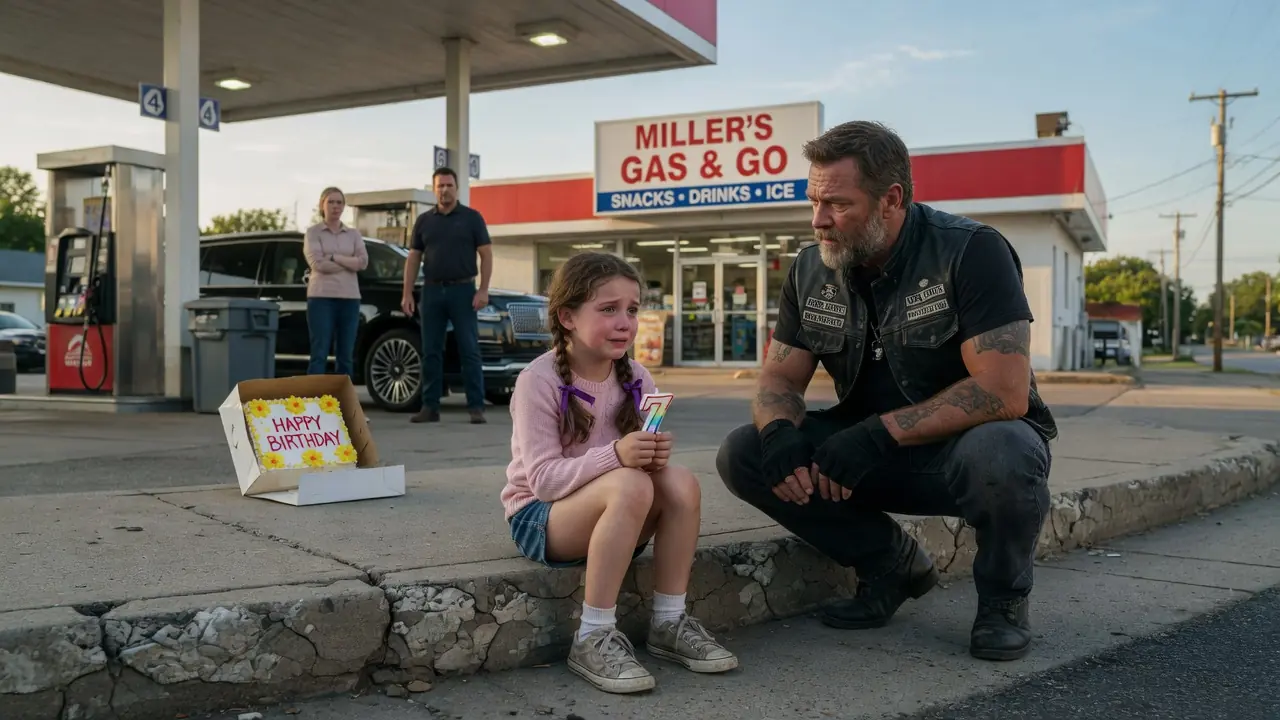
Cars moved in and out of the pumps, doors opened and closed, people paid for gas and coffee and lottery tickets, and life kept passing only a few feet from a child who looked as if the world had already forgotten her.
Her tiny shoulders shook with each breath.
The sound coming out of her was not the loud crying of a child throwing a tantrum. It was quieter than that, swallowed and broken, like she had learned that crying too loudly only made things worse. It was the kind of crying children do when they are not trying to get attention anymore. The kind they do when they already know nobody is coming.
Damon “Grave” Mercer cut the engine of his Harley and let the silence settle around him.
The last deep rumble of the bike faded into the evening heat. A pickup truck pulled away from pump two. Someone laughed near the convenience store door. A trucker cursed at the air machine because it had eaten his quarters. A teenage cashier leaned against the counter inside, watching the clock and waiting for his shift to end.
Normal life kept moving, careless and loud.
But Damon’s eyes stayed on the child.
He was not the kind of man people expected to approach crying little girls.
At forty-eight, Damon Mercer looked like the last person any parent would choose to comfort a child. He was broad-shouldered and heavy-built, with tattoos running from his wrists to the base of his neck, a gray-streaked beard, and a face that looked like it had been carved by weather, fists, and years of grief he had never learned to explain. His leather vest carried the patch of the Iron Saints Motorcycle Club, a name that made shopkeepers lower their voices and made police officers watch from across parking lots.
Most strangers crossed the street when Damon walked toward them.
The little girl did not cross anything.
She just sat there crying into her hands.
Damon swung one leg off the bike and stood for a moment, unsure why his boots were already carrying him toward her. He knew engines. He knew loyalty. He knew bad men, long roads, and the kind of silence that fell in a clubhouse before trouble started. He knew how to read danger in the angle of a man’s shoulders, how to tell when a smile was fake, and how to spot a lie before the mouth finished forming it.
But he did not know children.
Not really.
Children made him careful in a way grown men never did. They reminded him of breakable things. They reminded him of things he had failed to protect.
Still, he knew pain.
And this child had too much of it for one small body.
He stopped a few feet away and lowered himself into a crouch. His knees cracked. The leather of his vest creaked. He kept his hands visible and his voice lower than usual.
“Hey, kiddo,” he said. “You lost?”
The girl did not look up.
Her hair was tied into two messy braids with purple ribbons, though one ribbon had nearly come undone. Tears had cut clean tracks through the dust on her cheeks. Her dress was pale yellow with tiny white daisies printed on it, but one sleeve had a faint smear of pink frosting near the cuff. In her lap, she clutched a crumpled birthday candle shaped like the number seven.
Damon looked at the candle.
Then at her.
“You hurt?”
She shook her head quickly, then seemed to think about it and hugged her knees tighter.
“Your mom around?”
Another shake.
For a few seconds, Damon thought that was all he would get. Then she whispered, “He threw it away.”
Damon frowned.
“Threw what away?”
The little girl finally looked at him.
Her eyes were brown and huge and full of something Damon had seen too often in adults. It was not only sadness. It was the shock of being hurt by someone who was supposed to love you, the confusion of a heart trying to understand why a safe person had become dangerous.
“My cake,” she said.
The words broke on the last syllable.
Damon went still.
“It was strawberry,” she added, as if the flavor mattered in court, as if the details might help him understand the size of the crime. “With yellow flowers. Mommy made it before we left. She said we could eat it at Grandma’s house. But he got mad and threw it in the trash behind the gas station.”
Damon looked past her toward the dumpsters near the side of the building.
A smashed bakery box lay half-open on the ground beside them. Pink frosting smeared the cardboard. A corner of cake had fallen into the gravel. Yellow icing flowers were crushed into the dirt, delicate and ruined, bright against the dust like something too innocent to belong there.
Damon felt something cold move through him.
Not rage yet.
Recognition.
A cake was never just a cake when someone chose to destroy it in front of a child.
A birthday cake was a message. A small, careful thing made with love. A promise that, for one day at least, the child mattered. To throw it away was not about frosting or sugar. It was about power. It was about showing a child and her mother that even joy belonged to him, and he could ruin it whenever he wanted.
“Who threw it away?” Damon asked.
The girl’s mouth trembled.
“My dad.”
Before Damon could answer, a woman’s voice called from the pumps.
“Lily.”
Not loud.
Not sharp.
Terrified.
Damon turned.
A woman stood beside a black luxury SUV at pump four. She was beautiful in a thin, exhausted way, with dark hair pulled into a low bun and sunglasses pushed up on her head. Her blouse was expensive, but one sleeve was wrinkled where someone had gripped it too hard. Her face was pale beneath careful makeup, and the makeup did not quite hide the yellowing bruise beneath her cheekbone.
Her eyes were locked on Damon.
Not with suspicion.
With fear.
Not fear of him exactly.
Fear that he had seen too much.
The back door of the SUV opened.
A man stepped out.
Tall. White. Perfectly dressed. Navy suit, polished shoes, silver watch, hair combed back with the kind of precision that looked expensive. He had the smooth face of someone used to being photographed at charity dinners, business luncheons, and hospital fundraisers. The sort of man who looked generous in public and cruel in private.
Damon knew the type before the man spoke.
The little girl flinched.
Damon saw it.
The woman saw him see it.
The man did too.
His gaze moved over Damon’s leather vest, tattoos, boots, and beard. His mouth curled slightly.
“You bothering my daughter?” he asked.
Damon rose slowly.
The man was tall.
Damon was taller.
“No,” Damon said.
The man stepped closer, still smiling.
“Then move along.”
The woman whispered, “Victor, please.”
The man turned his head toward her.
Just a fraction.
That was all it took.
She went silent.
Victor.
Damon stored the name.
The man reached down and gripped Lily’s arm.
Too hard.
The girl sucked in a tiny breath but did not cry out. She had learned not to. That hurt Damon more than the sound would have.
Damon’s hands flexed at his sides.
“Careful,” he said.
Victor looked back at him.
“Excuse me?”
Damon’s voice stayed low.
“You’re holding her too tight.”
Victor laughed once.
“Is that right?”
The woman hurried forward.
“She’s okay,” she said quickly. “She’s fine. Lily, come on, sweetheart.”
Her voice shook.
She took Lily’s hand, gently prying the child from Victor’s grip without making it look like defiance. It was a tiny movement, careful and practiced. A mother saving her child from pain while trying not to trigger the man who caused it.
Victor’s eyes narrowed.
Damon watched the whole exchange. The mother’s fear. The child’s silence. The man’s control. It was not the first time he had seen this kind of family.
Years ago, he had seen it in a kitchen with broken cabinets and yellow light over a cracked sink. His sister Maren had stood there with one hand covering her ribs, smiling too brightly, saying she had slipped again. She had said that five times before Damon finally understood she was not clumsy.
By the time he understood, it was too late.
Victor opened the SUV door.
Lily climbed in.
The woman followed, but Victor caught her wrist before she could get inside. His fingers pressed into her skin. Damon saw her face tighten. Victor leaned close to her ear and spoke words Damon could not hear.
He did not need to.
The woman’s eyes flicked toward him once.
Help me.
She did not say it.
She did not move her lips.
But Damon heard it all the same.
Victor looked at Damon one last time.
“People like you should learn not to stare at other people’s families.”
Damon gave him a flat look.
“People like you should learn not to hurt them in public.”
The smile disappeared from Victor’s face.
For one second, the rich man beneath the polish showed through.
Cold.
Ugly.
Real.
Then he got in the SUV.
The vehicle pulled away from the pump and left the gas station, smooth and silent, carrying the little girl, the frightened mother, and the kind of monster who looked respectable from a distance.
Damon stood there until the SUV disappeared onto the highway.
Then he walked to the trash behind the gas station.
The cake box was torn open. Most of the cake was ruined. The pink frosting had smeared into the dirt. Ants had already found the sugar. But one yellow icing flower still held its shape near the corner, small and stubborn, refusing to collapse with the rest of it.
Damon stared at it for a long time.
Then he pulled out his phone and called his vice president.
Rafe answered on the second ring.
“What’s wrong?”
Damon looked at the crushed birthday cake.
“I need you to run a name.”
Rafe’s voice changed immediately.
“Who?”
“Victor. Drives a black luxury SUV. Wife or girlfriend, maybe named Clara. Daughter named Lily. Seven years old today.”
“That’s not a lot.”
“He threw away her birthday cake at Miller’s Gas.”
Silence.
Then Rafe said, “I’ll find him.”
Damon ended the call and looked down at the frosting in the dirt.
His sister Maren had loved strawberry cake.
That was the part that stayed with him on the ride back to the clubhouse.
Not Victor’s suit.
Not the black SUV.
Not even the fear in Clara’s eyes.
The cake.
Strawberry cake with yellow flowers.
A small, careful thing made by a mother for a child.
Destroyed because a man wanted to prove he could.
The Iron Saints clubhouse sat at the edge of the old rail yard, in a brick warehouse that had once stored machine parts. The outside looked rough enough to scare away curiosity. Faded sign, blacked-out windows, bikes lined along the side like steel animals waiting to run. A person driving past would think twice before slowing down.
Inside, it was different.
Not soft.
Never soft.
But alive.
It smelled of leather, coffee, motor oil, and smoke from the years before anyone bothered to stop lighting cigarettes indoors. Old posters hung near the bar. A pool table sat under a crooked lamp. A framed photo of fallen brothers rested near the back wall, with fresh flowers placed beneath it every Sunday whether anyone admitted to doing it or not.
The room was loud when Damon entered.
Then it was not.
Men looked up from the bar, from card games, from half-finished plates of food. They saw his face and stopped talking.
Rafe “Preacher” Knox stood from a table near the back. He was the club’s vice president, thick-built and calm, with a shaved head, a dark beard, and the patient eyes of someone who had once wanted to become a pastor before the world gave him other uses. He had a way of listening that made people confess things they had planned to keep hidden.
“What happened?” Rafe asked.
Damon walked past him toward the chapel room.
“Church.”
Rafe did not ask again.
Within ten minutes, the club’s core members sat around the long table.
Rafe.
Holt, the mechanic, whose temper was bad but whose hands were honest.
Sparrow, thin, restless, and dangerous with a computer.
Doc, a former Army medic whose hands were gentler than his face.
Bear, who looked exactly like his name and spoke half as often.
Reno, who handled local contacts.
Mack, who knew every cop, tow driver, bail bondsman, and night clerk within three counties.
And the others who had earned their place in that room through miles, loyalty, and silence.
Damon stood at the head of the table.
He told them about the gas station.
The child.
The cake.
The mother.
The bruise.
Victor’s grip.
When he finished, nobody laughed. Nobody dismissed it. Nobody asked why he cared.
But Holt, always practical, leaned back and rubbed one hand over his jaw.
“Could be ugly,” Holt said. “But we need more than one scene at a gas station.”
Damon looked at him.
“I know what I saw.”
“I’m not saying you don’t.”
Damon leaned forward, both palms flat on the table.
“The little girl flinched before he touched her. The mother watched my hands like she expected violence from every man in the world. He threw away a birthday cake because he knew it would hurt both of them.”
The room went quieter.
Damon’s voice lowered.
“Maren had that same look.”
No one moved.
Every Iron Saint knew about Maren.
Damon’s younger sister, who used to sing loudly while washing dishes and leave notes inside Damon’s lunchbox when they were kids. Maren, who married a man with clean suits, clean hands, and a clean public reputation. Maren, who told everyone she was fine until she stopped being able to tell anyone anything.
Damon had spent twenty years carrying the knowledge that he had seen too late.
Rafe finally spoke.
“Name is Victor Albright.”
All eyes shifted to him.
“Sparrow sent me the file before church started,” Rafe said. “Victor Albright. Real estate developer. Owns Albright Holdings. Big money. Big donors. Sits on hospital boards, school boards, police foundation board. Wife is Clara Albright. Daughter Lily. House on North Ridge Road. Gated. Private security.”
“Of course he does,” Damon said.
Sparrow tapped his laptop.
“There are rumors. Lawsuits settled out of court. Former assistant paid off. One housekeeper quit after calling 911, then withdrew the statement. Two police wellness checks at the residence in the last year. Both closed as unfounded.”
Doc swore softly.
“Kids?” Damon asked.
“Only Lily,” Rafe said.
Damon looked around the table.
“We are not storming a house. We are not grabbing anybody. We are not starting a war on a hunch.”
Bear raised an eyebrow.
That was unusually cautious for Damon.
Damon saw the look.
“We do this wrong, Victor uses it against her. He tells a judge she ran off with bikers. He says we threatened him. He says she’s unstable. Men like him prepare traps before anyone knows there’s a cage.”
Rafe nodded.
“Smart.”
Damon looked at Sparrow.
“Find everything.”
Then at Bear.
“Take the ridge tonight. Watch the house. Do not get seen.”
Bear nodded once.
Doc leaned forward.
“If she needs medical help, I want to be ready.”
“She will,” Damon said.
He was not guessing.
He knew.
That night, Bear parked an old work van half a mile from the Albright estate.
North Ridge Road climbed above town into wealth. The houses sat behind walls and trees, each pretending privacy was the same as virtue. The roads were smooth. The lawns were perfect. The mailboxes looked custom-made. Nothing rattled, nothing rusted, nothing seemed tired enough to tell the truth.
Victor Albright’s house was a long, cold structure of glass and stone, set behind a black iron gate. Security cameras watched the driveway. White lights glowed under the roofline. The place looked less like a home than a showroom where no one was allowed to touch anything.
Bear watched from the shadows.
For three hours, nothing happened.
Then, near midnight, he saw movement through the large windows on the second floor.
Victor.
Pacing.
Phone in hand.
Angry.
Clara stood near the doorway with her arms folded close to her body. Even at a distance, Bear could read fear in her posture.
Victor turned on her.
His gestures were sharp.
Clara stepped back.
He followed.
Bear lifted the binoculars.
Victor grabbed her by both shoulders and shook her hard enough that her head snapped slightly. Then he shoved her out of sight.
Bear’s jaw clenched.
He wanted to move.
He did not.
Instead, he wrote the time.
11:52 p.m.
Then he took a photo of the window.
Not enough for court by itself.
Enough for a pattern.
Enough to start.
Back at the clubhouse, Sparrow worked through the night.
Victor’s life was a locked house with too many windows.
Business filings.
Lawsuits.
Shell companies.
Security contracts.
Property transfers.
Charity donations.
Police foundation events.
The more Sparrow dug, the more the pattern appeared.
Victor did not just control Clara.
He controlled narratives.
He donated to the right people. Hired the right lawyers. Settled with the right nondisclosure agreements. Smiled in the right photographs. Men like him did not hide by disappearing. They hid by standing under bright lights and making everyone call it respectability.
By morning, Damon had enough to know two things.
Clara was in danger.
And if they moved wrong, Victor would use the system against her.
That afternoon, something arrived through the Iron Saints’ public website.
Most messages were nonsense: threats, spam, drunken invitations, and strangers asking if they could buy patches they had not earned. Sparrow almost deleted the new one.
Then he froze.
The message had no name.
Just one sentence.
The cake was strawberry. She wanted yellow flowers.
Sparrow printed it and walked it into chapel.
Damon read it once.
Then again.
A slow breath moved through him.
“It’s her.”
Rafe looked at the page.
“She’s reaching out.”
Damon nodded.
“She remembered the cake. She knows I’ll remember too.”
Doc leaned forward.
“Can we respond?”
Sparrow shook his head.
“No return address. It came through a masked browser. Smart. Scared, but smart.”
Damon folded the paper carefully.
“She needs to know we got it.”
“How?” Holt asked.
Damon looked at Rafe.
“The gas station.”
That evening, Damon rode back to Miller’s Gas & Go.
He bought a strawberry cupcake from the convenience store bakery case. It was cheap, wrapped in plastic, with a swirl of yellow frosting that looked more orange than yellow. He placed it carefully on top of the trash bin where the cake had been thrown away.
Then he set a folded napkin beneath it.
On the napkin, he wrote one word.
Seen.
He rode away.
The next day, Bear reported that Clara had driven to the gas station alone.
She was there for less than two minutes.
When she left, the cupcake was gone.
So was the napkin.
For the first time since Damon saw Lily crying on the curb, he let himself believe Clara might be ready.
But ready did not mean safe.
Over the next week, the Iron Saints watched without touching.
They learned the guard shifts. The house staff schedule. The school route. The grocery routine. The days Victor worked from home. The nights he left for meetings. They learned which roads had cameras and which cameras were real. They learned which security men watched the gate and which ones watched Victor’s temper.
They learned Clara had no phone that was not monitored, no car that did not have a tracker, no credit card in her name that Victor could not freeze.
They learned Lily’s grandmother, Elise Moreno, lived three towns away but had been blocked from contact for nearly a year.
They learned Victor had already filed papers implying Clara was mentally unstable.
Preemptive.
Strategic.
A trap waiting for the day she tried to leave.
Doc brought in someone from his old Army network: Evelyn Shaw, a domestic violence advocate who had worked with survivors for twenty-five years and had no patience for biker theatrics.
She came to the clubhouse in jeans, boots, and a brown coat, took one look around, and said, “If any of you make this about your revenge instead of her safety, I will ruin your lives myself.”
Rafe smiled faintly.
Damon said, “Good.”
Evelyn studied him.
“You the one who saw the girl?”
“Yes.”
“You want to hit him?”
“Yes.”
“Can you not?”
Damon’s jaw flexed.
“Yes.”
“Then we can work.”
With Evelyn’s help, they built a real plan.
Not a raid.
Not a movie.
A rescue that could survive court.
Clara needed documentation, safe transport, legal representation, medical care, a protective order, and a custody strategy before Victor knew she was gone. Most of all, she needed to choose.
No one could drag her into freedom.
That was just another kind of control.
“The mistake people make,” Evelyn told the club, standing at the head of the chapel table like she had been born there, “is thinking escape is one moment. It’s not. It’s a chain of moments. If one link breaks, the abuser uses it. He uses panic. He uses missing paperwork. He uses the child. He uses money. He uses fear. He uses anyone too proud to slow down and do things properly.”
Damon listened without interrupting.
He hated every word.
He knew she was right.
The message came four days later.
Same website.
Same hidden route.
Tomorrow. School charity dinner. He will take me. Lily stays home with nurse. I can get to east garden at 8:20. I need my daughter.
Damon stared at the message.
His hands curled once.
Then relaxed.
Evelyn read it and nodded.
“She’s giving us a window.”
Rafe said, “We get Lily first?”
Evelyn looked at him sharply.
“You do nothing to that child without the mother’s consent and legal backup.”
“She just gave consent.”
“In writing from an anonymous message that Victor’s lawyer will say anyone sent.”
Rafe went silent.
Evelyn softened slightly.
“I’m not slowing you down to be difficult. I’m keeping them safe after the dramatic part ends.”
Damon nodded.
“She’s right.”
The final plan was simple on the surface and complicated underneath.
Evelyn would be at the charity dinner as a guest under her real name. She had contacts everywhere and could get herself into rooms rich men thought were theirs. A family lawyer would be waiting at a safe location. Lily’s grandmother would be contacted and ready. Doc would be nearby. Sparrow would preserve every message and security detail legally enough to hand to a judge.
The Iron Saints would not storm Victor’s house.
They would create noise.
A lot of it.
Not violence.
Presence.
At 8:00 p.m. the next night, as Victor Albright stood in a ballroom accepting praise for donating to a children’s hospital, the street outside filled with motorcycles.
Not one or two.
Dozens.
Then more.
Iron Saints from three charters rolled slowly down the avenue in a legal procession, engines rumbling low and deep. They carried no weapons in sight. They blocked no emergency lane. They broke no law. They simply rode in formation around the block, again and again, thunder moving between the glass buildings and the valet stand.
They carried black flags for Maren, Damon’s sister, and for every woman whose fear had been polished over by powerful men.
Guests drifted toward the windows.
Cameras came out.
Security hurried outside.
Victor’s face tightened the moment he saw the patches.
Clara stood beside him in a dark blue dress, her hands clasped so tightly her knuckles were pale. Her smile remained in place because smiles had been part of her survival for too long.
Evelyn stepped beside her as if admiring the view.
“Clara Albright,” she said softly. “My name is Evelyn Shaw. Damon Mercer received your message.”
Clara’s breath caught.
Evelyn did not look at her.
“Do you want to leave tonight?”
Clara stared out the window at the bikes.
At the thunder.
At proof that someone had heard her.
“Yes,” she whispered.
“Do you want Lily with you?”
A tear slid down Clara’s cheek.
“Yes.”
“Then follow my instructions exactly.”
Victor turned, eyes narrowing.
“Clara.”
Evelyn smiled brightly and stepped between them.
“Mr. Albright, Evelyn Shaw. I believe we met at the policy luncheon last spring.”
He blinked, forced into manners by public space.
“Of course.”
That hesitation gave Clara enough time to move.
She walked toward the ladies’ room.
Not fast.
Not dramatically.
Just a woman stepping away at dinner.
Inside, another advocate waited with a coat and flat shoes to replace Clara’s heels. A small bag sat on the counter. Clara looked at it, then at the woman.
The advocate said, “You do not have to go. But if you go, we go now.”
Clara looked at herself in the mirror.
For seven years, she had watched herself become smaller in expensive rooms. She had explained bruises as clumsiness. She had told her mother she was busy when Victor blocked calls. She had watched Lily learn to be silent at dinner, silent in cars, silent when men raised their voices.
Then she remembered Lily on the curb.
The candle shaped like seven.
The cake in the dirt.
“No,” Clara whispered.
The advocate frowned.
“No?”
Clara turned from the mirror.
“No more.”
By 8:20, Clara exited through the east garden door.
Damon was there.
Not in the shadows like a kidnapper.
Standing near the gate with Evelyn’s colleague, a lawyer, and a uniformed off-duty officer hired as a witness. Damon’s Harley idled at the curb, but he stood away from it, hands visible, eyes steady.
Clara stopped when she saw him.
The biker from the gas station.
The man who had seen her when she thought no one ever would.
“Lily,” she said.
Damon nodded.
“Already moving.”
“What does that mean?”
“It means your mother is with her.”
Clara’s knees almost gave.
Her mother, Elise, had arrived at the Albright house with a court liaison and a child welfare advocate after Evelyn’s emergency filing triggered a welfare response based on documented prior calls and new evidence. It was not clean. It was not easy. Victor’s private nurse protested. Security tried to delay.
But there were witnesses now.
Paper now.
Names now.
Not bikers breaking doors.
A system forced to do what it should have done before.
Lily left the house wrapped in her grandmother’s coat, clutching a stuffed rabbit and asking where her birthday cake was.
By the time Victor realized Clara was gone from the ballroom, she was already in a car with Damon riding behind it on his Harley and three other bikes following at a legal distance.
Victor called her phone.
It was still in her purse, abandoned beneath a sink in the hotel restroom.
Then he called security.
Then police.
Then his lawyer.
Then he made the mistake all controlling men make when control slips.
He stopped pretending.
In the hotel lobby, in front of donors, cameras, hospital executives, and half the city’s polite society, Victor Albright shouted that his wife belonged to him, that she was unstable, that nobody had the right to take his child, and that he would bury anyone who helped her.
Someone recorded it.
Someone always does, once the mask starts cracking in public.
Sparrow had the clip saved before midnight.
The safe house was not the clubhouse.
Evelyn refused.
“This is not a biker fantasy,” she said. “She needs quiet.”
So Clara and Lily went to a small protected home owned by a women’s shelter outside the city. Damon hated the distance. He accepted it.
When Clara arrived, Lily ran into her arms so hard they both nearly fell.
“Mommy!”
Clara dropped to her knees and held her daughter like she was trying to gather every stolen breath back into her body.
Damon stood near the door and looked away.
Some things were too sacred for staring.
Lily looked over her mother’s shoulder.
“You came back,” she whispered.
Clara sobbed.
“I will always come back.”
For the next three days, Clara barely slept.
She answered questions. Signed forms. Gave statements. Took Lily to a child therapist. Let Doc photograph the old bruising on her wrist and cheek under Evelyn’s supervision, each image taken only after Clara gave permission.
The questions exhausted her more than she expected.
When did he first hurt you?
Did he ever threaten Lily?
Who controlled the money?
Who had access to your phone?
Did he isolate you from your mother?
Did he ever use medical professionals to undermine you?
Did he ever call you unstable in front of others?
Every answer felt like lifting a stone from a wall she had been trapped behind.
The legal war began immediately.
Victor filed an emergency petition claiming Clara had kidnapped Lily and fallen under the influence of a criminal motorcycle gang. His lawyer attached photos of Damon, Rafe, and other Iron Saints, choosing the harshest images available online, photos of poker runs, funerals, and roadside stops, trying to make them look like an invading army.
Evelyn’s lawyer answered with evidence.
Photos.
Medical records.
Witness statements.
Prior wellness calls.
Housekeeper testimony.
The gas station message.
The video from the charity dinner.
The hotel lobby recording.
A statement from Lily’s grandmother.
Documentation from the child welfare advocate.
The judge did not grant Victor custody.
He granted Clara emergency protection.
Temporary custody.
A no-contact order.
A full hearing.
When the judge asked Clara why she had waited so long to leave, she did not look ashamed.
She had practiced with Evelyn, but the words still trembled.
“Because I was afraid he would use the law against me,” Clara said. “Because he told me nobody would believe me. Because when a man owns the house, the cars, the phones, the bank accounts, and most of the people in the room, escape does not look like walking through a door. It looks like jumping from a moving car and hoping the road is softer than the place behind you.”
The courtroom went silent.
Even the judge lowered his eyes for a moment.
Victor’s rage turned sloppy after that.
He threatened the shelter through intermediaries. He sent men to follow Damon. He tried to bribe a former housekeeper. He tried to pressure Lily’s school. He tried to convince Clara’s mother that custody battles could destroy families.
Each move became another document.
Another witness.
Another brick in the wall closing around him.
Sparrow uncovered financial crimes tied to Victor’s real estate deals. Not by hacking into forbidden systems, but by following public records, shell companies, campaign donations, and property transfers that had always been there for anyone stubborn enough to connect them.
Victor had bullied contractors.
Underpaid crews.
Shifted funds between charities and development accounts.
Used nonprofit events to launder reputation and influence.
The bikers did not need to break the law.
Victor had already broken enough of it himself.
Two months after Lily cried on the gas station curb, Victor Albright was arrested on charges that had nothing and everything to do with Clara.
Fraud.
Coercion.
Witness intimidation.
Campaign finance violations.
Later, domestic violence charges followed.
The news showed him being led from a courthouse in handcuffs, still wearing a suit, still trying to look offended rather than afraid.
Damon watched the footage from the clubhouse bar.
He felt no joy.
Only a hard, tired satisfaction.
Monsters rarely looked like monsters when the world first met them.
That was why they lasted.
Clara and Lily did eventually come to the clubhouse.
Not to hide.
To visit.
Lily insisted.
She remembered Damon and the cupcake.
The Iron Saints prepared like royalty was coming. Holt fixed the wobbly picnic table. Doc bought juice boxes and three kinds of napkins because he did not know which one children preferred. Rafe threatened anyone who cursed before the child left. Bear pretended not to be excited and then spent two hours hanging yellow streamers.
Damon arrived late from a meeting and stopped in the doorway.
The main room had been transformed.
Balloons.
Paper plates.
A crooked banner that read Happy Birthday Lily.
A giant strawberry cake with yellow frosting flowers sat on the center table.
Lily stood in front of it with both hands over her mouth.
“Is it mine?” she whispered.
Bear cleared his throat.
“Unless you know another Lily who got robbed of cake by a jackass.”
Rafe smacked the back of his head.
“Language.”
Lily giggled.
Clara stood behind her, one hand pressed to her lips.
Damon walked over slowly and crouched in front of Lily.
“Happy birthday, kiddo. Little late.”
Lily looked at him.
Then threw her arms around his neck.
Damon froze.
Every biker in the room pretended not to see his eyes go wet.
Then he hugged her back carefully, like she was made of glass and sunlight.
They sang Happy Birthday.
Badly.
So badly Lily laughed through the whole thing.
Clara cried quietly beside Evelyn, who handed her a napkin without making a speech.
After cake, Lily sat on Bear’s motorcycle while it was safely parked and off. Rafe let her wear his helmet. Doc checked the chin strap three times even though nobody was going anywhere. Holt showed her how a wrench worked and then panicked when she picked up the heaviest one. Sparrow pretended not to know how to draw flowers, then spent twenty minutes helping Lily sketch yellow icing roses on a paper plate.
Damon stood outside with Clara as the sun lowered behind the rail yard.
“You saved us,” she said.
He shook his head.
“No.”
She looked at him.
“You did.”
“No,” he repeated. “You sent the message. You walked out the garden door. You told the truth when it got hard. We helped. That’s different.”
Clara looked toward Lily, laughing as Bear pretended the bike would not start because it was too full of birthday cake.
“I was so afraid.”
“I know.”
“I still am sometimes.”
“That makes sense.”
“Does it go away?”
Damon thought of Maren.
Of the years he could not say her name without feeling like his ribs were breaking.
Of the way grief changed shape but did not vanish.
“No,” he said honestly. “But it stops driving if you keep your hands on the wheel.”
Clara smiled faintly.
“That sounds like something a biker would say.”
“It’s all we know.”
They stood in silence.
Then Clara said, “Why did you help us?”
Damon looked at the row of motorcycles.
Then at the clubhouse.
Then at Lily.
“My sister,” he said.
Clara did not ask more.
She did not need to.
A year later, Lily turned eight in her grandmother’s backyard.
There was a strawberry cake with yellow flowers.
Clara made it herself.
This time, nobody threw it away.
Damon came with Rafe, Bear, Doc, Sparrow, and half the Iron Saints, all of them standing awkwardly among folding chairs, juice boxes, and neighborhood children who thought the motorcycles were the best part of the party.
Lily introduced Damon to everyone as “my big scary friend who saved my cake.”
Damon let her.
Clara looked healthier now.
Not healed.
Healing.
There was a difference.
Her laughter came easier. Her shoulders no longer stayed lifted near her ears. She had started taking accounting classes. She had her own phone, her own bank account, her own car, and her own name on her own lease.
Small things that were not small at all.
Victor awaited trial from jail after violating the protective order twice and attempting to intimidate a witness.
His empire was being sold piece by piece.
His name disappeared from charity walls faster than it had once appeared.
Respectability, Damon learned again, was often paint.
Rain came for it eventually.
Near the end of the party, Lily brought Damon a slice of cake.
The frosting was too sweet.
He ate every bite.
“You like it?” she asked.
“Best cake I ever had.”
“You said that last time.”
“I meant it both times.”
She considered this seriously.
Then nodded.
“I believe you.”
Clara watched from the porch.
Evelyn stood beside her.
“He’s good with her,” Clara said.
Evelyn smiled.
“He’s terrible with children.”
Clara laughed.
Evelyn continued, “But he is good with pain. Sometimes that is enough until joy teaches him the rest.”
Across the yard, Damon let Lily put a paper birthday crown on his head.
The Iron Saints howled with laughter.
Damon glared at them, which only made it worse.
For a moment, the world felt almost gentle.
Years later, people still told the story wrong.
They said a biker gang rescued a woman from a mansion.
They said Damon Mercer brought thunder to a rich man’s door.
They said the Iron Saints took down Victor Albright.
Some of that was true.
But it was not the whole truth.
The whole truth began with a little girl on a gas station curb, crying over a strawberry cake with yellow flowers.
It began with a mother brave enough to send a message.
It began with a biker who saw a bruise and did not look away.
It continued because people who knew how to be loud learned when to be careful. Because an advocate insisted safety mattered more than revenge. Because documents were gathered. Because witnesses spoke. Because a grandmother answered the phone. Because a child believed, somehow, that the rough man on the motorcycle had come back for her.
Damon kept the folded napkin in his wallet for years.
Seen.
One word.
A promise.
Sometimes he unfolded it when the road was long and the ghosts rode too close.
He would think of Maren.
Then Clara.
Then Lily laughing with frosting on her face.
He had not saved his sister.
That truth would never change.
But he had learned something since then.
A person could not go back and rescue the dead.
But he could honor them by refusing to abandon the living.
On quiet nights, Damon still stopped at Miller’s Gas & Go.
He never bought cigarettes.
He had quit after Lily’s eighth birthday because she told him smoke smelled like angry clouds.
He would park his Harley near the curb and look toward the trash bins.
The stain was long gone.
The cake box gone.
The day gone.
But the memory remained.
Not as guilt anymore.
As instruction.
Look closer.
Listen harder.
Do not mistake small cruelty for small danger.
A thrown-away birthday cake could be a doorway into a house full of fear.
A child’s tears could be the first honest alarm.
A woman’s silence could carry a whole emergency.
And sometimes, the difference between a prison and a road was one stranger deciding the story did not end at the gas station.
Damon would start the bike.
The engine would rumble beneath him.
The road would open.
And somewhere, in a small safe house turned real home, a girl named Lily would be sleeping beneath a string of yellow paper flowers, knowing that monsters could fall, mothers could come back, and even the scariest-looking men in the world could arrive carrying cake.
Some heroes did not wear capes.
Some wore leather.
Some rode into the dark not to create fear, but to bring someone out of it.
And when they came, the sound was thunder.
Not the kind that destroys.
The kind that tells the frightened:
You are not alone anymore.