The burger had barely touched the table when the biker raised one weathered hand and stopped the waitress from turning away. “You’re in danger. Pretend I’m your father.” Twenty-six-year-old Emily Parker froze beside the Formica table, both hands still gripping the edge of the white dinner plate, her fitted pink diner uniform suddenly feeling too bright beneath the fluorescent lights. Across from her, fifty-eight-year-old Jack Callahan did not look at the food she had brought him; his gray eyes remained fixed on the reflection of three men in dark suits sitting at the counter behind her.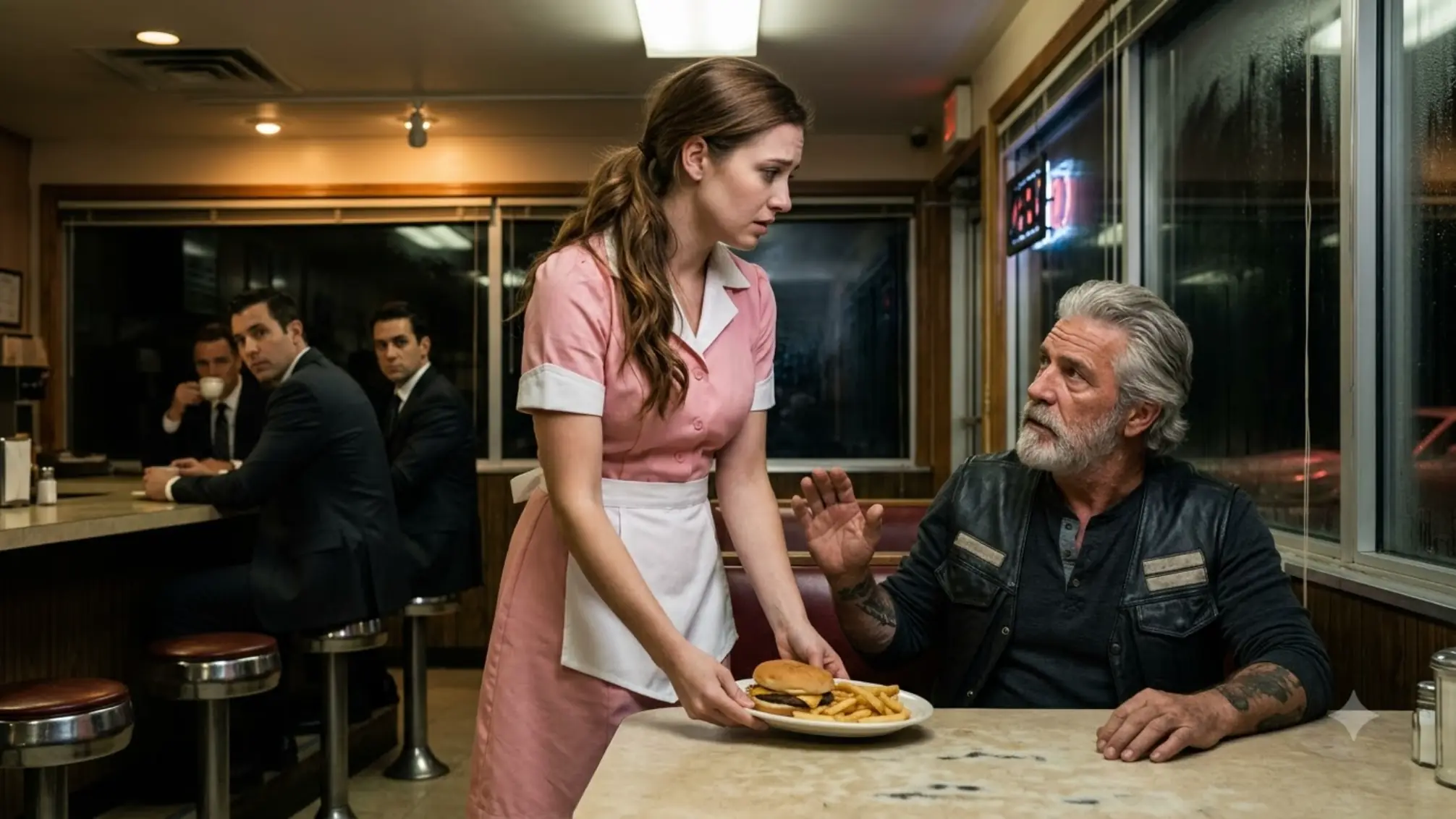
Emily’s chest tightened. “Why? Who are those men?” she whispered, keeping her face angled toward Jack so anyone watching might believe they were having an ordinary family conversation. Jack slowly pushed himself upright, his black leather vest opening over a charcoal henley while tattoos disappeared beneath his sleeves. “They’ve followed you through three shifts,” he said. Emily’s hands began trembling when one of the men behind her shifted on his stool and reached inside his jacket.
“Dad,” Emily said louder, forcing the word through a dry throat, “please take me home.” Jack stood immediately and positioned his broad body between her and the counter. The diner had been noisy only seconds earlier, filled with silverware, an old jukebox humming beside the restrooms, and the cook shouting orders through the kitchen window, yet the room suddenly felt unnaturally quiet. One of the suited men slowly turned his head toward them.
Emily had been working at Miller’s Highway Diner outside Scranton, Pennsylvania, for seven months. The money was poor, the night shifts were exhausting, and the uniform made her feel like she belonged in an advertisement from fifty years earlier, but she needed the job because her mother’s medical bills had eaten through nearly every dollar she had saved. She rented a one-bedroom apartment above a laundromat fifteen minutes away and usually drove home alone shortly after midnight. Until that week, she had never considered herself worth following.
The first strange thing happened Monday night. Emily finished her shift at 11:47, crossed the parking lot, and noticed a black sedan idling near the gas station across the highway. Its lights switched on as she pulled away, then followed her through two turns before disappearing when she entered a residential neighborhood. She convinced herself it was coincidence because frightened imagination was easier to accept than the possibility somebody had chosen her intentionally.
Tuesday brought another warning. A clean-cut man in a charcoal suit entered shortly before closing and ordered only coffee, then sat facing the waitresses’ station for nearly an hour without touching the cup after his first sip. When Emily left, she saw the same black sedan two cars behind her until she deliberately circled a grocery-store parking lot. The sedan continued straight, and she laughed nervously at herself for being paranoid.
By Wednesday, Jack Callahan noticed. He had been eating at Miller’s twice a week for nearly twelve years, always requesting black coffee, a burger without onions, and whichever pie looked least likely to have spent three days beneath plastic. Most customers knew him as an old biker who fixed motorcycles in a garage behind his farmhouse, but Jack noticed people with the instincts of a man who had spent decades understanding when a room felt wrong. Three strangers arriving separately, choosing positions with clear views of Emily, and leaving only after she did felt wrong.
Jack said nothing the first night because he wanted to be certain. On Thursday he parked his motorcycle behind the diner rather than in his usual place, then waited inside until Emily finished closing duties. Two of the suited men walked out before her and entered a dark sedan near the far edge of the lot. Jack followed from a distance when they pulled away behind Emily’s faded Honda.
The sedan followed her almost six miles. Jack remained several cars back, riding without drawing attention until Emily turned into her apartment lot. The sedan stopped across the street for four minutes before continuing. Jack memorized the plate.
Friday afternoon, he called an old friend named Raymond Holt, a retired state investigator who still had enough professional contacts to check whether something obvious connected the vehicle to known criminal activity. Raymond refused to access anything improperly but ran publicly available ownership information and discovered the sedan belonged to Keystone Corporate Recovery Services. The company presented itself online as an investigative and asset-location business, yet several lawsuits accused it of aggressive intimidation on behalf of private clients.
Jack returned to the diner Friday night and sat where he could see both entrances. At 9:16, one suited man arrived. At 9:31, the second entered.
At 10:02, the third man sat at the counter. That was when Jack stopped believing Emily was imagining anything. He watched the three men communicate almost entirely through glances while carefully avoiding sitting together. When Emily moved toward the kitchen, one checked his phone, another looked toward the employee exit, and the third repositioned himself so he could see the parking lot.
Jack waited until Emily brought his dinner. Then he gave her the warning. Her frightened response told him something equally important: she already suspected someone had been following her.
The oldest suited man rose first. He was perhaps forty-five, with close-cropped brown hair, a narrow face, and the calculated confidence of someone accustomed to creating fear without technically threatening anyone. He left money beside his coffee and walked toward the door. The other two remained seated.
Jack leaned toward Emily. “Do you have a back exit?” She nodded. “Kitchen.” Jack looked toward the cook.
“Any cameras behind the building?” Emily whispered that one covered the employee lot. Jack nodded once.
“Good. Call somebody you trust and tell them exactly where you are.” Emily swallowed. “There isn’t anybody nearby.” Jack’s jaw tightened.
“Then call the police.”
She looked toward the suited men. “What do I say? They haven’t done anything.” Jack understood the problem immediately.
Being followed felt terrifying but could be difficult to explain without evidence. The men had not threatened Emily openly, touched her, or even spoken to her that night. If she called police and the strangers calmly claimed they were simply customers, the encounter might end with everyone leaving separately. Jack needed to understand why they were there before deciding what came next.
“Who would want to scare you?” he asked. Emily shook her head. “Nobody.” Jack waited.
She hesitated. “Maybe my old boss.”
That changed the conversation. Before joining Miller’s, Emily had worked eighteen months as an administrative assistant at Carrington Development Group, a regional real-estate company specializing in apartment complexes and commercial redevelopment. She left suddenly after discovering discrepancies in maintenance invoices while preparing financial records for an annual audit.
Emily had not been an accountant. Her job was scanning invoices, preparing spreadsheets, and organizing documents for executives. But she noticed multiple payments to companies whose addresses matched vacant buildings, including repair bills for work tenants later claimed had never happened. When she asked her supervisor about the inconsistencies, he told her to stop reviewing files outside her assigned responsibilities.
Two days later, Emily found copies of tenant complaints stored inside a shared folder scheduled for deletion. Several alleged dangerous mold, faulty heating systems, and electrical problems management repeatedly documented as repaired despite residents saying nothing had been fixed. Emily quietly copied the records onto a personal flash drive because she feared the files would vanish.
Her supervisor discovered what she had done. He called her into his office and demanded the drive.
Emily refused. She resigned that afternoon.
Jack stared at her. “Where is it?” Emily looked toward her apron pocket.
“Not here.”
“Good.”
“I mailed copies to an attorney.”
“Better.”
Emily looked confused. “Why would they still follow me if the lawyer has them?” Jack glanced at the two men at the counter.
“Because maybe they don’t know you sent copies.”
The thought made Emily’s face pale. One of the suited men stood.
Jack immediately raised his voice enough to sound like an annoyed father. “Emily, get your coat. We’re leaving.” She nodded quickly and walked toward the employee area.
The man moved toward the hallway leading to the restrooms. Jack adjusted his position.
The second suited man remained at the counter but turned on his stool.
Jack stared directly at him.
The man smiled.
It was not friendly. Jack recognized the expression immediately as a challenge designed to see whether he would look away.
He did not.
Emily returned wearing a gray coat over her pink uniform and carrying her handbag. Jack took the bag without asking and slung it over one shoulder like a father who had done it a thousand times.
“Stay beside me.”
They walked toward the front entrance. The second man stood.
“Emily Parker?”
She froze.
Jack stepped slightly in front of her. “Who’s asking?”
The man buttoned his suit jacket. “Private matter.”
Jack smiled without humor. “Then keep it private.”
The man’s expression hardened. “Ms. Parker needs to speak with us.”
Emily found enough courage to answer herself. “No, I don’t.”
The third man emerged from the restroom corridor and positioned himself near the exit. Jack noticed immediately.
“You’re blocking the door.”
The man shrugged. “Nobody’s blocking anything.”
Jack moved toward him.
The suited man stepped aside at the last second.
Jack and Emily reached the parking lot. Cold night air struck her face as she searched desperately for the sedan.
It was gone.
Jack stopped.
“That’s worse.”
Emily looked at him. “Why?”
“Because the first guy left ten minutes ago.”
Jack guided her toward his motorcycle, then changed his mind. A motorcycle offered no protection and made following them easy.
“Your car.”
They hurried toward Emily’s Honda.
The rear passenger tire was flat.
Jack crouched beside it. The sidewall carried a clean puncture too deliberate to be road damage.
Emily whispered, “Oh God.”
Jack stood. “Back inside.”
They turned.
The three men had followed them into the parking lot.
The oldest man, the one who left first, appeared from behind a delivery van.
Jack placed Emily behind him.
“Enough.”
The man lifted both hands. “Nobody wants trouble.”
Jack’s voice became low. “Then why’d you cut her tire?”
“No idea what you’re talking about.”
Emily pulled out her phone.
The man immediately said, “You don’t need police.”
“That sentence usually means we do,” Jack replied.
The man looked past him toward Emily. “Ms. Parker, Carrington Development believes you possess company property. Return it, sign a confidentiality acknowledgment, and everybody goes home.”
Emily stared. “You’ve been following me over files?”
“We’re authorized to recover stolen property.”
“I didn’t steal anything.”
“You copied confidential records.”
“They showed fraud.”
The man’s face changed slightly. “Careful.”
Jack heard it.
So did Emily.
She raised her phone higher. “Say that again.”
The man noticed she was recording.
He stepped backward. “Turn that off.”
Jack smiled.
“No.”
Another suited man moved toward Emily.
Jack stepped into his path. No punch was thrown, but the warning in his posture was unmistakable.
“Try walking around me.”
The man stopped.
Sirens sounded faintly in the distance.
Emily looked surprised. Jack reached into his vest and held up his phone.
“I called while you were talking.”
The oldest man cursed.
All three turned toward the parking lot exit.
Jack moved sideways, not blocking them physically but keeping their faces visible for Emily’s recording.
“Let them go,” he said.
Emily whispered, “Why?”
“Because police can find them easier than you can explain a parking-lot fight.”
Two patrol cars arrived less than a minute later. The suited men had barely reached their sedan when officers blocked the exit.
Nobody was dramatically arrested on the spot. Officers separated everyone, collected identification, photographed Emily’s damaged tire, and reviewed preliminary video from the diner.
The men claimed Keystone Corporate Recovery had been hired to locate company property believed stolen by a former employee. They denied cutting the tire and insisted they never threatened Emily.
Then diner security footage complicated their story. One camera showed the oldest man walking toward Emily’s Honda after leaving the diner.
A second exterior camera caught him bending near the rear tire.
The footage did not clearly show a knife or tool.
But it showed enough to justify further questions.
Officer Melissa Grant asked Emily whether she possessed the disputed documents. Emily explained everything about Carrington, the deleted tenant complaints, questionable invoices, and the attorney.
The officer’s tone changed.
“You already have counsel?”
“Yes.”
“Call them.”
Emily’s attorney answered despite the late hour. When Emily described what happened, he immediately told her not to discuss the contents of the files further with anyone except police and authorized investigators.
He also revealed something Emily did not know.
Earlier that afternoon, he had submitted copies of the Carrington records to the state attorney general’s consumer-protection division and a federal housing investigator.
The men following her were already too late.
Jack watched Emily absorb that information. For the first time all evening, her shoulders relaxed.
The oldest investigator did not react as well. When police informed him that contact with Emily would now be documented, he demanded to speak with his company attorney.
The three men eventually left after officers completed their initial investigation and instructed them not to approach Emily that night. The damaged tire and surveillance footage remained part of an open complaint.
Jack stayed.
He helped Emily move her car into the brightly lit section beside the diner while waiting for roadside assistance. At 1:18 a.m., the tire was replaced.
Emily stood beside him holding two coffees. “Why did you notice them?”
Jack shrugged.
“I’m old.”
“That’s not an answer.”
“Old people watch rooms.”
She smiled weakly. “You followed me yesterday?”
“Yes.”
“That’s slightly creepy.”
“Fair.”
Emily laughed for the first time.
Then she became serious. “What if you hadn’t been here?”
Jack looked toward the diner.
“You would’ve figured something out.”
She shook her head. “I didn’t even trust myself enough to call police.”
“That’s what intimidation does.”
Jack took the coffee.
“Makes you spend half your energy wondering whether you’re allowed to be afraid.”
Emily remembered that sentence.
The investigation into Carrington Development moved slowly. There were no dramatic raids the next morning, and executives did not immediately appear in handcuffs.
Instead, auditors began requesting records. Housing inspectors revisited several properties.
Former employees were interviewed. Tenants were contacted.
The files Emily preserved became useful because they contained timestamps showing maintenance complaints existed before invoices claimed repairs had been completed. Several vendor companies listed in Carrington records shared mailing addresses, phone numbers, or ownership connections with people tied to senior management.
Investigators also examined whether documents had been intentionally destroyed after Emily raised questions.
Carrington denied wrongdoing.
The company claimed accounting irregularities resulted from subcontractor reporting errors and said Emily had misunderstood normal administrative practices.
That explanation weakened when multiple tenants produced photographs showing dangerous conditions months after alleged repairs had been billed.
Then another former employee came forward.
His name was Marcus Bell, a maintenance coordinator who left Carrington eight months before Emily. He had saved emails instructing staff to close tenant work orders in the system even when parts were unavailable.
His emails matched Emily’s records.
Suddenly, her flash drive was no longer an isolated accusation.
The pressure intensified.
Keystone Corporate Recovery received scrutiny as well. Investigators found the company had been hired through Carrington’s outside legal consultants shortly after Emily resigned.
Its contract authorized document recovery and contact attempts.
It did not authorize threatening conduct or disabling vehicles.
The man seen beside Emily’s tire denied damaging it.
Forensic evidence was insufficient to prove exactly how the puncture occurred, so prosecutors did not manufacture certainty where evidence could not support it.
Emily appreciated that.
She had learned that truth mattered more when people resisted exaggerating it.
The harassment evidence was stronger. Phone records showed repeated surveillance activity around the diner and Emily’s apartment.
Investigators documented several contacts inconsistent with Keystone’s claim that it merely wanted to deliver a written request.
Civil protective restrictions followed while the broader case remained active.
Emily moved apartments anyway.
Not because Jack told her to.
Because sleeping beside a window facing the street had become impossible.
The new apartment sat above a family-owned bakery on a busy block with better lighting. Her landlord installed an exterior camera without charging extra after hearing what happened.
Jack helped move furniture.
He arrived with three bikers from his garage.
Emily stared at them.
“You brought an army?”
Jack looked offended. “They’re terrible movers.”
One biker named Eddie carried her couch upstairs alone.
Emily raised an eyebrow.
Jack shrugged. “Okay, one useful soldier.”
Their friendship surprised everyone at Miller’s. Emily was twenty-six, polished when she had the energy, and still hopeful enough to believe most problems could eventually be solved.
Jack was fifty-eight, tattooed, gruff, and preferred motorcycles to nearly every conversation.
Yet they developed a strange father-daughter rhythm.
He started arriving near the end of her Friday shifts.
She complained that he tipped too much.
He complained that she overcooked his coffee.
Six months after the parking-lot incident, Emily’s mother met him.
She hugged Jack before he could protest.
“You kept my daughter safe.”
Jack immediately looked uncomfortable.
“She kept herself safe.”
Emily’s mother shook her head.
“She needed somebody to remind her she wasn’t imagining danger.”
Jack had no answer.
The Carrington investigation eventually became public nearly a year later. State regulators announced findings involving deceptive maintenance records, improper billing practices, unsafe housing conditions, and failures to address tenant complaints.
Several executives faced civil penalties.
One senior manager was separately charged after investigators alleged records had been intentionally altered during the review.
Carrington agreed to millions in repairs, tenant reimbursements, monitoring, and compliance reforms.
Emily’s name did not appear prominently in most news reports.
She preferred that.
She never wanted fame.
She wanted the tenants whose complaints had been deleted to get working heaters, safe electrical systems, and apartments without mold spreading across children’s bedroom walls.
One afternoon, an envelope arrived at Miller’s.
Inside was a handwritten letter from a woman named Denise Harper, who lived in one of Carrington’s apartment complexes.
My son has asthma. They fixed the mold behind his bedroom wall last week. I don’t know who finally made them listen, but someone told me a former employee saved our complaints before they disappeared. If that was you, thank you.
Emily read the letter three times.
Then she walked toward Jack’s table.
He was eating pie.
She placed the letter in front of him.
Jack read it quietly.
When he finished, he handed it back.
“You did good.”
Emily sat across from him.
“I was terrified.”
“Most useful things are terrifying at some point.”
“That sounds made up.”
“It probably is.”
She laughed.
Then her eyes filled.
“I almost gave them the flash drive.”
“When?”
“The first week after I quit. Somebody called saying they’d sue me until I couldn’t afford rent.”
Jack put down his fork.
“What stopped you?”
Emily looked at the letter.
“I kept thinking about the tenant complaints.”
Jack nodded.
“There you go.”
The three men from the diner eventually became a smaller footnote. Keystone terminated two after its internal review and ended its contract with Carrington.
The oldest investigator disputed the company’s findings and insisted he acted professionally.
Emily never saw him again.
That suited her perfectly.
Her life slowly became ordinary.
She continued working at Miller’s while enrolling in evening bookkeeping courses.
Two years later, she left the diner for an accounting position at a nonprofit housing organization.
On her final night, Miller’s owner secretly invited regular customers to say goodbye.
Jack arrived early and took his normal seat.
Emily walked over wearing her pink uniform for the last time.
“Burger, no onions?”
“Obviously.”
She placed the plate down.
Jack looked at her.
“You’re in danger.”
Emily froze for half a second.
Then she saw his grin.
“You are not funny.”
“Pretend I’m your father.”
She threw a napkin at him.
The entire counter laughed.
After closing, Jack walked her to the parking lot.
No black sedan waited across the highway.
No strangers watched from the windows.
Only his motorcycle, Emily’s newer used car, and the diner sign glowing above the empty pavement.
Emily hugged him.
Jack tolerated it awkwardly.
“You know,” she said, “that night you told me to call you Dad.”
“I remember.”
“I thought you were insane.”
“Reasonable.”
She stepped back.
“You were the first person who believed me before I could prove I was scared for a good reason.”
Jack looked toward the highway.
“That’s what fathers are supposed to do.”
Emily smiled.
“Exactly.”
Jack realized what he had said only after the word left his mouth.
He looked at her.
Emily said nothing.
Neither did he.
Some relationships did not need paperwork, shared blood, or formal declarations.
They simply formed in moments when somebody refused to leave another person alone with fear.
Years afterward, Emily still remembered the diner exactly as it looked that Friday night.
The steaming grill.
The fluorescent ceiling lights.
Her pink uniform.
Three men pretending to drink coffee.
And an old biker sitting beside a burger he never touched because he was too busy watching the reflection behind her.
People who later heard the story always focused on the threatening strangers.
Emily remembered something quieter.
Jack noticed.
That was all.
He noticed when she was frightened.
He noticed when the same car followed her.
He noticed when everyone else assumed she was simply another waitress finishing another ordinary night shift.
Then he gave her the simplest possible plan.
Pretend I’m your father.
Those four words changed the balance immediately.
The men expected a woman alone.
Suddenly she was not.
And by the time they understood why that mattered, Emily had stopped wondering whether she was allowed to trust the fear telling her something was wrong.