Mara Whitfield thought she was the kind of person who noticed things.
She worked at a nonprofit on the east side of Nashville, not far from Dickerson Pike.
The organization helped people with rent assistance, food vouchers, bus passes, shelter referrals, and the kind of paperwork that made already exhausted people feel smaller.
Mara thought she knew what hardship looked like.
At least, she believed she did.
She knew the way someone’s hands shook when they asked if any grocery cards were still available. She knew the careful smile of a mother trying not to cry in front of her children. She knew how shame could make a person speak softly, even when they had done nothing wrong except run out of options.
She had sat across from people who smelled like bus stations, hospital waiting rooms, cheap motel soap, rain, and fear.
She had learned not to judge.
That was what she told herself.
Then she posted a thirty-second video that nearly destroyed a man who was trying to save a girl.
It happened on a cold Tuesday morning in February.
The sky over Nashville was low and gray, and the wind came hard down Gallatin Pike. It pushed paper cups along the curb and rattled the glass doors of every shop on the block.
Mara was walking toward Haven Roast, the coffee shop beside the old laundromat, because the coffee machine at her office had broken again.
She had two grant reports due, a headache starting behind her right eye, and a list of families waiting for emergency assistance the nonprofit did not have enough funding to provide.
That was when she heard shouting.
Not ordinary shouting.
Not two people arguing over a parking spot.
This was a deep, rough, gravelly voice that cut through traffic noise and made everyone on the sidewalk turn.
“Kayla. Stop. Look at me.”
Mara turned toward the bus stop.
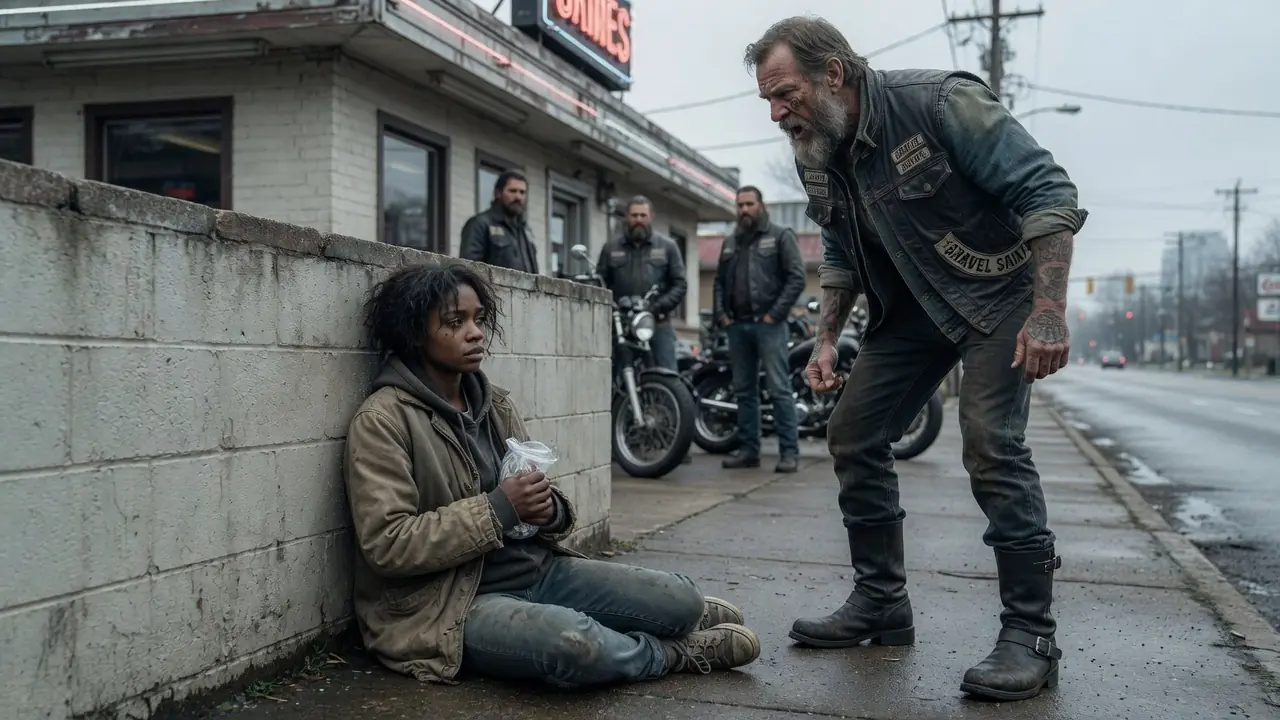
A young woman stood near the curb, thin as a shadow, wrapped in a dirty beige coat too large for her body. She looked about twenty, maybe twenty-one, with brown skin, tangled black curls, and the hollow cheeks of someone who had not slept safely in a long time.
She looked too young to be that tired.
She clutched a cracked phone in one hand and a small plastic bag in the other. Her eyes were unfocused, fixed somewhere across the street, though there was nothing there except traffic and gray morning light.
A huge man stood in front of her.
He was the kind of man people noticed from a distance and decided things about before he spoke.
Six-foot-four.
Wide through the shoulders.
White, weathered skin.
Gray-black beard down to his chest.
Tattoos covered both arms from wrists to under his sleeves. He wore a black leather cut over a denim jacket, with road patches, memorial patches, and a large back patch that read Gravel Saints Riding Club.
He grabbed the young woman’s coat near the shoulder and pulled her back from the curb.
She flinched.
People stopped.
No one stepped in.
Mara did what too many people do now when fear and uncertainty meet.
She pulled out her phone.
“Kayla,” the biker shouted. “Don’t you dare step into that road.”
The girl twisted like she wanted to get away.
The biker held her coat tighter.
Mara’s video showed only that.
A huge biker yelling at a young homeless girl.
His hand on her coat.
Her body shrinking away.
Two men near the laundromat stepping back instead of helping.
Mara’s own breath shaking behind the phone.
It did not show the delivery truck that had just blasted through the slush inches from where Kayla had been standing.
It did not show the way Kayla’s foot had already left the curb.
It did not show the biker’s hand opening the second she was away from danger.
It did not show his face after he said her name.
That was the thing Mara missed.
His face was not rage.
It was recognition so painful it came out wrong.
At the time, Mara did not understand that.
At the time, she saw a frightening man and a vulnerable young woman.
So she posted the video.
She wrote: Does anyone know this man? He just grabbed a young homeless girl outside Haven Roast. This didn’t look right.
Mara thought she was helping.
That was what made it worse.
The video spread faster than anything truthful ever does.
By the time Mara stepped inside the coffee shop, her phone was already buzzing.
Likes.
Comments.
Shares.
Anger multiplying beneath her name.
She should have deleted it then.
She should have waited.
She should have asked one question before giving the internet a villain.
Instead, she followed them inside.
Not because she was brave.
Because she was curious.
The coffee shop went quiet when the biker brought Kayla through the door.
His arm was around her shoulders now, but not like someone holding her captive. He was holding her up. Her knees were barely working, and she leaned into him because she had no strength left.
The barista, a young man named Owen, looked ready to call the police.
Then Kayla whispered, “Don’t. I know him.”
The biker guided her to the booth farthest from the windows.
Then he took off his leather cut and laid it over her shoulders.
That detail unsettled Mara.
A man like that without his vest looked strangely unfinished, like he had removed armor he usually needed to survive the world.
Kayla pulled the leather around herself with both hands.
Her fingers were thin, cracked, and red from the cold.
He turned toward the counter.
“Oatmeal,” he said. “Egg sandwich. Coffee. Water. Soup if you’ve got it. Real bowls, not to-go cups.”
His voice sounded like gravel in a metal bucket.
But his hands were shaking when he pulled cash from his wallet.
Owen glanced toward the booth.
“Is she okay?”
The biker looked back at Kayla.
“No,” he said. “But she’s here.”
That sentence should have stopped Mara.
It did not.
She stood near the condiment station with her phone burning in her pocket.
The comments kept coming.
Somebody call the cops.
Typical biker trash.
That poor girl looks terrified.
Why is nobody helping her?
Then the first comment that did not fit appeared.
Wait. Is that Silas Boone?
Then another.
That’s Preacher from the Gravel Saints. He’s rough, but he’s not cruel.
Then another.
Y’all don’t know what you’re talking about. That man fixed my mother’s furnace for free.
Then another.
He helped bury my brother when nobody else showed up.
Mara stared at the screen.
The comments were turning strange.
Not all of them.
The anger was still louder.
But now names appeared.
Stories.
Corrections.
People who knew him.
People who owed him something.
People who had seen him arrive at their worst hour with tools, coffee, and no need for thanks.
The biker’s name, Mara learned, was Silas Boone.
Everyone called him Preacher, not because he was religious exactly, but because when he finally spoke, people said it sounded like judgment and mercy fighting in the same mouth.
The Gravel Saints were not an outlaw club.
They were not saints either.
They were mechanics, roofers, welders, recovering addicts, divorced fathers, widowers, two nurses, one retired teacher, and a former Marine named Ruthie Bell who rode a silver Harley and scared everybody more than the men did.
They met behind a repair garage off Trinity Lane, under a tin roof that pinged loudly whenever rain hit it.
Their clubhouse smelled like oil, leather, burnt coffee, floor cleaner, and whatever stew Ruthie kept in a slow cooker.
Silas was their sergeant-at-arms.
That title sounded dangerous until Mara learned what it meant in their world.
He checked on members who stopped answering calls.
He picked up men from bars and took their keys before they could ruin their lives again.
He sat outside courtrooms with fathers trying to win back visitation with their children.
He fixed cars for widows, patched roofs for old neighbors, and stood silently at funerals where too few people came.
He did not talk much.
When he did, people listened.
Inside Haven Roast that morning, he sat across from Kayla with both hands flat on the table where she could see them.
That detail mattered.
Mara did not understand why then.
Later, Ruthie told her, “A scared person watches hands first. Preacher knows that.”
The food arrived.
Oatmeal.
Egg sandwich.
Coffee.
Water.
A bowl of chicken soup Owen found in the back because his aunt had made extra for the staff.
Kayla stared at the food like it belonged to someone else.
Silas pushed the plate closer.
“Eat.”
She shook her head.
“Kayla.”
“I can’t pay you back,” she whispered.
Silas leaned forward.
“Eat.”
Kayla picked up the sandwich with both hands and took a bite so small it seemed to break something in the room.
Owen turned away.
A woman near the window stopped pretending to look at her laptop.
Silas watched Kayla chew, his jaw tight, his eyes wet but not spilling.
Men like him, Mara thought then, must learn early how to swallow tears until they become something harder.
“Nine months?” he asked.
Kayla nodded.
“Clean nine months?”
She nodded again.
His eyes closed for one second.
Only one.
But in that second, the whole man seemed to fold inward.
“Why didn’t you call?” he asked.
Kayla laughed once.
It was not because anything was funny.
It was the kind of sound a person makes when the truth has no soft doorway.
“From where, Silas?”
He closed his mouth.
That one hit him.
He took out his phone and made calls.
The first was to someone named Ruthie.
“Found her,” he said.
There was silence on the other end.
“Alive,” he added.
Another silence.
“Nine months clean. No place.”
The second call was to a recovery center outside Hendersonville.
He did not ask if they had space.
He asked who was working intake and whether the director still owed him for “the Parker boys.”
The third call was to a woman named Denise who ran a transitional housing program for young women aging out of foster care.
“No, not next week,” Silas said. “Today.”
A pause.
“I’ll bring cash.”
Another pause.
“Because it’s Kayla.”
That was when Kayla started crying.
Not loudly.
Not dramatically.
Just one hand over her mouth, shoulders folding under that heavy leather vest.
Silas looked like he wanted to reach across the table.
He did not.
That, more than anything, made Mara understand he cared about her.
Because he knew care did not give him the right to touch her.
The first version of the story was the one everybody saw.
Mara’s video was thirty seconds long.
It showed Silas grabbing Kayla’s coat.
It showed him yelling.
It showed Kayla flinching.
It showed strangers afraid to intervene.
It showed Mara shaking behind the camera.
It did not show the truck.
It did not show him pulling her away from the road.
It did not show him taking off his vest.
It did not show him feeding her.
It did not show his hands flat on the table.
It did not show the way he said her name like he had been carrying it for two years.
Kayla Harris was twenty years old.
She was not Silas’s wife.
She was not his girlfriend.
She was not some woman from an old romance.
She was the daughter of his best friend.
That was the truth none of them saw on the sidewalk.
Her father, Marcus Harris, had ridden with the Gravel Saints for nearly fifteen years. Everyone called him Doc, though he was not a doctor.
He had been a paramedic before his back gave out, and he was the kind of man who showed up with jumper cables, bandages, a thermos of coffee, and exactly the right curse word for any situation.
Kayla grew up around the garage.
She did homework at the clubhouse table.
She learned to change oil before she learned to drive.
She used to braid Ruthie’s hair and steal sunflower seeds from Silas’s jacket pocket.
The Gravel Saints were not blood family, but to Kayla, they were uncles, aunties, protectors, and witnesses.
Silas had known her since she was seven.
He had seen her lose baby teeth, win spelling bees, break her wrist trying to skateboard down a driveway, and cry into her father’s shirt after her first boyfriend dumped her at sixteen.
When Kayla was little, she called Silas “Preachy” because she could not say Preacher.
He pretended to hate it.
He never did.
Inside his leather vest, near the left flap, was a small yellow sunflower patch stitched in messy thread.
Kayla had made it when she was eleven.
She said the vest looked too scary and needed “one nice thing hiding inside.”
Silas wore it for nine years without replacing it.
That was the detail that did not fit when Mara first noticed it.
A man with skull rings, scarred knuckles, and a beard down to his chest had a crooked yellow sunflower stitched inside his vest.
Not on the outside.
Inside.
Where only someone close would ever see it.
Then Kayla’s father died.
It happened two years before the morning outside Haven Roast.
A drunk driver crossed the center line on a rain-slick road outside Lebanon and hit Marcus Harris’s truck head-on.
Kayla was eighteen.
Still too young for the world to take the one person who made it feel safe.
Her mother had left when she was small, drifting in and out of contact until contact became nothing. So when Marcus died, Kayla did not just lose a father.
She lost the whole roof of her life.
The Gravel Saints tried to hold her.
Ruthie cooked.
Silas handled paperwork.
Deacon repaired the truck because Kayla wanted something of her father’s to survive.
Gloria, the retired nurse, sat with Kayla through the funeral and kept one hand on her back whenever the girl started shaking.
But grief is not reasonable.
It does not care how many people bring casseroles.
It does not care how many bikers stand guard at a graveside.
It can still find the one unlocked door and crawl in.
Kayla tried community college for one semester.
Then she stopped going.
She moved between couches.
She stopped answering calls.
She fell in with people who knew how to recognize a young woman with grief in her eyes and no one legally responsible for her.
At first, Silas found her.
Twice.
Once behind a motel near Murfreesboro.
Once outside a gas station in Madison.
Both times, he brought her home.
Both times, she promised she would stay.
Both times, grief won again.
The third time she disappeared, she stayed gone.
For two years, Silas kept looking.
Not every hour.
Not every day.
But always.
He kept a small duffel bag in his truck.
Clean socks.
Sweatpants.
A hoodie.
Toothbrush.
Protein bars.
A prepaid phone.
A bus card.
A paperback novel because Kayla used to read fantasy books when she was scared.
Whenever someone called about a young woman matching her description near East Nashville, Clarksville, Bowling Green, Chattanooga, or Memphis, Silas went.
Most times, it was not her.
A few times, it was someone who needed help anyway.
So he helped them too.
That morning outside Haven Roast was the first time he had seen Kayla in almost a year.
He recognized the way she stood before he recognized her face.
Ruthie told Mara he once said, “You don’t forget the posture of a kid who thinks nobody’s coming.”
He had been outside the laundromat checking the chain on a club member’s bike when he saw Kayla drifting toward the curb.
She was looking across the street at something that was not there.
A delivery truck came too fast through slush.
Silas moved before thinking.
He grabbed her coat and pulled her back.
That was when Mara started filming.
That is how easy it is to turn rescue into accusation.
Mara went back to her office that day, but she did not work.
Her phone was a storm.
By noon, the video had been shared thousands of times.
People were tagging local news pages.
Someone found the Gravel Saints’ garage address and posted it.
Someone else wrote that men like Silas should not be allowed near vulnerable young women.
Others pushed back hard.
A woman named Denise wrote, Preacher fixed my roof after the tornado and wouldn’t take a dollar.
A man named Rafael wrote, He sat with me in detox when my own brother wouldn’t answer the phone.
Another wrote, That girl is Kayla. If you know, you know. Leave them alone.
That last comment made Mara’s stomach turn.
If you know, you know.
She did not know.
But she had posted anyway.
At three that afternoon, her director, Alison, stepped into her cubicle.
She was holding her phone.
“Mara,” she said carefully, “is this your post?”
Mara looked at the screen.
Her video.
Silas’s hand on Kayla’s coat.
His voice.
Kayla’s flinch.
The clip had already been reposted by a local watchdog page with the caption: Disturbing scene outside East Nashville coffee shop. Who protects vulnerable girls from men like this?
Mara’s face went hot.
“Yes,” she said.
Alison closed the office door behind her.
“Did you stay? Did you find out what happened?”
Mara opened her mouth.
Then closed it.
Alison’s expression changed.
“Mara.”
“I thought—”
“I know what you thought,” Alison said. “But did you know?”
That question stayed with Mara.
Did you know?
No.
She did not.
She had mistaken fear for fact.
Mara deleted the post.
It was too late.
Deleting a spark after the field catches fire does not unburn the grass.
That evening, Mara drove to the garage off Trinity Lane.
She told herself she was going to apologize.
That was partly true.
She was also going because guilt had made sitting still impossible.
The Gravel Saints’ clubhouse sat behind Boone Auto & Cycle, a low brick garage with bay doors, oil-stained concrete, and an American flag hanging beside a hand-painted sign that read: Coffee Is Free. Lies Cost Extra.
About a dozen bikes were parked under the tin roof.
The rain had started by then, tapping hard above her as she stood near her car wondering whether she was about to do the bravest or stupidest thing of her life.
A woman opened the side door before Mara knocked.
She was in her late sixties, short, broad-shouldered, with white hair pulled into a braid and arms covered in old tattoos. She wore a purple bandana, black boots, and a look that suggested she had once argued with death and won.
“You the camera girl?” she asked.
Mara’s stomach dropped.
“Yes.”
“Come in before you freeze. I’m Ruthie.”
Inside, the clubhouse was warmer than Mara expected.
It smelled like leather, floor cleaner, coffee, and stew. A few men looked up from a card table. Another was repairing a child’s bicycle near the wall. Someone had stacked donated coats in labeled plastic bins.
Silas sat at the far end of the room.
His vest was back on.
The sunflower patch was hidden again.
Kayla was not in the room.
He looked at Mara once.
Then looked away.
She deserved that.
Ruthie pointed to a chair.
“Sit.”
Mara sat.
“I deleted the video,” she said.
Silas did not move.
Ruthie poured coffee into a chipped mug and set it in front of her.
“Fire already spread.”
“I know.”
“No,” Silas said from across the room.
His voice was low.
“You don’t.”
Everyone went quiet.
He stood slowly.
Up close, he looked even larger, but tired in a way the video had not captured.
“You know what happened after your video?” he asked.
Mara shook her head.
“The recovery center hesitated,” he said. “Said they were getting messages. Said until they understood the situation, maybe it was better Kayla go somewhere else.”
Mara’s throat tightened.
“I’m sorry.”
“The housing program got tagged,” he continued. “Denise got phone calls. People asking why she helps girls who run around with biker gangs.”
Mara pressed her hands together in her lap.
“I’m sorry.”
“Kayla saw comments before Ruthie took her phone.”
Mara looked down.
“She already thinks her life is too damaged to fix,” Silas said. “You gave strangers a chance to agree.”
The words landed hard.
Mara wanted to defend herself.
Say she meant well.
Say the clip looked bad.
Say anyone would have been worried.
But the truth was simpler.
“I was wrong,” she said.
Silas looked at her for a long time.
Then he sat back down.
Ruthie crossed her arms.
“Wrong is a start. Useful is better.”
Mara looked up.
“What can I do?”
“Tell the truth,” Ruthie said.
“I deleted it.”
“Deletion is not truth. It is hiding your mess.”
Silas leaned forward.
“You posted without asking. Now ask.”
So Mara did.
She asked who Kayla was.
She asked what happened outside the coffee shop.
She asked what the video missed.
She asked permission to write it down.
Silas did not answer first.
Ruthie did.
Then Deacon.
Then Gloria, the retired nurse who ran harm-reduction supply drives from the back of her SUV.
Then Silas, slowly and painfully, told Mara the rest.
Not all at once.
Men like him do not hand grief over easily.
They make people prove they will not drop it.
Kayla was in the back room of the clubhouse, asleep on a couch beneath two quilts. Ruthie had called Denise again, and Denise had agreed to hold a bed for Kayla if the online noise calmed down.
Silas had already paid the intake deposit.
He had also called a clinic, a counselor, and a lawyer who helped young adults replace missing identification.
At midnight, when Mara stood to leave, Ruthie walked her out.
The rain had stopped.
The motorcycles under the tin roof gleamed beneath a yellow security light.
“I thought I understood people,” Mara said.
Ruthie snorted.
“Everybody thinks that until people stop fitting easy boxes.”
“I really thought he was hurting her.”
“I know.”
Ruthie looked at Mara.
“That’s why it worked.”
The next morning, Mara posted a new video.
No dramatic music.
No self-pity.
Just her sitting at her kitchen table, face bare, voice shaking.
She said her name.
She said she had posted the original clip without full context.
She said the man in the video was Silas Boone, known as Preacher, and the young woman was Kayla Harris, the twenty-year-old daughter of his late best friend.
She said Silas had pulled Kayla away from an oncoming truck.
She said he had taken her inside, fed her, covered her with his vest, called a recovery center, and arranged safe housing.
She said her video had caused harm.
Then she said the sentence she hated most because it was the truest.
She had turned a rescue into a public accusation because she chose speed over understanding.
She posted it.
Then she called Haven Roast and asked whether they had security footage from outside.
Owen answered.
“I was hoping you’d call,” he said.
The coffee shop camera had captured the truck.
It had captured Kayla stepping toward the curb.
It had captured Silas pulling her back half a second before the truck passed.
It had captured what Mara’s video did not.
Owen sent it to her with one message.
Make it right.
So Mara posted that too.
The correction spread.
Not as fast as the first video.
Corrections never do.
But it spread enough.
Some people apologized.
Some deleted their comments.
Some doubled down because being wrong in public is too painful for people who enjoy judging strangers.
The recovery center called Silas back.
Denise did too.
By Friday, Kayla had a bed in a thirty-day support program for young women in Hendersonville.
Silas drove her there.
He did not go inside with her until she asked.
That mattered too.
At the entrance, Kayla stood beside his truck wearing clean sweatpants, Ruthie’s old denim jacket, and a knitted hat someone from the club had bought at Walmart.
She looked cleaner but still fragile.
Healing does not turn people into inspirational posters overnight.
It makes them tired, ashamed, hopeful, terrified, and hungry all at once.
Silas stood by the truck with both hands in his pockets.
“I’ll come in if you want,” he said.
Kayla looked at the building.
Then at him.
“You’ll wait?”
He nodded.
“As long as you need.”
She swallowed.
“Not like before.”
His face changed.
“No,” he said. “Not like before.”
“I can’t be the little girl everybody remembers.”
“I know.”
“I don’t even know if I can be anybody.”
He looked at her with so much grief and care that Mara had to look away.
“You can be Kayla,” he said. “That’s enough.”
Kayla cried then.
He did not touch her until she stepped forward first.
Then he hugged her carefully, like she was both precious and breakable, which perhaps she was.
Mara was there because Ruthie told her to come.
“Witness the whole thing this time,” Ruthie had said.
So Mara did.
For the next few weeks, Mara learned the difference between a story and a life.
A story wants clean lines.
A life refuses them.
Silas was not perfect.
He had been too loud sometimes. Too protective. Too quick to assume forceful words could scare danger away. He had once believed that if he watched every street, answered every call, and searched every corner, he could save Kayla from grief.
He could not.
Kayla had lied.
She had disappeared.
She had hurt people who loved her.
She had run from help because help felt too much like being seen.
Both of them carried guilt.
Neither of them fit neatly into victim and rescuer.
But that morning outside Haven Roast, Silas saved her.
That was true.
And truth deserved the whole room, not just the ugliest angle.
The Gravel Saints did not forgive Mara quickly.
Some never did.
Deacon, the mechanic repairing the child’s bike, called her “Spielberg” for a month.
Ruthie corrected him only when he said it too kindly.
Silas remained polite but distant.
That was fair.
Trust, Mara learned, is not restored because the guilty person feels sorry.
It is restored, if ever, through usefulness repeated without applause.
So Mara became useful.
At the nonprofit, she helped Kayla replace her ID.
She helped Kayla apply for food assistance.
She helped Denise’s housing program with documentation.
She helped the recovery center arrange transportation to follow-up appointments.
She helped Silas and Ruthie build a small referral sheet for young adults leaving treatment with nowhere stable to go.
The Gravel Saints already had the informal network.
Names in phones.
Couches.
Garages.
Rooms above shops.
People willing to drive at midnight.
Mara helped turn some of it into paperwork that could survive outside memory.
Silas hated the paperwork.
Ruthie loved that he hated it.
“Good,” she told him. “Suffer. It builds character.”
Two months after the video, Kayla moved into a small room above Denise’s community thrift shop.
It was not beautiful.
The carpet was old.
The radiator clanked.
The window looked over an alley where stray cats fought like unpaid actors.
But the door locked.
The bed was clean.
The rent was covered for three months through a quiet fund the Gravel Saints never advertised.
Kayla cried when she saw the room.
Not because it was perfect.
Because it was hers.
Silas stood in the doorway, careful not to enter until she invited him.
She turned around and saw him waiting.
“Come in,” she said.
He stepped inside.
Only then.
The room had a small table by the window. On it, Ruthie had placed a coffee maker, a bag of grounds, two mugs, and a packet of sunflower seeds.
Kayla picked up the packet and laughed through tears.
“I used to steal these from your jacket.”
Silas looked down.
“You were terrible at stealing.”
“I was eleven.”
“You were loud.”
She smiled.
For a second, Mara saw the child everyone else had been trying to remember.
Then the smile faded into something older.
“I miss my dad,” Kayla whispered.
Silas’s face tightened.
“Me too.”
“He would be ashamed of me.”
Silas shook his head immediately.
“No.”
“You don’t know that.”
“I do.”
His voice became rough.
“Your dad would be scared. Angry, maybe. Heartbroken, definitely. But ashamed? Never.”
Kayla looked at him.
Silas swallowed hard.
“He loved you too much for shame.”
She broke then.
Not quietly.
Not neatly.
She folded into a chair, covering her face, sobbing like a child who had finally reached a place safe enough to fall apart.
Silas knelt in front of her but did not touch her.
“I’m here,” he said. “I’m not your dad. I know that. I can’t be him.”
Kayla cried harder.
“But I promised him I would look out for you,” Silas continued. “And I failed plenty. I was late plenty. I didn’t know how to help plenty. But I never stopped looking.”
She lowered her hands.
Her eyes were red.
“You really looked?”
“For two years.”
“Why?”
Silas looked at the sunflower patch inside his vest.
Then back at her.
“Because somebody should.”
That was the most honest kind of love Mara had ever witnessed.
Not romantic.
Not clean.
Not easy.
Just stubborn enough to remain.
The internet moved on, of course.
It always does.
One week it was Silas and Kayla.
The next it was a restaurant argument, a school board shouting match, a celebrity apology, and a doorbell camera clip of a delivery driver slipping on ice.
But for the people in the video, the story did not end when strangers lost interest.
Kayla still had to wake up and choose recovery every morning.
Silas still had to learn that protecting someone did not mean controlling every step she took.
Mara still had to live with the fact that her carelessness had made a fragile girl’s first day back in the world even harder.
Three months later, the nonprofit hosted a winter fundraiser.
They called it The Warm Road Project.
It provided emergency bus cards, motel vouchers, recovery transport, document replacement, and small grants for young adults leaving treatment or homelessness.
A state ID.
Work boots.
A phone.
A week of groceries.
A ride to court.
The Gravel Saints agreed to help with transportation.
Ruthie insisted on being listed as logistics director, then threatened to quit when they printed her name too small.
Silas attended only because Kayla asked him to.
She was ninety-six days sober by then.
She wore jeans, a green sweater, and a yellow sunflower pin on her jacket. Her curls had been washed, trimmed, and pulled back from her face.
Hardship still lived in her eyes, but so did presence.
People noticed her.
Some whispered.
She stood at the podium anyway.
Mara’s job was to introduce her, but before she could, Kayla touched her arm.
“I want to say something first,” Kayla whispered.
The room quieted.
Kayla gripped the sides of the podium.
For a moment, Mara thought she might not speak.
Then Kayla lifted her head.
“My name is Kayla Harris,” she said. “A few months ago, some of you saw the worst-looking part of one of the best things anyone ever did for me.”
No one moved.
“I was not okay that morning. I was tired, cold, sober, scared, and not sure I wanted to keep trying. I stepped toward a road I did not really see.”
She looked toward Silas.
He stood near the back wall, arms folded, head low.
“Silas pulled me back,” she said.
Her voice trembled.
“He yelled because he was scared. He grabbed my coat because a truck was coming. Then he fed me. He covered me. He called people who knew how to help. He waited while I decided whether to keep living different.”
Silas covered his mouth with one hand.
Kayla continued.
“He did not save me because I was perfect. I was not. He did not save me because I made it easy. I did not.”
She swallowed.
“He saved me because I was Kayla. Because I was Marcus Harris’s daughter. Because I was a kid he had known before the world hurt me. Because he still believed there was someone inside me worth finding.”
The room was silent.
Kayla turned to Mara.
“Mara posted the first video. She hurt me with it.”
Mara’s stomach dropped, though she had known this was possible.
She nodded.
“I did,” Mara said quietly.
Kayla looked back at the crowd.
“But she came back. She listened. She told the truth when it made her look bad. That matters too.”
Mara started crying before she could stop herself.
Not because she deserved comfort.
Because grace is most painful when a person knows they have not earned it.
Kayla finished with one sentence.
“Before you share someone’s worst moment, ask whether you are showing the truth or just the part that makes you feel righteous.”
People stood.
Not all at once.
Slowly.
Then the applause filled the room.
Silas did not clap.
He could not.
He stood against the wall with one hand covering his mouth, crying in a way that made no sound.
After the event, Mara found him outside beside his bike.
The Nashville air was cold, but not as cold as that morning.
He was holding an unlit cigarette, turning it between his fingers like he needed something to do.
“I’m sorry,” Mara said.
He looked at her.
“You’ve said that.”
“I know.”
“You keep saying it like you’re waiting for it to fix something.”
Mara looked down.
“Maybe I am.”
He put the unlit cigarette behind his ear.
“Sorry doesn’t fix much.”
“No.”
“But what you’re doing now helps.”
That was the closest thing to forgiveness Mara received from Silas Boone.
It was enough.
A year later, Mara could still see the video in her mind.
Not the one she posted.
The real one.
Kayla drifting toward the curb.
Silas seeing her.
The truck coming.
His hand reaching.
His voice breaking her name open in the street.
People think the opposite of cruelty is kindness.
Sometimes it is.
But sometimes the opposite of cruelty is patience.
Patience enough to ask one more question.
To wait ten more seconds.
To follow the person inside.
To admit that a thirty-second clip cannot hold one dead father, two years of searching, nine months of sobriety, and one man’s terror at finding the girl he promised to protect half a step from disappearing again.
Mara still worked at the nonprofit.
The Warm Road Project was real now.
The Gravel Saints drove for them twice a week. Ruthie still ran logistics like a battlefield commander. Deacon still called Mara Spielberg, though now he did it with a smile.
Kayla worked part-time at Denise’s thrift shop downstairs from her room.
She answered phones, sorted donated clothes, made coffee, and kept a jar of sunflower seeds near the register.
She was not fixed.
No one was.
But she was there.
That mattered.
Silas visited every Saturday morning.
He never went upstairs unless invited.
He brought coffee, breakfast sandwiches, and sometimes a new paperback book because Kayla had started reading again.
Sometimes they talked.
Sometimes they sat quietly.
Sometimes Kayla told stories about her father that made Silas laugh and then look away because grief still had teeth.
Once, Mara saw Kayla reach across the thrift shop counter and touch the inside flap of Silas’s vest, right where the sunflower patch was hidden.
He looked down at her hand.
Then up at her face.
Neither of them said anything.
They did not have to.
The first version of the story had made Silas look like a monster.
The fuller version made him human.
That is harder for people.
Monsters are easy.
Heroes are easy.
Humans require attention.
Mara thought she was someone who noticed things.
Now she knew noticing was not the same as understanding.
A camera can catch motion.
It cannot catch history.
It cannot catch the years someone spent searching.
It cannot catch the difference between a hand that harms and a hand that pulls someone back from the road.
The morning Mara filmed Silas Boone, she believed she was protecting a young woman from a dangerous stranger.
What she had actually found was a man standing in the cold with his heart breaking in public.
And because she did not wait long enough to see the whole truth, she nearly turned his love into evidence against him.
That was why Mara told the story later.
Not because she had been right.
Because she had been wrong.
And sometimes the most important thing a person can do is stop defending the first thing they thought they saw, and finally become brave enough to see what was really there.