“Can I sit with you?”
Rowan Mercer did not turn around immediately. He remained on the edge of the weathered dock, staring across the darkening river while the last pale light faded behind the trees. His black BMW stood several feet away with the driver’s door still open, and the hospital envelope beside him moved gently in the evening breeze. He had been sitting there for nearly an hour, trying to understand how a doctor could use so many careful words to say that his eight-year-old daughter might die.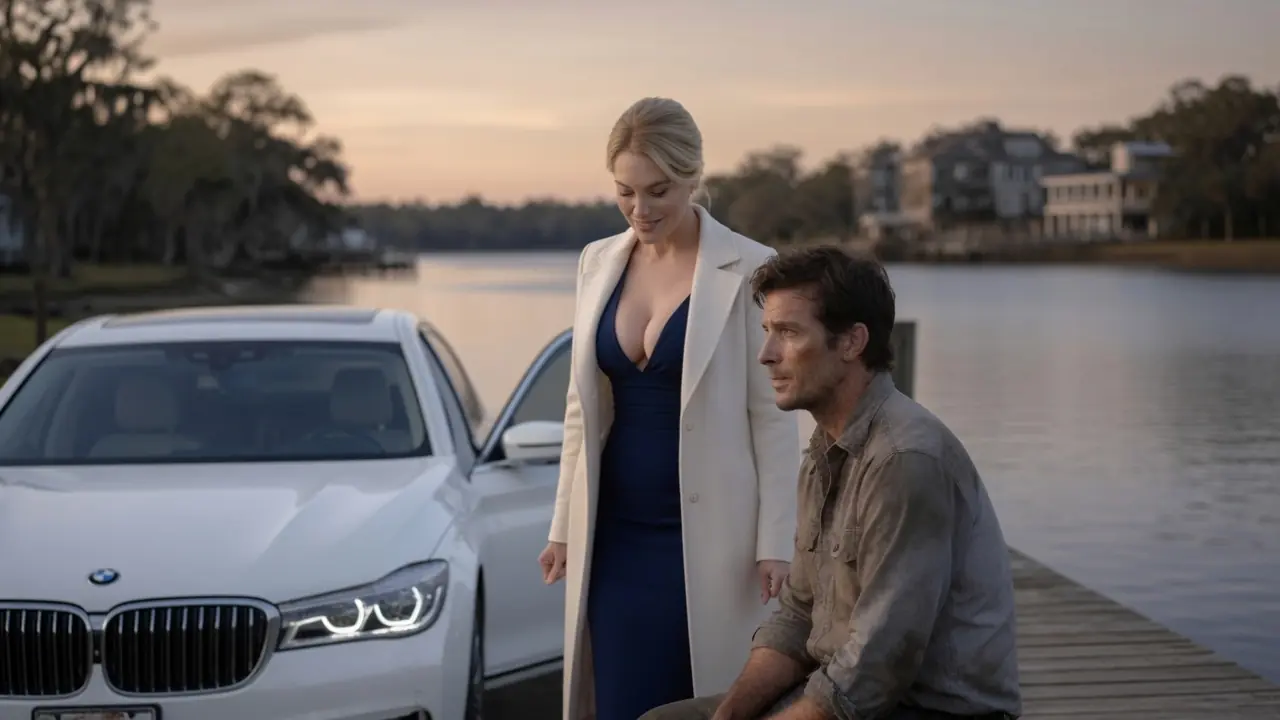
The woman waiting behind him was dressed for a world that had never included men sitting alone on docks with medical bills folded inside their pockets. She wore a fitted navy dress beneath an ivory coat, her blonde hair pinned into a loose bun and black heels resting carefully on the uneven wood. A dark sedan waited near the road, but the driver remained inside, giving her space. Rowan assumed she had come from the charity dinner taking place across the river at Charleston Children’s Hospital.
“You can sit,” he said finally. “Just don’t tell me everything will be fine.”
The woman lowered herself beside him, leaving enough distance to respect his silence. “I wasn’t going to.”
“Everyone says it because they don’t know what else to say.”
“Sometimes people say it because your pain frightens them.”
Rowan looked at her for the first time.
She appeared to be in her early thirties, composed but not untouched by sadness. Her fair skin and elegant clothes suggested wealth, yet her eyes carried the alert patience of someone familiar with hospital corridors. She did not ask why he was crying or offer a rehearsed speech about hope.
“My daughter needs a bone-marrow transplant,” Rowan said. “The doctors tested every relative we have. No match.”
“How old is she?”
“Eight.”
“What’s her name?”
“Isla.”
The woman repeated the name softly. “Isla.”
Rowan picked up the hospital envelope before the wind could carry it into the river. The front displayed the logo of Charleston Children’s Hospital and the words TRANSPLANT SERVICES in blue. Inside were consent forms, donor-search information, treatment plans, and a list of costs that made his hands feel numb.
“She was tired for months,” he said. “I blamed school, growth spurts, everything except what it was. Then she fainted during breakfast.”
“What did they diagnose?”
“Severe aplastic anemia. Her bone marrow isn’t making enough blood cells. Medication helped for a while, but not enough.”
The woman’s posture changed slightly.
“You know what that means,” Rowan said.
“Yes.”
“How?”
She looked across the river. “I had leukemia when I was seventeen.”
Rowan studied her again.
The stranger did not resemble the fragile patients he had passed inside the transplant wing. She looked healthy, confident, and entirely in control of her life. Yet when she touched the small pendant beneath her collarbone, her fingers trembled.
“I spent almost a year waiting for a donor,” she continued. “My parents tested everyone. Nobody matched closely enough. Then the registry found someone.”
“And it worked?”
“I’m sitting here.”
Rowan lowered his gaze.
“That’s what people keep telling me. That one person somewhere might be able to save Isla. But the registry has millions of names, and somehow they still can’t find the right one.”
“Searches can expand.”
“They already expanded internationally.”
“More people can be tested.”
“I don’t have the money to launch one of those campaigns you see online.”
The woman turned toward him. “You may not need it.”
Rowan gave a tired laugh. “People with money always think money is the part everyone misunderstands.”
She accepted the criticism without offense.
“What do you do?” she asked.
“I repair marine engines at a boatyard. I used to own half the business with my brother, but Isla’s treatment changed that.”
“You sold your share?”
“I sold almost everything except the tools I need to keep working.”
“And her mother?”
“Died when Isla was three.”
The woman closed her eyes briefly. “I’m sorry.”
“Her name was Emily. A drunk driver crossed the center line while she was coming home from work.”
Rowan had told the story so many times that the words usually arrived without emotion. That evening, however, something about the river and the stranger’s quiet attention made the loss feel new. He remembered identifying Emily’s wedding ring, explaining death to a child too young to understand permanence, and promising Isla that he would never leave her too.
Now his daughter’s life depended on a stranger he could not find.
The woman removed a business card from her purse.
“My name is Serafina Vale.”
Rowan looked at the card, then at her.
The name was familiar. Vale Biotherapeutics appeared on hospital buildings, research grants, and television advertisements. Serafina Vale was the billionaire chief executive who had inherited a pharmaceutical company and transformed it into one of the country’s largest supporters of transplant research.
Rowan handed the card back.
“I don’t need a publicity story.”
Her expression tightened. “I didn’t offer one.”
“Your foundation probably has cameras waiting at that dinner.”
“They do. That’s why I left.”
“Why?”
“Because I was expected to stand on a stage and describe surviving cancer as if it were a clean, inspiring journey. I was tired of making terrified families applaud a story that left out the fear.”
Rowan said nothing.
Serafina placed the card on the dock between them.
“My foundation funds donor recruitment programs. We can organize testing drives, cover travel, and search registries that smaller hospitals sometimes reach slowly. I can’t promise a match, but I can promise the search will not stop because you ran out of money.”
Rowan stared at the card.
“Why would you do that for someone you met beside a river?”
“Because someone once did something far greater for me without knowing my name.”
The answer sounded sincere, but accepting help had become difficult for Rowan. Every bill he could not pay felt like a failure. Every hospital worker who lowered their voice around him seemed to see a desperate father instead of a capable man.
“I don’t want Isla turned into a campaign poster.”
“Then she won’t be.”
“I don’t want strangers filming her hospital bed.”
“They won’t.”
“And I won’t owe you.”
Serafina looked at him steadily. “You won’t.”
Rowan almost refused anyway.
Then he imagined Isla that morning, smiling weakly while asking whether he could bring her blue sweater to the hospital because the transplant wing was always cold. Pride had already cost him sleep, savings, and parts of his future. He would not allow it to cost his daughter her chance.
He picked up the card.
“What happens next?”
Serafina’s shoulders relaxed. “I call the medical director of my foundation. With your permission, she contacts Isla’s transplant team tonight.”
Rowan nodded.
Serafina made the call from the dock.
She did not mention her own name until the doctor asked who was authorizing the foundation’s involvement. She spoke clearly about expanding the donor search, funding community testing, and protecting Isla’s privacy. Within fifteen minutes, the hospital had received confirmation that every eligible cost related to donor recruitment would be covered.
Rowan listened, feeling both grateful and ashamed of his relief.
When the call ended, Serafina returned the phone to her purse.
“The first testing drive can begin Monday.”
“That fast?”
“Faster if the hospital approves a weekend event.”
“You do this often?”
“Not personally.”
“Then why now?”
Her gaze moved to his wrist.
Rowan wore a faded blue fabric band beneath his watch. It had been there so long that the printed letters were nearly unreadable. Serafina leaned closer, suddenly pale.
“What is that bracelet?”
Rowan looked down.
“This?”
“May I see it?”
He removed the watch and turned his wrist. A small plastic plate attached to the band displayed an old registry number.
517-0846-RM
Serafina stopped breathing.
Rowan noticed the change immediately. “What’s wrong?”
“Where did you get that?”
“A donor center in Raleigh.”
“When?”
“Seventeen years ago.”
Serafina reached for the pendant at her throat and opened it. Inside the small silver case was a folded strip of paper protected beneath clear plastic.
She handed it to Rowan.
The same number appeared across the center.
DONOR IDENTIFICATION: 517-0846-RM
Rowan read it twice.
The river, the distant hospital lights, and the sound of cars behind them seemed to disappear.
“That’s impossible,” he said.
Serafina’s eyes filled with tears. “No. It isn’t.”
Rowan looked from the paper to the bracelet.
At twenty-one, he had joined the national marrow registry after his younger sister, Hannah, died while waiting for a donor. Two years later, a coordinator called to say he might match a teenage leukemia patient. Rowan completed the tests, traveled to Raleigh, and donated stem cells without ever learning the recipient’s identity.
The procedure left him sore and exhausted for several days.
Then life continued.
He received one anonymous letter six months later saying the recipient had survived. He placed it inside a box with Hannah’s belongings and never asked for anything more.
“You were seventeen?” Rowan whispered.
Serafina nodded.
“You were the girl.”
“You saved my life.”
“I donated cells.”
“You gave me seventeen years I was never supposed to have.”
Rowan looked away.
He did not know how to receive the emotion in her voice. The donation had always belonged to Hannah in his mind. He had registered because he could not save his sister and needed to believe someone else’s family might avoid the same grief.
“I tried to find you,” Serafina said.
“I asked the registry to keep my identity private.”
“Why?”
“Because I didn’t want anyone thinking they owed me.”
“I wrote letters.”
“I received one.”
“Only one?”
“My father sent several through the registry.”
Rowan shook his head. “I got one letter. It said you were back in school and wanted to become a doctor.”
Serafina smiled through tears. “I changed my mind after one semester.”
“I noticed.”
She laughed softly, but the sound broke.
“My family searched for years. The registry said the donor declined contact.”
“I didn’t decline you personally.”
“You didn’t know me.”
“That was the point.”
Serafina moved closer, no longer looking like a billionaire or executive. She looked like the frightened teenager Rowan had never seen, the one who had waited inside a hospital room while strangers searched the world for someone whose cells might keep her alive.
“Your donation gave me college,” she said. “It gave me my father’s last twelve years. It gave me the chance to rebuild our company and fund transplant programs. Every room I’ve entered since seventeen exists because you said yes.”
Rowan swallowed hard.
“My sister was twelve when she died. She waited seven months for a match. I registered at her funeral reception.”
Serafina covered her mouth.
“I couldn’t save Hannah,” he continued. “Saving you was the closest I could get.”
“You did save her memory.”
He looked toward Charleston Children’s Hospital.
“And now my daughter may die waiting like she did.”
Serafina took his hand.
Not as a wealthy benefactor making a promise, but as someone whose heartbeat existed because of him.
“She won’t wait alone,” Serafina said. “Neither will you.”
The donor drive began forty-eight hours later.
Vale Foundation teams opened testing stations across South Carolina, North Carolina, Georgia, and Florida. Serafina refused every interview requesting photographs of Isla. Public announcements focused on increasing registry diversity and helping all patients seeking matches, not turning one sick child into a spectacle.
Thousands registered during the first week.
None matched Isla closely enough.
Rowan spent his days at the hospital and his nights repairing engines at the boatyard whenever a coworker could stay with her. Serafina began appearing at the hospital without assistants or cameras. She brought paperwork, coffee, and occasionally a meal Rowan forgot to eat.
Isla liked her immediately.
“You’re the lady Dad met at the river,” she said during their first meeting.
“I am.”
“Were you crying too?”
Serafina glanced at Rowan. “A little.”
“My dad cries when he thinks I’m sleeping.”
Rowan cleared his throat. “We don’t have to share every family secret.”
Isla smiled.
She was small for eight, with dark curls, large blue eyes, and a knitted cap covering hair thinned by treatment. Serafina sat beside her bed and listened while Isla explained that the hospital television had terrible cartoons and the nurses never put enough marshmallows in hot chocolate.
“Do billionaires get better hot chocolate?” Isla asked.
“Sometimes,” Serafina said. “But it usually comes in cups too expensive to enjoy.”
“Dad makes it with cinnamon.”
“That sounds better.”
Rowan watched them together, troubled by how natural the moment felt.
He had known Serafina less than two weeks, yet she already understood the parts of him he hid from everyone else. She knew what it meant to wait for blood counts, fear infections, and search a doctor’s face for answers before the doctor spoke. She never told Isla to remain positive or called her brave when she was simply exhausted.
Serafina allowed her to be afraid.
One evening, Rowan found Serafina asleep in the chair beside Isla’s bed. Her ivory coat had slipped to the floor, and Isla’s hand rested loosely inside hers. Rowan covered both of them with a hospital blanket.
Serafina woke.
“You should go home,” he whispered.
“So should you.”
“I am home right now.”
The words escaped before Rowan could stop them.
Serafina looked around the hospital room and understood.
Three weeks into the search, Isla developed a severe infection. Doctors transferred her to intensive care, and the transplant timeline became dangerously short. The foundation expanded its campaign internationally, but every possible match failed during final testing.
Rowan stopped answering friends.
He ate only when Serafina placed food directly in front of him. He slept in short intervals with his head against the hospital wall and repeatedly reread the same transplant information as if new words might appear.
One morning, Serafina found him in the chapel despite knowing he was not religious.
“I didn’t know where else to sit,” he said.
She lowered herself beside him.
“I used to come here during treatment,” she said. “Not to pray. Just because nobody asked me to smile.”
Rowan pressed both hands against his face.
“I promised Emily I would protect Isla.”
“You have.”
“She needs someone I can’t find.”
“That is not your failure.”
“I sold the business, the house, and everything she might have inherited. I would give her my own marrow if my body matched.”
“I know.”
“And none of it matters.”
Serafina turned toward him. “It matters to Isla that her father is here every time she opens her eyes.”
“What if that isn’t enough?”
“Then you keep being here anyway.”
Rowan looked at her.
“Is that what your parents did?”
“My mother couldn’t handle the hospital. She visited twice. My father slept in the hallway for ten months.”
“Where is he now?”
“He died five years ago.”
“I’m sorry.”
Serafina smiled sadly. “He spent the rest of his life trying to find you.”
Rowan lowered his gaze.
“Maybe I was wrong to stay anonymous.”
“You were allowed to make that choice.”
“But he deserved to know Hannah’s death created something good.”
Serafina took his hand again.
“He knew someone saved me. That was enough for him.”
The call came at 2:13 the following morning.
A potential donor had been identified in Denmark—a twenty-seven-year-old teacher who had joined the registry during a Vale Foundation campaign four years earlier. The preliminary match was excellent, but confirmatory testing and international transport would take time.
Serafina immediately offered the foundation’s medical aircraft.
Rowan refused to celebrate until every test was complete.
For four days, they waited.
The donor completed additional bloodwork. Samples crossed borders. Specialists compared markers while Isla’s condition remained fragile.
On the fifth morning, Dr. Patel entered the room smiling.
“We have a confirmed match.”
Rowan did not react at first.
The words seemed too important to understand immediately.
“A full match?” he asked.
“The best unrelated match we could reasonably hope for.”
“Are you sure?”
“Yes.”
Rowan gripped the bed rail.
Isla looked between the adults. “Does that mean I get the transplant?”
Dr. Patel nodded. “It means someone very special said yes.”
Isla smiled weakly.
Rowan bent over her and cried against the blanket.
Serafina stepped into the hallway to give them privacy, but Rowan followed several minutes later. He found her near the window, crying silently while looking toward the river.
“You found the donor,” he said.
“The registry found her.”
“Your campaign brought her in four years ago.”
“Someone else might have found a match eventually.”
“But you didn’t wait for eventually.”
Rowan moved closer.
“I spent seventeen years believing the donation ended when your treatment worked.”
Serafina wiped her cheeks.
“It didn’t.”
“No. It came back and saved Isla too.”
The transplant took place two weeks later.
The donor’s cells arrived in a temperature-controlled container carried by a medical courier from the airport. The actual infusion appeared surprisingly simple, almost too ordinary for something carrying an entire future. Isla watched the bag carefully and asked whether the cells knew where to go.
“They’re smarter than they look,” Rowan said.
Serafina remained outside the room until Isla asked for her.
“You’re part of the family now,” the child said.
Rowan looked at Serafina.
Neither corrected her.
Recovery was difficult.
Isla developed fevers, nausea, and painful sores. Some days she refused food and begged to go home. Rowan stayed beside her through every setback, while Serafina quietly used her foundation to arrange specialists without once asking for public recognition.
Weeks passed before Isla’s blood counts began improving.
The first time doctors used the word engraftment, Rowan walked into the hallway and pressed his forehead against the wall. Serafina found him there.
“Good news?” she asked.
“The donor cells are working.”
Serafina smiled.
Rowan turned toward her. “I don’t know how to thank you.”
“You already did.”
“That happened seventeen years ago.”
“I’m still using the life you gave me.”
He stepped closer.
For months, something had been growing between them—something deeper than gratitude and more dangerous than friendship. Rowan had resisted it because Serafina’s wealth created a distance he did not know how to cross. Serafina had resisted because she feared he would always wonder whether her feelings came from a debt.
“I don’t want you loving me because of a bracelet,” Rowan said.
“I don’t.”
“How can you know?”
“Because the man who donated to me was twenty-three and anonymous. I’m in love with the father who sleeps in hospital chairs, argues with doctors, repairs nurses’ cars in the parking garage, and still asks whether everyone else has eaten.”
Rowan’s breath caught.
Serafina continued.
“I’m grateful to the donor. I love the man.”
He touched her face gently.
Their first kiss happened in the transplant hallway while a cleaning cart rattled past and a nurse pretended not to notice.
Isla came home four months later.
Rowan rented a smaller house near the river because their old home had been sold during treatment. Serafina offered to purchase one, but he refused.
Instead, she helped him reopen the marine-repair business through a legitimate investment reviewed by independent attorneys. Rowan retained control and repaid every dollar under written terms. Serafina respected him more for insisting.
Their relationship moved slowly.
She learned how to make hot chocolate with cinnamon. Rowan attended business dinners without pretending to understand every financial conversation. Isla taught Serafina how to braid hair badly and reminded them both that hospital rules no longer controlled bedtime.
A year after the transplant, they returned to the same dock.
Isla ran ahead carrying a small wooden sailboat Rowan had built for her. Serafina wore an ivory coat similar to the one from the night they met, while Rowan still wore the faded donor bracelet beneath his watch.
“You should replace that thing,” she said.
“It appears to work.”
“For what?”
“It attracts billionaires.”
Serafina laughed.
They sat together as Isla launched the sailboat into the calm water.
Rowan took a small box from his pocket.
Serafina noticed immediately.
“What is that?”
“A question I’ve been carrying for three weeks.”
He opened the box.
Inside was a simple diamond ring set beside a tiny silver plate engraved with two numbers—the identification code from his donation and the date of Isla’s transplant.
Serafina covered her mouth.
“Seventeen years ago, I gave something to a stranger because I couldn’t save my sister,” Rowan said. “Then the stranger found me when I thought I was about to lose my daughter.”
Tears filled Serafina’s eyes.
“You never owed me anything,” he continued. “But you gave us everything anyway. Not because I saved you. Because that is who you chose to become.”
He took her hand.
“Serafina Vale, can I keep sitting beside you for the rest of our lives?”
She laughed through her tears.
“Yes.”
Isla turned from the river.
“Did she say yes?”
“She did,” Rowan answered.
“Good. I already told everyone at school.”
Serafina pulled Isla into her arms while Rowan laughed for the first time in what felt like years.
They married beside the river the following spring.
No reporters attended. No business magazines received exclusive photographs. The guests included nurses, doctors, boatyard workers, foundation employees, and families whose children were still searching for donors.
At the reception, Serafina announced a new program named after Rowan’s sister.
The Hannah Mercer Match Initiative would fund donor registration in underserved communities and cover travel expenses for international donors. The program’s first public ambassador was Isla, who stood proudly beside a photograph of the Danish teacher whose cells had saved her.
Rowan never removed the old bracelet.
It reminded him that the smallest decision could travel farther than anyone imagined. A grieving young man had joined a registry because his sister died. That choice saved a teenage girl, who grew into a woman capable of building the search that later saved his daughter.
Years afterward, people often described their story as an impossible coincidence.
Rowan disagreed.
Coincidence brought Serafina to the dock.
Everything afterward required choice.
She chose to sit beside a broken stranger.
He chose to trust her with Isla’s name.
A donor in another country chose to answer a call.
And two people connected by blood they had never shared chose to become a family.
The first time Serafina asked whether she could sit with him, Rowan believed his future was ending across the river inside a hospital room.
He had not understood that the woman beside him was living proof that one act of kindness could survive for decades.
He had saved her life without knowing her name.
Then she returned that life to him by helping save the person whose name meant everything.