“You look like charity, not executive material—get out.”
The words cut through the marble lobby of Bennett Global Tower with enough force to stop every conversation within twenty feet. Claire Bennett stood beneath the enormous silver company logo in a fitted ivory designer suit, one hand extended toward the man she had just publicly dismissed. At thirty-four, she was one of the youngest billionaire chief executives in Manhattan, and she carried her authority like a blade that had never met resistance.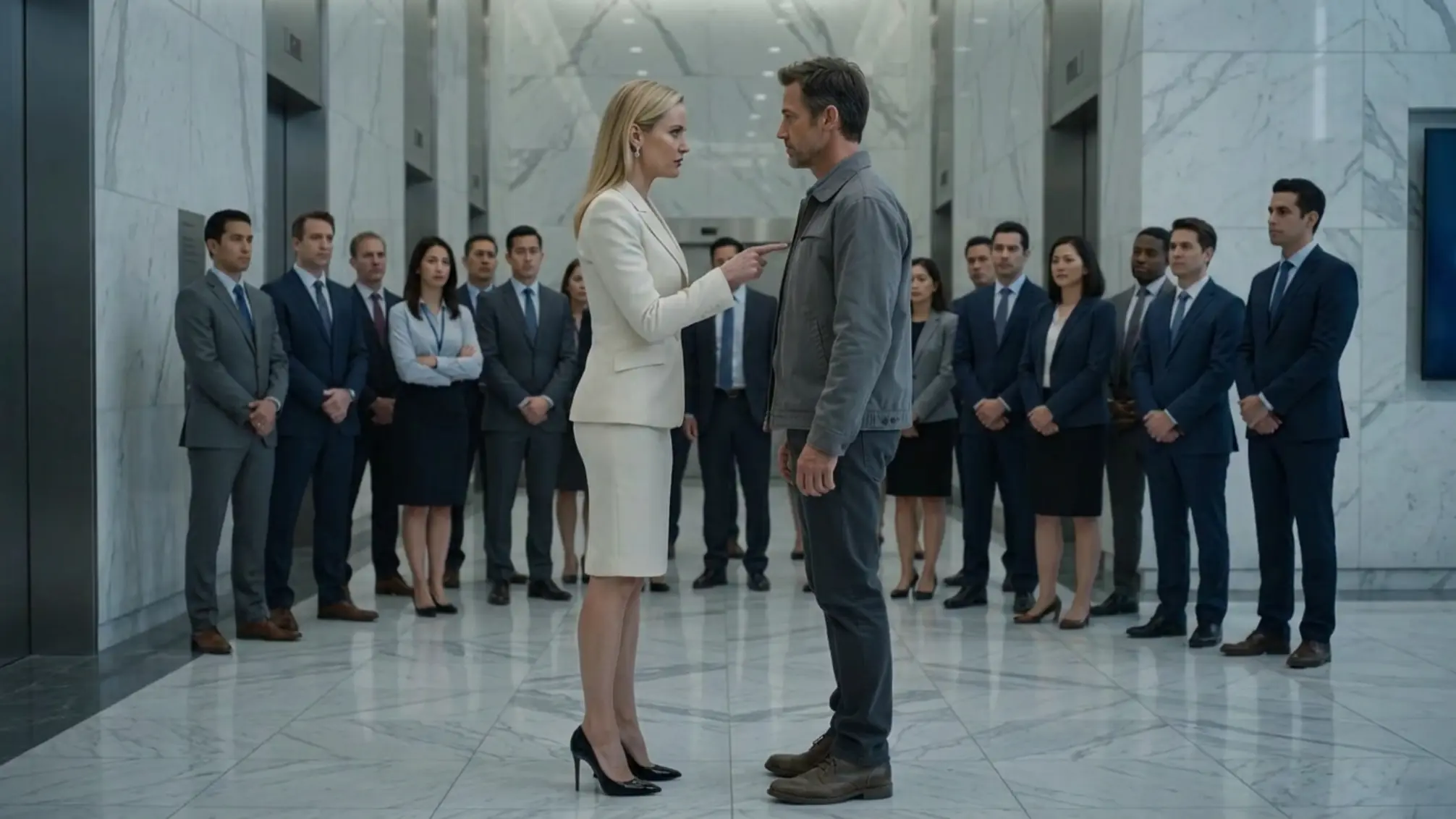
Ryan Walker stood across from her holding a repaired brown leather bag.
He was forty-one, quietly handsome, and dressed in a gray jacket that had survived too many winters. His dark-brown hair was neatly combed, light stubble framed his face, and his steady gray eyes showed neither panic nor embarrassment. He looked exactly like what Claire believed him to be: an ordinary new employee who had somehow slipped through the company’s polished recruitment system.
Dozens of American employees watched from the lobby, elevators, and mezzanine.
Claire dropped Ryan’s temporary badge onto the marble floor.
“Make sure everyone remembers you said that,” Ryan replied.
He knelt, picked up the badge, and rose without breaking eye contact.
Claire stepped closer until only a few inches separated them.
“You’re nobody here,” she said. “And I’ll have security bury you outside.”
Ryan turned his head toward the enormous glass entrance.
“Too late,” he answered. “My board just arrived to remove you.”
Claire followed his gaze.
Ten black SUVs pulled up for the single dad.
The vehicles stopped in perfect formation along the curb, their dark windows reflecting the forty-story tower. Every door opened almost simultaneously. Security officers in dark suits stepped onto the plaza first, followed by lawyers, senior executives, and members of Bennett Global’s board.
At the center of the group walked Gerald Hastings, the seventy-year-old white American chairman whose signature appeared on every major corporate filing.
Claire’s confidence vanished one degree at a time.
Gerald had not visited the tower in almost two years. He avoided public appearances, communicated through private channels, and spoke directly only with the company’s most powerful shareholders. Yet now he was crossing the plaza toward the man Claire had just fired.
Employees moved toward the glass walls.
Phones appeared discreetly in hands.
Ryan remained beside the discarded badge, his posture calm while the procession entered the lobby.
Gerald walked straight past Claire.
“Mr. Walker,” he said.
Then the chairman of Bennett Global lowered his head.
It was not the casual nod of an executive greeting an employee. It was a deliberate gesture of respect from a man who clearly understood the hierarchy in the room.
The board members behind him did the same.
Claire stared at Ryan.
Her voice had lost its edge. “What is this?”
Ryan looked down at the temporary badge in his hand.
“This,” he said, “is the moment everyone remembers what you said.”
Gerald turned toward Claire.
“Ms. Bennett, step away from Mr. Walker.”
Claire did not move.
“I am the chief executive of this company.”
“For now,” Gerald replied.
The words traveled through the lobby like electricity.
Ryan had entered Bennett Global Tower five days earlier using his own name but none of his real authority. He applied for a junior operations position, completed the same paperwork as other new hires, and accepted a temporary badge from an employee who never looked up from her monitor.
No one recognized him.
That was intentional.
Ryan controlled fifty-two percent of Bennett Global through a private ownership trust created by the company’s late founder, Arthur Bennett. Arthur had been Claire’s grandfather and Ryan’s mentor. The older man had met Ryan twenty years earlier, when Ryan was a scholarship student working nights in one of Bennett Global’s distribution warehouses.
Arthur noticed him because Ryan solved problems no one had assigned him.
He repaired broken inventory systems, protected temporary workers from unpaid overtime, and once stopped a six-figure shipment error by checking a number three managers had ignored. Arthur eventually moved him into corporate strategy, financed his graduate education, and taught him everything about the business.
Ryan never became a public executive.
He preferred systems, governance, and long-term decisions to interviews and magazine covers. When Arthur died, the controlling shares passed into a trust naming Ryan as the ultimate voting beneficiary.
Claire received the title.
Ryan received the power to decide whether she deserved to keep it.
For three years, he governed from outside the tower.
Reports showed rising profits, faster acquisitions, and impressive market expansion. Claire appeared on magazine covers as the ruthless young leader modernizing her grandfather’s old company. The board praised her decisiveness.
But other numbers told a darker story.
Employee turnover had doubled.
Internal complaints were disappearing before reaching the board.
Highly qualified managers were leaving after being repeatedly passed over for polished candidates with weaker results.
Ryan asked for explanations and received carefully written reports blaming competitive labor markets.
He stopped trusting the reports.
Numbers could reveal a wound.
They could not always identify who held the knife.
Ryan decided to enter the company as the kind of employee executives rarely noticed. He wore an inexpensive jacket, carried the old leather bag his daughter had repaired for him, and accepted work far below his ability.
His advisers called the plan reckless.
His twelve-year-old daughter called it necessary.
Emma Walker was the reason Ryan had never pursued a public corporate life. Her mother died when Emma was six, leaving Ryan to raise her alone. He became an expert at early breakfasts, school schedules, forgotten science projects, and joining board meetings after bedtime stories.
The night before he entered Bennett Global Tower, Emma sat across from him at their kitchen table.
“Are you pretending to be poor?” she asked.
“No.”
“You own a big company.”
“I control part of one.”
“And you’re wearing that jacket.”
Ryan glanced at the faded sleeve. “It still works.”
Emma studied him with the uncomfortable intelligence children inherited before adults were prepared for it.
“You want to see how they treat people who can’t help them.”
Ryan stopped tying his shoe.
“That’s exactly what I want to see.”
“What if they’re mean to you?”
“Then I’ll know.”
She looked worried.
Ryan reached across the table and squeezed her hand.
“Knowing the truth is better than being protected by a lie.”
During his first days inside the tower, he discovered that the truth was worse than the reports.
His supervisor, Diane Foster, decided he did not belong before he completed his first assignment. She mocked his jacket, questioned his education, and gave him repetitive tasks intended to expose incompetence.
Instead, Ryan completed them perfectly.
Diane responded by accusing him of showing off.
Younger employees followed her example because contempt appeared to be the safest path toward approval. They joked about his repaired bag and asked whether he had wandered into the financial district while searching for a construction site.
Ryan recorded everything.
Not through hidden cameras or theatrical traps. He simply took notes, preserved emails, and observed which employees joined the bullying, which stayed silent, and which offered quiet kindness when no executive was watching.
One woman stood out.
Maya Collins, a twenty-nine-year-old Black American senior analyst, found Ryan eating alone in a break room after Diane removed him from a team lunch.
“You didn’t make the error she blamed on you,” Maya said.
Ryan looked up. “I know.”
“She knows too.”
“Why didn’t anyone say anything?”
Maya gave a tired smile. “Because saying something gets you labeled difficult.”
She sat across from him.
“Claire rewards people who make fast judgments. Diane copies her.”
“And you?”
“I’ve survived by being excellent enough that firing me would raise questions.”
Ryan watched her carefully.
“How long have you worked here?”
“Six years.”
“Promotions?”
“Two were promised. Both went to people I trained.”
That evening, Ryan asked Gerald Hastings for Maya’s personnel file.
Her record was exceptional.
Her promotion history was not.
By the fifth morning, Ryan had seen enough to justify a full investigation. He planned to leave quietly and begin the review from outside.
Then Claire noticed him.
She had arrived on the junior operations floor furious about a failed acquisition. The executive responsible was protected by personal relationships, so her anger moved downward toward safer targets.
Ryan’s stillness caught her attention.
He did not rush to appear busy when she entered. He continued reviewing the spreadsheet in front of him because the task mattered more than the performance of working.
Claire stopped beside his desk.
“Who is this?”
Diane hurried forward.
“New employee. Honestly, I don’t know how he passed screening.”
Claire examined Ryan’s clothing.
“Stand up.”
He did.
She circled him slowly while employees pretended not to watch.
“You know what this company represents?” she asked.
“Yes.”
“Then look at yourself. Do you honestly believe you belong here?”
Ryan considered the question.
“I think belonging isn’t decided by a jacket.”
A few employees lowered their eyes to hide their reactions.
Claire felt the room move away from her control.
She could have asked about his work.
She could have checked his record.
Instead, she chose humiliation.
Within minutes, they were standing in the lobby, where she fired him publicly and dropped his badge to the floor.
Now ten black SUVs waited outside.
Gerald addressed the employees surrounding them.
“Ryan Walker is the controlling owner of Bennett Global.”
The lobby became completely silent.
Diane’s hand flew to her mouth.
Claire looked at Ryan as though the man before her had physically transformed.
“You own the company?”
“I own the voting control your position depends on.”
“You deceived us.”
Ryan’s expression hardened.
“I wore ordinary clothes and accepted an ordinary job. Anything you revealed after that belongs to you.”
Claire glanced toward the watching employees.
“We should discuss this privately.”
“You made the dismissal public.”
“This is different.”
“Only because you know who I am now.”
The distinction struck her.
Gerald handed Ryan a folder.
Inside was the emergency board resolution authorizing an immediate suspension of executive authority pending investigation. The directors had signed it after receiving Ryan’s preliminary report that morning.
Ryan removed the first page and gave it to Claire.
Her eyes moved across the document.
“You planned to suspend me before today?”
“No. I planned to investigate.”
“Then why is this ready?”
“Because five minutes ago, Gerald watched you fire an employee without cause while insulting his appearance.”
Claire looked toward Gerald.
The chairman did not defend her.
Ryan continued.
“You did not ask what I had accomplished. You did not review my work. You looked at a repaired bag, a worn jacket, and a man who refused to bow.”
His voice remained quiet.
“That was enough for you to erase me.”
Claire’s face flushed.
“I run a competitive organization. Presentation matters.”
“So does judgment.”
“I made one mistake.”
Maya Collins stepped forward from the edge of the crowd.
“No,” she said.
Every head turned toward her.
Claire’s eyes narrowed.
“Excuse me?”
Maya’s hands trembled, but her voice held.
“You’ve done this for years.”
Diane tried to interrupt.
“Maya, this is not the time.”
Ryan looked toward her.
“It’s exactly the time.”
Maya described promotions denied without explanation, employees fired for lacking executive presence, and complaints quietly redirected back to the same supervisors being accused.
Others began speaking.
A forty-eight-year-old American operations manager said Claire once dismissed a logistics specialist because his rural accent made clients “question the company’s sophistication.”
A young Asian American employee admitted she had been instructed to straighten her naturally textured hair before meeting investors.
A white American single mother described being excluded from advancement because Claire assumed childcare made her unreliable, despite performance records proving otherwise.
The lobby transformed into a public record.
Claire stood in the center of it, no longer able to dismiss each experience as an isolated misunderstanding.
Ryan did not smile.
He had not come for revenge.
What he heard disturbed him more than the insult directed at him because it proved the company’s failure reached far beyond one encounter.
He turned toward Gerald.
“Freeze all terminations and promotions approved during the past twenty-four months.”
Claire’s head snapped toward him.
“You cannot paralyze the company.”
“I’m preventing further damage while we learn how much already exists.”
“You don’t understand daily operations.”
“I understand that fear has been wearing the costume of performance.”
She stepped closer.
“I built this company’s growth.”
“You inherited a foundation other people built.”
The words cut through her last defense.
Claire had spent years telling herself that results justified her methods. Profit increased, market share expanded, and board presentations sparkled. She rarely examined how many talented people had been sacrificed along the way.
Ryan looked toward security.
“Escort Ms. Bennett to her office. She may collect personal belongings under supervision. Her executive access is suspended.”
Claire stared at him.
“You’re firing me in front of everyone?”
“No.”
A flicker of relief crossed her face.
Ryan continued.
“I’m removing your power until an independent review determines what you did with it.”
Security moved beside her.
For the first time that morning, Claire looked small.
She walked toward the executive elevator while the employees parted. No one laughed. No one celebrated.
They simply watched the woman who had ruled the building through fear experience what uncertainty felt like.
Ryan remained in the lobby.
Gerald offered to take him upstairs through the private elevator.
Ryan refused.
Instead, he turned to the employees.
“Everyone who witnessed what happened today will receive a secure interview request. No manager will see your statements. Retaliation will result in immediate dismissal.”
Diane’s face drained of color.
Ryan looked directly at her.
“That applies especially to supervisors.”
He picked up his repaired leather bag.
The strap had been stitched by Emma using dark thread that did not perfectly match the original leather. Earlier, employees had mocked it.
Now no one dared look at it casually.
Ryan noticed the change.
It disappointed him.
Their respect had arrived only after power became visible, exactly as Claire’s apology would have if he had allowed her time to make one.
He addressed them once more.
“Do not treat me differently because of those vehicles outside.”
No one spoke.
“Treat the next person wearing an old jacket better.”
The independent review began that afternoon.
Ryan hired an external law firm with no previous connection to Bennett Global. Investigators reviewed hiring records, promotion decisions, complaint files, employee exits, executive expenses, and internal communications going back seven years.
The findings were severe.
Claire had created a management culture where appearance, personal confidence, and social background carried more weight than measurable performance. She rarely wrote discriminatory language directly, but her coded phrases appeared repeatedly.
“Not polished enough.”
“Doesn’t project leadership.”
“May not fit premium culture.”
“Client-facing risk.”
Those descriptions disproportionately damaged employees from working-class backgrounds, people with regional accents, older applicants, single parents, and candidates who did not resemble the executives already in power.
Diane Foster had turned Claire’s preferences into an unofficial policy.
She trained managers to eliminate applicants before interviews based on clothing, university prestige, and perceived social status. Internal messages showed her joking about “charity hires” and calling talented employees “warehouse material.”
She was terminated within the week.
Several younger workers who joined her bullying remained employed but received formal discipline and were required to participate in the investigation. Ryan believed punishment without education merely taught people to hide their behavior more carefully.
Maya Collins provided years of documentation.
She had warned the company about an acquisition model that later cost Bennett Global eighty million dollars. Her analysis was ignored because a less experienced executive presented a more confident alternative.
Ryan promoted her to director of strategic risk after an independent panel reviewed her work without seeing her name.
The decision was not symbolic.
She had earned it years earlier.
The review uncovered something even more dangerous.
Victor Grant, Bennett Global’s fifty-six-year-old chief acquisitions officer, had manipulated performance reports to conceal losses connected to companies owned by his friends. Claire approved his deals because he looked and sounded exactly like the executives she trusted.
He wore expensive suits.
He spoke without hesitation.
He graduated from the university she admired.
While she dismissed employees for looking poor, Victor quietly moved millions through inflated consulting agreements.
Federal investigators entered the tower two months later.
Victor was removed in handcuffs.
Claire watched the news from the temporary apartment where she had been living since her suspension. Her name appeared in every article, not because she participated in the fraud, but because her leadership culture allowed it to survive.
She had built a system obsessed with appearances.
Victor understood that system perfectly.
He made himself look right.
No one examined whether he was right.
The board voted to remove Claire permanently as chief executive.
Gerald delivered the decision in the same lobby where she fired Ryan.
There were no employees gathered this time.
Ryan attended because he believed she deserved to hear it directly.
Claire wore a plain gray suit and no visible jewelry. Without the ivory designer clothing and staff following behind her, she looked younger and more human.
Gerald handed her the letter.
She read it slowly.
“My grandfather built this company,” she said.
Ryan stood beside the window.
“And expected us to protect what it represented.”
“You think I never cared?”
“I think you cared about winning.”
“I thought winning protected the company.”
“It protected your image.”
Claire folded the letter.
Her eyes moved toward Ryan’s repaired bag.
“I hated that bag the moment I saw it.”
“I know.”
“It made you look like you didn’t respect the place.”
Ryan touched the repaired strap.
“My daughter fixed it.”
Claire looked up.
“She was nine when the original strap broke. She spent two hours sewing it because she heard me say I didn’t want to throw away something that still worked.”
He paused.
“You saw poverty. I saw my child trying to help her father.”
Claire closed her eyes.
For the first time, the shame appeared without being accompanied by fear for her position.
“I was wrong.”
“Yes.”
“I’m sorry.”
Ryan’s face remained calm.
“I believe you’re sorry now.”
“That doesn’t sound like forgiveness.”
“It isn’t.”
She nodded.
The honesty hurt, but she accepted it.
“Will you destroy everything I built?”
“No.”
“What will you do?”
“Save what should have existed beneath it.”
Ryan assumed temporary operational control.
He removed unnecessary executive layers, reopened unfair termination cases, and invited former employees to submit confidential appeals. Some returned. Others declined, saying the company had waited too long.
He apologized to them anyway.
Bennett Global replaced subjective executive presence evaluations with structured assessments tied to actual performance. Hiring panels reviewed anonymized qualifications before seeing photographs, addresses, or university names.
Promotion decisions required written evidence.
Managers could no longer dismiss employees without documented cause and independent human-resources approval.
The reforms initially frightened investors.
Three major partners threatened to withdraw, arguing the company was distracted by internal culture instead of profit. Ryan met them personally.
“Culture is not separate from profit,” he told them. “It decides which problems people feel safe enough to report before those problems become expensive.”
Maya sat beside him during the meetings.
She presented the acquisition risks Victor had hidden and demonstrated that several overlooked employees had identified the fraud years earlier.
The partners stayed.
Within a year, employee turnover fell by forty percent.
Internal reporting increased before declining as issues were resolved. Productivity improved because teams stopped protecting weak managers merely because those managers appeared powerful.
Bennett Global recovered.
Claire did not.
At least not quickly.
For months, she received no corporate invitations, media praise, or calls from executives asking for favors. Former allies disappeared. Friends who enjoyed her authority found her less interesting without it.
She was forced to discover who remained after the title vanished.
One person surprised her.
Maya Collins agreed to meet her for coffee.
Claire arrived early.
“I expected you to refuse.”
“I nearly did.”
“Why didn’t you?”
Maya looked at her directly.
“Because you need to hear what your leadership cost people from someone who survived it.”
For two hours, Maya described years of being ignored, imitated, and passed over. Claire listened without defending herself.
At the end, Maya stood.
“An apology doesn’t give me back those years.”
“I know.”
“No. You’re beginning to know.”
Claire accepted the distinction.
Six months later, she wrote Ryan a letter.
She did not ask for her title.
She asked for work.
Any position, she wrote. No executive authority, no private office, no guarantee of advancement. She wanted to understand the company from the level she had refused to see.
Gerald called the request manipulative.
Ryan was less certain.
He met Claire in a small conference room on the seventh floor.
“You want to return?”
“Yes.”
“Why?”
“Because leaving lets me tell myself the person who did those things ended when the title ended.”
Ryan waited.
“She didn’t,” Claire continued. “I have to change while standing near the damage, not somewhere nobody knows what I did.”
He studied her.
“You would report to people you once ignored.”
“I should.”
“Employees will distrust you.”
“They should.”
“You may never become an executive again.”
Claire took a slow breath.
“Then I’ll learn whether I wanted leadership or only power.”
Ryan offered her a junior role in the employee-development department.
Her first assignment was reviewing exit interviews from workers who left under her administration.
Every file carried a life she had reduced to a phrase.
Not polished enough.
Wrong cultural fit.
Insufficient executive presence.
Claire read them all.
Some nights, she cried alone in the parking garage before driving home. The work did not redeem her. It simply removed her ability to hide from what she had done.
Months became years.
Claire earned cautious trust through consistency rather than speeches. She stopped entering rooms with answers already prepared. She listened. She learned names.
Employees gradually stopped lowering their voices when she approached.
She never returned to the chief executive position.
That was not the ending people expected when they heard the story.
Ryan believed some losses should remain permanent because consequences gave change its weight.
Claire eventually became director of workplace ethics, a role confirmed only after employees anonymously evaluated her performance. Maya supported the appointment after three years of watching her work.
“You’re sure?” Ryan asked.
“No,” Maya replied. “But certainty was part of the old problem.”
Ryan smiled.
The repaired leather bag remained beside his desk throughout his years as chairman.
He could have replaced it with anything.
He kept it because Emma’s uneven stitches reminded him that value did not always arrive polished.
On the anniversary of the day the SUVs arrived, Ryan entered the lobby wearing the same gray jacket.
A new receptionist greeted him warmly without recognizing him.
“Good morning, sir. How can I help you?”
“I have a meeting upstairs.”
“Of course. May I see your identification?”
Ryan handed it over.
She checked it carefully, returned it, and offered directions without changing her tone after seeing his title.
That pleased him more than the ten SUVs ever had.
The vehicles had revealed his power.
The receptionist revealed that the company no longer required power before offering dignity.
Ryan crossed the marble floor where Claire had once dropped his badge. Employees moved around him naturally, busy with their own work and unafraid of being noticed by the wrong executive.
Maya joined him near the elevators.
“Board meeting in five minutes.”
“I know.”
“You’re wearing the jacket.”
“My daughter says it’s becoming an embarrassment.”
“She’s right.”
Ryan looked at the repaired strap.
“Still works.”
The elevator doors opened.
Before entering, he glanced through the glass toward the curb where ten black SUVs had once lined the plaza.
People remembered those vehicles because they created a spectacular reversal.
Ryan remembered something else.
He remembered the sound of a plastic badge striking marble.
The silence of employees who knew the firing was wrong.
The expression on Claire’s face when she believed a man without visible power deserved no respect.
The company changed because those moments were finally examined honestly.
Not because its owner arrived with security.
Power could frighten people into better behavior.
Only character made that behavior real after the powerful person left the room.
Ryan stepped into the elevator beside Maya.
The doors began closing.
A young employee hurried across the lobby carrying a worn backpack with one strap repaired in bright blue thread. The receptionist held the elevator and waved him forward.
“Come on,” she said. “There’s room.”
Ryan moved aside.
The young man entered, slightly breathless.
“Thank you.”
No one examined his clothes.
No one questioned whether he belonged.
The doors closed, carrying them upward together inside the company that had finally learned the lesson hidden beneath one public humiliation:
The person who looks least powerful may control the room.
But even when they do not, dignity still belongs to them.