“Move aside, woman. People like you should be cleaning floors, not sitting in a billion-dollar gala.”
Vivian Hargrove pointed directly at Dorothy Whitfield across the ballroom.
“Can someone escort this old lady back where she belongs?”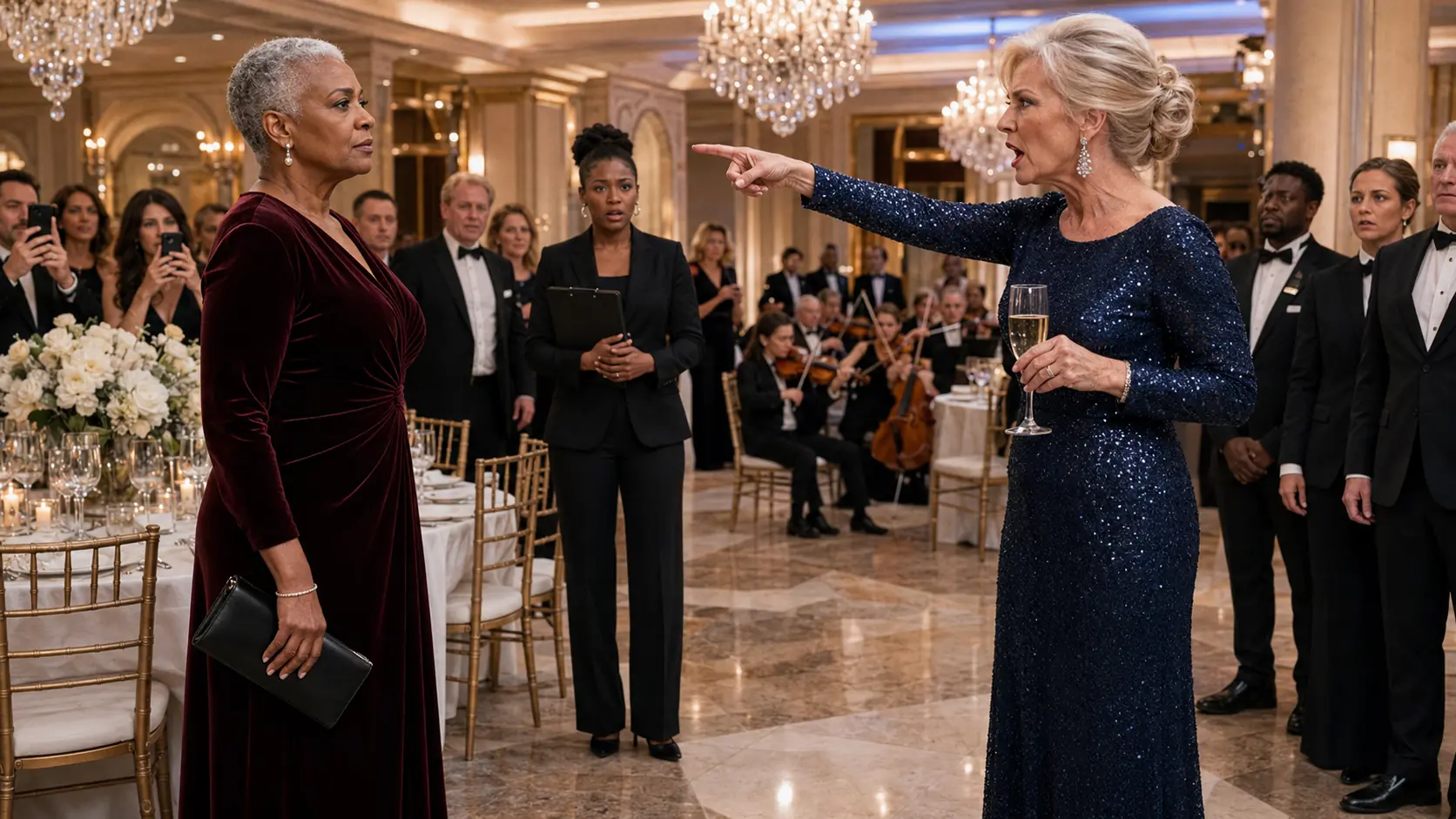
Her voice rang through the polished room.
“Security! Get this woman out of here!”
Dorothy did not flinch.
She reached into her clutch, pulled out the nine-hundred-and-fifty-million-dollar deal contract, and held it out between two fingers.
“In that case,” she said, her voice calm enough to silence the people closest to her, “it seems our partnership won’t be moving forward.”
The moment Dorothy uttered those words, Vivian’s downfall became inevitable.
The ballroom smelled like money.
Not the clean, honest kind.
The kind that had been sitting in the same family for so long it started to smell like old leather and entitlement.
Chandeliers the size of small cars blazed overhead. Waiters in white gloves moved through the crowd like ghosts, refilling glasses that were never quite empty. A string quartet played in the corner, soft, forgettable music meant to make rich people feel cultured.
The Hargrove Charity Gala was the biggest event on Atlanta’s social calendar.
Every year, Sterling Hargrove Sr. threw open the doors of the Ritz-Carlton Grand Ballroom, invited the city’s most powerful people, and reminded everyone exactly who he was.
Tonight, he had more reason than usual to celebrate.
Forty-eight hours.
That was all that stood between Sterling Hargrove and the biggest deal of his life.
Nine hundred fifty million dollars.
A real estate acquisition that would make him the single largest private commercial property owner in the entire American South.
His attorneys had assured him everything was in order. One outstanding signature remained. Some trust administrator, an elderly widow connected to the Whitfield Legacy Trust. A formality. Nothing to worry about.
Sterling worked the room like a man who had already won.
He was tall, silver-haired, and wore his tuxedo like a second skin. His laugh was too loud and his handshakes were too firm. He was the kind of man who made every gesture feel like a performance.
His wife, Vivian, moved beside him in a midnight blue sequined gown. Her silver hair was swept back, her smile sharp enough to cut glass.
Their son, Trip, and his wife, Cassidy, trailed behind them, laughing at the right moments and nodding at the right people.
The Hargroves owned every room they walked into.
Or so they believed.
Dorothy May Whitfield arrived alone.
She came through the main entrance at 8:15, moving without hurry and without fanfare. She was sixty-seven years old, with close-cropped silver hair, warm brown skin, and the kind of posture that came not from arrogance, but from decades of standing straight in rooms that wanted her to shrink.
Her dress was deep burgundy velvet, elegant but not flashy. Pearl earrings. Low heels. A small clutch purse held close at her side.
She looked like exactly what she was.
A woman who had nothing to prove.
At the registration desk, a young staffer scrolled through the guest list with growing nervousness.
“I’m sorry, ma’am. I’m not finding a… can you spell your last name again?”
“Whitfield,” Dorothy said patiently. “It may be listed under the LLC. Whitfield Legacy Trust.”
More scrolling.
An awkward silence stretched out like taffy.
People nearby began to glance over.
That was when Vivian Hargrove spotted her.
Vivian stopped mid-conversation.
She looked Dorothy up and down. The unhurried dress. The modest heels. The woman standing alone at a desk full of confused staff.
A slow smile spread across her face.
She leaned toward Cassidy, not even bothering to lower her voice.
“Good Lord,” Vivian said. “Who let the help wander in from the kitchen?”
She lifted her champagne flute and pointed, actually pointed, at Dorothy.
“Somebody ought to tell her the serving trays are in the back.”
The laughter came fast.
Trip’s shoulders shook.
Cassidy covered her mouth, but her eyes were bright with amusement.
Sterling Sr. glanced over, saw what his wife was doing, and simply turned away.
He did not correct her.
He did not even flinch.
The small cluster of guests nearby went dead quiet.
Naomi Pruitt froze.
She was twenty-four, one of the junior event coordinators for the evening, stationed near the entrance with a clipboard and a lapel mic transmitter clipped to her blazer. She had been doing this job for two years. She had seen rich people be rude before.
But this was different.
This was public.
This was cruel.
And it was loud enough that half the entrance hall had heard it.
Naomi looked at Dorothy, bracing for the reaction.
There was none.
Dorothy’s face did not change.
Not a flicker.
Not a tightening of the jaw.
Not a blink.
She stood at that registration desk with the stillness of someone who had been in worse rooms, faced worse people, and come out the other side.
She looked at the staffer, not at Vivian, not at the laughing cluster, and said simply, “Take your time.”
The staffer finally found the entry.
Dorothy took the badge with steady hands and pinned it to her dress.
It read:
Dorothy M. Whitfield
Whitfield Legacy Trust
Then she walked into the ballroom.
Naomi watched her go, heart hammering, unable to shake the feeling that something enormous had just happened, and that the Hargroves were the only ones in the room who did not know it yet.
Dorothy had taken exactly eleven steps into the ballroom when Reg found her.
Reginald Okafor moved fast for a man in a tuxedo. He was broad-shouldered and dark-skinned, with close-cropped hair going gray at the temples and the kind of face that did not waste expressions on things that did not matter.
He had been Dorothy’s attorney for twenty-two years. He had stood beside her in federal courtrooms, in church basements, in hospital waiting rooms.
He knew her tells.
The slight lift of her chin.
The way her fingers curled when she was containing something.
He gripped her elbow and steered her firmly toward a quiet alcove near the east wall, half hidden behind a column draped in white fabric.
“We have a problem,” he said.
“We have several,” Dorothy replied. “Which one are you referring to?”
Reg did not smile.
“The Hargroves don’t know who you are.”
Dorothy looked at him steadily.
“Explain that.”
He did.
For six weeks, the Hargroves’ legal team had been communicating exclusively with Dorothy’s administrative proxy, a property manager named Gerald, who handled routine trust correspondence.
The attorneys had identified the Whitfield Legacy Trust only by its LLC registration number. They had never once cross-referenced the trustee’s name against a real person.
They assumed, because it was easier, because it fit their worldview, that the person holding the thirty-four percent stake was some distant corporate administrator.
Maybe a bank.
Maybe a hired manager.
Certainly not the woman herself.
They had been chasing a signature without ever looking at whose hand held the pen.
“They have no idea,” Reg said, his voice low and tight. “None. Their lead attorney called Gerald twice this week. Gerald referred them to me. I’ve been returning their calls from a blocked number.”
He paused.
“Dorothy, they spent six weeks trying to pressure a proxy. The actual trustee, you, they have never spoken to directly.”
Dorothy absorbed this without blinking.
Across the room, she could still hear the tail end of Vivian’s laughter.
“And Walter?” she asked.
“That’s the other thing.”
As if on cue, Walter Bains appeared at the edge of the alcove.
He was a heavyset man of sixty-one, with a ruddy face and the permanently worried expression of someone who managed other people’s enormous amounts of money.
He was Meridian Capital’s board chairman, the man whose nine-hundred-and-fifty-million-dollar acquisition depended entirely on the deal closing in forty-eight hours.
He was also, at this particular moment, the color of old chalk.
He had seen what Vivian did at the registration desk.
He had heard every word.
“Mrs. Whitfield,” he said carefully, like a man walking on ice he was not sure would hold, “I want to begin by saying, on behalf of everyone at Meridian, that what just happened at that desk was completely—”
“Mr. Bains,” Dorothy said quietly. “Are you here to apologize, or are you here to confirm that I’m the trustee your partners have been trying to reach?”
A beat of silence.
“Both,” he admitted.
“I know who I am, Walter. The question is whether your partners did.”
Bains opened his mouth, then closed it.
The answer was written all over his face.
They didn’t.
They truly, genuinely did not know.
The woman Vivian Hargrove had just pointed at and mocked in front of a room full of Atlanta’s most powerful people, the woman they assumed belonged in the kitchen, was the sole trustee of the one asset that stood between the Hargrove family and the biggest deal of their lives.
Word was moving through the room now.
Quietly.
The way important information always moved in rooms like this.
A whisper to an attorney.
A murmur between board members.
A glance exchanged across champagne glasses.
The inner circle was beginning to understand.
Dorothy watched it happen.
She saw the moment Trip Hargrove received the news from his legal team across the room. She watched the color leave his face. She watched him turn to look at her, really look at her, for the first time all evening.
She did not look away.
She held his gaze with the same calm, unhurried stillness she had shown at the registration desk.
No anger.
No satisfaction.
Just clarity.
The look of a woman who had known exactly what she was walking into when she pinned on that badge and stepped through those doors.
Trip’s jaw tightened.
He turned away first.
“That’s what I thought,” Dorothy said softly.
Reg stood beside her, watching the room recalibrate in real time.
“Dorothy,” he said quietly. “What do you want to do?”
She straightened her spine, smoothed the front of her burgundy dress with one hand, and picked up a glass of water from a passing tray.
“I’m going to do,” she said, “exactly what I came here to do.”
Sterling Hargrove Sr. crossed the ballroom like a man who had never once been told no.
The crowd parted for him naturally, the way crowds always parted for men like Sterling. He moved with the loose, easy confidence of someone who believed every problem in the world had a price tag, and he had never yet found one he could not afford.
His smile was already deployed before he was halfway across the floor.
Hand extended.
Eyes warm.
Voice ready.
Dorothy watched him come.
She did not move toward him.
She did not adjust her posture.
She did not put down her glass of water.
She simply stood and watched him cross the distance between them.
And by the time he arrived, his hand still outstretched and his smile still gleaming, she had already decided exactly how this would go.
“Mrs. Whitfield,” Sterling said, his voice rich and smooth, like something rehearsed in front of a mirror. “What an absolute honor. I am so sorry about the confusion at the door. Completely unacceptable, and I assure you it will be addressed.”
He said this as though the confusion at the door had been a clerical error and not his wife pointing at a woman and suggesting she belonged in the kitchen.
“We are so glad you’re here tonight.”
Dorothy looked at his outstretched hand.
She did not take it.
“Mr. Hargrove,” she said.
Her voice was pleasant and precise, the voice of a woman who had spent thirty years in courtrooms.
Sterling’s smile flickered, just barely, then reset. He lowered his hand smoothly, as if he had meant to put it in his pocket all along.
He shifted closer, dropping his voice to a confidential murmur, glancing briefly at Reg before deciding to ignore him entirely.
“I’ll be direct with you,” Sterling said. “I respect your time too much for anything else. The Meridian acquisition is forty-eight hours from closing. The offer we’ve structured for the Whitfield Trust is more than generous, considerably above market. Your late husband built something remarkable, and we intend to honor that legacy.”
He paused, letting that land.
“All we need is your authorization. Tonight, if possible, or first thing tomorrow morning at the latest.”
Dorothy listened to all of it without interrupting.
When he finished, she opened her small clutch purse.
Sterling watched with the relaxed expression of a man expecting a pen.
What she produced was not a pen.
It was a single folded document, crisp, precise, prepared.
She held it out to him between two fingers, the way a person hands something to someone she does not particularly want to touch.
Sterling took it and unfolded it.
His eyes moved across the first paragraph.
The smile died.
The document was a formal notice of trust review and withdrawal of good-faith negotiation status.
It was dated three days earlier.
It had been prepared by Reg before Dorothy ever set foot in this ballroom.
Before tonight.
Before the registration desk.
Before Vivian and her champagne glass and her pointing finger.
Dorothy had already made her decision.
She had not come tonight to be persuaded.
She had come to deliver this in person because Calvin had always told her, “When you close a door, close it to someone’s face so they know it’s closed.”
Sterling looked up from the document.
The charm was gone.
What replaced it was something colder and more honest.
“You can’t be serious,” he said.
“I am entirely serious.”
Dorothy’s voice carried.
Not loud, but clear.
Clear enough for the tight circle of board members and attorneys who had drifted closer, sensing something significant.
“Your family’s conduct this evening confirmed everything I needed to know about how the Whitfield Legacy Trust’s assets would be stewarded under your management.”
Sterling’s jaw tightened.
“Mrs. Whitfield, I strongly advise you to think carefully about—”
“I have thought carefully,” she said. “I’ve been thinking carefully for six weeks while your attorneys called my proxy and assumed I wouldn’t notice.”
She paused.
“I noticed everything, Mr. Hargrove.”
Then she turned and walked toward the exit.
The room felt it.
The shift.
The sudden stillness that spreads through a crowd when something irreversible has just happened and everyone present knows it.
Reg fell into step beside her without a word.
Behind them, Walter Bains’s phone rang.
He answered it, listened for four seconds, and closed his eyes.
Without the Whitfield Trust’s thirty-four percent stake, the Meridian board could not proceed. The deal structure required full acquisition.
There was no workaround.
There was no contingency.
Nine hundred fifty million dollars.
Gone.
The sound came from somewhere behind Dorothy.
Sharp.
Sudden.
Unmistakable.
She did not turn around.
She did not need to.
Vivian Hargrove’s champagne glass had slipped from her fingers and shattered on the marble floor.
Dorothy pushed open the grand exit doors and walked out into the Atlanta night without looking back.
The night air hit Dorothy like a relief.
After three hours in that ballroom, the heat of it, the noise of it, the weight of all those watching eyes, the cool Atlanta evening felt like setting down something heavy.
She walked through the Ritz-Carlton’s entrance without slowing, past the valets, past the couple arguing quietly near the fountain, and straight to Reg’s waiting car at the end of the curved drive.
Reg held the passenger door open.
She got in without a word.
He settled into the driver’s seat, loosened his bow tie with one finger, and exhaled slowly.
For a moment, neither of them spoke.
The city hummed around them.
Distant traffic.
A siren somewhere far off.
The muffled bass of music from a bar down the block.
Then Reg started laughing.
It was quiet at first.
Then it was not.
The kind of laugh that comes from somewhere deep, equal parts relief, disbelief, and pure, uncomplicated joy.
“Dorothy,” he managed. “The look on his face when he unfolded that paper.”
“Don’t,” she said.
But the corner of her mouth moved.
“I’m just saying.”
“Reggie.”
He composed himself.
Barely.
He started the car and pulled away from the curb, still grinning.
Dorothy looked out the passenger window at the city sliding past.
The lit-up hotels.
The late-night restaurants.
The ordinary people living their ordinary Friday nights, unbothered by billionaires, broken deals, and marble floors covered in champagne.
She felt something loosen in her chest.
Something that had been wound tight for weeks.
Calvin would have loved tonight.
He would have sat exactly where Reg was sitting, laughing exactly like that.
And then he would have reached over, squeezed her hand, and said the words she could hear so clearly it almost hurt.
That’s my Dorothy.
Cool as January water.
She pressed her fingers lightly against the car window.
“We did it, Cal.”
Reg’s phone rang.
The laughter stopped.
He glanced at the screen, frowned, and answered it on speaker.
“Reg Okafor.”
The voice on the other end was clipped and urgent.
A source inside Meridian Capital, someone Reg had cultivated over years of deal-adjacent legal work.
Dorothy did not know his name.
She had never asked.
“They’re filing tonight,” the voice said. “Emergency motion. Hargrove’s legal team. They’re challenging the trust.”
Reg’s hands tightened on the wheel.
“On what grounds?”
“The original 1987 trust document. There’s a co-trustee clause. It names Franklin Whitfield as required co-signatory on major disposition decisions. They’re saying the 1999 amendment that dissolved it has a technical filing defect. If the challenge holds, Mrs. Whitfield can’t act unilaterally.”
The car felt smaller suddenly.
Dorothy stared straight ahead.
“They’ve been sitting on this,” Reg said.
It was not a question.
“Weeks,” the voice confirmed. “It was their contingency. If she signed, they never needed it. She didn’t sign.”
Another pause.
Heavier this time.
“There’s more. They’ve already contacted Franklin Whitfield directly. They’re offering him four million dollars to file an affidavit supporting their position.”
The silence in the car was total.
Dorothy knew Franklin.
She had known him for forty years.
She had known his resentment, known the way he had sat at Calvin’s funeral with his arms crossed and his jaw set, furious at a dead man for leaving everything to a trust instead of to family.
She had tried in the years since to extend kindness.
It had never quite taken.
Franklin Whitfield was a man who had turned his grief into something with teeth.
And now someone had handed him four million reasons to use those teeth on her.
“Has he agreed?” Reg asked.
“His attorneys filed the affidavit two hours ago.”
Reg ended the call.
For a long moment, the only sound was the car moving through Atlanta streets.
A red light caught them at the corner of Peachtree and Pine.
Dorothy watched a young woman cross in front of the headlights, laughing at something on her phone, completely untouched by any of this.
“They turned it into a weapon,” Dorothy said quietly.
“Yes.”
“The deal isn’t dead. They’re using the legal challenge to try to force my hand.”
“Yes,” Reg said again.
His voice was careful now.
All the laughter from five minutes ago was completely gone.
“If a court finds the co-trustee clause was never properly dissolved, they could seek an injunction freezing the trust’s assets. And if they get Franklin positioned as co-trustee—”
“They get their deal,” Dorothy finished. “Through him.”
The light turned green.
Dorothy looked out the window at the city her husband had loved and built and refused to abandon, even when it was hard.
“Take me home, Reg,” she said quietly. “We have work to do.”
Calvin had built the brownstone with his own hands.
Not entirely.
He had help.
Friends from the congregation, men who showed up on Saturdays with tool belts and covered-dish suppers their wives sent along.
But the foundation decisions, the framing choices, the details that made a house a home, those had been Calvin’s.
The wide crown molding.
The built-in bookshelves lining the study walls.
The kitchen window positioned precisely to catch the morning light over the backyard garden.
Dorothy had lived there for thirty-eight years.
She knew every creak in every floorboard.
By six o’clock in the morning, the dining room table was buried under paper.
Reg had arrived at dawn with two trust law specialists.
A sharp-eyed woman named Patricia Hwang and a quiet, methodical man named Bernard Cole.
Both carried laptops and the particular focused energy of people who understood they were behind.
Four banker’s boxes of trust documentation sat stacked against the wall.
Two laptops glowed open.
Three empty coffee cups had already accumulated near the window.
Dorothy sat at the head of the table in a pressed blouse and reading glasses, looking like exactly what she was.
A woman who had been awake since before anyone else arrived and had already read more than any of them.
Patricia spread the documents across the table and did not waste time.
“The co-trustee clause is real,” she said. “It’s in the original 1987 document, section four, subsection C. Calvin named his brother Franklin as required co-signatory on any major disposition decision, defined as any transaction exceeding two hundred fifty thousand dollars.”
She tapped the page.
“The 1999 amendment was clearly intended to dissolve it. Calvin’s intent is not in question, but the amendment was filed with a technical defect. The notarization references the wrong county recorder’s office. Under strict reading of Georgia trust law, that defect is arguable.”
“How arguable?” Dorothy asked.
“Arguable enough to litigate,” Bernard said. “Not a slam dunk for the Hargroves, but enough to get in front of a judge.”
Reg leaned forward.
“And if they get in front of a sympathetic judge and succeed?”
“Then the court issues a temporary injunction freezing the trust’s assets while the co-trustee question resolves. That process takes months. Six, maybe eight.”
Patricia paused.
“During that window, the court could appoint a receiver to manage trust operations.”
The word sat on the table like something no one wanted to touch.
A receiver.
A court-appointed outsider handed the keys to everything Calvin built.
Someone with no loyalty to Dorothy.
No understanding of what the trust represented.
No reason to refuse a nine-hundred-and-fifty-million-dollar offer from a well-resourced family with excellent attorneys and a very persuasive checkbook.
“And Franklin,” Dorothy said. “Walk me through what he actually filed.”
Bernard pulled the affidavit.
“He’s affirming the Hargroves’ position, stating that to his knowledge, the co-trustee clause was never properly dissolved, and that he believes he retains legal standing as co-signatory.”
He set the paper down carefully.
“He’s not lying, exactly. He genuinely may not know about the amendment, or he’s choosing not to know.”
Dorothy removed her reading glasses and set them on the table.
She had known Franklin Whitfield since she was twenty-six years old.
She had watched him stand at the back of the church at her wedding with his arms folded, like a man attending something he had been dragged to. She had watched him and Calvin argue at Thanksgiving tables, reconcile at Easter dinners, and argue again.
She had watched him sit at Calvin’s funeral with dry eyes and a clenched jaw.
And she had understood, even then, even in her own grief, that Franklin’s anger was really just love with nowhere to go.
That did not make what he was doing acceptable.
It just made it human.
And humans, Dorothy knew, could be reasoned with.
Or they could be defeated in court.
Either way, she intended to handle it.
“What do we need?” she asked.
“Time,” Patricia said. “And anything that corroborates Calvin’s intent to dissolve that clause. Correspondence, notes, anything from the original trust attorney.”
“The attorney died in 2008,” Reg said.
“His files didn’t,” Dorothy replied.
Everyone looked at her.
“Gerald has the archive contact for the estate. Calvin was meticulous. If he directed that amendment, he wrote it down somewhere first.”
She stood, smoothing her blouse.
“Find it.”
The room went back to work.
That evening, after everyone had gone, Dorothy sat alone in Calvin’s study.
The bookshelves surrounded her like old friends.
His photograph watched her from the corner of the desk.
That wide, easy smile.
The one that had made her say yes forty years ago without a moment’s hesitation.
She picked it up with both hands.
“I need you to have been smarter than them, Cal. Please.”
She set it down gently, straightened her spine, and walked back to the war room.
The fight had only just begun.
The call came in on a Tuesday.
Reg was at the dining room table, buried in trust law precedents, when his assistant forwarded the message through the firm’s public line.
A young woman named Naomi Pruitt was asking to speak with someone on Dorothy’s legal team.
She said it was about the gala.
She said it was important.
Reg called her back within the hour.
He listened for four minutes without interrupting.
Then he said, “Don’t talk to anyone else. Don’t send anything to anyone else. I’ll meet you this afternoon.”
He hung up and looked at Dorothy across the table.
“You remember the young woman from the registration desk? The event coordinator?”
Dorothy looked up from her reading glasses.
“The one with the clipboard? She had a lapel mic.”
They met at a coffee shop six blocks from the brownstone.
Nothing fancy.
The kind of place with mismatched chairs and a chalkboard menu and regulars who minded their own business.
Naomi was already there when they arrived, seated in the back corner with both hands wrapped around a coffee cup she clearly was not drinking.
She was twenty-four, neatly dressed, with careful eyes that moved to the door the moment they walked in.
She stood when she saw Dorothy.
“Mrs. Whitfield?”
Her voice was steady, but her hands were not.
“I wasn’t sure if I should call. I almost didn’t.”
“But you did,” Dorothy said simply.
She sat down across from her.
“Tell me what you have.”
Naomi explained it carefully.
Her role that evening required her to carry a lapel mic transmitter, standard equipment for the gala’s audio setup. The Hargrove Family Foundation recorded every annual gala for two purposes: a highlight broadcast sent to major donors, and an archived record for the foundation’s internal use.
The transmitter on Naomi’s lapel fed directly into the gala’s main audio system.
It was live from the moment she clipped it on at seven until she removed it at midnight.
She had been standing six feet from Vivian Hargrove when it happened.
Every word was on tape.
Reg leaned forward slowly.
“The foundation archives this audio?”
“Yes. The production company they hire keeps a full unedited master recording. I still have my copy of the transmitter log. It shows my unit was active and feeding to the main board the entire evening.”
Naomi pulled a folded piece of paper from her jacket pocket and slid it across the table.
“That’s the production company’s contact and the archive reference number. The recording hasn’t been edited or deleted. I checked yesterday.”
Reg picked up the paper and read it twice.
Dorothy watched him.
She recognized the look on his face.
The particular stillness of a man who had just found something significant and was working very hard not to show how significant it was.
“Naomi,” he said carefully. “Does anyone else know you have this?”
“No.”
“Has anyone from the Hargrove organization contacted you since the gala? About the audio, about anything?”
“No,” Naomi said. “They don’t know I know. I don’t think they even thought about the recording.”
That was the thing about people like the Hargroves, Dorothy thought.
They said whatever they wanted, whenever they wanted, to whoever was standing nearby.
Because they had spent their entire lives in rooms where no one with less power ever pushed back.
It never occurred to them to be careful.
Why would it?
Nothing had ever cost them anything before.
Back at the brownstone that afternoon, Reg contacted the production company directly and initiated the formal authentication process for the archive recording.
By evening, they had a confirmed copy.
Crystal-clear audio.
Timestamp verified.
Vivian’s voice unmistakable.
The laughter of Trip and Cassidy and the rest of the cluster captured in full.
Reg sat back in his chair and rubbed his face with both hands.
“This isn’t just optics,” he said. “This is evidence. The Hargroves’ entire legal narrative depends on framing Dorothy as an irrational actor, an elderly widow manipulated by her attorneys into blocking a deal that would benefit the trust. This recording destroys that narrative. It establishes that on the same evening they were seeking her signature, their family publicly humiliated her based on her race and her age.”
He looked at Dorothy.
“That goes to intent. It goes to the hostile environment surrounding their so-called good-faith negotiation. It supports a discrimination claim that could reframe this entire legal battle.”
Dorothy had listened to the recording once, sitting very still, hands folded in her lap, eyes closed.
When it ended, she sat quietly for a moment.
Then she opened her eyes.
“File it,” she said.
Reg nodded and reached for his phone.
Dorothy turned to Naomi, who was standing near the doorway, uncertain whether she still belonged in the room.
“You didn’t have to do this,” Dorothy said.
Naomi looked at her.
“Yes, I did,” she said simply. “Somebody had to.”
The story broke on a Wednesday morning.
Dorothy’s phone started ringing before seven.
She was already up.
She had not slept past 5:30 in twenty years.
She was standing at the kitchen window with her first cup of coffee, watching the garden in the early gray light.
The first call was from Reg.
The second was from a number she did not recognize.
She let that one go to voicemail.
By 7:30, she had listened to the voicemail and understood exactly what the Hargroves had done.
The story had been placed in three financial publications simultaneously.
The kind of coordinated leak that required a public relations firm and a deliberate strategy.
The framing was careful and cruel in equal measure.
An elderly widow, possibly under undue influence from her personal attorney, is blocking a landmark acquisition that legal experts say would deliver significant financial benefit to trust stakeholders.
One publication used the phrase, “Sources close to the negotiations suggest Mrs. Whitfield may not fully understand the complexity of the transaction.”
May not fully understand.
Dorothy set her coffee cup down on the counter with a precise, controlled movement.
She understood perfectly.
By nine o’clock, the story had national pickup.
A financial cable network ran a three-minute segment.
The chyron at the bottom of the screen read:
Billion-Dollar Deal in Jeopardy Over Disputed Trust
They did not mention Vivian’s comments at the gala.
They did not mention six weeks of pressure through a proxy.
They did not mention four million dollars paid to Franklin Whitfield.
They mentioned only an elderly widow, a blocked deal, and unnamed sources expressing concern about undue influence.
Dorothy’s grandchildren called within the hour.
Her granddaughter Maya, twenty-six and furious on her grandmother’s behalf, called from Chicago barely holding herself together.
“Grandma, they’re making you sound like you don’t know what you’re doing. They’re making it sound like Reg is taking advantage of you.”
“Maya,” Dorothy said calmly, “I know exactly what they’re doing.”
“Then what are we going to do about it?”
“We are going to let them finish,” Dorothy said. “And then we are going to answer.”
She hung up and called Reg.
The reporter was waiting outside the courthouse at 11:15.
Dorothy had gone with Reg to file a routine procedural document.
Forty minutes, in and out.
The reporter was young, aggressive, and had clearly been tipped off about their arrival time.
He stepped directly into Dorothy’s path with a microphone and a camera operator behind him.
“Mrs. Whitfield, can you respond to reports that your attorney may be influencing your decision to block the Meridian acquisition against the interests of trust beneficiaries?”
Dorothy stopped walking.
Reg put a hand on her arm.
“Dorothy.”
She looked at the reporter with the same calm, steady expression she had worn at the registration desk five days earlier.
“No comment today,” she said pleasantly.
Then she walked around him.
It was the right call.
She knew it was the right call.
But the camera caught her face, composed, unhurried, giving nothing away.
And she knew that composure would be reframed as arrogance by afternoon.
She was right.
Trip Hargrove arrived at the brownstone at two o’clock without calling ahead.
Dorothy answered the door herself.
He stood on her front porch in a charcoal suit that cost more than most people’s monthly rent. One hand in his pocket, his expression arranged into something approximating concern.
He was polished.
Rehearsed.
Every inch his father’s son.
“Mrs. Whitfield, I apologize for coming unannounced. I was hoping we could talk. Just the two of us. No attorneys, no formalities.”
Dorothy looked at him for a moment.
Then she stepped back from the door.
“Come in.”
She led him to the front sitting room.
Not the war room.
Not Calvin’s study.
The formal room with stiff furniture and family photographs on the wall.
The room that said, you are not trusted here.
Trip sat without being invited and looked around with the evaluating eyes of a man pricing real estate.
“I’ll be honest with you,” he said. “I think you’ve been given bad advice. Reg Okafor is a fine attorney, but this situation has grown beyond a simple trust dispute. There are beneficiaries with real financial interests at stake. People who want this deal.”
He leaned forward slightly.
“I think you’re a smart woman who deserves to understand what prolonged litigation actually looks like. Years, Mrs. Whitfield. Years of legal costs, frozen assets, public scrutiny.”
He let that sit.
“Or we resolve this cleanly this week, and everyone walks away whole.”
It was smooth.
It was threatening.
It was dressed up in the language of concern without a single genuine word in it.
Dorothy stood.
“Can I get you some coffee, Mr. Hargrove?”
Trip blinked.
“I… no, thank you. I—”
“Then let me show you out.”
She walked him to the door without raising her voice.
The moment it closed behind him, she picked up the phone.
“Cecilia,” she said when her oldest friend answered. “It’s time.”
The discovery happened at 11:47 at night.
Dorothy knew the exact time because she had checked the clock on the study wall thirty seconds before Bernard called out from the dining room.
His voice carried a controlled urgency that made everyone still look up from what they were doing.
“Reg. Come look at this.”
It had been a long three days since Trip’s visit.
The war room had not emptied.
Patricia and Bernard had essentially moved in. Their jackets hung over the dining room chairs. Their takeout containers stacked up in the kitchen trash. Their laptops ran searches through Georgia trust law archives at hours when sensible people were asleep.
Reg had been working eighteen-hour days.
Dorothy had matched him hour for hour without complaint.
They were chasing one specific thing: any documentation from Calvin’s original trust attorney, a meticulous, old-school lawyer named Harold Greer, who had retired in 2004 and died four years later.
They needed anything that corroborated Calvin’s intent to dissolve the co-trustee clause before the 1999 amendment was filed.
Harold Greer’s physical files had passed to his estate and then to a document storage company in Decatur. Getting access had required three phone calls, two signed release forms, and a courier fee that Reg paid without blinking.
The boxes had arrived that afternoon.
Six of them.
Packed with the accumulated paperwork of a forty-year legal practice.
They had been working through them for seven hours.
Bernard had found it in box four.
It was a single page, cream-colored stationery with Calvin’s handwriting, that distinctive, deliberate script Dorothy would have recognized anywhere.
Each letter formed with the careful precision of a man who believed that how you wrote something said something about how seriously you meant it.
Dated March 3, 1999.
Two weeks before the amendment was filed.
Dear Harold,
I am writing to formally direct you to dissolve the co-trustee clause in section four, subsection C, of the Whitfield Legacy Trust document dated 1987.
My brother Franklin is no longer in a position to serve in this capacity, and it is my clear and considered intention that Dorothy Mae Whitfield shall serve as sole trustee with full authority over all trust decisions without requirement of co-signature.
Please file the appropriate amendment at your earliest convenience and confirm completion in writing.
The trust is Dorothy’s. It has always been Dorothy’s.
Please make the paperwork reflect what has always been true.
In faith,
Calvin J. Whitfield
The letter was notarized.
Witnessed by two signatures Dorothy recognized.
Deacons from Calvin’s church.
Both still living.
Reg read it standing up, one hand flat on the dining room table.
He read it twice.
Then he straightened slowly and looked at Dorothy.
She was standing in the doorway of the dining room in her robe, reading glasses pushed up on her forehead.
She had come downstairs when she heard Bernard’s voice.
Reg held the letter out to her without speaking.
She took it and read it once.
The room was completely quiet.
The trust is Dorothy’s. It has always been Dorothy’s.
She had to take her glasses off, just for a moment, just long enough to press two fingers to the bridge of her nose and breathe.
Calvin had written those words twenty-six years ago in his careful, deliberate hand to a lawyer who kept meticulous records.
And those records had sat in a storage box in Decatur, waiting patiently for exactly this moment.
As if he had known.
Dorothy was not a superstitious woman.
But she felt this in her chest like a hand pressed warm against her sternum.
As if he had prepared for this fight long before either of them could have imagined it was coming.
“He always was thorough,” she said softly.
“This is dispositive,” Patricia said from across the table, her voice carefully professional but with an unmistakable current of excitement running beneath it. “The technical defect in the amendment becomes nearly irrelevant in the face of this letter. No judge weighing Calvin Whitfield’s unambiguous, witnessed, notarized written instruction to his attorney is going to rule that a county recorder notation error overrides documented intent. This changes everything.”
“It doesn’t just change the hearing,” Reg said. “It changes their entire position. The foundation of the Hargroves’ legal challenge is that the co-trustee clause was never properly dissolved. This letter proves Calvin dissolved it in his own words before the paperwork was ever filed.”
Bernard was already photographing the document for the digital archive.
Reg looked up.
“We file this first thing tomorrow.”
Dorothy nodded.
She folded the letter carefully, the way a person handles something irreplaceable, and held it against her chest for just a moment before setting it on the table.
Reg opened the cabinet above the kitchen counter and produced a bottle of good bourbon that had been waiting there since the first day of the war room.
He poured four glasses without asking.
He handed Dorothy hers and raised his own.
“Calvin,” he said simply.
Dorothy touched her glass to his.
“Calvin,” she said softly.
The courthouse was quiet at eight in the morning.
That particular kind of quiet that only exists in public buildings before the day fully starts.
Echoing footsteps.
Distant printers.
The smell of old carpet and recycled air.
Dorothy walked through the main corridor beside Reg with the measured pace of someone who had spent thirty years inside buildings exactly like this one.
She knew how to move through a courthouse.
She knew how to breathe in one.
Patricia and Bernard were already at the courtroom doors when they arrived.
Judge Drummond had come, too.
Not in any official capacity.
Simply as a sixty-seven-year-old woman who had watched her closest friend fight too hard and too long to miss the moment it mattered.
She stood near the window at the end of the corridor in a charcoal blazer.
When Dorothy approached, she simply took her hand and held it for three seconds without saying a word.
That was enough.
The hearing began at nine sharp.
The presiding judge was the Honorable Marcus Webb, sixty-two, silver-haired, with the unhurried deliberateness of a man who had heard every legal argument at least twice and was no longer impressed by volume or confidence.
He had a reputation for patience and an even shorter one for tolerating nonsense.
Reg argued first.
He laid it out methodically.
The 1987 trust document.
The 1999 amendment.
The technical filing defect the Hargroves had identified.
And then Calvin’s letter.
He presented the original document, the notarization, and the two witness signatures. Both deacons were still living and available to testify.
Then he read the critical line directly into the record.
“The trust is Dorothy’s. It has always been Dorothy’s.”
He let it sit in the courtroom air for a full three seconds before moving on.
Then he presented the authenticated gala recording.
He did not editorialize.
He simply informed the court that on the evening the Hargrove family was seeking Dorothy’s signature on a major financial transaction, their family publicly subjected her to racial and age-based humiliating remarks in front of witnesses.
The recording had been submitted as part of a formal discrimination complaint filed with the DOJ Civil Rights Division.
He noted this went directly to the question of whether the Hargroves’ negotiation had ever been conducted in good faith.
Judge Webb listened to the recording excerpt without expression.
He wrote something down.
The Hargroves’ lead attorney, a tall, silver-suited man named Douglas Fitch, who carried himself like someone accustomed to winning, rose and delivered his counterargument with the polished confidence of a man billing eight hundred dollars an hour.
The filing defect was real.
The amendment was legally imperfect.
Franklin Whitfield’s standing as co-trustee had never been properly extinguished under the strict letter of Georgia trust law.
Calvin’s letter, Fitch argued, was a personal instruction to an attorney, not a legal instrument, and could not substitute for properly executed documentation.
It was a competent argument.
But Judge Webb kept returning to Calvin’s letter.
He asked Fitch three questions about it, each one sharper than the last.
He asked whether the Hargrove position required the court to believe that a notarized, witnessed, written instruction from a trust’s creator to his own attorney, explicitly stating his intent and direction, should be legally subordinate to a county recorder notation error.
Fitch said, “Yes. With respect, Your Honor, yes.”
Judge Webb wrote something else down.
The session concluded at 11:30.
No immediate ruling.
Judge Webb stated he required time to review the complete record. Both parties would receive written notice within five business days.
In the corridor afterward, Fitch gathered his files without making eye contact with anyone on Dorothy’s team.
That told Reg everything he needed to know.
By evening, the war room felt different.
Dorothy’s granddaughter Maya had driven down from Atlanta’s north side with two bunches of flowers from the farmers market.
Sunflowers, because she remembered they were Calvin’s favorite.
She put them in the big Mason jar on the kitchen counter and stood on her toes to hug Dorothy for a long time without saying anything.
Reg had opened another bottle.
Judge Drummond sat in her usual armchair and declared with the authority of someone who had presided over hundreds of hearings that the judge’s questions to Fitch were not the questions of a man who planned to rule against them.
Dorothy sat in the garden as the last of the summer light faded over Calvin’s roses.
The evening was warm and still.
Somewhere down the block, a neighbor was grilling, and the smell drifted over the fence and mixed with the roses in the cooling air.
For the first time in two weeks, Dorothy Whitfield allowed herself to feel something close to peace.
She closed her eyes and turned her face toward the last of the light.
“Almost, Cal. Almost.”
The ruling arrived on a Friday afternoon.
Reg received it by electronic filing at 2:17.
Dorothy was in the kitchen making tea when she heard his chair scrape back hard against the dining room floor.
The sound of a man who had stood up without meaning to.
She set the kettle down and walked to the doorway.
Reg was standing at his laptop, perfectly still, reading.
She knew from his stillness that it was not good.
He read it to her straight.
No softening.
No preamble.
Because Dorothy had never once in twenty-two years asked him to soften anything, and he respected her too much to start now.
The judge found the technical defect question too complex for summary resolution.
A full evidentiary hearing would be required.
The court needed testimony from both living witnesses to Calvin’s 1999 letter, a deposition from Franklin Whitfield, and expert analysis of the filing defect under Georgia trust law.
The hearing was scheduled for six weeks from Monday.
Six weeks.
The injunction request, the Hargroves’ attempt to freeze the trust’s assets immediately, was neither granted nor denied.
The trust would remain in operational limbo pending the full hearing.
Dorothy retained day-to-day management authority, but no major transactions could proceed.
“It’s not a loss,” Patricia said carefully, looking at Dorothy from across the table. “The injunction wasn’t granted against you.”
Reg’s phone buzzed.
He looked at the screen.
Something moved across his face that Dorothy had seen only twice before in twenty-two years.
Once when Calvin died.
Once when a case they had worked on together for three years collapsed on the morning of closing arguments.
“What?” Dorothy said.
Not a question.
A demand.
Reg turned the phone so she could see the filing notification.
Franklin Whitfield had filed a separate civil action.
Bernard pulled up the filing within minutes and read it aloud in the flat, careful voice of someone delivering a medical diagnosis.
Franklin’s suit alleged that Dorothy had mismanaged the Whitfield Legacy Trust since Calvin’s death, citing three specific property decisions she had made in the past five years as evidence of negligent stewardship.
The suit requested the immediate appointment of a court-appointed receiver to administer all trust assets pending resolution of both the co-trustee dispute and the new mismanagement claims.
The room went silent.
Patricia was the first to speak.
“The mismanagement claims are thin. The three decisions he’s citing were all sound. We can defend every one of them with documentation.”
“The claims don’t have to win,” Reg said.
His voice was flat.
“They just have to be plausible enough for a judge to consider the receivership request. And right now, with the co-trustee question already in front of the court…”
He stopped and pressed his fingers to his forehead.
“A judge looking at two simultaneous disputes about the trust’s validity and management might decide a neutral receiver is the tidiest solution while everything resolves.”
“And the receiver,” Dorothy said quietly, “would be court-appointed, outside your control, under pressure from the most well-resourced party in the room.”
Reg looked at her.
“Dorothy, if they get a receiver appointed before the evidentiary hearing—”
“They get their deal,” she said. “Through the receiver. Without my signature.”
It was the same conclusion she had reached in the car three weeks earlier, on the night it all started.
But hearing it now, after Calvin’s letter, after the hearing that had felt so promising, after Maya’s sunflowers sitting in the Mason jar on the kitchen counter, it landed differently.
Reg laid it all out with the honesty she had always demanded from him.
The receivership motion would be heard within two weeks.
Their grounds for opposing it were strong but not airtight.
Franklin’s mismanagement claims were thin but not dismissible.
The Hargroves’ legal team was large, experienced, and financially inexhaustible.
They could file motions faster than Dorothy’s team could answer them.
“We can fight it,” Patricia said. “We will fight it.”
“I know,” Dorothy said.
She excused herself.
She walked to the kitchen, stood at the sink, and looked out the window at Calvin’s garden.
The roses needed deadheading.
She had been meaning to do it for two weeks and had not found the time.
Small things.
The small things kept slipping away while the big ones demanded everything.
Sixty seconds.
She allowed herself exactly sixty seconds.
The sound of the kettle beginning to whisper on the stove.
The late afternoon light moving through the window.
The weight of it pressing down on her shoulders like something physical.
Then she turned off the kettle, straightened her back, and walked to the doorway.
“Leave me alone tonight,” she said to the room. “All of you.”
She said it gently.
They understood.
One by one, they gathered their things.
Reg was the last to leave.
He paused at the front door and looked back at her, standing in the hallway of the home Calvin built, surrounded by Calvin’s books, Calvin’s molding, and Calvin’s careful, loving choices.
“Dorothy.”
“Good night, Reg,” she said.
He left.
The house settled into silence around her.
She walked to Calvin’s study, turned on the small lamp on his desk, and sat down in his chair.
The banker’s boxes were still stacked against the wall.
The ones they had not fully searched yet.
The ones she had been avoiding because going through Calvin’s things still felt, even now, like a loss she had not finished absorbing.
She pulled the first box toward her and began to read.
The clock on the study wall read 4:17 when Dorothy found it.
She had been reading for hours.
The house was completely dark outside the small circle of the desk lamp.
That particular total darkness that only comes in the hours before dawn, when the city finally stops pretending to sleep and actually does.
Her tea had gone cold.
Her reading glasses had left small red marks on the bridge of her nose.
Three boxes sat emptied on the floor beside her, their contents sorted into careful piles across Calvin’s desk.
She almost missed it.
The folder was plain manila, unmarked except for Calvin’s handwriting on the tab.
Small, precise letters that simply read:
HUD 1991
It had been tucked flat against the bottom of the fourth box beneath a stack of old correspondence and a rolled-up set of property blueprints.
She had pulled it out because she pulled everything out.
Because Calvin had taught her, by example for forty years, that the most important document in any stack was almost always the one that looked the least important.
She opened it.
The file was thick.
Forty, maybe fifty pages of carefully organized documentation.
Property records.
Handwritten notes.
Photographs of storefronts and residential lots.
Pages of typed testimony summaries.
Federal correspondence stamped with the HUD regional office seal.
Dorothy read the cover page twice.
In the late 1980s, before Reverend Calvin J. Whitfield became known primarily as a developer and community leader, he had worked as a registered civil rights investigator in partnership with the Department of Housing and Urban Development’s Atlanta Regional Office.
Dorothy had known this.
She had been proud of it.
What she had not known, or had not known in this specific detail, was what he had documented.
Between 1988 and 1992, a company called Hargrove Southern Development had acquired seventeen properties across three Atlanta neighborhoods: Vine City, Mechanicsville, and the West End.
All seventeen acquisitions involved elderly homeowners.
All seventeen closed at prices ranging from thirty to forty-two percent below independently assessed market value.
Calvin had documented how it worked.
First came the liens.
Manufactured or exaggerated code violations filed with the city, creating legal clouds on the properties that made them difficult to sell to anyone else and expensive to fight.
Then came the letters.
Official-looking correspondence implying the homeowner faced serious legal exposure if they did not act quickly.
Then the offer.
Arriving in the window of maximum fear and confusion, dressed up in the language of rescue.
We can take this problem off your hands.
Calvin had names.
He had dates.
He had the offers documented alongside the actual market assessments.
He had testimony from nine homeowners, seven of them women, six of them over sixty, describing in their own words how the process had felt.
Like drowning.
Like being held underwater by someone smiling at you.
And at the top of the chain, named directly in Calvin’s summary report, was Sterling Hargrove Sr.
Not a subsidiary.
Not a manager acting without oversight.
Sterling himself.
His signature on acquisition authorizations.
His name on the corporate filings.
His fingerprints on seventeen stolen properties in the neighborhoods where Dorothy now lived and worked and tended the roses Calvin had planted.
The HUD file had been submitted to the regional office in March of 1991.
Calvin had followed up twice.
There was a response acknowledging receipt.
Then nothing.
The file had been received, logged, and buried.
The way inconvenient things were buried when powerful people had the right friends in the right offices.
But Calvin had kept his copy.
Of course he had.
Dorothy sat in the silence of the study for a long time.
The clock moved to 4:30.
Then 4:45.
The first gray suggestion of dawn began at the edge of the curtains.
She thought about seventeen families.
Elderly people.
Most of them gone now.
People who had saved for decades to own something, to have something permanent to pass to their children, and who had been systematically maneuvered out of it by a company that understood exactly what it was doing and did it anyway.
She thought about Sterling Hargrove Sr. standing in a charity ballroom, working the crowd, performing generosity for an audience.
She thought about Vivian’s pointing finger.
Somebody ought to tell her the serving trays are in the back.
She thought about Calvin, her meticulous, deliberate, thoroughly prepared Calvin, tucking this folder flat against the bottom of a box where it would survive everything, wait for everything, and be found when it was needed.
He had known.
He had documented it.
He had made sure it would never disappear.
Dorothy took off her reading glasses, pressed her fingers against her eyes, and breathed.
Then she picked up the phone and called Reg.
It was 4:50 in the morning.
“I found something,” she said when he answered on the second ring.
“How bad?”
Dorothy looked down at Sterling Hargrove’s name, written in her husband’s careful hand thirty-five years earlier.
“For them?” she said quietly. “Very.”
Reg arrived at 5:15 with his tie undone and his laptop under his arm.
By 6:00, Judge Drummond was at the kitchen table with both hands wrapped around a mug of coffee, reading Calvin’s HUD file with the focused stillness of a retired judge who understood exactly what she was looking at.
By 8:00, Patricia and Bernard had arrived.
By 10:00, Dorothy had made four phone calls, and the dining room table looked like a command center in the final hours before a major operation.
Nobody had slept.
Nobody mentioned it.
The first order of business was authentication.
Bernard spent ninety minutes on the phone with the HUD regional archive office in Atlanta, cross-referencing Calvin’s file against the federal record.
The original submission still existed.
Logged.
Dated.
Preserved in the federal system exactly as Calvin had filed it in March of 1991.
Every property record, every testimony summary, every piece of documentation in Calvin’s copy had a corresponding entry in the federal archive.
Calvin’s file was not just credible.
It was federally corroborated.
Bernard set the phone down and looked at Reg.
“It’s clean. Every page checks out.”
Reg nodded once.
“Then we move.”
Dorothy directed the strategy herself.
She stood at the head of the dining room table, not sitting, standing, and laid it out with the precision of someone who had spent thirty years building cases in federal courtrooms.
Her voice was calm.
Her instructions were exact.
The team around her moved accordingly.
First, the DOJ complaint.
Reg drafted it that morning, a formal submission to the Civil Rights Division of the Department of Justice, documenting the HUD file’s contents, Calvin’s original investigation, and the clear pattern of housing discrimination conducted by Hargrove Southern Development between 1988 and 1992.
The complaint named Sterling Hargrove Sr. directly.
It identified all seventeen affected properties and requested a formal investigation into historical discriminatory acquisition practices, with assessment for potential federal remediation of affected families or their heirs.
Dorothy reviewed every paragraph before Reg filed it electronically at 11:43.
Second, the legal counteroffensive.
Patricia filed the cross-claims in the civil action before noon.
The first cross-claim targeted Franklin Whitfield, citing breach of fiduciary duty based on his brief designation as a contingent trust beneficiary, which carried with it a legal obligation of good faith toward the trust and its primary trustee.
The second and third cross-claims targeted the Hargrove legal team directly.
Tortious interference with the trust’s operations.
Abuse of process in the filing of the receivership motion.
Naomi’s authenticated gala recording was formally attached to the DOJ discrimination complaint as supporting evidence, establishing the Hargrove family’s demonstrated attitude toward elderly individuals on the same evening they were seeking Dorothy’s signature.
Third, the press.
Dorothy had thought carefully about this one.
She did not want a tabloid.
She did not want outrage-driven social media.
She wanted a journalist who understood what this story actually was.
Not a dramatic gala moment, but a thirty-five-year arc of exploitation, documentation, survival, and reckoning.
She found him through Judge Drummond, who had crossed paths with him during a housing discrimination case three years earlier.
His name was David Osei, a veteran investigative journalist at a major national newspaper with a decade of work on redlining and predatory real estate practices in American cities.
He arrived at the brownstone at two in the afternoon, sat across from Dorothy at the kitchen table, and listened for ninety minutes without writing a single note.
Then he opened his notebook.
“Mrs. Whitfield,” he said, “I’ve been covering stories like this for ten years. I’ve never had one with documentation like this.”
“My husband was thorough,” Dorothy said.
By four in the afternoon, everything was filed, authenticated, and in motion.
Reg stood back from the table and looked at what they had built in twelve hours.
The DOJ complaint.
The cross-claims.
The press briefing.
The evidentiary package combining Calvin’s HUD file, the notarized 1999 letter, and the authenticated gala recording into a single comprehensive record of who Sterling Hargrove Sr. was, what his family had done, and what it had cost real people across three decades.
Judge Drummond stood in the kitchen doorway with her second coffee and surveyed the room with the quiet satisfaction of someone watching a very long game reach its final moves.
Dorothy prepared her statement at the dining room table, writing it by hand first, the way she always had, in the same deliberate script Calvin had loved.
She wrote it once.
Read it back.
Changed two words.
Reg watched her and asked quietly whether she wanted him to deliver it instead.
She looked up from the paper.
“Calvin documented this for thirty-five years,” she said. “I’m going to be the one who says it out loud.”
She set down her pen, straightened the page, and looked out the window at the garden.
Tomorrow morning.
The courthouse steps.
She was ready.
The Atlanta morning was clear, bright, and sharp.
The kind of October morning that felt like the city had been scrubbed clean overnight.
Blue sky.
Cool air.
The trees along the courthouse block beginning to turn at the edges.
Dorothy stood in front of the mirror in her bedroom at 7:15 and dressed with the same deliberate care she had brought to every significant moment of her professional life.
Dark navy suit.
White blouse.
Pearl earrings.
The small gold pin Calvin had given her on their twentieth wedding anniversary.
A tiny scales of justice.
Because he had known her that well.
She looked at herself in the mirror for a long moment.
Then she picked up her statement, folded it once, and put it in her jacket pocket.
By 8:30, a modest crowd had gathered on the courthouse steps.
It had grown by the time Dorothy arrived at 8:50.
Press.
Attorneys.
A cluster of onlookers who had seen the financial news coverage and understood that something consequential was happening.
Three television cameras.
Two radio recorders.
David Osei standing to one side with his notebook, watching everything.
Dorothy walked through the gathering without hurrying.
Reg was on her left.
Judge Drummond was on her right.
Naomi stood slightly behind, back straight, chin up.
The witness who had refused to look away, now present for what that refusal had helped build.
Dorothy stepped up to the podium.
She did not tap the microphone.
She did not shuffle papers.
She did not clear her throat.
She simply placed her statement on the podium, looked out at the crowd with calm, steady eyes, and began.
Her voice carried without effort.
“My name is Dorothy May Whitfield. I am the sole trustee of the Whitfield Legacy Trust established by my late husband, Reverend Calvin J. Whitfield, in 1987. I am here this morning to address three matters of public record.”
She paused.
Let the quiet work.
“First, on the evening of October 9th, at the Hargrove Family Foundation annual gala, Vivian Hargrove publicly directed discriminatory remarks at me about my race and my age in front of witnesses while her family was actively seeking my signature on a major financial transaction.”
Dorothy’s voice did not waver.
“Those remarks were recorded. That recording has been authenticated and submitted as evidence in a formal complaint filed yesterday morning with the Civil Rights Division of the United States Department of Justice.”
A ripple moved through the crowd.
Cameras adjusted.
“Second, my late husband, Reverend Calvin Whitfield, served as a registered civil rights investigator in partnership with HUD’s Atlanta regional office between 1988 and 1992. During that time, he documented a clear and deliberate pattern of racially discriminatory property acquisition practices conducted by Hargrove Southern Development, the predecessor company to Sterling Hargrove Sr.’s current real estate empire.”
She looked up from the page directly into the nearest camera.
“Calvin documented seventeen acquisitions targeting elderly homeowners across three Atlanta neighborhoods. He documented manufactured liens, coordinated legal harassment, and pressure buyouts at thirty to forty percent below market value. He named Sterling Hargrove Sr. directly. He filed that documentation with the federal government in 1991. It was buried.”
She paused again.
“It is no longer buried.”
The crowd had gone very still.
“Third, in response to the Hargrove family’s current legal campaign against the Whitfield Legacy Trust, including the attempted co-trustee challenge, the media smear framing me as incompetent, the unannounced visit to my home, and the retaliatory civil filing seeking a court-appointed receiver, my legal team has filed cross-claims this morning for tortious interference, abuse of process, and breach of fiduciary duty.”
Dorothy folded the page deliberately.
Then she looked up.
“The Hargrove family mistook my stillness for weakness.”
Her voice was quiet now.
Quieter than anything she had said before.
And somehow that made it carry further.
“They assumed that because I am an elderly woman, I could be humiliated in public, pressured in private, and buried in paperwork until I surrendered what my husband and I spent a lifetime building.”
She paused.
“They were wrong.”
She stepped back from the podium.
The crowd erupted.
The clip was everywhere within forty minutes.
Walter Bains watched it from his office on the fourteenth floor of the Meridian Capital building.
He leaned forward with both elbows on his desk, watching Dorothy’s face on his laptop screen as she said they were wrong and stepped back from the podium.
He watched it twice.
Then he picked up his phone and called an emergency board meeting for that afternoon.
Naomi stood at the bottom of the courthouse steps and handed Dorothy a bottle of water as she descended.
Their eyes met.
No words were needed.
Reg’s phone was already ringing.
Dorothy accepted the water, unscrewed the cap, and took a long, unhurried drink in the clear October sunlight.
The dominoes did not fall slowly.
They fell the way things fall when the structure holding them up was never as solid as it looked.
Fast.
Loud.
All at once.
Within forty-eight hours of Dorothy’s press conference, the Hargrove empire began coming apart at the seams in ways no amount of money or legal maneuvering could stop.
Dorothy watched it happen from her kitchen.
She was not gloating.
That had never been her style.
She simply stayed informed.
Reg called with updates.
David Osei sent verified information as his article moved through editorial.
And Walter Bains, to his credit, called her directly with the Meridian news before it became public.
The first domino was Meridian Capital.
Walter Bains convened the emergency board meeting at three o’clock on the afternoon of the press conference.
Dorothy’s statement had aired on national financial news by noon. The DOJ complaint filing was public record by one.
By 2:30, three Meridian board members had already called Walter independently, asking the same question.
How did we not know about the HUD file?
The answer, of course, was that the Hargroves had not disclosed it.
Sterling Sr. had known that file existed.
He had known for thirty-five years and had said nothing.
That omission was not just a moral failure.
It was a material misrepresentation of the legal and reputational risk profile of the entire acquisition partnership.
The board voted at 4:15.
Unanimous.
Meridian Capital Group formally withdrew from the acquisition partnership with the Hargrove family, citing, in the carefully lawyered language of the official statement, material undisclosed legal and reputational risk factors inconsistent with fiduciary obligations to Meridian stakeholders.
Walter called Dorothy at 4:30.
“It’s done,” he said. “I’m sorry it took this long to do the right thing.”
“Walter,” Dorothy said, “do better next time from the start.”
Then she hung up.
The second domino was the banks.
Sterling Hargrove Sr. had structured his finances in the particular way of men who believed their deals always closed.
Leveraged aggressively.
Extended far beyond what the underlying assets could support.
With the Meridian deal’s cash injection serving as the load-bearing wall of the entire structure.
When Meridian withdrew, that wall disappeared.
Three banking relationships called within twenty-four hours.
Loan covenant reviews were initiated.
Two bridge facilities were frozen pending reassessment.
Sterling’s publicly traded subsidiary, Hargrove Commercial Properties, opened Thursday morning at its normal price and closed down fourteen percent.
By Friday afternoon, it had lost twenty-two percent of its total value across two sessions.
Trip Hargrove had personally guaranteed several bridge loans against assets he had assumed would be backstopped by the Meridian deal proceeds.
When the margin calls came, he had seventy-two hours to respond.
He could not respond without liquidating core assets at fire-sale prices.
The math was brutal.
It was public.
And it was entirely of his own making.
The third domino was Vivian.
The gala recording had been playing on a loop across news platforms for forty-eight hours by the time the Hargrove Family Foundation began receiving calls.
Three board members resigned publicly before the end of the week.
Each statement was careful.
Each one said the same thing in different words.
This is not consistent with the values this foundation claims to represent.
Vivian Hargrove, whose entire identity had been constructed around the performance of philanthropic grace, watched her social architecture collapse in real time.
The charity circuit that had celebrated her for two decades went quiet.
Invitations stopped arriving.
The foundation’s annual giving review, scheduled for the following month, was postponed indefinitely.
She had laughed in a ballroom, pointed at an elderly woman, and said somebody ought to tell her the serving trays are in the back.
And now the world knew.
Franklin called on a Thursday evening.
Dorothy was in the garden deadheading the roses, finally the small thing that had been waiting for weeks, when her phone buzzed on the garden table.
She looked at the screen, set down her clippers, and answered.
Franklin’s voice was different.
The hardness was gone.
What was left underneath was something older, more tired, and far less certain of itself.
“The attorneys withdrew,” he said. “I filed the non-contest this morning.”
Dorothy was quiet.
“Cal always said you were the strongest person he ever knew.”
Franklin’s voice broke slightly on his brother’s name.
“I should have… I knew what I was doing, Dorothy. I want you to know that. I knew.”
“I know you knew, Franklin.”
A long silence.
“I’m sorry,” he said.
It came out broken, like something that had been held in too long and finally forced its way out whether he wanted it to or not.
Dorothy looked at Calvin’s roses in the fading evening light.
“I know you’re hurting,” she said quietly. “You’ve been hurting for a long time. But you don’t get to use my grief against me. Not ever again.”
She said it without anger.
Simply.
Finally.
“Okay,” Franklin said.
Just that.
“Okay.”
She ended the call and stood in the garden for a while longer.
The roses.
The evening light.
The city humming quietly beyond the fence.
Reg called at nine o’clock with the final confirmation.
The receivership motion had been formally withdrawn.
The trust was fully hers.
Dorothy sat in Calvin’s chair in the quiet study of the home he built, surrounded by everything he left her.
And she simply breathed.
Six weeks later, the roses were still blooming.
That surprised Dorothy every time she looked at them.
October roses were not supposed to last this long.
The Atlanta fall had turned properly cool now, the mornings sharp and bright, the evenings carrying that particular smell of wood smoke and dry leaves that meant the season was genuinely changing.
But Calvin’s roses were still going.
Stubborn.
Unhurried.
Refusing to quit before they were ready.
She understood that completely.
The garden was full by two o’clock.
Reg arrived first, as he always did, with a bottle of sweet tea from the place on Martin Luther King Jr. Drive that Dorothy had been going to since 1987.
He set it on the garden table without ceremony and settled into the chair that had become his over the past six weeks, the one nearest the fence with the slight wobble in the left leg that he had learned to compensate for without thinking about it.
Judge Drummond arrived ten minutes later in a bright yellow cardigan that she wore like a declaration.
She brought pound cake.
Her own.
Made from scratch that morning.
Because Cecilia Drummond did not bring store-bought anything to important occasions, and this, she had informed Dorothy firmly over the phone, was an important occasion.
Naomi came with Dorothy’s granddaughter Maya, the two of them having met for the first time three weeks ago and fallen immediately into the easy rhythm of people who recognize something of themselves in each other.
They came through the garden gate laughing about something, and the sound of it moved through the yard like something warm.
Dorothy stood at the garden table and watched them all arrive, feeling the particular fullness of a life that had been tested and had held.
There was news to share.
Good news.
The kind that arrived quietly and meant everything.
The DOJ Civil Rights Division had formally opened an investigation into Hargrove Southern Development’s historical acquisition practices the previous week.
David Osei’s article had run in the national paper eight days ago.
Front page.
Above the fold.
With Calvin’s photograph and the headline:
A Reverend’s 35-Year-Old File Is Finally Being Heard
Three of the seventeen families Calvin had documented were still traceable.
Elderly heirs.
Adult grandchildren of the original homeowners.
Federal investigators were now assessing their cases for potential remediation.
Calvin’s file was finally doing what Calvin had always intended it to do.
Dorothy had cried when she read the article.
Once.
Privately.
In the study.
Then she had folded it carefully and placed it in the manila folder beside the HUD file. She had put them both in the fireproof box where she kept the things that mattered most.
The other news was the trust.
Dorothy had made her decision three weeks earlier, sitting in Calvin’s study at midnight with a legal pad and a pen, writing down what she actually wanted.
Not what the law required.
Not what made financial sense on paper.
But what Calvin had always wanted and never quite had the resources to execute.
She was not going to sell.
She was never going to sell.
Instead, she was converting a substantial portion of the trust’s income-generating assets into the foundation of a new nonprofit structure.
The Whitfield Community Land Trust.
Its purpose was straightforward: to make affordable home ownership permanently available in Vine City, Mechanicsville, and the West End, the exact three neighborhoods where Hargrove Southern Development had spent four years stripping elderly families of the properties they had worked their whole lives to own.
Calvin had wanted to build something in those neighborhoods for forty years.
He had documented what was taken from them.
Now his trust would begin the work of giving something back.
Naomi Pruitt had accepted the position of community liaison two weeks earlier.
She had cried when Dorothy offered it.
Dorothy had handed her a tissue and told her to stop that and get to work.
In the garden, the afternoon settled into the easy rhythm of people who had been through something hard together and come out the other side.
Reg poured the sweet tea.
Judge Drummond cut the pound cake into generous slices and passed them around with the authority of a woman who had decided everyone was getting a large piece whether they wanted one or not.
Maya sat cross-legged on the garden bench beside Naomi, their voices low and bright.
Dorothy stood at the edge of the rose bed and picked up the small framed photograph of Calvin from the garden table where she had placed it that morning.
That wide, easy smile.
The good suit he wore for every occasion he considered worth dressing for.
The eyes that had looked at her for forty years like she was the most interesting person in any room.
She looked at him for a long, unhurried moment.
“We won, Cal.”
The words were quiet.
Just for him.
Just for the garden.
Just for the roses and the good October light.
“We won the right way.”
She set the photograph down gently.
Then she turned to the people gathered around her.
Her real wealth.
The kind that could not be acquired, challenged, or buried in legal filings.
She held out her hand for the glass of sweet tea Reg was already passing her way.
“All right,” she said.
She sat down among them in the warm afternoon light, in the garden Calvin planted, in the city they had refused to surrender.
And she was, at last, at peace.