Move aside, woman. People like you should be cleaning floors, not sitting in a billion-dollar gala.
Can someone escort this old lady back where she belongs? Vivian Hargrove pointed directly at Dorothy Whitfield across the ballroom.
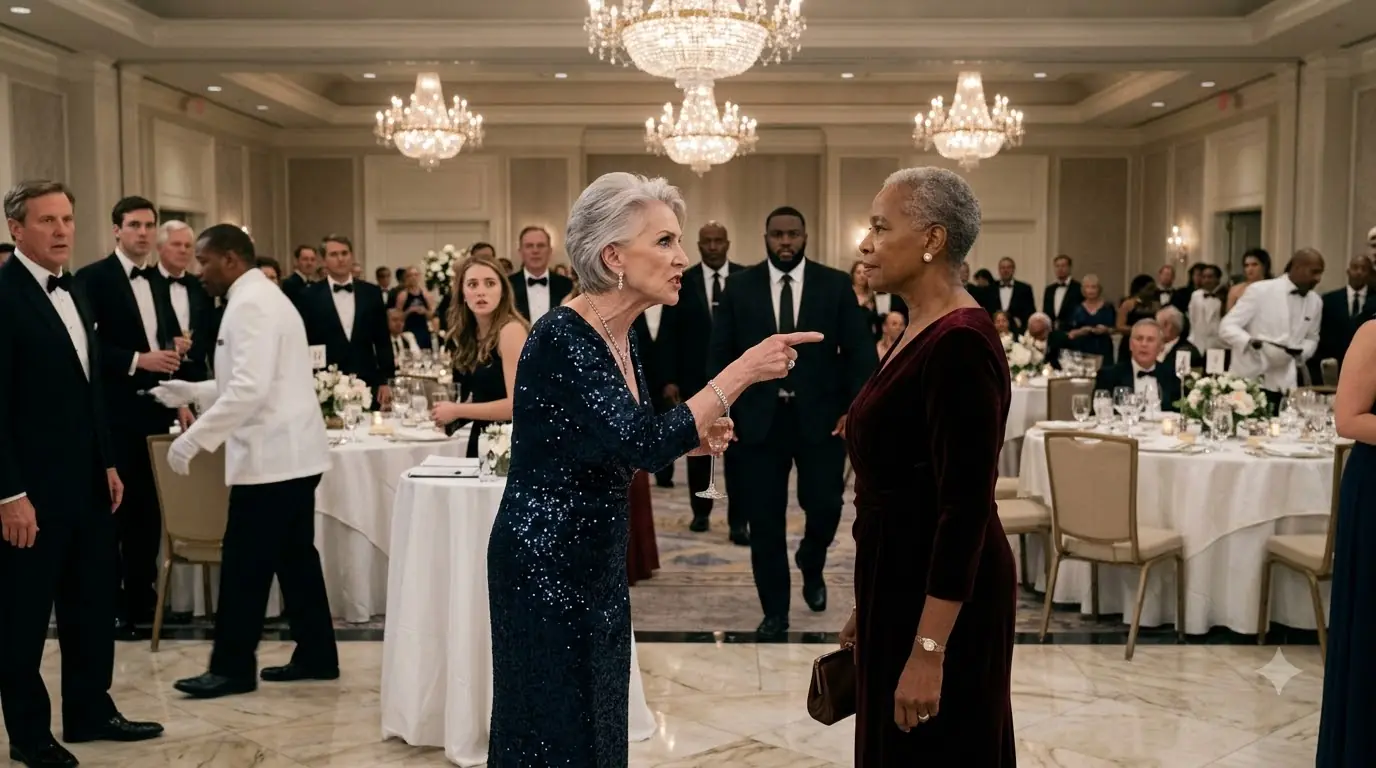
Security, get this woman out of here. Dorothy pulled out the $950 million deal contract and held it out between two fingers. In that case, it seems our partnership won't be moving forward. The moment Dorothy uttered those words, Vivian's downfall became inevitable.
The ballroom smelled like money. Not the clean, honest kind. The kind that had been sitting in the same family for so long it started to smell like old leather and entitlement. Chandeliers the size of small cars blazed overhead.
Waiters in white gloves moved through the crowd like ghosts, refilling glasses that were never quite empty. A string quartet played in the corner. Soft, forgettable music meant to make rich people feel cultured. The Hargrove Charity Gala was the biggest event on Atlanta's social calendar.
Every year, Sterling Hargrove Senior threw open the doors of the Ritz-Carlton Grand Ballroom, invited the city's most powerful people, and reminded everyone exactly who he was. Tonight, he had more reason than usual to celebrate. Forty-eight hours, that's all that stood between Sterling Hargrove and the biggest deal of his life. $950 million.
A real estate acquisition that would make him the single largest private commercial property owner in the entire American South. His attorneys had assured him everything was in order. One outstanding signature remained. Some trust administrator, an elderly widow connected to the Whitfield Legacy Trust.
A formality, nothing to worry about. Sterling worked the room like a man who had already won. He was tall, silver-haired, and wore his tuxedo like a second skin. His laugh was too loud, and his handshakes too firm, the kind of man who made every gesture feel like a performance.
His wife, Vivian, moved beside him in a midnight blue sequined gown, her silver hair swept back, her smile sharp enough to cut glass. Their son Trip and his wife Cassidy trailed behind them, laughing at the right moments, nodding at the right people. The Hargroves owned every room they walked into, or so they believed. Dorothy May Whitfield arrived alone.
She came through the main entrance at 8:15, moving without hurry, without fanfare. She was 67 years old with close-cropped silver hair, warm brown skin, and the kind of posture that came not from arrogance, but from decades of standing straight in rooms that wanted her to shrink. Her dress was deep burgundy velvet, elegant, not flashy. Pearl earrings, low heels, a small clutch purse held close at her side.
She looked like exactly what she was, a woman who had nothing to prove. At the registration desk, a young staffer scrolled through the guest list with growing nervousness. I'm sorry, ma'am. I'm not finding a name.
Can you spell your last name again? Whitfield, Dorothy said patiently. It may be listed under the LLC. Whitfield Legacy Trust.
More scrolling. An awkward silence stretched out like taffy. People nearby began to glance over. That was when Vivian Hargrove spotted her.
Vivian stopped mid-conversation. She looked Dorothy up and down, the unhurried dress, the modest heels, the woman standing alone at a desk full of confused staff. A slow smile spread across her face. She leaned toward Cassidy, not even bothering to lower her voice.
Good lord, Vivian said, "Who let the help wander in from the kitchen?" She lifted her champagne flute and pointed, actually pointed at Dorothy. Somebody ought to tell her the serving trays are in the back. The laughter came fast.
Trip's shoulders shook. Cassidy covered her mouth, but her eyes were bright with amusement. Sterling Senior glanced over, saw what his wife was doing, and simply turned away. He didn't correct her, didn't even flinch.
The small cluster of guests nearby went dead quiet. Naomi Puit froze. She was 24, one of the junior event coordinators for the evening, stationed near the entrance with a clipboard and a lapel mic transmitter clipped to her blazer. She had been doing this job for 2 years.
She had seen rich people be rude before, but this was different. This was public. This was cruel. And it was loud enough that half the entrance hall had heard it.
Naomi looked at Dorothy, bracing for the reaction. There wasn't one. Dorothy's face didn't change. Not a flicker, not a tightening of the jaw, not a blink.
She stood at that registration desk with the stillness of someone who had been in worse rooms, faced worse people, and come out the other side. She looked at the staffer, not at Vivian, not at the laughing cluster, and said simply, "Take your time." The staffer found the entry. Dorothy took the badge with steady hands and pinned it to her dress.
It read Dorothy M. Whitfield, Whitfield Legacy Trust. She walked into the ballroom. Naomi watched her go, heart hammering, unable to shake the feeling that something enormous had just happened, and that the Hargroves were the only ones in the room who didn't know it yet.
Dorothy had taken exactly 11 steps into the ballroom when Reggie found her. Reginald Okafor moved fast for a man in a tuxedo. He was broad-shouldered, dark-skinned, with close-cropped hair going gray at the temples, and the kind of face that didn't waste expressions on things that didn't matter. He had been Dorothy's attorney for 22 years.
He had stood beside her in federal courtrooms, in church basement, in hospital waiting rooms. He knew her tells, the slight lift of her chin, the way her fingers curled when she was containing something. He gripped her elbow and steered her firmly toward a quiet alcove near the east wall, half hidden behind a column draped in white fabric. "We have a problem," he said.
"We have several," Dorothy replied. "Which one are you referring to?" Reggie didn't smile. "The Hargroves don't know who you are."
Dorothy looked at him steadily. "Explain that." He did. For six weeks, the Hargroves' legal team had been communicating exclusively with Dorothy's administrative proxy, a property manager named Gerald, who handled routine trust correspondence.
The attorneys had identified the Whitfield Legacy Trust only by its LLC registration number. They had never once cross-referenced the trustee's name against a real person. They assumed because it was easier, because it fit their worldview, that the person holding the 34% stake was some distant corporate administrator. Maybe a bank, maybe a hired manager.
Certainly not the woman herself. They had been chasing a signature without ever looking at whose hand held the pen. They have no idea, Reggie said, his voice low and tight. None.
Their lead attorney called Gerald twice this week. Gerald referred them to me. I've been returning their calls from a blocked number. He paused.
Dorothy, they spent six weeks trying to pressure a proxy. The actual trustee, you, they have never spoken to directly. Dorothy absorbed this without blinking. Across the room, she could still hear the tail end of Vivian's laughter.
"And Walter?" she asked. "That's the other thing." As if on cue, Walter Baines appeared at the edge of the alcove. He was a heavyset man of 61 with a ruddy face and the permanently worried expression of someone who managed other people's enormous amounts of money.
He was Meridian Capital's board chairman, the man whose $950 million acquisition depended entirely on the deal closing in 48 hours. He was also at this particular moment the color of old chalk. He had seen what Vivian did at the registration desk. He had heard every word.
"Mrs. Whitfield." His voice was careful, like a man walking on ice he wasn't sure would hold. "I want to begin by saying, on behalf of everyone at Meridian, that what just happened at that desk was completely," "Mr.
Baines," Dorothy said quietly. Are you here to apologize or are you here to confirm that I'm the trustee your partners have been trying to reach? A beat of silence. Both, he admitted.
Dorothy nodded once as if this confirmed something she had already calculated. I know who I am, Walter. The question is whether your partners did. Baines opened his mouth, closed it.
The answer was written all over his face. They didn't. They truly, genuinely did not know. The woman Vivian Hargrove had just pointed at and mocked in front of a room full of Atlanta's most powerful people, the woman they assumed belonged in the kitchen, was the sole trustee of the one asset that stood between the Hargrove family and the biggest deal of their lives.
Word was moving through the room now. Quietly, the way important information always moved in rooms like this, a whisper to an attorney, a murmur between board members, a glance exchanged across champagne glasses. The inner circle was beginning to understand. Dorothy watched it happen.
She saw the moment Trip Hargrove received the news from his legal team across the room. She watched the color leave his face. She watched him turn to look at her. Really look at her.
For the first time all evening. She didn't look away. She held his gaze with the same calm, unhurried stillness she had shown at the registration desk. No anger, no satisfaction, just clarity.
The look of a woman who had known exactly what she was walking into when she pinned on that badge and stepped through those doors. Trip's jaw tightened. He turned away first. "That's what I thought," Dorothy said softly.
To no one in particular, to everyone who deserved to hear it. Reggie stood beside her, watching the room recalibrate in real time. "Dorothy," he said quietly, "what do you want to do?" She straightened her spine, smoothed the front of her burgundy dress with one hand, picked up a glass of water from a passing tray.
"I'm going to do," she said, "exactly what I came here to do." Sterling Hargrove Senior crossed the ballroom like a man who had never once been told no. The crowd parted for him naturally, the way crowds always parted for men like Sterling. He moved with the loose, easy confidence of someone who believed every problem in the world had a price tag, and he had never yet found one he couldn't afford.
His smile was already deployed before he was halfway across the floor. Hand extended, eyes warm, voice ready. Dorothy watched him come. She didn't move toward him, didn't adjust her posture, didn't put down her glass of water.
She simply stood and watched him cross the distance between them. And by the time he arrived, his hands still outstretched and his smile still gleaming, she had already decided exactly how this would go. Mrs. Whitfield, his voice was rich and smooth, like something rehearsed in front of a mirror.
What an absolute honor. I am so sorry about the confusion at the door. Completely unacceptable, and I assure you it will be addressed." He said this as though the confusion at the door had been a clerical error, and not his wife pointing at a black woman and suggesting she belonged in the kitchen.
"We are so glad you're here tonight." Dorothy looked at his outstretched hand. She did not take it. "Mr.
Hargrove," she said. Her voice was pleasant, precise, the voice of a woman who had spent 30 years in courtrooms. Sterling's smile flickered, just barely, then reset. He lowered his hand smoothly as if he'd meant to put it in his pocket all along.
He shifted closer, dropping his voice to a confidential murmur, glancing briefly at Reggie before deciding to ignore him entirely. "I'll be direct with you," Sterling said. I respect your time too much for anything else. The Meridian acquisition is 48 hours from closing.
The offer we've structured for the Whitfield Trust is more than generous, considerably above market. Your late husband built something remarkable, and we intend to honor that legacy. He paused, letting that land. All we need is your authorization, tonight if possible, or first thing tomorrow morning at the latest.
Dorothy listened to all of it without interrupting. When he finished, she opened her small clutch purse. Sterling watched with the relaxed expression of a man expecting a pen. What she produced was not a pen.
It was a single folded document, crisp, precise, prepared. She held it out to him between two fingers. The way you hand something to someone you don't particularly want to touch. Sterling took it, unfolded it.
His eyes moved across the first paragraph. The smile died. The document was a formal notice of trust review and withdrawal of good faith negotiation status. It was dated 3 days ago.
It had been prepared by Reggie before Dorothy ever set foot in this ballroom, before tonight, before the registration desk, before Vivian and her champagne glass and her pointing finger. Dorothy had already made her decision. She had not come tonight to be persuaded. She had come to deliver this in person because Calvin had always told her, "When you close a door, close it to someone's face so they know it's closed."
Sterling looked up from the document. The charm was gone. What replaced it was something colder and more honest. "You can't be serious," he said.
"I am entirely serious." Dorothy's voice carried, not loud, but clear. Clear enough for the tight circle of board members and attorneys who had drifted closer, sensing something significant. "Your family's conduct this evening confirmed everything I needed to know about how the Whitfield Legacy Trust's assets would be stewarded under your management."
Sterling's jaw tightened. "Mrs. Whitfield, I strongly advise you to think carefully about," "I have thought carefully," she said. "I've been thinking carefully for 6 weeks while your attorneys called my proxy and assumed I wouldn't notice."